REVIEW 3 major objections 6 minor 4 references
Provisioning Energy-Efficiency and QoS for Multi-Carrier CoMP with Limited Feedback
T0 review · 3 major / 6 minor · reviewed 2026-08-14 · deepseek-v4-flash
Pith's one-line read This paper argues that feedback-bit allocation, per-subcarrier cluster size, user scheduling, and subcarrier assignment must be optimized jointly in multi-carrier CoMP with limited feedback, and it supplies a single greedy framework that…
desk verdict The unified WSU framework and multi-level greedy FBP are a real step forward, but the headline gains are computed with an approximation the authors admit is false, so the paper is worth reviewing with a strong request for system-level validation. read the letter →
The pith
A machine-rendered reading of the paper's core claim, the machinery that carries it, and where it could break.
The reading
What carries the argument
The load-bearing object is the weighted sum utility (WSU) of Eq. (7), a single combinatorial objective in which the utilization of each scheduled user-subcarrier pair can be swapped between capacity, effective capacity, energy efficiency, or effective energy efficiency, so that one algorithmic core serves all four problems. Inside that core is a three-level greedy feedback-bit partitioner: gFBP first gives bits to subcarriers, C-lFBP divides each subcarrier's bits among active cells, and U-lFBP divides a cell's bits among the channel directions a user must quantize. The cluster-based subcarrier assignment (C-bSA) then re-selects users and switches base stations off per subcarrier when their contribution to the cluster utility is too small. The analytical glue is the quantization-cell approximation of Eq. (3), which models the CDI quantization error of a codebook as a beta/exponential pair and converts feedback-bit counts into the closed-form capacity and effective-capacity expressions labeled Results 1-4 that every greedy step evaluates.
What would settle it
Take the converged feedback-bit partition and per-subcarrier cluster-size allocation from the paper's algorithms, simulate the exact SINR of Eq. (2) with actual vector-quantization codebooks instead of the quantization-cell-approximation densities, and recompute weighted sum capacity and energy efficiency; if the four-to-seven-fold gains over random or equal feedback baselines shrink or reverse, the Appendix A independence approximation is the load-bearing error.
Extended reading notes
Core claim
The paper's central claim is that the resource-allocation problem in a multi-carrier coordinated multi-point downlink with per-user quantized feedback can and should be cast as a single weighted-sum-utility maximization over three interacting sets of variables: which users are scheduled on each subcarrier, which base stations remain active on each subcarrier (the per-subcarrier cluster size), and how the finite feedback bit budget is split among subcarriers, cells, and links. It derives closed-form approximations for four link utilities, capacity, statistical-delay-constrained effective capacity, energy efficiency, and delay-constrained energy efficiency, all under the quantization-cell approximation, so the same greedy machinery applies to all four. The proposed alternating algorithm, greedy feedback-bit partitioning (gFBP) together with cluster-based subcarrier assignment (C-bSA), converges in about two iterations in the reported scenarios, delivers up to a seven-fold utility gain from user scheduling and cluster-size choice alone, and, by the paper's simulations, improves system performance by several orders of magnitude relative to equal or interference-minimizing feedback partitions.
Load-bearing premise
The formulas the optimizer depends on were derived by treating certain quantization-error random variables as independent, which the paper's own Appendix A says they clearly are not, so if that simplification is materially biased the scheduling and feedback allocations may be optimizing the wrong objective and the reported gains may not survive on the true signal-to-interference-plus-noise ratio.
Editorial extensions
If this is right
- Treating feedback-bit partitioning and per-subcarrier cluster size as separate design stages forfeits the largest part of the gain: the simulations attribute up to a seven-fold improvement to joint user scheduling and cluster-size choice, with further gains from coordinated bit partitioning over equal or interference-minimizing baselines.
- One algorithmic implementation covers capacity, statistical-delay QoS, energy efficiency, and delay-aware energy efficiency, because all four are instances of the same WSU problem.
- Increasing the number of antennas without increasing the feedback budget can slightly hurt performance, since CDI quantization errors then degrade both the desired signal and the ability to null interference; antenna count and feedback capacity need to be scaled together.
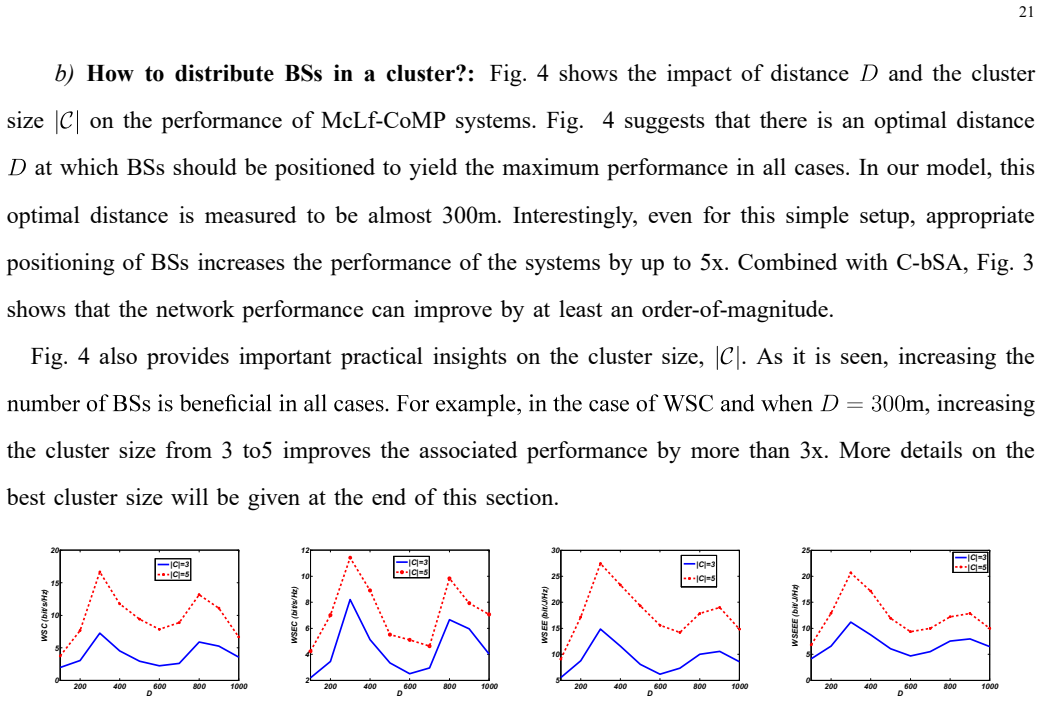
- Geometric placement matters: there is an optimal base-station distance (about 300 m in the reported cluster), and most of the cluster-size benefit is captured with 3 to 5 active base stations, so adding more base stations yields diminishing returns.
- The combinatorial resource-allocation problem is computationally tractable in practice, since the greedy iterations converge in roughly two rounds.
Reading between the lines
- Because the WSU core is agnostic to the link-utility function, the same gFBP/C-bSA machinery could be retargeted to other objectives the paper does not study, such as outage probability, secrecy rate, or minimum-rate guarantees, without redesigning the combinatorial engine.
- A direct stress test the paper does not run is to implement the converged allocations with actual random-vector-quantization codebooks and the exact SINR of Eq. (2); if the reported four-to-seven-fold gains shrink or reverse, the false-independence approximation admitted in Appendix A is the culprit.
- The optimal base-station spacing and the saturation of gains beyond about five base stations suggest an implicit design rule: moderate cluster sizes and regular geometry capture most of the limited-feedback CoMP benefit, so operators can save on base-station count and backhaul.
- The algorithm assumes path-loss information is roughly static between executions, so a practical extension would be a mobility-triggered reallocation that reuses the previous feedback-bit partition as a warm start.
Signed reviews
Editorial analysis
A structured set of objections, weighed in public.
Referee Report
Summary. The paper studies downlink resource allocation in multi-carrier coordinated multi-point (CoMP) systems with limited feedback. It proposes a unified weighted-sum-utility (WSU) framework and instantiates it for four objectives: weighted sum capacity (WSC), weighted sum effective capacity (WSEC), weighted sum energy efficiency (WSEE), and weighted sum effective energy efficiency (WSEEE). The resource variables include feedback bit partitioning (FBP) across subcarriers, cells, and users, per-subcarrier cluster size, user scheduling, and subcarrier assignment. Two greedy algorithms are developed: gFBP for feedback bit allocation and C-bSA for cluster-size determination, scheduling, and subcarrier assignment. The paper derives approximate closed-form expressions for capacity and effective capacity under quantized CDI, and reports simulation results showing convergence in about two iterations and gains of up to 4.5-7-fold over random allocation, with the abstract claiming improvement 'by several orders-of-magnitude.'
Significance. If the results hold against the true system model, the paper would make a useful contribution: it provides a unified analytical treatment of four practically important objectives in a complex limited-feedback CoMP setting, and it offers computationally feasible greedy algorithms for a combinatorial problem that would otherwise be intractable. The single-link Monte Carlo validation in Fig. 1 is a genuine strength, as is the attempt to model the interaction between feedback-bit allocation, cluster size, and user scheduling. However, the paper does not supply machine-checked proofs or code, and the analytical results are approximations, not bounds. The practical insights on cluster sizing and BS placement are potentially valuable but are obtained from simulations that evaluate the same approximate objective functions that the algorithms maximize; their validity therefore depends on the accuracy of those approximations at system level, which is not established.
major comments (3)
- [Section VI, Remark 3, Fig. 3, and Appendix A, Eq. (31)] The central performance claim is computed inside the approximation domain. The reported gains (4.5- to 7-fold, and 'several orders-of-magnitude' in the abstract) compare optimized and random allocations using utilities built from Results 2 and 4. Those results inherit the independence assumption of Appendix A, Eq. (31), where the authors state that the random variables 'clearly are not' independent. The only validation, Fig. 1, is for a single link under one parameter set; there is no system-level comparison against the exact SINR in Eq. (2) or a Monte Carlo evaluation of the true effective capacity. Consequently, the paper's central claim that joint FBP, cluster-size, and scheduling yields large gains is not yet established against the true system model. I request a system-level validation of the final allocations under Eq. (2) or an analytical bound on the approximation error.
- [Appendix D, Eq. (15) and Eq. (44)] Result 4 is derived only under the restriction b=1, and the text states that the general case is 'too complicated' to evaluate. Since WSEC and WSEEE are two of the four headline objectives, the QoS-related simulation results in Section VI are limited to a single statistical-delay exponent unless the more complex Result 3 is used. The paper should state explicitly which approximation was used in each simulation figure and should validate the b=1 case against the true effective capacity in Eq. (11) at the operating points of Section VI; this is load-bearing for the QoS claims.
- [Section V, Algorithm 4, and Fig. 3] The claim that the algorithms converge in about two iterations is demonstrated only in terms of the approximate utility, and no optimality gap or comparison with a near-optimal solution is provided for any non-trivial instance. Because the greedy structure is a core contribution, the paper would be substantially strengthened by a small-scale comparison against exhaustive search on a reduced problem (e.g., few subcarriers and a small cluster), or at least by a discussion of how the greedy decisions can deviate from the optimum. Without such a check, the reported gains relative to a random initial allocation cannot be separated from the possibility that the algorithms simply escape a deliberately poor starting point.
minor comments (6)
- [Abstract and Remark 3] The abstract claims improvement 'by several orders-of-magnitude', while Remark 3 and Fig. 3 report up to 7-fold gains; please align the abstract with the numerical results.
- [Section VI, text near Fig. 3] 'C-bCA' appears in the text and should be 'C-bSA' for consistency with Algorithm 4.
- [Section VII, Conclusions] The conclusion states that the paper derives 'analytical bounds on the capacity', but Results 1-4 are approximations, not bounds; please correct the wording.
- [Throughout, especially Section II and figure captions] The manuscript contains many missing mathematical symbols and incomplete sentences, which makes verification difficult; a clean, typeset revision is needed.
- [Eq. (16)] 'Jonsen's Inequality' should be 'Jensen's Inequality'.
- [Fig. 1 caption] The caption does not state the QoS exponent b used in the effective-capacity plots; please add this parameter so the validation can be interpreted.
Circularity Check
Reported gains are measured in the same WSU objective the algorithms maximize, so the headline improvement is partly self-evaluated against an unvalidated approximation.
-
self definitional
[Section VI, Remark 3 and Fig. 3, combined with Section IV Eqs. (8)–(23) and Section V gFBP/C-bSA]
"Remark 3:is actually the WSU when the SA, UE scheduling, and p-sCSD mechanisms all are done randomly. One way to assess to what extent these mechanisms contribute to the overall network performance is by comparingand, for example,. Our numerical results presented in Section VI indicate that this can be up to 7-fold."
The 'overall network performance' in Remark 3 is the WSU objective itself. WSU is assembled from the approximate utilities of Result 2/Result 4 (Eqs. (10),(15)), and gFBP/C-bSA greedily maximize exactly this WSU (Eq. (7), Section V). The reported 4.5–7x improvements are therefore differences between a locally optimized value and a random value of the same function being optimized, so the abstract's 'several orders-of-magnitude' system-performance claim is an in-model, self-evaluated statement rather than an independent check against the exact SINR expression (2) or true effective capacity.
full rationale
There is no data fitting, no load-bearing self-citation chain, and no uniqueness theorem imported from the authors' prior work; the capacity and effective-capacity expressions are derived from QCA with external citations, and Fig. 1 gives a single-link Monte Carlo sanity check. The circularity burden is that the system-level evaluation metric is the same WSU that the algorithms maximize: Remark 3 explicitly treats WSU as 'overall network performance,' and Figs. 3–6 plot that WSU, so the gains are in-model improvements rather than measurements of the true SINR. Appendix A candidly discloses the false independence assumption ('we have assumed that random variables ... are independent, which clearly are not'); this is an approximation/validity risk rather than a circular step, and it is weighed as a limitation. Because the central claim is partially self-evaluated but the underlying approximations are not fitted and are externally anchored for a single link, the score is 4 rather than higher.
Assumptions & free parameters
free parameters (1)
- delta (initial feedback bits per subcarrier) =
1, 2, 10, 20 in simulations
assumptions (6)
- domain assumption QCA model for quantization error distribution (Eq. 3, from [45])
- ad hoc to paper Independence of quantization error random variables in Appendix A
- domain assumption Candidate beamforming via ICIC projection (Eq. 1) with equal power division across antennas
- ad hoc to paper b=1 restriction for effective capacity approximation Result 4
- domain assumption Energy consumption model from [11] with circuit power and rate-proportional power
- domain assumption Standard OFDMA constraints: at most one UE per cell per subcarrier, block Rayleigh fading
Cite this review
Pith. "Pith review of Provisioning Energy-Efficiency and QoS for Multi-Carrier CoMP with Limited Feedback." pith.science (2026). https://pith.science/paper/S23PFORJ
@misc{pith2026190807119,
  author       = {Pith},
  title        = {Pith review of: Provisioning Energy-Efficiency and QoS for Multi-Carrier CoMP with Limited Feedback},
  year         = {2026},
  howpublished = {\url{https://pith.science/paper/S23PFORJ}},
  note         = {Machine review of arXiv:1908.07119}
}
read the original abstract
We consider resource allocation (RA) in multi-carrier coordinated multi-point (CoMP) systems with limited feedback, in which a cluster of base stations (BSs), each equipped with multiple antennas, are connect to each other and/or a central processor via backhauls/fronthauls. The main objective of coordinated RA is to select user equipments (UEs) on each subcarrier, dynamically decide upon the cluster size for each subcarrier, and finally partition the feedback resources, provisioned for acquisition of channel direction information (CDI) across all subcarriers, active cells, and selected UEs, in order to maximize the weighted sum utility (WSU). We show how to recast the WSU maximization problem to achieve spectral efficiency, quality-of-service (QoS), and energyefficiency (EE). Specifically, we investigate four instances of WSU to maximize practical system objectives: (i) weighted sum capacity, (ii) weighted sum effective capacity, (iii) weighted sum energy-efficiency (EE), and (iv) weighted sum effective EE. The unified composition of these problems through WSU allows us to use the same set of developed algorithms for all cases. The algorithms have a greedy structure achieving fast convergence, and successfully cope with the huge computational complexity of RA problems, mostly rooted in their combinatorial compositions. Our simulation results shed lights on the network optimization by discovering insights on appropriate cluster-size, distribution of BSs in the cluster, and the number of subcarriers. The proposed UE scheduling and subcarrier assignment are shown to improve the system performance by several orders-of-magnitude.
Figures


Figures from the paper (3 more)


Reference graph
Works this paper leans on
-
[1]
1Multi-Carrier CoMP with Limited FeedbackMohammad G. Khoshkholgh, Victor C. M. Leung,Fellow, IEEE, Kang G. Shin,LifeFellow, IEEE, Keivan Navaie,Senior Member , IEEEAbstractWe consider resource allocation (RA) in multi-carrier coordinated multi-point (CoMP) systems with limitedfeedback, in which a cluster of base stations (BSs) — each equipped with multipl...
work page 2015
-
[6]
Impact of different system parameters on WSU.VII. CONCLUSIONSIn this paper we have studied several RA problems pertinent to the multi-carrier limited-feedbackcoordinated multi-point (McLf-CoMP) systems. Each cluster consisted of a number of BSs connectedcalledweighted sum utility(WSU), and then demonstrated how it capable of being recast into optimization...
work page 2014
-
[2008]
26[37]IEEE Trans. Inf. Theory, vol. 52, no. 11, pp. 5045–5060, Nov. 2006.[38] R. Bhagavatula and R. W . Heath, “Adaptive bit partitioning for multicell intercell interference nulling with delayed limited feedback,”IEEE Trans. Sig. Proc., vol. 59, no. 8, pp. 3824–3836, Aug. 2011.[39] G. Caireet al., “Multiuser MIMO achievable rates with downlink training a...
work page 2006
-
[2014]
Bit allocation and pairing methods for multi-user distributed antenna systems with limited feedback,
25[16] H. Leeet al., “Bit allocation and pairing methods for multi-user distributed antenna systems with limited feedback,”IEEE Trans.Comm., vol. 62, no. 8, pp. 2905–2915, Aug. 2014.[17] R. Irmeret al.IEEE Comm. Mag., vol. 49, no. 2, pp. 102–111,Feb. 2011.[18] E. Pateromichelakiset al., “On the evolution of multi-cell scheduling in 3GPP LTE / LTE-A,”IEEE ...
work page 2014
Reviewed August 14, 2026 · model on record in the stance chip above.
Discussion (0). Continue with ORCID to comment.