REVIEW 4 major objections 6 minor 3 references
Forecasting Nigerian Equity Stock Returns Using Long Short-Term Memory Technique
T0 review · 4 major / 6 minor · reviewed 2026-08-07 · deepseek-v4-flash
Pith's one-line read The paper claims an LSTM trained on 20 years of cleaned Nigerian Stock Exchange data predicts the tested equities with accuracy between 93% and 99%.
desk verdict A standard LSTM-application paper whose 93-98% accuracy claim is uninterpretable: the metric is undefined and the error tables are internally impossible. read the letter →
The pith
A machine-rendered reading of the paper's core claim, the machinery that carries it, and where it could break.
The reading
What carries the argument
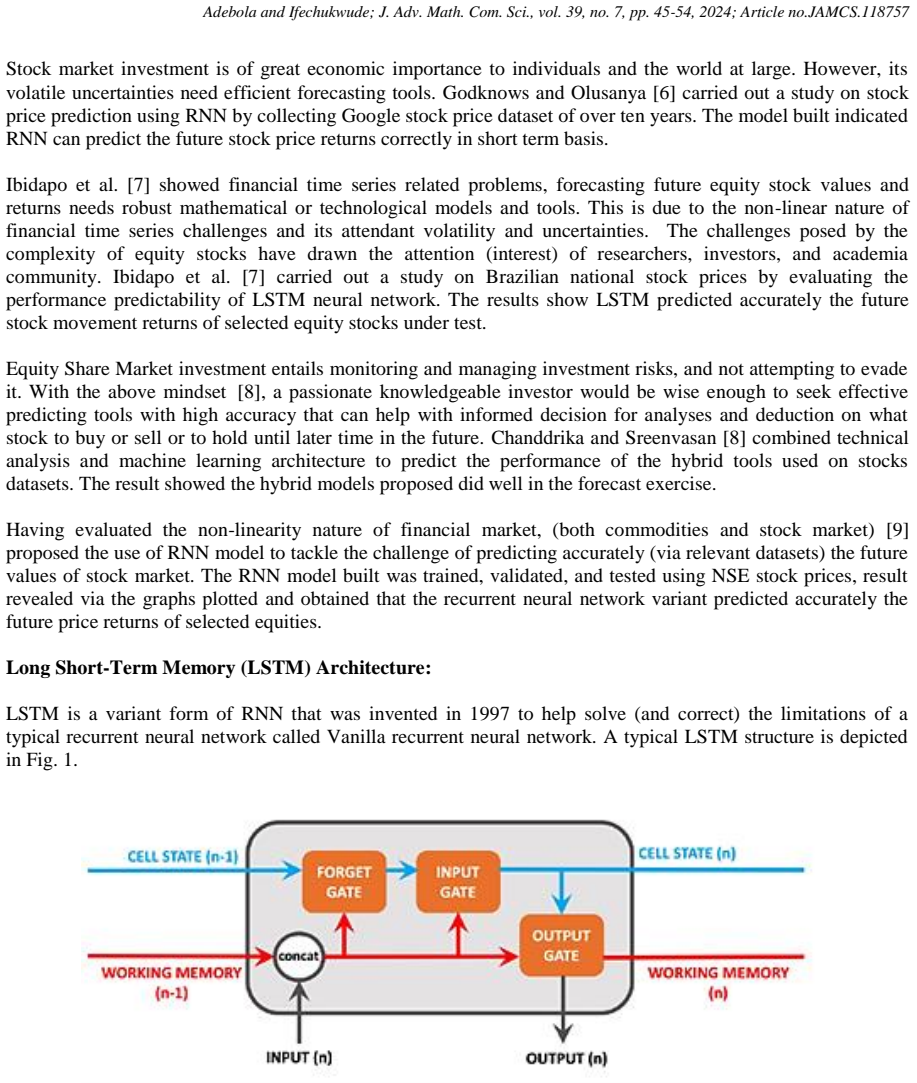
The load-bearing object is the LSTM recurrent network, whose cell state acts as an internal memory that the forget, input, and output gates update. Each gate is a sigmoid layer with a point-wise multiplication operator that decides what to remove, add, or emit from the memory. The paper's specific configuration — 40 units, an input window of 55 prior observations, dropout 0.2, batch size 35, and 50 epochs — maps normalized opening, high, low, close, and volume values to a predicted closing price. The gates matter because they allow the network to carry relevant price patterns across time steps instead of treating each day in isolation, which the authors argue is what lets it handle the non-linear nature of equity series. Supporting machinery includes MinMaxScaler normalization to a 0-1 range and reshaping the data into the 3D matrix format the LSTM consumes.
What would settle it
Take the LSTM's predicted closing prices for the held-out 20% of any tested stock, form one-day-ahead return predictions, and compare them with the naive forecast that tomorrow's close equals today's close. If the naive forecast has equal or lower RMSE on price levels, or if the LSTM's sign accuracy on returns is near 50%, the central 'over 90% accuracy' claim is refuted.
Extended reading notes
Core claim
The central discovery claimed is that the LSTM forecasts closing prices for eight Nigerian equities with accuracy scores between 0.9346 and 0.98533, with the accompanying MAE, MSE, and RMSE values interpreted as low loss errors. The specific network uses 40 units, an input shape of 55 time steps by 1 feature, a dropout of 0.2, a batch size of 35, and 50 epochs; it is trained on 80% of each stock's cleaned data and tested on the remaining 20%. From the eight-stock table the authors report an average predictive accuracy of 97% and 3% lost errors. They conclude that LSTM models are useful for financial time-series problems provided the training dataset is reliable, and they recommend hybrid LSTM-CNN models as future work to reduce the risk of relying on a single model.
Load-bearing premise
The claim collapses if the reported accuracy measures how closely the model tracks past closing price levels rather than how well it predicts future returns, because a model that simply repeats the last observed price can score very high on such a metric without forecasting skill.
Editorial extensions
If this is right
- Trained on cleaned NSE data covering 2001-2022, the LSTM predicts the tested equities' closing prices with reported accuracy between 93% and 99%, which the authors translate into a 97% average and 3% error.
- Against an artificial neural network and a convolutional neural network on the same stocks, the LSTM has higher reported accuracy on most of the eight names, so the recurrent memory structure is claimed to fit these price series better.
- Because the model needs only daily price and volume features plus standard hyperparameter values, the method is portable to other Nigerian equities with at least 20 years of consistent data.
- Predicted closing prices can be converted into return signals, so an investor who trusts the model would have a concrete input to trading decisions rather than relying on technical or fundamental judgment alone.
- The authors' recommended hybrid LSTM-CNN extension follows directly: combining the sequence memory of LSTM with the feature extraction of CNN would target the single-model risk the study acknowledges.
Reading between the lines
- The paper does not state whether the 80/20 split respects chronological order; if the split is random, the model could see future patterns during training, so the accuracy claim is only meaningful under a time-ordered split.
- The reported accuracy is computed against predicted price levels, not against the sign or magnitude of one-day returns; a naive forecast that repeats yesterday's close can score nearly as well on price levels even with no predictive skill for returns.
- A direct extension would measure the LSTM's return-direction accuracy against a 'repeat last close' benchmark on the same test window, which would settle whether the model forecasts movements or merely tracks the series.
- If the accuracy holds on a time-ordered split with return-based metrics, the same pipeline could be tested across other African exchanges, where thin trading and data gaps would stress the cleaning and normalization steps.
Editorial analysis
A structured set of objections, weighed in public.
Referee Report
Summary. The paper proposes an LSTM model to forecast Nigerian equity stock returns, using daily price data from 2001 to 2022 for eight stocks listed on the Nigerian Stock Exchange. The model is trained on 80% of the data and tested on 20%, and performance is reported in terms of accuracy, MAE, MSE, and RMSE, with comparisons against ANN and CNN. The central claim, stated in the abstract and conclusion, is that the LSTM predicts future prices and returns with over 90% accuracy, averaging 97%. However, the paper never defines the 'accuracy' metric, and the reported error metrics in Tables 3 and 4 contain internal contradictions.
Significance. If the claimed results were valid, the paper would provide strong evidence that LSTM models can forecast equity returns in an African emerging market with 93-98% accuracy, which would be a notable empirical contribution. The paper deserves credit for using a real multi-decade dataset and for benchmarking three neural architectures. However, the central claim is not supported as stated: 'accuracy' is undefined, the metric values are internally inconsistent, and the evaluation protocol is not specified well enough to rule out leakage. Because the headline result rests on these uninterpretable numbers, the paper cannot be considered a reliable contribution in its current form.
major comments (4)
- [Section 3, 'Evaluations Metrics Utilised'] The metric 'Accuracy' is listed among the evaluation metrics but no formula or definition is given anywhere in the paper. The abstract and conclusion use this quantity to assert that the model predicts returns with over 90% accuracy (97% average), yet for a regression task on price levels, 'accuracy' is not a standard metric. Without a definition, the reader cannot tell whether it measures return-direction correctness, R-squared, or some normalized error; under the most plausible level-based definitions, a persistence forecast would also score very high, so the headline claim is uninterpretable.
- [Table 3] The WAPCO row reports MAE=4.474 and RMSE=0.7401. For any fixed error vector, MAE cannot exceed RMSE (by the RMS-AM inequality), so these two numbers cannot come from the same set of prediction errors. Similarly, the AIICO row gives MSE=0.00285 and RMSE=0.544, but sqrt(0.00285) is approximately 0.053, not 0.544. These internal contradictions indicate that the metric columns are not a coherent output of the claimed evaluation.
- [Tables 3 and 4] The same model and stock appear with different metric values across the two tables: BERGER LSTM RMSE is 0.2776 in Table 3 but 0.2710 in Table 4, and WAPCO accuracy is 0.9739 in Table 3 but 0.97739 in Table 4. Since Table 4 is supposed to report the same LSTM results as Table 3, these discrepancies suggest that the numbers were produced by different runs or were transcribed inconsistently, further undermining the reliability of the reported 93-98% accuracy range.
- [Section 3, dataset split] The paper states that 80% of the dataset was used for training and 20% for testing, but it never specifies whether the split is chronological. For a time-series forecasting problem, a random split can allow future information to enter the training set, and the MinMaxScaler is described as being applied before the split, which risks using test-set statistics in scaling. Without a chronological split and leakage-free preprocessing, the out-of-sample nature of the reported errors cannot be verified.
minor comments (6)
- [Section 3, 'Evaluations Metrics Utilised'] The phrase 'Mean Squared Error (MAE)' should read 'Mean Squared Error (MSE)'; the same heading also misspells 'Evaluations' as 'Evaluations'.
- [Section 4, interpretation paragraph] The sentence referring to 'the first row of Table 2' should instead refer to Table 3, since Table 2 contains a sample of raw stock data, not model predictions.
- [Table 4] Stock names are misspelled in the table header and rows: 'GTBAN' should be 'GTBank', 'VAPC' should be 'WAPCO', and the CNN column header is missing a closing parenthesis.
- [Literature Review] The phrase 'Recurrent Neutral Network' should be 'Recurrent Neural Network', and 'Hochreiter and Schmid Huber' should be 'Hochreiter and Schmidhuber'.
- [Section 3, model architecture] The text 'a unit value of 40, a total input shape of (55,1)' should use the plural 'units', and the relationship between the input shape, lookback window, and the number of units is not explained.
- [References] Reference [10] is a Towards Data Science blog post, not a peer-reviewed source; it should be clearly marked as a tutorial or replaced with a primary reference.
Circularity Check
No circular derivation identifiable; undefined 'accuracy' is a verifiability defect, not a circular one.
full rationale
The paper's claimed derivation chain is straightforward: collect Nigerian equity price data, clean and normalize it, split into 80% train and 20% test, train an LSTM, predict test prices, and report Accuracy, MAE, MSE, RMSE. The only step that could be circular is the undefined 'accuracy' metric, but the paper never defines it, and no equation is given that would let us exhibit a reduction of the reported 93-98% accuracy to a fitted input or to the autocorrelation of price levels. The internal inconsistencies (e.g., WAPCO MAE 4.474 exceeds RMSE 0.7401; AIICO RMSE 0.544 is not sqrt(MSE)=0.053; BERGER RMSE differs between Table 3 and Table 4) are arithmetic or reporting failures, not instances of a prediction being equivalent to its inputs by construction. There are no load-bearing self-citations, no imported uniqueness theorems, and no fitted parameter renamed as a prediction. The absence of a stated chronological split and the use of price levels rather than actual returns are correctness risks, but the circularity analyzer requires a specific reduction; none is present in the manuscript.
Assumptions & free parameters
free parameters (6)
- LSTM hidden units =
40
- Lookback window length =
55 days
- Dropout rate =
0.2
- Batch size =
35
- Epoch count =
50
- Train/test split ratio =
80/20
assumptions (4)
- domain assumption The NSE historical dataset is reliable and cleaning it (removing noise and missing data) does not introduce selection bias
- domain assumption The metric called 'accuracy' is a valid measure of predictive skill for stock returns
- domain assumption The 80/20 train/test split is chronological and leakage-free
- standard math The standard LSTM formulation and its Keras/TensorFlow implementation are correct
Cite this review
Pith. "Pith review of Forecasting Nigerian Equity Stock Returns Using Long Short-Term Memory Technique." pith.science (2026). https://pith.science/paper/S2JTWGZE
@misc{pith2026250701964,
  author       = {Pith},
  title        = {Pith review of: Forecasting Nigerian Equity Stock Returns Using Long Short-Term Memory Technique},
  year         = {2026},
  howpublished = {\url{https://pith.science/paper/S2JTWGZE}},
  note         = {Machine review of arXiv:2507.01964}
}
read the original abstract
Investors and stock market analysts face major challenges in predicting stock returns and making wise investment decisions. The predictability of equity stock returns can boost investor confidence, but it remains a difficult task. To address this issue, a study was conducted using a Long Short-term Memory (LSTM) model to predict future stock market movements. The study used a historical dataset from the Nigerian Stock Exchange (NSE), which was cleaned and normalized to design the LSTM model. The model was evaluated using performance metrics and compared with other deep learning models like Artificial and Convolutional Neural Networks (CNN). The experimental results showed that the LSTM model can predict future stock market prices and returns with over 90% accuracy when trained with a reliable dataset. The study concludes that LSTM models can be useful in predicting financial time-series-related problems if well-trained. Future studies should explore combining LSTM models with other deep learning techniques like CNN to create hybrid models that mitigate the risks associated with relying on a single model for future equity stock predictions.
Figures

Reference graph
Works this paper leans on
-
[1]
Predicting Nigerian Stock Returns Using Technical Analysis and Machine Learning,
[1]. David Oyewola, Emmanuel Gbenga Dada, Ezekiel Olaoluwa Omole and K. A. Al-Mustapha, “Predicting Nigerian Stock Returns Using Technical Analysis and Machine Learning,” European Journal of Electrical and Computer Engineering. 2019;3(2):1-8. [2]. Hochreiter S, Schmidhuber J. Long short-term memory. Neural Computation. 1997;9(8):1735–1780. [3]. Abubakar S...
work page 2019
-
[2017]
[8]. Chanddrika PV, Sreenvasan KS. Application of deep learning techniques on stock market indices. Journal of scientific Engineering. 2020;7:10. [9]. Neenwi S, Asagba PO , Kabari LG. Predicting the nigerian stock market using artificial neural network. European Journal of Computer Science and Information. 2013;1(1):30-39. [10]. Asutosh N. Predicting stoc...
work page 2020
-
[2021]
Available: https://towardsdatascience.com/predicting -stock-price-with-lstm-13af86a74944. [Accessed 13 May 2021]. [11]. Chungu DA. Determinants of Stock Market Performance in Zambia. Journal of Economics, Management and Trade. 2022;28(4):62-76. [12]. XXT Lu M . An efficient time -series recurrent neural network for stock price prediction. Information Scie...
work page 2024
Reviewed August 7, 2026 · model on record in the stance chip above.
Discussion (0). Sign in to comment.