REVIEW 3 major objections 4 minor 59 references
Suppression of ferromagnetic spin fluctuations in the filled skutterudite superconductor SrOs4As12 revealed by 75As NMR-NQR measurements
T0 review · 3 major / 4 minor · reviewed 2026-08-14 · deepseek-v4-flash
Pith's one-line read SrOs4As12 suppresses the ferromagnetic spin fluctuations of its Fe counterpart and pairs electrons in a conventional s-wave state, 75As NMR shows.
desk verdict New NMR/NQR data make a credible case that ferromagnetic fluctuations are suppressed in SrOs4As12; the s-wave conclusion is plausible but rests on excluding the 2.2–4 K data without a model. read the letter →
The pith
A machine-rendered reading of the paper's core claim, the machinery that carries it, and where it could break.
The reading
What carries the argument
The two measured quantities are the Knight shift $K$, obtained from the field dependence of the lower edge of 75As NQR spectra in fields up to 0.5 T, and the nuclear spin-lattice relaxation rate $1/T_1$, normally written as $1/T_1T$. $K$ tracks the static spin susceptibility while $1/T_1T$ tracks the $q$-summed dynamical susceptibility; the strong suppression of both relative to SrFe4As12 is the evidence against ferromagnetic correlations. In the superconducting state the mechanism is the BCS coherence-factor formula for $1/T_1$ with a triangular broadening function, fitted with gap $\Delta(0)=6$ K and broadening ratio $r=5$, which yields the coherence peak and the exponential-like drop.
What would settle it
Measure 75As $1/T_1$ and the Knight shift on a SrOs4As12 sample with a sharp superconducting transition, for instance a single crystal: persistence of the 2.2-4 K anomaly without a $T_c$ distribution would disprove the s-wave assignment, as would a Knight shift that fails to drop below $T_c$ in a spin-singlet state.
Extended reading notes
Core claim
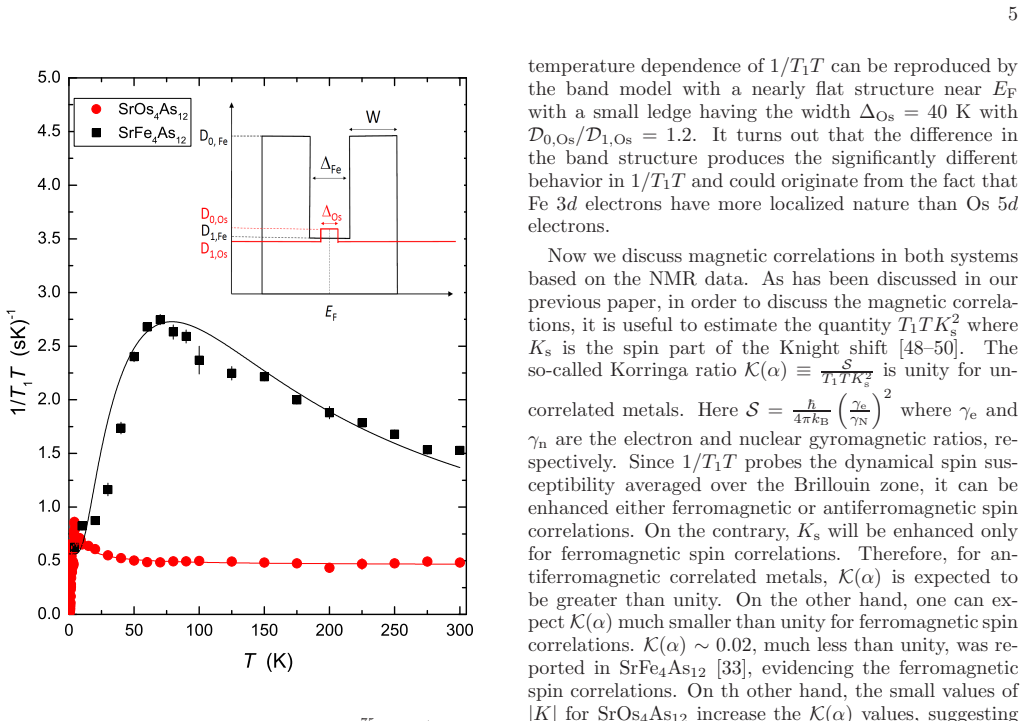
The paper's central claim is that SrOs4As12 sits on the nonmagnetic side of a magnetic-superconducting divide: the 75As Knight shift $K$ and the relaxation rate $1/T_1T$ are much smaller than in SrFe4As12, and the $K$--$\chi$ plot has nearly zero intercept, showing that the static spin susceptibility is strongly reduced. The nearly temperature-independent $1/T_1T$ above 50 K is consistent with an almost flat band with a small 40 K ledge near the Fermi energy rather than with magnetic correlations. Below $T_c \sim 4.8$ K, a Hebel-Slichter coherence peak and a drop of $1/T_1$ by more than two orders of magnitude indicate a fully gapped, spin-singlet $s$-wave superconducting state; the gap ratio $2\Delta(0)/k_BT_c \approx 2.5$ comes out slightly below the BCS weak-coupling value, and the residual temperature-independent $1/T_1$ below 0.4 K is assigned to impurity effects.
Load-bearing premise
The load-bearing premise is that the complicated $1/T_1$ behavior between 2.2 K and 4 K is an extrinsic artifact of a distribution of superconducting $T_c$ values mixed with normal-state signal; if that window is intrinsic, the BCS fit and s-wave assignment rest on selected data.
Editorial extensions
If this is right
- The Fe-to-Os substitution removes ferromagnetic spin correlations and is accompanied by conventional s-wave superconductivity, so magnetic fluctuations and singlet s-wave pairing appear to compete in this family.
- Because the low-temperature normal-state $1/T_1T$ is comparable in the two compounds, the effective density of states at the Fermi level is similar; the absence of superconductivity in SrFe4As12 is therefore attributed to the ferromagnetic fluctuations, not to a lack of electronic states.
- The more-than-two-orders-of-magnitude drop in $1/T_1$ below $T_c$ establishes that superconductivity in SrOs4As12 is bulk, not filamentary or surface.
- If ferromagnetic correlations are the obstacle, suppressing them in SrFe4As12, for example by pressure, should restore superconductivity; the authors report that such experiments are underway.
Reading between the lines
- A straightforward extension would be a 75As Knight-shift measurement below $T_c$: a spin-singlet s-wave state should show a clear drop of $K$ in the superconducting state, which the present normal-state data do not test.
- Comparing SrRu4As12 with the same NMR protocol would map the 3d/4d/5d trend in this family and test whether the suppression of magnetic fluctuations is monotonic with d-electron delocalization.
- The fitted flat-band ledge width of 40 K is a single-band parameter; band-structure calculations or specific-heat measurements could upgrade it into an independent quantitative check.
Signed reviews
Editorial analysis
A structured set of objections, weighed in public.
Referee Report
Summary. The paper reports 75As NMR and NQR measurements on the filled skutterudite superconductor SrOs4As12, with the goal of comparing its magnetic and superconducting properties with the isostructural, non-superconducting SrFe4As12, which exhibits ferromagnetic spin correlations. The authors determine the Knight shift K from NQR spectra in small applied fields and measure the spin-lattice relaxation rate 1/T1 in the normal and superconducting states. They find that |K| and 1/T1T are smaller in SrOs4As12 than in SrFe4As12 at most temperatures, and that the temperature dependence of 1/T1T can be reproduced by a simple band model with a nearly flat density of states near the Fermi energy. They interpret these results as evidence that ferromagnetic spin fluctuations are strongly suppressed in SrOs4As12. From the temperature dependence of 1/T1 below Tc, including a coherence peak just below Tc and a large decrease at low temperatures, they conclude that the superconductivity is conventional s-wave BCS type.
Significance. If the conclusions hold, the paper provides a useful comparative NMR study of two isostructural filled skutterudites, showing how replacing Fe (3d) with Os (5d) suppresses ferromagnetic correlations and allows conventional s-wave superconductivity to emerge. The strength of the paper is the direct microscopic comparison between SrOs4As12 and SrFe4As12 using the same experimental techniques and analysis methods, which makes the qualitative suppression of the static spin susceptibility credible. The paper also contains substantial experimental detail, including NQR-based Knight shift determination and a careful discussion of the complications arising from the broad superconducting transition. The main caveat is that the s-wave conclusion depends on excluding a significant temperature interval from the BCS analysis, and the Knight shift data carry large uncertainties, so several quantitative statements are less secure than the qualitative comparison.
major comments (3)
- [§V.B, Fig. 5] The s-wave conclusion rests on excluding the temperature range T = 2.2–4 K as extrinsic. The text states: 'we consider that the temperature dependence of 1/T1 in T = 2.2 − 4 K is not intrinsic but extrinsic and more artificially, we will not discuss it in this paper.' This exclusion is not quantitatively justified. The sample shows a broad resistive transition (onset 4.8 K, zero resistance 2.2 K), a two-step superconducting volume fraction, and a β exponent that varies non-monotonically with a local minimum near 3.5 K. These observations imply that the measured 1/T1 in this window is a temperature-dependent superposition of normal and superconducting fractions. Without modeling this mixture, the BCS fit with Δ(0) = 6 K, r = 5, and an added constant 1/T1 = 0.008 s−1 is compared only to the remaining data, so the coherence peak and the derived 2Δ(0)/kBTc = 2.5 are not robust evidence for s-wave pairing. The claim that 'the temperature dependence of 1/T1 in the superconducting state evidences a conventional s-wave superconductivity' is therefore not fully established. Please either model the two-component response over the full temperature range or present the s-wave conclusion as tentative and limited to temperatures below about 2 K, where the superconducting fraction is largest.
- [§IV, Fig. 3] The Knight shift is reported as K = -1.2 ± 2.5 % at 10 K, and the temperature dependence in Fig. 3 shows variations that are smaller than this uncertainty. Therefore the statement that K is 'nearly independent of temperature, consistent with the temperature dependence of the magnetic susceptibility' is not supported by the K data alone; the consistency is only apparent in the susceptibility curves. The K–χ plot in the inset combines data from both compounds and yields a nearly zero intercept, but given the large error bars on K, the conclusion of K0 ≈ 0 and the derived hyperfine coupling Ahf = -3.84 ± 1.60 kOe/μB are rough estimates. This does not invalidate the qualitative suppression of |K| in SrOs4As12 compared with SrFe4As12, but quantitative statements such as the estimated |Ks| ≈ 0.21% from the Korringa relation should be labeled as order-of-magnitude estimates rather than precise experimental values.
- [§V.A, Summary] The Summary states: 'The large suppression in the |K| and 1/T1T in SrOs4As12 compared with those in SrFe4As12 indicates no obvious ferromagnetic spin correlations.' However, in §V.A the text states: 'It is interesting to point out that the 1/T1T values for both systems are almost comparable at low temperatures below ∼ 20 K in the normal state.' The suppression of 1/T1T is therefore only present at higher temperatures; below 20 K the values are comparable. The inference about ferromagnetic correlations is based on the different temperature dependence of 1/T1T and on the Korringa ratio, not on a uniform suppression of 1/T1T. Please qualify the summary to avoid overstating the 1/T1T suppression, or explicitly distinguish the temperature ranges over which the suppression is observed.
minor comments (4)
- [§II] The stretched-exponential function is written as 1 − M(t)/M(∞) = e−(3t/T1)β, but the exponent is later said to be β ∼ 0.8 in the paramagnetic state. Since β multiplies (3t/T1), it would be helpful to state explicitly that β is the stretching exponent and to define its range for the normal and superconducting states.
- [§V.B] Equation (6) is written with a proportionality sign, and the normalization constant is not specified. Also, the broadening function is described as triangular with width 2δ, but the relationship between δ and the parameters used in the fit (r = Δ(0)/δ) is not shown in the equation. Please clarify the normalization and the precise definition of δ.
- [§V.B] The ad hoc constant term 1/T1 = 0.008 s−1 added to reproduce the low-temperature flattening is introduced without a physical model. The text says its 'origin is not clear at present' but suggests impurity effects. This is acceptable, but it would be more transparent to state explicitly that this term is a free parameter of the fit and to discuss its possible relation to the normal-state fraction or magnetic impurity relaxation.
- [Various] There are several typographical and wording issues, for example: 'more artificially' is an unusual phrase in §V.B; 'on th other hand' in §V.A should be 'on the other hand'; and in the Figure 5 caption, the pink and red curves are described but the labels in the main text are not always consistent. A careful proofread is recommended.
Circularity Check
No significant circularity: the central claims rest on direct NMR/NQR measurements and cross-compound comparison; model fits are presented as reproductions, not as predictions derived from the conclusions.
full rationale
The paper's central claims are empirical comparisons of measured Knight shift K and spin-lattice relaxation rate 1/T1T between SrOs4As12 and SrFe4As12, plus an s-wave BCS assignment from the temperature dependence of 1/T1 below Tc. No step in the derivation chain reduces by construction to its own input. The comparison with SrFe4As12 uses the authors' prior PRB paper [33], but that is an independent experimental dataset on a different compound, not an assumption that defines the present result. The flat-band model in Sec. V.A is explicitly a fit ('the observed temperature dependence of 1/T1T can be reproduced by the band model') and is not presented as an independent prediction; likewise the BCS calculation in Sec. V.B is fitted to the superconducting-state data with adjustable parameters and a constant offset, and the paper openly states that the intermediate 2.2-4 K window is excluded as 'not intrinsic but extrinsic and more artificially.' That exclusion is a legitimate data-selection caveat and a correctness risk, but it is not circularity: the s-wave conclusion is not logically forced by the assumptions because the BCS curve is compared against, not generated from, the observed 1/T1 values. The Korringa-ratio discussion also uses an assumed uncorrelated value to estimate |Ks|, which is an interpretive consistency check rather than a derivation of the measured |K|. Overall, the paper's conclusions rest on direct measurements and on fits that are acknowledged as reproductions, so no self-definitional, fitted-input-renamed-as-prediction, or self-citation-load-bearing circular step is present.
Assumptions & free parameters
free parameters (4)
- Band model parameters for 1/T1T fit (Δ_Os, D0,Os/D1,Os) =
Δ_Os = 40 K, D0,Os/D1,Os = 1.2
- BCS superconducting gap fit parameters (Δ(0), r, constant 1/T1 offset) =
Δ(0) = 6 K, r = Δ(0)/δ = 5, added constant 1/T1 = 0.008 s^-1
- NQR frequency temperature-dependence parameters (νNQR(0), α_Q) =
νNQR(0) = 62.14 MHz, α_Q = 2.09e-6 K^-3/2
- EFG parameters for NMR/NQR spectral simulation (νQ, η) =
νQ = 60.1 MHz, η = 0.45 at 10 K
assumptions (5)
- domain assumption The EFG principal-axis directions at the As sites are identical to those determined for Sb sites in isostructural PrOs4Sb12/CeOs4Sb12 (parallel to [100], [010], [001]).
- ad hoc to paper The band-structure model with a flat band and small ledge near EF (parameters Δ_Os, D0/D1) is an adequate description of the density of states for computing 1/T1T.
- ad hoc to paper The excluded 1/T1 behavior in the 2.2-4 K range is extrinsic, arising from a distribution of Tc and mixed normal/superconducting signal contributions.
- domain assumption The observed 1/T1 is isotropic, so the Korringa-ratio discussion and Ks estimate apply directly.
- standard math Standard BCS theory with coherence factors applies to the SC-state relaxation rate.
Cite this review
Pith. "Pith review of Suppression of ferromagnetic spin fluctuations in the filled skutterudite superconductor SrOs4As12 revealed by 75As NMR-NQR measurements." pith.science (2026). https://pith.science/paper/S2TX52EO
@misc{pith2026190807923,
  author       = {Pith},
  title        = {Pith review of: Suppression of ferromagnetic spin fluctuations in the filled skutterudite superconductor SrOs4As12 revealed by 75As NMR-NQR measurements},
  year         = {2026},
  howpublished = {\url{https://pith.science/paper/S2TX52EO}},
  note         = {Machine review of arXiv:1908.07923}
}
abstract
Motivated by the recent observation of ferromagnetic spin correlations in the filled skutterudite SrFe$_4$As$_{12}$ [Ding et al., Phys. Rev. B 98, 155149 (2018)], we have carried out $^{75}$As nuclear magnetic resonance (NMR) and nuclear quadrupole resonance (NQR) measurements to investigate the role of magnetic fluctuations in a newly discovered isostructural superconductor SrOs$_4$As$_{12}$ with a superconducting transition temperature of $T_{\rm c}$ $\sim$ 4.8 K. Knight shift $K$ determined by the NQR spectrum under a small magnetic field ($\le$ 0.5 T) is nearly independent of temperature, consistent with the temperature dependence of the magnetic susceptibility. The nuclear spin-lattice relaxation rate divided by temperature, 1/$T_1T$, is nearly independent of temperature above $\sim$ 50 K and increases slightly with decreasing temperature below the temperature. The temperature dependence is reasonably explained by a simple model where a flat band structure with a small ledge near the Fermi energy is assumed. By comparing the present NMR data with those in SrFe$_4$As$_{12}$, we found that the values of $|K|$ and $1/T_1T$ in SrOs$_4$As$_{12}$ are smaller than those in SrFe$_4$As$_{12}$, indicating no obvious ferromagnetic spin correlations in SrOs$_4$As$_{12}$. From the temperature dependence of 1/$T_1$ in the superconducting state, an $s$-wave superconductivity is realized.
Figures



Figures from the paper (3 more)


Reference graph
Works this paper leans on
- [1]
-
[2]
D. C. Johnston, Adv. Phys. 59, 803 (2010)
2010
-
[3]
has been de- termined by x-ray diffraction measurements to be 8.561 ˚ A [31]. Magnetic susceptibility measurement was per- formed using a magnetic properties measurement system (MPMS, Quantum Design, Inc.) under a magnetic field of 5 T. NMR and NQR measurements of 75As ( I = 3 2 , γ N 2π = 7.2919 MHz/T, Q = 0.29 barns) nuclei were con- ducted using a lab-bu...
-
[4]
Dai, Rev
P. Dai, Rev. Mod. Phys. 87, 855 (2015)
2015
- [5]
-
[6]
Q.-P. Ding, W. R. Meier, J. Cui, M. Xu, A. E. B¨ ohmer, S. L. Bud’ko, P. C. Canfield, and Y. Furukawa, Phys. Rev. Lett. 121, 137204 (2018)
work page 2018
-
[7]
The Physics of Organic Superconductors and Conduc- tors, edited by A. Lebed (Springer-Verlag, 2008)
work page 2008
-
[8]
G. R. Stewart, Rev. Mod. Phys. 56, 755 (1984)
1984
Show all 59 references
-
[9]
Aoki and J
D. Aoki and J. Flouquet, J. Phys. Soc. Jpn. 81, 011003 (2012)
2012
-
[10]
D. Aoki, K. Ishida, and J. Flouquet, J. Phys. Soc. Jpn. 88, 022001 (2019)
2019
-
[11]
Nakai, K
Y. Nakai, K. Ishida, Y. Kamihara, M. Hirano, and H. Hosono, Phys. Rev. Lett. 101, 077006 (2008)
2008
-
[12]
Wiecki, V
P. Wiecki, V. Ogloblichev, A. Pandey, D. C. Johnston, and Y. Furukawa, Phys. Rev. B 91, 220406(R) (2015)
2015
-
[13]
Wiecki, B
P. Wiecki, B. Roy, D. C. Johnston, S. L. Bud’ko, P. C. Canfield, and Y. Furukawa, Phys. Rev. Lett.115, 137001 (2015)
2015
-
[14]
Cui, Q.-P
J. Cui, Q.-P. Ding, W. R. Meier, A. E. B¨ ohmer, T. Kong, V. Borisov, Y. Lee, S. L. Bud’ko, R. Valent´ ı, P. C. Can- field, and Y. Furukawa, Phys. Rev. B 96, 104512 (2017)
2017
-
[15]
Y. Li, Z. Yin, Z. Liu, W. Wang, Z. Xu, Y. Song, L. Tian, Y. Huang, D. Shen, D. L. Abernathy, J. L. Niedziela, R. A. Ewings, T.G. Perring, D. M. Pajerowski, M. Matsuda, P. Bourges, E. Mechthild, Y. Su, and P. Dai, Phys. Rev. Lett. 122, 117204 (2019)
2019
-
[16]
Leithe-Jasper, W
A. Leithe-Jasper, W. Schnelle, H. Rosner, N. Senthilku - maran, A. Rabis, M. Baenitz, A. Gippius, E. Morozova, J. A. Mydosh, and Y. Grin, Phys. Rev. Lett. 91, 037208 (2003)
2003
-
[17]
Leithe-Jasper, W
A. Leithe-Jasper, W. Schnelle, H. Rosner, M. Baenitz, A. Rabis, A. A. Gippius, E. N. Morozova, H. Borrmann, U. Burkhardt, R. Ramlau, U. Schwarz, J. A. Mydosh, Y. Grin, V. Ksenofontov, and S. Reiman, Phys. Rev. B 70, 214418 (2004)
2004
-
[18]
Schnelle, A
W. Schnelle, A. Leithe-Jasper, H. Rosner, R. Cardoso- Gil, R. Gumeniuk, D. Trots, J. A. Mydosh, and Y. Grin, Phys. Rev. B 77, 094421 (2008)
2008
-
[19]
Matsuoka, K
E. Matsuoka, K. Hayashi, A. Ikeda, K. Tanaka, T. Taka- batake, and M. Matsumura, J. Phys. Soc. Jpn. 74, 1382 (2005)
2005
-
[20]
Matsumura, G
M. Matsumura, G. Hyoudou, H. Kato, T. Nishioka, E. Matsuoka, H. Tou, T. Takabatake, and M. Sera, J. Phys. 8 Soc. Jpn. 74, 2205 (2005)
2005
-
[21]
Ishida, H
K. Ishida, H. Murakawa, K. Kitagawa, Y. Ihara, H. Kote- gawa, M. Yogi, Y. Kitaoka, Ben-Li Young, M. S. Rose, D. E. MacLaughlin, H. Sugawara, T. D. Matsuda, Y. Aoki, H. Sato, and H. Harima, Phys. Rev. B 71, 024424 (2005)
2005
-
[22]
Nakai, K
Y. Nakai, K. Ishida, D. Kikuchi, H. Sugawara, and H. Sato, J. Phys. Soc. Jpn. 74, 3370 (2005)
2005
-
[23]
Matsumura, H
M. Matsumura, H. Kato, T. Nishioka, E. Matsuoka, K. Hayashi, and T. Takabatake, J. Magn. Magn. Mater. 310, 1035 (2007)
2007
-
[24]
Magishi, R
K. Magishi, R. Watanabe, A. Hisada, T. Saito, K. Koyama, J. Phys. Soc. Jpn. 83, 84712 (2014)
2014
-
[25]
Schnelle, A
W. Schnelle, A. Leithe-Jasper, M. Schmidt, H. Rosner, H. Borrmann, U. Burkhardt, J. A. Mydosh, and Y. Grin, Phys. Rev. B 72, 020402(R) (2005)
2005
-
[26]
Sakurai, M
A. Sakurai, M. Matsumura, H. Kato, T. Nishioka, E. Matsuoka, K. Hayashi, and T. Takabatake, J. Phys. Soc. Jpn. 77, 063701 (2008)
2008
-
[27]
Gippius, M
A. Gippius, M. Baenitz, E. Morozova, A. Leithe-Jasper, W. Schnelle, A. Shevelkov, E. Alkaev, A. Rabis, J. My- dosh, Y. Grin, and F. Steglich, J. Magn. Magn. Mater. 300, 403(E) (2006)
2006
-
[28]
Magishi, Y
K. Magishi, Y. Nakai, K. Ishida, H. Sugawara, I. Mori, T. Satito, and K. Koyama, J. Phys. Soc. Jpn. 75, 023701 (2006)
2006
-
[29]
Takabatake, E
T. Takabatake, E. Matsuoka, S. Narazu, K. Hayashi, S. Morimoto, T. Sasakawa, K. Umeo, and M. Sera, Physica B 383, 93 (2006)
2006
-
[30]
Matsuoka, S
E. Matsuoka, S. Narazu, K. Hayashi, K. Umeo, and T. Takabatake, J. Phys.Soc. Jpn. 75, 014602 (2006)
2006
-
[31]
Takegaraha, M
K. Takegaraha, M. Kudoh, H. Harima, J. Phys. Soc. Jpn, 77, Supp. A. 294 (2008)
2008
-
[32]
Nishine, Y
K. Nishine, Y. Kawamura, J. Hayashi, and C. Sekine, Jpn. J. Appl. Phys. 56, 05FB01 (2017)
2017
-
[33]
Shankar, Sandeep, D
A. Shankar, Sandeep, D. P. Rai, R. K. Thapa, and P. K. Mandal, J. App. Phys. 121, 055103 (2017)
2017
-
[34]
Q.-P. Ding, K. Rana, K. Nishine, Y. Kawamura, J. Hayashi, C. Sekine, and Y. Furukawa, Phys. Rev. B 98, 155149 (2018)
2018
-
[35]
C. B. H. Evers, L. Boonk, and W. Jeitschko, Z. Anorg. Allg. Chem. 620, 1028 (1994)
1994
-
[36]
H. Tou, M. Doi, M. Sera, M. Yogi, Y. Kitaoka, H. Kote- gawa, G.-q. Zheng, H. Harima, H. Sugawara, H. Sato, Physica B 359-361, 892 (2005)
2005
-
[37]
H. Tou, Y. Inaoka, M. Doi, M. Sera, K. Asaki, H. Kote- gawa, H. Sugawara, and H. Sato, J. Phys. Soc. Jpn. 80, 074703 (2011)
2011
-
[38]
M. Yogi, H. Niki, M. Yashima, H. Mukuda, Y. Kitaoka, H. Sugawara, and H. Sato, J. Phys. Soc. Jpn. 78, 053703 (2009)
2009
-
[39]
Shimizu, H
M. Shimizu, H. Amanuma, K. Hachitani, H. Fukazawa, Y. Kohori, T. Namiki, C. Sekine, and I. Shirotani, J. Phys. Soc. Jpn. 76, 104705 (2007)
2007
-
[40]
Matsumura, G
M. Matsumura, G. Hyoudou, M. Itoh, H. Kato, T. Nish- ioka, E. Matsuoka, H. Tou, T. Takabatake, and M. Sera, J. Phys. Soc. Jpn. 76, 084716 (2007)
2007
-
[41]
Nowak, O
B. Nowak, O. ˙Zoga/suppress l, A. Pietraszko, R. E. Baumbach, M. B. Maple, and Z. Henkie, Phys. Rev. B 79, 214411 (2009)
2009
-
[42]
Nowak, O
B. Nowak, O. ˙Zoga/suppress l, Z. Henkie, and M.B. Maple, Solid State Commun. 151, 550 (2011)
2011
-
[43]
M. Yogi, H. Niki, T. Kawata, and C. Sekine, JPS Conf. Proc. 3, 011046 (2014)
2014
-
[44]
Takagi, H
S. Takagi, H. Muraoka, T. D. Matsuda, Y. Haga, S. Kambe, R. E. Walstedt, E. Yamamoto, and Y. ¯Onuki, J. Phys. Soc. Jpn. 73, 469 (2004)
2004
-
[45]
Dean, Phys
C. Dean, Phys. Rev. 96, 1053 (1954)
1954
-
[46]
T. P. Das and E. L. Hahn, Nuclear Quadrupole Reso- nance Spectroscopy in Solid State Physics, Supplement I (Academic Press Inc., New York, 1958)
1958
-
[47]
Here NA is Avogadro’s number and z = 2 is the number of the nearest neighbor Os ions at the As site
Ks(T ) is proportional to the spin part of magnetic suscep- tibility χ s(T ) via hyperfine coupling constant Ahf: Ks(T ) = zAhf χ s(T ) NA . Here NA is Avogadro’s number and z = 2 is the number of the nearest neighbor Os ions at the As site. In previous paper [33], Ahf = -2.24 ...
-
[48]
Mandrus, J
D. Mandrus, J. L. Sarrao, A. Migliori, J. D. Thompson, and Z. Fisk, Phys. Rev. B 51, 4763 (1995)
1995
-
[49]
Moriya, J
T. Moriya, J. Phys. Soc. Jpn. 18, 516 (1963)
1963
-
[50]
Narath and H
A. Narath and H. T. Weaver, Phys. Rev.175, 373 (1968)
1968
-
[51]
Z. Li, Y. Ooe, X.- C Wang, Q.-Q. Liu, C.-Q. Jin, M. Ichioka, and G.-q. Zheng, J. Phys. Soc. Jpn. 79, 083702 (2010)
2010
-
[52]
In order to check the anisotropy in 1/ T1, we have mea- sured the position dependence of 1/ T1 in the As NQR spectrum under a magnetic field of 0.5 T
In this analysis, we have assumed that 1/ T1 is isotropic. In order to check the anisotropy in 1/ T1, we have mea- sured the position dependence of 1/ T1 in the As NQR spectrum under a magnetic field of 0.5 T. We do not observe significant change in 1/ T1 at different positions (...
-
[53]
H.Hammond and W
R. H.Hammond and W. D.Knight, Phys. Rev. 120, 762 (1960)
1960
-
[54]
Wada, and K
S. Wada, and K. Asayama, J. Phys. Soc. Jpn., 34, 1168 (1973)
1973
-
[55]
Br¨ uckner, R
F. Br¨ uckner, R. Sarkar, M. G¨ unther, H. K¨ uhne, H. Luetkens, T. Neupert, A. P. Reyes, P. L. Kuhns, P. K. Biswas, T. St¨ urzer, D. Johrendt, and H.-H. Klauss, Phys. Rev. B 90, 220503(R) (2014)
2014
-
[56]
Matano, K
K. Matano, K. Arima, S. Maeda, Y. Nishikubo, K. Kudo, M. Nohara, and G.-q. Zheng, Phys. Rev. B89, 140504(R) (2014)
2014
-
[57]
L. C. Hebel, Phys. Rev. 116, 79 (1959)
1959
-
[58]
Q.-P. Ding, P. Wiecki, V. K. Anand, N. S. Sangeetha, Y. Lee, D. C. Johnston, and Y. Furukawa, Phys. Rev. B 93, 140502(R) (2016)
2016
-
[59]
Kawamura, S
Y. Kawamura, S. Deminami, L. Salamakha, A. Sidorenko, P. Heinrich, H. Michor, E. Bauer, and C. Sekine, Phys. Rev. B 98, 024513 (2018)
2018
Reviewed August 14, 2026 · model on record in the stance chip above.
Discussion (0). Continue with ORCID to comment.