REVIEW 4 major objections 3 minor 88 references
Quantum Machine Learning for Predicting Anastomotic Leak: A Clinical Study
T0 review · 4 major / 3 minor · reviewed 2026-08-07 · deepseek-v4-flash
Pith's one-line read Simulated quantum neural networks trained on four clinical predictors generally outperform hyperparameter-tuned classical models at identifying patients at risk of anastomotic leak when the decision threshold is set for 83% sensitivity…
desk verdict A readable but methodologically flawed QML benchmark whose central comparative claim rests on test-set threshold fitting; worth a careful referee, not acceptance as is. read the letter →
The pith
A machine-rendered reading of the paper's core claim, the machinery that carries it, and where it could break.
The reading
What carries the argument
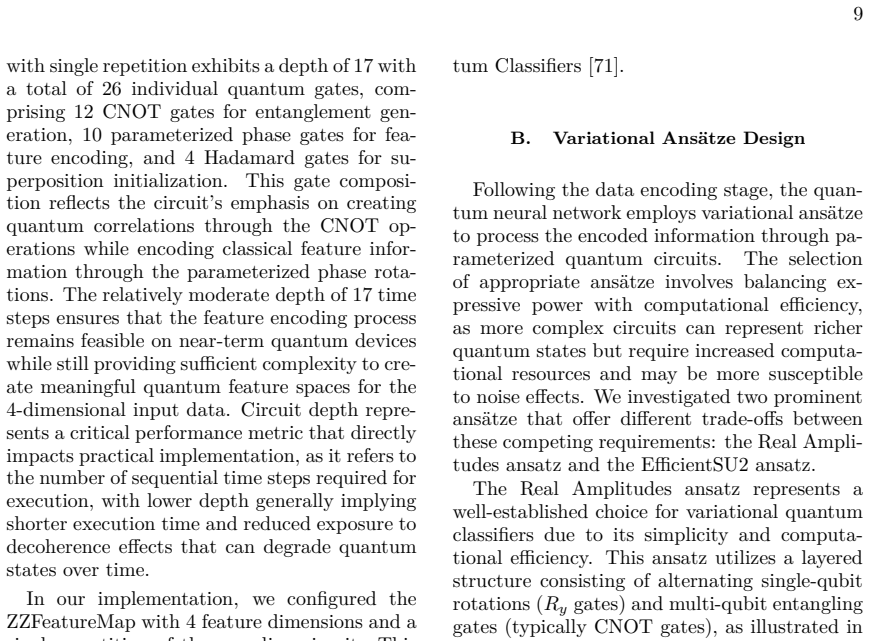
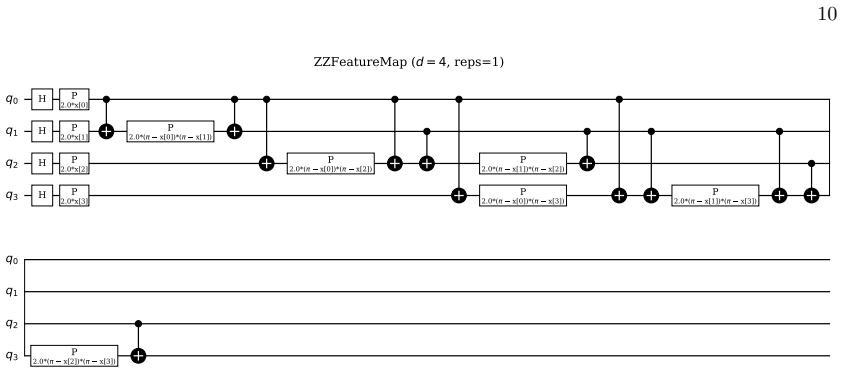
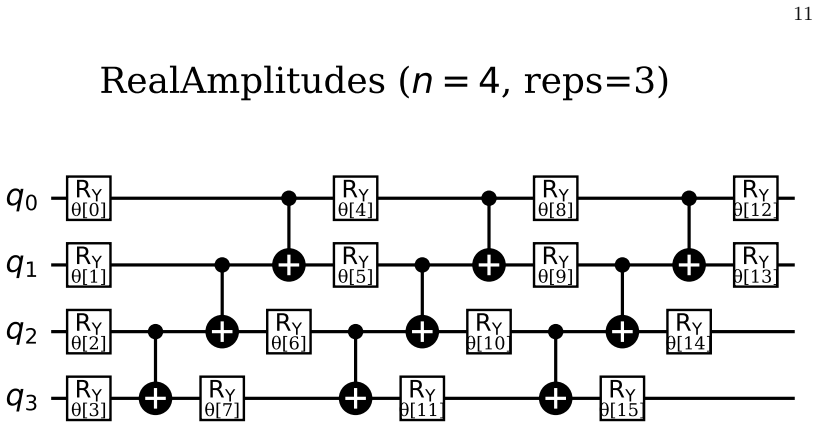
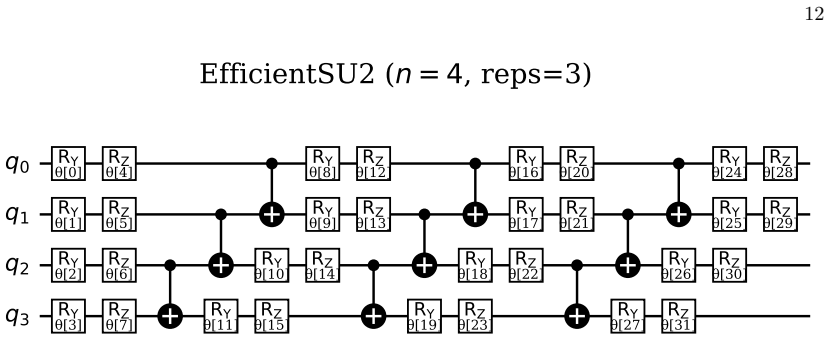
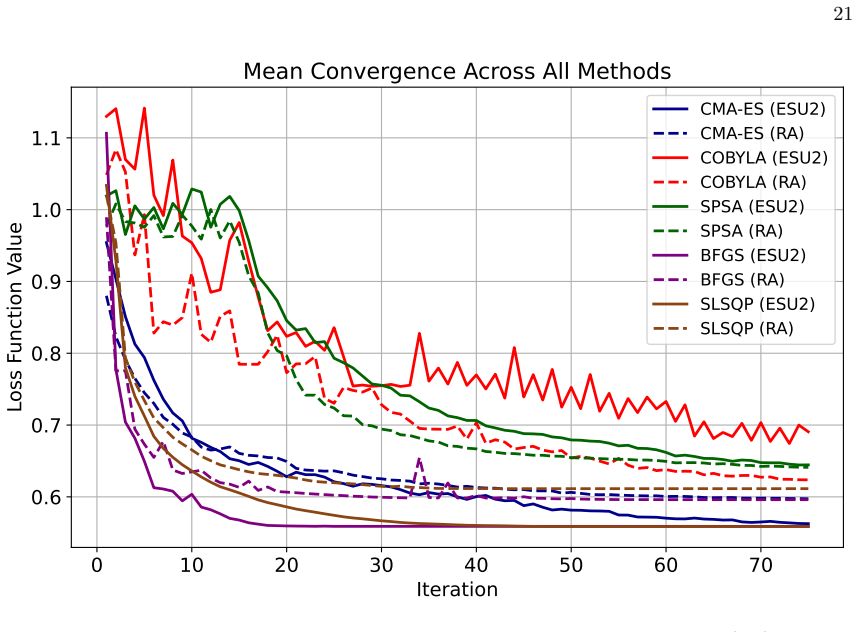
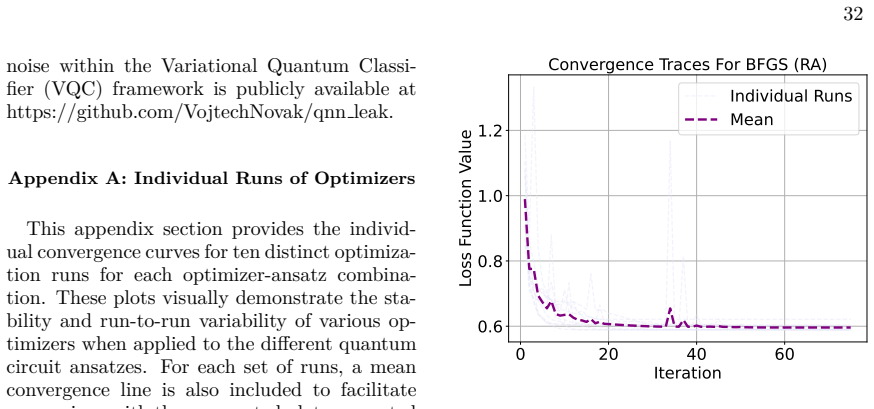
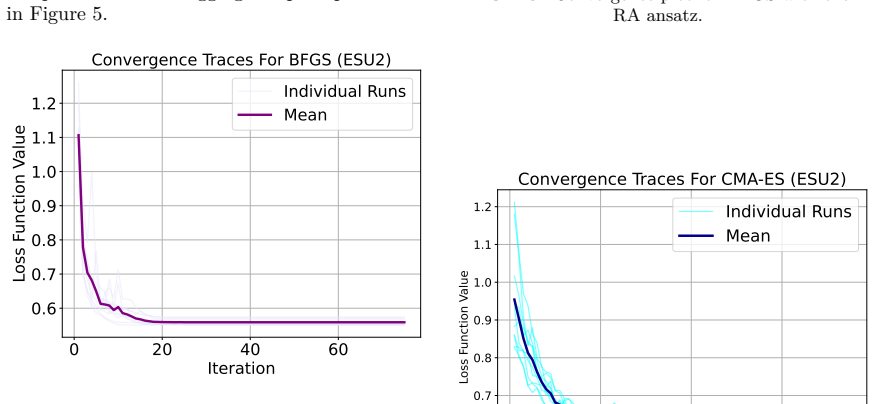
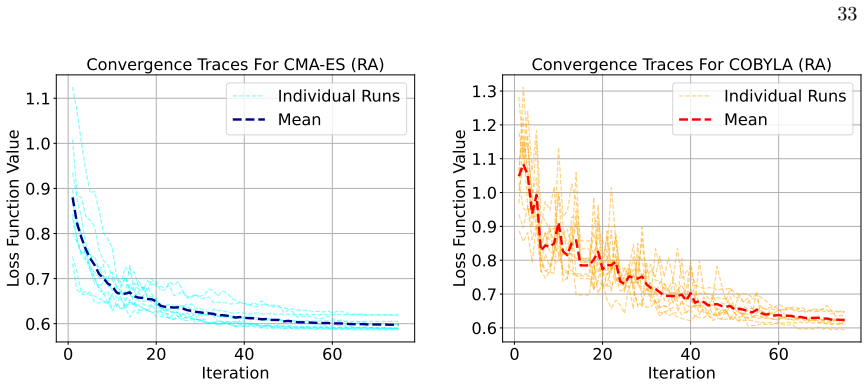
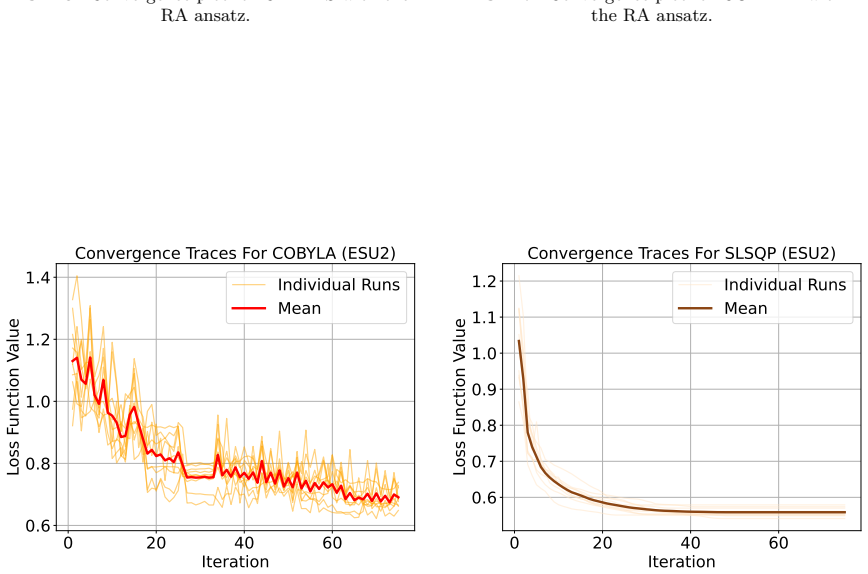
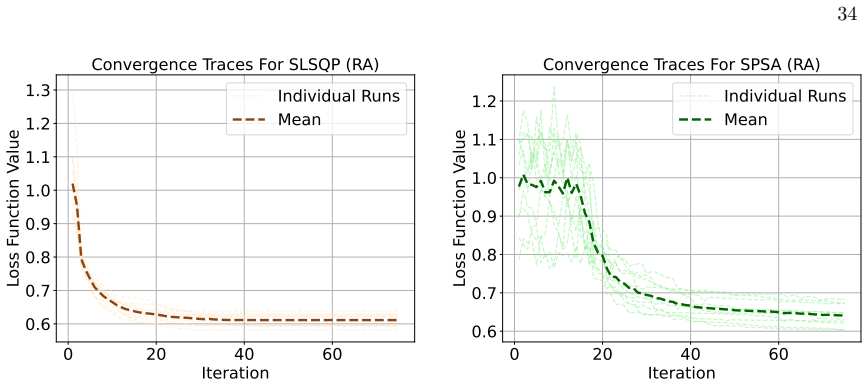
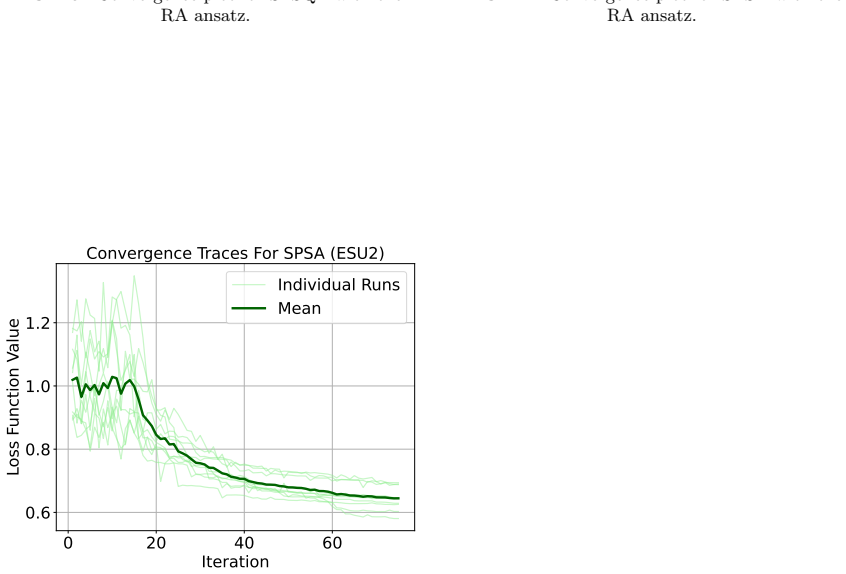
The machinery is a hybrid variational quantum classifier: a ZZFeatureMap encodes the four clinical features into a 4-qubit state through single-qubit rotations and ZZ-interaction terms that create quadratic feature products, followed by a trainable ansatz (RealAmplitudes or EfficientSU2) whose parameters are optimized by BFGS, CMA-ES, COBYLA, SLSQP, or SPSA. The whole circuit is simulated under a depolarizing noise model with single-qubit gate error probability $p_{gate}=0.05$ and 1024 shots per circuit, approximating near-term hardware conditions. The argument runs on the coupling between ansatz expressiveness and optimizer convergence: configurations that reach lower final loss also show better AUC, calibration, and screening metrics, and the ZZFeatureMap's quadratic encoding is what the authors credit for the QNN's non-linear feature interactions.
What would settle it
Re-run the full pipeline with feature selection and threshold fitting performed only inside each training fold through nested cross-validation, then compare the QNNs against the same classical baselines at the fixed 83% sensitivity level; if the QNN advantage over the MLP and logistic regression disappears or reverses under this leak-free protocol, the central claim of general QNN superiority at fixed sensitivity is refuted.
Extended reading notes
Core claim
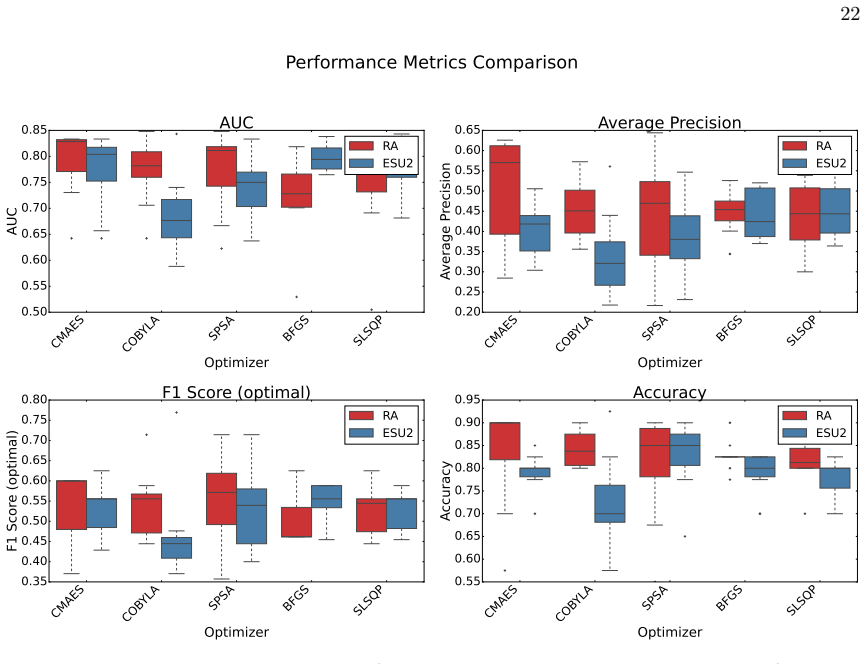
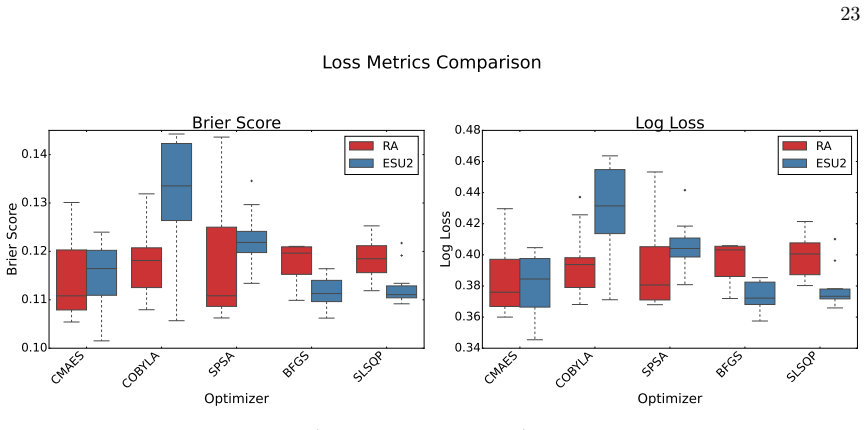
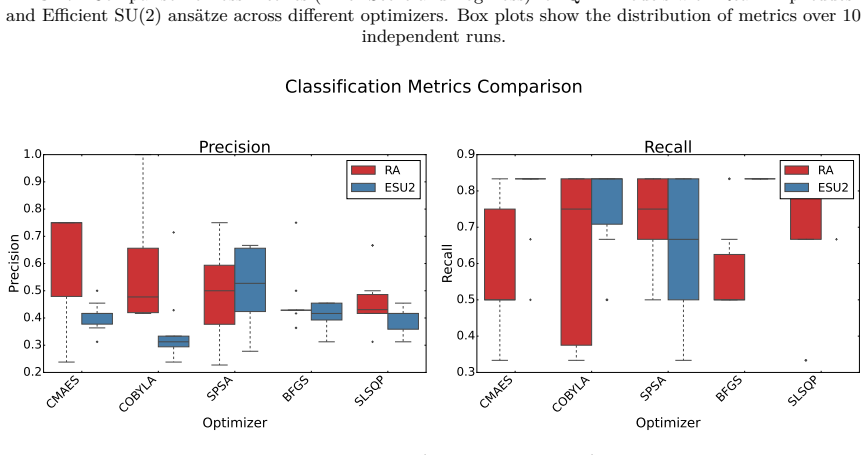
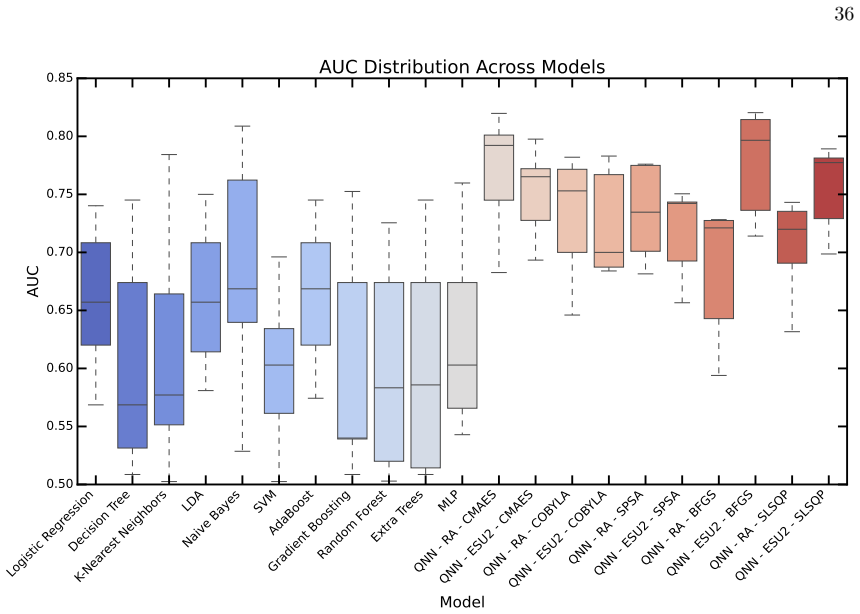
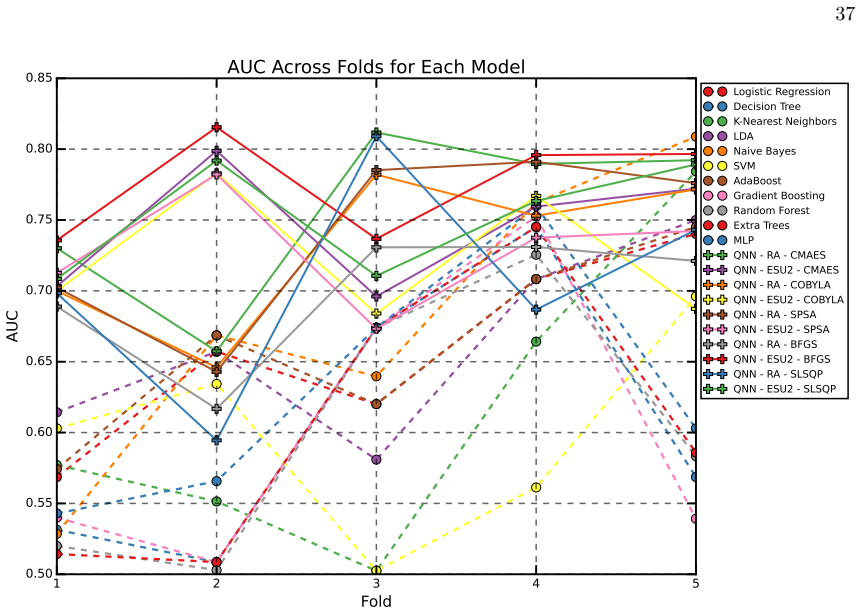
On the paper's own terms, the central discovery is a trade-off between classification power and probability calibration. At a clinically motivated fixed sensitivity of 83%, simulated QNNs generally outperform classical models on threshold-dependent screening metrics, while classical models, particularly the multilayer perceptron, produce better-calibrated probabilities. The best QNN configuration, EfficientSU2 optimized by BFGS, achieved the highest mean AUC of $0.7966 \pm 0.0237$ and the lowest Brier score among QNNs ($0.1116 \pm 0.0029$); RealAmplitudes with CMA-ES led in average precision ($0.5041 \pm 0.1214$); and several QNN configurations reached negative predictive values of 95-96%. The paper argues that variational parameter optimization quality propagates directly into clinical metrics, and that the QNN's learned feature importance differs from logistic regression in ways that suggest non-linear, possibly entangled, feature interactions.
Load-bearing premise
The whole comparison rests on the assumption that outcome information never leaked into model construction: the paper itself concedes (Section X.D) that the sample is small with only 28 leak events, and the four predictors were chosen using the full dataset while the 83% sensitivity thresholds were fitted on the held-out fold, so any such leakage would make the reported AUC, NPV, and accuracy optimistic.
Editorial extensions
If this is right
- If the 83%-sensitivity result holds, QNNs could serve as a first-pass screening tool for anastomotic leak, where high negative predictive value would reduce missed cases and guide postoperative monitoring.
- The ansatz-optimizer choice matters more than the quantum-versus-classical label; no single configuration dominates all metrics, so deployment would require selecting a configuration to match the clinical goal.
- Probability calibration is a separate axis from classification strength: classical models such as the MLP would remain preferred for risk scoring, while QNNs would be preferred for screening alerts that prioritize catching true positives.
- The reported link between optimizer convergence and clinical metrics means that advances in variational optimization could translate directly into improved screening performance.
- External validation on larger, multi-center cohorts is required before any clinical application, as the paper itself emphasizes.
Reading between the lines
- A direct extension not tested in the paper would be to replace the ZZFeatureMap with a classical quadratic-feature baseline, such as logistic regression with explicit interaction terms, to isolate whether the quantum encoding's quadratic products are what drive the apparent gain.
- The paper's fixed 83% sensitivity thresholds appear to have been selected using the held-out fold; a leak-free protocol that performs feature selection and threshold fitting entirely inside each training fold would test whether the QNN advantage over classical models survives a fully nested cross-validation.
- A hardware test on a real noisy quantum device, which the paper lists as future work, would reveal whether the depolarizing error model with $p_{gate}=0.05$ is representative; if real-device noise erases the QNN advantage, the screening claim would be limited to simulation settings.
- Since the dataset contains only 28 leak events, the reported NPV and AUC values have wide uncertainty intervals; a useful next analysis would report confidence intervals on the AUC difference between the best QNN and MLP rather than on each model separately.
Editorial analysis
A structured set of objections, weighed in public.
Referee Report
Summary. The paper reports a benchmark of four-feature quantum neural network (QNN) classifiers against classical machine learning models for predicting anastomotic leak after colorectal surgery, using a single-center dataset of 200 patients (28 events). It claims that QNNs, simulated under a depolarizing noise model, generally outperform classical models at a fixed sensitivity of 83%, with the EfficientSU2-BFGS configuration achieving the highest AUC (0.7966 ± 0.0237), and it further discusses optimizer-convergence effects and perturbation-based feature importance. The stated clinical conclusion is that QNNs may serve as screening tools pending larger validation.
Significance. If the reported comparison were valid, the paper would provide a useful proof-of-concept for applying QNNs to a high-stakes, imbalanced clinical prediction task, with notable strengths: ten independent optimization runs per configuration, explicit noise modeling, and publicly available code and data access. However, the central comparative claim rests on an evaluation protocol that leaks test information at multiple stages, and the key summary table is internally inconsistent. As presented, the evidence does not support the QNN-over-classical claim, so the scientific contribution is currently not established.
major comments (4)
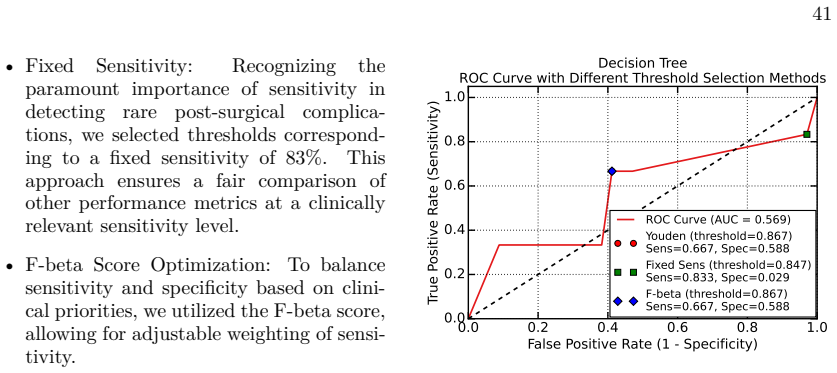
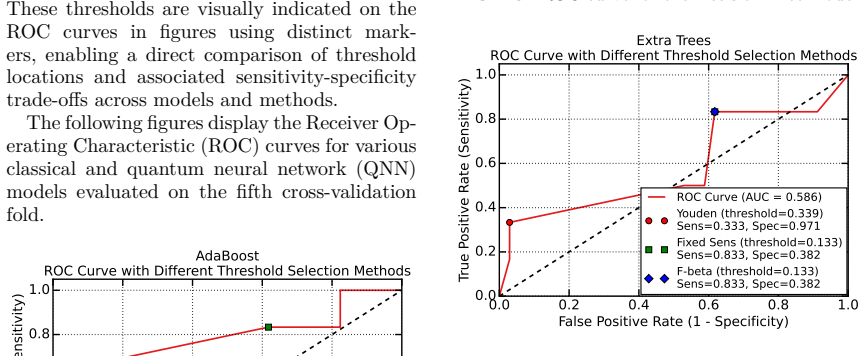
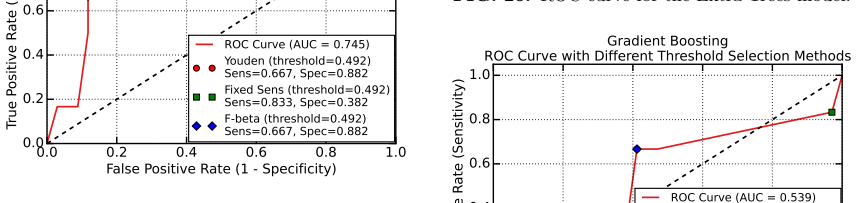
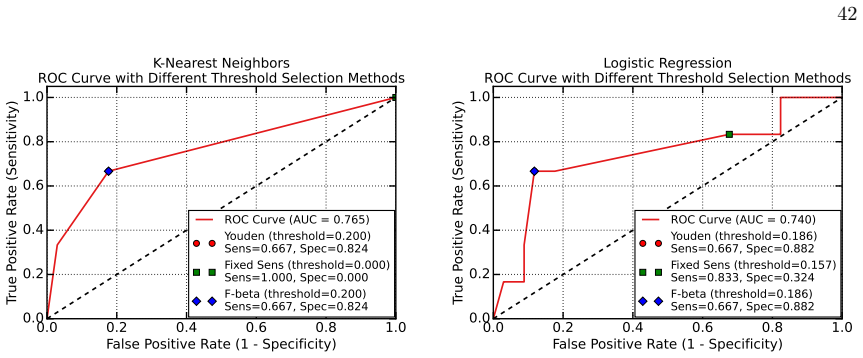
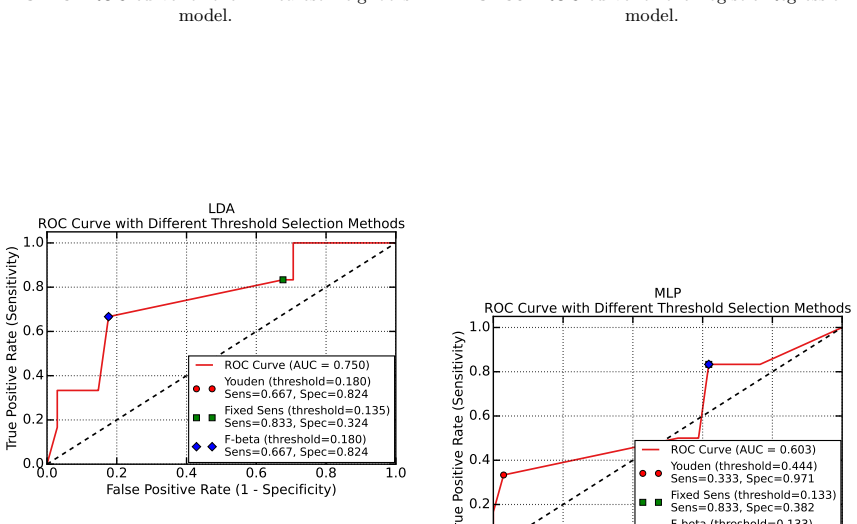
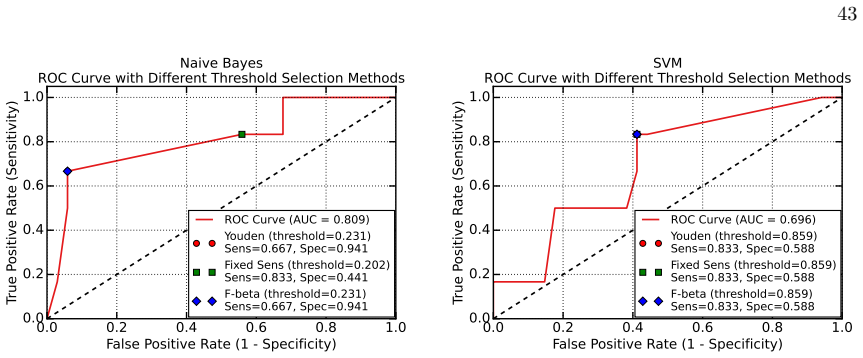
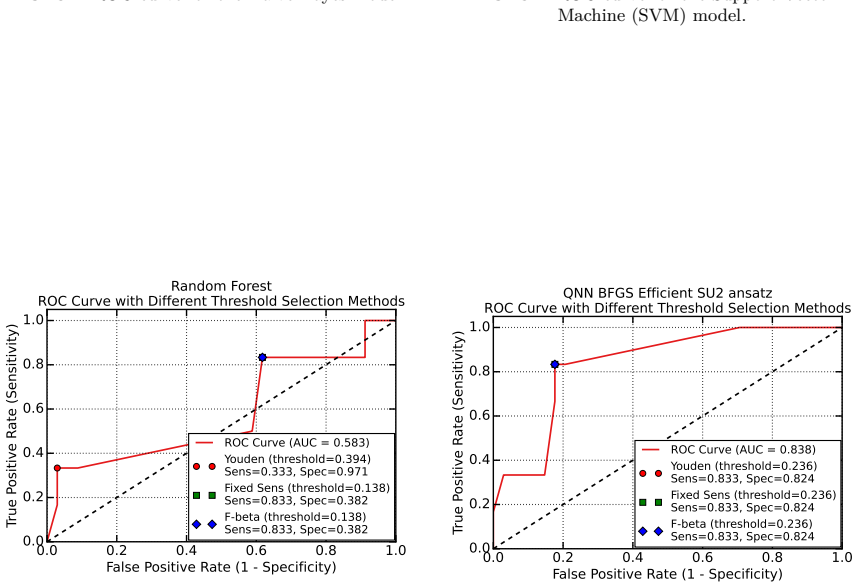
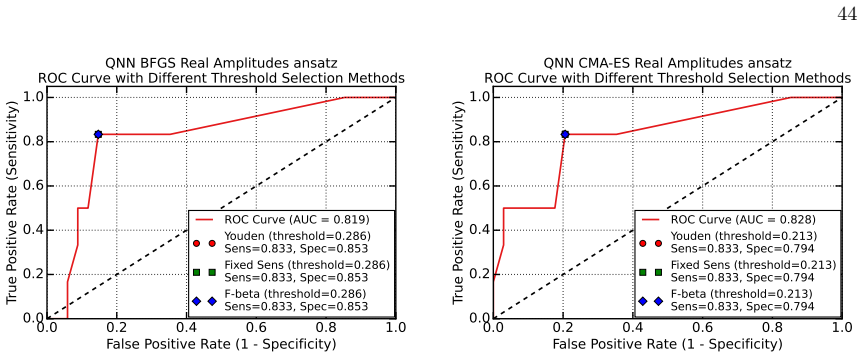
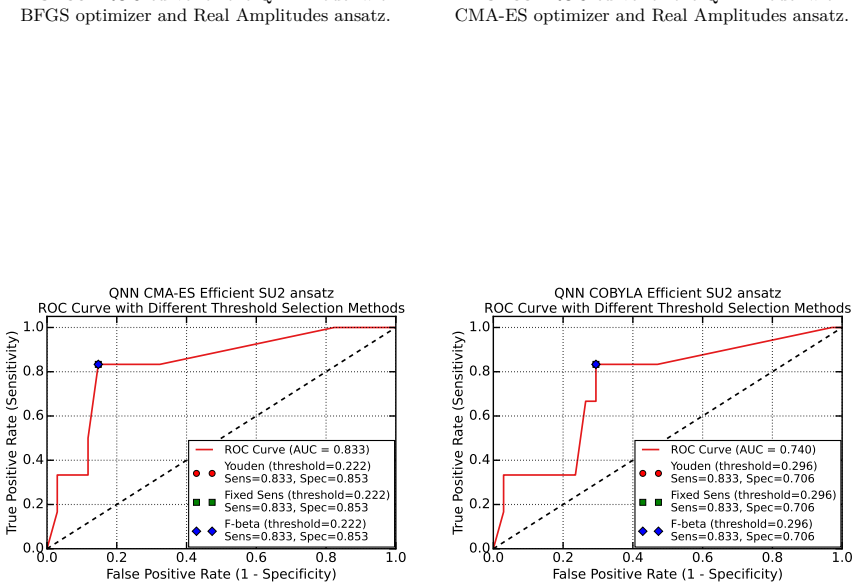
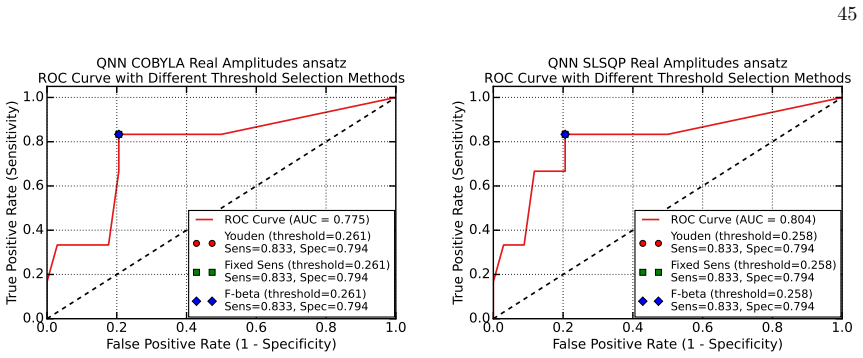
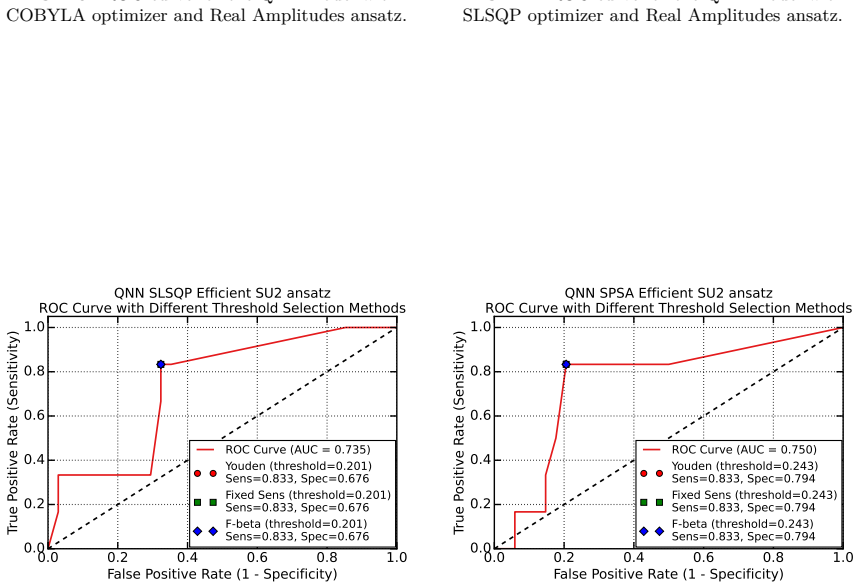
- [Section X.C and ROC appendix] The 'fixed sensitivity=83%' thresholds used for Table XIV are selected from the ROC curve of the held-out fold itself (Figures 24–44 state 'Fixed Sens (threshold=...)' for fold five), and the metrics in Table XIV are then reported on that same fold. This is test-set threshold fitting, which systematically inflates threshold-dependent metrics such as specificity, PPV, NPV, and accuracy. The paper's headline claim that 'QNNs generally outperform classical models across most metrics' relies on exactly these metrics; the calibration metrics (Brier Score, Log Loss) in the same table are comparable or favor the classical MLP. A valid protocol must select thresholds on training/validation data only, e.g., by nested cross-validation, and then evaluate once on the test fold.
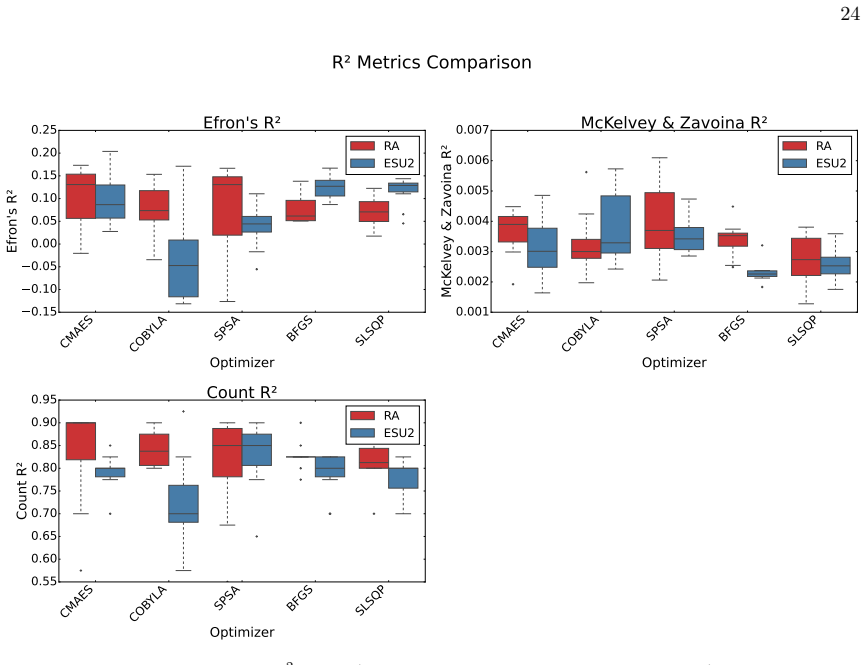
- [Table XIV, Section X.C] The QNN rows of Table XIV are internally inconsistent. With a prevalence of 14% (28/200), accuracy at 83% sensitivity is determined by specificity: accuracy = 0.83×0.14 + specificity×0.86. For QNN-CMAES-RA (specificity 64%), the implied accuracy is about 67%, not the reported 84%; for QNN-BFGS-RA (specificity 35%), the implied accuracy is about 42%, not 83%. The reported accuracy values match the Count R2 column of the upper table, suggesting that the accuracy and the sensitivity/specificity columns are computed at different operating points. This makes Table XIV unreliable as a comparative table and undermines the conclusion drawn from it.
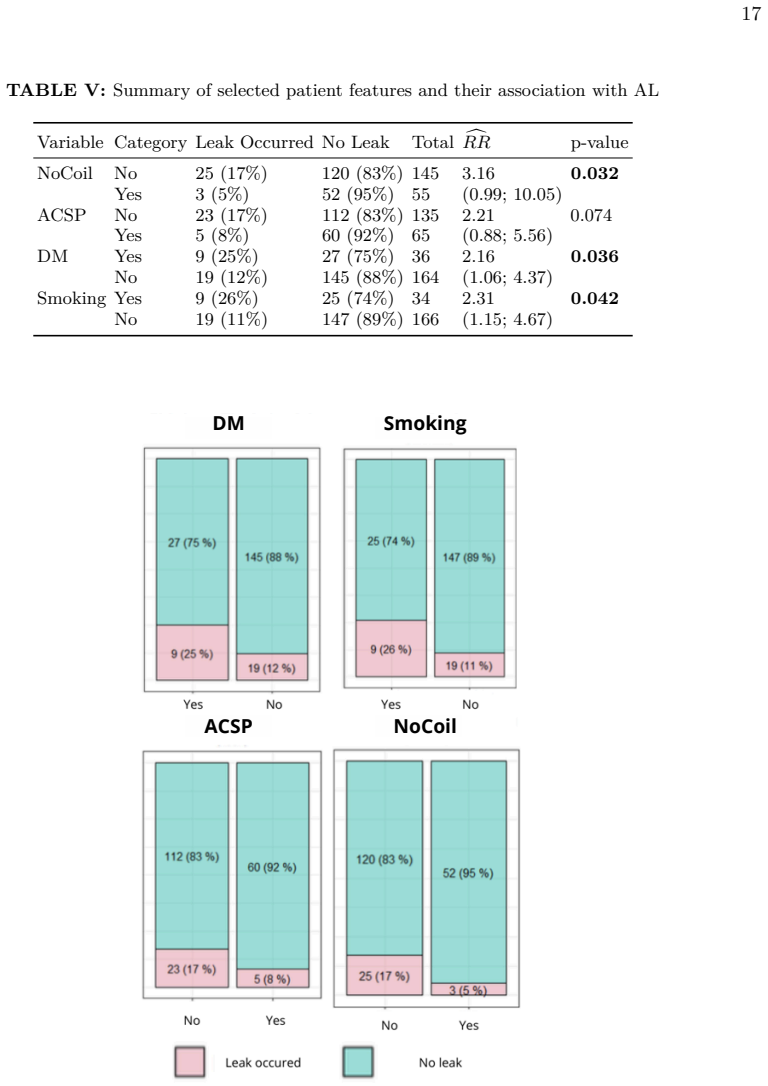
- [Sections VIII–IX and Appendix B] Feature selection is performed on the full dataset before any cross-validation: chi-square tests and AIC/BIC reduction (Sections VIII–IX) identify NoCoil, ACSP, DM, and Smoking using all 200 patients, and the same patients are then used for the cross-validated evaluations reported in Section X and Appendix B. This leaks outcome information into the feature-selection step and biases all subsequent AUC, accuracy, and calibration estimates. Correct methodology requires performing feature selection inside each training fold, or otherwise demonstrating that the selected features do not depend on the held-out outcomes.
- [Section X.B and Abstract] The abstract's headline result (EfficientSU2-BFGS with mean AUC 0.7966 ± 0.0237) is selected post hoc as the best among ten optimizer-ansatz configurations across multiple metrics. The same section notes that different configurations excel in different metrics and that 'no single configuration dominated across all metrics.' Reporting the maximum over configurations as the main result, without any multiple-comparison correction or pre-specified primary analysis, substantially inflates the apparent performance and makes the 'QNNs generally outperform' claim difficult to interpret.
minor comments (3)
- [Section VI, Table I] SPSA is classified as a 'Gradient-Free Method,' but SPSA is a stochastic gradient approximation technique that estimates gradients from two function evaluations per iteration; this classification should be corrected.
- [Figure 4] The caption 'Risk factors of Anastomotic leak' is uninformative; the text refers to 'the figure' with multiple panels, but the figure has no subplot labels or legend, making it difficult for the reader to map the visual claims to the variables NoCoil, ACSP, DM, and Smoking.
- [Section V.A] The text states that p_gate = 0.05 is a 'conservative upper bound' consistent with IBM Manila error rates, but typical single-qubit gate error rates on such devices are 0.1–0.5%, so 5% is roughly an order of magnitude higher; the justification for this choice should be clarified or revised.
Circularity Check
No significant circularity: the QNN-versus-classical benchmark is an empirical measurement with independent classical baselines, and the self-citations are background only.
full rationale
The paper's central results are measured, not derived: QNN AUC, average precision, calibration, and R2 values come from simulated noisy circuits evaluated under cross-validation, benchmarked against independently hyperparameter-tuned classical models. There is no equation in which a claimed output is defined in terms of that same output, and no fitted parameter is renamed as a prediction. The 'fixed sensitivity of 83%' protocol in Section X.C and the ROC appendix does select thresholds from the fifth-fold ROC and report metrics on that same fold; this is a test-set threshold-fitting and optimism concern, but it is not circular under the seven patterns because the sensitivity is an imposed operating point and the reported specificity, PPV, NPV, and accuracy are not equal by construction to any fitted input. Similarly, feature selection by chi-square and AIC on the full dataset (Sections VIII–IX) creates a leakage risk but no definitional circularity. The only self-references (refs [75] and [76]) support a background statement about CMA-ES robustness; the paper's own convergence experiments in Table XIII carry that claim, so those citations are not load-bearing. The paper explicitly flags the N=200 sample-size limitation in Section X.D and the Conclusion, which is a generalizability caveat rather than a circularity signal. Hence no significant circularity.
Assumptions & free parameters
free parameters (3)
- p_gate =
0.05
- feature_subset =
NoCoil, ACSP, DM, Smoking
- sensitivity_target =
83%
assumptions (4)
- domain assumption Patient cohort of 200 from a single hospital (2015-2016) is representative of the broader colorectal surgery population for AL prediction.
- domain assumption Depolarizing noise with only single-qubit errors adequately approximates real noisy quantum hardware for benchmarking QNNs.
- domain assumption The ZZFeatureMap and chosen ansaetze form a suitable model family for binary clinical features.
- standard math Standard statistical independence of patients and logistic regression assumptions.
Cite this review
Pith. "Pith review of Quantum Machine Learning for Predicting Anastomotic Leak: A Clinical Study." pith.science (2026). https://pith.science/paper/S2WPD6CH
@misc{pith2026250601708,
  author       = {Pith},
  title        = {Pith review of: Quantum Machine Learning for Predicting Anastomotic Leak: A Clinical Study},
  year         = {2026},
  howpublished = {\url{https://pith.science/paper/S2WPD6CH}},
  note         = {Machine review of arXiv:2506.01708}
}
abstract
Anastomotic leak (AL) is a life-threatening complication following colorectal surgery, and its accurate prediction remains a significant clinical challenge. This study explores the potential of Quantum Neural Networks (QNNs) for AL prediction, presenting a rigorous benchmark against hyperparameter-tuned classical models including logistic regression, multilayer perceptrons, and boosting algorithms. Using a clinical dataset of 200 patients and four key predictors identified through statistical analysis, we evaluated QNNs with ZZFeatureMap encoding and EfficientSU2 and RealAmplitudes ans\"atze simulated under realistic hardware noise models. Our framework emphasizes robustness, with performance metrics averaged over 10 independent optimization runs using multiple algorithms. The EfficientSU2-BFGS combination achieved the highest mean AUC of $0.7966 \pm 0.0237$, while RealAmplitudes with CMA-ES excelled in Average Precision ($0.5041 \pm 0.1214$), critical for imbalanced medical datasets. We establish a direct link between optimizer convergence and model efficacy, where effective variational parameter optimization translates to improved classification metrics. Interpretability analysis suggests QNNs may capture complex, non-linear feature relationships not evident in classical linear models. This work highlights QNNs' potential as screening tools while underscoring the need for model selection based on specific clinical goals, pending validation on larger datasets.
Figures
Figures from the paper (29 more)

Reference graph
Works this paper leans on
-
[1]
Regu- larization is applied to prevent overfitting
Models and Hyperparameters • Logistic Regression : A linear model that predicts the probability of a binary outcome using a logistic function. Regu- larization is applied to prevent overfitting. – Possible Hyperparameters : Reg- ularization strength C ∈ {0.01, 0.1, 1, 10}, penalty type ∈{ L1, L2}. • K-Nearest Neighbors (KNN): A non- parametric model that ...
-
[2]
These parameters were selected based on the highest AUC score during the inner 3- fold cross-validation
Optimal Hyperparameters The optimal hyperparameters for each classi- fier across the five folds are summarized in Ta- ble XV. These parameters were selected based on the highest AUC score during the inner 3- fold cross-validation. Appendix E: Quantum Measurement Operators The quantum neural network classification is performed through projective measuremen...
-
[3]
Carleo, Y
G. Carleo, Y. Nomura, and M. Imada, Con- structing exact representations of quantum many-body systems with deep neural networks, Nature Communications 9, 1 (2018)
2018
-
[4]
W. Liu, P. Gao, Y. Wang, W. Yu, and M. Zhang, A unitary weights based one- iteration quantum perceptron algorithm for non-ideal training sets, IEEE Access 7, 36854 (2019)
2019
-
[5]
J. W. Z. Lau, K. H. Lim, H. Shrotriya, and L. C. Kwek, Nisq computing: where are we and where do we go?, AAPPS Bulletin 32, 27 (2022)
2022
-
[6]
Biamonte, P
J. Biamonte, P. Wittek, N. Pancotti, P. Reben- trost, N. Wiebe, and S. Lloyd, Quantum ma- chine learning, Nature 549, 195 (2017)
2017
-
[7]
C. Ciliberto, M. Herbster, A. D. Ialongo, M. Pontil, A. Rocchetto, and S. Severini, Quan- tum machine learning: A classical perspective, Proc. Roy. Soc. A Math. Phys. Eng. Sci. 474, 10.1098/rspa.2017.0761 (2018)
arXiv 2018
-
[8]
Schuld and N
M. Schuld and N. Killoran, Quantum machine learning in feature hilbert spaces, Phys. Rev. Lett. 122, 40504 (2019)
2019
Show all 88 references
-
[9]
J. D. Mart´ ın-Guerrero and L. Lamata, Quan- tum machine learning: A tutorial, Neurocom- puting 470, 457 (2022)
2022
-
[10]
Wiebe, A
N. Wiebe, A. Kapoor, and K. M. Svore, Quan- tum deep learning, Quantum Inf. Comput. 16, 541 (2016)
2016
-
[11]
Somma, G
R. Somma, G. Ortiz, E. Knill, and J. Guber- natis, Quantum simulations of physics prob- lems, Int. J. Quantum Inf. 1, 189 (2003)
2003
-
[12]
Schuld, I
M. Schuld, I. Sinayskiy, and F. Petruccione, An introduction to quantum machine learning, Contemp. Phys. 56, 172 (2015)
2015
-
[13]
Sierra-Sosa, J
D. Sierra-Sosa, J. Arcila-Moreno, B. Garcia- Zapirain, C. Castillo-Olea, and A. El- maghraby, Dementia prediction applying vari- ational quantum classifier, arXiv preprint arXiv:2007.08653 (2020)
2020 arXiv
-
[14]
Schuld, Supervised quantum machine learn- ing models are kernel methods, arXiv preprint arXiv:2101.11020 (2021)
M. Schuld, Supervised quantum machine learn- ing models are kernel methods, arXiv preprint arXiv:2101.11020 (2021)
2021 arXiv
-
[15]
Havlicek, A
V. Havlicek, A. D. Corcoles, K. Temme, A. W. Harrow, A. Kandala, J. M. Chow, and J. M. Gambetta, Supervised learning with quantum- enhanced feature spaces, Nature 567, 209 (2019)
2019
-
[16]
Farhi and H
E. Farhi and H. Neven, Classification with quantum neural networks on near term proces- sors, arXiv preprint arXiv:1802.06002 (2018)
2018 arXiv
-
[17]
N. Moll, P. Barkoutsos, L. S. Bishop, J. M. Chow, A. Cross, D. J. Egger, and et al., Quan- tum optimization using variational algorithms on near-term quantum devices, Quantum Sci- ence and Technology 3, 30503 (2018)
2018
-
[18]
Lloyd, M
S. Lloyd, M. Mohseni, and P. Rebentrost, Quantum principal component analysis, Na- ture Physics 10, 631 (2014)
2014
-
[19]
M. C. Caro, H.-Y. Huang, M. Cerezo, K. Sharma, A. Sornborger, L. Cincio, and P. J. Coles, Generalization in quantum machine learning from few training data, Nature Com- munications 13, 4919 (2022)
2022
-
[20]
Kumar, G
T. Kumar, G. Singh, and R. Kumar, Perfor- mance analysis of quantum classifier on bench- marking datasets, International Journal of Ad- vanced Computer Science and Applications10, 375 (2022)
2022
-
[21]
Kharsa, A
R. Kharsa, A. Bouridane, and A. Amira, Ad- vances in quantum machine learning and deep learning for image classification: A survey, Neurocomputing 552, 126506 (2023)
2023
-
[22]
Jerbi, L
S. Jerbi, L. J. Fiderer, H. P. Nautrup, J. M. K¨ ubler, H. J. Briegel, and V. Dun- jko, Qdataset: Quantum datasets for machine learning, arXiv preprint arXiv:2108.06661 (2021), arXiv:2108.06661 [quant-ph]
2021 arXiv
-
[23]
Abohashima, M
Z. Abohashima, M. Elhoseny, and E. H. Houssein, Classification with quantum ma- chine learning: A survey, arXiv preprint arXiv:2006.12270 (2020), arXiv:2006.12270 [quant-ph]
2020 arXiv
-
[24]
Benˇ curik, M
V. Benˇ curik, M. ˇSkrovina, L. Mart´ ınek, J. Bartoˇ s, M. Mach´ aˇ ckov´ a, M. Dosoudil, E. ˇStˇ ep´ anov´ a, L. Pˇ ribylov´ a, R. Briˇ s, and K. Vom´ aˇ ckov´ a, Intraoperative fluorescence an- giography and risk factors of anastomotic leak- age in mini-invasive low rectal ...
2021
-
[25]
Blanco-Colino and E
R. Blanco-Colino and E. Espin-Basany, Intra- operative use of icg fluorescence imaging to re- duce the risk of anastomotic leakage in col- orectal surgery: a systematic review and meta- analysis, Techniques in coloproctology 22, 15 (2018)
2018
-
[26]
H. Kato, S. Munakata, K. Sakamoto, K. Sug- imoto, R. Yamamoto, S. Ueda, S. Tokuda, S. Sakuraba, T. Kushida, H. Orita, et al. , Im- 48 pact of left colonic artery preservation on anas- tomotic leakage in laparoscopic sigmoid resec- tion and anterior resection for sigmoid and re...
2019
-
[27]
S. Zhao, L. Zhang, F. Gao, M. Wu, J. Zheng, L. Bai, F. Li, B. Liu, Z. Pan, J. Liu, et al. , Transanal drainage tube use for preventing anastomotic leakage after laparoscopic low an- terior resection in patients with rectal cancer: a randomized clinical trial, JAMA surgery156, ...
2021
-
[28]
A. L. Axtell, C. Angeles, D. P. McCarthy, J. D. Maloney, G. E. Leverson, and M. M. De- Camp, Anastomotic leak after esophagectomy– analysis of the sts general thoracic surgery database, The Annals of Thoracic Surgery (2025)
2025
-
[29]
Trastulli, G
S. Trastulli, G. Munzi, J. Desiderio, R. Ciroc- chi, M. Rossi, and A. Parisi, Indocyanine green fluorescence angiography versus standard in- traoperative methods for prevention of anasto- motic leak in colorectal surgery: meta-analysis, British Journal of Surgery 108, 359 (2021)
2021
-
[30]
J. He, M. He, J.-H. Tang, and X.-H. Wang, Anastomotic leak risk factors follow- ing colon cancer resection: a systematic re- view and meta-analysis, Langenbeck’s Archives of Surgery 408, 252 (2023)
2023
-
[31]
S. Awad, A. I. Abd El-Rahman, A. Abbas, et al. , The assessment of perioperative risk factors of anastomotic leakage after intestinal surgeries: a prospective study, BMC Surgery 21, 29 (2021)
2021
-
[32]
J. Lin, B. Zheng, S. Lin, et al. , The efficacy of intraoperative icg fluorescence angiography on anastomotic leak after resection for colorectal cancer: a meta-analysis, International Journal of Colorectal Disease 36, 27 (2021)
2021
-
[33]
C. R. Balamurugan, R. Kodali, D. S. Hansalia, and V. Rengan, The impact of indocyanine green fluorescence angiography on anastomotic leak rates in colorectal surgery: a systematic review, Surgical Endoscopy 10.1007/s00464- 025-11547-1 (2025)
2025 doi
-
[34]
M. L. Venn, R. L. Hooper, T. Pampiglione, et al. , Systematic review of preoperative and intraoperative colorectal anastomotic leak pre- diction scores (alps), BMJ Open 13, e073085 (2023)
2023
-
[35]
Virtanen, R
P. Virtanen, R. Gommers, T. E. Oliphant, M. Haberland, T. Reddy, D. Cournapeau, E. Burovski, P. Peterson, W. Weckesser, J. Bright, S. J. van der Walt, M. Brett, J. Wil- son, K. J. Millman, N. Mayorov, A. R. J. Nel- son, E. Jones, R. Kern, E. Larson, C. J. Carey, ˙I. Polat, Y. ...
2020
-
[36]
Javadi-Abhari, M
A. Javadi-Abhari, M. Treinish, K. Krsulich, C. J. Wood, J. Lishman, J. Gacon, S. Martiel, P. D. Nation, L. S. Bishop, A. W. Cross, B. R. Johnson, and J. M. Gambetta, Quantum com- puting with Qiskit (2024), arXiv:2405.08810 [quant-ph]
2024 arXiv
-
[37]
Preskill, Quantum computing in the nisq era and beyond, Quantum 2, 79 (2018)
J. Preskill, Quantum computing in the nisq era and beyond, Quantum 2, 79 (2018)
2018
-
[38]
Farhi, J
E. Farhi, J. Goldstone, and S. Gutmann, A quantum approximate optimization algorithm, arXiv preprint arXiv:1411.4028 (2014)
2014 arXiv
-
[39]
Peruzzo, J
A. Peruzzo, J. McClean, P. Shadbolt, M.-H. Yung, X.-Q. Zhou, P. J. Love, A. Aspuru- Guzik, and J. L. O’brien, A variational eigen- value solver on a photonic quantum processor, Nature communications 5, 4213 (2014)
2014
-
[40]
Cerezo, A
M. Cerezo, A. Arrasmith, R. Babbush, S. C. Benjamin, S. Endo, K. Fujii, J. R. McClean, K. Mitarai, X. Yuan, L. Cincio, et al. , Vari- ational quantum algorithms, Nature Reviews Physics 3, 625 (2021)
2021
-
[41]
Schuld, I
M. Schuld, I. Sinayskiy, and F. Petruccione, The quest for a quantum neural network, Quantum Information Processing 13, 2567 (2014)
2014
-
[42]
Abbas, D
A. Abbas, D. Sutter, C. Zoufal, A. Lucchi, A. Figalli, and S. Woerner, The power of quan- tum neural networks, Nature Computational Science 1, 403 (2021)
2021
-
[43]
Benedetti, E
M. Benedetti, E. Lloyd, S. Sack, and M. Fioren- tini, Parameterized quantum circuits as ma- chine learning models, Quantum Science and Technology 4, 043001 (2019)
2019
-
[44]
M. C. Caro, H.-Y. Huang, M. Cerezo, K. Sharma, A. Sornborger, L. Cincio, and P. J. Coles, Generalization in quantum machine learning from few training data, Nature com- munications 13, 4919 (2022)
2022
-
[45]
Larocca et al
M. Larocca et al. , Group-invariant quantum machine learning, Physical Review A 106, 022402 (2022)
2022
-
[46]
J. J. Meyer, M. Mularski, E. Gil-Fuster, A. A. 49 Mele, F. Arzani, A. Wilms, and J. Eisert, Exploiting symmetry in variational quantum machine learning, PRX quantum 4, 010328 (2023)
2023
-
[47]
Y. Liu, S. Arunachalam, and K. Temme, A rig- orous and robust quantum speed-up in super- vised machine learning, Nat. Phys. 17, 1013 (2021)
2021
-
[48]
F. J. Schreiber, J. Eisert, and J. J. Meyer, Clas- sical surrogates for quantum learning models, Physical Review Letters 131, 100803 (2023)
2023
-
[49]
J¨ ager and R
J. J¨ ager and R. V. Krems, Universal expres- siveness of variational quantum classifiers and quantum kernels for support vector machines, Nature Communications 14, 576 (2023)
2023
-
[50]
Kandala, A
A. Kandala, A. Mezzacapo, K. Temme, M. Takita, M. Brink, J. M. Chow, and J. M. Gambetta, Hardware-efficient variational quantum eigensolver for small molecules and quantum magnets, Nature 549, 242 (2017)
2017
-
[51]
Hadfield, Z
S. Hadfield, Z. Wang, B. O’Gorman, E. G. Ri- effel, D. Venturelli, and R. Biswas, From the quantum approximate optimization algorithm to a quantum alternating operator ansatz, Al- gorithms 12, 34 (2019)
2019
-
[52]
K. Beer, D. Bondarenko, T. Farrelly, T. J. Osborne, R. Salzmann, D. Scheiermann, and R. Wolf, Training deep quantum neural net- works, Nature communications 11, 808 (2020)
2020
-
[53]
Heimann, G
D. Heimann, G. Sch¨ onhoff, and F. Kirch- ner, Learning capability of parametrized quan- tum circuits, arXiv preprint arXiv:2209.10345 (2022)
2022 arXiv
-
[54]
Bud, History of biotechnology, e LS (2001)
R. Bud, History of biotechnology, e LS (2001)
2001
-
[55]
Van Beuzekom and A
B. Van Beuzekom and A. Arundel, OECD biotechnology statistics 2006 (Citeseer, 2006)
2006
-
[56]
Dabba, A
A. Dabba, A. Tari, and S. Meftali, Hybridiza- tion of moth flame optimization algorithm and quantum computing for gene selection in mi- croarray data, Journal of Ambient Intelligence and Humanized Computing 12, 2731 (2021)
2021
-
[57]
Sergioli, C
G. Sergioli, C. Militello, L. Rundo, L. Minafra, F. Torrisi, G. Russo, K. L. Chow, and R. Giun- tini, A quantum-inspired classifier for clono- genic assay evaluations, Scientific Reports 11, 2830 (2021)
2021
-
[58]
R. Y. Li, S. Gujja, S. R. Bajaj, O. E. Gamel, N. Cilfone, J. R. Gulcher, D. A. Lidar, and T. W. Chittenden, Quantum processor- inspired machine learning in the biomedical sci- ences, Patterns 2 (2021)
2021
-
[59]
Sengupta and P
K. Sengupta and P. R. Srivastava, Quantum algorithm for quicker clinical prognostic analy- sis: An application and experimental study us- ing ct scan images of covid-19 patients, BMC Medical Informatics and Decision Making 21, 1 (2021)
2021
-
[60]
Acar and I
E. Acar and I. Yilmaz, Covid-19 detection on ibm quantum computer with classical-quantum transfer learning, Turkish Journal of Electri- cal Engineering & Computer Sciences 29, 46 (2021)
2021
-
[61]
Amin et al
J. Amin et al. , Quantum machine learning ar- chitecture for covid-19 classification based on synthetic data generation using conditional ad- versarial neural network, Cognitive Computa- tion (2021)
2021
-
[62]
El-shafeiy, A
E. El-shafeiy, A. E. Hassanien, K. M. Sal- lam, and A. A. Abohany, Approach for training quantum neural network to predict severity of covid-19 in patients, Computational Materials Continua 66, 1745 (2021)
2021
-
[63]
A. M. Iliyasu and C. Fatichah, A quantum hy- brid pso combined with fuzzy k-nn approach to feature selection and cell classification in cervi- cal cancer detection, Sensors 17, 2935 (2017)
2017
-
[64]
Matic, M
A. Matic, M. Monnet, J. M. Lorenz, B. Schachtner, and T. Messerer, Quantum- classical convolutional neural networks in radiological image classification (2022), arXiv:2204.12390 [quant-ph]
2022 arXiv
-
[65]
Aishwarya, V
S. Aishwarya, V. Abeer, B. B. Sathish, and K. Subramanya, Quantum computational tech- niques for prediction of cognitive state of hu- man mind from eeg signals, Journal of Quan- tum Computing 2, 157 (2020)
2020
-
[66]
Gandhi, G
V. Gandhi, G. Prasad, D. Coyle, L. Be- hera, and T. M. McGinnity, Quantum neu- ral network-based eeg filtering for a brain– computer interface, IEEE transactions on neu- ral networks and learning systems 25, 278 (2013)
2013
-
[67]
Maheshwari, B
D. Maheshwari, B. Garcia-Zapirain, and D. Sierra-Soso, Machine learning applied to di- abetes dataset using quantum versus classical computation, in 2020 IEEE international sym- posium on signal processing and information technology (ISSPIT) (IEEE, 2020) pp. 1–6
2020
-
[68]
Gupta, H
H. Gupta, H. Varshney, T. K. Sharma, N. Pachauri, and O. P. Verma, Compara- tive performance analysis of quantum machine learning with deep learning for diabetes pre- diction, Complex & Intelligent Systems 8, 3073 (2022)
2022
-
[69]
Sierra-Sosa, J
D. Sierra-Sosa, J. D. Arcila-Moreno, B. Garcia- Zapirain, and A. Elmaghraby, Diabetes type 2: 50 Poincare data preprocessing for quantum ma- chine learning., Computers, Materials & Con- tinua 67 (2021)
2021
-
[70]
Maheshwari, U
D. Maheshwari, U. Ullah, P. A. O. Marulanda, A. G.-O. Jurado, I. D. Gonzalez, J. M. O. Merodio, and B. Garcia-Zapirain, Quantum machine learning applied to electronic health- care records for ischemic heart disease classifi- cation, Hum.-Cent. Comput. Inf. Sci13 (2023)
2023
-
[71]
S. Zhou, V. Giovannetti, S. Pirandola, E. M. Kessler, J. Preskill, and S. Lloyd, Achieving the heisenberg limit in quantum metrology us- ing quantum error correction, Nature Commu- nications 9, 78 (2018)
2018
-
[72]
A. W. Cross, L. S. Bishop, S. Sheldon, P. D. Nation, and J. M. Gambetta, Validating quan- tum computers using randomized model cir- cuits, Physical Review A 100, 032328 (2019)
2019
-
[73]
Vasques, H
X. Vasques, H. Paik, and L. Cif, Applica- tion of quantum machine learning using quan- tum kernel algorithms on multiclass neuron m- type classification, Scientific Reports 13, 11541 (2023)
2023
-
[74]
D. C. Liu and J. Nocedal, On the limited mem- ory bfgs method for large scale optimization, Mathematical programming 45, 503 (1989)
1989
-
[75]
Hansen, S
N. Hansen, S. D. M¨ uller, and P. Koumout- sakos, Reducing the time complexity of the derandomized evolution strategy with covari- ance matrix adaptation (cma-es), Evolutionary computation 11, 1 (2003)
2003
-
[76]
Bonet-Monroig, H
X. Bonet-Monroig, H. Wang, D. Vermetten, B. Senjean, C. Moussa, T. B¨ ack, V. Dunjko, and T. E. O’Brien, Performance comparison of optimization methods on variational quantum algorithms, Physical Review A 107, 032407 (2023)
2023
-
[77]
Ill´ esov´ a, V
S. Ill´ esov´ a, V. Nov´ ak, T. Bezdˇ ek, M. Beseda, and C. Possel, Numerical optimization strate- gies for the variational hamiltonian ansatz in noisy quantum environments, arXiv preprint arXiv:2505.22398 (2025)
2025
-
[78]
Nov´ ak, I
V. Nov´ ak, I. Zelinka, and V. Sn´ aˇ sel, Opti- mization strategies for variational quantum al- gorithms in noisy landscapes, arXiv preprint arXiv:2506.01715 (2025)
2025
-
[79]
M. J. Powell, A direct search optimization method that models the objective and constraint functions by linear interpolation (Springer, 1994)
1994
-
[80]
Kraft, A software package for sequential quadratic programming, Forschungsbericht- Deutsche Forschungs- und Versuchsanstalt fur Luft- und Raumfahrt (1988)
D. Kraft, A software package for sequential quadratic programming, Forschungsbericht- Deutsche Forschungs- und Versuchsanstalt fur Luft- und Raumfahrt (1988)
1988
-
[81]
J. C. Spall, Multivariate stochastic approxima- tion using a simultaneous perturbation gradi- ent approximation, IEEE transactions on au- tomatic control 37, 332 (1992)
1992
-
[82]
N. R. Sproston and J. J. Ashworth, Role of c- reactive protein at sites of inflammation and in- fection, Frontiers in immunology 9, 754 (2018)
2018
-
[83]
Akaike, Akaike’s information criterion, in International encyclopedia of statistical science (Springer, 2011) pp
H. Akaike, Akaike’s information criterion, in International encyclopedia of statistical science (Springer, 2011) pp. 25–25
2011
-
[84]
S. I. Vrieze, Model selection and psychological theory: a discussion of the differences between the akaike information criterion (aic) and the bayesian information criterion (bic)., Psycho- logical methods 17, 228 (2012)
2012
-
[85]
McFadden, Regression-based specification tests for the multinomial logit model, Journal of econometrics 34, 63 (1987)
D. McFadden, Regression-based specification tests for the multinomial logit model, Journal of econometrics 34, 63 (1987)
1987
-
[86]
T. J. Smith and C. M. McKenna, A compar- ison of logistic regression pseudo r2 indices, Multiple Linear Regression Viewpoints 39, 17 (2013)
2013
-
[87]
Ansin, An evaluation of the cox-snell resid- uals (2015)
E. Ansin, An evaluation of the cox-snell resid- uals (2015)
2015
-
[88]
J. Zhu, H. Zou, S. Rosset, T. Hastie, et al. , Multi-class adaboost, Statistics and its Inter- face 2, 349 (2009)
2009
Reviewed August 7, 2026 · model on record in the stance chip above.
Discussion (0). Sign in to comment.