REVIEW 2 major objections 4 minor 49 references
Domain-Driven Solver (DDS) Version 2.0: a MATLAB-based Software Package for Convex Optimization Problems in Domain-Driven Form
T0 review · 2 major / 4 minor · reviewed 2026-08-14 · deepseek-v4-flash
Pith's one-line read DDS 2.0 solves every combination of eight convex constraint families with one infeasible-start primal-dual interior-point method and returns certificates for the main statuses.
desk verdict A genuinely useful solver package with real new derivations, but the quantum relative entropy section has a sign error that makes the displayed barrier no barrier at all, and even the intended candidate lacks the self-concordance guarantee the rest of the theory relies on. read the letter →
The pith
A machine-rendered reading of the paper's core claim, the machinery that carries it, and where it could break.
The reading
What carries the argument
The load-bearing object is the Domain-Driven form, in which the feasible set is written as Ax in D with D the closure of the domain of a self-concordant barrier, a smooth penalty that blows up at the boundary and whose curvature changes slowly enough for interior-point methods to be provably efficient. The algorithm alternates predictor and corrector steps built from the barrier's gradient and Hessian together with the Legendre-Fenchel conjugate of the barrier, which is the companion dual penalty used to form search directions and to evaluate the support function needed for certificates. Specific barriers carry the individual constraint families: matrix-monotone functions give the quantum-entropy barrier, a proven barrier handles the generalized power cone, a theorem for hyperbolic polynomials gives -ln(p(x)) on the hyperbolicity cone, and the paper proves a self-concordant barrier for vector relative entropy in an appendix. For quantum relative entropy, DDS uses the barrier -ln(t - Tr(X ln X - X ln Y)) - ln det X - ln det Y, which the paper explicitly marks as not yet known to be self-concordant, so the theoretical convergence guarantees do not yet cover that family.
What would settle it
Test the required smoothness inequality for the quantum relative entropy barrier -ln(t - Tr(X ln X - X ln Y)) - ln det X - ln det Y at nearly commuting positive-definite matrices X and Y: if some feasible direction h makes the third derivative exceed twice the 3/2 power of the second derivative, the barrier is not of the needed type and the polynomial-time guarantee for QRE collapses.
Extended reading notes
Core claim
The paper's thesis is that the Domain-Driven formulation is not only a theoretical umbrella but a workable software design: one solver can accept every combination of the listed constraint families and solve them with a single infeasible-start primal-dual interior-point method, provided each family supplies a self-concordant barrier and, where possible, its Legendre-Fenchel conjugate. For each family, DDS uses the barrier tailored to that set rather than reformulating the set as a semidefinite program, which lets it return dual certificates for problems whose constraints are not spectrahedral. The stopping rules and status reports are taken from a companion analysis of status determination, so the solver distinguishes solved, infeasible, unbounded, and ill-conditioned outcomes at a user-chosen tolerance. The numerical sections show the direct-barrier approach scaling well on nuclear-norm, quantum-entropy, and hyperbolic-polynomial problems, including a primal-heavy variant used when the conjugate barrier is unavailable.
Load-bearing premise
The convergence and certificate guarantees rest on every constraint family having a smooth penalty function of the special type interior-point methods require, and for quantum relative entropy the paper explicitly says that property is not yet known to hold.
Editorial extensions
If this is right
- Because all listed constraint families can be mixed in one problem, a user can model a convex program with entropy, quantum, and conic constraints together and solve it without converting the whole problem to a standard symmetric cone.
- For families with proven barriers, the solver inherits the polynomial iteration bound of the infeasible-start primal-dual algorithm, so the practical stopping rules are backed by a convergence guarantee rather than only by heuristics.
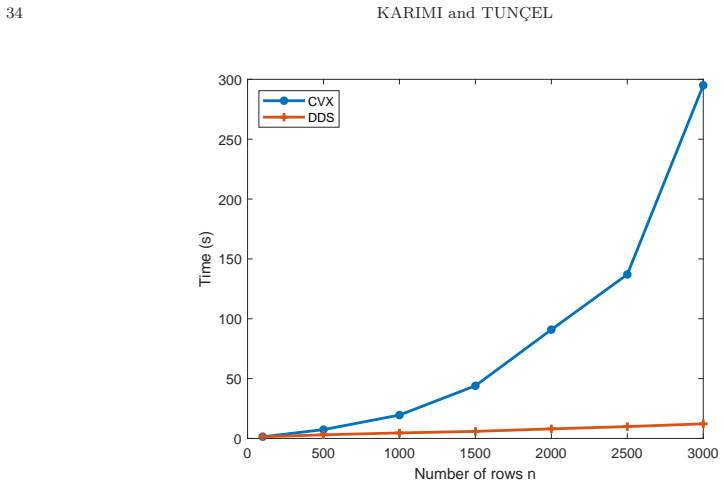
- Direct use of tailored barriers avoids semidefinite approximations for non-spectral constraints; the numerical experiments indicate near-linear growth in running time for nuclear-norm minimization when the matrix is much wider than tall.
- Hyperbolic-polynomial constraints, which standard modeling systems generally do not accept, become solvable through the primal-heavy variant that approximates the missing conjugate while keeping dual iterates feasible.
Reading between the lines
- Editorial inference: if a self-concordant barrier for quantum relative entropy is later found, the existing code could absorb it without structural change, and the numerical QRE results would move from empirical demonstrations to certified solutions.
- Editorial inference: the certificate machinery suggests a testable use outside the package: on a suspected-infeasible relative-entropy instance, one can independently check the returned dual certificate, giving a practical oracle for convex infeasibility in information-theoretic relaxations.
- Editorial inference: the same barrier-plus-conjugate recipe points to an expansion path for future constraint families; whenever a new barrier has a conjugate that reduces to a few one-dimensional root solves, that family can likely be added to DDS with modest code changes.
- Editorial inference: if the QRE barrier is not self-concordant, the QRE entries in the numerical tables should be interpreted as empirical performance data, and the status certificates for those runs would need independent verification before being relied on.
Signed reviews
Editorial analysis
A structured set of objections, weighed in public.
Referee Report
Summary. The manuscript presents DDS 2.0, a MATLAB package for convex optimization in the Domain-Driven form, i.e., problems of the form inf{<c,x> : Ax in D} where D is described by self-concordant barriers. The paper is primarily a user's guide, supplemented by theoretical appendices. It claims to accept every combination of eight constraint classes: symmetric cones, SOCP-representable quadratic constraints, 2D epigraphs of univariate convex functions, generalized power cones, matrix-norm epigraphs, vector relative entropy, quantum entropy and quantum relative entropy, and hyperbolic polynomials. The underlying algorithm is described as an infeasible-start primal-dual interior-point method from the authors' companion paper [19]. Numerical experiments compare DDS with CVX, CVXQUAD, and CBLIB/DIMACS benchmarks.
Significance. If the claims are correct, DDS 2.0 is a useful and unusually broad solver: it ships as working MATLAB code with many examples, it handles non-spectral convex constraints -- such as relative entropy, quantum entropy, and hyperbolic polynomial constraints -- without SDP approximations, and it provides detailed appendices with explicit formulas for gradients, Hessians, and Legendre-Fenchel conjugates. The use of external benchmark libraries (DIMACS, CBLIB) and comparisons against CVX and CVXQUAD for the quantum entropy cases are also strengths. However, the central claim of universal coverage of 'every combination' is compromised by the quantum relative entropy part: the displayed barrier is not a self-concordant barrier as written, and the paper explicitly states its self-concordance is not known. Consequently, the polynomial-time convergence and certificate guarantees from [19,20] do not transfer to QRE constraints, and the QRE numerical results are empirical demonstrations rather than guaranteed instances. This is a load-bearing weakness, not a presentation issue.
major comments (2)
- [Section 9, quantum relative entropy barrier] The displayed function Phi(t,X,Y) := ln(t - qre(X,Y)) - ln det X - ln det Y is not a barrier for the epigraph {qre(X,Y) <= t}. For a barrier one needs the value to tend to +infinity as t approaches qre(X,Y) from above; the first term, as written, tends to -infinity, and ln of a concave argument is not generally convex. If the intended function is -ln(t - qre(X,Y)) - ln det X - ln det Y, then the paper's immediately following statement that this function is 'not yet known to be s.c.' means that the main convergence and certificate theory of [19,20] does not apply to QRE constraints.
- [Section 9 and Table 6] The abstract and Section 1 state that DDS is a 'practical implementation' of the infeasible-start primal-dual algorithm of [19] and accepts every listed combination of constraints. For QRE, neither a self-concordance proof nor a computable Legendre-Fenchel conjugate is provided; Appendix C derives the conjugate only for quantum entropy, not for quantum relative entropy. Therefore the duality-gap stopping criteria (Section 13, Eqs. (71)-(74)) and the status certificates of [20] are not established for QRE rows in Table 6. The manuscript should explicitly qualify that QRE constraints are handled heuristically and that the corresponding numerical results are empirical, not covered by the theoretical guarantees.
minor comments (4)
- [Section 5, generalized power cone] In the paragraph after Eq. (24), 'GNC' appears where the context requires the abbreviation 'GPC' used elsewhere in the same section.
- [Section 6.1, nuclear norm] The text 'solving (DN) by [x,y]=DDS(c,A,b,Z)' should read '[x,y]=DDS(c,A,b,cons)' to match the calling syntax defined in Section 2.
- [Example 3.1, SOCP input] The RHS for the SOCP block is given as 'b{2,2}' in one place, but the data structure consistently uses 'b{k,1}' for the shift vector; this should be corrected.
- [Section 13, numerical results] Tables 5 and 6 report single runs with iteration counts and times but not final objective values, duality gaps, or accuracy relative to the stated tolerance; reporting these quantities would make the comparisons with CVXQUAD more informative and reproducible.
Circularity Check
No significant circularity: the derivation is self-contained or rests on independently stated prior results, with external benchmarks.
full rationale
The paper's central claim is that DDS implements the infeasible-start primal-dual method designed in the authors' prior work [19], with status determination based on [20]. These are self-citations, but they are not circular reductions: [19] and [20] are separately stated theoretical results whose assumptions (self-concordant barriers and domain-driven data) do not include the numerical outcomes reported here, and the manuscript reproduces the needed barrier derivatives, Legendre-Fenchel conjugates, and status criteria in the main text and appendices. The benchmark evidence is external (DIMACS, CBLIB, and comparisons against CVX and CVXQUAD), so the numerical claims are not fitted to the algorithm's own outputs. The one explicit caveat is Section 9, where the quantum relative entropy barrier is introduced as 'not yet known to be s.c.'; this means the formal convergence and certificate guarantees of [19] do not presently cover QRE constraints, and the QRE table is empirical rather than guaranteed. That is a correctness/limitation gap, not a circular derivation, so it does not raise the circularity score.
Assumptions & free parameters
assumptions (6)
- standard math Validity of the infeasible-start primal-dual algorithm and its complexity bounds from Karimi and Tunçel [19].
- domain assumption Each constraint set admits a computable ϑ-self-concordant barrier with efficient Legendre-Fenchel conjugate.
- standard math Güler's theorem that -ln(p) is a d-LH s.c. barrier for the hyperbolicity cone (Theorem 10.1, cited [17]).
- standard math Compatibility results from Nesterov and Nemirovski [27] used in the Appendix E proof of the vector relative entropy barrier.
- domain assumption User-supplied polynomials satisfy the hyperbolicity condition and the given direction lies in the interior of the hyperbolicity cone.
- ad hoc to paper The barrier Φ(t,X,Y)=ln(t - qre(X,Y)) - ln det X - ln det Y behaves as a self-concordant barrier in practice.
Cite this review
Pith. "Pith review of Domain-Driven Solver (DDS) Version 2.0: a MATLAB-based Software Package for Convex Optimization Problems in Domain-Driven Form." pith.science (2026). https://pith.science/paper/S2WYTYXA
@misc{pith2026190803075,
  author       = {Pith},
  title        = {Pith review of: Domain-Driven Solver (DDS) Version 2.0: a MATLAB-based Software Package for Convex Optimization Problems in Domain-Driven Form},
  year         = {2026},
  howpublished = {\url{https://pith.science/paper/S2WYTYXA}},
  note         = {Machine review of arXiv:1908.03075}
}
read the original abstract
Domain-Driven Solver (DDS) is a MATLAB-based software package for convex optimization problems in Domain-Driven form [Karimi and Tun\c{c}el, arXiv:1804.06925]. The current version of DDS accepts every combination of the following function/set constraints: (1) symmetric cones (LP, SOCP, and SDP); (2) quadratic constraints that are SOCP representable; (3) direct sums of an arbitrary collection of 2-dimensional convex sets defined as the epigraphs of univariate convex functions (including as special cases geometric programming and entropy programming); (4) generalized power cone; (5) epigraphs of matrix norms (including as a special case minimization of nuclear norm over a linear subspace); (6) vector relative entropy; (7) epigraphs of quantum entropy and quantum relative entropy; and (8) constraints involving hyperbolic polynomials. DDS is a practical implementation of the infeasible-start primal-dual algorithm designed and analyzed in [Karimi and Tun\c{c}el, arXiv:1804.06925]. This manuscript contains the users' guide, as well as theoretical results needed for the implementation of the algorithms. To help the users, we included many examples. We also discussed some implementation details and techniques we used to improve the efficiency and further expansion of the software to cover the emerging classes of convex optimization problems.
Figures
Reference graph
Works this paper leans on
-
[19]
Primal-Dual Interior-Point Methods for Domain-Driven Formulations
M. Karimi and L. Tunc ¸el, Primal-dual interior-point methods for Domain-Driven for mulations, Mathemat- ics of Operations Research (to appear), arXiv preprint arXi v:1804.06925, (2018)
work page Pith review arXiv 2018
-
[20]
, Status determination by interior-point methods for convex optimization problems in domain-driven form, arXiv preprint arXiv:1901.07084, (2019)
work page Pith review arXiv 2019
-
[1]
N. Amini and P. Br ¨and´en, Non-representable hyperbolic matroids, Adv. Math., 334 (2018), pp. 417–449
work page 2018
-
[2]
S. Boyd, S.-J. Kim, L. V andenberghe, and A. Hassibi , A tutorial on geometric programming , Optimization and Engineering, 8 (2007), pp. 67–127
work page 2007
-
[3]
P. Br ¨and´en, Polynomials with the half-plane property and matroid theor y, Advances in Mathematics, 216 (2007), pp. 302–320. [4] , Obstructions to determinantal representability , Advances in Mathematics, 226 (2011), pp. 1202–1212
work page 2007
- [5]
-
[6]
A real stable extension of the Vamos matroid polynomial
S. Burton, C. Vinzant, and Y. Youm , A real stable extension of the vamos matroid polynomial , arXiv preprint arXiv:1411.2038, (2014)
work page Pith review arXiv 2014
-
[7]
V. Chandrasekaran and P. Shah , Relative entropy optimization and its applications , Mathematical Pro- gramming, 161 (2017), pp. 1–32
work page 2017
Show all 49 references
-
[8]
R. Chares , Cones and Interior-Point Algorithms for Structured Convex Optimization Involving Powers and Exponentials, PhD thesis, Universit´ e Catholique de Louvain, Louvain-l a-Neuve, 2008
2008
-
[9]
Y.-B. Choe, J. G. Oxley, A. D. Sokal, and D. G. W agner , Homogeneous multivariate polynomials with the half-plane property , Advances in Applied Mathematics, 32 (2004), pp. 88–187
2004
-
[10]
Dahl and E
J. Dahl and E. D. Andersen , A primal-dual interior-point algorithm for nonsymmetric e xponential-cone optimization, Optimization Online, (2019)
2019
-
[11]
Davis, All convex invariant functions of hermitian matrices , Archiv der Mathematik, 8 (1957), pp
C. Davis, All convex invariant functions of hermitian matrices , Archiv der Mathematik, 8 (1957), pp. 276–278
1957
-
[12]
F ang, J
S.-C. F ang, J. R. Rajasekera, and H.-S. J. Tsao , Entropy optimization and Mathematical Programming , vol. 8, Springer Science & Business Media, 1997. 40 KARIMI and TUNC ¸ EL
1997
-
[13]
F awzi, J
H. F awzi, J. Saunderson, and P. A. P arrilo , Semidefinite approximations of the matrix logarithm , Foun- dations of Computational Mathematics, 19 (2019), pp. 259–2 96
2019
-
[14]
F aybusovich and T
L. F aybusovich and T. Tsuchiya , Matrix monotonicity and self-concordance: how to handle qu antum en- tropy in optimization problems , Optimization Letters, (2017), pp. 1513–1526
2017
-
[15]
H. A. Friberg , Cblib 2014: a benchmark library for conic mixed-integer and continuous optimization , Math- ematical Programming Computation, 8 (2016), pp. 191–214
2016
-
[16]
Grant, S
M. Grant, S. Boyd, and Y. Ye , CVX: MATLAB software for disciplined convex programming , 2008
2008
-
[17]
G ¨uler, Hyperbolic polynomials and interior point methods for conv ex programming, Mathematics of Op- erations Research, 22 (1997), pp
O. G ¨uler, Hyperbolic polynomials and interior point methods for conv ex programming, Mathematics of Op- erations Research, 22 (1997), pp. 350–377
1997
-
[18]
Hiai and D
F. Hiai and D. Petz , Introduction to matrix analysis and applications , Springer Science & Business Media, 2014
2014
-
[21]
A. S. Lewis , The mathematics of eigenvalue optimization , Mathematical Programming, 97 (2003), pp. 155– 176
2003
-
[22]
H. D. Mittelmann , The state-of-the-art in conic optimization software , in Handbook on Semidefinite, Conic and Polynomial Optimization, Springer, 2012, pp. 671–686
2012
-
[23]
Version 9 .0., 2019
MOSEK ApS , The MOSEK optimization toolbox for MATLAB manual. Version 9 .0., 2019. http://docs.mosek.com/9.0/toolbox/index.html
2019
-
[24]
T. G. J. Myklebust , On primal-dual interior-point algorithms for convex optim isation, PhD thesis, Depart- ment of Combinatorics and Optimization, Faculty of Mathema tics, University of Waterloo
-
[25]
Nemirovski and L
A. Nemirovski and L. Tunc ¸el, Cone-free primal-dual path-following and potential reduc tion polynomial time interior-point methods, Mathematical Programming, 102 (2005), pp. 261–294
2005
-
[26]
Nesterov , Lectures on Convex Optimization , Springer, 2018
Y. Nesterov , Lectures on Convex Optimization , Springer, 2018
2018
-
[27]
Nesterov and A
Y. Nesterov and A. Nemirovski , Interior-Point Polynomial Algorithms in Convex Programmi ng, SIAM Series in Applied Mathematics, SIAM: Philadelphia, 1994
1994
-
[28]
P ataki and S
G. P ataki and S. Schmieta , The DIMACS library of semidefinite-quadratic-linear progr ams, tech. rep., Preliminary draft, Computational Optimization Research C enter, Columbia University, New York, 2002
2002
-
[29]
Recht, M
B. Recht, M. F azel, and P. A. P arrilo , Guaranteed minimum-rank solutions of linear matrix equati ons via nuclear norm minimization , SIAM Review, 52 (2010), pp. 471–501
2010
-
[30]
Renegar , Hyperbolic programs, and their derivative relaxations , Foundations of Computational Mathemat- ics, 6 (2006), pp
J. Renegar , Hyperbolic programs, and their derivative relaxations , Foundations of Computational Mathemat- ics, 6 (2006), pp. 59–79
2006
-
[31]
Roy and L
S. Roy and L. Xiao , On self-concordant barriers for generalized power cones , tech. rep., Tech. Report MSR- TR-2018-3, January 2018, https://www. microsoft. com/en- us . . . , 2018
2018
-
[32]
J. F. Sturm , Using SeDuMi 1.02, a MATLAB toolbox for optimization over sy mmetric cones , Optimization Methods and Software, 11 (1999), pp. 625–653
1999
-
[33]
K.-C. Toh, M. J. Todd, and R. H. T ¨ut¨unc¨u, On the implementation and usage of SDPT3–a MATLAB software package for semidefinite-quadratic-linear progr amming, version 4.0 , in Handbook on semidefinite, conic and polynomial optimization, Springer, 2012, pp. 715 –754
2012
-
[34]
Tropp , An introduction to matrix concentration inequalities , arXiv preprint arXiv:1501.01571, (2015)
J. Tropp , An introduction to matrix concentration inequalities , arXiv preprint arXiv:1501.01571, (2015)
2015 arXiv
-
[35]
Tunc ¸el and A
L. Tunc ¸el and A. Nemirovski, Self-concordant barriers for convex approximations of str uctured convex sets, Foundations of Computational Mathematics, 10 (2010), pp. 4 85–525
2010
-
[36]
R. H. T ¨ut¨unc¨u, K.-C. Toh, and M. J. Todd , Solving semidefinite-quadratic-linear programs using SDP T3, Mathematical programming, 95 (2003), pp. 189–217
2003
-
[37]
D. G. W agner and Y. Wei , A criterion for the half-plane property , Discrete Mathematics, 309 (2009), pp. 1385–1390
2009
-
[38]
Zinchenko , On hyperbolicity cones associated with elementary symmetr ic polynomials , Optim
Y. Zinchenko , On hyperbolicity cones associated with elementary symmetr ic polynomials , Optim. Lett., 2 (2008), pp. 389–402. Domain-Driven Solver (DDS) 41 Appendix A. Calculating the predictor and corrector steps As discussed in [ 19], for both the predictor and corrector st...
2008
-
[39]
44 KARIMI and TUNC ¸ EL Proposition B.1
and ( 31). 44 KARIMI and TUNC ¸ EL Proposition B.1. (a) Consider Φ( X, U) defined in (30). Let, for simplicity, ¯X := X − U U⊤, then, we have Φ ′(X, U)[(dX , dU )] = Tr( − ¯X −1dX + ¯X −1(dU U ⊤ + U d⊤ U )), Φ ′′(X, U)[(dX , dU ), ( ¯dX , ¯dU )] = Tr( ¯X −1dX ¯X −1 ¯dX ) −Tr( ¯...
-
[44]
LF conjugates for the first three s.c
Finding the LF conjugates for the first two Table 9. LF conjugates for the first three s.c. barriers in Table 2. Φ( z, t) Φ ∗(y, η) 1 −ln(t + ln(z)) − ln(z) −1 + (−η + 1) [ −1 + ln −(−η+1) y ] − ln(−η) 2 −ln(ln(t) − z) − ln(t) −1 + (y + 1) [ −1 + ln −(y+1) η ] − ln(y) 3 −ln(t − ...
-
[46]
Also note that its sum- mation with a linear term t + A(u, z) is also ( R+, 1)-compatible with the barrier −ln(z) − ln(u)
and canceling out the common terms from both sides, ( 136) reduces to (zdu + 2udz) ≤ 3 √ z2d2 u + u2d2 z.(137) We can assume that the LHS is nonnegative, then by taking the s quare of both side and reordering, we get the obvious inequality 8z2d2 u − 4zdyudz + 5u2d2 z = 4z2d2 u...
-
[48]
direct sum
and ( 141) for all j and adding them together yields the inequality we want for ¯A. Therefore, ¯A is ( R+, 1)-compatible with the barrier −∑ i ln(ui) −∑ i ln(zi), and by [27]-Proposition 5.1.7, ( 133) is a (2 ℓ + 1)-s.c. barrier. Appendix F. Comparison with some related solver...
-
[57]
, λn(Y )), then we have X = U Diag(λ1(X),
can be written as η + 1 t − φ(X) = 0 Y + −f ′(X) t − φ(X) + X −1 = 0 .(103) If we substitute the first equation in the second one, we get 1 η Y + f ′(X) + 1 η X −1 = 0.(104) 46 KARIMI and TUNC ¸ EL This equation implies that Y and X are simultaneously diagonalizable and if we h...
-
[88]
can be written as A⊤HA 0 A⊤h 0 −A⊤G−1A c h⊤A c ⊤ ζ /bracehtipupleft /bracehtipdownright/bracehtipdownleft/bracehtipupright ˜H +η∗β c A⊤G−1h∗ 0 c A⊤G−1h∗ 0 ⊤ .(91) This matrix is a (2 n + 1)-by-(2n + 1) matrix ˜H plus a rank one u...
-
[96]
If we choose ( ¯dX , ¯dU ) to represent the jth column of this identity matrix, we get h(j)
we can easily get each entry of h; consider the identity matrix of size m2 + mn. If we choose ( ¯dX , ¯dU ) to represent the jth column of this identity matrix, we get h(j). Practically, this can be done by a f or loop, which is not efficient. What we did in the code is to imple...
-
[103]
= −1 − n + Tr(Θ Y /η) + Tr(Θ) .(108) If we substitute t and X in ( 57), we get the result
and using ( 107) we can write ηt = −1 + Tr(ηX ln(X)) = −1 + Tr(−Θ · ln(X)) = −1 + Tr ( Θ · (1 η Y + I − Θ −1 )) . = −1 − n + Tr(Θ Y /η) + Tr(Θ) .(108) If we substitute t and X in ( 57), we get the result. □ To implement our primal-dual techniques, we need the gradie nt and Hes...
-
[110]
Now we can use Theorems C.2 and C.1 to calculate the Hessian of a matrix function
to non-diagonal matrices. Now we can use Theorems C.2 and C.1 to calculate the Hessian of a matrix function. Corollary C.1. Let X, H, and ˜H be self-adjoint matrices and f : (a, b) ↦→R be a continuously differentiable function defined on an interval. Assume that t he eigenvalues...
-
[135]
We claim that A is ( R+, 1)-compatible with the barrier −ln(u) − ln(z) ([ 27]- Definition 5.1.2)
implies that A is concave with respect to R+. We claim that A is ( R+, 1)-compatible with the barrier −ln(u) − ln(z) ([ 27]- Definition 5.1.2). For this, we need to show A′′′[d, d, d] ≤ −3A′′[d, d] √ z2d2 u + u2d2 z u2z2 .(136) By using (
-
[136]
Clearly we have z2 j (dj u)2 + u2 j (dj z)2 u2 j z2 j ≤ ℓ∑ i z2 i (di u)2 + u2 i (di z)2 u2 i z2 i , ∀j ∈ {1,
for ¯A. Clearly we have z2 j (dj u)2 + u2 j (dj z)2 u2 j z2 j ≤ ℓ∑ i z2 i (di u)2 + u2 i (di z)2 u2 i z2 i , ∀j ∈ {1, . . . , ℓ}.(141) Using inequality (
-
[142]
Domain-Driven Solver (DDS) 59 F.4
We also have the choice to solve the dual problem because al l of the above cones are self-dual. Domain-Driven Solver (DDS) 59 F.4. CVX [16]. CVX is an interface that is more user-friendly than solvers l ike SeDuMi. It provides many options for giving the problem as an input, ...
Reviewed August 14, 2026 · model on record in the stance chip above.
Discussion (0). Continue with ORCID to comment.