REVIEW 3 major objections 4 minor 35 references
Shifting from Ranking to Set Selection for Retrieval Augmented Generation
T0 review · 3 major / 4 minor · reviewed 2026-08-06 · deepseek-v4-flash
Pith's one-line read For multi-hop RAG, choosing passages as a covering set beats ranking them one by one.
desk verdict A practical set-selection reranker for RAG that beats fixed-top-k baselines, though the paper never cleanly separates 'better set' from 'better k'. read the letter →
The pith
A machine-rendered reading of the paper's core claim, the machinery that carries it, and where it could break.
The reading
What carries the argument
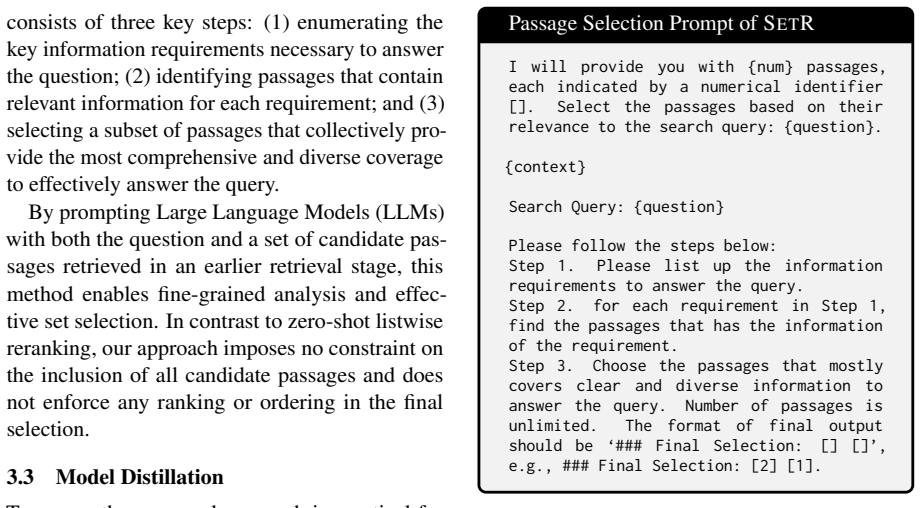
The central object is the information-requirement identification (IRI) prompt, a three-step Chain-of-Thought procedure that enumerates the information needs of the query, locates passages that address each need, and then selects the passages with the most comprehensive and diverse coverage. SETR is a supervised-fine-tuned Llama-3.1-8B-Instruct model that distills this reasoning from GPT-4o-generated selections over 40K training queries paired with top-20 candidate pools; the IRI step is what preserves intermediate reasoning steps and lets the model reject redundant or distractor passages rather than merely ordering them.
What would settle it
Take a set of multi-hop queries and construct candidate pools in which all gold-evidence passages are removed from the top-20 while distractors remain; if SETR still produces high answer accuracy, the central claim is unsupported, but if its accuracy falls to the retrieval-only baseline, the pool-dependence is confirmed.
Extended reading notes
Core claim
The paper's central claim is that set-wise passage selection, rather than relevance ranking, is the correct second-stage operation for RAG. SETR decomposes a query into explicit information requirements, maps candidate passages to those requirements, then selects the subset with maximal collective coverage; because the output is an unranked set with no fixed k, the method avoids both the redundancy of top-k retrieval and the information loss that occurs when multiple reasoning threads are collapsed into a single relevance score. With the first-stage retriever and the generator held fixed, SETR improves end-to-end EM, F1, and accuracy on HotpotQA, 2WikiMultiHopQA, MuSiQue, and MultiHopRAG, and improves precision and recall on MultiHopRAG, while using roughly half as many passages as standard reranking.
Load-bearing premise
The entire comparison assumes that the first-stage retriever's top-20 pool already contains the evidence needed to answer each multi-hop question; if a critical fact is missing from that pool, no set-selection strategy can recover it.
Editorial extensions
If this is right
- Replacing a reranker with SETR in a standard RAG pipeline can cut generator input tokens by about half while improving answer accuracy.
- Because selected-set size is not fixed, practitioners no longer need to tune the top-k value per task or corpus.
- SETR can be dropped into existing pipelines as a direct replacement for traditional rerankers, without changing the first-stage retriever or the generator.
- The explicit information-requirement list makes selection more interpretable: each chosen passage can be traced to a stated requirement of the query.
- On presence-based retrieval metrics, set selection improves precision and recall over rank-based baselines, indicating that coverage, not just ordering, is what drives downstream answer quality.
Reading between the lines
- Going beyond the paper, the same set-selection formulation should help single-hop RAG queries where top-k results often duplicate the same fact; one testable prediction is that SETR's advantage shrinks as query complexity decreases and duplication rises.
- The paper leaves implicit that a requirement with no supporting passage in the candidate pool is a useful failure signal: an iterative RAG system could use that signal to issue a targeted follow-up retrieval rather than guessing.
- Because selection is order-agnostic, the approach is naturally compatible with parallel selection over much larger candidate pools than the 20 passages used here; validating it at pool sizes of 100 or more would be a direct test of its scalability.
- Since the method is distilled from a teacher model's reasoning, its ceiling may track how reliably the teacher enumerates requirements; measuring selection quality as a function of requirement-list completeness would isolate this dependency.
Editorial analysis
A structured set of objections, weighed in public.
Referee Report
Summary. The paper proposes SETR, a fine-tuned Llama-3.1-8B-Instruct model that performs set-wise passage selection for retrieval-augmented generation. Unlike conventional rerankers that output a fixed top-k list, SETR uses Chain-of-Thought reasoning and explicit information requirement identification to select a variable-size set of passages that collectively cover the query's information needs. The method is trained by distillation from GPT-4o teacher labels on MS MARCO-derived data and evaluated on four multi-hop QA benchmarks (HotpotQA, 2WikiMultiHopQA, MuSiQue, MultiHopRAG) against BM25, dense retrievers, cross-encoder rerankers, and LLM-based listwise rerankers including RankGPT. The paper reports end-to-end QA improvements in EM/F1/Accuracy, higher precision and recall on MultiHopRAG, lower token usage, and two controlled comparisons (teacher upper bound and unified training setting) intended to isolate the effect of the set-selection formulation from model capacity and training data.
Significance. If the central claim is substantiated, SETR would be a practical and efficient alternative to traditional top-k reranking for multi-hop RAG, with the additional benefit of removing the need to manually choose k. The paper has notable strengths: it ships code and a reproducible recipe, includes controlled teacher-based and unified-setting experiments, reports token-level efficiency, and is explicit about the dependence on the first-stage retriever in the Limitations section. However, the headline comparison is confounded by the fact that all reranking baselines are fixed at k=5 while SETR selects roughly half as many passages on average. Because the ablations vary the reasoning component within the set-selection framework only, the paper does not yet isolate whether the gains come from set-level compositional reasoning or simply from adaptive truncation of noisy contexts. This is the central load-bearing issue for the paper's contribution claim.
major comments (3)
- [§4.2, Table 1; §5.2–5.3; Figure 3] All reranking baselines in Table 1 are evaluated with a fixed k=5 (the '# of Passages' column is 5.00 for every baseline), whereas SETR outputs a variable set averaging 2.48–3.41 passages across datasets. The reported gains over rerankers could therefore be explained by learned truncation rather than by set-wise compositional reasoning. The ablations SETR-Selection only, SETR-CoT, and SETR-CoT & IRI vary the reasoning component while holding the set-selection framework fixed, and the teacher upper-bound and unified-setting comparisons in Tables 3 and 4 similarly compare against rerankers that produce a fixed top-5 output. Figure 3 sweeps fixed k but does not implement a per-query adaptive-k reranker, and the average k of reranking curves at the reported operating points still differs from SETR's average selection size. To support the claim that set selection rather than adaptive truncation drives the gains, the authors should add a reranking control with per-query adaptive passage counts (e.g., score thresholding or a learned stopping criterion) matched to SETR's average count, or compare SETR against a reranker at the same per-query number of passages. Without such a control, the specific claim that selecting a set collectively—rather than choosing a better k—is responsible for the improvement is not yet established.
- [§4.3, Table 2; §5.1, Figure 3a] The presence-based metrics (Prec@5, Recall@5) and Hit@k are computed for SETR even though SETR selects, on average, fewer than five passages (e.g., 2.91 in the full model with bge-large-en-v1.5). The manuscript does not specify how a selected set of size smaller than the metric's k is treated: whether the denominator for precision is still 5, whether the selected set is padded with unselected candidates, or whether the metric is computed over the selected set only. This matters because such choices can systematically deflate or inflate precision and recall relative to reranking baselines, which always output exactly five passages. The authors should state the exact computation used for these metrics or, preferably, report set-based metrics (precision and recall over the selected set with the set size reported) alongside the rank-based metrics.
- [Table 1 and Table 3] The headline end-to-end results are reported without confidence intervals, standard deviations, or significance tests, and several differences are small relative to the likely noise in these benchmarks. For example, on 2WikiMultiHopQA the best EM difference over RankGPT is about 1.1–1.6 points in Table 1, and on MuSiQue the best F1 difference is about 2.2 points in Table 1; the MultiHopRAG Accuracy differences in Table 1 are even smaller (e.g., 47.14 vs. 45.69). Given that the paper's central claim is that SETR 'significantly outperforms' baselines, the authors should provide paired significance tests (e.g., bootstrap or paired t-test over questions) or at least multiple runs with standard deviations for the main comparisons. This is especially important because the proposed method varies the number of passages, which can affect variance in generation quality.
minor comments (4)
- [§4.1, Appendix A.3] MultiHopRAG uses gpt-4o-2024-08-06 as the generator while the other three benchmarks use Llama-3.1-8B-Instruct. The paper does state this in Appendix A.3, but the cross-benchmark comparisons in the abstract and introduction should be phrased carefully to avoid implying that all benchmarks use the same generator; the within-benchmark comparisons are fair, but the cross-benchmark aggregate pattern is a mix of two different generator configurations.
- [§1, Contributions] There is a typo in the third contribution: 'communty-driven' should be 'community-driven'. Other small typos include 'presense-based' in Table 2's caption area and 'Receprocal' in Appendix A.3; these should be corrected.
- [Figure 3] In Figures 3b, 3c, 3e, and 3f, the reranking curves are parameterized by a fixed maximum number of passages fed to the generator, but SETR's operating point is a single average count. Adding a marker that shows the corresponding reranker performance at the same average passage count (or annotating the variance of SETR's selection count) would make the comparison easier to interpret and would directly address the cardinality confound.
- [§2.2] The related work mentions Provence (Chirkova et al., 2025) for context pruning, but no context-pruning method is included as a baseline in the experiments. Since context pruning is closely related to selecting a variable-size subset, a comparison against a context-pruning method (or at least a discussion of why it is not applicable) would strengthen the positioning of SETR relative to existing work.
Circularity Check
No circular derivation: SETR's claims rest on external benchmarks and independent ablations, not on fitted inputs or self-citation chains.
full rationale
The paper's derivation chain is self-contained and externally anchored. SETR is distilled from GPT-4o teacher labels on MS MARCO-derived training queries, while all headline results are measured on held-out multi-hop benchmarks (HotpotQA, 2WikiMultiHopQA, MuSiQue, MultiHopRAG) that are not used for training. No fitted constant is renamed as a prediction: the reported passage counts are emergent outputs of the selection model, and the performance numbers come from answer generation and retrieval evaluation, not from reconstructing the training labels. The teacher upper bound in Table 3 and the unified-setting retraining in Table 4 explicitly control for model capacity, base model, and teacher supervision, which is the opposite of a circular reduction. The ablation variants are trained from the same data with different prompts, so the IRI contribution is empirical rather than definitional. The only near-confound, namely fixed-k=5 reranking baselines versus SETR's variable set size, is a comparison-design issue (no adaptive-k reranking control) rather than an equation-level equivalence or a fitted input called a prediction. The Limitations section acknowledges dependence on the initial retrieval stage, further separating the claim from any self-fulfilling construction. No load-bearing self-citation chain or imported uniqueness argument is present. Therefore no circular step meets the evidentiary bar of exhibiting a specific reduction to the paper's own inputs.
Assumptions & free parameters
free parameters (3)
- Candidate pool size K=20 =
20
- Average selected set size (emergent) =
2.63 to 3.41 across variants
- Fine-tuning hyperparameters =
5 epochs, lr=5e-6, batch size 512
assumptions (4)
- domain assumption The first-stage retriever returns a top-20 candidate pool that contains enough evidence to answer each query.
- domain assumption GPT-4o zero-shot selections used as teacher labels are sufficiently accurate to distill a high-quality student model.
- domain assumption Presence-based metrics (Precision/Recall) are more appropriate than rank-based metrics for evaluating set selection.
- domain assumption Evaluation benchmarks are external to the training data and not used to fit the method.
Cite this review
Pith. "Pith review of Shifting from Ranking to Set Selection for Retrieval Augmented Generation." pith.science (2026). https://pith.science/paper/S3626GCY
@misc{pith2026250706838,
  author       = {Pith},
  title        = {Pith review of: Shifting from Ranking to Set Selection for Retrieval Augmented Generation},
  year         = {2026},
  howpublished = {\url{https://pith.science/paper/S3626GCY}},
  note         = {Machine review of arXiv:2507.06838}
}
read the original abstract
Retrieval in Retrieval-Augmented Generation(RAG) must ensure that retrieved passages are not only individually relevant but also collectively form a comprehensive set. Existing approaches primarily rerank top-k passages based on their individual relevance, often failing to meet the information needs of complex queries in multi-hop question answering. In this work, we propose a set-wise passage selection approach and introduce SETR, which explicitly identifies the information requirements of a query through Chain-of-Thought reasoning and selects an optimal set of passages that collectively satisfy those requirements. Experiments on multi-hop RAG benchmarks show that SETR outperforms both proprietary LLM-based rerankers and open-source baselines in terms of answer correctness and retrieval quality, providing an effective and efficient alternative to traditional rerankers in RAG systems. The code is available at https://github.com/LGAI-Research/SetR
Figures


Figures from the paper (4 more)


Reference graph
Works this paper leans on
-
[4]
arXiv preprint arXiv:2501.16214
Provence: efficient and robust context pruning for retrieval-augmented generation. arXiv preprint arXiv:2501.16214. Nick Craswell, Bhaskar Mitra, Emine Yilmaz, and Daniel Campos
-
[7]
Don’t hallucinate, abstain: Identifying llm knowl- edge gaps via multi-llm collaboration. Preprint, arXiv:2402.00367. Kelvin Guu, Kenton Lee, Zora Tung, Panupong Pasu- pat, and Mingwei Chang
-
[8]
Why so gullible? enhancing the robustness of retrieval-augmented models against counterfactual noise. Preprint, arXiv:2305.01579. Lei Huang, Weijiang Yu, Weitao Ma, Weihong Zhong, Zhangyin Feng, Haotian Wang, Qianglong Chen, Weihua Peng, Xiaocheng Feng, Bing Qin, and Ting Liu
-
[9]
Adaptive-rag: Learning to adapt retrieval-augmented large lan- guage models through question complexity. Preprint, arXiv:2403.14403. Albert Q. Jiang, Alexandre Sablayrolles, Arthur Men- sch, Chris Bamford, Devendra Singh Chaplot, Diego de las Casas, Florian Bressand, Gianna Lengyel, Guil- laume Lample, Lucile Saulnier, Lélio Renard Lavaud, Marie-Anne Lach...
-
[10]
Mistral 7b. Preprint, arXiv:2310.06825. Vladimir Karpukhin, Barlas O˘guz, Sewon Min, Patrick Lewis, Ledell Wu, Sergey Edunov, Danqi Chen, and Wen-tau Yih
-
[11]
arXiv preprint arXiv:2004.04906
Dense passage retrieval for open-domain question answering. arXiv preprint arXiv:2004.04906. Patrick Lewis, Ethan Perez, Aleksandra Piktus, Fabio Petroni, Vladimir Karpukhin, Naman Goyal, Hein- rich Küttler, Mike Lewis, Wen tau Yih, Tim Rock- täschel, Sebastian Riedel, and Douwe Kiela
arXiv 2004
-
[12]
Retrieval-augmented generation for knowledge- intensive nlp tasks. Preprint, arXiv:2005.11401. Ilya Loshchilov and Frank Hutter
arXiv 2005
-
[14]
arXiv preprint arXiv:2411.00142
Judgerank: Lever- aging large language models for reasoning-intensive reranking. arXiv preprint arXiv:2411.00142. Rodrigo Nogueira and Kyunghyun Cho
Show all 35 references
-
[15]
arXiv preprint arXiv:1901.04085
Pas- sage re-ranking with bert. arXiv preprint arXiv:1901.04085. Ronak Pradeep, Sahel Sharifymoghaddam, and Jimmy Lin. 2023a. Rankvicuna: Zero-shot listwise doc- ument reranking with open-source large language models. Preprint, arXiv:2309.15088. Ronak Pradeep, Sahel Sharifymog...
1901 arXiv
-
[16]
arXiv preprint arXiv:2306.17563
Large language models are effective text rankers with pairwise rank- ing prompting. arXiv preprint arXiv:2306.17563. Ori Ram, Yoav Levine, Itay Dalmedigos, Dor Muhlgay, Amnon Shashua, Kevin Leyton-Brown, and Yoav Shoham
-
[17]
Preprint, arXiv:2302.00083
In-context retrieval-augmented lan- guage models. Preprint, arXiv:2302.00083. Stephen Robertson and Hugo Zaragoza
-
[18]
Preprint, arXiv:2401.18059
Raptor: Recursive abstractive processing for tree-organized retrieval. Preprint, arXiv:2401.18059. Zhihong Shao, Yeyun Gong, Yelong Shen, Minlie Huang, Nan Duan, and Weizhu Chen
-
[19]
Preprint, arXiv:2305.15294
En- hancing retrieval-augmented large language models with iterative retrieval-generation synergy. Preprint, arXiv:2305.15294. Freda Shi, Xinyun Chen, Kanishka Misra, Nathan Scales, David Dohan, Ed Chi, Nathanael Schärli, and Denny Zhou
-
[20]
Preprint, arXiv:2302.00093
Large language models can be easily distracted by irrelevant context. Preprint, arXiv:2302.00093. Weiwei Sun, Lingyong Yan, Xinyu Ma, Shuaiqiang Wang, Pengjie Ren, Zhumin Chen, Dawei Yin, and Zhaochun Ren
-
[21]
Preprint, arXiv:2304.09542
Is chatgpt good at search? investigating large language models as re-ranking agents. Preprint, arXiv:2304.09542. Yixuan Tang and Yi Yang
-
[22]
Preprint, arXiv:2401.15391
Multihop-rag: Bench- marking retrieval-augmented generation for multi- hop queries. Preprint, arXiv:2401.15391. Hugo Touvron et al
-
[23]
Preprint, arXiv:2307.09288
Llama 2: Open foun- dation and fine-tuned chat models. Preprint, arXiv:2307.09288. Harsh Trivedi, Niranjan Balasubramanian, Tushar Khot, and Ashish Sabharwal
-
[24]
Preprint, arXiv:2212.10509
Interleav- ing retrieval with chain-of-thought reasoning for knowledge-intensive multi-step questions. Preprint, arXiv:2212.10509. Lewis Tunstall, Edward Beeching, Nathan Lambert, Nazneen Rajani, Kashif Rasul, Younes Belkada, Shengyi Huang, Leandro von Werra, Clémentine Fourri...
-
[25]
Preprint, arXiv:2310.16944
Zephyr: Direct distillation of lm alignment. Preprint, arXiv:2310.16944. Hitesh Wadhwa, Rahul Seetharaman, Somyaa Aggar- wal, Reshmi Ghosh, Samyadeep Basu, Soundararajan Srinivasan, Wenlong Zhao, Shreyas Chaudhari, and Ehsan Aghazadeh
-
[26]
Preprint, arXiv:2406.12824
From rags to rich parame- ters: Probing how language models utilize external knowledge over parametric information for factual queries. Preprint, arXiv:2406.12824. Boxin Wang, Wei Ping, Peng Xu, Lawrence McAfee, Zihan Liu, Mohammad Shoeybi, Yi Dong, Oleksii Kuchaiev, Bo Li, Ch...
-
[27]
Preprint, arXiv:2304.06762
Shall we pretrain autoregressive language models with retrieval? a comprehensive study. Preprint, arXiv:2304.06762. Ziting Wang, Haitao Yuan, Wei Dong, Gao Cong, and Feifei Li
-
[28]
Preprint, arXiv:2411.00744
Corag: A cost-constrained retrieval optimization system for retrieval-augmented genera- tion. Preprint, arXiv:2411.00744. Jinyang Wu, Feihu Che, Chuyuan Zhang, Jianhua Tao, Shuai Zhang, and Pengpeng Shao. 2024a. Pandora’s box or aladdin’s lamp: A comprehensive analysis re- vea...
-
[29]
Preprint, arXiv:2309.07597
C-pack: Packaged resources to advance general chinese embedding. Preprint, arXiv:2309.07597. Zhilin Yang, Peng Qi, Saizheng Zhang, Yoshua Ben- gio, William W. Cohen, Ruslan Salakhutdinov, and Christopher D. Manning
-
[31]
arXiv preprint arXiv:2402.15838
Listt5: Listwise reranking with fusion-in-decoder improves zero-shot retrieval. arXiv preprint arXiv:2402.15838. Lianmin Zheng, Wei-Lin Chiang, Ying Sheng, Siyuan Zhuang, Zhanghao Wu, Yonghao Zhuang, Zi Lin, Zhuohan Li, Dacheng Li, Eric P. Xing, Hao Zhang, Joseph E. Gonzalez, ...
-
[32]
Preprint, arXiv:2306.05685
Judg- ing llm-as-a-judge with mt-bench and chatbot arena. Preprint, arXiv:2306.05685. Honglei Zhuang, Zhen Qin, Rolf Jagerman, Kai Hui, Ji Ma, Jing Lu, Jianmo Ni, Xuanhui Wang, and Michael Bendersky
-
[33]
Given a query and a can- didate passage, it outputs a score to reorder retrieved documents by their relevance
is a pointwise reranker based on LLaMA-2 7B model (Tou- vron et al., 2023). Given a query and a can- didate passage, it outputs a score to reorder retrieved documents by their relevance. It demonstrates strong performance in both in- domain and zero-shot settings, serving as a...
2023
-
[34]
It reframes reranking as a single- token decoding task, enabling fast and ef- ficient passage selection
is a zero-shot listwise reranker based on Mistral 7B (Jiang et al., 2023). It reframes reranking as a single- token decoding task, enabling fast and ef- ficient passage selection. Despite its sim- plicity, it achieves competitive performance and serves as a strong open-source ...
2023
-
[35]
Let’s think step by step
and employ gpt-4o-2024-08-06 as the generator due to its strong reasoning performance. Notably, even when provided with gold evidences, open-source models such as Llama2-70B and Mixtral-8x7B achieve rel- atively low accuracy (0.32 and 0.36, respectively), while GPT-4 attains a...
2024
-
[2018]
Preprint, arXiv:1809.09600
Hotpotqa: A dataset for diverse, explainable multi-hop question answer- ing. Preprint, arXiv:1809.09600. Soyoung Yoon, Eunbi Choi, Jiyeon Kim, Hyeongu Yun, Yireun Kim, and Seung-won Hwang
-
[2019]
Preprint, arXiv:1711.05101
De- coupled weight decay regularization. Preprint, arXiv:1711.05101. Xueguang Ma, Liang Wang, Nan Yang, Furu Wei, and Jimmy Lin
-
[2020]
Preprint, arXiv:2003.07820
Overview of the trec 2019 deep learning track. Preprint, arXiv:2003.07820. Shangbin Feng, Weijia Shi, Yike Wang, Wenxuan Ding, Vidhisha Balachandran, and Yulia Tsvetkov
2019 arXiv
-
[2021]
Preprint, arXiv:2102.07662
Overview of the trec 2020 deep learning track. Preprint, arXiv:2102.07662. Nick Craswell, Bhaskar Mitra, Emine Yilmaz, Daniel Campos, and Ellen M. V oorhees
2020 arXiv
-
[2023]
Preprint, arXiv:2310.11511
Self-rag: Learning to retrieve, generate, and critique through self-reflection. Preprint, arXiv:2310.11511. Zijian Chen, Ronak Pradeep, and Jimmy Lin
-
[2024]
Preprint, arXiv:2411.05508
An early first reproduction and improvements to single- token decoding for fast listwise reranking. Preprint, arXiv:2411.05508. Nadezhda Chirkova, Thibault Formal, Vassilina Nikoulina, and Stéphane Clinchant
-
[2025]
arXiv preprint arXiv:2502.02464
Rankify: A comprehensive python toolkit for re- trieval, re-ranking, and retrieval-augmented gener- ation. arXiv preprint arXiv:2502.02464. Akari Asai, Zeqiu Wu, Yizhong Wang, Avirup Sil, and Hannaneh Hajishirzi
Reviewed August 6, 2026 · model on record in the stance chip above.
Discussion (0). Sign in to comment.