REVIEW 2 major objections 6 minor 48 references
Electron Induced Massive Dynamics of Magnetic Domain Walls
T0 review · 2 major / 6 minor · reviewed 2026-08-14 · deepseek-v4-flash
Pith's one-line read This paper claims that conduction electrons give a magnetic domain wall in a metal a real inertial mass, present even in a perfectly clean wire.
desk verdict The Keldysh collective-coordinate formalism is genuinely useful, but the clean-system electron mass and zero-damping result rest on a wrong intraband matrix-element statement that a referee should catch. read the letter →
The pith
A machine-rendered reading of the paper's core claim, the machinery that carries it, and where it could break.
The reading
What carries the argument
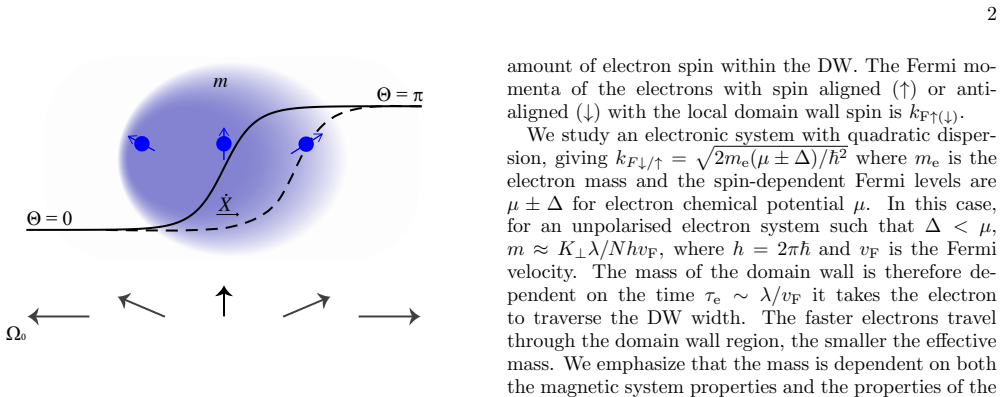
The central machinery is the Keldysh collective-coordinate technique combined with a spectral decomposition of the electron response kernel into a dissipative part $J_{ij}(\omega)$ and an inertial part $f_{ij}(\omega)$. For a static planar domain wall, the electron eigenstates are obtained in the adiabatic (WKB) limit, and the motion of the wall couples to the electrons through velocity-dependent perturbations $\dot{\chi}$ and $\dot{\phi}$. The inertial part $f_{ij}(\omega)$ is shown to have the form $f_{ii}(\omega) \approx 4\Delta \hbar^2 \omega^2 s / [(\hbar\omega)^2 - 4\Delta^2]$, which at low frequencies reduces to $-\hbar^2 \omega^2 s/\Delta$, exactly the Fourier transform of a second-derivative term in the equations of motion. This pole structure, arising from the constant interband energy difference $2\Delta$, is what converts electron dynamics into an effective domain wall mass.
What would settle it
A measurement of the ac spin-torque response of a single clean ferromagnetic nanowire with no pinning centers should show a resonance below the spin-band gap $2\Delta$ whose position follows Eq. (39); observing instead a flat, inertia-free response with no hysteresis in pulsed-current displacement experiments would refute the claim that conduction electrons alone give the domain wall a mass.
Extended reading notes
Core claim
The central claim is that conduction electrons induce a mass term in the equations of motion of a rigid planar domain wall in a metallic ferromagnet, even in a clean ballistic system. Starting from a Keldysh collective-coordinate action, the authors integrate out the electrons and obtain a response kernel whose low-frequency inertial part produces terms $M_{dw}\ddot{\phi}$ and $M_{dw}\ddot{\chi}$ in the coupled Langevin equations, with $M_{dw} = \hbar^2 s/\Delta$, where $s$ is the amount of electron spin inside the domain wall width and $\Delta$ is the electron–magnetization exchange coupling. The mass is nonzero for both collective coordinates even though the intrinsic bare mass is zero. The paper proves this by computing the response kernel for an adiabatic domain wall and showing that the interband scattering contribution has a pole at the electronic spin-gap $2\Delta$, so below that gap the dissipative spectral function vanishes and only the inertial term survives. The result is summarized in Eqs. (30a)-(30b), and the mass is estimated to be of order $m \approx K_\perp \lambda / N \hbar v_F$ in typical metallic nanowires.
Load-bearing premise
The central result assumes the two conduction-electron spin bands have identical parabolic dispersion with a momentum-independent exchange splitting $2\Delta$, so that the interband energy difference is exactly $2\Delta$ for every wavevector; if the bands have different effective masses or non-parabolic dispersion, the interband energy difference becomes k-dependent and the clean pole that produces the mass is replaced by a continuum.
Editorial extensions
If this is right
- A clean metallic domain wall without any pinning should show inertial dynamics, including delayed response to spin torque and continued motion after the driving current is removed.
- The domain wall position should exhibit a resonant peak in response to an ac current at a frequency set by the interplay of exchange splitting, anisotropy, and the number of spins in the wall, given approximately by Eq. (39).
- The domain wall equations of motion map, in a suitable limit, onto the resistively shunted Josephson junction model, implying that underdamped domain walls can show hysteresis with a retrapping torque $j_r \propto \alpha^{-1}\sqrt{2m}$ below the critical torque.
- The effective mass can be tuned by changing electronic properties such as the Fermi velocity, exchange splitting, or the amount of electron spin within the domain wall, suggesting a route to control inertia through material design.
- Because the dissipative electron response vanishes below the spin gap in this clean adiabatic model, any observed damping in clean metallic domain walls must come from other sources, such as disorder, phonons, or magnons.
Reading between the lines
- Beyond the paper, one could test the mass formula directly by measuring the ac response in a series of clean ferromagnetic nanowires with different Fermi velocities: the resonance frequency should scale inversely with the electron time-of-flight through the wall.
- Beyond the paper, the same Keldysh collective-coordinate approach likely applies to other magnetic textures such as skyrmions or vortices, where the relative motion between the texture and the conduction electrons could similarly produce an effective mass even without pinning.
- Beyond the paper, the assumption of identical parabolic bands could be relaxed in a numerical calculation: if the interband energy difference becomes k-dependent, the clean pole at $2\Delta$ is replaced by a continuum, which would turn the pure inertial response into a frequency-dependent mass with associated damping.
- Beyond the paper, the predicted hysteresis in domain wall motion could be used as a memory or logic element where the order of current pulses determines the distance traveled by the wall, similar to underdamped Josephson junction switching.
Signed reviews
Editorial analysis
A structured set of objections, weighed in public.
Referee Report
Summary. The paper develops a Keldysh collective-coordinate formalism for a rigid magnetic domain wall (DW) coupled to conduction electrons in a metallic ferromagnetic nanowire. The electrons are integrated out to yield a matrix response kernel and correlated two-component noise for the DW position and tilt-angle, leading to a generalized fluctuation-dissipation theorem. In the adiabatic limit of a wide DW, the inertial part of the kernel is evaluated with WKB eigenstates, giving a low-frequency coefficient f_ii(omega) ~ -hbar^2 omega^2 s/Delta and hence a mass M_dw = hbar^2 s/Delta for both collective coordinates. The paper then derives consequences of this mass: resonant response to ac current and hysteretic dynamics analogous to underdamped Josephson junctions. The central quantitative claim is that this electron-induced mass exists even in a clean system without pinning.
Significance. If the central result is correct, the paper provides a physical mechanism for intrinsic DW inertia in clean metallic ferromagnets, a concrete generalization of the fluctuation-dissipation theorem to matrix response kernels with correlated noise, and observable predictions (resonance at omega_m and a hysteresis threshold m_h). The general Keldysh framework in Sec. III, especially Eqs. (23)-(26), is a genuine strength: the derivation is standard and the generalized FDT follows from the Keldysh structure. The mass is a parameter-dependent prediction obtained from a stated microscopic model, not a fit, and the paper appropriately identifies it as a model result. However, the explicit evaluation of the inertial kernel in Appendix C contains a load-bearing approximation that is not correct for the phi channel, so the quantitative mass prediction and the zero-damping conclusion are not established as written.
major comments (2)
- [Appendix C, Eq. (C1), and Sec. IV (paragraph after Eq. (29))] The calculation excludes intraband terms by asserting that "the intraband matrix elements |iV^{σσ}_q|²≈δ(q), and therefore their contribution is zero." This is only true for the χ channel, whose matrix element contains ∂x of the spinor and vanishes by orthogonality. For the φ channel, Eq. (13b) gives φV^{σσ}_{kk'} = (ℏ/2)∫ dx e^{iqx} φ†_{σk} τ3 φ_{σk'}, and with the WKB states (B9) the diagonal expectation is ⟨φ_{σk}|τ3|φ_{σk}⟩ = ±tanh(ζx). The Fourier transform of tanh(ζx) is not δ(q); it is nonzero for all q and behaves as ~2i/q at small q. Consequently, intraband φ transitions contribute to J_φφ(ω) and f_φφ(ω) at low frequencies, with ℏω≈ℏv_F q. This contradicts the statements in Sec. IV that intraband scattering is "exactly zero in all cases" and that J_ij(ω)=0 below the electronic gap. Since the same dropped terms enter the low-frequency coefficient f_ii(ω)≈−ℏ²ω²s/Δ, the mass M_dw=ℏ²s/Δ in Eqs. (30a)-(30b), and hence the resonance and hysteresis predictions of Sec. VI, are not established by the calculation as presented. This is a load-bearing issue for the paper's central claim.
- [Sec. IV and Eq. (29)] The explicit low-frequency results for f_ii(ω) and the zero-damping conclusion assume that the two spin bands have identical parabolic dispersion with a momentum-independent exchange splitting 2Δ. If the bands have different effective masses or non-parabolic dispersion, the interband energy difference becomes k-dependent, the spectral function J_ij(ω) acquires a continuum below 2Δ, and both the damping and the mass coefficient are modified. The general Keldysh formalism of Sec. III is not affected, but the paper should state this model restriction explicitly and, ideally, assess whether the predicted mass survives in a more general band structure before claiming that the mass is present in clean metallic systems generally.
minor comments (6)
- [Sec. I] There is a typo: "disorderd systems" should read "disordered systems."
- [Eq. (1)] The mass parameter m appears in Eq. (1) before it is defined in Eq. (2); consider defining it earlier or referring forward explicitly.
- [Appendix C] The notation in the line "we assume that Kq∼kFq≪Δ" is unclear; it should be specified whether this means K·q, Kq/2, or another combination, and the approximation should be stated more carefully.
- [Sec. IV] The phrases "ℏω≲2Δ" and "ℏω<2Δ" are used interchangeably; the intended frequency range should be stated with a single convention.
- [Sec. IV] The statement that finite electron lifetime still gives exactly zero Ohmic damping is asserted without a derivation; even if true, it needs explicit support or a reference.
- [Sec. VI A and Fig. 2] The plot and the analytic formulas use f_ij(ω) from Eq. (29) for frequencies that may extend above the gap, where Eq. (29) has poles and the low-frequency approximation is uncontrolled; the range of validity used in Fig. 2 should be stated.
Circularity Check
No circularity: the electron-induced domain-wall mass is derived from the Keldysh response kernel and model parameters, not fitted or assumed.
full rationale
I walked the derivation chain from the model action through the Keldysh response kernel to the claimed mass. The response functions eta_ij(omega), J_ij(omega), and f_ij(omega) are derived from the electron action in Eqs. (23)-(26) and Appendix A, not postulated. The adiabatic WKB eigenstates in Eqs. (28) and Appendix B are supplied by an independent semiclassical method, and the mass M_dw = hbar^2 s/Delta follows from the low-frequency limit of the computed inertial kernel f_ii(omega) in Eq. (29a) and Appendix C. The introductory formula m = K_perp s/(2 Delta N) is a stated result that is later recovered from the equations of motion; this is normal organization, not a definitional loop. No parameter is fitted to the predicted mass, and no observable is used as an input to define the same observable. The self-citations in the paper, such as the use of soliton/Keldysh methods from prior work, are methodological and not load-bearing for the central mass claim. The paper's assertion that intraband matrix elements contribute zero, and the unshown check that a finite electron lifetime still gives zero damping, are technical gaps or potential correctness issues, but they are not cases where a result is equivalent to its inputs by construction. The central claim is therefore self-contained against the stated model assumptions.
Assumptions & free parameters
assumptions (5)
- domain assumption The domain wall is rigid: only the position X and tilt angle phi are dynamical degrees of freedom; all spin-wave deformations are neglected.
- domain assumption The electron spins adiabatically follow the static domain wall profile in the WKB approximation (zeta = lambda_F/lambda << 1).
- domain assumption The two spin bands have identical quadratic dispersion with a constant exchange splitting: epsilon_{sigma,k} = hbar^2 k^2/2m - mu +/- Delta.
- domain assumption The DW velocities are small enough for linear response: dchi/dt << v_F/lambda and dphi/dt << Delta.
- standard math Electrons are in thermal equilibrium and the noise is related to the response by the fluctuation-dissipation theorem.
Cite this review
Pith. "Pith review of Electron Induced Massive Dynamics of Magnetic Domain Walls." pith.science (2026). https://pith.science/paper/S3AUBLT4
@misc{pith2026190802299,
  author       = {Pith},
  title        = {Pith review of: Electron Induced Massive Dynamics of Magnetic Domain Walls},
  year         = {2026},
  howpublished = {\url{https://pith.science/paper/S3AUBLT4}},
  note         = {Machine review of arXiv:1908.02299}
}
read the original abstract
We study the dynamics of domain walls (DWs) in a metallic, ferromagnetic nanowire. We develop a Keldysh collective coordinate technique to describe the effect of conduction electrons on rigid magnetic structures. The effective Lagrangian and Langevin equations of motion for a DW are derived. The DW dynamics is described by two collective degrees of freedom: position and tilt-angle. The coupled Langevin equations therefore involve two correlated noise sources, leading to a generalized fluctuation-dissipation theorem (FDT). The DW response kernel due to electrons contains two parts: one related to dissipation via FDT, and another `inertial' part. We prove that the latter term leads to a mass for both degrees of freedom, even though the intrinsic bare mass is zero. The electron-induced mass is present even in a clean system without pinning or specifically engineered potentials. The resulting equations of motion contain rich dynamical solutions and point toward a new way to control domain wall motion in metals via the electronic system properties. We discuss two observable consequences of the mass, hysteresis in the DW dynamics and resonant response to ac current.
Figures


Reference graph
Works this paper leans on
-
[1]
M. Hayashi, L. Thomas, R. Moriya, C. Rettner, and S. S. Parkin, Science 320, 209 (2008)
work page 2008
-
[2]
S. S. Parkin, M. Hayashi, and L. Thomas, Science 320, 190 (2008)
work page 2008
-
[3]
H. Tanigawa, T. Koyama, G. Yamada, D. Chiba, S. Ka- sai, S. Fukami, T. Suzuki, N. Ohshima, N. Ishiwata, Y. Nakatani, and T. Ono, Appl. Phys. Expr. 2, 053002 (2009)
work page 2009
- [4]
- [5]
-
[6]
Catalan, J
G. Catalan, J. Seidel, R. Ramesh, and J. F. Scott, Rev. Mod. Phys. 84, 119 (2012)
2012
- [7]
-
[8]
M. Tsoi, R. Fontana, and S. Parkin, Appl. Phys. Lett. 83, 2617 (2003)
work page 2003
Show all 48 references
-
[9]
Yamanouchi, D
M. Yamanouchi, D. Chiba, F. Matsukura, and H. Ohno, Nature 428, 539 (2004)
2004
-
[10]
Berger, Journal of Applied Physics 55, 1954 (1984)
L. Berger, Journal of Applied Physics 55, 1954 (1984)
1984
-
[11]
Slonczewski, in AIP Conf
J. Slonczewski, in AIP Conf. Proc. , Vol. 5 (AIP, 1972) pp. 170–174
1972
-
[12]
Braun and D
H.-B. Braun and D. Loss, Phys. Rev. B 53, 3237 (1996)
1996
-
[13]
Tatara and H
G. Tatara and H. Kohno, Phys. Rev. Lett. 92, 086601 (2004)
2004
-
[14]
D¨ oring, Zeitschrift f¨ ur Naturforschung A 3, 373 (1948)
W. D¨ oring, Zeitschrift f¨ ur Naturforschung A 3, 373 (1948)
1948
-
[15]
Takagi and G
S. Takagi and G. Tatara, Phys. Rev. B 54, 9920 (1996)
1996
-
[16]
Braun and D
H.-B. Braun and D. Loss, J. of Appl. Phys. 76, 6177 (1994)
1994
-
[17]
Duine and C
R. Duine and C. M. Smith, Phys. Rev. B 77, 094434 (2008)
2008
-
[18]
Thomas, R
L. Thomas, R. Moriya, C. Rettner, and S. S. Parkin, Science 330, 1810 (2010)
2010
-
[19]
Saitoh, H
E. Saitoh, H. Miyajima, T. Yamaoka, and G. Tatara, Nature 432, 203 (2004)
2004
-
[20]
Duine, A
R. Duine, A. N´ u˜ nez, and A. MacDonald, Phys. Rev. Lett. 98, 056605 (2007)
2007
-
[21]
Jiang, P
W. Jiang, P. Upadhyaya, Y. Fan, J. Zhao, M. Wang, L.- T. Chang, M. Lang, K. L. Wong, M. Lewis, Y.-T. Lin, et al., Phys. Rev. Lett. 110, 177202 (2013)
2013
-
[22]
Sitte, K
M. Sitte, K. Everschor-Sitte, T. Valet, D. R. Rodrigues, J. Sinova, and A. Abanov, Phys. Rev. B. 94, 064422 (2016)
2016
-
[23]
Torrejon, E
J. Torrejon, E. Martinez, and M. Hayashi, Nat. Comms. 7, 13533 (2016)
2016
-
[24]
Domenichini, C
P. Domenichini, C. P. Quinteros, M. Granada, S. Collin, J.-M. George, J. Curiale, S. Bustingorry, M. G. Capeluto, and G. Pasquini, Phys. Rev. B 99, 214401 (2019)
2019
-
[25]
Vogel, M
J. Vogel, M. Bonfim, N. Rougemaille, O. Boulle, I. M. Miron, S. Auffret, B. Rodmacq, G. Gaudin, J. Cezar, F. Sirotti, et al., Phys. Rev. Lett. 108, 247202 (2012)
2012
-
[26]
Chauleau, R
J.-Y. Chauleau, R. Weil, A. Thiaville, and J. Miltat, Phys. Rev. B. 82, 214414 (2010). 14
2010
-
[27]
Barone and G
A. Barone and G. Paterno, Physics and applications of the Josephson effect (Wiley, 1982)
1982
-
[28]
T. T. Heikkil¨ a,The Physics of Nanoelectronics: Trans- port and Fluctuation Phenomena at Low Temperatures (Oxford University Press, 2013)
2013
-
[29]
Altland and B
A. Altland and B. D. Simons, Condensed matter field theory (Cambridge University Press, 2010)
2010
-
[30]
N. L. Schryer and L. R. Walker, J. Appl. Phys. 45, 5406 (1974)
1974
-
[31]
Tatara, H
G. Tatara, H. Kohno, and J. Shibata, Phys. Rep. 468, 213 (2008)
2008
-
[32]
Emori, U
S. Emori, U. Bauer, S.-M. Ahn, E. Martinez, and G. S. Beach, Nature Mat. 12, 611 (2013)
2013
-
[33]
Rajaraman, Solitons and instantons (North-Holland, 1987)
R. Rajaraman, Solitons and instantons (North-Holland, 1987)
1987
-
[34]
Kovrizhin, Phys
D. Kovrizhin, Phys. Lett. A 287, 392 (2001)
2001
-
[35]
D. K. Efimkin, J. Hofmann, and V. Galitski, Phys. Rev. Lett. 116, 225301 (2016)
2016
-
[36]
Psaroudaki, S
C. Psaroudaki, S. Hoffman, J. Klinovaja, and D. Loss, Phys. Rev. X 7, 041045 (2017)
2017
-
[37]
S. K. Kim, O. Tchernyshyov, V. Galitski, and Y. Tserkovnyak, Phys. Rev. B 97, 174433 (2018)
2018
-
[38]
Kamenev, Field theory of non-equilibrium systems (Cambridge University Press, 2011)
A. Kamenev, Field theory of non-equilibrium systems (Cambridge University Press, 2011)
2011
-
[39]
Caldeira and A
A. Caldeira and A. J. Leggett, Phys. Rev. A 31, 1059 (1985)
1985
-
[40]
R. G. Littlejohn and W. G. Flynn, Phys. Rev. A 44, 5239 (1991)
1991
-
[41]
Berger, Phys
L. Berger, Phys. Rev. B 33, 1572 (1986)
1986
-
[42]
Kopnin, JETP Lett
N. Kopnin, JETP Lett. 27 (1978)
1978
-
[43]
Nikoli´ c and S
P. Nikoli´ c and S. Sachdev, Physica C460, 256 (2007)
2007
-
[44]
D. J. Thouless and J. R. Anglin, Phys. Rev. Lett. 99, 105301 (2007)
2007
-
[45]
Simula, Phys
T. Simula, Phys. Rev. A 97, 023609 (2018)
2018
-
[46]
Ivanchenko and L
Y. Ivanchenko and L. Zil’Berman, Sov. Phys. JETP 28, 113 (1969)
1969
-
[47]
R. F. Voss and R. A. Webb, Phys. Rev. Lett. 47, 265 (1981)
1981
-
[48]
M. H. Devoret, J. M. Martinis, and J. Clarke, Phys. Rev. Lett. 55, 1908 (1985)
1985
Reviewed August 14, 2026 · model on record in the stance chip above.
Discussion (0). Continue with ORCID to comment.