REVIEW 3 major objections 5 minor 114 references
Effects of matter with anisotropic pressure on the Fan-Wang regular black hole shadows
T0 review · 3 major / 5 minor · reviewed 2026-08-15 · deepseek-v4-flash
Pith's one-line read Dressing a Fan-Wang regular black hole in a Kiselev-like anisotropic fluid with negative pressures enlarges its shadow and can create three horizons.
desk verdict Routine but careful shadow catalogue for Fan-Wang plus an anisotropic fluid; the headline EHT constraints are invalid because the cosmological horizon sits at ~10M, far inside Earth's distance. read the letter →
The pith
A machine-rendered reading of the paper's core claim, the machinery that carries it, and where it could break.
The reading
What carries the argument
The engine is the modified metric function $f(r) = 1 - \frac{2M r^2}{(r+l)^3} - \frac{a}{r^{3\omega+1}}$, built by superposing the Fan-Wang regular black hole (magnetic-charge parameter $l$) and the Kiselev anisotropic fluid (normalization $a$, constant equation-of-state parameter $\omega$). Null geodesics are governed by the effective potential $V_{\mathrm{eff}}(r) = (L^2/r^2) f(r)$. The photon sphere is located by $r f'(r) - 2 f(r) = 0$, the impact parameter is $b_{ph} = r_{ph}/\sqrt{f(r_{ph})}$, and the shadow angular diameter is $\Omega = 2b_{ph}/D$. These three relations carry the argument from the metric to the horizons, photosphere, accretion images, and EHT constraints.
What would settle it
Compute the Einstein tensor of the metric $f(r) = 1 - \frac{2M r^2}{(r+l)^3} - \frac{a}{r^{3\omega+1}}$ and compare it with the sum of the Fan-Wang and Kiselev energy-momentum tensors; any mismatch at any radius would show that the three-horizon and shadow numbers are not a general-relativistic prediction for this fluid. A simpler check is whether the combined fluid's radial and tangential pressures remain constant and equal to $\omega$ times the energy density everywhere.
Extended reading notes
Core claim
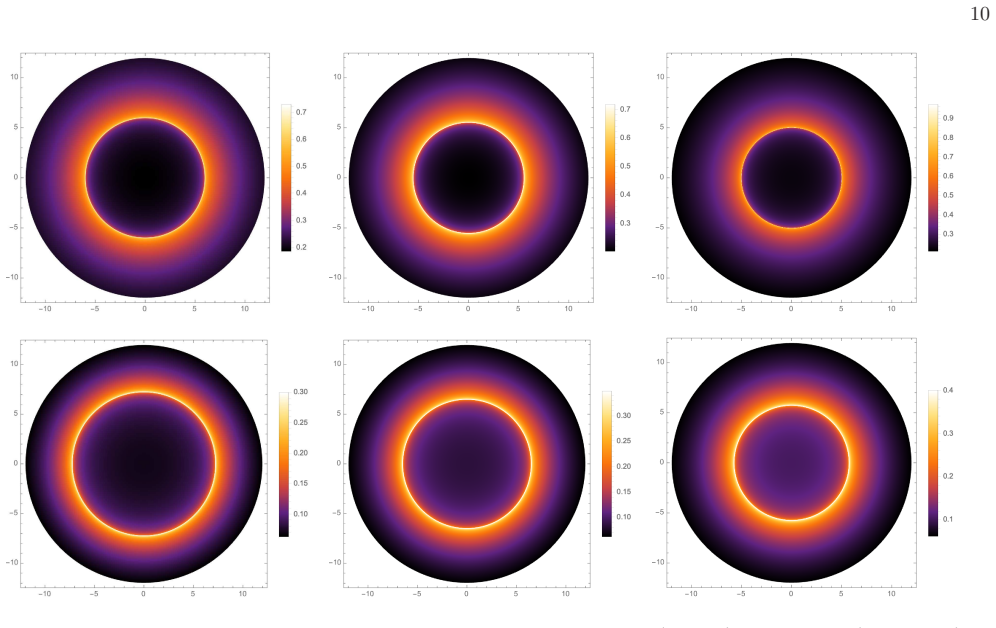
The central claim is that adding the Kiselev anisotropic-fluid term to the Fan-Wang regular black hole yields a valid spacetime whose observable null-geodesic features are calculable and measurably different. Concretely, with $M=1$, $a=0.05$, and $l=4/27$, the state parameter $\omega=-0.7$ produces three horizons and enlarges the event horizon by about 13%, the photon sphere by about 9%, and the shadow impact parameter by about 32% relative to the fluid-free Fan-Wang black hole. The shadow's angular diameter is then $\Omega = 2 b_{ph}/D$, and matching it to the EHT measurements for Sgr A* and M87* restricts $a$ to the intervals $0.090$-$0.103$ and $0.102$-$0.118$ at $\omega=-2/3$ for $l=8/27$. The paper also computes the specific intensity of the shadow for static and infalling spherical accretion and finds that the fluid raises the luminosity of the photon ring while leaving the overall shadow size only moderately changed.
Load-bearing premise
The paper assumes that simply adding the Kiselev anisotropic-fluid term $-a/r^{3\omega+1}$ to the Fan-Wang metric produces an exact solution of Einstein's equations; if that superposition is not a real solution, none of the derived horizons, photon spheres, or shadow sizes follow.
Editorial extensions
If this is right
- For $M=1$, $a=0.05$, and $\omega=-0.7$, the Fan-Wang black hole with $l=4/27$ acquires a cosmological horizon at $r_c\approx 13.19\,M$ in addition to the inner and event horizons, and $r_h$, $r_{ph}$, and $b_{ph}$ all exceed their fluid-free values.
- At $\omega=-2/3$ and $l=8/27$, the EHT angular diameters bound the fluid strength to $0.090 < a < 0.103$ for Sgr A* and $0.102 < a < 0.118$ for M87*.
- For fixed $\omega$, larger $l$ shrinks $r_h$, $r_{ph}$, and $b_{ph}$ and raises the peak intensity; for fixed $l$, more negative $\omega$ enlarges $r_h$ and $b_{ph}$ and pulls the cosmological horizon inward.
- In both static and infalling spherical accretion, the observed specific intensity peaks at the critical impact parameter $b=b_{ph}$; the infalling model gives lower peak intensities but preserves the ordering of shadow sizes and ring luminosities.
- The fluid's effect on the shadow is moderate in the representative case, so detecting it requires precision measurements rather than a qualitative change in the image.
Reading between the lines
- Beyond the paper, the same intensity formulas could be used to predict photon-ring brightness asymmetries for a non-spherical or tilted accretion flow, where the $\omega$ dependence of the peak at $b_{ph}$ would show up more sharply than in angular diameter alone.
- A natural extension is to map the allowed $(a,\omega)$ region for both EHT sources, since the paper reports bounds only at $\omega=-2/3$ but provides the machinery for any $\omega$ in $(-1,-1/3)$.
- If a future derivation shows the superposition is not an exact Einstein solution, the shadow formulas would still apply to any metric of that functional form, but the physical interpretation of $a$ and $\omega$ as a fluid's equation of state would need to be revised.
Signed reviews
Editorial analysis
A structured set of objections, weighed in public.
Referee Report
Summary. The paper studies the Fan-Wang regular black hole metric supplemented by a Kiselev-like anisotropic fluid term, writing f(r)=1-2Mr^2/(r+l)^3 - a/r^{3ω+1} with ω in (-1,-1/3). It computes the inner, event, and cosmological horizons, the photon sphere and impact parameter, and then models the shadow and photon ring under static and infalling spherical accretion, comparing angular diameters to EHT results for Sgr A* and M87*. The central claimed results are that the anisotropic fluid with negative pressure modifies the shadow size and brightness, and that EHT data constrain the parameter a (e.g., 0.090<a<0.103 for Sgr A* and 0.102<a<0.118 for M87* at ω=-2/3 and l=8/27).
Significance. If the model and its observer assumptions were valid, the paper would provide a useful extension of regular-black-hole shadow phenomenology to anisotropic equation-of-state matter, a topic of current interest. The geodesic and horizon calculations are standard, and the numerical tables appear internally consistent; the accretion-intensity machinery follows the common framework of Ref. [76]. However, the paper's main observational constraints are undermined by the presence of a cosmological horizon, and the stress-energy interpretation is not derived. The useful part of the paper is the metric-level dictionary between parameters (l,a,ω) and shadow features, which is independent of the EHT comparison.
major comments (3)
- [Section III, Eq. (19), Fig. 8] The EHT constraints are invalid as stated. For the parameters used (ω=-2/3, l=8/27, a≈0.09-0.118), the metric has a cosmological horizon at r_c≈1/a≈8-11 M. The Earth distances D=8.127 kpc and D=16.8 Mpc correspond to D/M≈4×10^10 and ≈6×10^10, so Earth is far outside r_c, where f(r)<0 and no static observer exists. Thus Eq. (19), which assumes an asymptotic static observer, cannot be applied. The paper itself says the observer is 'proximate to the cosmological horizon,' which is inconsistent with substituting terrestrial distances into Eq. (18). These ranges and Fig. 8 must be removed or recomputed with an observer at finite radius r_obs<r_c and the correct angular formula, e.g., sin α = b√f(r_obs)/r_obs.
- [Section II, Eq. (4)] The superposition ansatz f = f_Fan-Wang + f_Kiselev is not justified. The paper states that the metric function is derived by adding the Kiselev term, but it does not compute the Einstein tensor or the stress-energy tensor. Because the Einstein tensor is nonlinear in f, the total matter content is not the linear sum of the Fan-Wang and Kiselev sources; the claim that the surrounding fluid has constant radial and tangential equations of state is therefore unverified. For the combined metric one expects cross-terms, so the pressure anisotropy may not be of the asserted form. The authors should either derive T_μν for Eq. (4) and check p_r/ρ, p_t/ρ and the energy conditions, or explicitly frame the metric as a phenomenological ansatz and soften the physical interpretation accordingly.
- [Section IV, Eqs. (20)-(28), Figs. 9-12] The intensity and shadow images are computed without specifying the observer's radius. In a spacetime with a cosmological horizon at finite r_c, there is no asymptotic region, so 'distant observer' and the unbounded integrals in Eqs. (23) and (28) are not well-defined. The integration limits should depend on r_obs, and as r_obs approaches r_c the observed angular size and intensity profile change because f(r_obs)→0 suppresses the angular radius. Please state r_obs and the integration limits for each impact-parameter class (b<b_ph, b=b_ph, b>b_ph); otherwise the comparison of luminosities in Figs. 10 and 12 is ambiguous.
minor comments (5)
- [Abstract and Section I] The statement that negative pressures 'de facto violate the Zel'dovich limit' is incorrect: the Zel'dovich limit p ≤ ρ is satisfied by negative pressures. The relevant statement would be that the fluid violates the strong energy condition (ρ+3p<0 for ω<-1/3). This phrasing appears in the abstract and in Sections I and V.
- [Eq. (10a) and Section IV] The sign in ˙t = -E/f differs from the usual ˙t = E/f with E=-p_t; this is harmless where only E² enters, but the statement in Section IV that Eq. (10a) gives k^t=1/b is unclear and should be justified.
- [Throughout] The term 'photosphere' is used for the photon sphere; in astrophysics 'photosphere' denotes the visible surface of a star or accretion flow. Consider replacing it with 'photon sphere' or defining the intended meaning explicitly.
- [Section IV, Eqs. (23) and (28)] The emissivity normalization is dropped in Eqs. (23) and (28); the plotted intensities are thus in arbitrary units. Please state this explicitly and specify the proportionality constant.
- [Fig. 8] The left panel is reproduced from Ref. [76], but the caption does not state the source; the caption should include the reproduction credit.
Circularity Check
No significant circularity: the shadow, horizon, and intensity results follow directly from the explicit metric ansatz, and the cited prior work is not doing load-bearing circular work.
full rationale
The paper's central results are derived from an explicit metric ansatz, Eq. (4), f(r) = 1 - 2Mr^2/(r+l)^3 - a/r^(3w+1). The horizon radii follow from f(r)=0, the photon sphere from rf'(r)-2f(r)=0, the impact parameter from b_ph = r_ph/sqrt(f(r_ph)), and the shadow intensities from the standard geodesic redshift and proper-length integrals of Eqs. (20)-(28). These are direct consequences of the stated spacetime, not outputs of a fit that is later renamed a prediction. The EHT comparison in Fig. 8 is likewise a constraint procedure: with M, D, w, and l fixed, the angular-diameter relation Eq. (19) is inverted to bracket a, and the paper presents the resulting ranges as restrictions on a rather than as independent predictions. The paper does contain self-citations, notably [98] for the condition that Fan-Wang event horizons exist only for l <= 8/27, and [57, 61, 99] for related regular-black-hole and accretion contexts. However, the l <= 8/27 condition is a simple analytic property of the Fan-Wang lapse function and is not a uniqueness theorem or an unverified imported result; it is parameter-free and externally checkable, so it does not constitute load-bearing circularity. The weakest assumption in the paper, that the Kiselev anisotropic-fluid term can simply be added to the Fan-Wang lapse function to form a valid solution, is a physical-validity concern rather than a circularity concern: the paper does not derive the combined stress-energy tensor from a Lagrangian or verify the Einstein equations, but this is a correctness risk, not a reduction of the output to the input. For the same reason, the skeptical note about the observer distance and the cosmological horizon is an applicability concern for Eq. (19), not a circular step. Overall, the derivation chain is self-contained once the metric ansatz is accepted, and no prediction is equivalent to an input by construction.
Assumptions & free parameters
free parameters (3)
- a =
0.05 (main runs); EHT bounds 0.090-0.103 (Sgr A*) and 0.102-0.118 (M87*) for omega=-2/3
- omega =
-0.4, -0.5, -0.6, -0.7, -0.8 (scanned)
- l =
0, 2/27, 4/27, 6/27, 8/27 (scanned)
assumptions (3)
- domain assumption The Fan-Wang metric f(r) = 1 - 2M r^2/(r+l)^3 is a valid regular black hole solution.
- ad hoc to paper The total stress-energy tensor is the linear sum of the Fan-Wang source and the Kiselev anisotropic fluid, permitting f(r) = 1 - 2M r^2/(r+l)^3 - a/r^(3 omega + 1).
- domain assumption EHT angular-diameter measurements for Sgr A* and M87* can be interpreted through the static spherical accretion shadow model.
Cite this review
Pith. "Pith review of Effects of matter with anisotropic pressure on the Fan-Wang regular black hole shadows." pith.science (2026). https://pith.science/paper/S42HYCBN
@misc{pith2026250718787,
  author       = {Pith},
  title        = {Pith review of: Effects of matter with anisotropic pressure on the Fan-Wang regular black hole shadows},
  year         = {2026},
  howpublished = {\url{https://pith.science/paper/S42HYCBN}},
  note         = {Machine review of arXiv:2507.18787}
}
read the original abstract
We here investigate the consequences of an exotic fluid, exhibiting negative radial and tangential pressures, \emph{de facto} violating the Zel'dovich limit, on a regular solution that easily generalizes the Schwarzschild black hole. More precisely, we focus on the regular Fan-Wang spacetime, computing how the black hole shadow images, surrounded by the quoted fluid, is modified through the presence of \emph{negative} equations of state for the two pressure components. Even though quite different from quintessence, we consider constant radial and tangential equations of state with the aim of emulating, but not reproducing, dark energy effects. Moreover, we explore the main properties of infalling spherical accretion flows and, accordingly, the influence of the equations of state on the horizons, photosphere, and impact parameter of the Fan-Wang black hole. Afterwards, we examine the luminosities of the shadow and the photon ring in two distinct spherically accretion flows, as well as the observed specific intensity of the shadow itself. Last but not least, we physically interpret the impact of negative pressures on our findings and discuss possible extensions to the isotropic case.
Figures


Figures from the paper (9 more)




Reference graph
Works this paper leans on
-
[76]
Effect of quintessence dark energy on the shadow of Hayward black holes with spherical accretion
M. Heydari-Fard, Indian Journal of Physics 98, 3019 (2024), 2209.09103
work page Pith review arXiv 2024
-
[1]
B. P. Abbott and et al., Phys. Rev. Lett. 116, 061102 (2016), 1602.03837
arXiv 2016
-
[2]
B. P. Abbott and et al., Phys. Rev. Lett. 116, 241103 (2016), 1606.04855
arXiv 2016
-
[3]
B. P. Abbott and et al., Phys. Rev. Lett. 119, 161101 (2017), 1710.05832
arXiv 2017
-
[4]
R. Abbott and et al., Phys. Rev. D 102, 043015 (2020), 2004.08342
arXiv 2020
-
[5]
R. Abbott and et al., Astrophys. J. Lett. 915, L5 (2021), 2106.15163
arXiv 2021
-
[7]
Event Horizon Telescope Collaboration, Astrophys. J. Lett. 875, L2 (2019), 1906.11239
arXiv 2019
-
[8]
Event Horizon Telescope Collaboration, Astrophys. J. Lett. 875, L3 (2019), 1906.11240
arXiv 2019
Show all 114 references
-
[9]
Event Horizon Telescope Collaboration, Astrophys. J. Lett. 875, L4 (2019), 1906.11241
2019 arXiv
-
[10]
Event Horizon Telescope Collaboration, Astrophys. J. Lett. 875, L5 (2019), 1906.11242
2019 arXiv
-
[11]
Event Horizon Telescope Collaboration, Astrophys. J. Lett. 875, L6 (2019), 1906.11243
2019 arXiv
-
[12]
R. M. Wald, ed., General relativity (1984)
1984
-
[13]
Penrose, Phys
R. Penrose, Phys. Rev. Lett. 14, 57 (1965)
1965
-
[14]
S. W. Hawking and R. Penrose, Proceedings of the Royal Society of London Series A 314, 529 (1970)
1970
-
[15]
Carballo-Rubio, F
R. Carballo-Rubio, F. Di Filippo, S. Liberati, C. Pacil io, and M. Visser, Journal of High Energy Physics 2018, 23 (2018), 1805.02675
2018 arXiv
-
[16]
Bonanno, A.-P
A. Bonanno, A.-P. Khosravi, and F. Saueressig, Phys. Rev. D 103, 124027 (2021), 2010.04226
2021 arXiv
- [17]
-
[18]
Y. Guo, C. Lan, and Y.-G. Miao, Phys. Rev. D 106, 124052 (2022)
2022
- [19]
-
[20]
Sharif and H
M. Sharif and H. Saba Nawaz, Chinese Journal of Physics 67, 193 (2020)
2020
-
[21]
Wei, Entropy 20, 192 (2018)
Y.-H. Wei, Entropy 20, 192 (2018)
2018
-
[22]
Huang, H.-W
B.-H. Huang, H.-W. Hu, and L. Zhao, arXiv e-prints arXiv:2311.12286 (2023), 2311.12286
2023 arXiv
- [23]
-
[24]
Bouhmadi-L´ opez, C.-Y
M. Bouhmadi-L´ opez, C.-Y. Chen, X. Y. Chew, Y. C. Ong, and D.-h. Yeom, European Physical Journal C 81, 278 (2021), 2005.13260
2021 arXiv
-
[25]
Abdujabbarov, M
A. Abdujabbarov, M. Amir, B. Ahmedov, and S. G. Ghosh, Phys. Rev. D 93, 104004 (2016), 1604.03809
2016 arXiv
-
[26]
Sharif and S
M. Sharif and S. Iftikhar, European Physical Journal C 76, 630 (2016), 1611.00611
2016 arXiv
-
[27]
P. V. P. Cunha, C. A. R. Herdeiro, B. Kleihaus, J. Kunz, and E. Radu, Physics Letters B 768, 373 (2017), 1701.00079
2017 arXiv
-
[28]
M. Amir, B. P. Singh, and S. G. Ghosh, European Phys- ical Journal C 78, 399 (2018), 1707.09521
2018 arXiv
-
[29]
B. P. Singh and S. G. Ghosh, Annals of Physics 395, 127 (2018), 1707.07125
2018 arXiv
-
[30]
A. Saha, S. M. Modumudi, and S. Gangopadhyay, General Relativity and Gravitation 50, 103 (2018), 1802.03276
2018 arXiv
-
[31]
Ayzenberg and N
D. Ayzenberg and N. Yunes, Classical and Quantum Gravity 35, 235002 (2018), 1807.08422
2018 arXiv
-
[32]
X. Hou, Z. Xu, and J. Wang, Journal of Cosmology and Astroparticle Physics 2018, 040 (2018), 1810.06381
2018 arXiv
-
[33]
Shaikh, P
R. Shaikh, P. Kocherlakota, R. Narayan, and P. S. Joshi, Mon. Not. Roy. Astr. Soc. 482, 52 (2019), 1802.08060
2019 arXiv
-
[34]
Haroon, M
S. Haroon, M. Jamil, K. Jusufi, K. Lin, and R. B. Mann, Phys. Rev. D 99, 044015 (2019), 1810.04103
2019 arXiv
-
[35]
S. E. Gralla, D. E. Holz, and R. M. Wald, Phys. Rev. D 100, 024018 (2019), 1906.00873
2019 arXiv
-
[36]
R. A. Konoplya, Physics Letters B 795, 1 (2019), 1905.00064
2019 arXiv
-
[37]
Jusufi, M
K. Jusufi, M. Jamil, and T. Zhu, European Physical Journal C 80, 354 (2020), 2005.05299
2020 arXiv
- [38]
-
[39]
Li and K.-J
G.-P. Li and K.-J. He, Journal of Cosmology and As- troparticle Physics 2021, 037 (2021), 2105.08521
2021 arXiv
-
[40]
Afrin, R
M. Afrin, R. Kumar, and S. G. Ghosh, Mon. Not. Roy. Astr. Soc. 504, 5927 (2021), 2103.11417
2021 arXiv
-
[41]
J. Peng, M. Guo, and X.-H. Feng, Chinese Physics C 45, 085103 (2021), 2008.00657
2021 arXiv
-
[42]
K.-J. He, S. Guo, S.-C. Tan, and G.-P. Li, Chinese Physics C 46, 085106 (2022), 2103.13664
2022 arXiv
-
[43]
S. V. M. C. B. Xavier, H. C. D. Lima Junior, and L. C. B. Crispino, Phys. Rev. D 107, 064040 (2023), 2303.17666
2023 arXiv
-
[44]
Lambiase, R
G. Lambiase, R. C. Pantig, and A. ¨Ovg¨ un, EPL (Euro- physics Letters) 148, 49001 (2024), 2408.09620
2024 arXiv
-
[45]
Zheng, M.-Q
H.-B. Zheng, M.-Q. Wu, G.-P. Li, and Q.-Q. Jiang, Eu- ropean Physical Journal C 85, 46 (2025), 2411.10315
2025 arXiv
-
[46]
C.-Y. Yang, M. Israr Aslam, X.-X. Zeng, and R. Saleem, Journal of High Energy Astrophysics 46, 100345 (2025), 2411.11807
2025 arXiv
-
[47]
D. Li, Y. Zuo, S. Hu, C. Deng, Y. Wang, and W. Cao, arXiv e-prints arXiv:2504.04102 (2025), 2504.04102
2025 arXiv
-
[48]
Stuchl ´ ık and J
Z. Stuchl ´ ık and J. Schee, European Physical Journal C 79, 44 (2019)
2019
- [49]
- [50]
-
[52]
S. G. Ghosh, M. Amir, and S. D. Maharaj, Nuclear Physics B 957, 115088 (2020), 2006.07570
2020 arXiv
-
[53]
Ahmed, D
F. Ahmed, D. V. Singh, and S. G. Ghosh, General Rel- ativity and Gravitation 54, 21 (2022), 2002.12031
2022 arXiv
-
[54]
Li and C
Z. Li and C. Bambi, Journal of Cosmology and As- troparticle Physics 2014, 041 (2014), 1309.1606
2014 arXiv
-
[55]
Capozziello, S
S. Capozziello, S. Gambino, and O. Luongo, Physics of the Dark Universe 48, 101950 (2025), 2503.21987
2025 arXiv
-
[56]
Khoshrangbaf, A
M. Khoshrangbaf, A. R. Akbarieh, K. Atazadeh, and H. Motavalli, New Astronomy 117, 102354 (2025)
2025
-
[57]
Kurmanov, T
Y. Kurmanov, T. Konysbayev, G. Suliyeva, G. Ikhsan, N. Saiyp, G. Rabigulova, and A. Urazalina, Inter- national Journal of Mathematics and Physics 15, 57 (2024), doi:10.26577/ijmph.2024v15i1a7
2024 doi
-
[58]
Li, European Physical Journal C 85, 514 (2025), 2412.08447
Z. Li, European Physical Journal C 85, 514 (2025), 2412.08447
2025 arXiv
-
[59]
A. R. Akbarieh, M. Khoshragbaf, and M. Atazadeh, International Journal of Geometric Methods in Modern Physics 22, 2450323-59 (2025), 2302.02784
2025 arXiv
-
[60]
W. Zeng, Y. Ling, Q.-Q. Jiang, and G.-P. Li, arXiv e- prints arXiv:2308.00976 (2023), 2308.00976
2023 arXiv
-
[61]
Boshkayev, T
K. Boshkayev, T. Konysbayev, Y. Kurmanov, O. Lu- ongo, M. Muccino, A. Taukenova, and A. Urazalina, Eu- ropean Physical Journal C 84, 230 (2024), 2307.15003
2024 arXiv
-
[62]
Guo, Y.-X
S. Guo, Y.-X. Huang, Y.-H. Cui, Y. Han, Q.-Q. Jiang, E.-W. Liang, and K. Lin, European Physical Journal C 83, 1059 (2023), 2310.20523
2023 arXiv
-
[63]
Narzilloev, A
B. Narzilloev, A. Abdujabbarov, and A. Hakimov, In- ternational Journal of Modern Physics A 37, 2250144 (2022)
2022
-
[64]
De Martino, R
I. De Martino, R. Della Monica, and D. Rubiera-Garcia, Phys. Rev. D 108, 124054 (2023), 2310.11039
2023 arXiv
-
[66]
Corona, R
D. Corona, R. Giamb` o, and O. Luongo, Int. J. Geom. Meth. Mod. Phys. 21, 2440019 (2024), 2402.18997
2024 arXiv
-
[67]
Giamb` o and O
R. Giamb` o and O. Luongo, Class. Quant. Grav. 41, 125005 (2024), 2308.10060
2024 arXiv
-
[68]
A. G. Riess and et al., Astrophys. J. 116, 1009 (1998), astro-ph/9805201
1998 arXiv
-
[69]
Perlmutter and et al., Astrophys
S. Perlmutter and et al., Astrophys. J. 517, 565 (1999), astro-ph/9812133
1999 arXiv
-
[70]
Carloni, O
Y. Carloni, O. Luongo, and M. Muccino, Phys. Rev. D 111, 023512 (2025), 2404.12068
2025 arXiv
-
[71]
A. C. Alfano, O. Luongo, and M. Muccino, JCAP 12, 055 (2024), 2408.02536
2024 arXiv
- [72]
-
[73]
A. C. Alfano, O. Luongo, and M. Muccino, JHEAp 46, 100348 (2025), 2411.04878
2025 arXiv
-
[74]
P. J. E. Peebles and B. Ratra, Astrophys. J. Lett. 325, L17 (1988)
1988
-
[75]
R. R. Caldwell, R. Dave, and P. J. Steinhardt, Phys. Rev. Lett. 80, 1582 (1998), astro-ph/9708069
1998 arXiv
-
[77]
Malligawad, S
M. Malligawad, S. K. Narasimhamurthy, and Z. Nek- ouee, Physics Letters B 856, 138963 (2024)
2024
-
[78]
M. M. Gohain, K. Bhuyan, R. Borgohain, T. Gogoi, K. Bhuyan, and P. Phukon, arXiv e-prints arXiv:2412.06252 (2024), 2412.06252
2024
-
[79]
Mondal, T
D. Mondal, T. Roy, and U. Debnath, Nuclear Physics B 1014, 116859 (2025)
2025
-
[80]
Ahmed, S
F. Ahmed, S. U. Islam, and S. G. Ghosh, Journal of High Energy Astrophysics 46, 100350 (2025)
2025
-
[81]
B. R. Yashwanth, S. K. Narasimhamurthy, Z. Nekouee, and M. Malligawad, European Physical Journal C 84, 1276 (2024)
2024
-
[82]
C. Sun, Y. Liu, W.-L. Qian, and R. Yue, Chinese Physics C 46, 065103 (2022), 2201.01890
2022 arXiv
-
[83]
Carloni, O
Y. Carloni, O. Luongo, and M. Muccino (2025), 2506.11531
2025
-
[84]
P. K. S. Dunsby, O. Luongo, and M. Muccino, Phys. Rev. D 109, 023510 (2024), 2308.15776
2024 arXiv
-
[85]
P. K. S. Dunsby, O. Luongo, and L. Reverberi, Phys. Rev. D 94, 083525 (2016), 1604.06908
2016 arXiv
-
[86]
Li, X.-D
M. Li, X.-D. Li, S. Wang, and Y. Wang, Commun. Theor. Phys. 56, 525 (2011), 1103.5870
2011 arXiv
-
[87]
Capozziello, R
S. Capozziello, R. D’Agostino, and O. Luongo, Int. J. Mod. Phys. D 28, 1930016 (2019), 1904.01427
2019 arXiv
- [88]
-
[89]
Belfiglio, Y
A. Belfiglio, Y. Carloni, and O. Luongo, Phys. Dark Univ. 44, 101458 (2024), 2307.04739
2024 arXiv
-
[90]
E. J. Copeland, M. Sami, and S. Tsujikawa, Int. J. Mod. Phys. D 15, 1753 (2006), hep-th/0603057
2006 arXiv
- [91]
-
[92]
quintessence
a terminological error was made, the described effect was incorrectly called “quintessence” and, accordingly, Kiselev solution cannot be identified either with an ideal fluid or with quintessence in its classical cosmological un- derstanding as a scalar field with a timelike gradi...
-
[93]
V. V. Kiselev, Classical and Quantum Gravity 20, 1187 (2003), gr-qc/0210040
2003 arXiv
-
[94]
V. V. Kiselev, arXiv e-prints gr-qc/0303031 (2003), gr - qc/0303031
2003 arXiv
-
[95]
Visser, Classical and Quantum Gravity 37, 045001 (2020), 1908.11058
M. Visser, Classical and Quantum Gravity 37, 045001 (2020), 1908.11058
2020 arXiv
- [97]
-
[98]
Maeda, Journal of High Energy Physics 2022, 108 (2022), 2107.04791
H. Maeda, Journal of High Energy Physics 2022, 108 (2022), 2107.04791
2022 arXiv
-
[99]
Kurmanov, K
Y. Kurmanov, K. Boshkayev, T. Konysbayev, O. Lu- ongo, N. Saiyp, A. Urazalina, G. Ikhsan, and G. Suliyeva, Physics of the Dark Universe 46, 101566 (2024), 2404.15437
2024 arXiv
-
[100]
Suliyeva, K
G. Suliyeva, K. Boshkayev, T. Konysbayev, Y. Kur- manov, O. Luongo, M. Muccino, H. Quevedo, A. Uraza- lina, F. Belissarova, and A. Dalelkhankyzy, Chinese Journal of Physics 96, 1065 (2025), 2503.18380
2025 arXiv
-
[101]
Cvetiˇ c, G
M. Cvetiˇ c, G. W. Gibbons, and C. N. Pope, Phys. Rev. D 94, 106005 (2016), 1608.02202
2016 arXiv
-
[102]
Fernando, General Relativity and Gravitation 44, 1857 (2012), 1202.1502
S. Fernando, General Relativity and Gravitation 44, 1857 (2012), 1202.1502
2012 arXiv
-
[103]
Ghaderi, Astrophysics and Space Science 362, 218 (2017)
K. Ghaderi, Astrophysics and Space Science 362, 218 (2017)
2017
-
[104]
Javed, J
W. Javed, J. Abbas, and A. ¨Ovg¨ un, Annals of Physics 418, 168183 (2020), 2007.16027
2020 arXiv
- [105]
-
[106]
Akiyama et al
K. Akiyama et al. (Event Horizon Telescope), Astro- phys. J. Lett. 875, L1 (2019), 1906.11238
2019 arXiv
-
[107]
Akiyama et al
K. Akiyama et al. (Event Horizon Telescope), Astro- phys. J. Lett. 930, L12 (2022)
2022
-
[108]
Jaroszynski and A
M. Jaroszynski and A. Kurpiewski, Astron. Astrophys. 326, 419 (1997), astro-ph/9705044
1997 arXiv
- [109]
-
[110]
Al-Badawi, F
A. Al-Badawi, F. Ahmed, and I. Sakalli, arXiv e-prints arXiv:2504.00332 (2025), 2504.00332
2025 arXiv
-
[111]
Dariescu and V
M. Dariescu and V. Lungu, European Physical Journal 14 Plus 140, 476 (2025)
2025
-
[112]
M. H. Macˆ edo, J. Furtado, and R. R. Landim, arXiv e-prints arXiv:2507.03701 (2025), 2507.03701
2025
-
[113]
M. C. Ara´ ujo, J. G. Lima, C. R. Muniz, and J. Furtado, arXiv e-prints arXiv:2507.07372 (2025), 2507.07372
2025 arXiv
-
[114]
Al-Badawi, F
A. Al-Badawi, F. Ahmed, T. Xamidov, S. Shaymatov, and I. Sakalli, arXiv e-prints arXiv:2503.18027 (2025), 2503.18027
2025 arXiv
-
[115]
H.-L. Li, M. Zhang, and Y.-M. Huang, European Phys- ical Journal C 84, 860 (2024)
2024
-
[116]
Y. Liu, G. Mustafa, S. K. Maurya, G. D. A. Yildiz, and E. G¨ udekli, Physics of the Dark Universe 42, 101311 (2023)
2023
-
[117]
R. Wang, F. Gao, and J. Liu, Results in Physics 58, 107499 (2024)
2024
-
[118]
Hamil and B
B. Hamil and B. C. L¨ utf¨ uo˘ glu, Physics of the Dark Uni- verse 42, 101293 (2023), 2305.07123
2023 arXiv
Reviewed August 15, 2026 · model on record in the stance chip above.
Discussion (0). Continue with ORCID to comment.