Fast Radio Burst Cosmology: Hubble Tension and Dark Energy
Pith reviewed 2026-06-26 10:13 UTC · model grok-4.3
The pith
Fast radio bursts measure the Hubble constant independently at low redshifts via their dispersion measure to redshift relation and constrain dark energy parameters.
A machine-rendered reading of the paper's core claim, the machinery that carries it, and where it could break.
Core claim
Localized FRBs supply a precise dispersion measure-redshift relation that models the intergalactic medium electron density tightly enough to deliver independent low-redshift H0 values competitive with other probes and to constrain dark energy equation-of-state parameters, while current samples already demonstrate this utility and future surveys will deliver more stringent limits on cosmic acceleration.
What carries the argument
The dispersion measure-redshift relation of FRBs, which integrates free-electron density through the intergalactic medium to provide a direct distance tracer independent of luminosity or angular size.
If this is right
- Current localized and non-localized FRB samples already yield competitive constraints on H0.
- FRBs act as effective tracers for the dark energy equation-of-state parameters.
- Uncertainties in Galactic and host-galaxy electron density models plus IGM inhomogeneities remain the main precision limiters.
- Rapid growth in high-precision surveys and localized samples will produce stringent limits on late-time acceleration, dark energy evolution, and cosmic baryons.
Where Pith is reading between the lines
- If FRB-derived H0 values converge on the local ladder result while disagreeing with CMB inferences, the method could help isolate whether the Hubble tension arises from early- or late-universe physics.
- FRB sightlines could map the spatial distribution of baryons in the IGM on large scales once electron-density models improve.
- Combining FRB data with supernova or BAO measurements in joint analyses might break degeneracies in dark energy models that single probes cannot resolve.
Load-bearing premise
Uncertainties in Galactic and host galaxy electron density models and intergalactic medium inhomogeneities can be controlled sufficiently for high-precision cosmological constraints.
What would settle it
A catalog of hundreds of localized FRBs that produces an H0 value discrepant at several sigma from both local distance-ladder and CMB-inferred values while the same sample fails to improve dark energy constraints beyond current supernova or BAO bounds.
Figures
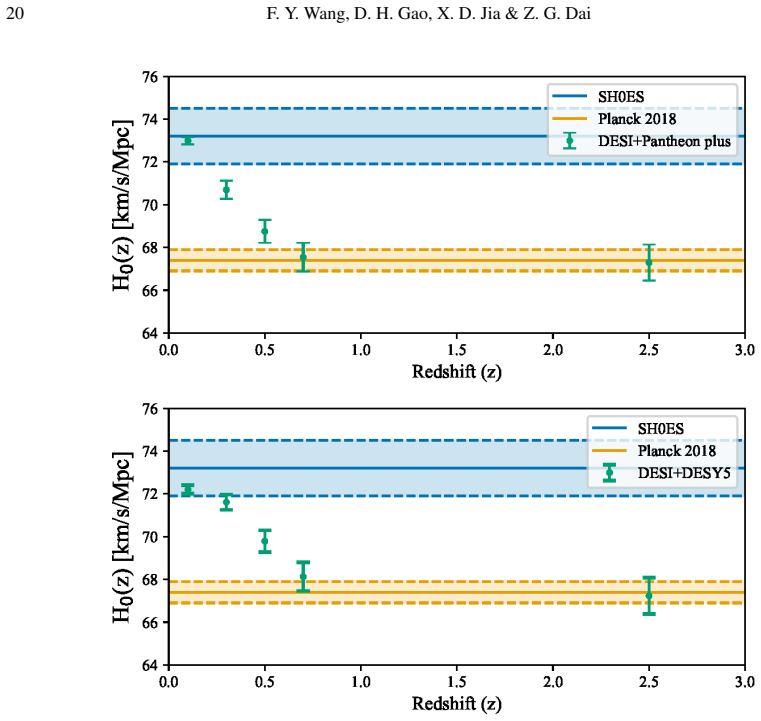
read the original abstract
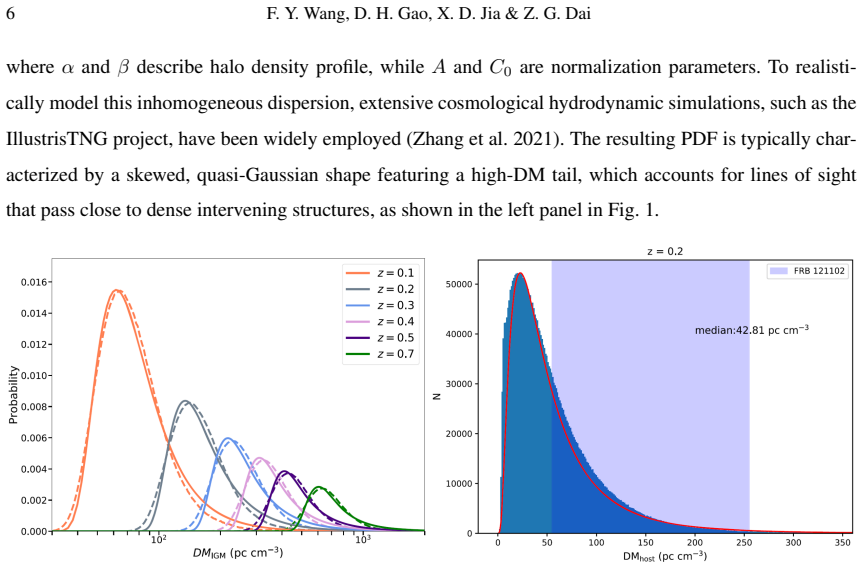
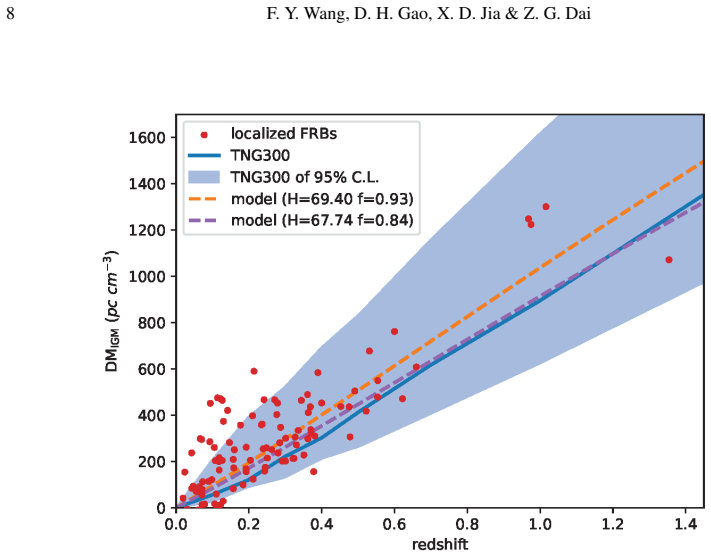
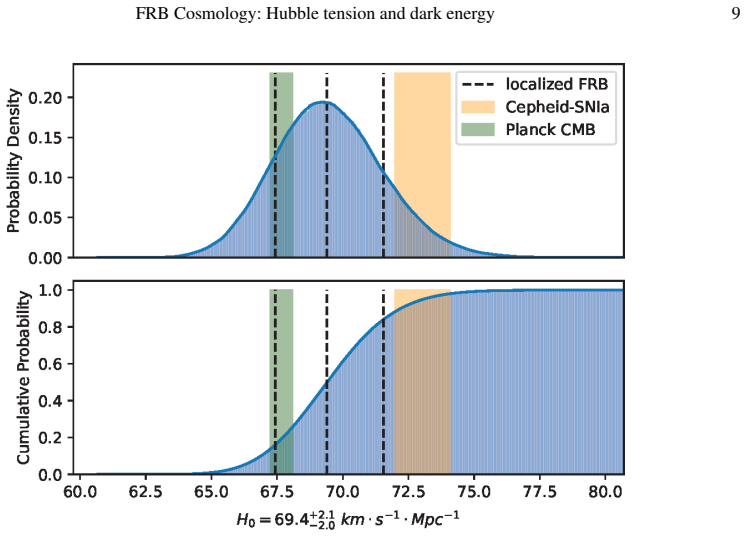
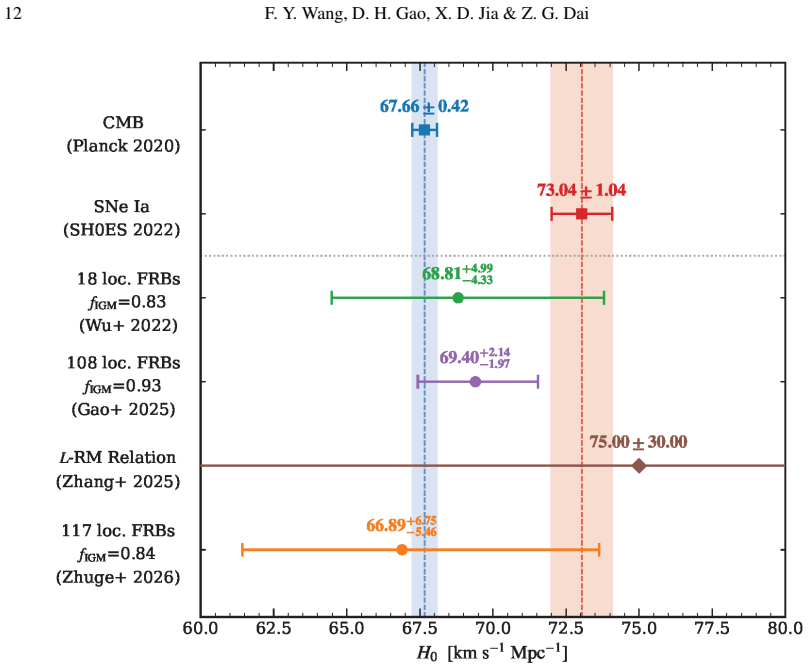
Fast radio bursts (FRBs) are luminous, millisecond-duration extragalactic radio transients that have emerged as a powerful, complementary cosmological probe for investigating the late-time cosmic evolution, offering unique advantages over conventional probes such as Type Ia supernovae, baryon acoustic oscillations, and cosmic microwave background radiation. This review systematically summarizes the cosmological applications of FRBs, focusing on their critical roles in measuring the Hubble constant ($H_0$) and constraining dark energy properties. Benefiting from the precise dispersion measure (DM) - redshift relation of localized FRBs, the integrated electron density of the intergalactic medium (IGM) along the line of sight can be tightly modeled, enabling independent and low-redshift measurements of the cosmic expansion rate. Current FRB samples consisting of localized and non-localized events provide competitive $H_0$ constraints, offering an independent method to measure $H_0$. FRBs also serve as effective tracers to constrain dark energy equation-of-state parameters. We comprehensively discuss key limiting factors for FRB cosmological precision, including uncertainties in Galactic and host galaxy electron density models, and IGM inhomogeneities. With the rapid growth of high-precision FRB surveys and localized FRB samples, FRBs are promising to provide stringent constraints on late-time cosmic acceleration, dark energy evolution and cosmic baryons.
Editorial analysis
A structured set of objections, weighed in public.
Referee Report
Summary. This review summarizes the cosmological applications of fast radio bursts (FRBs), emphasizing their use via the dispersion measure (DM)-redshift relation to obtain independent low-redshift H0 measurements and to constrain dark energy equation-of-state parameters. It states that current localized and non-localized FRB samples already yield competitive H0 constraints, positions FRBs as effective tracers for dark energy, identifies key systematics (Galactic/host electron density models and IGM inhomogeneities), and argues that future high-precision surveys will deliver stringent constraints on late-time acceleration and cosmic baryons.
Significance. If the cited literature is represented accurately and comprehensively, the manuscript provides a useful compilation of FRB cosmology results that highlights their complementary strengths relative to SN Ia, BAO, and CMB probes. The explicit identification of dominant systematics in the abstract and throughout is a strength, as is the forward-looking discussion of survey prospects. No new derivations or fits are introduced, so the paper's value lies in synthesis rather than novel claims.
minor comments (2)
- [Abstract] The abstract refers to 'current FRB samples' providing 'competitive H0 constraints' without quoting specific numerical values or citing the particular analyses (e.g., which localized sample yields what H0 uncertainty); adding one or two representative numbers would improve immediate readability.
- [Introduction] Section headings and the overall structure are not visible in the provided excerpt, but the transition from H0 discussion to dark-energy constraints to systematics would benefit from an explicit roadmap paragraph at the end of the introduction.
Simulated Author's Rebuttal
We thank the referee for their positive assessment of the manuscript and for recommending acceptance. No major comments were raised in the report.
Circularity Check
Review paper; no derivations or fits introduced by authors
full rationale
The manuscript is explicitly a review that summarizes external literature on FRB applications to cosmology. Its strongest claims rest on cited prior analyses of localized FRB samples for H0 and dark-energy constraints. No new equations, parameter fits, or modeling assumptions are derived within the paper itself. The abstract and structure flag systematics (Galactic/host DM, IGM inhomogeneity) as external limiting factors without introducing author-defined quantities that are then re-used as predictions. No self-citation chain, ansatz smuggling, or renaming of results occurs. The work is therefore self-contained against external benchmarks and exhibits no circularity.
Axiom & Free-Parameter Ledger
Reference graph
Works this paper leans on
-
[1]
2025, Physical Review D, 112, 083515 3, 13
Abdul Karim, M., Aguilar, J., Ahlen, S., et al. 2025, Physical Review D, 112, 083515 3, 13
2025
-
[2]
K., & Beniamini, P
Acharya, S. K., & Beniamini, P. 2025, Journal of Cosmology and Astroparticle Physics, 2025, 073 9
2025
-
[3]
G., Aguilar, J., Ahlen, S., et al
Adame, A. G., Aguilar, J., Ahlen, S., et al. 2025, Journal of Cosmology and Astroparticle Physics, 2025, 021 3, 13
2025
-
[4]
2023, Science, 380, 599 13
Anna-Thomas, R., Connor, L., Dai, S., et al. 2023, Science, 380, 599 13
2023
-
[5]
2026, Scientia Sinica Physica, Mechanica & Astronomica, 56, 239601 9
Bao, W., Yang, L., & JunJie, W. 2026, Scientia Sinica Physica, Mechanica & Astronomica, 56, 239601 9
2026
-
[6]
2021, Universe, 7, 85 4, 10
Bhandari, S., & Flynn, C. 2021, Universe, 7, 85 4, 10
2021
-
[7]
Y ., et al
Bhardwaj, M., Michilli, D., Kirichenko, A. Y ., et al. 2024, ApJ, 971, L51 7
2024
-
[8]
Bhattacharya, M., Kumar, P., & Linder, E. V . 2021, Phys. Rev. D, 103, 103526 4
2021
-
[9]
2025, Astronomy and Astrophysics, 695, L12 7
Bruni, G., Piro, L., Yang, Y .-P., et al. 2025, Astronomy and Astrophysics, 695, L12 7
2025
-
[10]
2025, MNRAS, 537, L61 11
Chang, C., Zhang, S., Xiao, D., et al. 2025, MNRAS, 537, L61 11
2025
-
[11]
J., Wharton, R
Chatterjee, S., Law, C. J., Wharton, R. S., et al. 2017, Nature, 541, 58 3, 7
2017
-
[12]
H., Jia, X
Chen, J. H., Jia, X. D., Dong, X. F., & Wang, F. Y . 2024, ApJ, 973, L54 14 CHIME Collaboration, Amiri, M., Bandura, K., et al. 2022, The Astrophysical Journal Supplement Series, 261, 29 3 CHIME/FRB Collaboration, Amiri, M., Andersen, B. C., et al. 2021, ApJS, 257, 59 3, 10 Chime/Frb Collaboration, Andersen, B. C., Bandura, K., et al. 2023, ApJ, 947, 83 4...
2024
-
[13]
2023, MNRAS, 521, 4024 11
Connor, L., & Ravi, V . 2023, MNRAS, 521, 4024 11
2023
-
[14]
2025, Nature Astronomy, 9, 1226–1239 4, 7, 10
Connor, L., Ravi, V ., Sharma, K., et al. 2025, Nature Astronomy, 9, 1226–1239 4, 7, 10
2025
-
[15]
Cordes, J. M., & Lazio, T. J. W. 2002, arXiv e-prints, astroph/0207156 5
-
[16]
2022, Journal of Astronomical Telescopes, Instruments, and Systems, 8, 011019 19
Crichton, D., Aich, M., Amara, A., et al. 2022, Journal of Astronomical Telescopes, Instruments, and Systems, 8, 011019 19
2022
-
[17]
2026, Phys
Dai, X., Yang, Y ., Wang, Y ., et al. 2026, Phys. Rev. D, 113, 063514 15
2026
-
[18]
G., De Simone, B
Dainotti, M. G., De Simone, B. D., Schiavone, T., et al. 2022, Galaxies, 10, 24 15
2022
-
[19]
G., De Simone, B., Schiavone, T., et al
Dainotti, M. G., De Simone, B., Schiavone, T., et al. 2021, The Astrophysical Journal, 912, 150 15
2021
-
[20]
2014, ApJ, 783, L35 5 DES Collaboration, Abbott, T
Deng, W., & Zhang, B. 2014, ApJ, 783, L35 5 DES Collaboration, Abbott, T. M. C., Acevedo, M., et al. 2024, ApJ, 973, L14 14 Di Valentino, E., Said, J. L., Riess, A., Pollo, A., & Poulin, G. 2025, Physics of the Dark Universe, 49, 101965 13, 14 Di Valentino, E., Mena, O., Pan, S., et al. 2021, Classical and Quantum Gravity, 38, 153001 13, 14
2014
-
[21]
2017, ApJ, 846, L27 19 22 F
Fialkov, A., & Loeb, A. 2017, ApJ, 846, L27 19 22 F. Y . Wang, D. H. Gao, X. D. Jia & Z. G. Dai
2017
-
[22]
Fortunato, J. A. S., Bacon, D. J., Hip ´olito-Ricaldi, W. S., & Wands, D. 2025, Journal of Cosmology and Astroparticle Physics, 2025, 018 10
2025
- [23]
-
[24]
2014, ApJ, 788, 189 13, 14
Gao, H., Li, Z., & Zhang, B. 2014, ApJ, 788, 189 13, 14
2014
-
[25]
2022, MNRAS, 516, 1977 11
Gao, R., Li, Z., & Gao, H. 2022, MNRAS, 516, 1977 11
2022
-
[26]
Giar`e, W., Najafi, M., Pan, S., Di Valentino, E., & Firouzjaee, J. T. 2024, J. Cosmol. Astropart. Phys., 2024, 035 13 G´omez-Valent, A., & Amendola, L. 2018, Journal of Cosmology and Astroparticle Physics, 2018, 051 17
2024
-
[27]
Hackstein, S., Br ¨uggen, M., Vazza, F., & Rodrigues, L. F. S. 2020, Monthly Notices of the Royal Astronomical Society, 498, 4811 10
2020
-
[28]
2022, MNRAS, 511, 662 4, 7, 9
Hagstotz, S., Reischke, R., & Lilow, R. 2022, MNRAS, 511, 662 4, 7, 9
2022
-
[29]
2019, Bulletin of the AAS, 51, https://baas.aas.org/pub/2020n7i255 19
Hallinan, G., Ravi, V ., Weinreb, S., et al. 2019, Bulletin of the AAS, 51, https://baas.aas.org/pub/2020n7i255 19
2019
-
[30]
W., Qiu, H., et al
Hoffmann, J., James, C. W., Qiu, H., et al. 2024, Monthly Notices of the Royal Astronomical Society, 528, 1583 10
2024
-
[31]
Horstmann, N., Pietschke, Y ., & Schwarz, D. J. 2022, Astronomy & Astrophysics, 668, A34 15
2022
-
[32]
W., Bunton, J
Hotan, A. W., Bunton, J. D., Chippendale, A. P., et al. 2021, Publications of the Astronomical Society of Australia, 38, e009 3
2021
-
[33]
P., Jia, X
Hu, J. P., Jia, X. D., Gao, D. H., et al. 2025, MNRAS, 542, 1063 13
2025
-
[34]
P., & Wang, F
Hu, J. P., & Wang, F. Y . 2022, Monthly Notices of the Royal Astronomical Society, 517, 576 18
2022
-
[35]
2023, Universe, 9, 94 9, 13
Hu, J.-P., & Wang, F.-Y . 2023, Universe, 9, 94 9, 13
2023
-
[36]
P., Wang, F
Hu, J. P., Wang, F. Y ., & Dai, Z. G. 2021, Monthly Notices of the Royal Astronomical Society, 507, 730 18
2021
-
[37]
2005, Physical Review D, 71, 023506 15, 16
Huterer, D., & Cooray, A. 2005, Physical Review D, 71, 023506 15, 16
2005
-
[38]
L., Drout, M
Ibik, A. L., Drout, M. R., Gaensler, B. M., et al. 2024, ApJ, 961, 99 7
2024
-
[39]
2004, Monthly Notices of the Royal Astronomical Society, 348, 999 5
Inoue, S. 2004, Monthly Notices of the Royal Astronomical Society, 348, 999 5
2004
-
[40]
2003, The Astrophysical Journal, 598, L79 5
Ioka, K. 2003, The Astrophysical Journal, 598, L79 5
2003
-
[41]
N., & Spitler, L
Jahns-Schindler, J. N., & Spitler, L. G. 2025, Physical Review D, 112, 103541 9
2025
-
[42]
W., Ghosh, E
James, C. W., Ghosh, E. M., Prochaska, J. X., et al. 2022, MNRAS, 516, 4862 4, 7, 9
2022
-
[43]
D., Gao, D
Jia, X. D., Gao, D. H., Chen, J. H., et al. 2026, ApJ, 1003, 179 14
2026
-
[44]
D., Hu, J
Jia, X. D., Hu, J. P., & Wang, F. Y . 2023, Astronomy & Astrophysics, 674, A45 15, 17
2023
-
[45]
2025, Phys
Kalita, S., Bhatporia, S., & Weltman, A. 2025, Phys. Dark Univ., 48, 101926 4, 7
2025
-
[46]
2026, ApJ, 996, 50 10, 19 FRB Cosmology: Hubble tension and dark energy 23
Kalita, S., Uniyal, A., Bulik, T., & Mizuno, Y . 2026, ApJ, 996, 50 10, 19 FRB Cosmology: Hubble tension and dark energy 23
2026
-
[47]
F., Stappers, B
Keane, E. F., Stappers, B. W., Kramer, M., & Lyne, A. G. 2012, MNRAS, 425, L71 3
2012
-
[48]
C., & Pen, U.-L
Keating, L. C., & Pen, U.-L. 2020, MNRAS, 496, L106 5
2020
-
[49]
´O., Ruchika, Sen, A
Krishnan, C., Colg ´ain, E. ´O., Ruchika, Sen, A. A., Sheikh-Jabbari, M. M., & Yang, T. 2020, Physical Review D, 102, 103525 15
2020
-
[50]
M., & Yang, T
Krishnan, C., ´O Colg´ain, E., Sheikh-Jabbari, M. M., & Yang, T. 2021, Physical Review D, 103, 103509 15, 18
2021
-
[51]
Krochek, K., & Kovetz, E. D. 2022, Physical Review D, 105, 103528 11
2022
-
[52]
Kumar, P., & Linder, E. V . 2019, Phys. Rev. D, 100, 083533 12
2019
-
[53]
2020, Phys
Laha, R. 2020, Phys. Rev. D, 102, 023016 4
2020
-
[54]
J., Sharma, K., Ravi, V ., et al
Law, C. J., Sharma, K., Ravi, V ., et al. 2024, The Astrophysical Journal, 967, 29 3
2024
- [55]
-
[56]
W., et al
Li, D., Wang, P., Zhu, W. W., et al. 2021, Nature, 598, 267 4
2021
-
[57]
B., Yang, Y
Li, Y ., Zhang, S. B., Yang, Y . P., et al. 2026, Science, 391, 280 4
2026
-
[58]
2018, Nature Communications, 9, 3833 11
Li, Z.-X., Gao, H., Ding, X.-H., Wang, G.-J., & Zhang, B. 2018, Nature Communications, 9, 3833 11
2018
-
[59]
E., & Linder, E
Liao, K., Shafieloo, A., Keeley, R. E., & Linder, E. V . 2019, The Astrophysical Journal Letters, 886, L23 17
2019
-
[60]
E., & Linder, E
Liao, K., Shafieloo, A., Keeley, R. E., & Linder, E. V . 2020, The Astrophysical Journal Letters, 895, L29 17
2020
-
[61]
2023, MNRAS, 520, 1324 4
Lin, H.-N., Tang, L., & Zou, R. 2023, MNRAS, 520, 1324 4
2023
-
[62]
2023, MNRAS, 520, 6237 4, 7
Lin, H.-N., & Zou, R. 2023, MNRAS, 520, 6237 4, 7
2023
-
[63]
Linder, E. V . 2003, Phys. Rev. Lett., 90, 091301 13
2003
-
[64]
2025, Phys
Ling, J.-L., Du, G.-H., Li, T.-N., et al. 2025, Phys. Rev. D, 112, 083528 13
2025
-
[65]
Dispersion Measure Distribution of Unlocalized Fast Radio Bursts as a Probe of the Hubble Constant
Liu, Y ., Wei, J.-J., Wu, P., & Wu, X.-F. 2026, arXiv e-prints, arXiv:2604.03769 10
work page internal anchor Pith review Pith/arXiv arXiv 2026
-
[66]
2023, ApJ, 946, L49 7, 9
Liu, Y ., Yu, H., & Wu, P. 2023, ApJ, 946, L49 7, 9
2023
-
[67]
R., Bailes, M., McLaughlin, M
Lorimer, D. R., Bailes, M., McLaughlin, M. A., Narkevic, D. J., & Crawford, F. 2007, Science, 318, 777 3
2007
-
[68]
J., Men, Y
Luo, R., Wang, B. J., Men, Y . P., et al. 2020, Nature, 586, 693 4
2020
-
[69]
P., Prochaska, J
Macquart, J. P., Prochaska, J. X., McQuinn, M., et al. 2020, Nature, 581, 391 4, 5, 7, 9
2020
-
[70]
2025, Monthly Notices of the Royal Astronomical Society, 536, 3232 19
Mazurenko, S., Banik, I., & Kroupa, P. 2025, Monthly Notices of the Royal Astronomical Society, 536, 3232 19
2025
-
[71]
2014, ApJ, 780, L33 5
McQuinn, M. 2014, ApJ, 780, L33 5
2014
-
[72]
2020, Astronomy & Astrophysics, 639, A101 14, 15 Mu˜noz, J
Millon, M., Galan, A., Courbin, F., et al. 2020, Astronomy & Astrophysics, 639, A101 14, 15 Mu˜noz, J. B., Kovetz, E. D., Dai, L., & Kamionkowski, M. 2016, Phys. Rev. Lett., 117, 091301 4, 11
2020
-
[73]
Najafi, M., Pan, S., Di Valentino, E., & Firouzjaee, J. T. 2024, Physics of the Dark Universe, 45, 101539 13
2024
-
[74]
2022, Nature, 606, 873 7 ´O Colg ´ain, E., Dainotti, M
Niu, C.-H., Aggarwal, K., Li, D., et al. 2022, Nature, 606, 873 7 ´O Colg ´ain, E., Dainotti, M. G., Capozziello, S., et al. 2026, Journal of High Energy Astrophysics, 49, 100428 13 ´O Colg´ain, E. ´O., & Sheikh-Jabbari, M. M. 2025, MNRAS, 542, L24 13 ´O Colg´ain, E., Sheikh-Jabbari, M. M., Solomon, R., et al. 2022, Physical Review D, 106, L041301 15
2022
-
[75]
K., & Cordes, J
Ocker, S. K., & Cordes, J. M. 2026, ApJ, 1002, 3 5 24 F. Y . Wang, D. H. Gao, X. D. Jia & Z. G. Dai
2026
-
[76]
2025, Phys
Pang, Y .-H., Zhang, X., & Huang, Q.-G. 2025, Phys. Rev. D, 111, 123504 13
2025
-
[77]
Park, C.-G., P´erez, J. d. C., & Ratra, B. 2024, Phys. Rev. D, 110, 123533 13
2024
-
[78]
2025, International Journal of Modern Physics D, 34, 2550061 13
Park, C.-G., & Ratra, B. 2025, International Journal of Modern Physics D, 34, 2550061 13
2025
-
[79]
2022, New Astronomy Reviews, 95, 101659 14
Perivolaropoulos, L., & Skara, F. 2022, New Astronomy Reviews, 95, 101659 14
2022
-
[80]
Petroff, E., Hessels, J. W. T., & Lorimer, D. R. 2022, A&A Rev., 30, 2 4, 19
2022
discussion (0)
Sign in with ORCID, Apple, or X to comment. Anyone can read and Pith papers without signing in.