Recognition: no theorem link
Dispersion Measure Distribution of Unlocalized Fast Radio Bursts as a Probe of the Hubble Constant
Pith reviewed 2026-05-13 17:08 UTC · model grok-4.3
The pith
Unlocalized fast radio bursts constrain the Hubble constant to 73.8 km s^{-1} Mpc^{-1} from their dispersion measure distribution alone.
A machine-rendered reading of the paper's core claim, the machinery that carries it, and where it could break.
Core claim
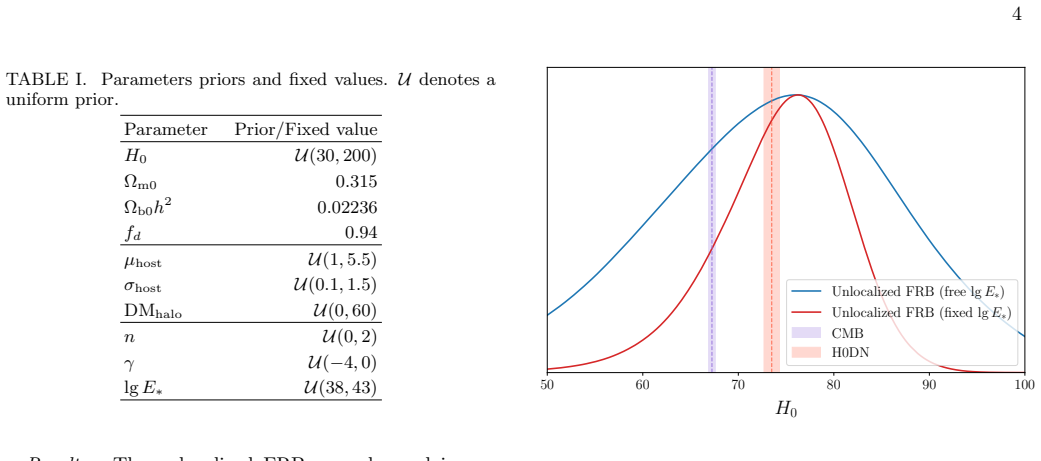
Analyzing a selected sample of 2124 unlocalized FRBs from the CHIME Catalog II, we obtain H0 = 73.8^{+14.0}_{-12.3} km s^{-1} Mpc^{-1} at the 1σ confidence level. Cosmic expansion imprints itself on the DM distribution of these bursts even without redshift information, allowing an independent constraint on H0. Breaking the degeneracy between H0 and the characteristic cutoff energy E* of the FRB isotropic energy distribution would reduce the uncertainty to 9 percent. This constitutes the first H0 measurement derived solely from the DM distribution of unlocalized FRBs and highlights their potential as a new cosmological probe.
What carries the argument
The modeled distribution of observed dispersion measures for unlocalized FRBs, whose shape depends on H0 through the relation between luminosity distance and DM, jointly fitted with the cutoff energy E* of the isotropic energy function.
If this is right
- Unlocalized FRBs supply an independent H0 measurement that does not rely on host-galaxy redshifts or precise localizations.
- The present 18 percent uncertainty shrinks to 9 percent once the degeneracy with the energy cutoff E* is broken.
- Joint analyses that combine the DM distribution of unlocalized events with the redshifts of localized FRBs can produce tighter overall constraints.
- The method opens a statistical route to cosmology that scales with the rapidly growing number of detected but unlocalized bursts.
Where Pith is reading between the lines
- If future surveys independently pin down the FRB energy distribution, this technique could become a fully standalone cosmological probe competitive with existing H0 methods.
- The same DM-distribution framework could be extended to constrain additional parameters such as the dark-energy equation of state once sample sizes grow by another factor of a few.
- Discrepancies between this H0 value and those from the distance ladder or CMB would point either to new physics or to unmodeled contributions to the DM that vary with redshift.
Load-bearing premise
The isotropic energy distribution of FRBs is assumed to take a specific functional form with a single characteristic cutoff energy E* that can be treated as separable from the cosmological effect of H0.
What would settle it
A high-precision measurement of the DM distribution shape from a much larger unlocalized sample that cannot be reproduced by the model for any combination of H0 and E* within the reported uncertainties.
Figures

read the original abstract
We present constraints on the Hubble constant ($H_0$) derived from the observed dispersion measure (DM) distribution of unlocalized fast radio bursts (FRBs). While localized FRBs with redshift measurements have been used to investigate the Hubble tension, their sample remains limited. Here we demonstrate that unlocalized FRBs -- which are far more numerous -- can independently constrain $H_0$ without requiring redshift information, as cosmic expansion imprints itself on their DM distribution. Analyzing a selected sample of 2124 unlocalized FRBs from the CHIME Catalog II, we obtain $H_0 = 73.8^{+14.0}_{-12.3}~\mathrm{km\,s^{-1}\,Mpc^{-1}}$ at the $1\sigma$ confidence level, corresponding to an uncertainty of about 18%. Breaking the degeneracy between $H_0$ and the characteristic cutoff energy $E_*$ of the FRB isotropic energy distribution would reduce this uncertainty to 9%. This work constitutes the first $H_0$ measurement derived solely from the DM distribution of unlocalized FRBs, highlighting their potential as a new cosmological probe. Future joint analyses with localized FRBs promise even tighter constraints.
Editorial analysis
A structured set of objections, weighed in public.
Referee Report
Summary. The manuscript claims that the observed dispersion measure (DM) distribution of unlocalized fast radio bursts encodes information about cosmic expansion, allowing a constraint on the Hubble constant H0 without requiring source redshifts. Using a selected sample of 2124 FRBs from the CHIME Catalog II, the authors report H0 = 73.8^{+14.0}_{-12.3} km s^{-1} Mpc^{-1} (1σ), corresponding to an 18% uncertainty, and note that this result incorporates a degeneracy with the characteristic cutoff energy E* of the assumed FRB isotropic energy distribution; breaking that degeneracy would halve the error bar. The work positions unlocalized FRBs as a new cosmological probe.
Significance. If the modeling assumptions hold, the result would constitute a novel, independent route to H0 that exploits the statistical power of the much larger unlocalized FRB population. This could eventually complement localized-FRB and other late-universe probes in addressing the Hubble tension, although the present 18% precision limits immediate impact.
major comments (2)
- [Abstract] Abstract and modeling description: the reported 18% uncertainty is stated to include the degeneracy with E*, yet the central claim requires that the FRB energy distribution (power-law index, cutoff form, possible redshift evolution) is either fixed or marginalized over a sufficiently broad prior; without an explicit joint posterior or tests against alternative functional forms, the H0 value remains conditional on the specific energy-distribution choice rather than fully independent.
- [Sample selection and forward modeling] Sample definition and forward model: the selection cuts that reduce the CHIME Catalog II to 2124 events are treated as fixed inputs whose effect on the DM histogram is not quantified via mock catalogs or sensitivity tests; any mismatch between the assumed additional DM contributions (host, Milky Way, etc.) and reality would shift the inferred H0 without an internal diagnostic.
minor comments (1)
- [Abstract] The abstract would benefit from a concise statement of the fixed cosmological parameters and the precise functional form adopted for the energy distribution.
Simulated Author's Rebuttal
We thank the referee for the constructive and detailed report. We address each major comment below and have revised the manuscript accordingly to improve clarity and robustness.
read point-by-point responses
-
Referee: [Abstract] Abstract and modeling description: the reported 18% uncertainty is stated to include the degeneracy with E*, yet the central claim requires that the FRB energy distribution (power-law index, cutoff form, possible redshift evolution) is either fixed or marginalized over a sufficiently broad prior; without an explicit joint posterior or tests against alternative functional forms, the H0 value remains conditional on the specific energy-distribution choice rather than fully independent.
Authors: We agree that explicit marginalization and robustness tests strengthen the claim. In the original analysis E* was treated as a free parameter and the quoted 18% uncertainty is the marginal posterior width on H0. In the revision we now display the joint H0–E* posterior, add explicit tests with alternative power-law indices and cutoff forms (including mild redshift evolution), and update the abstract and methods section to state that the result is conditional on the assumed energy-distribution family while remaining stable within the explored priors. revision: yes
-
Referee: [Sample selection and forward modeling] Sample definition and forward model: the selection cuts that reduce the CHIME Catalog II to 2124 events are treated as fixed inputs whose effect on the DM histogram is not quantified via mock catalogs or sensitivity tests; any mismatch between the assumed additional DM contributions (host, Milky Way, etc.) would shift the inferred H0 without an internal diagnostic.
Authors: We acknowledge the value of explicit quantification. The revised manuscript now includes mock-catalog simulations that propagate the exact selection cuts through the forward model and demonstrate that the cuts do not introduce a significant bias in the recovered H0. We have also added posterior-predictive checks and sensitivity tests varying the host and Milky Way DM distributions, providing internal diagnostics for possible mismatches. revision: yes
Circularity Check
No circularity: forward modeling of DM distribution yields data-driven H0 constraint
full rationale
The derivation forward-models the observed DM histogram of the 2124 CHIME FRBs as a function of H0 together with the FRB energy distribution (including its cutoff E*). The reported H0 posterior is obtained by fitting this model to the data, with the acknowledged degeneracy between H0 and E* folded into the 18% uncertainty. No equation or step reduces the final H0 value to an input parameter by construction, nor does any self-citation supply a load-bearing uniqueness theorem. The result remains falsifiable against the external DM histogram and is therefore self-contained.
Axiom & Free-Parameter Ledger
free parameters (2)
- H0
- E*
axioms (1)
- domain assumption The observed DM is dominated by the intergalactic medium contribution whose mean scales with redshift and thus with H0.
Reference graph
Works this paper leans on
-
[1]
Following the recent estimate in [41], we setf= 10 −0.75 in our analysis
The parameterσ d is related to the standard deviation of DMcos and is commonly parameterized asσ d =f z −0.5, wherefcharacterizes the strength of baryon feedback. Following the recent estimate in [41], we setf= 10 −0.75 in our analysis. The mean value of⟨DM cos⟩depends directly on the cosmological model and can be computed as [11, 38, 42, 43]: ⟨DMcos⟩(z) ...
work page 2018
-
[2]
S. Casertanoet al.(H0DN), arXiv:2510.23823 [astro- ph.CO] (2025)
work page internal anchor Pith review Pith/arXiv arXiv 2025
-
[3]
E. Camphuiset al.(SPT-3G), arXiv:2506.20707 [astro- ph.CO] (2025)
work page internal anchor Pith review arXiv 2025
-
[4]
Planck 2018 results. VI. Cosmological parameters
N. Aghanimet al.(Planck), Astron. Astrophys.641, A6 (2020), [Erratum: Astron.Astrophys. 652, C4 (2021)], arXiv:1807.06209 [astro-ph.CO]. TABLE II. Constraints on parameters. The mean values and 1σCLs are listed. Parameter Constraint H0 73.8+14.0 −12.3 µhost <2.5 σhost <0.9 DMhalo 31.3+12.4 −5.96 n0.99 +0.50 −0.67 γ−1.6 +0.22 −0.22 lgE ∗ 40.9+0.2 −0.2
work page internal anchor Pith review Pith/arXiv arXiv 2020
-
[5]
A. G. Riesset al., Astrophys. J. Lett.934, L7 (2022), arXiv:2112.04510 [astro-ph.CO]
work page internal anchor Pith review Pith/arXiv arXiv 2022
-
[6]
In the Realm of the Hubble tension $-$ a Review of Solutions
E. Di Valentino, O. Mena, S. Pan, L. Visinelli, W. Yang, A. Melchiorri, D. F. Mota, A. G. Riess, and J. Silk, Class. Quant. Grav.38, 153001 (2021), arXiv:2103.01183 [astro- ph.CO]
work page internal anchor Pith review arXiv 2021
- [7]
-
[8]
M. Kamionkowski and A. G. Riess, Ann. Rev. Nucl. Part. Sci.73, 153 (2023), arXiv:2211.04492 [astro-ph.CO]
- [9]
- [10]
- [11]
-
[12]
W. Deng and B. Zhang, Astrophys. J. Lett.783, L35 (2014), arXiv:1401.0059 [astro-ph.HE]
- [13]
- [14]
-
[15]
A. Walters, A. Weltman, B. M. Gaensler, Y.-Z. Ma, and A. Witzemann, Astrophys. J.856, 65 (2018), arXiv:1711.11277 [astro-ph.CO]
- [16]
-
[17]
E. Petroff, J. W. T. Hessels, and D. R. Lorimer, Astron. Astrophys. Rev.27, 4 (2019), arXiv:1904.07947 [astro- ph.HE]
-
[18]
E. Petroff, J. W. T. Hessels, and D. R. Lorimer, Astron. Astrophys. Rev.30, 2 (2022), arXiv:2107.10113 [astro- ph.HE]
-
[19]
Q. Wu and F.-Y. Wang, Chin. Phys. Lett.41, 119801 (2024), arXiv:2409.13247 [astro-ph.HE]
- [20]
-
[21]
S. Hagstotz, R. Reischke, and R. Lilow, Mon. Not. Roy. Astron. Soc.511, 662 (2022), arXiv:2104.04538 [astro- ph.CO]
- [22]
-
[23]
Q. Wu, G.-Q. Zhang, and F.-Y. Wang, Mon. Not. Roy. Astron. Soc.515, L1 (2022), [Erra- tum: Mon.Not.Roy.Astron.Soc. 531, L8 (2024)], arXiv:2108.00581 [astro-ph.CO]. 6 50 100 H0 −2 −1 γ 40.5 41.0 41.5 lg E∗ 20 40DMhalo 0.5 1.0 1.5 n 0.5 1.0 σhost 2 4µhost 2 4 µhost 0.5 1.0 σhost 0.5 1.0 1.5 n 20 40 DMhalo 40.5 41.5 lg E∗ −2 −1 γ FIG. 2. The 1D posterior dis...
-
[24]
Z.-W. Zhao, J.-G. Zhang, Y. Li, J.-F. Zhang, and X. Zhang, arXiv:2212.13433 [astro-ph.CO] (2022)
- [25]
- [26]
- [27]
- [28]
- [29]
- [30]
- [31]
-
[32]
Y.-Y. Wang, S.-J. Gao, and Y.-Z. Fan, Astrophys. J.981, 9 (2025), arXiv:2501.09260 [astro-ph.CO]
- [33]
-
[34]
2025, arXiv e-prints, arXiv:2508.05161, doi: 10.48550/arXiv.2508.05161
J. Zhuge, M. Kalomenopoulos, and B. Zhang, Astrophys. J.996, 66 (2026), arXiv:2508.05161 [astro-ph.CO]
-
[35]
2025, arXiv e-prints, arXiv:2507.06841, doi: 10.48550/arXiv.2507.06841
J.-G. Zhang, J.-Y. Song, W.-P. Sun, Z.-W. Zhao, J.-F. Zhang, and X. Zhang, arXiv:2507.06841 [astro-ph.CO] (2025)
- [36]
-
[37]
Abbottet al.(The CHIME/FRB), Astrophys
T. Abbottet al.(The CHIME/FRB), Astrophys. J. Suppl.283, 34 (2026), arXiv:2601.09399 [astro-ph.HE]
-
[38]
J. M. Yao, R. N. Manchester, and N. Wang, Astrophys. J.835, 29 (2017), arXiv:1610.09448 [astro-ph.GA]
work page Pith review arXiv 2017
- [39]
-
[40]
2013, The Astrophysical Journal Letters, 780, L33, doi: 10.1088/2041-8205/780/2/L33
M. McQuinn, Astrophys. J. Lett.780, L33 (2014), arXiv:1309.4451 [astro-ph.CO]
- [41]
-
[42]
J. Baptista, J. X. Prochaska, A. G. Mannings, C. W. James, R. M. Shannon, S. D. Ryder, A. T. Deller, D. R. Scott, M. Glowacki, and N. Tejos, Astrophys. J.965, 57 (2024), arXiv:2305.07022 [astro-ph.CO]
-
[43]
K. Ioka, Astrophys. J. Lett.598, L79 (2003), arXiv:astro- ph/0309200
-
[44]
S. Inoue, Mon. Not. Roy. Astron. Soc.348, 999 (2004), arXiv:astro-ph/0309364
- [45]
- [46]
- [47]
- [48]
-
[49]
Calebet al., arXiv:2508.01648 [astro-ph.HE] (2025)
M. Calebet al., arXiv:2508.01648 [astro-ph.HE] (2025)
-
[50]
P. Madau and M. Dickinson, Ann. Rev. Astron. Astro- phys.52, 415 (2014), arXiv:1403.0007 [astro-ph.CO]
work page internal anchor Pith review Pith/arXiv arXiv 2014
- [51]
-
[52]
Amiriet al.(CHIME/FRB), Astrophys
M. Amiriet al.(CHIME/FRB), Astrophys. J. Supp.257, 59 (2021), arXiv:2106.04352 [astro-ph.HE]
-
[53]
T. Hashimotoet al., Mon. Not. Roy. Astron. Soc.511, 1961 (2022), arXiv:2201.03574 [astro-ph.HE]
-
[54]
K. Shinet al., Astrophys. J.944, 105 (2023), arXiv:2207.14316 [astro-ph.HE]
-
[55]
Connoret al., Nature Astron.9, 1226 (2025), arXiv:2409.16952 [astro-ph.CO]
L. Connoret al., Nature Astron.9, 1226 (2025), arXiv:2409.16952 [astro-ph.CO]
-
[56]
D. Foreman-Mackey, D. W. Hogg, D. Lang, and J. Good- man, PASP125, 306 (2013), 1202.3665
work page internal anchor Pith review arXiv 2013
discussion (0)
Sign in with ORCID, Apple, or X to comment. Anyone can read and Pith papers without signing in.