Trade-Offs in Decentralized Gigantic MIMO with Hard-Boundary Constraints
Pith reviewed 2026-07-01 03:29 UTC · model grok-4.3
The pith
An adaptation of the WAX framework permits trade-offs between complexity and performance for gigantic MIMO systems under hard-boundary constraints.
A machine-rendered reading of the paper's core claim, the machinery that carries it, and where it could break.
Core claim
The proposed adaptation of the WAX framework enables the exploitation of trade-offs between complexity and performance in practical gigantic MIMO implementations with hard-boundary constraints.
What carries the argument
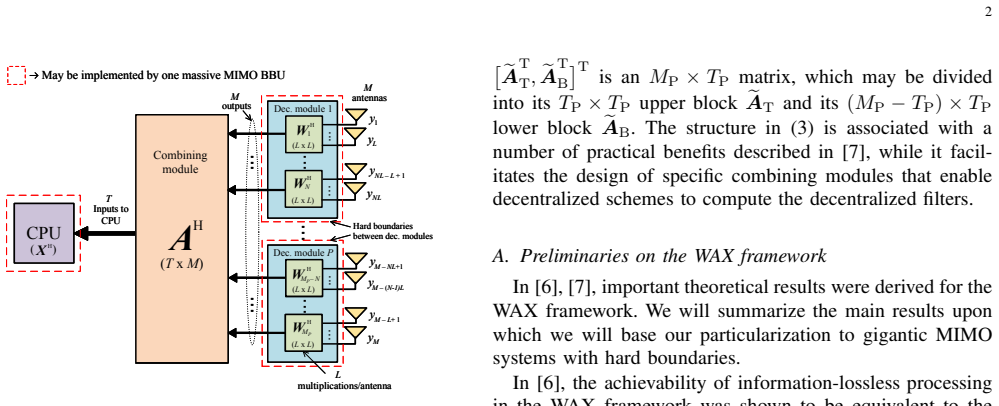
The adapted WAX framework performing decentralized processing on non-cooperating hardware modules that respect hard boundaries.
If this is right
- Decentralized processing can be realized with state-of-the-art massive MIMO baseband units.
- Different degrees of decentralization can be selected to match available interconnection bandwidth.
- Hard-boundary constraints between modules can be accommodated while still achieving viable performance.
Where Pith is reading between the lines
- The same modular approach could reduce interconnection requirements in other large antenna-array systems where full cooperation is costly.
- Hardware designs could scale antenna count without proportional growth in central processing resources.
- Direct testing on FR3-band hardware would confirm whether the simulated trade-offs hold under real propagation and hardware impairments.
Load-bearing premise
The adapted WAX framework maintains useful performance when applied to non-cooperating modules separated by hard boundaries.
What would settle it
A hardware prototype or detailed simulation in which the adapted framework under hard-boundary constraints produces rates that fall below a stated practical threshold for the chosen complexity level.
Figures
read the original abstract
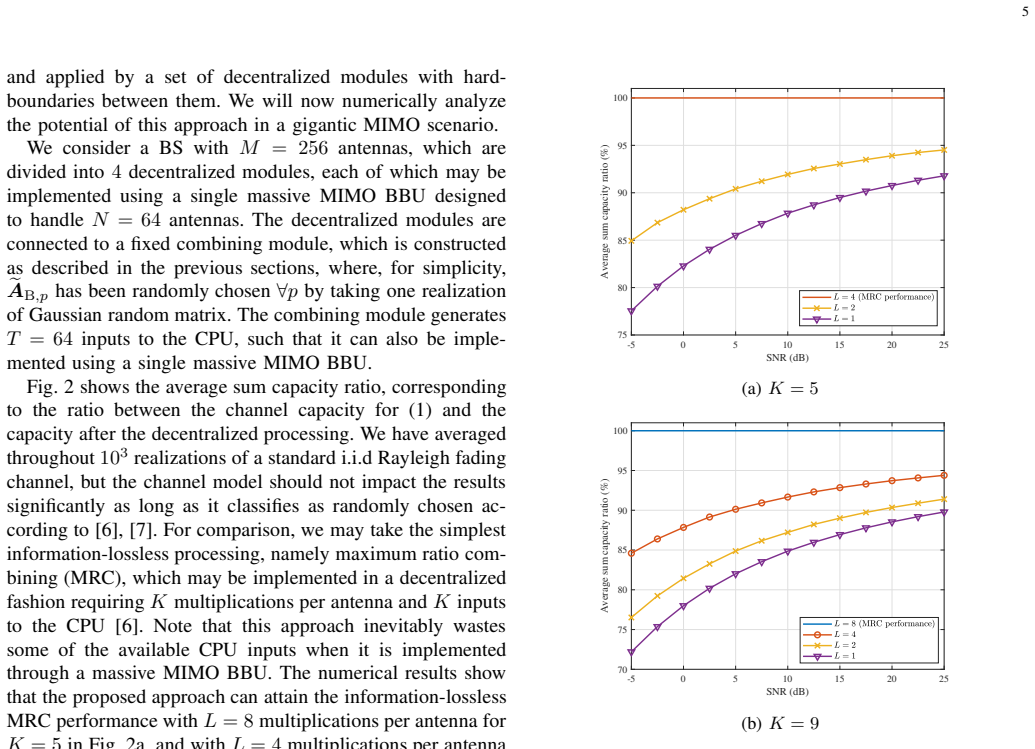
To maintain the antenna apertures offered by 5G massive MIMO systems operating at the sub-6GHz band, known as FR1, 6G base stations (BSs) using the upper-mid band, FR3, should increase the number of antennas by a factor 4-8, giving rise to gigantic MIMO. This poses challenges in terms of processing complexity and interconnection bandwidth. The WAX framework, previously introduced for exploring trade-offs in decentralized architectures, may offer the flexibility needed to tackle these challenges. However, no results have been established on the applicability of this framework in the presence of hard-boundary constraints. The current work explores gigantic MIMO implementations based on a novel adaptation of the WAX framework, where the decentralized processing is performed by non-cooperating hardware modules. These modules may be implemented through state-of-the-art massive MIMO baseband units (BBUs). The results show the potential of the proposed framework towards exploiting trade-offs between complexity and performance in practical gigantic MIMO implementations.
Editorial analysis
A structured set of objections, weighed in public.
Referee Report
Summary. The manuscript proposes a novel adaptation of the WAX framework for decentralized gigantic MIMO processing under hard-boundary constraints, where non-cooperating hardware modules (implementable via state-of-the-art massive MIMO BBUs) perform the processing; it claims that this enables exploitation of complexity-performance trade-offs in practical 6G FR3 implementations, with results showing 'potential' for such trade-offs.
Significance. If substantiated with concrete results, the work could be significant for addressing interconnection bandwidth and processing complexity challenges when scaling from 5G FR1 massive MIMO to 6G gigantic MIMO by a factor of 4-8, by providing a flexible decentralized approach that avoids full cooperation among modules.
major comments (1)
- [Abstract] Abstract: the central claim that the adaptation 'shows the potential' for trade-offs rests on unspecified 'results' with no equations, simulation parameters, performance numbers, error bars, or comparisons to cooperating WAX baselines or centralized architectures, which is load-bearing for assessing whether the framework remains effective without major degradation under non-cooperation and hard boundaries.
minor comments (1)
- [Abstract] Abstract: the description of hard-boundary constraints and the exact nature of the WAX adaptation could be clarified with at least one high-level equation or block diagram reference to aid reader understanding.
Simulated Author's Rebuttal
We thank the referee for their review. We address the single major comment below.
read point-by-point responses
-
Referee: [Abstract] Abstract: the central claim that the adaptation 'shows the potential' for trade-offs rests on unspecified 'results' with no equations, simulation parameters, performance numbers, error bars, or comparisons to cooperating WAX baselines or centralized architectures, which is load-bearing for assessing whether the framework remains effective without major degradation under non-cooperation and hard boundaries.
Authors: The abstract is a concise summary, per standard practice. The full manuscript details the adapted WAX framework (including equations), simulation parameters, performance metrics with error bars, and comparisons to cooperating WAX and centralized baselines in Sections III-V. We agree the abstract could better substantiate the claim and will revise it to include key numerical results and setup details. revision: yes
Circularity Check
No significant circularity; exploratory adaptation without derivations or load-bearing self-citations
full rationale
The provided abstract and context describe an initial exploration of adapting the prior WAX framework to non-cooperating modules and hard-boundary constraints. No equations, derivations, fitted parameters, or uniqueness theorems are presented. The central claim is scoped as showing 'potential' for trade-offs rather than a result forced by internal definitions or self-citation chains. The WAX reference is to previous work but is not invoked as a load-bearing uniqueness result here. This is a normal non-finding for an abstract-level exploratory paper.
Axiom & Free-Parameter Ledger
Reference graph
Works this paper leans on
-
[1]
Trade-Offs in Quasi-Decentralized Massive
Vidal Alegría, Juan and Rusek, Fredrik and Sánchez, Jesús Rodríguez and Edfors, Ove , booktitle=. Trade-Offs in Quasi-Decentralized Massive. 2020 , volume=
2020
-
[2]
2021 , volume=
Vidal Alegría, Juan and Rusek, Fredrik and Edfors, Ove , journal=IEEE_J_SP, title=. 2021 , volume=
2021
-
[3]
2023 , volume=
Vidal Alegría, Juan and Rusek, Fredrik , journal=IEEE_J_SP, title=. 2023 , volume=
2023
-
[4]
Enabling Decentralized Computation of the
Vidal Alegría, Juan and Rusek, Fredrik , booktitle=. Enabling Decentralized Computation of the. 2022 , volume=
2022
-
[5]
Vidal Alegr\'. Proc. IEEE Int. Conf. Acoust., Speech Signal Process. (ICASSP) , title=. 2022 , volume=
2022
-
[6]
Modular Binary Tree Architecture for Distributed Large Intelligent Surface , year=
Vidal Alegría, Juan and Rusek, Fredrik and Rodríguez Sánchez, Jesús and Edfors, Ove , booktitle=. Modular Binary Tree Architecture for Distributed Large Intelligent Surface , year=
-
[7]
Shepard, Clayton and others , title =. Proc. 18th Annu. Int. Conf. Mobile Comput. Netw., (Mobicom) , year =. doi:10.1145/2348543.2348553 , acmid =
-
[8]
Yang, Qing and Li, Xiaoxiao and Yao, Hongyi and Fang, Ji and Tan, Kun and Hu, Wenjun and Zhang, Jiansong and Zhang, Yongguang , title =. Proc. ACM SIGCOMM , year =
-
[9]
J. R. in Proc. IEEE Int. Symp. Inf. Theory (ISIT) , title=. 2019 , volume=. doi:10.1109/ISIT.2019.8849465 , ISSN=
-
[10]
J. in Proc. IEEE 90th Veh. Technol. Conf. , title=. 2019 , volume=. doi:10.1109/VTCFall.2019.8891538 , ISSN=
-
[11]
K. Proc. 53rd Asilomar Conf. Signals, Syst., Comput. , title=. 2019 , volume=
2019
-
[12]
T. L. Marzetta , journal=IEEE_J_WCOM, title=. 2010 , volume=. doi:10.1109/TWC.2010.092810.091092 , ISSN=
-
[13]
Massive. Digit. Signal Process. , volume =. 2019 , issn =. doi:https://doi.org/10.1016/j.dsp.2019.06.007 , author =
-
[14]
E. Bertilsson and O. Gustafsson and E. G. Larsson , booktitle=. A scalable architecture for massive. 2016 , volume=. doi:10.1109/ACSSC.2016.7869172 , ISSN=
-
[15]
K. Li and R. R. Sharan and Y. Chen and T. Goldstein and J. R. Cavallaro and C. Studer , journal=IEEE_J_ESTC, title=. 2017 , volume=. doi:10.1109/JETCAS.2017.2775151 , ISSN=
-
[16]
Puglielli and others , journal=
A. Puglielli and others , journal=. Design of Energy- and Cost-Efficient Massive. 2016 , volume=. doi:10.1109/JPROC.2015.2492539 , ISSN=
-
[17]
Malkowsky and others , journal=
S. Malkowsky and others , journal=. The World's First Real-Time Testbed for Massive. 2017 , volume=. doi:10.1109/ACCESS.2017.2705561 , ISSN=
-
[18]
J. R. Sanchez and F. Rusek and M. Sarajlic and O. Edfors and L. Liu , booktitle=. Fully Decentralized Massive. 2018 , volume=. doi:10.1109/SiPS.2018.8598321 , ISSN=
-
[19]
M. Sarajlic and F. Rusek and J. R. Sanchez and L. Liu and O. Edfors , journal=. Fully Decentralized Approximate Zero-Forcing Precoding for Massive. 2019 , volume=. doi:10.1109/LWC.2019.2892044 , ISSN=
-
[20]
and Edfors, Ove and Tufvesson, Fredrik and Marzetta, Thomas L
Larsson, Erik G. and Edfors, Ove and Tufvesson, Fredrik and Marzetta, Thomas L. , journal=. Massive MIMO for next generation wireless systems , year=
-
[21]
H. Q. Ngo and E. G. Larsson and T. L. Marzetta , journal=IEEE_J_COM, title=. 2013 , volume=. doi:10.1109/TCOMM.2013.020413.110848 , ISSN=
-
[22]
and Thomas, Joy A
Cover, Thomas M. and Thomas, Joy A. , title =. 2006 , isbn =
2006
-
[23]
2008 , isbn =
Paulraj, Arogyaswami and Nabar, Rohit and Gore, Dhananjay , title =. 2008 , isbn =
2008
-
[24]
2022 , volume=
Rodríguez Sánchez, Jesús and Rusek, Fredrik and Edfors, Ove and Liu, Liang , journal=IEEE_J_SP, title=. 2022 , volume=
2022
-
[25]
, journal=IEEE_J_SP, title=
Pizzo, Andrea and Torres, Andrea de Jesus and Sanguinetti, Luca and Marzetta, Thomas L. , journal=IEEE_J_SP, title=. 2022 , volume=
2022
-
[26]
S. Beyond Massive. 2018 , volume=. doi:10.1109/TSP.2018.2816577 , ISSN=
-
[27]
J. G. What Will 5G Be? , year=
-
[28]
IEEE Communications Magazine , title=
Z. IEEE Communications Magazine , title=. 2011 , volume=
2011
-
[29]
Decentralized Signal Detection via Expectation Propagation Algorithm for Uplink Massive
Z. Decentralized Signal Detection via Expectation Propagation Algorithm for Uplink Massive. 2020 , volume=
2020
-
[30]
H. Q. Cell-Free Massive. 2017 , volume=
2017
-
[31]
Scalable Cell-Free Massive
E. Scalable Cell-Free Massive. 2020 , volume=
2020
-
[32]
Prospective Multiple Antenna Technologies for Beyond 5
J. Prospective Multiple Antenna Technologies for Beyond 5. 2020 , volume=
2020
-
[33]
Distributed Dimension Reduction for Distributed Massive
Wiffen, Fred and Chin, Woon Hau and Doufexi, Angela , booktitle=. Distributed Dimension Reduction for Distributed Massive. 2021 , volume=
2021
-
[34]
Decentralization Issues in Cell-free Massive
Riera-Palou, Felip and Femenias, Guillem , booktitle=. Decentralization Issues in Cell-free Massive. 2019 , volume=
2019
-
[35]
, journal=
Carvalho, Elisabeth De and Ali, Anum and Amiri, Abolfazl and Angjelichinoski, Marko and Heath, Robert W. , journal=. Non-Stationarities in Extra-Large-Scale Massive. 2020 , volume=
2020
-
[36]
2022 , volume=
Amiri, Abolfazl and Rezaie, Sajad and Manchón, Carles Navarro and de Carvalho, Elisabeth , journal=IEEE_J_WCOM, title=. 2022 , volume=
2022
-
[37]
Uncoordinated and Decentralized Processing in Extra-Large
Amiri, Abolfazl and Manchón, Carles Navarro and de Carvalho, Elisabeth , journal=. Uncoordinated and Decentralized Processing in Extra-Large. 2022 , volume=
2022
-
[38]
Intelligent Reflecting Surface Enhanced Wireless Network via Joint Active and Passive Beamforming , year=
Q. Intelligent Reflecting Surface Enhanced Wireless Network via Joint Active and Passive Beamforming , year=
-
[39]
IEEE Access , title=
J. IEEE Access , title=. 2019 , volume=
2019
-
[40]
Wireless Communications Through Reconfigurable Intelligent Surfaces , year=
Basar, Ertugrul and Di Renzo, Marco and De Rosny, Julien and Debbah, Merouane and Alouini, Mohamed-Slim and Zhang, Rui , journal=. Wireless Communications Through Reconfigurable Intelligent Surfaces , year=
-
[41]
2019 , volume=
Wu, Qingqing and Zhang, Rui , journal=IEEE_J_WCOM, title=. 2019 , volume=
2019
-
[42]
and Debbah, Mérouane and Yuen, Chau , journal=IEEE_J_WCOM, title=
Huang, Chongwen and Zappone, Alessio and Alexandropoulos, George C. and Debbah, Mérouane and Yuen, Chau , journal=IEEE_J_WCOM, title=. 2019 , volume=
2019
-
[43]
Electronics letters , volume=
Near Shannon limit performance of low density parity check codes , author=. Electronics letters , volume=
-
[44]
Hardy, G. H. and Wright, E. M. , biburl =
-
[45]
Enabling
Björnson, Emil and Kara, Ferdi and Kolomvakis, Nikolaos and Kosasih, Alva and Ramezani, Parisa and Salman, Murat Babek , journal=. Enabling. 2025 , volume=
2025
-
[46]
2023 , volume=
Li, Mengting and Yuan, Zhiqiang and Lyu, Yejian and Kyösti, Pekka and Zhang, Jianhua and Fan, Wei , journal=IEEE_M_COM, title=. 2023 , volume=
2023
-
[47]
2025 , volume=
Nerini, Matteo and Clerckx, Bruno , journal=IEEE_J_SP, title=. 2025 , volume=
2025
-
[48]
Evaluation of Near-Field Fed
Osterland, Dennis and Lutz, Felix-Christopher and Benzin, Andreas and Keusgen, Wilhelm and Caire, Giuseppe , booktitle=. Evaluation of Near-Field Fed. 2025 , volume=
2025
-
[49]
2026 , eprint=
Robust High Mobility NLOS UE Beamforming Strategy for Gigantic MIMO , author=. 2026 , eprint=
2026
-
[50]
Decentralized Multi-Antenna Architectures with Unitary Constraints , year=
Vidal Alegría, Juan and Edfors, Ove , booktitle=. Decentralized Multi-Antenna Architectures with Unitary Constraints , year=
-
[51]
2025 , volume=
Levy, Ohad and Shlezinger, Nir , journal=IEEE_J_COM, title=. 2025 , volume=
2025
discussion (0)
Sign in with ORCID, Apple, or X to comment. Anyone can read and Pith papers without signing in.