A Universal All-Fiber Quantum Buffer for the Telecom Band
Pith reviewed 2026-06-29 05:22 UTC · model grok-4.3
The pith
A fully fiber-integrated quantum buffer operates over the full telecom C-band with 0.46 dB loss and storage exceeding 18 microseconds.
A machine-rendered reading of the paper's core claim, the machinery that carries it, and where it could break.
Core claim
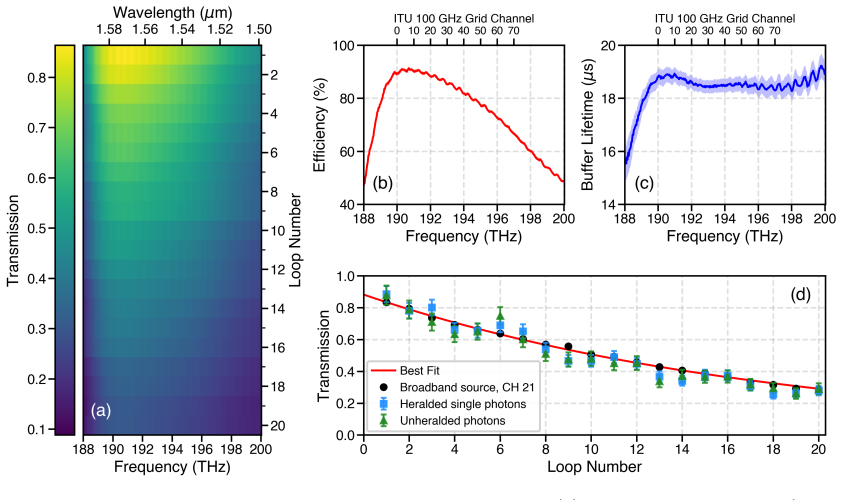
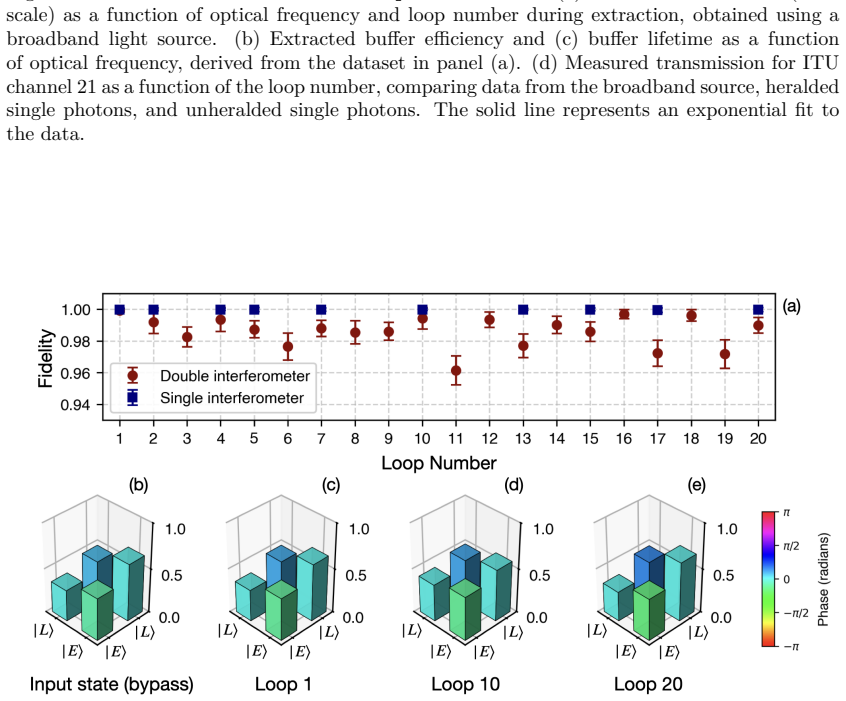
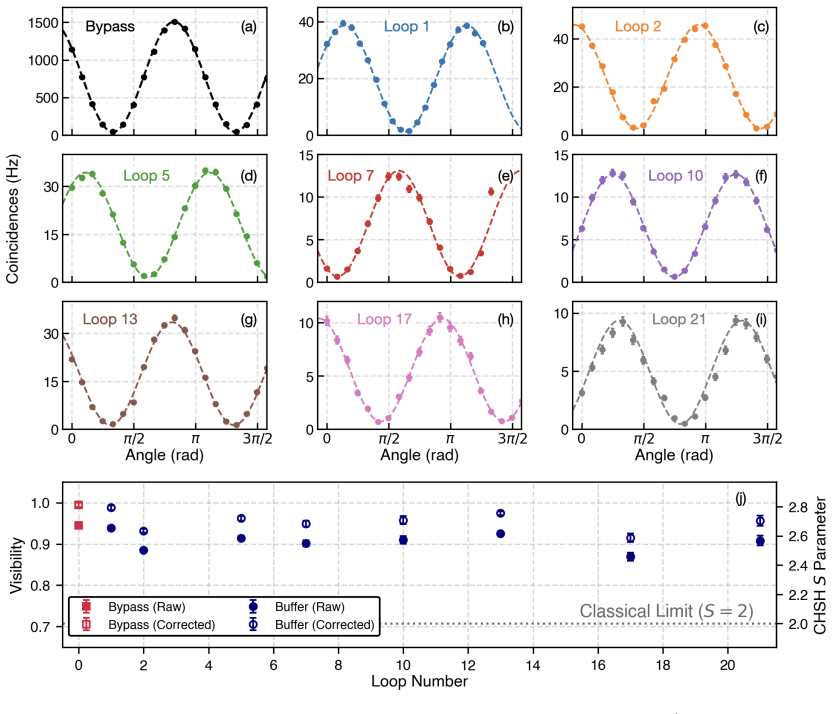
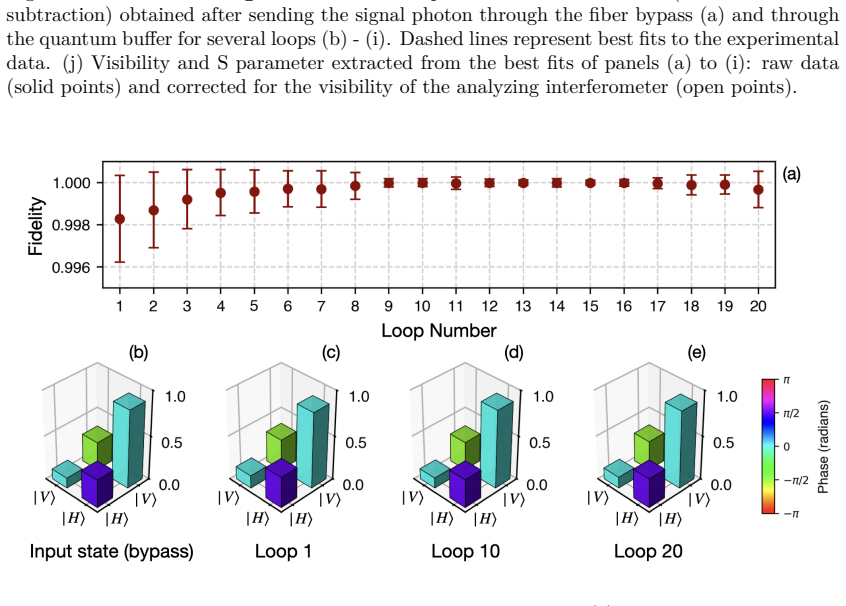
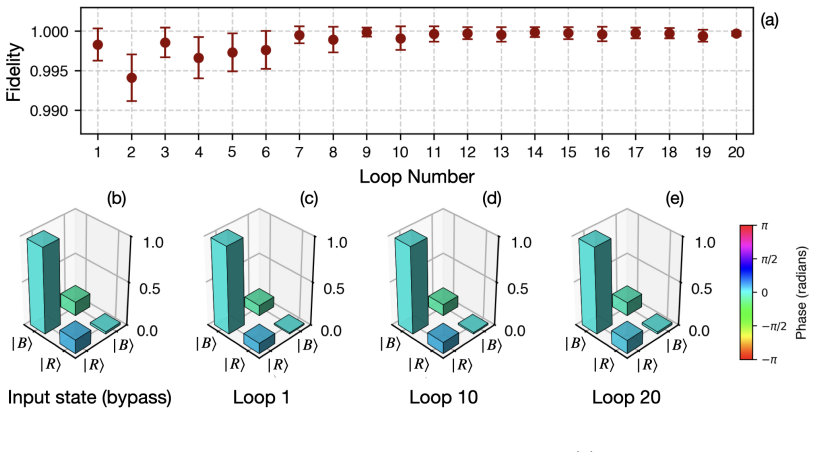
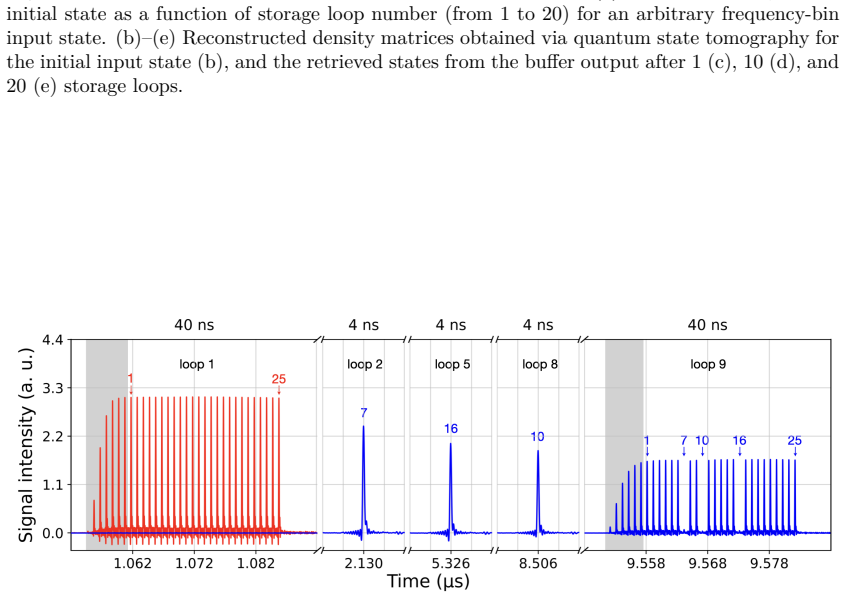
By implementing an actively switched dual-Sagnac cavity driven by cross-phase modulation, the device achieves an ultra-low input/output loss of 0.46 dB and a storage time exceeding 18 μs. The device exhibits an operational bandwidth exceeding 12.5 THz covering the full telecom C-band, simultaneous buffering of over 200 temporal modes, high-fidelity storage for time-bin, frequency-bin, and polarization qubits, and faithful preservation of entanglement.
What carries the argument
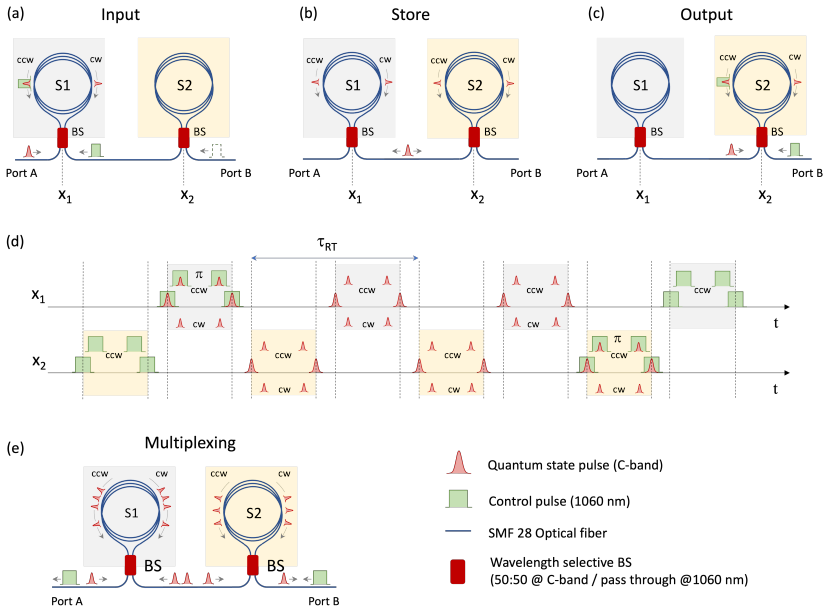
Actively switched dual-Sagnac cavity driven by cross-phase modulation, which routes light for on-demand storage while keeping loss and added noise low across a wide band.
If this is right
- Enables room-temperature temporal alignment of photonic signals for quantum network synchronization.
- Supports simultaneous storage and selective readout of more than 200 temporal modes at telecom wavelengths.
- Preserves all three fiber-compatible qubit encodings and entanglement with only the reported loss.
- Removes a major synchronization barrier to deploying global photonic quantum networks.
Where Pith is reading between the lines
- The buffer could be cascaded or inserted directly into existing fiber links to support quantum repeater protocols without cryogenic hardware.
- Its multi-mode capacity suggests it could handle the timing jitter present in high-rate entangled photon sources used in metropolitan networks.
- Extension to longer storage times might be tested by adding low-loss fiber loops while monitoring whether the cross-phase modulation switch remains mode-independent.
Load-bearing premise
The actively switched dual-Sagnac cavity driven by cross-phase modulation maintains the reported high fidelity for all three qubit degrees of freedom and entanglement without introducing significant additional decoherence or noise beyond the stated 0.46 dB loss.
What would settle it
Measurement of fidelity drop or added noise well above the level expected from 0.46 dB loss when storing polarization or frequency-bin qubits would show the universality claim does not hold.
Figures
read the original abstract
The realization of a scalable quantum internet relies on the ability to temporally align asynchronous photonic signals through on-demand buffering. While matter-based quantum memories achieve long storage times, their extremely narrow bandwidths and cryogenic requirements pose significant barriers to integration with existing telecommunications infrastructure. Conversely, current all-optical memories operate at room temperature but are hampered by high input/output losses and a lack of universality across different photonic degrees of freedom. Here, we demonstrate a universal, fully fiber-integrated quantum buffer operating over the full telecom C-band that overcomes these fundamental trade-offs. By implementing an actively switched dual-Sagnac cavity driven by cross-phase modulation, we achieve an ultra-low input/output loss of 0.46 dB and a storage time exceeding 18 $\mu$s. The device exhibits an operational bandwidth exceeding 12.5 THz ($\sim$100 nm), covering the full telecom C-band. We show the simultaneous buffering of over 200 temporal modes with the ability to address them either collectively or one by one. We demonstrate high-fidelity storage for all three degrees of freedom compatible with optical fiber propagation, namely time-bin, frequency-bin, and polarization qubits, along with faithful preservation of entanglement, confirming the platform's true universality. These results provide a robust, room-temperature solution for the high-rate synchronization of multidimensional quantum states, clearing a major hurdle for the deployment of global photonic quantum networks.
Editorial analysis
A structured set of objections, weighed in public.
Referee Report
Summary. The manuscript reports an experimental demonstration of a universal all-fiber quantum buffer for the telecom C-band based on an actively switched dual-Sagnac cavity driven by cross-phase modulation. It claims an input/output loss of 0.46 dB, storage time exceeding 18 μs, operational bandwidth >12.5 THz covering the full C-band, simultaneous buffering of >200 temporal modes (addressable collectively or individually), and high-fidelity preservation of time-bin, frequency-bin, and polarization qubits as well as entanglement, all at room temperature.
Significance. If the reported performance metrics and fidelity data hold under full experimental scrutiny, the work would represent a notable advance for photonic quantum networks by delivering a room-temperature, low-loss, broadband, fiber-integrated buffer that is universal across the three fiber-compatible degrees of freedom. This directly addresses synchronization needs without cryogenic or narrowband limitations of matter-based memories.
minor comments (3)
- The abstract and results sections should explicitly state the measured storage efficiencies and fidelities with statistical uncertainties for each degree of freedom and for the entangled state to allow direct comparison against the 0.46 dB loss budget.
- Clarify in the methods or supplementary information how individual temporal modes are addressed on demand without crosstalk, including any measured crosstalk levels.
- Figure captions and axis labels should include the exact wavelengths or frequency ranges used for the C-band demonstration and the number of modes tested in the 200-mode claim.
Simulated Author's Rebuttal
We thank the referee for their positive assessment of the manuscript, recognition of its significance for photonic quantum networks, and recommendation for minor revision. No major comments were raised in the report.
Circularity Check
No significant circularity; experimental demonstration only
full rationale
The manuscript is an experimental report of a fiber-integrated quantum buffer. All central claims (0.46 dB loss, >18 μs storage, >12.5 THz bandwidth, >200 modes, high-fidelity storage across time-bin/frequency-bin/polarization and entanglement preservation) are presented as direct measurement outcomes rather than predictions derived from equations. No load-bearing derivation chain, fitted-parameter predictions, self-citations used as uniqueness theorems, or ansatz smuggling appears in the provided text. The work is therefore self-contained against external benchmarks and receives the default non-circularity finding.
Axiom & Free-Parameter Ledger
Reference graph
Works this paper leans on
-
[1]
H. J. Kimble. The quantum internet.Nature, 453(7198):1023–1030, 2008
2008
-
[2]
Quantum internet: A vision for the road ahead.Science, 362(6412), October 2018
Stephanie Wehner, David Elkouss, and Ronald Hanson. Quantum internet: A vision for the road ahead.Science, 362(6412), October 2018
2018
-
[3]
England, Peter C
Khabat Heshami, Duncan G. England, Peter C. Humphreys, Philip J. Bustard, Victor M. Acosta, JoshuaNunn, andBenjaminJ.Sussman. Quantummemories: emergingapplications and recent advances.Journal of Modern Optics, 63(20):2005–2028, March 2016
2005
-
[4]
Briegel, W
H.-J. Briegel, W. Dür, J. I. Cirac, and P. Zoller. Quantum repeaters: The role of imperfect local operations in quantum communication.Physical Review Letters, 81(26):5932–5935, December 1998
1998
-
[5]
Quan- tum repeaters based on atomic ensembles and linear optics.Reviews of Modern Physics, 83(1):33–80, March 2011
Nicolas Sangouard, Christoph Simon, Hugues de Riedmatten, and Nicolas Gisin. Quan- tum repeaters based on atomic ensembles and linear optics.Reviews of Modern Physics, 83(1):33–80, March 2011
2011
-
[6]
Optical quantum memory and its applications in quantum communication systems.Journal of Research of the National Institute of Standards and Technology, 125, January 2020
Lijun Ma, Oliver Slattery, and Xiao Tang. Optical quantum memory and its applications in quantum communication systems.Journal of Research of the National Institute of Standards and Technology, 125, January 2020
2020
-
[7]
Lvovsky, Barry C
Alexander I. Lvovsky, Barry C. Sanders, and Wolfgang Tittel. Optical quantum memory. Nature Photonics, 3(12):706–714, December 2009
2009
-
[8]
Quantum optical memory for entanglement distribution.Optica, 10(11):1511, November 2023
Yisheng Lei, Faezeh Kimiaee Asadi, Tian Zhong, Alex Kuzmich, Christoph Simon, and Mahdi Hosseini. Quantum optical memory for entanglement distribution.Optica, 10(11):1511, November 2023
2023
-
[9]
Photonic integrated quantum memory in rare-earth doped solids.Laser& Photonics Reviews, 17(10), August 2023
Zong-Quan Zhou, Chao Liu, Chuan-Feng Li, Guang-Can Guo, Daniel Oblak, Mi Lei, Andrei Faraon, Margherita Mazzera, and Hugues de Riedmatten. Photonic integrated quantum memory in rare-earth doped solids.Laser& Photonics Reviews, 17(10), August 2023
2023
-
[10]
Highly multimode storage in a crystal.New Journal of Physics, 13(1):013013, January 2011
M Bonarota, J-L Le Gouët, and T Chanelière. Highly multimode storage in a crystal.New Journal of Physics, 13(1):013013, January 2011
2011
-
[11]
Yu, and Ying-Cheng Chen
Ya-Fen Hsiao, Pin-Ju Tsai, Hung-Shiue Chen, Sheng-Xiang Lin, Chih-Chiao Hung, Chih-Hsi Lee, Yi-Hsin Chen, Yong-Fan Chen, Ite A. Yu, and Ying-Cheng Chen. Highly efficient co- herent optical memory based on electromagnetically induced transparency.Physical Review Letters, 120(18), May 2018
2018
-
[12]
Storage and retrieval of vector beams of light in a multiple-degree- of-freedom quantum memory.Nature Communications, 6(1), 2015
Valentina Parigi, Vincenzo D’Ambrosio, Christophe Arnold, Lorenzo Marrucci, Fabio Sciar- rino, and Julien Laurat. Storage and retrieval of vector beams of light in a multiple-degree- of-freedom quantum memory.Nature Communications, 6(1), 2015
2015
-
[13]
Verma, Matthew D
Erhan Saglamyurek, Jeongwan Jin, Varun B. Verma, Matthew D. Shaw, Francesco Marsili, Sae Woo Nam, Daniel Oblak, and Wolfgang Tittel. Quantum storage of entangled telecom- wavelength photons in an erbium-doped optical fibre.Nature Photonics, 9(2):83–87, January 2015
2015
-
[14]
Pearson, Bin Fang, Elizabeth A
Kai Shinbrough, Donny R. Pearson, Bin Fang, Elizabeth A. Goldschmidt, and Virginia O. Lorenz. Chapter five - broadband quantum memory in atomic ensembles. In Louis F. DiMauro, Hélène Perrin, and Susanne F. Yelin, editors,Advances in Atomic, Molecular, and Optical Physics, volume 72 ofAdvances In Atomic, Molecular, and Optical Physics, pages 297–360. Acade...
2023
-
[15]
Multimode quantum memory based on atomic frequency combs.Physical Review A, 79(5), May 2009
Mikael Afzelius, Christoph Simon, Hugues de Riedmatten, and Nicolas Gisin. Multimode quantum memory based on atomic frequency combs.Physical Review A, 79(5), May 2009
2009
-
[16]
Hedges, Rose L
Manjin Zhong, Morgan P. Hedges, Rose L. Ahlefeldt, John G. Bartholomew, Sarah E. Beavan, Sven M. Wittig, Jevon J. Longdell, and Matthew J. Sellars. Optically addressable nuclear spins in solid with a six-hour coherence time.Nature, 517(7533):177–180, January 2015. 17
2015
-
[17]
Photonic quantum state transfer between a cold atomic gas and a crystal.Nature, 551(7681):485–488, November 2017
Nicolas Maring, Pau Farrera, Kutlu Kutluer, Margherita Mazzera, Georg Heinze, and Hugues de Riedmatten. Photonic quantum state transfer between a cold atomic gas and a crystal.Nature, 551(7681):485–488, November 2017
2017
-
[18]
Arnold, Michelle Victora, Michael E
Nathan T. Arnold, Michelle Victora, Michael E. Goggin, and Paul G. Kwiat. Broad- bandwidth photonic quantum memory. InQuantum 2.0 Conference and Exhibition, QUAN- TUM, page QM4B.3. Optica Publishing Group, 2022
2022
-
[19]
Fiber-coupled broadband quantum mem- ory for polarization-encoded photonic qubits.npj Quantum Information, 11(1), October 2025
Sandra Cheng, Carson Evans, and Todd Pittman. Fiber-coupled broadband quantum mem- ory for polarization-encoded photonic qubits.npj Quantum Information, 11(1), October 2025
2025
-
[20]
Fiber loop quantum buffer for photonic qubits.New Journal of Physics, 26(8):083011, August 2024
Kim Fook Lee, Gamze Gül, Zhao Jim, and Prem Kumar. Fiber loop quantum buffer for photonic qubits.New Journal of Physics, 26(8):083011, August 2024
2024
-
[21]
O. A. Collins, S. D. Jenkins, A. Kuzmich, and T. A. B. Kennedy. Multiplexed memory- insensitive quantum repeaters.Physical Review Letters, 98(6), February 2007
2007
-
[22]
(invited)storybehindthenonlinearfiberopticsbook.Optik, 277:170715, April 2023
GovindP.Agrawal. (invited)storybehindthenonlinearfiberopticsbook.Optik, 277:170715, April 2023
2023
-
[23]
Unconventional time-bandwidth performance of resonant cavities with nonreciprocal coupling.Physical Review A, 103(1), January 2021
IvanCardea, DavideGrassani, JeremyUpham, SebastianA.Schulz, KosmasL.Tsakmakidis, and Camille-Sophie Brès. Unconventional time-bandwidth performance of resonant cavities with nonreciprocal coupling.Physical Review A, 103(1), January 2021
2021
-
[24]
All-optical switching of photonic entanglement.New Journal of Physics, 13(10):105004, October 2011
Matthew A Hall, Joseph B Altepeter, and Prem Kumar. All-optical switching of photonic entanglement.New Journal of Physics, 13(10):105004, October 2011
2011
-
[25]
Photonic quantum information with time-bins: Principles and ap- plications, 2025
Ashutosh Singh, Anuj Sethia, Leili Esmaeilifar, Raju Valivarthi, Neil Sinclair, Maria Spirop- ulu, and Daniel Oblak. Photonic quantum information with time-bins: Principles and ap- plications, 2025
2025
-
[26]
Marcikic, H
I. Marcikic, H. de Riedmatten, W. Tittel, V. Scarani, H. Zbinden, and N. Gisin. Time- bin entangled qubits for quantum communication created by femtosecond pulses.Physical Review A, 66(6), December 2002
2002
-
[27]
Quantum repeaters with photon pair sources and multimode memories.Physical Review Letters, 98(19), May 2007
Christoph Simon, Hugues de Riedmatten, Mikael Afzelius, Nicolas Sangouard, Hugo Zbinden, and Nicolas Gisin. Quantum repeaters with photon pair sources and multimode memories.Physical Review Letters, 98(19), May 2007
2007
-
[28]
Coherentspincontrolatthequantumlevelinanensemble-basedoptical memory.Physical Review Letters, 114(23), 2015
Pierre Jobez, Cyril Laplane, Nuala Timoney, Nicolas Gisin, Alban Ferrier, Philippe Goldner, andMikaelAfzelius. Coherentspincontrolatthequantumlevelinanensemble-basedoptical memory.Physical Review Letters, 114(23), 2015
2015
-
[29]
Slater, Mathew George, Raimund Ricken, Morgan P
Neil Sinclair, Erhan Saglamyurek, Hassan Mallahzadeh, Joshua A. Slater, Mathew George, Raimund Ricken, Morgan P. Hedges, Daniel Oblak, Christoph Simon, Wolfgang Sohler, and Wolfgang Tittel. Spectral multiplexing for scalable quantum photonics using an atomic frequency comb quantum memory and feed-forward control.Physical Review Letters, 113(5), 2014
2014
-
[30]
J. Nunn, K. Reim, K. C. Lee, V. O. Lorenz, B. J. Sussman, I. A. Walmsley, and D. Jaksch. Multimode memories in atomic ensembles.Physical Review Letters, 101(26), December 2008
2008
-
[31]
Storage of multiple single-photon pulses emitted from a quantum dot in a solid-state quantum memory
Jian-Shun Tang, Zong-Quan Zhou, Yi-Tao Wang, Yu-Long Li, Xiao Liu, Yi-Lin Hua, Yang Zou, Shuang Wang, De-Yong He, Geng Chen, Yong-Nan Sun, Ying Yu, Mi-Feng Li, Guo- Wei Zha, Hai-Qiao Ni, Zhi-Chuan Niu, Chuan-Feng Li, and Guang-Can Guo. Storage of multiple single-photon pulses emitted from a quantum dot in a solid-state quantum memory. Nature Communication...
2015
-
[32]
Quantum storage of photonic entanglement in a crystal.Nature, 469(7331):508–511, January 2011
Christoph Clausen, Imam Usmani, Félix Bussières, Nicolas Sangouard, Mikael Afzelius, Hugues de Riedmatten, and Nicolas Gisin. Quantum storage of photonic entanglement in a crystal.Nature, 469(7331):508–511, January 2011
2011
-
[33]
Slater, Daniel Oblak, Félix Bus- sières, Mathew George, Raimund Ricken, Wolfgang Sohler, and Wolfgang Tittel
Erhan Saglamyurek, Neil Sinclair, Jeongwan Jin, Joshua A. Slater, Daniel Oblak, Félix Bus- sières, Mathew George, Raimund Ricken, Wolfgang Sohler, and Wolfgang Tittel. Broadband waveguide quantum memory for entangled photons.Nature, 469(7331):512–515, January 2011. 18
2011
-
[34]
England, Kent A.G
Duncan G. England, Kent A.G. Fisher, Jean-Philippe W. MacLean, Philip J. Bustard, Rune Lausten, Kevin J. Resch, and Benjamin J. Sussman. Storage and retrieval of thz- bandwidth single photons using a room-temperature diamond quantum memory.Physical Review Letters, 114(5), February 2015
2015
-
[35]
Christensen, Jia Jun Wong, Hee Su Park, Kevin T
Fumihiro Kaneda, Bradley G. Christensen, Jia Jun Wong, Hee Su Park, Kevin T. McCusker, and Paul G. Kwiat. Time-multiplexed heralded single-photon source.Optica, 2(12):1010, November 2015
2015
-
[36]
Fumihiro Kaneda, Feihu Xu, Joseph Chapman, and Paul G. Kwiat. Quantum-memory- assisted multi-photon generation for efficient quantum information processing.Optica, 4(9):1034, August 2017
2017
-
[37]
PhilipJ.Bustard, KentBonsma-Fisher, CyrilHnatovsky, DanGrobnic, StephenJ.Mihailov, Duncan England, and Benjamin J. Sussman. Toward a quantum memory in a fiber cavity controlled by intracavity frequency translation.Physical Review Letters, 128(12), March 2022
2022
-
[38]
AUniversalAll-FiberQuan- tum Buffer for the Telecom Band
M. Asobe, H. Itoh, T. Miyazawa, and T. Kanamori. Efficient and ultrafast all-optical switch- ing using high𝛿𝑛, small core chalcogenide glass fibre.Electronics Letters, 29(22):1966–1968, October 1993. 19 SupplementaryInformationfor“AUniversalAll-FiberQuan- tum Buffer for the Telecom Band” S1 Cross-phase modulation in optical fibers Our fiber-loop quantum b...
discussion (0)
Sign in with ORCID, Apple, or X to comment. Anyone can read and Pith papers without signing in.