REVIEW 3 major objections 4 minor 1 cited by
Direct Numerical Simulations of K-type transition in a flat-plate boundary layer with supercritical fluids
T0 review · 3 major / 4 minor · reviewed 2026-08-12 · deepseek-v4-flash
Pith's one-line read Heated supercritical wall delays K-type transition and makes the breakdown gradual.
desk verdict First DNS of K-type transition in a supercritical boundary layer, with a plausible but not fully proven mechanism and an unquantified delay claim; deserves serious review with revisions. read the letter →
The pith
A machine-rendered reading of the paper's core claim, the machinery that carries it, and where it could break.
The reading
What carries the argument
The central mechanism is the K-type (fundamental) breakdown, in which a two-dimensional fundamental wave and an oblique three-dimensional wave pair produce streamwise-aligned Lambda-vortices whose nonlinear growth leads to turbulence. In the transcritical flow, the load-bearing new element is the localized secondary instability of low-speed streaks: once the steady longitudinal mode (0,1) exceeds roughly 10% amplitude, co-rotating and counter-rotating vortex legs create low-speed streaks that destabilize in a symmetric varicose mode, making hairpin vortices, and an antisymmetric sinuous mode, making the streaks meander and shed near-wall vortices. The paper also relies on mode-II instability, a supercritical-flow instability tied to the kinematic-viscosity minimum at the Widom line, which is the only unstable mode for the fundamental frequency within the DNS domain.
What would settle it
Run the same K-type forcing with a more accurate real-fluid equation of state for carbon dioxide, or in an experiment, at a reduced pressure of 1.10 and a wall-to-free-stream temperature ratio of 1.222, and locate where the disturbance amplitudes saturate and where the skin-friction maximum occurs; if transition is not delayed relative to the subcritical case, or if a violent breakdown appears at the Lambda-vortex valleys, the central claim is refuted.
Extended reading notes
Core claim
At supercritical pressure with a wall temperature above the pseudo-boiling temperature, K-type breakdown of a flat-plate boundary layer follows a gradual route: large-amplitude higher harmonics dominate the early breakdown stage, the fundamental resonance is delayed and weakened, and just before transition the steady longitudinal mode (0,1) triggers a localized secondary instability on low-speed streaks near the legs of the aligned Lambda-vortices. The symmetric varicose component evolves into hairpin vortices while the antisymmetric sinuous component causes the streak pair to meander and generates additional near-wall vortices. As a result, transition to turbulence is not violent and occurs significantly later than in the subcritical heating case, and it lacks the strong secondary vortices at the spanwise valleys that characterise the H-type route.
Load-bearing premise
All supercritical simulations use the reduced van der Waals equation of state and analytical transport correlations, so the claim that transcritical K-type breakdown is delayed and gradual depends on those models reproducing the real property variations of a supercritical fluid near the pseudo-boiling line.
Editorial extensions
If this is right
- In the transcritical regime the fundamental (K-type) resonance is delayed and weakened, and higher harmonics such as (2,0) can dominate the early breakdown stage.
- Subharmonic resonance between mode (2,0) and the oblique pair (1,±1) becomes active just before transition onset, so the route loses its purely fundamental character.
- Steady longitudinal streaks can reach amplitudes above 10% and trigger localised secondary instability, making streak dynamics a necessary ingredient in transcritical transition prediction.
- Because the transcritical K-type breakdown is gradual whereas the H-type under the same conditions is violent, the disturbance scenario determines whether supercritical boundary layers transition abruptly or softly.
Reading between the lines
- The paper leaves implicit that the delaying effect depends on the wall temperature crossing the pseudo-boiling line; systematically varying the reduced wall temperature between 0.95 and 1.10 would reveal how the (0,1) streak amplitude threshold and the transition-onset shift scale with stratification.
- By analogy with the H-type comparison, one might expect that the noise-receptivity scenario determines whether supercritical boundary layers transition gradually or violently, so real flows with broad-spectrum disturbances may show a mix of both routes.
- A practical corollary is that transition-prediction correlations calibrated on ideal-gas or subcritical DNS may misestimate heat-transfer enhancement in supercritical heat exchangers, since the transcritical K-type route places the turbulent region farther downstream.
Signed reviews
Editorial analysis
A structured set of objections, weighed in public.
Referee Report
Summary. This paper reports direct numerical simulations of controlled K-type breakdown in a flat-plate boundary layer with a supercritical fluid at a reduced pressure of 1.10. Two wall-temperature cases are considered: a liquid-like subcritical case (Tw095) and a transcritical case with wall temperature above the pseudo-boiling line (Tw110), together with an ideal-gas reference case (TadIG) from Sayadi et al. Using a blowing/suction disturbance strip with a fundamental frequency and spanwise wavenumber, the authors compare disturbance-amplitude evolution, flow structures via the Q-criterion, and local vortex interactions. They find that in the subcritical case the K-type breakdown is slightly delayed relative to the ideal-gas reference, with a steady longitudinal mode (0,1) dominating the late transitional stage. In the transcritical case, higher harmonic (2,0) dominates the early nonlinear stage, transition is delayed further, and near the legs of aligned Lambda-vortices the authors observe symmetric varicose and antisymmetric sinuous modes, which they interpret as localized streak secondary instabilities that lead to additional hairpin vortices and near-wall streaky structures. They conclude that transcritical K-type breakdown is more gradual and less violent than the H-type breakdown under the same flow conditions.
Significance. If the main claims hold, this is an important contribution to the understanding of laminar-turbulent transition in supercritical fluids, documenting a qualitatively different breakdown route from the previously reported H-type case. The paper's strengths include a controlled DNS setup matched to an ideal-gas baseline, comparison with linear stability theory, and clear visual documentation of the flow structures. The observation that transcritical K-type transition is delayed and gradual, and that a localized streak secondary instability may be involved, is a falsifiable statement that can guide future stability analyses and engineering predictions. However, the absence of quantitative metrics for the delay and of direct evidence for the instability mechanism currently limits the significance to a descriptive level.
major comments (3)
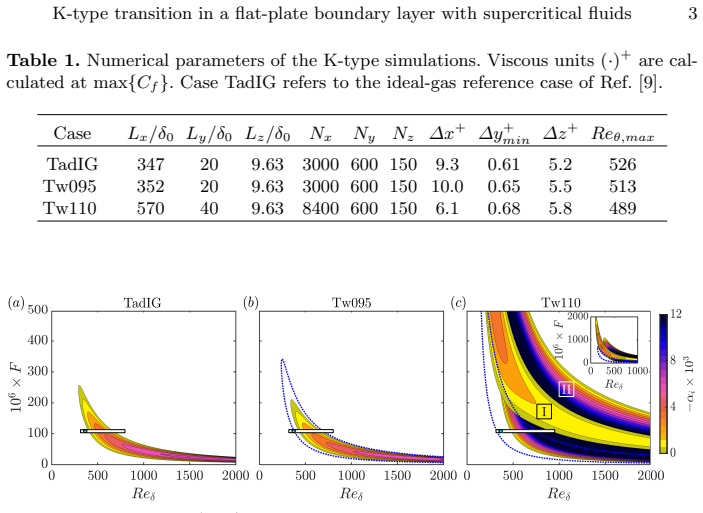
- [Section 4, Figures 2 and 3] The central claim that transition is 'significantly delayed' in the transcritical case is not quantified. The paper reports no transition-onset Reynolds number, no skin-friction-based criterion, and no direct comparison of Cf or amplitude curves between Tw095, Tw110, and TadIG; Figure 2 only shows Tw095 and Tw110, and the TadIG curves are not shown. In addition, Figure 3 compares the cases with different Q thresholds (0.06 vs 0.016) and different x-ranges, making the visual assessment of delay unreliable. The authors should report a quantitative measure such as Rex at min{Cf}, or a defined transition-onset location, for all three cases, and use consistent visualization parameters for a fair comparison.
- [Section 4, Figure 4 and following paragraph] The causal statement that localized streak secondary instabilities 'lead to' the simultaneous development of hairpin vortices and near-wall streaky structures is inferred from a single instantaneous flow field and from an amplitude threshold (the (0,1) mode exceeding 10%), but no secondary-instability analysis is performed. The symmetric varicose and antisymmetric sinuous modes are identified from the symmetry of u′ contours at one station, x/δ=238, and the downstream hairpins are observed in the same snapshot. To support the mechanism, the authors should either (i) perform a local linear stability analysis of the extracted streak profile to show that it is linearly unstable at the observed spanwise scales and frequencies, or (ii) explicitly reword the claim as a plausible conjecture rather than an established mechanism, downplaying it in the abstract and conclusions.
- [Sections 3 and 4, Table 1 and Figures 1–3] No grid-convergence or resolution-sensitivity study is presented. The transcritical case uses a substantially different grid (Nx=8400, Δx+=6.1) and a much longer domain (Lx/δ0=570) than the subcritical and ideal-gas cases (Nx=3000, Δx+≈9–10, Lx/δ0≈347–352). Since the conclusions depend on resolving the breakdown processes and on comparing the transition location across cases, the reader cannot rule out that part of the observed delay or change in breakdown route is numerical. A concise grid-convergence test, for instance comparing Cf and amplitude evolution for Tw110 at a coarser resolution, should be included.
minor comments (4)
- [Caption of Figure 2] The caption states that 'LST results are shown in black circles', but in the reproduced figure no circles are visible; please verify and correct the caption or the figure.
- [Section 2] The boundary-layer thickness is introduced as δ∗_99(x0) = δ∗_99,0 and later the local Blasius length scale δ∗ is defined; the notation is close but could be unified to avoid confusion between the inlet thickness and the local scale.
- [Section 3, references to Ref. [6]] The comparison with the H-type transition relies on Ref. [6], which is a symposium paper; please provide more specific quantitative statements from that comparison (e.g., transition-onset locations, Cf values) rather than only the qualitative remark that the transcritical K-type breakdown is 'not violent'.
- [Abstract and Conclusions] The phrase 'significantly delayed' is used without a quantitative context; consider giving the delay in terms of Rex or x/δ99,0 units to make the claim more precise.
Circularity Check
No circularity: the K-type transition delay is an observed DNS outcome under fixed external forcing, with no fitted parameter or self-citation chain defining the result.
full rationale
This is a direct numerical simulation experiment, not a derivation. The K-type disturbance is inserted with the same blowing/suction strip used for the external ideal-gas reference case of Sayadi et al., and no parameter is fitted to the observed transition delay. The subcritical and transcritical cases are compared under identical forcing, so the later and gentler breakdown in Tw110 is an outcome of the simulations rather than an input. Linear-stability statements in Sec. 3 are obtained from the authors' own LST calculations in Fig. 1, even though the mode-II label cites earlier work. Prior self-citations (mode II, H-type) supply context and comparison but do not define any DNS output quantity. The identification of streak secondary instabilities in Sec. 4 is inferred from instantaneous visualization and symmetry, which is a rigor caveat but not a circular reduction: no equation defines the observed hairpins in terms of the LSI assumption. Since no prediction is equivalent by construction to a fitted parameter, to a definition, or to a self-citation chain, the paper has no significant circularity.
Assumptions & free parameters
free parameters (3)
- Disturbance amplitudes A2-D and A3-D =
2.8e-2 and 4.0e-4
- Fundamental frequency F0 =
110e-6
- Spanwise wavenumber beta0 =
2*pi/ze
assumptions (5)
- domain assumption The reduced van der Waals equation of state captures the thermodynamics of the supercritical fluid near the Widom line.
- domain assumption The Jossi, Stiel, and Thodos analytical relations capture the transport properties.
- domain assumption The CUBENS high-order finite-difference code accurately solves the compressible Navier-Stokes equations for these flows.
- standard math Linear stability theory with the local parallel-flow assumption applies to this boundary layer.
- domain assumption The blowing/suction disturbance strip reproduces the canonical K-type breakdown in supercritical conditions.
Cite this review
Pith. "Pith review of Direct Numerical Simulations of K-type transition in a flat-plate boundary layer with supercritical fluids." pith.science (2026). https://pith.science/paper/S5724IJ4
@misc{pith2026241114286,
  author       = {Pith},
  title        = {Pith review of: Direct Numerical Simulations of K-type transition in a flat-plate boundary layer with supercritical fluids},
  year         = {2026},
  howpublished = {\url{https://pith.science/paper/S5724IJ4}},
  note         = {Machine review of arXiv:2411.14286}
}
abstract
We investigate the controlled K-type breakdown of a flat-plate boundary-layer with highly non-ideal supercritical fluid at a reduced pressure of $p_{r,\infty}=1.10$. Direct numerical simulations are performed at a Mach number of $M_\infty=0.2$ for one subcritical (liquid-like regime) temperature profile and one strongly-stratified transcritical (pseudo-boiling) temperature profile with slightly heated wall. In the subcritical case, the formation of aligned $\Lambda$-vortices is delayed compared to the reference ideal-gas case of Sayadi et al. (J. Fluid Mech., vol. 724, 2013, pp. 480-509), with steady longitudinal modes dominating the late-transitional stage. When the wall temperature exceeds the pseudo-boiling temperature, streak secondary instabilities lead to the simultaneous development of additional hairpin vortices and near-wall streaky structures near the legs of the primary aligned $\Lambda$-vortices. Nonetheless, transition to turbulence is not violent and is significantly delayed compared to the subcritical regime.
Figures


Figures from the paper (1 more)

Forward citations
Cited by 1 Pith paper
-
Direct numerical simulation of complete transition to turbulence with a fluid at supercritical pressure
Transcritical heating makes supercritical-fluid boundary layers transition through billow-like Mode II instability and flow reversal, so a single 2-D wave can trigger turbulence from numerical noise alone.
Reference graph
Works this paper leans on
-
[1]
Robinet, J.-C., Gloerfelt, X.: Instabilities in non-ideal fluids. J. Fluid Mech. 880, 1--4, 2019
work page 2019
-
[2]
Ren, J., Marxen, O., Pecnik, R.: Boundary-layer stability of supercritical fluids in the vicinity of the Widom line. J. Fluid Mech. 871, 831--864, 2019
work page 2019
-
[3]
Bugeat, B., Boldini, P. C., Hasan, A. M., Pecnik, R.: Instability in strongly stratified plane Couette flow with application to supercritical fluids. J. Fluid Mech. 984, A31, 2024
work page 2024
-
[4]
Boldini, P. C., Bugeat, B., Peeters J. W. R., Kloker, M., Pecnik, R.: Transient growth in diabatic boundary layers with fluids at supercritical pressure. Phys. Rev. Fluids 9, 083901, 2024
work page 2024
-
[5]
Ren, J., Kloker, M.: Instabilities in three-dimensional boundary-layer flows with a highly non-ideal fluid. J. Fluid Mech. 951, A9, 2022
work page 2022
-
[6]
C., Gaspar, R., Bugeat, B., Costa, P., Peeters, J
Boldini, P. C., Gaspar, R., Bugeat, B., Costa, P., Peeters, J. W. R., Pecnik, R.: Direct numerical simulation of H-type transition in a flat-plate boundary layer with supercritical fluids. 14th International ERCOFTAC Symposium on Engineering Turbulence Modelling and Measurements (ETMM14), Barcelona, Spain, 2023
work page 2023
-
[7]
Rist, U., Fasel, H.: Direct numerical simulation of controlled transition in a flat-plate boundary layer. J. Fluid Mech. 298, 211--248, 1995
work page 1995
-
[8]
C., Hirai, R., Costa, P., Peeters J
Boldini, P. C., Hirai, R., Costa, P., Peeters J. W. R., Pecnik, R.: CUBENS: a GPU-accelerated high-order solver for wall-bounded flows with non-ideal fluids. submitted to Comput. Phys. Commun., 2024
work page 2024
Show all 22 references
-
[9]
and Moin, P.: Direct numerical simulation of complete H-type and K-type transitions with implications for the dynamics of turbulent boundary layers
Sayadi, T., Hamman, C. and Moin, P.: Direct numerical simulation of complete H-type and K-type transitions with implications for the dynamics of turbulent boundary layers. J. Fluid Mech. 724, 480--509, 2013
2013
-
[10]
, " * write output.state after.block = add.period write newline
ENTRY address archive author booktitle chapter doi edition editor eid eprint howpublished institution journal key month note number organization pages publisher school series title type url volume year label extra.label sort.label short.list INTEGERS output.state before.all mi...
-
[11]
write newline
" write newline "" before.all 'output.state := FUNCTION add.period duplicate empty 'skip "." * add.blank if FUNCTION if.digit duplicate "0" = swap duplicate "1" = swap duplicate "2" = swap duplicate "3" = swap duplicate "4" = swap duplicate "5" = swap duplicate "6" = swap dupl...
-
[12]
write newline
" write newline "" before.all 'output.state := FUNCTION add.period duplicate empty 'skip "." * add.blank if FUNCTION if.digit duplicate "0" = swap duplicate "1" = swap duplicate "2" = swap duplicate "3" = swap duplicate "4" = swap duplicate "5" = swap duplicate "6" = swap dupl...
-
[13]
, " * write output.state after.block = add.period write
ENTRY address author booktitle chapter edition editor eid howpublished institution journal key month note number organization pages publisher school series title type url volume year label INTEGERS output.state before.all mid.sentence after.sentence after.block FUNCTION init.s...
-
[14]
write newline
" write newline "" before.all 'output.state := FUNCTION n.dashify 't := "" t empty not t #1 #1 substring "-" = t #1 #2 substring "--" = not "--" * t #2 global.max substring 't := t #1 #1 substring "-" = "-" * t #2 global.max substring 't := while if t #1 #1 substring * t #2 gl...
-
[15]
write newline
" write newline "" before.all 'output.state := FUNCTION n.dashify 't := "" t empty not t #1 #1 substring "-" = t #1 #2 substring "--" = not "--" * t #2 global.max substring 't := t #1 #1 substring "-" = "-" * t #2 global.max substring 't := while if t #1 #1 substring * t #2 gl...
-
[16]
write newline
" write newline "" before.all 'output.state := FUNCTION fin.entry write newline FUNCTION new.block output.state before.all = 'skip after.block 'output.state := if FUNCTION stupid.colon after.authors 'output.state := FUNCTION insert.comma output.state before.all = 'skip between...
-
[17]
, " * write output.state after.block = add.period write newline
ENTRY address author booktitle chapter doi edition editor eid howpublished institution journal key month note number organization pages publisher school series title type url volume year label INTEGERS output.state before.all mid.sentence after.sentence after.block FUNCTION in...
-
[18]
write newline
" write newline "" before.all 'output.state := FUNCTION if.digit duplicate "0" = swap duplicate "1" = swap duplicate "2" = swap duplicate "3" = swap duplicate "4" = swap duplicate "5" = swap duplicate "6" = swap duplicate "7" = swap duplicate "8" = swap "9" = or or or or or or...
-
[19]
write newline
" write newline "" before.all 'output.state := FUNCTION if.digit duplicate "0" = swap duplicate "1" = swap duplicate "2" = swap duplicate "3" = swap duplicate "4" = swap duplicate "5" = swap duplicate "6" = swap duplicate "7" = swap duplicate "8" = swap "9" = or or or or or or...
-
[20]
, " * write output.state after.block = add.period write newline
ENTRY address author booktitle chapter doi edition editor eid howpublished institution journal key month note number organization pages publisher school series title type url volume year label INTEGERS output.state before.all mid.sentence after.sentence after.block FUNCTION in...
-
[21]
write newline
" write newline "" before.all 'output.state := FUNCTION if.digit duplicate "0" = swap duplicate "1" = swap duplicate "2" = swap duplicate "3" = swap duplicate "4" = swap duplicate "5" = swap duplicate "6" = swap duplicate "7" = swap duplicate "8" = swap "9" = or or or or or or...
-
[22]
write newline
" write newline "" before.all 'output.state := FUNCTION n.dashify 't := "" t empty not t #1 #1 substring "-" = t #1 #2 substring "--" = not "--" * t #2 global.max substring 't := t #1 #1 substring "-" = "-" * t #2 global.max substring 't := while if t #1 #1 substring * t #2 gl...
Reviewed August 12, 2026 · model on record in the stance chip above.
Discussion (0). Continue with ORCID to comment.