REVIEW 3 major objections 6 minor 86 references
You Only Look Omni Gradient Backpropagation for Moving Infrared Small Target Detection
T0 review · 3 major / 6 minor · reviewed 2026-08-03 · deepseek-v4-flash
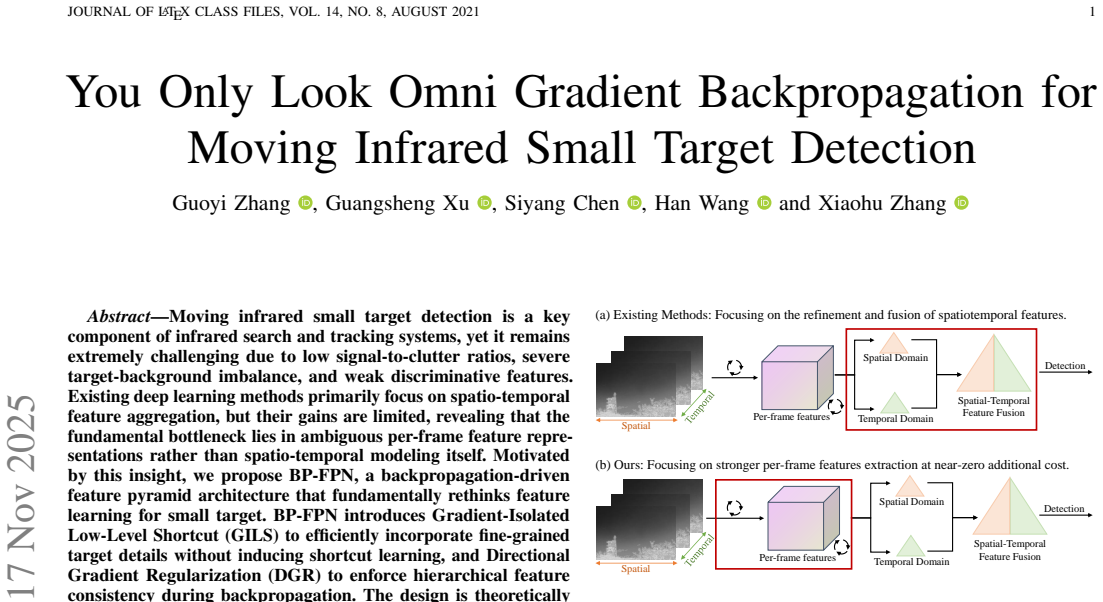
Pith's one-line read Moving infrared small target detection's true bottleneck is ambiguous per-frame features, not spatio-temporal modeling—and a backpropagation-designed feature pyramid, BP-FPN, fixes that bottleneck at near-zero extra cost.
desk verdict Large claimed gain from a simple plug-in FPN, but the baseline delta is not yet controlled and the theory is overclaimed; still worth a serious referee. read the letter →
The pith
A machine-rendered reading of the paper's core claim, the machinery that carries it, and where it could break.
The reading
What carries the argument
The load-bearing mechanisms are GILS and DGR. GILS is a gradient-isolated low-level shortcut: a high-resolution backbone feature (C2) is pixel-unshuffled and passed through a 1x1 convolution, but the input to this branch is detached (X.detach()), so gradients do not flow back to C2; the branch still refines target details during its own updates. DGR is directional gradient regularization: two fusions (first P3 with P4, then the result with downsampled detached C2) share the same fusion weights, so backpropagated gradients from both steps sum on one parameter vector, coupling low-, mid-, and high-level semantics and suppressing inconsistent gradient directions. The paper's theoretical expansi
What would settle it
Take the high-resolution FPN variant from Fig. 2(b), train it on a larger or augmented training set (or with a different backbone), and compare its mAP on unseen sequences: if its generalization gap to the vanilla FPN shrinks or disappears, the failure is a data-size artifact rather than a fundamental property of the gradient shortcut. Alternatively, keep the shortcut attached but scale its gradient by a small constant instead of detaching it; if performance does not improve toward the detached case, the benefit is specifically from zeroing that gradient path.
Extended reading notes
Core claim
The central claim is that a conventional FPN fails for moving infrared small targets because it loses low-level, high-resolution cues, while naively adding those cues through a high-resolution shortcut creates a dominant gradient path that makes the model memorize training patterns and fail to generalize. The remedy routes high-resolution C2 features through a learnable downsampler whose input is detached from backpropagation (Y = Down(X.detach())), so fine detail enters the forward path while shallow-layer gradients stay unchanged. Parameter-shared fusion (DGR) then makes the gradients of two sequential fusions land on the same weights, superposing error signals and implicitly regularizing
Load-bearing premise
The claim that the collapse of the high-resolution shortcut is caused by gradient flow through that shortcut—and that detaching it is what restores generalization—rests on a few ablation runs on one benchmark, not on a broad demonstration of the shortcut-learning mechanism across datasets and architectures.
Editorial extensions
If this is right
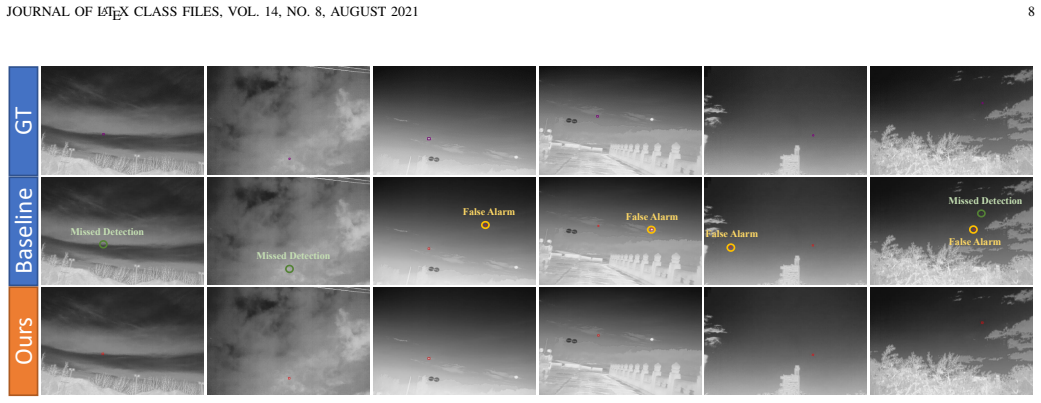
- If the diagnosis is right, future moving infrared small target detectors should prioritize intra-frame feature fidelity over further spatio-temporal fusion; the reported gains on IRDST (+11.31 mAP50, +6.37 F1) are achieved without changing the temporal aggregation module.
- GILS can be dropped into existing FPNs: attaching it to Hourglass FPN improves mAP50 from 72.85 to 74.51 at identical FLOPs/params, indicating the gradient-isolation principle transfers beyond the authors' own baseline.
- DGR's parameter-sharing mechanism is a zero-parameter-cost regularizer; it requires only reusing the baseline's existing fusion module twice, so any detector with a fusion layer can adopt it.
- BP-FPN reaches the baseline's final accuracy using roughly one-third of the training epochs, shortening development cycles.
- The plug-and-play results on Tridos (73.72 to 78.91 mAP50) suggest the components are framework-agnostic, not tied to SSTNet.
Reading between the lines
- A natural test beyond infrared: the same gradient-isolation trick might improve small-object detection in natural images where high-resolution skip connections are known to hurt robustness; the mechanism is stated generically enough to be tried there.
- The paper's 'shortcut learning' explanation is one plausible story; the detached branch also changes the loss surface and optimization dynamics, so the claim that gradient flow is the causal agent needs cross-dataset and cross-backbone validation to be fully general.
- Because DGR works through gradient superposition rather than architectural complexity, it suggests that many existing multi-scale fusion networks may be under-regularized by the same principle; re-using weights in sequential fusions could be a general design rule for cross-scale consistency.
Signed reviews
Editorial analysis
A structured set of objections, weighed in public.
Referee Report
Summary. This paper addresses moving infrared small target detection in video. It argues that the bottleneck is not spatio-temporal aggregation but weak/ambiguous per-frame features, and proposes BP-FPN, a macro-architecture added to an existing detector. BP-FPN has two components: GILS, which injects a downsampled C2 feature into the FPN fusion with the gradient detached, and DGR, which fuses low/mid/high features with a shared fusion module in a particular order. On IRDST, plugging BP-FPN into SSTNet raises mAP50 from 71.55 to 82.86 and F1 from 85.11 to 91.48 with negligible parameter/FLOP overhead; plugging into Tridos gives smaller gains. Ablations on IRDST support both components, and a plug-in experiment on Hourglass FPN is reported. The central claim is that per-frame representational quality is the first-order lever and that the design is theoretically grounded via backpropagation analysis.
Significance. If the empirical claims survive controlled comparison, this is a practically valuable result: the modification is tiny (+0.03M params, +5.1 GFLOPs) and transferable, and the proposed diagnosis of per-frame features over temporal aggregation is a useful counterpoint to the field's emphasis on spatio-temporal fusion. The paper is good at isolating the architecture design (Tables II, III, VI, VIII) and reports external benchmarks. However, the main empirical comparison is not controlled: the SSTNet baseline appears to be a published number rather than a same-protocol re-run, and no variance is reported. The shortcut-learning explanation is also presented as established fact although the evidence is indirect. The theoretical analysis is largely an algebraic restatement of the chain rule.
major comments (3)
- [§IV.B and Tables IV–VI] The headline +11.31 mAP50 gain over SSTNet (71.55→82.86) is not a controlled comparison. Section IV.B states that results are 'primarily ... as presented in the original papers of each method,' while Section IV.A specifies the authors' own training protocol (T=5, 512×512, 100 epochs, batch size 4, SGD lr 0.01). Nothing states that the SSTNet baseline 71.55 was re-run under this protocol; Table VI uses the same number. With no seeds or variance in Tables IV–VIII, part of the gap may be due to training schedule, split, NMS, or other protocol differences. At minimum, re-train SSTNet under exactly the authors' protocol and report mean±std over multiple runs, and state whether every compared method shares the same split and post-processing. Also reconcile Fig. 2 (baseline 'Training Epoch 65', ours 21) with Section IV.A's 100-epoch training.
- [§III.B and Table VI] The shortcut-learning mechanism is load-bearing for the paper's framing, but the evidence does not distinguish shortcut learning from optimization instability. The key ablation (strategy b: 67.67 vs c: 72.31) is one dataset, one run. The claim that detaching the C2 branch 'prevents shortcut learning' is inferred from final test mAP, but no measure of generalization (e.g., train vs test gap, sensitivity to spurious low-level patterns) is provided. The paper's own Section IV.D then states that 'the task is inherently a video-based detection problem, in which inter-frame correlation modeling remains crucial' and describes a failure caused by temporal aggregation. This is in tension with the abstract's claim that the bottleneck is per-frame representation, not spatio-temporal modeling. Please add a direct test of the shortcut hypothesis and either soften the causal claim or reconcile it with
- [§III.C, Eq. (6), Tables III and VI] Eq. (6) is a chain-rule identity; the paper's assertion that parameter sharing 'strengthens the shared beneficial representations while suppressing inconsistent ones' is posited, not derived. The later expansion in Eqs. (9)–(11) and (14)–(17) shows that additional gradient paths exist under sharing, but it does not establish that these paths align with 'beneficial' directions. The choice of Variant 2 over Variant 1 (Fig. 6) is an additional design freedom; the explanation in Section III.C is qualitative and difficult to falsify. Since the 'theoretically grounded' claim rests on this gradient-superposition argument, it should be either proved under stated assumptions or explicitly presented as a heuristic with a controlled study of fusion order.
minor comments (6)
- [§III.B, Eq. after (3)] The information-loss ratio has a typographical error: the denominator is written as C×H×H but should be C×H×W.
- [Table IV] The RSTNN row is identical to the HBMLCM row for all three datasets; please verify whether this is a copying error or a genuine duplication.
- [Tables II, III, VI] The repeated 71.55 baseline entry should be explicitly labeled as either the published value from [7] or a local re-run under the authors' protocol; the current presentation is ambiguous.
- [Fig. 2 vs §IV.A] The 'Training Epoch' values in Fig. 2 (65 and 21) conflict with the 100-epoch schedule described in Section IV.A. Define the checkpoint/early-stopping rule used for the reported results.
- [§IV.A] The performance-cost ratio PCR is used in Tables II, III, V–VIII but is not formally defined in the metrics paragraph; state the formula (apparently mAP50/GFlops) and any normalization.
- [General] No code or trained models are released. Given the protocol-mismatch concern above, code release would substantially improve the reproducibility of the plug-and-play claims.
Circularity Check
No significant circularity: the central claims are benchmark-based and the ablations compare direct architectural changes; the post-hoc theoretical framing and self-citations are concerns, but there is no definitional reduction by construction.
full rationale
The paper's load-bearing empirical claims are not derived from their own definitions. GILS is defined by Eq. 1 (Y=Down(X.detach())), but its benefit is established by direct ablation comparisons in Table II (81.40 vs 82.86) and Table VI, not by construction. DGR is defined by shared-parameter fusion (Eqs. 4--6); Eq. 6 is just the chain rule for shared parameters, and its effectiveness is established empirically by Table III (Variant 1 80.23 vs Variant 2 82.86) and Table VI. The theoretical discussion in Sec. III.C is post-hoc in the sense that Variant 2 was chosen empirically and then rationalized, and the shortcut-learning mechanism is under-supported; these are interpretation/evidence weaknesses rather than circular reductions. The baseline-control concern is real: Sec. IV.B states results are 'primarily ... as presented in the original papers of each method,' so the +11.31 mAP50 over SSTNet may mix training protocols (100-epoch/512x512 for Ours vs published numbers for SSTNet). This is an experimental-fairness threat, not a circularity. Several cited works are self-citations by the same group ([2],[3],[17],[18],[38],[40],[57]), but none is load-bearing for the central derivation; the per-frame bottleneck claim is argued in-text and supported by plug-in results on external benchmarks including Tridos (Table I). No equation reduces to its own input, and no prediction is forced by a fitted parameter.
Assumptions & free parameters
free parameters (3)
- Fusion order (Variant 2 over Variant 1) =
Variant 2: P3⊕P4 first, then C2 (Eqs. 7–8)
- Downsampling operator in GILS =
PixelUnshuffle2 + 1×1 conv (Eqs. 2–3)
- C2-shortcut output channels (2C) =
2C after 4C intermediate
assumptions (4)
- domain assumption Infrared small targets are extremely sparse, so under compressive sensing a learnable downsampling can preserve target information while discarding background clutter.
- domain assumption Shortcut learning arises from backpropagated gradients through direct low-level connections and degrades generalization.
- ad hoc to paper Gradient superposition under parameter sharing 'strengthens the shared beneficial representations while suppressing inconsistent ones.'
- domain assumption Reported numbers from other papers are directly comparable to the authors' runs (same splits, thresholds, training budgets).
Cite this review
Pith. "Pith review of You Only Look Omni Gradient Backpropagation for Moving Infrared Small Target Detection." pith.science (2026). https://pith.science/paper/S5M6USNS
@misc{pith2026251113013,
  author       = {Pith},
  title        = {Pith review of: You Only Look Omni Gradient Backpropagation for Moving Infrared Small Target Detection},
  year         = {2026},
  howpublished = {\url{https://pith.science/paper/S5M6USNS}},
  note         = {Machine review of arXiv:2511.13013}
}
read the original abstract
Moving infrared small target detection is a key component of infrared search and tracking systems, yet it remains extremely challenging due to low signal-to-clutter ratios, severe target-background imbalance, and weak discriminative features. Existing deep learning methods primarily focus on spatio-temporal feature aggregation, but their gains are limited, revealing that the fundamental bottleneck lies in ambiguous per-frame feature representations rather than spatio-temporal modeling itself. Motivated by this insight, we propose BP-FPN, a backpropagation-driven feature pyramid architecture that fundamentally rethinks feature learning for small target. BP-FPN introduces Gradient-Isolated Low-Level Shortcut (GILS) to efficiently incorporate fine-grained target details without inducing shortcut learning, and Directional Gradient Regularization (DGR) to enforce hierarchical feature consistency during backpropagation. The design is theoretically grounded, introduces negligible computational overhead, and can be seamlessly integrated into existing frameworks. Extensive experiments on multiple public datasets show that BP-FPN consistently establishes new state-of-the-art performance. To the best of our knowledge, it is the first FPN designed for this task entirely from the backpropagation perspective.
Figures


Figures from the paper (7 more)




Reference graph
Works this paper leans on
-
[1]
Background modeling in the fourier domain for maritime infrared target detection,
A. Zhou, W. Xie, and J. Pei, “Background modeling in the fourier domain for maritime infrared target detection,”IEEE Transactions on Circuits and Systems for Video Technology, vol. 30, no. 8, pp. 2634–2649, 2020
2020
-
[2]
Learning dynamic local context representations for infrared small target detection,
G. Zhang, G. Xu, S. Chen, H. Wang, and X. Zhang, “Learning dynamic local context representations for infrared small target detection,”IEEE Transactions on Geoscience and Remote Sensing, vol. 63, pp. 1–13, 2025
2025
-
[3]
It’s not the target, it’s the background: Rethinking infrared small- target detection via deep patch-free low-rank representations,
——, “It’s not the target, it’s the background: Rethinking infrared small- target detection via deep patch-free low-rank representations,”IEEE Transactions on Geoscience and Remote Sensing, vol. 63, pp. 1–13, 2025
2025
-
[4]
Learning contrast-enhanced shape-biased representations for infrared small target detection,
F. Lin, K. Bao, Y . Li, D. Zeng, and S. Ge, “Learning contrast-enhanced shape-biased representations for infrared small target detection,”IEEE Transactions on Image Processing, vol. 33, pp. 3047–3058, 2024
2024
-
[5]
Infrared small target detection with scale and location sensitivity,
Q. Liu, R. Liu, B. Zheng, H. Wang, and Y . Fu, “Infrared small target detection with scale and location sensitivity,” inProceedings of the IEEE/CVF Computer Vision and Pattern Recognition, 2024
2024
-
[6]
Deformable feature alignment and refinement for moving infrared small target detection,
D. Luo, Y . Xiang, H. Wang, L. Ji, S. Li, and M. Ye, “Deformable feature alignment and refinement for moving infrared small target detection,” Pattern Recognition, vol. 169, p. 111894, 2026
2026
-
[7]
Sstnet: Sliced spatio- temporal network with cross-slice convlstm for moving infrared dim- small target detection,
S. Chen, L. Ji, J. Zhu, M. Ye, and X. Yao, “Sstnet: Sliced spatio- temporal network with cross-slice convlstm for moving infrared dim- small target detection,”IEEE Transactions on Geoscience and Remote Sensing, vol. 62, pp. 1–12, 2024
2024
-
[8]
Triple-domain feature learning with frequency-aware memory enhancement for moving infrared small target detection,
W. Duan, L. Ji, S. Chen, S. Zhu, and M. Ye, “Triple-domain feature learning with frequency-aware memory enhancement for moving infrared small target detection,”IEEE Transactions on Geoscience and Remote Sensing, 2024
2024
Show all 86 references
-
[9]
Tcnet: A novel triple- cooperative network for video object detection,
Q. Qi, T. Hou, Y . Yan, Y . Lu, and H. Wang, “Tcnet: A novel triple- cooperative network for video object detection,”IEEE Transactions on Circuits and Systems for Video Technology, vol. 33, no. 8, pp. 3649–3662, 2023
2023
-
[10]
Dgc-net: Dynamic graph contrastive network for video object detection,
Q. Qi, H. Wang, Y . Yan, and X. Li, “Dgc-net: Dynamic graph contrastive network for video object detection,”IEEE Transactions on Image Processing, vol. 34, pp. 2269–2284, 2025
2025
-
[11]
Feature pyramid networks for object detection,
T.-Y . Lin, P. Dollár, R. Girshick, K. He, B. Hariharan, and S. Belongie, “Feature pyramid networks for object detection,” inCVPR, 2017, pp. 2117–2125
2017
-
[12]
Yoloh: you only look one hourglass for real-time object detection,
S. Wang, R. Chen, H. Wu, X. Li, and Z. Feng, “Yoloh: you only look one hourglass for real-time object detection,”IEEE transactions on image processing, vol. 33, pp. 2104–2115, 2024
2024
-
[13]
Bridging multi-scale context- aware representation for object detection,
B. Wang, R. Ji, L. Zhang, and Y . Wu, “Bridging multi-scale context- aware representation for object detection,”IEEE Transactions on Circuits and Systems for Video Technology, vol. 33, no. 5, pp. 2317–2329, 2023
2023
-
[14]
Rectify vit shortcut learning by visual saliency,
C. Ma, L. Zhao, Y . Chen, L. Guo, T. Zhang, X. Hu, D. Shen, X. Jiang, and T. Liu, “Rectify vit shortcut learning by visual saliency,”IEEE Transactions on Neural Networks and Learning Systems, vol. 35, no. 12, pp. 18 013–18 025, 2024
2024
-
[15]
Infrared small target detection in satellite videos: a new dataset and a novel recurrent feature refinement framework,
X. Ying, L. Liu, Z. Lin, Y . Shi, Y . Wang, R. Li, X. Cao, B. Li, S. Zhou, and W. An, “Infrared small target detection in satellite videos: a new dataset and a novel recurrent feature refinement framework,”IEEE Transactions on Geoscience and Remote Sensing, 2025
2025
-
[16]
Osformer: One-step transformer for infrared video small object detection,
H. Qin, T. Xu, Y . Tang, F. Xu, and J. Li, “Osformer: One-step transformer for infrared video small object detection,”IEEE Transactions on Image Processing, vol. 34, pp. 5725–5736, 2025
2025
-
[17]
Motion prior knowledge learning with homogeneous language descriptions for moving infrared small target detection,
S. Chen, L. Ji, W. Duan, S. Peng, and M. Ye, “Motion prior knowledge learning with homogeneous language descriptions for moving infrared small target detection,” inProceedings of the AAAI Conference on Artificial Intelligence, vol. 39, no. 2, 2025, pp. 2186–2194
2025
-
[18]
Language- driven motion prior knowledge learning for moving infrared small target detection,
S. Chen, L. Ji, S. Peng, S. Zhu, M. Ye, and Y . Sang, “Language- driven motion prior knowledge learning for moving infrared small target detection,”IEEE Transactions on Geoscience and Remote Sensing, 2025
2025
-
[19]
Temporal- channel transformer for 3d lidar-based video object detection for autonomous driving,
Z. Yuan, X. Song, L. Bai, Z. Wang, and W. Ouyang, “Temporal- channel transformer for 3d lidar-based video object detection for autonomous driving,”IEEE Transactions on Circuits and Systems for Video Technology, vol. 32, no. 4, pp. 2068–2078, 2022
-
[20]
Class-aware feature aggregation network for video object detection,
L. Han, P. Wang, Z. Yin, F. Wang, and H. Li, “Class-aware feature aggregation network for video object detection,”IEEE Transactions on Circuits and Systems for Video Technology, vol. 32, no. 12, pp. 8165– 8178, 2022
2022
-
[21]
Multilevel spatial- temporal feature aggregation for video object detection,
C. Xu, J. Zhang, M. Wang, G. Tian, and Y . Liu, “Multilevel spatial- temporal feature aggregation for video object detection,”IEEE Transac- tions on Circuits and Systems for Video Technology, vol. 32, no. 11, pp. 7809–7820, 2022
2022
-
[22]
Joint spatial and temporal feature enhancement network for disturbed object detection,
F. Zhang, H. Ji, Y . Zhang, and Z. Zhu, “Joint spatial and temporal feature enhancement network for disturbed object detection,”IEEE Transactions on Circuits and Systems for Video Technology, vol. 34, no. 12, pp. 12 258–12 273, 2024
2024
-
[24]
Transvod: End-to-end video object detection with spatial- temporal transformers,
Q. Zhou, X. Li, L. He, Y . Yang, G. Cheng, Y . Tong, L. Ma, and D. Tao, “Transvod: End-to-end video object detection with spatial- temporal transformers,”IEEE Transactions on Pattern Analysis and Machine Intelligence, vol. 45, no. 6, pp. 7853–7869, 2022. JOURNAL OF LATEX CLASS...
2022
-
[25]
Infrared small and dim target detection with transformer under complex backgrounds,
F. Liu, C. Gao, F. Chen, D. Meng, W. Zuo, and X. Gao, “Infrared small and dim target detection with transformer under complex backgrounds,” IEEE Transactions on Image Processing, vol. 32, pp. 5921–5932, 2023
2023
-
[26]
Wormhole dynamics in deep neural networks,
Y .-L. Lai and Z. Jin, “Wormhole dynamics in deep neural networks,” IEEE Transactions on Neural Networks and Learning Systems, vol. 36, no. 11, pp. 19 909–19 923, 2025
2025
-
[27]
An information-theoretic method to automatic shortcut avoidance and domain generalization for dense prediction tasks,
W. Chuah, R. Tennakoon, R. Hoseinnezhad, D. Suter, and A. Bab- Hadiashar, “An information-theoretic method to automatic shortcut avoidance and domain generalization for dense prediction tasks,”IEEE Transactions on Pattern Analysis and Machine Intelligence, vol. 45, no. 9, pp. ...
2023
-
[28]
Shortcut learning in deep neural networks,
R. Geirhos, J.-H. Jacobsen, C. Michaelis, R. Zemel, W. Brendel, M. Bethge, and F. A. Wichmann, “Shortcut learning in deep neural networks,”Nature Machine Intelligence, vol. 2, no. 11, pp. 665–673, 2020
2020
-
[29]
The pitfalls of simplicity bias in neural networks,
H. Shah, K. Tamuly, A. Raghunathan, P. Jain, and P. Netrapalli, “The pitfalls of simplicity bias in neural networks,”Advances in Neural Information Processing Systems, vol. 33, pp. 9573–9585, 2020
2020
-
[30]
What shapes feature representations? exploring datasets, architectures, and training,
K. Hermann and A. Lampinen, “What shapes feature representations? exploring datasets, architectures, and training,”Advances in Neural Information Processing Systems, vol. 33, pp. 9995–10 006, 2020
2020
-
[31]
Which shortcut cues will dnns choose? A study from the parameter-space perspective,
L. Scimeca, S. J. Oh, S. Chun, M. Poli, and S. Yun, “Which shortcut cues will dnns choose? A study from the parameter-space perspective,” inICLR, 2022
2022
-
[32]
On the foundations of shortcut learning,
K. L. Hermann, H. Mobahi, T. Fel, and M. C. Mozer, “On the foundations of shortcut learning,” inICLR, 2024
2024
-
[33]
On the spectral bias of neural networks,
N. Rahaman, A. Baratin, D. Arpit, F. Draxler, M. Lin, F. Hamprecht, Y . Bengio, and A. Courville, “On the spectral bias of neural networks,” inICML. PMLR, 2019, pp. 5301–5310
2019
-
[34]
Neural redshift: Random networks are not random functions,
D. Teney, A. M. Nicolicioiu, V . Hartmann, and E. Abbasnejad, “Neural redshift: Random networks are not random functions,” inCVPR, 2024, pp. 4786–4796
2024
-
[35]
Interpretability-guided inductive bias for deep learning based medical image,
D. Mahapatra, A. Poellinger, and M. Reyes, “Interpretability-guided inductive bias for deep learning based medical image,”Medical image analysis, vol. 81, p. 102551, 2022
2022
-
[36]
Manifoldron: Direct space partition via manifold discovery,
D. Wang, F.-L. Fan, B.-J. Hou, H. Zhang, Z. Jia, B. Zhang, R. Lai, H. Yu, and F. Wang, “Manifoldron: Direct space partition via manifold discovery,”IEEE Transactions on Neural Networks and Learning Systems, 2024
2024
-
[37]
Rectifying the shortcut learning of background for few-shot learning,
X. Luo, L. Wei, L. Wen, J. Yang, L. Xie, Z. Xu, and Q. Tian, “Rectifying the shortcut learning of background for few-shot learning,”Advances in Neural Information Processing Systems, vol. 34, pp. 13 073–13 085, 2021
2021
-
[38]
Beyond motion cues and structural sparsity: Revisiting small moving target detection,
G. Zhang, S. Chen, G. Xu, Z. Shen, H. Wang, and X. Zhang, “Beyond motion cues and structural sparsity: Revisiting small moving target detection,”arXiv preprint arXiv:2509.07654, 2025
2025 arXiv
-
[39]
Direction- coded temporal u-shape module for multiframe infrared small target detection,
R. Li, W. An, C. Xiao, B. Li, Y . Wang, M. Li, and Y . Guo, “Direction- coded temporal u-shape module for multiframe infrared small target detection,”IEEE Transactions on Neural Networks and Learning Systems, 2023
2023
-
[40]
Micpl: Motion-inspired cross-pattern learning for small-object detection in satellite videos,
S. Chen, L. Ji, S. Zhu, and M. Ye, “Micpl: Motion-inspired cross-pattern learning for small-object detection in satellite videos,”IEEE Transactions on Neural Networks and Learning Systems, vol. 36, no. 4, pp. 6437–6450, 2024
2024
-
[41]
Receptive-field and direction induced attention network for infrared dim small target detection with a large-scale dataset irdst,
H. Sun, J. Bai, F. Yang, and X. Bai, “Receptive-field and direction induced attention network for infrared dim small target detection with a large-scale dataset irdst,”IEEE Transactions on Geoscience and Remote Sensing, vol. 61, pp. 1–13, 2023
2023
-
[42]
A generic improvement to deep residual networks based on gradient flow,
V . Santhanam and L. S. Davis, “A generic improvement to deep residual networks based on gradient flow,”IEEE Transactions on Neural Networks and Learning Systems, vol. 31, no. 7, pp. 2490–2499, 2020
2020
-
[43]
Yolo-ms: Rethinking multi-scale representation learning for real-time object detection,
Y . Chen, X. Yuan, J. Wang, R. Wu, X. Li, Q. Hou, and M.-M. Cheng, “Yolo-ms: Rethinking multi-scale representation learning for real-time object detection,”IEEE Transactions on Pattern Analysis and Machine Intelligence, 2025
2025
-
[44]
Dpmnet: A remote sensing forest fire real-time detection network driven by dual pathways and multidimensional interactions of features,
G. Wang, H. Li, V . Sheng, Y . Ma, H. Ding, and H. Zhao, “Dpmnet: A remote sensing forest fire real-time detection network driven by dual pathways and multidimensional interactions of features,”IEEE Transactions on Circuits and Systems for Video Technology, vol. 35, no. 1, pp....
2025
-
[45]
Save the tiny, save the all: Hierarchical activation network for tiny object detection,
G. Guo, P. Chen, X. Yu, Z. Han, Q. Ye, and S. Gao, “Save the tiny, save the all: Hierarchical activation network for tiny object detection,”IEEE Transactions on Circuits and Systems for Video Technology, vol. 34, no. 1, pp. 221–234, 2024
2024
-
[46]
Efficient selective context network for accurate object detection,
J. Nie, Y . Pang, S. Zhao, J. Han, and X. Li, “Efficient selective context network for accurate object detection,”IEEE Transactions on Circuits and Systems for Video Technology, vol. 31, no. 9, pp. 3456–3468, 2021
2021
-
[47]
Spatio-temporal feature pyramid interactive attention network for egocentric gaze prediction,
M. Yuan and D. Xu, “Spatio-temporal feature pyramid interactive attention network for egocentric gaze prediction,”IEEE Transactions on Circuits and Systems for Video Technology, vol. 33, no. 10, pp. 5790–5801, 2023
2023
-
[48]
Bi-directional and triangular circulation fusion neural networks for small object detection,
F. Li, J. Duan, Q. Zhang, C. Shan, and H. Han, “Bi-directional and triangular circulation fusion neural networks for small object detection,” IEEE Transactions on Circuits and Systems for Video Technology, vol. 35, no. 6, pp. 5140–5152, 2025
2025
-
[49]
Cfrla-net: A context-aware feature representation learning anchor-free network for pedestrian detection,
J. Li, Y . Bi, S. Wang, and Q. Li, “Cfrla-net: A context-aware feature representation learning anchor-free network for pedestrian detection,” IEEE Transactions on Circuits and Systems for Video Technology, vol. 33, no. 9, pp. 4948–4961, 2023
2023
-
[50]
Af-yolo: Asymptotic feature extraction and fusion for aerial object detection,
L. Huang, X. Yu, H. Yan, L. Huang, Z. An, and Y . Xu, “Af-yolo: Asymptotic feature extraction and fusion for aerial object detection,” IEEE Transactions on Circuits and Systems for Video Technology, pp. 1–1, 2025
2025
-
[51]
Model-based compressive sensing,
R. G. Baraniuk, V . Cevher, M. F. Duarte, and C. Hegde, “Model-based compressive sensing,”IEEE Transactions on information theory, vol. 56, no. 4, pp. 1982–2001, 2010
1982
-
[52]
One-stage cascade refinement networks for infrared small target detection,
Y . Dai, X. Li, F. Zhou, Y . Qian, Y . Chen, and J. Yang, “One-stage cascade refinement networks for infrared small target detection,”IEEE Transactions on Geoscience and Remote Sensing, vol. 61, pp. 1–17, 2023
2023
-
[53]
Disentangled representation learning with transmitted information bottle- neck,
Z. Dang, M. Luo, C. Jia, G. Dai, J. Wang, X. Chang, and J. Wang, “Disentangled representation learning with transmitted information bottle- neck,”IEEE Transactions on Circuits and Systems for Video Technology, vol. 34, no. 12, pp. 13 297–13 310, 2024
2024
-
[54]
Detection and tracking meet drones challenge,
P. Zhu, L. Wen, D. Du, X. Bian, H. Fan, Q. Hu, and H. Ling, “Detection and tracking meet drones challenge,”IEEE Transactions on Pattern Analysis and Machine Intelligence, vol. 44, no. 11, pp. 7380–7399, 2021
2021
-
[55]
No more strided convolutions or pooling: A new cnn building block for low-resolution images and small objects,
R. Sunkara and T. Luo, “No more strided convolutions or pooling: A new cnn building block for low-resolution images and small objects,” inJoint European conference on machine learning and knowledge discovery in databases. Springer, 2022, pp. 443–459
2022
-
[56]
Infrared patch-image model for small target detection in a single image,
C. Gao, D. Meng, Y . Yang, Y . Wang, X. Zhou, and A. Hauptmann, “Infrared patch-image model for small target detection in a single image,” Image Processing, IEEE Transactions on, vol. 22, no. 12, pp. 4996–5009, 2013
2013
-
[57]
Vision-centric representation-efficient fine-tuning for robust universal foreground seg- mentation,
G. Zhang, S. Chen, G. Xu, H. Wang, and X. Zhang, “Vision-centric representation-efficient fine-tuning for robust universal foreground seg- mentation,”arXiv preprint arXiv:2504.14481, 2025
2025
-
[58]
Prior guided feature enrichment network for few-shot segmentation,
Z. Tian, H. Zhao, M. Shu, Z. Yang, R. Li, and J. Jia, “Prior guided feature enrichment network for few-shot segmentation,”TPAMI, 2020
2020
-
[59]
Real-world nighttime dehazing via score-guided multi-scale fusion and dual-channel enhancement,
T. Li, Y . Liu, S. Luo, W. Ren, and W. Lin, “Real-world nighttime dehazing via score-guided multi-scale fusion and dual-channel enhancement,”IEEE Transactions on Circuits and Systems for Video Technology, pp. 1–1, 2025
2025
-
[60]
Amsfusion: An adaptive multi-scale infrared and visible image fusion network based on attention mechanisms,
Q. Yang, K. Ren, and Q. Chen, “Amsfusion: An adaptive multi-scale infrared and visible image fusion network based on attention mechanisms,” IEEE Transactions on Circuits and Systems for Video Technology, pp. 1–1, 2025
2025
-
[61]
Mifnet: Multi-scale interaction fusion network for remote sensing image change detection,
W. Xie, W. Shao, D. Li, Y . Li, and L. Fang, “Mifnet: Multi-scale interaction fusion network for remote sensing image change detection,” IEEE Transactions on Circuits and Systems for Video Technology, vol. 35, no. 3, pp. 2725–2739, 2025
2025
-
[62]
Catfpn: Adaptive feature pyramid with scale-wise concatenation and self-attention,
J. Huang, Z. Chen, Q. M. J. Wu, C. Liu, H. Yuan, and W. He, “Catfpn: Adaptive feature pyramid with scale-wise concatenation and self-attention,”IEEE Transactions on Circuits and Systems for Video Technology, vol. 32, no. 12, pp. 8142–8152, 2022
2022
-
[63]
Feature alignment in anchor- free object detection,
F. Gao, Y . Cai, F. Deng, C. Yu, and J. Chen, “Feature alignment in anchor- free object detection,”IEEE Transactions on Circuits and Systems for Video Technology, vol. 33, no. 8, pp. 3799–3810, 2023
2023
-
[64]
Segmenting beyond the bounding box for instance segmentation,
X. Zhang, H. Li, F. Meng, Z. Song, and L. Xu, “Segmenting beyond the bounding box for instance segmentation,”IEEE Transactions on Circuits and Systems for Video Technology, vol. 32, no. 2, pp. 704–714, 2022
2022
-
[65]
Stdmanet: Spatio-temporal differential multiscale attention network for small moving infrared target detection,
P. Yan, R. Hou, X. Duan, C. Yue, X. Wang, and X. Cao, “Stdmanet: Spatio-temporal differential multiscale attention network for small moving infrared target detection,”IEEE Transactions on Geoscience and Remote Sensing, vol. 61, pp. 1–16, 2023
2023
-
[66]
Grad-cam: Visual explanations from deep networks via gradient-based localization,
R. R. Selvaraju, M. Cogswell, A. Das, R. Vedantam, D. Parikh, and D. Batra, “Grad-cam: Visual explanations from deep networks via gradient-based localization,” in2017 IEEE International Conference on Computer Vision (ICCV), 2017, pp. 618–626
2017
-
[67]
A dataset for infrared image dim-small aircraft target detection JOURNAL OF LATEX CLASS FILES, VOL. 14, NO. 8, AUGUST 2021 12 and tracking under ground/air background,
B. H. B. Hui, Z. S. Z. Song, H. F. H. Fan, P. Z. P. Zhong, W. H. W. Hu, X. Z. X. Zhang, J. L. J. Lin, H. S. H. Su, W. J. W. Jin, Y . Z. Y . Zhang et al., “A dataset for infrared image dim-small aircraft target detection JOURNAL OF LATEX CLASS FILES, VOL. 14, NO. 8, AUGUST 2021...
2021
-
[68]
Max-mean and max-median filters for detection of small targets,
S. D. Deshpande, M. H. Er, R. Venkateswarlu, and P. Chan, “Max-mean and max-median filters for detection of small targets,” inSignal and Data Processing of Small Targets 1999, vol. 3809. SPIE, 1999, pp. 74–83
1999
-
[69]
Analysis of new top-hat transformation and the application for infrared dim small target detection,
X. Bai and F. Zhou, “Analysis of new top-hat transformation and the application for infrared dim small target detection,”Pattern Recognition, vol. 43, no. 6, pp. 2145–2156, 2010
2010
-
[70]
Infrared small target detection utilizing the multiscale relative local contrast measure,
J. Han, K. Liang, B. Zhou, X. Zhu, J. Zhao, and L. Zhao, “Infrared small target detection utilizing the multiscale relative local contrast measure,” IEEE geoscience and remote sensing letters, vol. 15, no. 4, pp. 612–616, 2018
2018
-
[71]
High-boost-based multiscale local contrast measure for infrared small target detection,
Y . Shi, Y . Wei, H. Yao, D. Pan, and G. Xiao, “High-boost-based multiscale local contrast measure for infrared small target detection,” IEEE Geoscience and Remote Sensing Letters, vol. 15, no. 1, pp. 33–37, 2018
2018
-
[72]
Infrared small target detection based on partial sum of the tensor nuclear norm,
L. Zhang and Z. Peng, “Infrared small target detection based on partial sum of the tensor nuclear norm,”Remote Sensing, vol. 11, no. 4, p. 382, 2019
2019
-
[73]
Infrared small target detection based on the weighted strengthened local contrast measure,
J. Han, S. Moradi, I. Faramarzi, H. Zhang, Q. Zhao, X. Zhang, and N. Li, “Infrared small target detection based on the weighted strengthened local contrast measure,”IEEE Geoscience and Remote Sensing Letters, vol. 18, no. 9, pp. 1670–1674, 2021
2021
-
[74]
Asymmetric contextual modulation for infrared small target detection,
Y . Dai, Y . Wu, F. Zhou, and K. Barnard, “Asymmetric contextual modulation for infrared small target detection,” inProceedings of the IEEE/CVF Winter Conference on Applications of Computer Vision (WACV), January 2021, pp. 950–959
2021
-
[75]
Ristdnet: Robust infrared small target detection network,
Q. Hou, Z. Wang, F. Tan, Y . Zhao, H. Zheng, and W. Zhang, “Ristdnet: Robust infrared small target detection network,”IEEE Geoscience and Remote Sensing Letters, vol. 19, pp. 1–5, 2021
2021
-
[76]
Isnet: Shape matters for infrared small target detection,
M. Zhang, R. Zhang, Y . Yang, H. Bai, J. Zhang, and J. Guo, “Isnet: Shape matters for infrared small target detection,” in2022 IEEE/CVF Conference on Computer Vision and Pattern Recognition (CVPR), 2022, pp. 867–876
2022
-
[77]
Uiu-net: U-net in u-net for infrared small object detection,
X. Wu, D. Hong, and J. Chanussot, “Uiu-net: U-net in u-net for infrared small object detection,”IEEE Transactions on Image Processing, vol. 32, pp. 364–376, 2023
2023
-
[78]
Sanet: Spatial attention network with global average contrast learning for infrared small target detection,
J. Zhu, S. Chen, L. Li, and L. Ji, “Sanet: Spatial attention network with global average contrast learning for infrared small target detection,” in ICASSP 2023-2023 IEEE International Conference on Acoustics, Speech and Signal Processing (ICASSP). IEEE, 2023, pp. 1–5
2023
-
[79]
Attention-guided pyramid context networks for detecting infrared small target under complex background,
T. Zhang, L. Li, S. Cao, T. Pu, and Z. Peng, “Attention-guided pyramid context networks for detecting infrared small target under complex background,”IEEE Transactions on Aerospace and Electronic Systems, vol. 59, no. 4, pp. 4250–4261, 2023
2023
-
[80]
Dense nested attention network for infrared small target detection,
B. Li, C. Xiao, L. Wang, Y . Wang, Z. Lin, M. Li, W. An, and Y . Guo, “Dense nested attention network for infrared small target detection,”IEEE Transactions on Image Processing, vol. 32, pp. 1745–1758, 2023
2023
-
[81]
Sirst-5k: Exploring massive negatives synthesis with self-supervised learning for robust infrared small target detection,
Y . Lu, Y . Lin, H. Wu, X. Xian, Y . Shi, and L. Lin, “Sirst-5k: Exploring massive negatives synthesis with self-supervised learning for robust infrared small target detection,”IEEE Transactions on Geoscience and Remote Sensing, vol. 62, pp. 1–11, 2024
2024
-
[82]
Rpcanet: Deep unfolding rpca based infrared small target detection,
F. Wu, T. Zhang, L. Li, Y . Huang, and Z. Peng, “Rpcanet: Deep unfolding rpca based infrared small target detection,” inWACV, January 2024, pp. 4809–4818
2024
-
[83]
Tmp: Temporal motion perception with spatial auxiliary enhancement for moving infrared dim- small target detection,
S. Zhu, L. Ji, J. Zhu, S. Chen, and W. Duan, “Tmp: Temporal motion perception with spatial auxiliary enhancement for moving infrared dim- small target detection,”Expert Systems with Applications, vol. 255, p. 124731, 2024
2024
-
[84]
St- trans: Spatial-temporal transformer for infrared small target detection in sequential images,
X. Tong, Z. Zuo, S. Su, J. Wei, X. Sun, P. Wu, and Z. Zhao, “St- trans: Spatial-temporal transformer for infrared small target detection in sequential images,”IEEE Transactions on Geoscience and Remote Sensing, vol. 62, pp. 1–19, 2024
2024
-
[85]
Moving infrared dim and small target detection by mixed spatio-temporal encoding,
S. Peng, L. Ji, S. Chen, W. Duan, and S. Zhu, “Moving infrared dim and small target detection by mixed spatio-temporal encoding,”Engineering Applications of Artificial Intelligence, vol. 144, p. 110100, 2025
2025
-
[86]
Unified spatial–temporal edge-enhanced graph networks for pedestrian trajectory prediction,
R. Li, T. Qiao, S. Katsigiannis, Z. Zhu, and H. P. H. Shum, “Unified spatial–temporal edge-enhanced graph networks for pedestrian trajectory prediction,”IEEE Transactions on Circuits and Systems for Video Technology, vol. 35, no. 7, pp. 7047–7060, 2025
2025
-
[87]
Robust learning-based camera motion characterization scheme with applications to video stabilization,
M. Okade, G. Patel, and P. K. Biswas, “Robust learning-based camera motion characterization scheme with applications to video stabilization,” IEEE Transactions on Circuits and Systems for Video Technology, vol. 26, no. 3, pp. 453–466, 2016
2016
Reviewed August 3, 2026 · model on record in the stance chip above.
Discussion (0). Continue with ORCID to comment.