REVIEW 3 major objections 6 minor 150 references
Splitting today's matter density into geometry, growth, and early-universe pieces finds them compatible, yet their geometry–early difference sits 2σ from zero.
Reviewed by Pith at T0; open to challenge. T0 means a machine referee read the full paper against a public rubric. the ladder, T0–T4 →
T0 review · grok-4.5
2026-07-31 11:12 UTC pith:S66X3OGC
load-bearing objection Solid three-way Ω_m split that cleanly extends the DES/KiDS geometry–growth tests; the 2σ Δgeo,early flag is real under their partition but rests on untested assignment choices and forced CMB coupling. the 3 major comments →
Growth, geometry, and early-universe split of the matter density parameter Ω_(rm m)
The pith
A machine-rendered reading of the paper's core claim, the machinery that carries it, and where it could break.
Core claim
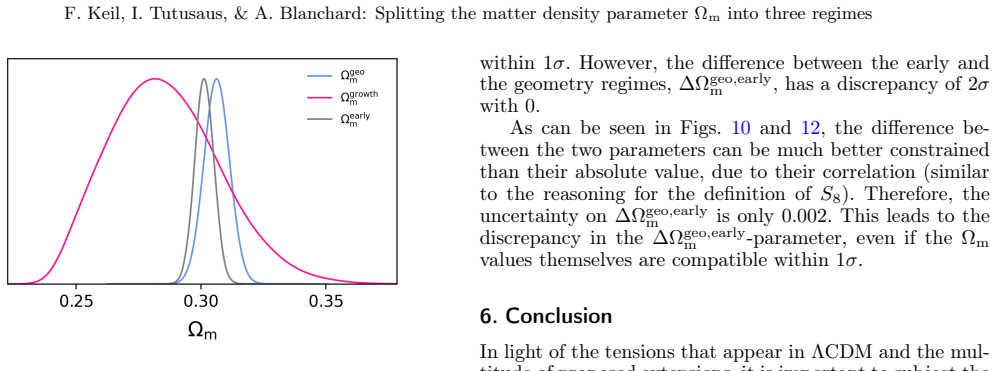
When Ωm is allowed three independent values—one for geometry, one for growth, and one for early-universe physics—and the same multi-probe data combination is analysed, the three posteriors remain compatible within ~1σ (Ωm^geo = 0.3064 ± 0.0051, Ωm^growth = 0.2855 ± 0.0221, Ωm^early = 0.3015 ± 0.0038), yet the tightly constrained difference ΔΩm^{geo,early} is 2σ away from zero.
What carries the argument
The three-regime phenomenological split of Ωm: every ingredient of each likelihood (linear power spectrum from the Boltzmann solver, growth-factor ODE and non-linear boost, window-function prefactors, sound-horizon integral or fit, luminosity and angular-diameter distances, multipole rescaling of the CMB spectra) is assigned to exactly one of geometry, growth, or early universe, producing three free matter densities that are sampled jointly.
Load-bearing premise
The assignment of every formula piece to exactly one regime is treated as a clean null test, even though several choices (which Hubble factors belong to geometry, whether the lensing prefactor is purely geometric, how much CMB growth information is simply cut rather than modelled) are judgment calls that could move the reported offset.
What would settle it
Re-run the identical data combination after moving the contested assignments (H′/H factors, weak-lensing prefactor, restored CMB lensing and high-ℓ scales modelled in the growth regime) and check whether ΔΩm^{geo,early} remains inconsistent with zero at ~2σ.
If this is right
- Geometry and early-universe matter densities stay strongly correlated once the full probe set is combined, so their difference is far better measured than either absolute value.
- Growth remains the weakest of the three constraints and is only weakly correlated with the other two regimes.
- The split model is mildly preferred by AIC over the single-Ωm analysis on the same data.
- Adding genuine growth probes (cluster counts, CMB lensing) is the direct next step the paper identifies for tightening the growth posterior.
Where Pith is reading between the lines
- The 2σ geometry–early offset may be an early, high-precision diagnostic of the same late-time expansion mismatch that appears as dynamical dark energy or an evolving Ωm in other analyses.
- Because the sound-horizon fit and the multipole rescaling both tie early and geometric densities together, any future change in the early-physics modelling will shift the geometry posterior even if late-time data are held fixed.
- If the offset survives more complete growth modelling, it supplies a concrete target for modified-gravity or early-dark-energy extensions that alter distances and the sound horizon differently.
Editorial analysis
A structured set of objections, weighed in public.
Referee Report
Summary. The manuscript introduces a three-way phenomenological split of the present-day matter density parameter into geometry, growth, and early-universe regimes, extending prior geometry–growth splits. Using DES Y3 3×2pt, scale-cut Planck TT/TE/EE (no lensing), DESI DR2 BAO, Pantheon+ without SH0ES, and a compiled RSD set, the authors implement probe-specific assignments (power-spectrum rescaling Eqs. 4–8, CMB multipole rescaling Eq. 25, rd fitting formula Eq. 28, RSD fσ8 Eq. 31, WL window App. B) and sample the joint likelihood with Nautilus. They report Ω_m^geo = 0.3064±0.0051, Ω_m^growth = 0.2855±0.0221, Ω_m^early = 0.3015±0.0038 (mutually compatible within ~1σ), a strong geometry–early correlation, weak growth correlations, ΔAIC≈12.3 mildly favouring the split model, and ΔΩ_m^{geo,early} ≡ Ω_m^geo − Ω_m^early offset from zero at 2σ (σ_Δ≈0.002).
Significance. If the three-regime split is a faithful null test of ΛCDM, the work is a useful consistency diagnostic that cleanly separates early-universe physics from late-time geometry and growth, and that can be applied to forthcoming Stage-IV data. The explicit probe-by-probe modelling, the joint nested-sampling comparison to a non-split baseline, and the multi-survey combination are genuine strengths. The reported 2σ offset in ΔΩ_m^{geo,early} would be of interest for the proposed Ω_m tension and for dynamical-dark-energy interpretations, but only if it is shown to be robust against the phenomenological partition choices that set the geometry–early correlation.
major comments (3)
- [§5, Fig. 12; Eqs. 3, 25, 28; §3.2; App. B] The central 2σ claim on ΔΩ_m^{geo,early} (Abstract; §5; Fig. 12) rests on a strong geometry–early correlation whose size is largely fixed by modelling choices that are not stress-tested: CMB multipoles are computed with Ω_early then rigidly rescaled by d_A^geo/d_A^early (Eq. 25) with growth excised via scale cuts and no lensing (§3.2); r_d uses a ΛCDM fitting formula locked to Ω_early (Eq. 28) rather than a consistent EBS sound horizon; H′/H in the growth ODE is forced geometric even when Ω_m in that ODE is growth (Eq. 3, §2.2.1); and the WL window prefactor is labelled geometric via background ρ̄ (App. B). Under a true single-Ω_m ΛCDM universe, a slight mis-attribution can imprint a mean offset on Δ at the reported 0.002 level. The manuscript should either (i) rerun the joint chain under at least one alternate, physically motivated assignment set and show that the 2σ flag is stable, or
- [§3.2, §4, §5, Fig. 10–12] Growth is deliberately under-powered: CMB lensing and high-ℓ/ISW scales are removed rather than modelled in the growth regime (§3.2), and the growth posterior is prior-limited by EuclidEmulator2 when Planck is used alone (§4, §5). The statement that “all regimes are compatible” and that growth is uncorrelated with the others is therefore partly by construction. Either include a growth-sensitive CMB channel (lensing or a controlled high-ℓ subset) with an explicit growth assignment, or qualify the growth conclusions as limited by the current data cuts and state that the null test is primarily geometry vs early.
- [§5, Eq. 32] The AIC comparison (ΔAIC≈12.3, §5) is reported as slightly favouring the split model, but the split adds two free parameters whose posterior volume and prior boundaries (especially Ω_growth_m) are not fully characterised, and the non-split vs split χ² difference is not tabulated. Please report Δχ², effective parameter counts, and a Bayes factor or nested-model evidence ratio so that the model-preference statement can be assessed independently of AIC.
minor comments (6)
- [Figs. 1–7, A.1–A.2] Figs. 1–7 and A.1–A.2 vary one regime at a time around a fixed Planck-like cosmology; it would help the reader if the caption stated the fixed values of the other two Ω_m parameters and of H0, As, ns explicitly.
- [Abstract] The abstract states that ΔΩ_m^{geo,early} is 2σ from 0 while the absolute values are compatible; add the numerical value and uncertainty of Δ (≈0.0049±0.002) in the abstract for clarity.
- [§2.2.3, Eq. 28] Eq. (28) cites Brieden et al. (2023); briefly note the accuracy of this approximation over the prior range of Ω_early_m h² used in the chains, or show a comparison to CAMB r_d at the posterior edges.
- [§3.1, App. D] Appendix D shows MagLim vs redMaGiC agreement but is only mentioned briefly in §3.1; a one-sentence quantitative statement (e.g. shift in Ω_geo_m and Ω_early_m) in the main text would help.
- [§5] Typographical/consistency: “Plancklikelihood” and similar concatenations appear in several places (§5); space as “Planck likelihood”. Also standardise “non-split” vs “nonsplit”.
- [§3.5] The RSD compilation (Blanchard et al. 2024) overlaps in tracer/redshift with DESI; the claim that covariance is negligible (§3.5) should cite a quantitative bound or a leave-one-out test.
Circularity Check
No significant circularity: phenomenological three-regime null test fitted to external survey likelihoods; results are not forced by construction.
full rationale
The paper’s central claim is a consistency (null) test: under ΛCDM the three split matter densities should coincide when each probe’s ingredients are assigned to geometry, growth, or early-universe regimes. The data are external (DES Y3 3×2pt, scale-cut Planck, DESI DR2 BAO, Pantheon+ without SH0ES, compiled RSD). The split likelihoods (rescaled P_lin via G^growth/G^early, multipole axis rescaling by d_A^geo/d_A^early, r_d from Ω_early, WL window prefactor as geometric, etc.) enlarge the parameter space and induce a geo–early correlation that tightens σ(ΔΩ_m^{geo,early}); they do not algebraically force the posterior mean of Δ away from zero. No quantity is defined from the quantity it is said to predict; no parameter is fitted to a subset and then reported as an independent prediction of a near-identical observable; and no load-bearing uniqueness or ansatz is imported solely via overlapping-author citation. Modeling judgment calls (H′/H forced geometric, CMB growth excised rather than modeled, r_d ΛCDM fit formula) affect robustness/correctness of the null test, not circularity of the derivation. Self-contained against external benchmarks; score 0.
Axiom & Free-Parameter Ledger
free parameters (4)
- Ω_m^geo =
0.3064 ± 0.0051
- Ω_m^growth =
0.2855 ± 0.0221
- Ω_m^early =
0.3015 ± 0.0038
- Standard ΛCDM + nuisance set (H0, ω_b, n_s, A_s, σ8/S8, DES biases/IA/photo-z/m, Planck foregrounds, SN M0)
axioms (6)
- domain assumption Scale-independent linear growth factor obeying the second-order ODE in Eq. 3, with H′/H evaluated in the geometry regime even when Ω_m in the source term is Ω_m^growth.
- ad hoc to paper Weak-lensing window prefactor proportional to Ω_m is geometric because it descends from the background density in the Poisson equation (App. B).
- ad hoc to paper CMB information used here is only primordial + distance-to-last-scattering; lensing, ISW, and ℓ>396 (and low-ℓ TT) are removed so growth does not enter (§3.2).
- domain assumption Sound horizon rd is given by the Brieden et al. (2023) ΛCDM fitting formula evaluated at Ω_m^early (Eq. 28), not by a free early-physics model.
- domain assumption Flat ΛCDM background distances and standard Limber/non-Limber projections as in DES Y3 CosmoSIS pipeline.
- domain assumption RSD compilation measurements are independent of each other and of DESI BAO covariance (§3.5).
invented entities (1)
-
Three-regime phenomenological Ω_m split (Ω_m^geo, Ω_m^growth, Ω_m^early)
no independent evidence
read the original abstract
While the $\Lambda$ cold dark matter ($\Lambda$CDM) model can successfully reproduce the measurements of many cosmological probes, some discrepancies have recently emerged. Therefore, it is necessary to test the standard cosmological model for consistency. An important stress test is to separate the influence of different cosmological regimes on the parameter inference. We treat three regimes separately here: geometry, growth, and the early universe. The geometrical regime concerns the expansion and curvature history, while the growth regime governs structure formation and the early-universe regime affects physics prior to recombination. Previous analyses have performed the split between geometry and growth, whereas we also consider the early universe influence separately. We perform this split for the present day matter density parameter $\Omega_{\rm m}$ using multiple cosmological observables. The used data are galaxy clustering and weak lensing statistics (3x2pt) from the Dark Energy Survey (DES), cosmic microwave background (CMB) data from Planck, spectroscopic baryon acoustic oscillations (BAO) from the Dark Energy Spectroscopic Instrument (DESI), type-Ia supernovae (SNe Ia) samples from Pantheon+, and redshift-space distortions (RSD) from a collection of galaxy surveys. For each of these probes, we introduce a phenomenological split into these three regimes. This work shows a strong correlation between the geometric and the early regime for the matter density, but no strong correlation between the growth regime and the others. All regimes are compatible in the posterior distribution, however the difference between the geometry and the early regimes, $\Delta\Omega_{\rm m}^{\rm geo,early}$, is 2$\sigma$ apart from 0.
Figures



Reference graph
Works this paper leans on
-
[1]
Testing gravity with CAMB and CosmoMC
Hojjati, Alireza and Pogosian, Levon and Zhao, Gong-Bo. Testing gravity with CAMB and CosmoMC. JCAP. 2011. doi:10.1088/1475-7516/2011/08/005. arXiv:1106.4543
Pith/arXiv arXiv 2011
-
[2]
A test of the standard cosmological model with geometry and growth
Andrade, Uendert and Anbajagane, Dhayaa and von Marttens, Rodrigo and Huterer, Dragan and Alcaniz, Jailson. A test of the standard cosmological model with geometry and growth. JCAP. 2021. doi:10.1088/1475-7516/2021/11/014. arXiv:2107.07538
Pith/arXiv arXiv 2021
-
[3]
Origin of cosmological neutrino mass bounds: background versus perturbations
Bert \'o lez-Mart \' nez, Toni and Esteban, Ivan and Hajjar, Rasmi and Mena, Olga and Salvado, Jordi. Origin of cosmological neutrino mass bounds: background versus perturbations. JCAP. 2025. doi:10.1088/1475-7516/2025/06/058. arXiv:2411.14524
Pith/arXiv arXiv 2025
-
[4]
The Three Faces of Omega \_ m: Testing Gravity with Low and High Redshift SN Ia Surveys
Abate, Alexandra and Lahav, Ofer. The Three Faces of Omega \_ m: Testing Gravity with Low and High Redshift SN Ia Surveys. Mon. Not. Roy. Astron. Soc. 2008. doi:10.1111/j.1745-3933.2008.00519.x. arXiv:0805.3160
arXiv 2008
-
[5]
Bernal, Jos \'e Luis and Verde, Licia and Cuesta, Antonio J. Parameter splitting in dark energy: is dark energy the same in the background and in the cosmic structures?. JCAP. 2016. doi:10.1088/1475-7516/2016/02/059. arXiv:1511.03049
Pith/arXiv arXiv 2016
-
[6]
and Eifler, Tim and Krause, Elisabeth
Zhong, Kunhao and Saraivanov, Evan and Caputi, James and Miranda, Vivian and Boruah, Supranta S. and Eifler, Tim and Krause, Elisabeth. Attention-based neural network emulators for multiprobe data vectors. I. Forecasting the growth-geometry split. Phys. Rev. D. 2025. doi:10.1103/PhysRevD.111.123519. arXiv:2402.17716
Pith/arXiv arXiv 2025
-
[7]
and Cuceu, Andrei and To, Chun-Hao and Zaborowski, Erik A
Taylor, Peter L. and Cuceu, Andrei and To, Chun-Hao and Zaborowski, Erik A. CombineHarvesterFlow: Joint Probe Analysis Made Easy with Normalizing Flows. 2024. doi:10.33232/001c.124495. arXiv:2406.06687
Pith/arXiv arXiv 2024
-
[8]
LSST: from Science Drivers to Reference Design and Anticipated Data Products
Ivezi \'c , Z eljko and others. LSST: from Science Drivers to Reference Design and Anticipated Data Products. Astrophys. J. 2019. doi:10.3847/1538-4357/ab042c. arXiv:0805.2366
Pith/arXiv arXiv 2019
-
[9]
Friedrich, O. and others. Dark Energy Survey year 3 results: covariance modelling and its impact on parameter estimation and quality of fit. Mon. Not. Roy. Astron. Soc. 2021. doi:10.1093/mnras/stab2384. arXiv:2012.08568
Pith/arXiv arXiv 2021
-
[10]
Krause, E. and others. Dark Energy Survey Year 3 Results: Multi-Probe Modeling Strategy and Validation. 2021. arXiv:2105.13548
Pith/arXiv arXiv 2021
-
[11]
Tests of Evolving Dark Energy with Geometric Probes of the Late-Time Universe
Zhong, Kunhao and Jain, Bhuvnesh. Tests of Evolving Dark Energy with Geometric Probes of the Late-Time Universe. 2025. arXiv:2509.26480
arXiv 2025
-
[12]
The fallacies of LCDM falsifications
Blanchard, Alain. The fallacies of LCDM falsifications. 2025. arXiv:2505.06244
Pith/arXiv arXiv 2025
-
[13]
Perivolaropoulos, Leandros and Skara, Foteini. Challenges for CDM: An update. New Astron. Rev. 2022. doi:10.1016/j.newar.2022.101659. arXiv:2105.05208
arXiv 2022
-
[14]
Modern cosmology , isbn =
Dodelson, Scott , year =. Modern cosmology , isbn =
-
[15]
and Cuceu, Andrei and To, Chun-Hao and Zaborowski, Erik A
Taylor, Peter L. and Cuceu, Andrei and To, Chun-Hao and Zaborowski, Erik A. , journal =. CombineHarvesterFlow: Joint. doi:10.33232/001c.124495 , year =
-
[16]
nautilus: boosting Bayesian importance nested sampling with deep learning
Lange, Johannes U. nautilus: boosting Bayesian importance nested sampling with deep learning. Mon. Not. Roy. Astron. Soc. 2023. doi:10.1093/mnras/stad2441. arXiv:2306.16923
Pith/arXiv arXiv 2023
-
[17]
Knabenhans, M. and others. Euclid preparation: IX. EuclidEmulator2 power spectrum emulation with massive neutrinos and self-consistent dark energy perturbations. Mon. Not. Roy. Astron. Soc. 2021. doi:10.1093/mnras/stab1366. arXiv:2010.11288
Pith/arXiv arXiv 2021
-
[18]
A new perspective on Dark Energy modeling via Genetic Algorithms
Nesseris, Savvas and Garcia-Bellido, Juan. A new perspective on Dark Energy modeling via Genetic Algorithms. JCAP. 2012. doi:10.1088/1475-7516/2012/11/033. arXiv:1205.0364
Pith/arXiv arXiv 2012
-
[19]
Testing cosmological structure formation using redshift-space distortions
Percival, Will J and White, Martin. Testing cosmological structure formation using redshift-space distortions. Mon. Not. Roy. Astron. Soc. 2009. doi:10.1111/j.1365-2966.2008.14211.x. arXiv:0808.0003
arXiv 2009
-
[20]
Pandey, S. and others. Dark Energy Survey year 3 results: Constraints on cosmological parameters and galaxy-bias models from galaxy clustering and galaxy-galaxy lensing using the redMaGiC sample. Phys. Rev. D. 2022. doi:10.1103/PhysRevD.106.043520. arXiv:2105.13545
Pith/arXiv arXiv 2022
-
[21]
Neutrino Masses, Scale-Dependent Growth, and Redshift-Space Distortions
Hern \'a ndez, Oscar F. Neutrino Masses, Scale-Dependent Growth, and Redshift-Space Distortions. JCAP. 2017. doi:10.1088/1475-7516/2017/06/018. arXiv:1608.08298
Pith/arXiv arXiv 2017
-
[22]
Precision calculations of the cosmic shear power spectrum projection
Kilbinger, Martin and others. Precision calculations of the cosmic shear power spectrum projection. Mon. Not. Roy. Astron. Soc. 2017. doi:10.1093/mnras/stx2082. arXiv:1702.05301
Pith/arXiv arXiv 2017
-
[23]
Martinelli, M. and others. Euclid: Forecast constraints on the cosmic distance duality relation with complementary external probes. Astron. Astrophys. 2020. doi:10.1051/0004-6361/202039078. arXiv:2007.16153
Pith/arXiv arXiv 2020
-
[24]
Machine learning improved fits of the sound horizon at the baryon drag epoch
Aizpuru, Andoni and Arjona, Rub\'en and Nesseris, Savvas. Machine learning improved fits of the sound horizon at the baryon drag epoch. Phys. Rev. D. 2021. doi:10.1103/PhysRevD.104.043521. arXiv:2106.00428
Pith/arXiv arXiv 2021
-
[25]
The Pantheon+ Analysis: Cosmological Constraints
Brout, Dillon and others. The Pantheon+ Analysis: Cosmological Constraints. Astrophys. J. 2022. doi:10.3847/1538-4357/ac8e04. arXiv:2202.04077
Pith/arXiv arXiv 2022
-
[26]
Conley, A. and others. Supernova Constraints and Systematic Uncertainties from the First 3 Years of the Supernova Legacy Survey. Astrophys. J. Suppl. 2011. doi:10.1088/0067-0049/192/1/1. arXiv:1104.1443
Pith/arXiv arXiv 2011
-
[27]
The Pantheon+ Analysis: The Full Data Set and Light-curve Release
Scolnic, Dan and others. The Pantheon+ Analysis: The Full Data Set and Light-curve Release. Astrophys. J. 2022. doi:10.3847/1538-4357/ac8b7a. arXiv:2112.03863
Pith/arXiv arXiv 2022
-
[28]
Nesseris, S. and others. Euclid: Forecast constraints on consistency tests of the CDM model. Astron. Astrophys. 2022. doi:10.1051/0004-6361/202142503. arXiv:2110.11421
Pith/arXiv arXiv 2022
-
[29]
Jesus, Jos\'e F. and Gomes, Mikael J. S. and Holanda, Rodrigo F. L. and Nunes, Rafael C. High-redshift cosmography with a possible cosmic distance duality relation violation. JCAP. 2025. doi:10.1088/1475-7516/2025/01/088. arXiv:2408.13390
Pith/arXiv arXiv 2025
-
[30]
New tests of cosmic distance duality relation with DESI 2024 BAO observations
Wang, Qiumin and Cao, Shuo and Jiang, Jianyong and Zhang, Kaituo and Jiang, Xinyue and Liu, Tonghua and Mu, Chengsheng and Cheng, Dadian. New tests of cosmic distance duality relation with DESI 2024 BAO observations. 2025. arXiv:2506.12759
Pith/arXiv arXiv 2024
-
[31]
and Giar\`e, William and Hogg, Natalie B
Teixeira, Elsa M. and Giar\`e, William and Hogg, Natalie B. and Montandon, Thomas and Poudou, Ad\`ele and Poulin, Vivian. Implications of distance duality violation for the H_0 tension and evolving dark energy. 2025. arXiv:2504.10464
Pith/arXiv arXiv 2025
-
[32]
Eisenstein, Daniel J. and Hu, Wayne. Baryonic features in the matter transfer function. Astrophys. J. 1998. doi:10.1086/305424. arXiv:astro-ph/9709112
Pith/arXiv arXiv 1998
-
[33]
A Two-parameter luminosity correction for type Ia supernovae
Tripp, Robert. A Two-parameter luminosity correction for type Ia supernovae. Astron. Astrophys. 1998
1998
-
[34]
Avgoustidis, Anastasios and Burrage, Clare and Redondo, Javier and Verde, Licia and Jimenez, Raul. Constraints on cosmic opacity and beyond the standard model physics from cosmological distance measurements. JCAP. 2010. doi:10.1088/1475-7516/2010/10/024. arXiv:1004.2053
Pith/arXiv arXiv 2010
-
[35]
Model-independent cosmological inference post DESI DR1 BAO measurements
Mukherjee, Purba and Sen, Anjan Ananda. Model-independent cosmological inference post DESI DR1 BAO measurements. Phys. Rev. D. 2024. doi:10.1103/PhysRevD.110.123502. arXiv:2405.19178
arXiv 2024
-
[36]
Pogosian, Levon and Zhao, Gong-Bo and Jedamzik, Karsten. A Consistency Test of the Cosmological Model at the Epoch of Recombination Using DESI Baryonic Acoustic Oscillation and Planck Measurements. Astrophys. J. Lett. 2024. doi:10.3847/2041-8213/ad7507. arXiv:2405.20306
Pith/arXiv arXiv 2024
-
[37]
Mixing of the Photon with Low Mass Particles
Raffelt, Georg and Stodolsky, Leo. Mixing of the Photon with Low Mass Particles. Phys. Rev. D. 1988. doi:10.1103/PhysRevD.37.1237
-
[38]
Alam, Shadab and others. The clustering of galaxies in the completed SDSS-III Baryon Oscillation Spectroscopic Survey: cosmological analysis of the DR12 galaxy sample. Mon. Not. Roy. Astron. Soc. 2017. doi:10.1093/mnras/stx721. arXiv:1607.03155
Pith/arXiv arXiv 2017
-
[39]
and Pettini, Max and Nollett, Kenneth M
Cooke, Ryan J. and Pettini, Max and Nollett, Kenneth M. and Jorgenson, Regina. The primordial deuterium abundance of the most metal-poor damped Ly system. Astrophys. J. 2016. doi:10.3847/0004-637X/830/2/148. arXiv:1607.03900
Pith/arXiv arXiv 2016
-
[40]
Dawson, Kyle S. and others. The SDSS-IV extended Baryon Oscillation Spectroscopic Survey: Overview and Early Data. Astron. J. 2016. doi:10.3847/0004-6256/151/2/44. arXiv:1508.04473
Pith/arXiv arXiv 2016
-
[41]
Scolnic, D. M. and others. The Complete Light-curve Sample of Spectroscopically Confirmed SNe Ia from Pan-STARRS1 and Cosmological Constraints from the Combined Pantheon Sample. Astrophys. J. 2018. doi:10.3847/1538-4357/aab9bb. arXiv:1710.00845
Pith/arXiv arXiv 2018
-
[42]
Exploring the expansion history of the universe
Linder, Eric V. Exploring the expansion history of the universe. Phys. Rev. Lett. 2003. doi:10.1103/PhysRevLett.90.091301. arXiv:astro-ph/0208512
Pith/arXiv arXiv 2003
-
[43]
Accelerating universes with scaling dark matter
Chevallier, Michel and Polarski, David. Accelerating universes with scaling dark matter. Int. J. Mod. Phys. D. 2001. doi:10.1142/S0218271801000822. arXiv:gr-qc/0009008
Pith/arXiv arXiv 2001
-
[44]
Sch\"oneberg, Nils , title = ". JCAP. 2024. doi:10.1088/1475-7516/2024/06/006. arXiv:2401.15054
arXiv 2024
-
[45]
Testing the cosmic distance duality relation using Type Ia supernovae and BAO observations
Yang, Fan and Fu, Xiangyun and Xu, Bing and Zhang, Kaituo and Huang, Yang and Yang, Ying. Testing the cosmic distance duality relation using Type Ia supernovae and BAO observations. Eur. Phys. J. C. 2025. doi:10.1140/epjc/s10052-025-13892-w. arXiv:2502.05417
Pith/arXiv arXiv 2025
-
[46]
Lectures on cosmology : accelerated expansion of the Universe. 2010. doi:10.1007/978-3-642-10598-2
-
[47]
Cosmic distance duality after DESI 2024 data release and dark energy evolution
Alfano, Anna Chiara and Luongo, Orlando. Cosmic distance duality after DESI 2024 data release and dark energy evolution. 2025. arXiv:2501.15233
Pith/arXiv arXiv 2024
-
[48]
Cosmic dissonance: are new physics or systematics behind a short sound horizon?
Arendse, Nikki and others. Cosmic dissonance: are new physics or systematics behind a short sound horizon?. Astron. Astrophys. 2020. doi:10.1051/0004-6361/201936720. arXiv:1909.07986
Pith/arXiv arXiv 2020
-
[49]
Colg \'a in, Eoin \'O . and Sheikh-Jabbari, M. M. DESI and SNe: Dynamical Dark Energy, _m Tension or Systematics?. Mon. Not. Roy. Astron. Soc. 2025. doi:10.1093/mnrasl/slaf042. arXiv:2412.12905
Pith/arXiv arXiv 2025
-
[50]
Fern\'andez-Garc\' a, E. and others. Missing Components in CDM from DESI Y1 BAO Measurements: Insights from Redshift Remapping. 2025. arXiv:2503.22469
arXiv 2025
-
[51]
Copeland, Edmund J. and Sami, M. and Tsujikawa, Shinji. Dynamics of dark energy. Int. J. Mod. Phys. D. 2006. doi:10.1142/S021827180600942X. arXiv:hep-th/0603057
Pith/arXiv arXiv 2006
-
[52]
The Cosmological Constant Problem
Weinberg, Steven. The Cosmological Constant Problem. Rev. Mod. Phys. 1989. doi:10.1103/RevModPhys.61.1
-
[53]
KiDS-1000 Cosmology: Cosmic shear constraints and comparison between two point statistics
Asgari, Marika and others. KiDS-1000 Cosmology: Cosmic shear constraints and comparison between two point statistics. Astron. Astrophys. 2021. doi:10.1051/0004-6361/202039070. arXiv:2007.15633
Pith/arXiv arXiv 2021
-
[54]
Cosmic acceleration vs axion - photon mixing
Bassett, Bruce A. Cosmic acceleration vs axion - photon mixing. Astrophys. J. 2004. doi:10.1086/383520. arXiv:astro-ph/0311495
Pith/arXiv arXiv 2004
-
[55]
Sch\"oneberg, Nils and Franco Abell\'an, Guillermo and P\'erez S\'anchez, Andrea and Witte, Samuel J. and Poulin, Vivian and Lesgourgues, Julien , title = ". Phys. Rept. 2022. doi:10.1016/j.physrep.2022.07.001. arXiv:2107.10291
Pith/arXiv arXiv 2022
-
[56]
Cosmology
Weinberg, Steven. Cosmology. 2008
2008
-
[57]
Hanson, Duncan and Challinor, Anthony and Lewis, Antony. Weak lensing of the CMB. Gen. Rel. Grav. 2010. doi:10.1007/s10714-010-1036-y. arXiv:0911.0612
Pith/arXiv arXiv 2010
-
[58]
Neutrino decoupling including flavour oscillations and primordial nucleosynthesis
Froustey, Julien and Pitrou, Cyril and Volpe, Maria Cristina. Neutrino decoupling including flavour oscillations and primordial nucleosynthesis. JCAP. 2020. doi:10.1088/1475-7516/2020/12/015. arXiv:2008.01074
Pith/arXiv arXiv 2020
-
[59]
Karhunen-Loeve eigenvalue problems in cosmology: How should we tackle large data sets?
Tegmark, Max and Taylor, Andy and Heavens, Alan. Karhunen-Loeve eigenvalue problems in cosmology: How should we tackle large data sets?. Astrophys. J. 1997. doi:10.1086/303939. arXiv:astro-ph/9603021
Pith/arXiv arXiv 1997
-
[61]
Suzuki, N. and others. The Hubble Space Telescope Cluster Supernova Survey: V. Improving the Dark Energy Constraints Above z > 1 and Building an Early-Type-Hosted Supernova Sample. Astrophys. J. 2012. doi:10.1088/0004-637X/746/1/85. arXiv:1105.3470
Pith/arXiv arXiv 2012
-
[62]
Isolating Geometry in Weak Lensing Measurements
Zhang, Jun and Hui, Lam and Stebbins, Albert. Isolating Geometry in Weak Lensing Measurements. Astrophys. J. 2005. doi:10.1086/497676. arXiv:astro-ph/0312348
Pith/arXiv arXiv 2005
-
[63]
Maus, Mark and Baleato Lizancos, Ant \'o n and White, Martin and de Mattia, Arnaud and Chen, Shi-Fan. An analytic approximation to the covariance between pre- and post-reconstruction galaxy two-point statistics. JCAP. 2026. doi:10.1088/1475-7516/2026/05/078. arXiv:2602.12343
Pith/arXiv arXiv 2026
-
[64]
Cosmic distance duality relation in light of time-delayed strong gravitational lensing*
Tang, Li and Lin, Hai-Nan and Wu, Ying. Cosmic distance duality relation in light of time-delayed strong gravitational lensing*. Chin. Phys. C. 2025. doi:10.1088/1674-1137/ad83a8. arXiv:2410.08595
Pith/arXiv arXiv 2025
-
[65]
Qi, Jing-Zhao and Jiang, Yi-Fan and Hou, Wan-Ting and Zhang, Xin. Testing the Cosmic Distance Duality Relation Using Strong Gravitational Lensing Time Delays and Type Ia Supernovae. Astrophys. J. 2025. doi:10.3847/1538-4357/ad9de4. arXiv:2407.07336
Pith/arXiv arXiv 2025
-
[66]
Holanda, R. F. L. and Carvalho, J. C. and Alcaniz, J. S. Model-independent constraints on the cosmic opacity. JCAP. 2013. doi:10.1088/1475-7516/2013/04/027. arXiv:1207.1694
Pith/arXiv arXiv 2013
-
[67]
Measuring the galaxy-mass and galaxy-dust correlations through magnification and reddening
Menard, Brice and Scranton, Ryan and Fukugita, Masataka and Richards, Gordon. Measuring the galaxy-mass and galaxy-dust correlations through magnification and reddening. Mon. Not. Roy. Astron. Soc. 2010. doi:10.1111/j.1365-2966.2010.16486.x. arXiv:0902.4240
arXiv 2010
-
[68]
Model Independent Probe of Cosmic Distance Duality Relation
Gahlaut, Savita. Model Independent Probe of Cosmic Distance Duality Relation. Res. Astron. Astrophys. 2025. doi:10.1088/1674-4527/adae45. arXiv:2501.15086
Pith/arXiv arXiv 2025
-
[69]
Batch Normalization: Accelerating Deep Network Training by Reducing Internal Covariate Shift
Ioffe, Sergey and Szegedy, Christian. Batch Normalization: Accelerating Deep Network Training by Reducing Internal Covariate Shift. 2015. arXiv:1502.03167
Pith/arXiv arXiv 2015
-
[70]
Brieden, Samuel and Gil-Mar\' n, H\'ector and Verde, Licia. A tale of two (or more) h's. JCAP. 2023. doi:10.1088/1475-7516/2023/04/023. arXiv:2212.04522
Pith/arXiv arXiv 2023
-
[71]
and Spiro, Susanna and Hook, Isobel and Scaramella, Roberto
Cardone, Vincenzo F. and Spiro, Susanna and Hook, Isobel and Scaramella, Roberto. Testing the distance duality relation with present and future data. Phys. Rev. D. 2012. doi:10.1103/PhysRevD.85.123510. arXiv:1205.1908
Pith/arXiv arXiv 2012
-
[72]
Confronting Lemaitre-Tolman-Bondi models with Observational Cosmology
Garcia-Bellido, Juan and Haugboelle, Troels. Confronting Lemaitre-Tolman-Bondi models with Observational Cosmology. JCAP. 2008. doi:10.1088/1475-7516/2008/04/003. arXiv:0802.1523
Pith/arXiv arXiv 2008
-
[73]
Clustering in real space and in redshift space
Kaiser, N. Clustering in real space and in redshift space. Mon. Not. Roy. Astron. Soc. 1987. doi:10.1093/mnras/227.1.1
-
[74]
and Baldry, I
Liske, J. and Baldry, I. K. and Driver, S. P. and Tuffs, R. J. and Alpaslan, M. and Andrae, E. and Brough, S. and Cluver, M. E. and Grootes, M. W. and Gunawardhana, M. L. P. and Kelvin, L. S. and Loveday, J. and Robotham, A. S. G. and Taylor, E. N. and Bamford, S. P. and Bland-Hawthorn, J. and Brown, M. J. I. and Drinkwater, M. J. and Hopkins, A. M. and M...
2015
-
[75]
Lange, Johannes U. and Hearin, Andrew P. and Leauthaud, Alexie and van den Bosch, Frank C. and Guo, Hong and DeRose, Joseph. Five per \, cent measurements of the growth rate from simulation-based modelling of redshift-space clustering in BOSS LOWZ. Mon. Not. Roy. Astron. Soc. 2021. doi:10.1093/mnras/stab3111. arXiv:2101.12261
Pith/arXiv arXiv 2021
-
[76]
Gil-Mar \' n, H \'e ctor and others. The clustering of the SDSS-IV extended Baryon Oscillation Spectroscopic Survey DR14 quasar sample: structure growth rate measurement from the anisotropic quasar power spectrum in the redshift range 0.8 < z < 2.2. Mon. Not. Roy. Astron. Soc. 2018. doi:10.1093/mnras/sty453. arXiv:1801.02689
Pith/arXiv arXiv 2018
-
[78]
The Subaru FMOS galaxy redshift survey (FastSound)
Okumura, Teppei and others. The Subaru FMOS galaxy redshift survey (FastSound). IV. New constraint on gravity theory from redshift space distortions at z 1.4. Publ. Astron. Soc. Jap. 2016. doi:10.1093/pasj/psw029. arXiv:1511.08083
Pith/arXiv arXiv 2016
-
[79]
de la Torre, S. and others. The VIMOS Public Extragalactic Redshift Survey (VIPERS). Gravity test from the combination of redshift-space distortions and galaxy-galaxy lensing at 0.5 < z < 1.2. Astron. Astrophys. 2017. doi:10.1051/0004-6361/201630276. arXiv:1612.05647
Pith/arXiv arXiv 2017
-
[80]
Koussour, M. and Myrzakulov, N. and Alfedeel, Alnadhief H. A. and Abebe, Amare. Constraining the cosmological model of modified f(Q) gravity: Phantom dark energy and observational insights. PTEP. 2023. doi:10.1093/ptep/ptad133. arXiv:2310.15067
Pith/arXiv arXiv 2023
-
[81]
Kunz, Martin and Sapone, Domenico. Crossing the Phantom Divide. Phys. Rev. D. 2006. doi:10.1103/PhysRevD.74.123503. arXiv:astro-ph/0609040
Pith/arXiv arXiv 2006
-
[82]
and Hoffman, Mark and Trodden, Mark
Carroll, Sean M. and Hoffman, Mark and Trodden, Mark. Can the dark energy equation-of-state parameter w be less than −1 ?. Phys. Rev. D. 2003. doi:10.1103/PhysRevD.68.023509. arXiv:astro-ph/0301273
Pith/arXiv arXiv 2003
discussion (0)
Sign in with ORCID, Apple, or X to comment. Anyone can read and Pith papers without signing in.