REVIEW 3 major objections 5 minor 3 cited by
Universal Driven Critical Dynamics near the Boundary
T0 review · 3 major / 5 minor · reviewed 2026-08-04 · deepseek-v4-flash
Pith's one-line read For cooling through an ordinary boundary transition, the boundary order parameter depends on the driving rate logarithmically rather than as the power law expected from the Kibble-Zurek mechanism.
desk verdict A genuinely new but under-supported anomaly: boundary FTS works for many protocols, but the log law for ordinary-transition cooling is not yet established beyond a two-parameter fit. read the letter →
The pith
A machine-rendered reading of the paper's core claim, the machinery that carries it, and where it could break.
The reading
What carries the argument
Boundary finite-time scaling (BFTS): a set of scaling forms that generalize bulk finite-time scaling by replacing the bulk order-parameter exponent β with the boundary exponent β_1. The key variable is the driving-induced length scale ξ_d ∝ v^{-1/r} with r = z + 1/ν, which controls both the temperature dependence and spatial crossover through the scaling variable x v^{1/r}. For the ordinary transition, the BFTS form fails for cooling because the exponent combination 2β_1/ν − (d−1) is non-negative, so surface fluctuations prevent domain formation and the driving-rate dependence becomes logarithmic.
What would settle it
Measure the squared boundary order parameter at the bulk critical point for 2D and 3D Ising cooling from the disordered phase at large driving rates; if M_s1^2 L^{d-1} scales as a power of v rather than as log(b v), or if the data do not collapse according to Eq. (13), the claimed abnormal logarithmic scaling is refuted.
Extended reading notes
Core claim
For cooling dynamics through an ordinary boundary transition, the squared boundary order parameter M_s1^2 obeys M_s1^2 = a L^{-(d-1)} log(b v) at the bulk critical point (Eq. 12), with a<0, b>0 constants. This is in contrast to the normal BFTS power-law form M_s1^2 ∝ L^{-(d-1)} v^{[2β_1/ν-(d-1)]/r} (Eq. 11), which fails for both 2D and 3D. The authors propose a generalized scaling form M_s1^2 = L^{-(d-1)}[a log(b v) + f_9(g v^{-1/(ν r)})] (Eq. 13) that collapses data away from the critical point. The breakdown is attributed to strong surface fluctuations that suppress formation of correlated domains at the boundary during cooling.
Load-bearing premise
The analysis assumes that boundary driving introduces no new dynamic critical exponent, so the bulk dynamic exponent z and the combination r = z + 1/ν fully determine the boundary scaling forms; if a separate surface relaxation time scale or a boundary-specific dynamic exponent exists, the predicted exponents and the log-vs-power-law discrimination would change.
Editorial extensions
If this is right
- For ordinary-boundary cooling, the squared boundary order parameter at the critical point is predicted to obey M_s1^2 = a L^{-(d-1)} log(b v), so experiments should look for a logarithmic, not power-law, dependence on the ramp rate.
- The sign of 2β_1/ν − (d−1) becomes a diagnostic: negative values allow the normal power-law BFTS; non-negative values signal the abnormal logarithmic regime.
- Heating and cooling are not symmetric at boundaries: heating obeys BFTS in all boundary universality classes, while cooling fails for the ordinary class, implying that separate scaling forms must be used for opposite ramp directions.
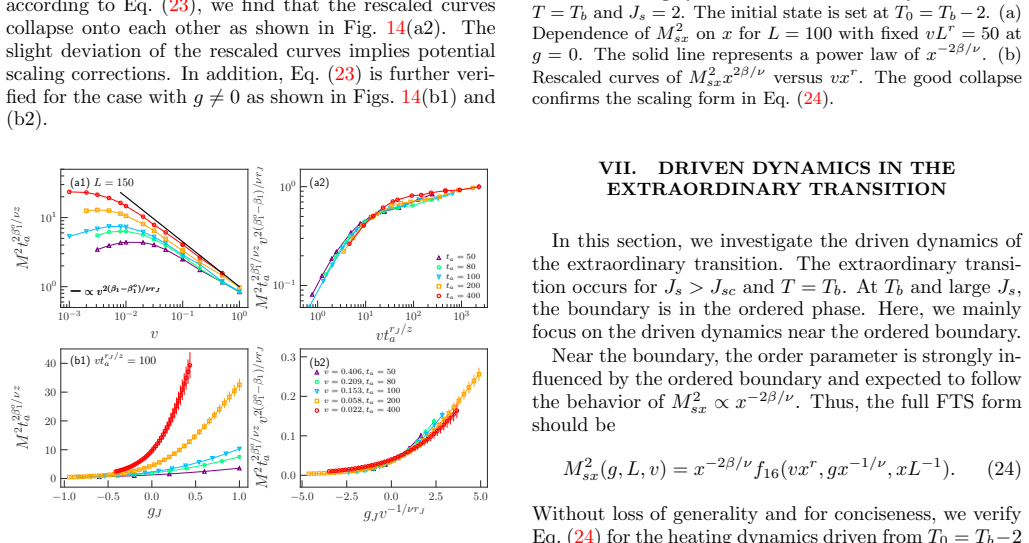
- For surface-coupling ramps across the special transition, increasing the coupling from the ordinary line requires an initial 'age' (waiting time) t_a; the proposed scaling form Eq. (23) ties the boundary order to t_a^{-2β_1^o/(ν z)} and v^{2(β_1−β_1^o)/(ν r_J)}.
- For the extraordinary transition, the ordered boundary enforces a power-law decay M_sx^2 ∝ x^{-2β/ν} into the bulk, and the full scaling form Eq. (24) holds with the driving dependence entering through v x^r.
Reading between the lines
- The logarithmic law may be generic in any boundary universality class where 2β_1/ν ≥ d−1, so testing another model (e.g., the O(N) model with an ordinary boundary) would probe universality of the mechanism.
- The waiting-time scaling for increasing surface coupling is reminiscent of aging phenomena; one could extend the formalism to other tricritical points where the initial state is critical along a different direction.
- If suppression of boundary domain formation during cooling is the true cause, spatially resolved measurements of M_sx^2 should show a depth profile: bulk power-law behavior at large x crossing over to the log behavior near the surface, with a crossover scale set by x v^{1/r}.
- The same driving-rate correction q(v) = v(1 + c v^{-ω/r}) used for the special transition could improve collapse in the ordinary cooling case, suggesting that higher-order scaling corrections may be present but do not change the leading log law.
Editorial analysis
A structured set of objections, weighed in public.
Referee Report
Summary. The paper studies driven critical dynamics near boundaries of 2D and 3D Ising models under linear temperature sweeps, and for the special transition also under surface-coupling sweeps. The authors propose a boundary finite-time scaling (BFTS) framework in which the bulk FTS forms are generalized by replacing the bulk order-parameter exponent beta with the boundary exponent beta_1. For heating in the ordinary transition, this yields scaling collapses in 2D and 3D, including a crossover full scaling form. The central new claim is that for cooling in the ordinary transition the normal BFTS form (11) fails and the boundary order parameter obeys an anomalous logarithmic law, Eq. (12), M^2_s1 = a L^{-(d-1)} log(bv). For the surface and special transitions, BFTS is reported for both heating and cooling, and for the special transition a generalized BFTS for aged initial states is proposed. The extraordinary transition is treated only through heating data. The abstract and summary, however, assert that cooling in the extraordinary transition is also BFTS, which is not demonstrated in the text.
Significance. Understanding driven critical dynamics near boundaries is a natural and important extension of the Kibble-Zurek mechanism, and this paper is the first systematic numerical exploration of it across ordinary, surface, special and extraordinary boundary classes. If the claimed logarithmic cooling law for the ordinary transition is correct, it would establish a qualitatively new boundary effect and imply that the standard FTS framework must be modified near boundaries. The paper makes productive use of published equilibrium boundary exponents and supports the ordinary/special/surface heating BFTS forms with data collapses over broad L and v ranges. The generalized BFTS for nonequilibrium initial states, Eq. (23), is also a useful conceptual addition. However, the paper contains no machine-checked proofs or code release; the main new quantitative claims rest entirely on numerical fits, and Eq. (12) is a falsifiable prediction that is not yet established by the evidence presented.
major comments (3)
- [Abstract; Sec. VII] The abstract and Sec. I state that cooling in the extraordinary transition is described by BFTS, but Sec. VII contains no cooling data: Fig. 15 and the text explicitly verify Eq. (24) only for heating (T0=Tb-2). The universal claim for ordinary/special/surface/extraordinary cooling is therefore unsupported for the extraordinary class. This is not merely presentational; the abstract's factual content is load-bearing. Either add cooling simulations (with a data collapse for M_s1^2 L^{d-1} vs vL^r) or restrict the claim to the cases actually simulated.
- [Eq. (12); Figs. 5(a1), 6(a1), 5(b2), 6(b2)] The central log law is established only by a two-parameter fit of M_s1^2 L^{-(d-1)} vs v at J_s=1 and T0=Tb+2. The fits are shown without statistical uncertainties or residuals, and no alternative forms (power law with small negative exponent, crossover to BFTS) are compared. Over roughly two decades a monotone function with slowly varying slope is consistent with several forms. The collapses in Figs. 5(b2)/6(b2) subtract exactly the fitted a log(bv) from the ordinate, so they do not independently validate the logarithmic form. In addition, the additive decomposition in Eq. (13) is assumed, not derived, and the constants a and b are not shown to be independent of J_s or of the initial temperature offset. At present Eq. (12) is an empirical curve, not a demonstrated universal scaling law.
- [Sec. II premise; Sec. VIII criterion] All BFTS forms rely on the premise that the bulk dynamic exponent z and r=z+1/nu determine boundary driven dynamics with no additional boundary time scale (Sec. II). This assumption is not tested. The criterion in Sec. VIII (2 beta_1/nu - (d-1) >= 0 for the abnormal log behavior) is a restatement of the sign of the power in Eq. (11) and does not by itself explain why a logarithm, rather than a power law with a different exponent, appears. A concrete check would be to measure the surface autocorrelation time directly, or to repeat the ordinary-cooling collapse with a free dynamic exponent and show that the bulk z gives a statistically acceptable collapse.
minor comments (5)
- [Sec. VI.A.1] Below Eq. (16), two references to Eq. (14) should be Eq. (16). The caption of Fig. 10(a2) also labels the vertical axis as M^2_sL L^{2 beta/nu}; the boundary quantity considered is M^2_s1 L^{2 beta_1/nu}.
- [Fig. 11(a1) caption] The quoted exponent, 2 beta_1/nu r, is inconsistent with the plotted quantity M^2_s1 L^{d-1}; the expected exponent is [2 beta_1/nu - (d-1)]/r.
- [Sec. VI.B.1] The sentence after Eq. (22) says 'for increasing J', but the paragraph and Fig. 13 describe decreasing J_s. Please correct this slip.
- [Eqs. (19) and (23)] The label f15 is used for two different scaling functions; renumber one of them to avoid ambiguity. Eq. (22) also reuses f12 from Eq. (16).
- [Sec. IV.A, opening paragraph] The Mermin-Wagner sentence refers to 'continuous symmetry breaking' in an Ising context where the spin symmetry is discrete. Please clarify that the 1D boundary of the 2D Ising model does not order independently for continuous-symmetry reasons and that any symmetry argument is not the same as the existing boundary criticality analysis.
Circularity Check
Logarithmic cooling law in ordinary transition is a two-parameter empirical fit; its 'confirmation' via Eq. (13) subtracts the same fitted form, so the central new claim is not independently validated.
-
fitted input called prediction
[Sec. IV B (Cooling dynamics), Eqs. (12)-(13), Figs. 5(a1), 5(b2), 6(a1), 6(b2)]
"From Figs. 5(a1) and 6(a1), for large v, we find that the dependence of M^2_{sL}L^{(d-1)} on v satisfies a logarithmic function: M^2_{s1} ∝ aL^{-(d-1)} log(bv), (12) in which a and b are dimension-dependent constants ... After rescaling the data according to Eq. (13), the rescaled curves collapse well, confirming the validity of Eq. (13)."
Eq. (13) is proposed immediately after a and b are fitted to M^2_{s1}L^{-(d-1)} vs v in Figs. 5(a1)/6(a1) (caption values a=-0.4539,b=0.0132 and a=-0.5026,b=0.0023). At g=0, Eq. (13) reduces to the fitted log law plus the constant f9(0); the collapse in Figs. 5(b2)/6(b2) is obtained by subtracting the very same fitted a log(bv) from the data. Hence the collapse does not independently confirm the logarithmic form; it is partly forced by the fit. No RG or microscopic derivation of the log is supplied, and no test of a,b under variation of J_s, initial offset, or alternative functional forms is reported, so the 'abnormal logarithmic scaling' is an empirical two-parameter fit presented as a discovered universal law.
full rationale
Most of the paper is self-contained and not circular: the BFTS forms for heating (Eqs. 8, 10, 16, 18, 22) and for cooling in surface, special, and extraordinary transitions (Eqs. 15, 19, 24) are tested by data collapse using exponents β, β1, ν, z taken from independent equilibrium literature. Those tests have substantive content and are not reduced to the paper's own inputs. The central anomalous claim, however, is Eq. (12): M^2_{s1} = a L^{-(d-1)} log(bv). This form is not derived from FTS or RG; it is read off the same simulation curves in Figs. 5(a1) and 6(a1), with a and b as fitted constants. The subsequent verification of Eq. (13) subtracts the fitted a log(bv) from the same observable, so the data collapse in Figs. 5(b2)/6(b2) cannot certify the logarithmic law independently. That is a partial circularity: a fitted input is presented as a discovered prediction, and its purported confirmation is partly by construction. The score is 6 rather than higher because the paper does contain substantial non-circular content (the BFTS framework and the special/surface/extraordinary collapses), and the log law, while weakly grounded, is at least a concrete empirical proposal that could be tested by future independent simulations. Self-citations appear (e.g., Refs. 25, 26, 32, 34, 104, 106) but are not load-bearing for the central ordinary-transition log claim; the issue is specifically the fit-to-validation overlap.
Assumptions & free parameters
free parameters (3)
- a and b in log scaling M^2_s1 = a L^{-(d-1)} log(bv) =
2D: a = -0.4539, b = 0.0132; 3D: a = -0.5026, b = 0.0023
- c and omega in finite-size correction y(L) = 1 + c L^{-omega} =
2D: c = -2.12, omega = 0.50; 3D: c = -3.39, omega = 0.50
- c and omega in driving-rate correction q(v) = v(1 + c v^{-omega/r}) =
c = 0.05, omega = 1 (3D special transition)
assumptions (5)
- standard math Adiabatic-impulse scenario of the Kibble-Zurek mechanism, with a driving-induced time scale zeta_d ~ v^{-z/r} and length scale xi_d ~ v^{-1/r}.
- ad hoc to paper Normal generalization of bulk FTS to the boundary: the boundary order parameter obeys the bulk FTS form with the bulk exponent beta replaced by the boundary exponent beta_1.
- domain assumption No new dynamic critical exponent is needed for boundary driven dynamics; the bulk dynamic exponent z governs the boundary time scale.
- ad hoc to paper The logarithmic scaling form (Eq. 12) is the correct asymptotic form for cooling in the ordinary transition.
- ad hoc to paper Generalized BFTS scaling form (Eq. 23) combining ordinary and special critical exponents with the waiting time t_a.
Cite this review
Pith. "Pith review of Universal Driven Critical Dynamics near the Boundary." pith.science (2026). https://pith.science/paper/S6GCAP63
@misc{pith2026250910049,
  author       = {Pith},
  title        = {Pith review of: Universal Driven Critical Dynamics near the Boundary},
  year         = {2026},
  howpublished = {\url{https://pith.science/paper/S6GCAP63}},
  note         = {Machine review of arXiv:2509.10049}
}
read the original abstract
The celebrated Kibble-Zurek mechanism (KZM) describes the scaling of physical quantities when external parameters sweep through a critical point. Boundaries are ubiquitous in real systems, and critical behaviors near the boundary have attracted extensive research. Different boundary universality classes, including ordinary, special, extraordinary, and surface transitions, have been identified. However, the driven critical dynamics near boundaries remains unexplored. Here, we systematically investigate the driven critical dynamics in various boundary universality classes of the Ising model in both two and three dimensions, and discover a wealth of dynamic scaling behaviors. We find that for heating dynamics in all boundary universality classes, as well as for cooling dynamics in special, extraordinary, and surface transitions, the dynamic scaling behaviors of the order parameter can be described by a normal generalization of the KZM, called boundary finite-time scaling (BFTS). In contrast, for cooling dynamics in ordinary transition, we discover an abnormal logarithmic scaling on the driving rate. Moreover, for the special transition, in addition to temperature driving, we also consider the driven dynamics by driving the surface couplings. For increasing the surface coupling across the special transition point along the line of the ordinary transition, the prerequisite of the KZM, which requires that the correlation length/time in the initial state to be short-ranged, breaks down. We develop a generalized BFTS for a nonequilibrium initial state characterized by the waiting time, or the ``age'', of the boundary. Possible generalizations are also discussed.
Figures


Figures from the paper (10 more)


Forward citations
Cited by 3 Pith papers
-
Anomalous Dynamical Scaling at Topological Quantum Criticality
Topological quantum critical points exhibit anomalous dynamical scaling in boundary dynamics and defect production due to edge modes, beyond conventional Kibble-Zurek scaling.
-
Finite-time Scaling of the surface special transition in a 3D classical Heisenberg model
Driving from the extraordinary-log surface critical state yields the novel large-rate form Ms^{2} ∝ R^{(1+ u s)/rs} [log(L R^{1/rs})]^{-q} for the surface order parameter.
-
Finite-time Scaling of the surface special transition in a 3D classical Heisenberg model
When driven from an extraordinary-log boundary critical state into the 3D Heisenberg surface special transition, the surface order parameter obeys M_s^2 ∝ R^{(1+η_s)/r_s} [log(LR^{1/r_s})]^{-q}, a new log-corrected fi...
Reference graph
Works this paper leans on
-
[1]
Heating dynamics To study the temperature-driven heating dynamics of the special transition, we fix the boundary couplingJsc = 1.50243 [92] and choose the initial temperature asT 0 = Tb −2, corresponding to the symmetry-breaking ordered phase. In this setup, thenormalgeneralization of the FTS forms leads to the BFTS form at the boundary with x= 1, M 2 s1(...
-
[2]
Cooling dynamics Given the similarity between the special transition and ordinary transition in heating dynamics, it is natural to ask whether the same applies to cooling. For the cooling 11 10−5 10−4 10−3 10−2 10−1 v 101 102 M 2 s1Ld−1 (a1) 3D special cooling ∝ v−[(d−1)−2β1/ν]/r∝ v−[(d−1)−2β1/ν]/r 101 103 105 vLr 10−1 100 M 2 s1L2β1/ν (a2) L = 20 L = 30 ...
-
[3]
The temperature is fixed atT b during the driving process
Decreasing coupling Here, we consider the driven dynamics of the special transition point by linearly decreasingJ s fromJ s0 = Jsc + 1 across the critical valueJ sc. The temperature is fixed atT b during the driving process. In the initial state, the bulk is at the critical point, while the surface is in the ordered phase, sinceT b is below the surface tr...
-
[4]
In this case, the equilibrium states for the initial parameters withJ s0 < Jsc andT=T b are critical in both the bulk and the surface
Increasing coupling Here we study the case for increasing coupling from Js < Jsc. In this case, the equilibrium states for the initial parameters withJ s0 < Jsc andT=T b are critical in both the bulk and the surface. In particular, the latter 10−5 10−4 10−3 10−2 10−1 v 2 4 6 M 2 s1 (a1) 3D special decrease Js ×10−1 ∝ v2β1/νrJ∝ v2β1/νrJ 100 102 104 vLrJ 10...
-
[5]
Topology of cosmic domains and strings,
T. W. B. Kibble, “Topology of cosmic domains and strings,” Journal of Physics A: Mathematical and Gen- eral9, 1387 (1976)
1976
-
[6]
Cosmological experiments in superfluid helium?
W. H. Zurek, “Cosmological experiments in superfluid helium?” Nature317, 505–508 (1985)
1985
-
[7]
Dynamics of a Quantum Phase Transition,
W. H. Zurek, U. Dorner, and P. Zoller, “Dynamics of a Quantum Phase Transition,” Phys. Rev. Lett.95, 105701 (2005)
2005
-
[8]
Dynamics of a Quantum Phase Tran- sition: Exact Solution of the Quantum Ising Model,
J. Dziarmaga, “Dynamics of a Quantum Phase Tran- sition: Exact Solution of the Quantum Ising Model,” Phys. Rev. Lett.95, 245701 (2005)
2005
Show all 115 references
-
[9]
Universal adiabatic dynamics in the vicinity of a quantum critical point,
A. Polkovnikov, “Universal adiabatic dynamics in the vicinity of a quantum critical point,” Phys. Rev. B72, 161201 (2005)
2005
-
[10]
Topological de- fects as relics of emergent continuous symmetry and Higgs condensation of disorder in ferroelectrics,
S.-Z. Lin, X. Wang, Y. Kamiya, G.-W. Chern, F. Fan, D. Fan, B. Casas, Y. Liu, V. Kiryukhin, W. H. Zurek, C. D. Batista, and S.-W. Cheong, “Topological de- fects as relics of emergent continuous symmetry and Higgs condensation of disorder in ferroelectrics,” Nature Physics10, 9...
2014
-
[11]
Kibble-Zurek univer- sality in a strongly interacting Fermi superfluid,
B. Ko, J. W. Park, and Y. Shin, “Kibble-Zurek univer- sality in a strongly interacting Fermi superfluid,” Nature Physics15, 1227–1231 (2019)
2019
-
[12]
Quantum Kibble–Zurek mechanism and critical dynamics on a programmable Rydberg sim- ulator,
A. Keesling, A. Omran, H. Levine, H. Bernien, H. Pich- ler, S. Choi, R. Samajdar, S. Schwartz, P. Silvi, S. Sachdev, P. Zoller, M. Endres, M. Greiner, V. Vuleti´ c, and M. D. Lukin, “Quantum Kibble–Zurek mechanism and critical dynamics on a programmable Rydberg sim- ulator,” N...
2019
-
[13]
Kibble-Zurek Mechanism for Dynamical Ordering in a Driven Vortex System,
S. Maegochi, K. Ienaga, and S. Okuma, “Kibble-Zurek Mechanism for Dynamical Ordering in a Driven Vortex System,” Phys. Rev. Lett.129, 227001 (2022)
2022
-
[14]
Quantum phases of mat- ter on a 256-atom programmable quantum simulator,
S. Ebadi, T. T. Wang, H. Levine, A. Keesling, G. Semeghini, A. Omran, D. Bluvstein, R. Samajdar, H. Pichler, W. W. Ho, S. Choi, S. Sachdev, M. Greiner, V. Vuleti´ c, and M. D. Lukin, “Quantum phases of mat- ter on a 256-atom programmable quantum simulator,” Nature595, 227–232 (2021)
2021
-
[15]
Kibble–Zurek mechanism of Ising domains,
K. Du, X. Fang, C. Won, C. De, F.-T. Huang, W. Xu, H. You, F. J. G´ omez-Ruiz, A. del Campo, and S.-W. Cheong, “Kibble–Zurek mechanism of Ising domains,” Nature Physics19, 1495–1501 (2023)
2023
-
[16]
Observation of generalized Kibble-Zurek mechanism across a first-order quantum phase transition in a spinor condensate,
L.-Y. Qiu, H.-Y. Liang, Y.-B. Yang, H.-X. Yang, T. Tian, Y. Xu, and L.-M. Duan, “Observation of generalized Kibble-Zurek mechanism across a first-order quantum phase transition in a spinor condensate,” Sci- ence Advances6, eaba7292 (2020)
2020
-
[17]
Quantum optimization of maximum inde- pendent set using Rydberg atom arrays,
S. Ebadi, A. Keesling, M. Cain, T. T. Wang, H. Levine, D. Bluvstein, G. Semeghini, A. Omran, J.-G. Liu, R. Samajdar, X.-Z. Luo, B. Nash, X. Gao, B. Barak, E. Farhi, S. Sachdev, N. Gemelke, L. Zhou, S. Choi, H. Pichler, S.-T. Wang, M. Greiner, V. Vuleti´ c, and M. D. Lukin, “Qu...
2022
-
[18]
Universal scaling of the dynamic BKT transi- tion in quenched 2D Bose gases,
S. Sunami, V. P. Singh, D. Garrick, A. Beregi, A. J. Barker, K. Luksch, E. Bentine, L. Mathey, and C. J. Foot, “Universal scaling of the dynamic BKT transi- tion in quenched 2D Bose gases,” Science382, 443–447 (2023)
2023
-
[19]
Probing Critical Behavior of Long- Range Transverse-Field Ising Model through Quantum Kibble-Zurek Mechanism,
B.-W. Li, Y.-K. Wu, Q.-X. Mei, R. Yao, W.-Q. Lian, M.- L. Cai, Y. Wang, B.-X. Qi, L. Yao, L. He, Z.-C. Zhou, 15 and L.-M. Duan, “Probing Critical Behavior of Long- Range Transverse-Field Ising Model through Quantum Kibble-Zurek Mechanism,” PRX Quantum4, 010302 (2023)
2023
-
[20]
A snapshot of do- main evolution between topological vortex and stripe in ferroelectric hexagonal ErMnO3,
J. Kang, Z. Gao, C. Guo, W. Zhu, H. Huang, J. Hong, S.-W. Cheong, and X. Wang, “A snapshot of do- main evolution between topological vortex and stripe in ferroelectric hexagonal ErMnO3,” Journal of Applied Physics133, 124102 (2023)
2023
-
[21]
Universal Breakdown of Kibble-Zurek Scaling in Fast Quenches across a Phase Transition,
H.-B. Zeng, C.-Y. Xia, and A. del Campo, “Universal Breakdown of Kibble-Zurek Scaling in Fast Quenches across a Phase Transition,” Phys. Rev. Lett.130, 060402 (2023)
2023
-
[22]
Defects and their Time Scales in Quantum and Classical Annealing of the Two-Dimensional Ising Model,
P. Weinberg, N. Xu, and A. W. Sandvik, “Defects and their Time Scales in Quantum and Classical Annealing of the Two-Dimensional Ising Model,” arXiv:2507.09273 (2025)
2025 arXiv
-
[23]
Dynamic Monte Carlo renor- malization group determination of critical exponents with linearly changing temperature,
F. Zhong and Z. Xu, “Dynamic Monte Carlo renor- malization group determination of critical exponents with linearly changing temperature,” Phys. Rev. B71, 132402 (2005)
2005
-
[24]
Finite-time scaling via linear driving,
S. Gong, F. Zhong, X. Huang, and S. Fan, “Finite-time scaling via linear driving,” New Journal of Physics12, 043036 (2010)
2010
-
[25]
Probing criticality with linearly varying ex- ternal fields: Renormalization group theory of nonequi- librium critical dynamics under driving,
F. Zhong, “Probing criticality with linearly varying ex- ternal fields: Renormalization group theory of nonequi- librium critical dynamics under driving,” Phys. Rev. E 73, 047102 (2006)
2006
-
[26]
Determination of the dynamic and static critical exponents of the two-dimensional three-state Potts model using linearly varying temper- ature,
S. Fan and F. Zhong, “Determination of the dynamic and static critical exponents of the two-dimensional three-state Potts model using linearly varying temper- ature,” Phys. Rev. E76, 041141 (2007)
2007
-
[27]
Finite- time scaling via linear driving: Application to the two- dimensional Potts model,
X. Huang, S. Gong, F. Zhong, and S. Fan, “Finite- time scaling via linear driving: Application to the two- dimensional Potts model,” Phys. Rev. E81, 041139 (2010)
2010
-
[28]
Nonequilibrium quan- tum criticality in open systems: The dissipation rate as an additional indispensable scaling variable,
S. Yin, P. Mai, and F. Zhong, “Nonequilibrium quan- tum criticality in open systems: The dissipation rate as an additional indispensable scaling variable,” Phys. Rev. B89, 094108 (2014)
2014
-
[29]
Kibble- Zurek mechanism and finite-time scaling,
Y. Huang, S. Yin, B. Feng, and F. Zhong, “Kibble- Zurek mechanism and finite-time scaling,” Phys. Rev. B90, 134108 (2014)
2014
-
[30]
Theory of driven nonequilibrium critical phenomena,
B. Feng, S. Yin, and F. Zhong, “Theory of driven nonequilibrium critical phenomena,” Phys. Rev. B94, 144103 (2016)
2016
-
[31]
Critical dynamics of the two- dimensional random-bond Potts model with nonequi- librium Monte Carlo simulations,
S. Fan and F. Zhong, “Critical dynamics of the two- dimensional random-bond Potts model with nonequi- librium Monte Carlo simulations,” Phys. Rev. E79, 011122 (2009)
2009
-
[32]
Scaling of the entangle- ment spectrum in driven critical dynamics,
Q. Hu, S. Yin, and F. Zhong, “Scaling of the entangle- ment spectrum in driven critical dynamics,” Phys. Rev. B91, 184109 (2015)
2015
-
[33]
Scaling theory of entan- glement entropy in confinements near quantum critical points,
X. Cao, Q. Hu, and F. Zhong, “Scaling theory of entan- glement entropy in confinements near quantum critical points,” Phys. Rev. B98, 245124 (2018)
2018
-
[34]
Equilibration of topological defects near the deconfined quantum multicritical point,
Y.-R. Shu, S.-K. Jian, A. W. Sandvik, and S. Yin, “Equilibration of topological defects near the deconfined quantum multicritical point,” Nature Communications 16, 3402 (2025)
2025
-
[35]
Kibble-Zurek mechanism for a one-dimensional incarnation of a deconfined quantum critical point,
R.-Z. Huang and S. Yin, “Kibble-Zurek mechanism for a one-dimensional incarnation of a deconfined quantum critical point,” Phys. Rev. Res.2, 023175 (2020)
2020
-
[36]
Finite-time scaling beyond the Kibble-Zurek prereq- uisite in Dirac systems,
Z. Zeng, Y.-K. Yu, Z.-X. Li, Z.-X. Li, and S. Yin, “Finite-time scaling beyond the Kibble-Zurek prereq- uisite in Dirac systems,” Nature Communications16, 6181 (2025)
2025
-
[37]
Nonequilib- rium critical dynamics with emergent supersymmetry,
Z. Zeng, Y.-K. Yu, Z.-X. Li, and S. Yin, “Nonequilib- rium critical dynamics with emergent supersymmetry,” Phys. Rev. B112, L060301 (2025)
2025
-
[38]
Finite-time scal- ing with two characteristic time scales: Driven critical dynamics with emergent symmetry,
Y.-R. Shu, L.-Y. Yang, and S. Yin, “Finite-time scal- ing with two characteristic time scales: Driven critical dynamics with emergent symmetry,” arXiv:2503.16796 (2025)
2025 arXiv
-
[39]
Relaxation critical dynamics with emergent symmetry,
Y.-R. Shu, T. Liao, and S. Yin, “Relaxation critical dynamics with emergent symmetry,” Phys. Rev. B110, 134306 (2024)
2024
-
[40]
Driving driven lattice gases to identify their universality classes,
Y. Li, Z. Zeng, and F. Zhong, “Driving driven lattice gases to identify their universality classes,” Phys. Rev. E100, 020105 (2019)
2019
-
[41]
W. Wang, S. Liu, J. Li, S.-X. Zhang, and S. Yin, “,” arXiv: 2411.06648 (2024)
2024 arXiv
-
[42]
Kibble- Zurek mechanism beyond adiabaticity: Finite-time scal- ing with critical initial slip,
Y. Huang, S. Yin, Q. Hu, and F. Zhong, “Kibble- Zurek mechanism beyond adiabaticity: Finite-time scal- ing with critical initial slip,” Phys. Rev. B93, 024103 (2016)
2016
-
[43]
Scaling in driven dy- namics starting in the vicinity of a quantum critical point,
S. Yin, C.-Y. Lo, and P. Chen, “Scaling in driven dy- namics starting in the vicinity of a quantum critical point,” Phys. Rev. B94, 064302 (2016)
2016
-
[44]
Dynamical non-ergodic scaling in continuous finite-order quan- tum phase transitions,
S. Deng, G. Ortiz, and L. Viola, “Dynamical non-ergodic scaling in continuous finite-order quan- tum phase transitions,” Europhysics Letters84, 67008 (2009)
2009
-
[45]
Kibble-Zurek problem: Universality and the scaling limit,
A. Chandran, A. Erez, S. S. Gubser, and S. L. Sondhi, “Kibble-Zurek problem: Universality and the scaling limit,” Phys. Rev. B86, 064304 (2012)
2012
-
[46]
Universal nonequilibrium quantum dynamics in imag- inary time,
C. De Grandi, A. Polkovnikov, and A. W. Sandvik, “Universal nonequilibrium quantum dynamics in imag- inary time,” Phys. Rev. B84, 224303 (2011)
2011
-
[47]
Nonequilibrium Dynamic Critical Scaling of the Quan- tum Ising Chain,
M. Kolodrubetz, B. K. Clark, and D. A. Huse, “Nonequilibrium Dynamic Critical Scaling of the Quan- tum Ising Chain,” Phys. Rev. Lett.109, 015701 (2012)
2012
-
[48]
Dy- namic scaling at classical phase transitions approached through nonequilibrium quenching,
C.-W. Liu, A. Polkovnikov, and A. W. Sandvik, “Dy- namic scaling at classical phase transitions approached through nonequilibrium quenching,” Phys. Rev. B89, 054307 (2014)
2014
-
[49]
Space and time renormalization in phase transition dy- namics,
A. Francuz, J. Dziarmaga, B. Gardas, and W. H. Zurek, “Space and time renormalization in phase transition dy- namics,” Phys. Rev. B93, 075134 (2016)
2016
-
[50]
Domb and J
C. Domb and J. L. Lebowitz, eds.,Phase Transitions and Critical Phenomena, Vol. 8 (Academic Press, 1983)
1983
-
[51]
Domb and J
C. Domb and J. L. Lebowitz, eds.,Phase Transi- tions and Critical Phenomena, Vol. 10 (Academic Press, 1986)
1986
-
[52]
The Theory of Boundary Critical Phe- nomena,
H. W. Diehl, “The Theory of Boundary Critical Phe- nomena,” International Journal of Modern Physics B 11, 3503–3523 (1997)
1997
-
[53]
Critical phenomena at perfect and non- perfect surfaces,
M. Pleimling, “Critical phenomena at perfect and non- perfect surfaces,” Journal of Physics A: Mathematical and General37, R79 (2004)
2004
-
[54]
Phase Transitions and Static Spin Correlations in Ising Models with Free Sur- faces,
K. Binder and P. C. Hohenberg, “Phase Transitions and Static Spin Correlations in Ising Models with Free Sur- faces,” Phys. Rev. B6, 3461–3487 (1972)
1972
-
[55]
Crossover Scaling and Critical Behavior at the “Surface-Bulk
K. Binder and D. P. Landau, “Crossover Scaling and Critical Behavior at the “Surface-Bulk” Multicritical Point,” Phys. Rev. Lett.52, 318–321 (1984). 16
1984
-
[56]
Monte Carlo study of surface phase transitions in the three-dimensional Ising model,
D. P. Landau and K. Binder, “Monte Carlo study of surface phase transitions in the three-dimensional Ising model,” Phys. Rev. B41, 4633–4645 (1990)
1990
-
[57]
Critical parameters for the d= 3 Ising model in a film geometry,
C. Ruge and F. Wagner, “Critical parameters for the d= 3 Ising model in a film geometry,” Phys. Rev. B 52, 4209–4216 (1995)
1995
-
[58]
Surface and bulk transitions in three-dimensional O(n) models,
Y. Deng, H. W. J. Bl¨ ote, and M. P. Nightingale, “Surface and bulk transitions in three-dimensional O(n) models,” Phys. Rev. E72, 016128 (2005)
2005
-
[59]
Bulk and surface phase transitions in the three-dimensionalO(4) spin model,
Y. Deng, “Bulk and surface phase transitions in the three-dimensionalO(4) spin model,” Phys. Rev. E73, 056116 (2006)
2006
-
[60]
Boundary criticality of the O(N) model ind= 3 critically revisited,
M. A. Metlitski, “Boundary criticality of the O(N) model ind= 3 critically revisited,” SciPost Phys.12, 131 (2022)
2022
-
[61]
Boundary Critical Behavior of the Three-Dimensional Heisenberg Universality Class,
F. Parisen Toldin, “Boundary Critical Behavior of the Three-Dimensional Heisenberg Universality Class,” Phys. Rev. Lett.126, 135701 (2021)
2021
-
[62]
Extraordinary-Log Surface Phase Transition in the Three-DimensionalXY Model,
M. Hu, Y. Deng, and J.-P. Lv, “Extraordinary-Log Surface Phase Transition in the Three-DimensionalXY Model,” Phys. Rev. Lett.127, 120603 (2021)
2021
-
[63]
Boundary bootstrap for the three-dimensional O(N) normal universality class,
R. Hu and W. Li, “Boundary bootstrap for the three-dimensional O(N) normal universality class,” arXiv:2508.20854 (2025)
2025 arXiv
-
[64]
Boundary Crit- icality of the 3D O(N) Model: From Normal to Extraor- dinary,
F. Parisen Toldin and M. A. Metlitski, “Boundary Crit- icality of the 3D O(N) Model: From Normal to Extraor- dinary,” Phys. Rev. Lett.128, 215701 (2022)
2022
-
[65]
The extraordinary bound- ary transition in the 3dO(N) model via conformal boot- strap,
J. Padayasi, A. Krishnan, M. A. Metlitski, I. A. Gruzberg, and M. Meineri, “The extraordinary bound- ary transition in the 3dO(N) model via conformal boot- strap,” SciPost Phys.12, 190 (2022)
2022
-
[66]
Classical-quantum cor- respondence of special and extraordinary-log criticality: Villain’s bridge,
Y. Sun, J. Lyu, and J.-P. Lv, “Classical-quantum cor- respondence of special and extraordinary-log criticality: Villain’s bridge,” Phys. Rev. B106, 174516 (2022)
2022
-
[67]
Surface criticality of the antiferromagnetic Potts model,
L.-R. Zhang, C. Ding, Y. Deng, and L. Zhang, “Surface criticality of the antiferromagnetic Potts model,” Phys. Rev. B105, 224415 (2022)
2022
-
[68]
Quantum extraordinary-log uni- versality of boundary critical behavior,
Y. Sun and J.-P. Lv, “Quantum extraordinary-log uni- versality of boundary critical behavior,” Phys. Rev. B 106, 224502 (2022)
2022
-
[69]
Boundary operator expan- sion and extraordinary phase transition in the tricritical O(N) model,
X. Sun and S.-K. Jian, “Boundary operator expan- sion and extraordinary phase transition in the tricritical O(N) model,” SciPost Phys.18, 210 (2025)
2025
-
[70]
Unconventional Surface Crit- ical Behavior Induced by a Quantum Phase Transi- tion from the Two-Dimensional Affleck-Kennedy-Lieb- Tasaki Phase to a N´ eel-Ordered Phase,
L. Zhang and F. Wang, “Unconventional Surface Crit- ical Behavior Induced by a Quantum Phase Transi- tion from the Two-Dimensional Affleck-Kennedy-Lieb- Tasaki Phase to a N´ eel-Ordered Phase,” Phys. Rev. Lett.118, 087201 (2017)
2017
-
[71]
Bipartite entanglement and surface criticality,
Y. Zhu, Z. Liu, Z. Wang, Y.-C. Wang, and Z. Yan, “Bipartite entanglement and surface criticality,” arXiv:2508.07277 (2025)
2025
-
[72]
Surface phase transitions in a (1 + 1)-dimensionalSU(2) 1 conformal field theory boundary coupled to a (2 + 1)-dimensionalZ 2 bulk,
Z. Wang, S.-Q. Ning, Z. Liu, J. Rong, Y.-C. Wang, Z. Yan, and W. Guo, “Surface phase transitions in a (1 + 1)-dimensionalSU(2) 1 conformal field theory boundary coupled to a (2 + 1)-dimensionalZ 2 bulk,” Phys. Rev. B110, 115122 (2024)
2024
-
[73]
Measuring the Boundary Gapless State and Crit- icality via Disorder Operator,
Z. Liu, R.-Z. Huang, Y.-C. Wang, Z. Yan, and D.-X. Yao, “Measuring the Boundary Gapless State and Crit- icality via Disorder Operator,” Phys. Rev. Lett.132, 206502 (2024)
2024
-
[74]
Edge modes of topological Mott insulators and deconfined quantum critical points,
Y. Liu, T. Sato, D. Hou, Z. Wang, W. Guo, and F. F. Assaad, “Edge modes of topological Mott insulators and deconfined quantum critical points,” arXiv:2508.04455 (2025)
2025 arXiv
-
[75]
Ex- traordinary transition at the edge of a correlated topo- logical insulator,
F. P. Toldin, F. F. Assaad, and M. A. Metlitski, “Ex- traordinary transition at the edge of a correlated topo- logical insulator,” arXiv:2508.00999 (2025)
2025 arXiv
-
[76]
Boundary criticality of topological quantum phase transitions in two-dimensional systems,
X.-C. Wu, Y. Xu, H. Geng, C.-M. Jian, and C. Xu, “Boundary criticality of topological quantum phase transitions in two-dimensional systems,” Phys. Rev. B 101, 174406 (2020)
2020
-
[77]
Gapless Symmetry-Protected Topological Order,
T. Scaffidi, D. E. Parker, and R. Vasseur, “Gapless Symmetry-Protected Topological Order,” Phys. Rev. X 7, 041048 (2017)
2017
-
[78]
Engineering Surface Critical Behavior of (2 + 1)-Dimensional O(3) Quantum Critical Points,
C. Ding, L. Zhang, and W. Guo, “Engineering Surface Critical Behavior of (2 + 1)-Dimensional O(3) Quantum Critical Points,” Phys. Rev. Lett.120, 235701 (2018)
2018
-
[79]
Nonordi- nary edge criticality of two-dimensional quantum criti- cal magnets,
L. Weber, F. Parisen Toldin, and S. Wessel, “Nonordi- nary edge criticality of two-dimensional quantum criti- cal magnets,” Phys. Rev. B98, 140403 (2018)
2018
-
[80]
Gapless Topological Phases and Symmetry- Enriched Quantum Criticality,
R. Verresen, R. Thorngren, N. G. Jones, and F. Poll- mann, “Gapless Topological Phases and Symmetry- Enriched Quantum Criticality,” Phys. Rev. X11, 041059 (2021)
2021
-
[81]
Surface critical behavior of coupled Haldane chains,
W. Zhu, C. Ding, L. Zhang, and W. Guo, “Surface critical behavior of coupled Haldane chains,” Phys. Rev. B103, 024412 (2021)
2021
-
[82]
Conformal Boundary Conditions of Symmetry-Enriched Quantum Critical Spin Chains,
X.-J. Yu, R.-Z. Huang, H.-H. Song, L. Xu, C. Ding, and L. Zhang, “Conformal Boundary Conditions of Symmetry-Enriched Quantum Critical Spin Chains,” Phys. Rev. Lett.129, 210601 (2022)
2022
-
[83]
The effects of surfaces on dynamic critical behavior,
S. Dietrich and H. W. Diehl, “The effects of surfaces on dynamic critical behavior,” Zeitschrift f¨ ur Physik B Condensed Matter51, 343–354 (1983)
1983
-
[84]
Monte Carlo Study of Crit- ical Relaxation near a Surface,
M. Kikuchi and Y. Okabe, “Monte Carlo Study of Crit- ical Relaxation near a Surface,” Phys. Rev. Lett.55, 1220–1222 (1985)
1985
-
[85]
Universality classes for the dynamic sur- face critical behavior of systems with relaxational dy- namics,
H. W. Diehl, “Universality classes for the dynamic sur- face critical behavior of systems with relaxational dy- namics,” Phys. Rev. B49, 2846–2860 (1994)
1994
-
[86]
Universal Short-Time Be- havior in Critical Dynamics near Surfaces,
U. Ritschel and P. Czerner, “Universal Short-Time Be- havior in Critical Dynamics near Surfaces,” Phys. Rev. Lett.75, 3882–3885 (1995)
1995
-
[87]
Nonequilibrium Critical Dy- namics at Surfaces: Cluster Dissolution and Nonalge- braic Correlations,
M. Pleimling and F. Igl´ oi, “Nonequilibrium Critical Dy- namics at Surfaces: Cluster Dissolution and Nonalge- braic Correlations,” Phys. Rev. Lett.92, 145701 (2004)
2004
-
[88]
Nonequilibrium critical dy- namics in inhomogeneous systems,
M. Pleimling and F. Igl´ oi, “Nonequilibrium critical dy- namics in inhomogeneous systems,” Phys. Rev. B71, 094424 (2005)
2005
-
[89]
Short-time critical dynamics at perfect and imperfect surfaces,
S. Z. Lin and B. Zheng, “Short-time critical dynamics at perfect and imperfect surfaces,” Phys. Rev. E78, 011127 (2008)
2008
-
[90]
Monte Carlo computation of correlation times of independent relax- ation modes at criticality,
M. P. Nightingale and H. W. J. Bl¨ ote, “Monte Carlo computation of correlation times of independent relax- ation modes at criticality,” Phys. Rev. B62, 1089–1101 (2000)
2000
-
[91]
Push- ing the limits of Monte Carlo simulations for the three- dimensional Ising model,
A. M. Ferrenberg, J. Xu, and D. P. Landau, “Push- ing the limits of Monte Carlo simulations for the three- dimensional Ising model,” Phys. Rev. E97, 043301 (2018)
2018
-
[92]
25th-order high-temperature expansion results for three-dimensional Ising-like systems on the simple-cubic lattice,
M. Campostrini, A. Pelissetto, P. Rossi, and E. Vi- cari, “25th-order high-temperature expansion results for three-dimensional Ising-like systems on the simple-cubic lattice,” Phys. Rev. E65, 066127 (2002)
2002
-
[93]
The lightcone bootstrap and the spectrum of the 3d Ising CFT,
D. Simmons-Duffin, “The lightcone bootstrap and the spectrum of the 3d Ising CFT,” Journal of High Energy Physics2017, 86 (2017). 17
2017
-
[94]
Dynamic critical exponentzof the three-dimensional Ising universality class: Monte Carlo simulations of the improved Blume-Capel model,
M. Hasenbusch, “Dynamic critical exponentzof the three-dimensional Ising universality class: Monte Carlo simulations of the improved Blume-Capel model,” Phys. Rev. E101, 022126 (2020)
2020
-
[95]
B. M. McCoy and T. T. Wu,The Two-Dimensional Ising Model(Harvard University Press, Cambridge, MA, 1973)
1973
-
[96]
Monte Carlo study of surface criti- cal phenomena: The special point,
M. Hasenbusch, “Monte Carlo study of surface criti- cal phenomena: The special point,” Phys. Rev. B84, 134405 (2011)
2011
-
[97]
Thermodynamic Casimir force: A Monte Carlo study of the crossover between the ordi- nary and the normal surface universality class,
M. Hasenbusch, “Thermodynamic Casimir force: A Monte Carlo study of the crossover between the ordi- nary and the normal surface universality class,” Phys. Rev. B83, 134425 (2011)
2011
-
[98]
Binder and D
K. Binder and D. W. Heermann,Monte Carlo Simula- tion in Statistical Physics(Springer Berlin, Heidelberg, 2010)
2010
-
[99]
Theory of dy- namic critical phenomena,
P. C. Hohenberg and B. I. Halperin, “Theory of dy- namic critical phenomena,” Rev. Mod. Phys.49, 435– 479 (1977)
1977
-
[100]
Critical dynamics: a field- theoretical approach,
R. Folk and G. Moser, “Critical dynamics: a field- theoretical approach,” Journal of Physics A: Mathemat- ical and General39, R207 (2006)
2006
-
[101]
U. C. T¨ auber,Critical Dynamics: A Field Theory Ap- proach to Equilibrium and Non-Equilibrium Scaling Be- havior(Cambridge University Press, 2014)
2014
-
[102]
Direct Observa- tion of the Proliferation of Ferroelectric Loop Domains and Vortex-Antivortex Pairs,
S. C. Chae, N. Lee, Y. Horibe, M. Tanimura, S. Mori, B. Gao, S. Carr, and S.-W. Cheong, “Direct Observa- tion of the Proliferation of Ferroelectric Loop Domains and Vortex-Antivortex Pairs,” Phys. Rev. Lett.108, 167603 (2012)
2012
-
[103]
Unconventional Continuous Structural Disorder at the Order-Disorder Phase Transition in the Hexago- nal Manganites,
S. H. Skjærvø, Q. N. Meier, M. Feygenson, N. A. Spaldin, S. J. L. Billinge, E. S. Bozin, and S. M. Sel- bach, “Unconventional Continuous Structural Disorder at the Order-Disorder Phase Transition in the Hexago- nal Manganites,” Phys. Rev. X9, 031001 (2019)
2019
-
[104]
Scaling Behavior and Beyond Equilibrium in the Hexagonal Manganites,
S. M. Griffin, M. Lilienblum, K. T. Delaney, Y. Kuma- gai, M. Fiebig, and N. A. Spaldin, “Scaling Behavior and Beyond Equilibrium in the Hexagonal Manganites,” Phys. Rev. X2, 041022 (2012)
2012
-
[105]
Global Formation of Topological Defects in the Multiferroic Hexagonal Manganites,
Q. N. Meier, M. Lilienblum, S. M. Griffin, K. Con- der, E. Pomjakushina, Z. Yan, E. Bourret, D. Meier, F. Lichtenberg, E. K. H. Salje, N. A. Spaldin, M. Fiebig, and A. Cano, “Global Formation of Topological Defects in the Multiferroic Hexagonal Manganites,” Phys. Rev. X7, 0410...
2017
-
[106]
Contin- uous N´ eel-VBS quantum phase transition in non-local one-dimensional systems with SO(3) symmetry,
C.-M. Jian, Y. Xu, X.-C. Wu, and C. Xu, “Contin- uous N´ eel-VBS quantum phase transition in non-local one-dimensional systems with SO(3) symmetry,” Sci- Post Phys.10, 033 (2021)
2021
-
[107]
Anisotropic perturba- tions in three-dimensional O(N)-symmetric vector mod- els,
M. Hasenbusch and E. Vicari, “Anisotropic perturba- tions in three-dimensional O(N)-symmetric vector mod- els,” Phys. Rev. B84, 125136 (2011)
2011
-
[108]
Driven Critical Dynamics in Tricitical Point,
T.-L. Wang, Y.-F. Jiang, and S. Yin, “Driven Critical Dynamics in Tricitical Point,” arXiv:2505.12595 (2025)
2025
-
[109]
Tricritical Kibble-Zurek Scaling in Rydberg Atom Ladders,
H. Wang, X. Li, and C. Li, “Tricritical Kibble-Zurek Scaling in Rydberg Atom Ladders,” arXiv:2505.12979 (2025)
2025
-
[110]
Scaling corrections in driven critical dynamics: Application to the two- dimensional dimerized quantum Heisenberg model,
J.-W. Liu, S. Yin, and Y.-R. Shu, “Scaling corrections in driven critical dynamics: Application to the two- dimensional dimerized quantum Heisenberg model,” Chinese Physics B34, 057502 (2025)
2025
-
[111]
Driven dynamics of localization phase transition in the Aubry-Andr´ e model with initial gapless extended states,
X.-Y. Wang, W.-J. Yu, Y.-M. Sun, and L.-J. Zhai, “Driven dynamics of localization phase transition in the Aubry-Andr´ e model with initial gapless extended states,” arXiv:2509.06358 (2025)
2025 arXiv
-
[112]
Edge Quantum Criticality and Emergent Supersymmetry in Topological Phases,
Z.-X. Li, Y.-F. Jiang, and H. Yao, “Edge Quantum Criticality and Emergent Supersymmetry in Topological Phases,” Phys. Rev. Lett.119, 107202 (2017)
2017
-
[113]
Emer- gent Space-Time Supersymmetry at the Boundary of a Topological Phase,
T. Grover, D. N. Sheng, and A. Vishwanath, “Emer- gent Space-Time Supersymmetry at the Boundary of a Topological Phase,” Science344, 280–283 (2014)
2014
-
[114]
Boundary criticality in two-dimensional interacting topological insulators,
Y. Ge, H. Yao, and S.-K. Jian, “Boundary criticality in two-dimensional interacting topological insulators,” arXiv:2504.12600 (2025)
2025 arXiv
-
[115]
Boundary criticality for the Gross-Neveu-Yukawa models,
H. Jiang, Y. Ge, and S.-K. Jian, “Boundary criticality for the Gross-Neveu-Yukawa models,” arXiv:2503.13247 (2025)
2025
Reviewed August 4, 2026 · model on record in the stance chip above.
Discussion (0). Sign in to comment.