REVIEW 2 major objections 5 minor 1 references
Efficient Terahertz Harmonic Generation with Coherent Acceleration of Electrons in the Dirac Semimetal Cd3As2
T0 review · 2 major / 5 minor · reviewed 2026-08-14 · deepseek-v4-flash
Pith's one-line read Thin films of the Dirac semimetal Cd3As2 convert intense terahertz light into its third harmonic with a field amplitude up to 100 V/cm, and the paper argues the conversion is driven by coherent intraband acceleration of Dirac electrons…
desk verdict Solid observation of THz third-harmonic generation in Cd3As2 with a clever anisotropic pump-probe diagnostic; the coherent-intraband mechanism survives scrutiny, but the quantitative efficiency claim rests on a soft internal-field calibration. read the letter →
The pith
A machine-rendered reading of the paper's core claim, the machinery that carries it, and where it could break.
The reading
What carries the argument
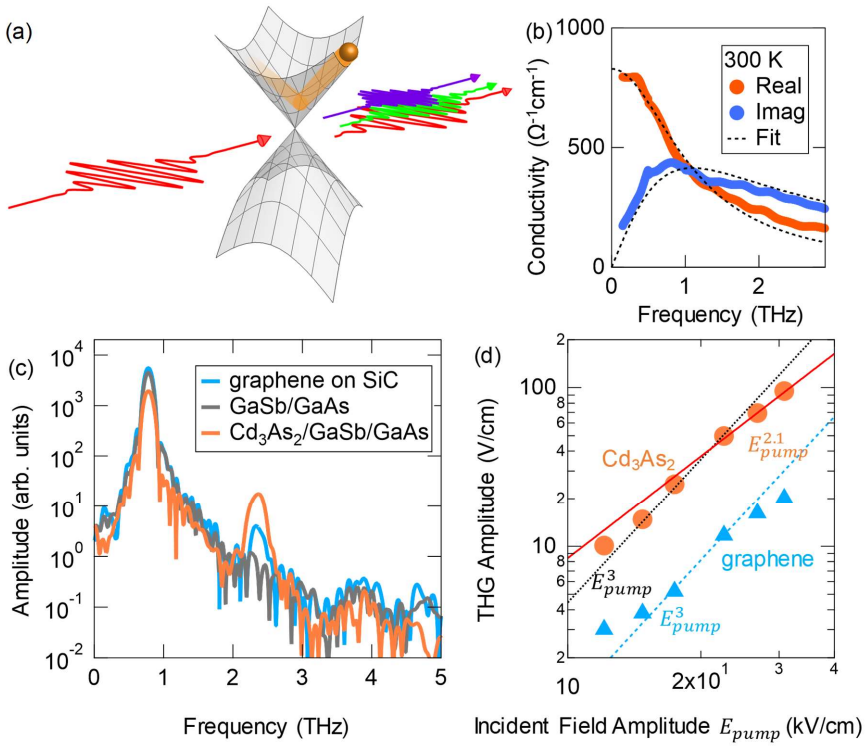
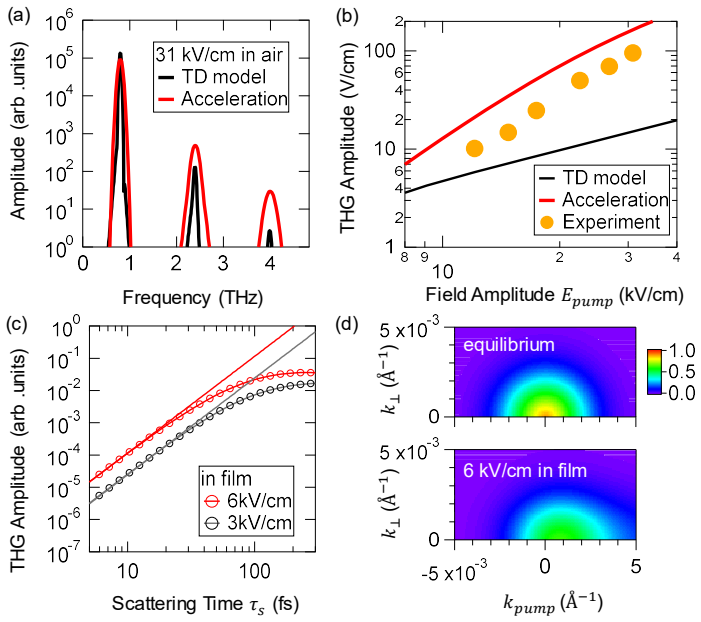
The load-bearing mechanism is coherent intraband acceleration of massless Dirac electrons: under an alternating field $E(t)$, the acceleration theorem shifts electron momenta as $d\mathbf{k}/dt = -e\mathbf{E}/\hbar$, and because the velocity of a massless Dirac electron has fixed magnitude $v_{\mathrm{F}}$ and is tied to the direction of $\mathbf{k}$, the oscillating field drives the Fermi distribution back and forth past the Dirac node instead of merely heating it. The paper models this with a linear dispersion $\epsilon_{\mathbf{k}}=\hbar v_{\mathrm{F}}|\mathbf{k}|$ and a relaxation-time Boltzmann equation with $\tau_{\mathrm{s}}=145$ fs, computing the nonlinear current and the transmitted field. The second key diagnostic is the pump-probe signal's $2f$ oscillation: a monochromatic pump at frequency $f$ modulates the third-order conductivity at $2f$, and the near-total absence of this oscillation for perpendicular probe polarization identifies the nonlinearity as directional, along the pump, exactly as a displaced momentum distribution would appear.
What would settle it
Directly measure the electric field inside the film at 31 kV/cm incident excitation, for example by comparing the transmitted fundamental waveform from films of calibrated thickness and conductivity under identical conditions; if the in-film field is not 6.5 kV/cm within roughly 10%, the reported 100 V/cm third-harmonic amplitude and the apparent factor-of-2 agreement with the coherent-acceleration model would need re-evaluation.
Extended reading notes
Core claim
The central claim is that a few-kV/cm terahertz field coherently displaces Dirac electrons along the pump polarization direction, creating a strongly unbalanced, nonthermal momentum distribution before scattering destroys it, and that the resulting intraband current is the dominant source of the observed third harmonic. The evidence is the anisotropic two-omega oscillation: the pump-probe signal oscillates at 1.6 THz when the probe is parallel to the pump, but almost nothing appears for a perpendicular probe, in stark contrast to the isotropic response expected from superconducting order-parameter oscillation or from the thermodynamic heating model. The authors further show by calculation that the coherent acceleration model, with a single Dirac cone and scattering time $\tau_{\mathrm{s}}=145$ fs, reproduces the measured third-harmonic amplitude within a factor of 2 and its saturating behavior, whereas the thermodynamic model with the measured relaxation time $\tau_{\mathrm{R}}\approx 8$ ps yields an amplitude roughly ten times smaller. On this basis they conclude that interband transitions are not the main source and that efficient room-temperature terahertz harmonic generation in Dirac semimetals is an intraband coherent effect.
Load-bearing premise
The load-bearing quantitative premise is that the electric field inside the 240-nm film is 6.5 kV/cm when the incident field is 31 kV/cm, an estimate from the linear-response Fresnel factor that ignores the observed 10% drop in fundamental transmittance at high field; if the true internal field differs substantially, the reported efficiency and factor-of-2 model agreement would need revision, although the polarization-anisotropy evidence would remain.
Editorial extensions
If this is right
- Terahertz third-harmonic generation in Cd3As2 is efficient enough to detect with a tabletop source at room temperature, yielding a 100 V/cm third-harmonic field from a 31 kV/cm incident field.
- The coherent-acceleration model explains both the value and the saturation of the third-harmonic amplitude across the perturbative-to-nonperturbative crossover, and the same model can be applied to other doped Dirac or Weyl systems.
- The polarization-resolved $2f$ oscillation is a diagnostic that distinguishes directionally coherent intraband nonlinearity from isotropic thermal or superconducting mechanisms.
- A scattering time of about 145 fs is not an obstacle: what matters is that the time to build an unbalanced momentum distribution, roughly 85 fs for a 6 kV/cm field, is shorter than the scattering time.
- Reducing Fresnel reflection losses with anti-reflection coating or applying the field through contact electrodes should increase the internal field and produce even stronger harmonics, as the paper suggests.
Reading between the lines
- If the coherent-acceleration picture is correct, materials with longer momentum scattering times than Cd3As2 should push the onset of nonperturbative harmonic generation to sub-kV/cm fields; that is a testable prediction for other topological semimetals.
- The internal-field estimate is the main quantitative uncertainty, so a direct measurement of the in-film field at 31 kV/cm incident excitation would reveal whether the factor-of-2 agreement is as good as claimed or partly fortuitous.
- The same polarization-resolved two-omega technique could be applied to other nonlinear materials as a general fingerprint for whether a terahertz nonlinearity is directional intraband motion rather than isotropic heating.
- The mechanism implies that harmonic emission should track the instantaneous momentum displacement rather than mere absorbed energy, so chirped or multicolor terahertz pulses could be used to shape the harmonic waveform.
Signed reviews
Editorial analysis
A structured set of objections, weighed in public.
Referee Report
Summary. The paper reports strong third-harmonic generation (THG) at 2.4 THz in thin epitaxial Cd3As2 films driven by 0.8 THz pulses from a tabletop source, with detected THG amplitude up to about 100 V/cm for an estimated 6.5 kV/cm internal fundamental field. Control measurements on GaSb/GaAs substrates and graphene/SiC, fifth-harmonic observations, and the measured perturbative-to-saturating power dependence support the existence of a strong terahertz nonlinearity. Time-resolved THz pump-probe measurements show a 2f (1.6 THz) oscillation of the probe response during quasi-monochromatic pumping that appears only for probe polarization parallel to the pump, together with a slow ~8 ps carrier relaxation that is inconsistent with the rapid heating/cooling cycles of the thermodynamic model. The authors model the nonlinear current with an intraband acceleration relaxation-time equation using independently measured parameters (tau_s = 145 fs, E_F = 50 meV, v_F = 0.93 x 10^6 m/s) and find agreement with the measured THG within a factor of 2, whereas the thermodynamic model with tau_R = 8 ps fails by about an order of magnitude. The central mechanistic claim is that the THG originates from coherent intraband acceleration of Dirac electrons rather than from an isotropic thermal response.
Significance. If substantiated, the result would be significant for terahertz nonlinear photonics: a bulk, room-temperature material with THz third-harmonic efficiency exceeding graphene's, plus a microscopic probe of the nonlinear current mechanism. The paper's strengths include the use of reference-substrate and graphene controls, the observation of both third and fifth harmonics, the direct and polarization-resolved 2f-oscillation observable, and the quantitative rejection of the thermodynamic model based on measured relaxation parameters rather than on a fit to the THG data. The quantitative efficiency and the factor-of-two model comparison rest on an internal-field calibration that the authors themselves flag as approximate; this is the main load-bearing weakness. The mechanistic evidence (anisotropic 2f oscillation, saturation, parameter-independent modeling) is less sensitive to that calibration.
major comments (2)
- [Supplemental Material Sec. 3, Fig. S3(d)] The reported 100 V/cm THG at 31 kV/cm incident field and the factor-of-two agreement of the coherent-acceleration model in Fig. 4(b) depend on the linear-response Fresnel factor 0.21 giving 6.5 kV/cm inside the 240 nm film. The manuscript explicitly notes a ~10% decrease of fundamental transmittance at the highest field and states that the internal field is evaluated in the linear-response regime. Because THG scales approximately as the third power of the fundamental field in the perturbative regime, a 10% uncertainty in internal field translates into roughly 30% uncertainty in THG amplitude, and if the true internal field is lower, the model-experiment comparison could degrade from "within a factor of 2" to a factor of about 3 or worse. The authors should propagate this calibration uncertainty into the quoted efficiency and into Fig. 4(b), or provide an independent estimate of the internal field that accounts for the observed nonlinear transmittance. The mechanism evidence from the anisotropic 2f oscillation does not depend on this calibration, but the quantitative efficiency claim does.
- [Fig. 3(c) and Supplemental Material Fig. S7] The claim that the 2f oscillation is absent for the perpendicular probe polarization rests on a null result that is not quantified. The manuscript says the oscillation is "hardly seen" and "never identified" in the perpendicular geometry, but no noise floor, amplitude ratio parallel/perpendicular, or detection limit is given. Since the rejection of an isotropic thermodynamic response relies on this asymmetry, the authors should provide a quantitative bound, for example the amplitude of the 1.6 THz Fourier component in the perpendicular geometry compared with the measurement noise level, and show that an isotropic component of the magnitude expected from the thermodynamic model would have been detected if present.
minor comments (5)
- [Main text, paragraph after Fig. 2] The phrase "fort this slow relaxation" should read "for this slow relaxation."
- [Fig. 4(b) caption] The caption says "in compassion with the experimental data"; this should be "in comparison with the experimental data."
- [Fig. 3(b)] The parallel and perpendicular traces are shown normalized and offset; please state the normalization point and the offset value so that the relative amplitudes of the two signals can be assessed.
- [Supplemental Material Sec. 3, Fig. S3(d)] In Fig. S3(d), please specify whether the transmittance is normalized to the low-field value, and include error bars or shot-to-shot scatter so the 10% decrease at 31 kV/cm can be evaluated quantitatively.
- [Main text and Supplemental Material] The terminology is inconsistent between "fifth harmonics" in the main text and "fifth harmonic generation (FHG)" in the Supplemental Material; please unify the terms.
Circularity Check
Derivation is self-contained: model parameters come from independent linear THz, ARPES, and magneto-THz measurements, and no fitted THG parameter is renamed as a prediction.
full rationale
The paper's central claim is that coherent intraband acceleration of Dirac electrons, not thermodynamic heating, produces the observed THz third harmonic. Walking the derivation chain: (i) the scattering time tau_s=145 fs is obtained from a Drude fit to linear THz conductivity spectra (Fig. 1(b), Supplemental Sec. 2), not from the THG data; (ii) E_F~50 meV and v_F=0.93e6 m/s are taken from prior magneto-THz and ARPES literature; (iii) the nonlinear current is computed from the Boltzmann relaxation-time equation (Supplemental Eq. 4) with these independently fixed parameters and a Gaussian pulse envelope, and the transmitted field follows from the thin-film formula (Supplemental Eq. 6), with no free parameter adjusted to match the THG amplitude; (iv) the thermodynamic model is imported from the graphene literature and rejected using the independently measured relaxation time tau_R~8 ps and the observed small (7%) increase of tau_s under pumping; (v) the anisotropic 2f oscillation is a directly measured pump-probe observable, and the Supplemental text explicitly derives why both THG and the 2f signal originate from the same third-order conductivity, which is a consistency relation rather than a circular definition. The only quantitatively load-bearing auxiliary input is the internal-field factor 0.21 from the linear-response Fresnel calculation; the authors explicitly acknowledge that the fundamental transmittance drops by 10% at high field and state they 'ignored this nonlinearity and evaluated the field strength inside the film ... as it is in linear response regime.' That is a stated approximation and a correctness risk for the factor-of-two model comparison, but it is not circular because the field calibration does not use the THG data or the model output. No equation in the paper reduces to its own input, no fitted parameter is renamed as a prediction, and no load-bearing uniqueness claim is imported from the authors' own prior work.
Assumptions & free parameters
free parameters (5)
- tau_s (scattering time) =
145 fs at 300 K
- E_F (Fermi energy) =
~50 meV
- v_F (Fermi velocity) =
0.93 x 10^6 m/s
- N (carrier density per area) =
2.7 x 10^12 cm^-2
- tau_R (relaxation time) =
~8 ps
assumptions (4)
- domain assumption The electronic structure is approximated by a single isotropic 3D Dirac cone with linear dispersion epsilon(k) = hbar v_F |k| near the Gamma point.
- domain assumption The relaxation time approximation with a single, time-independent scattering time tau_s and a static Fermi-Dirac distribution is valid for the high-field dynamics.
- domain assumption Interband transitions do not contribute significantly to THz THG.
- standard math The thin-film radiation formula relating current density to transmitted field, E_trans = (2 E - Z0 d J) / (n_s + 1), is valid.
Cite this review
Pith. "Pith review of Efficient Terahertz Harmonic Generation with Coherent Acceleration of Electrons in the Dirac Semimetal Cd3As2." pith.science (2026). https://pith.science/paper/S6JVJDU3
@misc{pith2026190807164,
  author       = {Pith},
  title        = {Pith review of: Efficient Terahertz Harmonic Generation with Coherent Acceleration of Electrons in the Dirac Semimetal Cd3As2},
  year         = {2026},
  howpublished = {\url{https://pith.science/paper/S6JVJDU3}},
  note         = {Machine review of arXiv:1908.07164}
}
read the original abstract
We report strong terahertz (~10^12 Hz) high harmonic generation in thin films of Cd3As2, a three-dimensional Dirac semimetal at room temperature. The third harmonics is detectable with tabletop light source and can be as strong as 100 V/cm by applying the fundamental field of 6.5 kV/cm inside the film, showing an unprecedented efficiency for terahertz frequency conversion. Our time-resolved terahertz spectroscopy and calculations also clarify the microscopic mechanism of the nonlinearity originating in the coherent acceleration of Dirac electrons in momentum space. Our results provide clear insights for nonlinear current of Dirac electrons driven by terahertz field under an influence of scattering, paving the way toward novel devices for high-speed electronics and photonics based on topological semimetals.
Figures


Figures from the paper (1 more)
Reference graph
Works this paper leans on
-
[1]
A Large Effective Phonon Magnetic Moment in a Dirac Semimetal
[S1] T. Schumann, M. Goyal, H. Kim, and S. Stemmer, APL Mater. 4, 126110 (2016). [S2] T. Schumann, M. Goyal, D. A. Kealhofer, and S. Stemmer, Phys. Rev. B 95, 241113(R) (2017). [S3] B. Cheng, T. Schumann, Y. C. Wang, X. S. Zhang, D. Barbalas, S. Stemmer, and N. P. Armitage, arXiv:1905.00309 (2019). [S4] T. Ando, J. Phys. Soc. Jpn. 75, 074716 (2006). [S5] ...
work page Pith review arXiv 2016
Reviewed August 14, 2026 · model on record in the stance chip above.
Discussion (0). Continue with ORCID to comment.