REVIEW 3 major objections 5 minor 90 references
Time dependence of complexity for Lovelock black holes
T0 review · 3 major / 5 minor · reviewed 2026-08-14 · deepseek-v4-flash
Pith's one-line read The paper argues that for Lovelock black holes, Complexity=Action predicts a late-time complexity growth rate that is a coupling-independent constant multiple of mass and does not reduce to Schwarzschild when couplings vanish.
desk verdict Useful general Noether-charge derivation of time-dependent CA complexity for Lovelock black holes, but the headline coupling-independent late-time rate is GHY-convention-dependent and the paper itself documents an alternative boundary term giving a different rate. read the letter →
The pith
A machine-rendered reading of the paper's core claim, the machinery that carries it, and where it could break.
The reading
What carries the argument
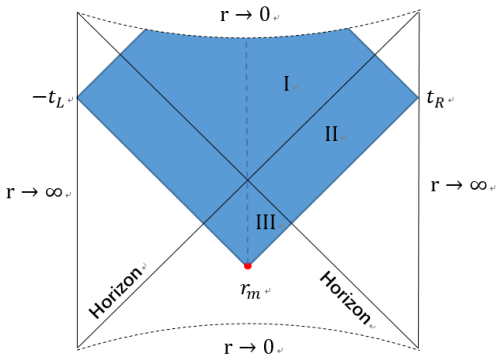
The machinery has three pieces. The Noether-charge identity $\partial_r(\sqrt{-g}Q^{rt})=\sqrt{-g}L$ rewrites every bulk-action integral as boundary terms, so time derivatives of the action become values of a temperature function times a Wald entropy function at the moving joints. The generalized Gibbons-Hawking-York boundary term, Eq. (36), evaluated at the singularity contributes the constant $\Delta$. The joint term at the moving corner $r_m$, whose motion is fixed by $t=-2r_*(r_m)$, contributes the logarithmic term; the Wald entropy function $\hat{S}(r)$ runs through both bulk and joint pieces and cancels except for the derivative term that vanishes at late times.
What would settle it
Compute the late-time complexity growth for a Gauss-Bonnet black hole using the alternative boundary term cited in the paper's footnote 5 instead of Eq. (36); the paper reports this gives $4M/3\pi$ rather than $(D-3)M/((D-4)\pi)$, so choosing one boundary term decides whether the coupling-independent $\Delta$ is physical.
Extended reading notes
Core claim
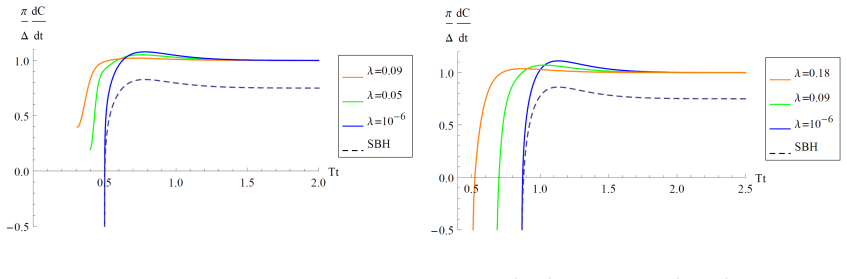
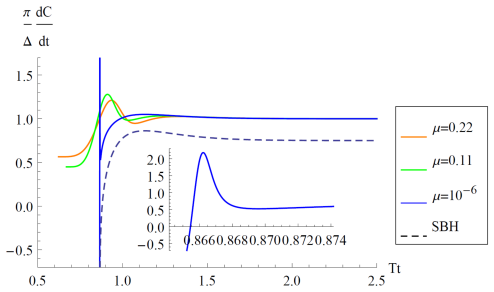
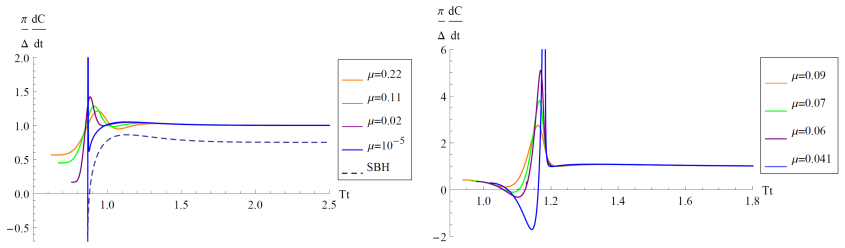
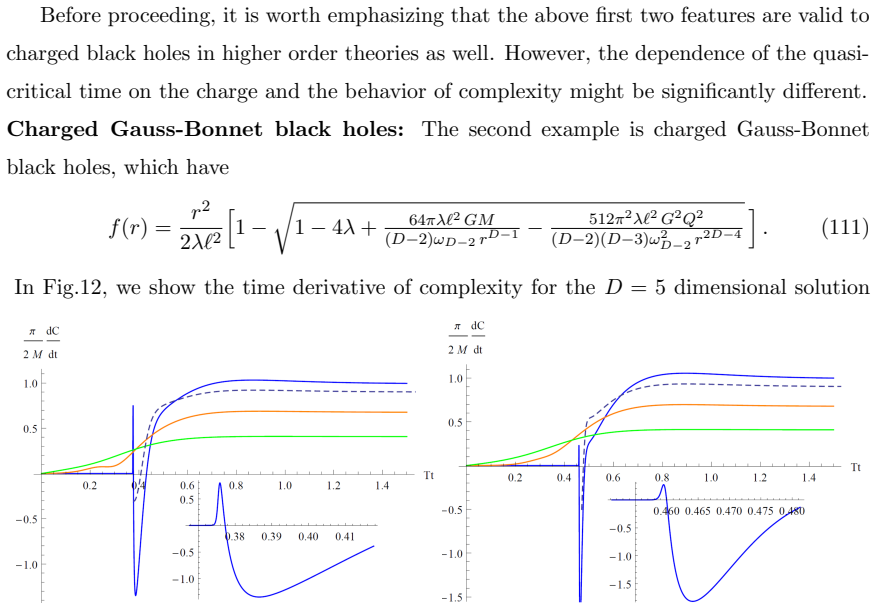
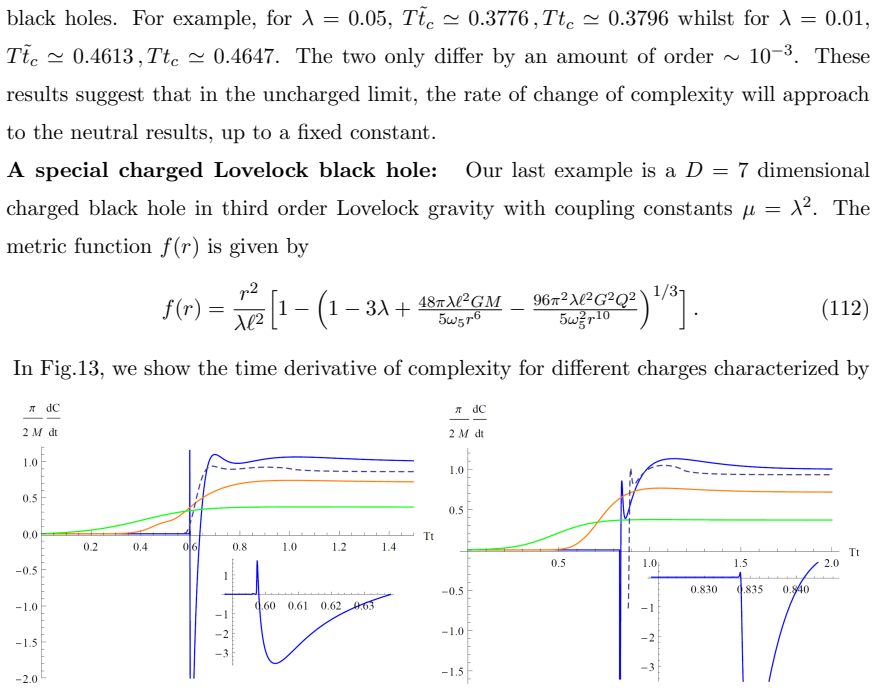
The central claim is that for neutral Lovelock black holes the full time evolution of the gravitational action on the Wheeler-DeWitt patch is captured by $$\frac{dI_{\rm grav}}{dt} = \$\Delta$ - \frac{\hat{S}'(r_m)}{4\pi}|f(r_m)|\log\left(\frac{|f(r_m)|}{\$alpha^{2}$}\right),$$ where $r_m(t)$ is the past joint of the patch and $\hat{S}$ is the Wald entropy function. At late times $r_m\to r_h$, the logarithm vanishes, and the growth rate becomes $dI_{\rm grav}/dt = \Delta$. Evaluating the generalized Gibbons-Hawking-York term at the future singularity gives $\Delta=2(D-3)M/(D-4)$ for Gauss-Bonnet black holes and $\Delta=6M$ for the third-order Lovelock case, so $\Delta/M$ is a pure number with no dependence on the higher-order couplings. Since the limits $\lambda\to 0$ and $r\to 0$ do not commute, the $\lambda\to0$ limit of $\Delta$ is not the Schwarzschild value $2M$; the paper shows numerically that the normalized growth rates differ by a fixed constant for the entire evolution after the critical time.
Load-bearing premise
Everything rests on Eq. (36) being the correct generalized Gibbons-Hawking-York boundary term for Lovelock gravity; the paper notes that another established boundary term yields a different late-time growth rate.
Editorial extensions
If this is right
- At late times, the action and therefore complexity growth rate for neutral Lovelock black holes is $\Delta/\pi$, with $\Delta$ a coupling-independent constant multiple of the mass.
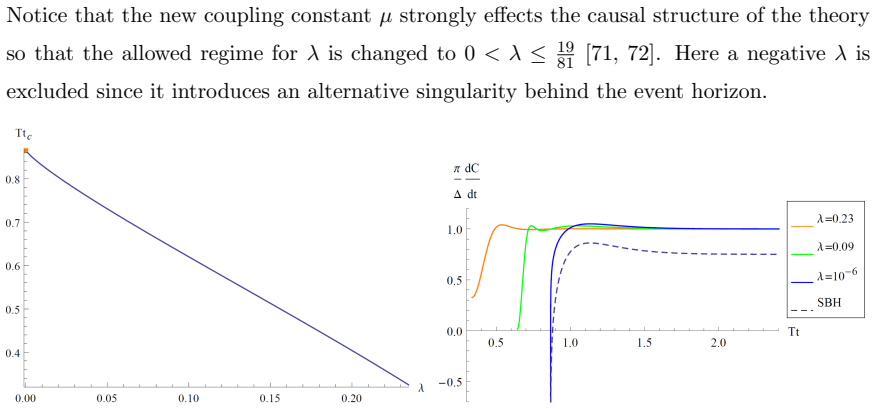
- In the vanishing-coupling limit, the normalized growth rate differs from Schwarzschild by a fixed constant for every time after the critical time, so perturbative treatments around Einstein gravity miss a finite offset.
- Because the next-to-leading-order late-time correction is positive, the growth rate reaches its limiting value from above, violating any conjectured upper bound set by that late-time rate.
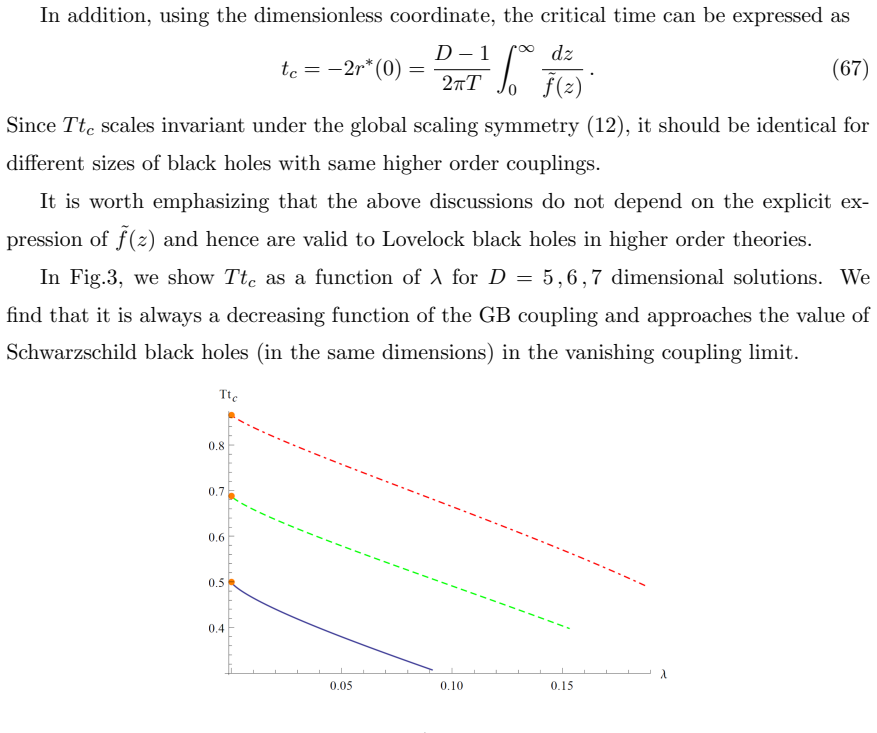
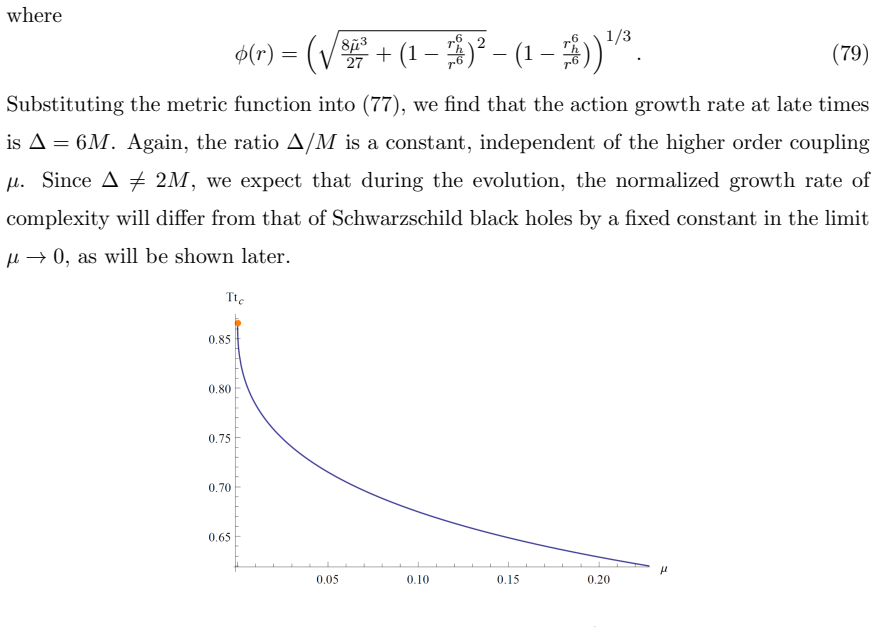
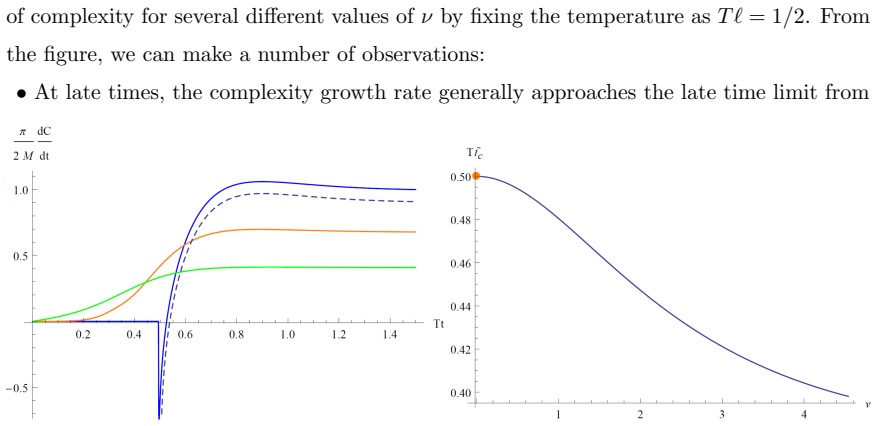
- The critical time $t_c$ measured in thermal time decreases with the Lovelock couplings, so higher-curvature corrections make complexity start growing earlier than in Schwarzschild.
- For charged Lovelock black holes, the uncharged limit approaches the universal rate $2M/\pi$, yet this remains offset from the neutral black hole's rate by a constant over the whole evolution.
Reading between the lines
- If a fundamental principle later fixes the boundary-term convention, the coupling-independent $\Delta$ would become a sharp Complexity=Action prediction distinguishing it from other complexity proposals; until then, the absence of a smooth Einstein limit should be read as convention-dependent.
- The derivation assumes a single central singularity, so Lovelock solutions with an alternative finite-radius singularity may behave differently; testing those backgrounds would show whether coupling independence survives.
- The observed inequality $T_+\le T_-$ for charged Lovelock black holes, if universal, predicts that all such charged solutions approach late-time complexity growth from above, a property that can be checked in other charged geometries.
- The early-time growth laws, constant for five-dimensional Gauss-Bonnet and logarithmic for higher dimensions, could be compared with boundary circuit-complexity computations in CFTs with finite $N$ corrections, where Lovelock couplings correspond to subleading $1/N$ effects.
Editorial analysis
A structured set of objections, weighed in public.
Referee Report
Summary. The paper studies the full time dependence of holographic complexity, under the CA proposal, for neutral and charged Lovelock black holes. The authors first derive, in Section 3, a general formula for the action growth rate in higher-order gravities by combining the bulk Noether-charge identity (33), a generalized GHY boundary term (36), and the joint/counter-term actions. For planar Lovelock black holes this leads to Eq. (45) and the late-time result Eq. (46), where the asymptotic rate is the constant Δ coming from the GHY term at the singularity. They evaluate Δ for Gauss-Bonnet and third-order Lovelock black holes and find that Δ/M is a pure number independent of the higher-order couplings (e.g., Δ = 2(D-3)M/(D-4) for Gauss-Bonnet). The paper emphasizes that, in the vanishing coupling limit, this rate does not reduce to the Schwarzschild value, that the two nevertheless differ by a constant during the whole evolution, and that the late-time limit is approached from above, violating the conjectured upper bound. For charged Lovelock black holes the authors recover the known late-time rate (98) from reference [34] and study numerically the approach to the uncharged limit, finding a mismatch with the neutral case. Numerical results for the full time dependence are presented for several families of Lovelock black holes.
Significance. If the late-time rate were a robust prediction of the CA proposal for Lovelock gravity, the paper would provide an interesting extension of previous results [39] and a concrete, falsifiable statement about how higher-curvature corrections affect complexity growth. The derivation is coherent, uses no fitted parameters, and is cross-checked against the independent late-time result [34] for charged black holes. However, the central claim is not stable under the choice of surface term: the paper itself notes in Section 4, footnote 5, that an alternative established Gauss-Bonnet GHY term [90] gives a different late-time rate (4M/3π instead of Δ = 2(D-3)M/(D-4)). The coupling-independent constant and the non-smooth Einstein limit are therefore properties of the convention (36), not robust CA predictions. This caveat does not destroy the value of the paper as a careful derivation under a specific prescription, but it requires the conclusions to be reframed and the ambiguity to be addressed in the main text.
major comments (3)
- [Section 4, footnote 5] The paper's central late-time claim, Eq. (46) with the coupling-independent Δ, rests entirely on the generalized GHY term (36). Footnote 5 concedes that the alternative, also-established Gauss-Bonnet boundary term of reference [90] gives dC/dt = 4M/3π for the same black holes, rather than Δ = 2(D-3)M/(D-4) from Eq. (61). This means that the constant Δ, the non-smooth λ→0 limit, and the statement that the rate 'does not reduce to Schwarzschild' are not invariants of the CA proposal but depend on the chosen surface-term convention. This issue should be moved from the footnote into the main text, and the corresponding claims in the abstract and Section 7 should be explicitly qualified as holding within the prescription (36).
- [Section 4, Eq. (62)] The argument that the non-commutativity of the limits ϵ→0 and λ→0 makes the result 'mathematically sound' explains the origin of the mismatch but does not resolve the physical ambiguity: the same order-of-limits reasoning applies to the alternative GHY term [90], which would give a different value of Δ. To make the central claim robust, the paper needs a physical criterion for selecting the surface term (36) over other admissible boundary terms, or it must explicitly present the result as one possible convention. Without such a criterion, Eq. (46) cannot be described as the complexity growth rate of Lovelock black holes.
- [Abstract and Section 7] The statement that the difference from the Schwarzschild result is 'a constant during the whole time evolution' inherits the same surface-term ambiguity. Because Δ enters Eqs. (45), (61), and (77), and because all numerical plots in Sections 4 and 5 normalize by Δ, the curves in Figs. 4, 7, 8, and 9 would be different, including the constant offset from the Schwarzschild curve, if the boundary term of [90] were used. The convention-dependence of these results should be acknowledged explicitly wherever they are summarized.
minor comments (5)
- [Section 3.5 and Section 6.3] The numerical procedure is described only verbally; no code or detailed discretization/error estimates are provided. Given that the central results are numerical, it would improve reproducibility to include pseudocode or state the integration method and tolerances.
- [Section 3.4, Eqs. (43)-(45)] The arbitrary normalization α of the null normals affects the logarithmic term in Eq. (45) and hence the early-time results such as Eqs. (70) and (81). The text states this only implicitly; it should be stated explicitly which observables (e.g., the late-time rate Δ) are α-independent and which early-time curves depend on the choice α.
- [Section 5, paragraph 1] The sentence 'In this section, we further examine the complexity growth rate for charged Lovelock black holes' appears in the introduction of Section 5, but the charged analysis is in Section 6; this organization error should be corrected.
- [Section 7, Conclusion] The concluding paragraph states that the paper studied 'third order Lovelock gravities' and then refers to 'section 6' for the organizational structure; the previous organization lists section 6 as the charged case and section 7 as the conclusion. The cross-reference should be updated for consistency.
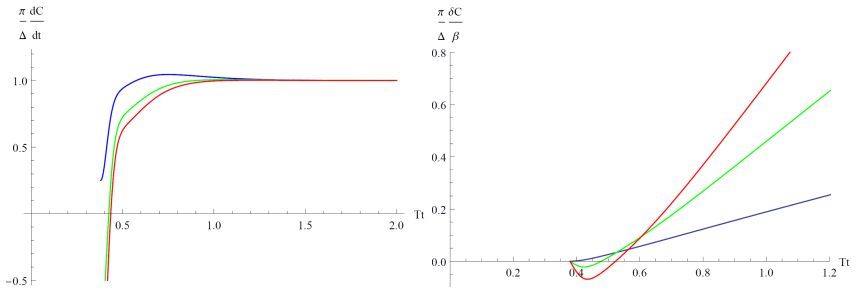
- [Section 4, Fig. 2 caption] The caption reports 'the complexity difference δC = C(t)−C(tc)' but the surrounding text and the left panel indicate that the plotted quantity is the rate dC/dt; please verify that the captions correctly label each panel.
Circularity Check
No circularity: the late-time growth rate is computed from the stated generalized GHY term and cross-checked against independent results; the footnote 5 boundary-term ambiguity is a disclosed robustness caveat, not a circular step.
full rationale
The derivation is self-contained. Section 3 obtains Eq. (45) by adding three separately derived pieces: the bulk piece (34) from the Wald-Iyer Noether identity (33), the GHY piece (37) from the standard generalized boundary term (36) of ref. [86], and the joint piece (44) from the corner-term results [31,35,87]. Delta is not a fitted parameter and is not an input renamed as a prediction; it is defined in (37) as the constant remainder of dIGHY/dt at the singularity and then evaluated explicitly for the Gauss-Bonnet and third-order Lovelock metrics, yielding (61) and Delta = 6M as genuine computations from the metric functions. The charged-sector late-time result (98)-(99) is explicitly checked against the independent result of ref. [34], and the arbitrary normalization alpha drops out at late times because the logarithm term in (45) vanishes as f(rm) -> 0. The relevant in-scope caveat is Section 4, footnote 5, where the paper concedes that the alternative established GB boundary term of ref. [90] gives dC/dt = 4M/3pi instead. This is a disclosed convention-dependence: the CA prediction depends on which boundary term defines the gravitational action, and its robustness as a physical prediction is therefore limited. But that is a premise-ambiguity about the action, not a circular reduction. The paper never fits Delta to data, never imports a uniqueness theorem from its own prior work, and its self-citations [48,49,77] concern the Noether-charge identity (33), which is standard, externally checkable Iyer-Wald mathematics and is unpacked transparently in the Appendix. The order-of-limits explanation (62) is an honest mathematical observation. Hence the derivation is self-contained and the circularity score is 0.
Assumptions & free parameters
free parameters (1)
- α (null-normal normalization) =
arbitrary positive constant
assumptions (5)
- standard math Wald-Iyer Noether charge identity (33): for a Killing horizon, ∂_r(√-g Q^rt)=√-g L
- domain assumption The CA conjecture C=I_grav/π (Eq. 1)
- domain assumption The WDW patch terminates at a single central singularity (no alternative singularity before r=0)
- domain assumption The generalized GHY term (36) from [86] is the correct surface term for Lovelock gravity
- domain assumption For charged black holes, an inner horizon exists and no alternative singularity lies before it
Cite this review
Pith. "Pith review of Time dependence of complexity for Lovelock black holes." pith.science (2026). https://pith.science/paper/S7GDNGRJ
@misc{pith2026190809310,
  author       = {Pith},
  title        = {Pith review of: Time dependence of complexity for Lovelock black holes},
  year         = {2026},
  howpublished = {\url{https://pith.science/paper/S7GDNGRJ}},
  note         = {Machine review of arXiv:1908.09310}
}
read the original abstract
We study the general time dependence of complexity for holographic states dual to Lovelock black holes using the "Complexity=Action" (CA) proposal. We observe that at early times, the critical time at which the complexity begins to increase is a decreasing function of the higher order coupling constants, which implies that the complexity evolves faster than that of Schwarzschild black holes. At late times, the rate of change of complexity is essentially determined by the generalised Gibbons-Hawking-York boundary term evaluated at the future singularity. In particular, its ratio to black hole mass is a characteristic constant, independent of the higher order couplings. Thus, in the vanishing coupling limit, the result in general does not reduce to that of Schwarzschild black holes, in spite of that the metric reduces to the latter as well as the gravitational action. In fact, the two differ by a constant during the whole time evolution. Including the next-to-leading order term around late times, we find that as the Einstein case, the late time limit is always approached from above, thus violating any conjectured upper bound given by the late time result. For charged Lovelock black holes, we find that with sufficient charge, the complexity roughly behaves the same as the Einstein case. However, for smaller charges, the two have some significant differences. In particular, unlike the Einstein case, in the uncharged limit the complexity growth rate does not match with the neutral case, differing by a constant in the whole time evolution.
Figures
Figures from the paper (11 more)
Reference graph
Works this paper leans on
-
[34]
P. A. Cano, R. A. Hennigar and H. Marrochio, Complexity Growth Rate in Lovelock Gravity, Phys. Rev. Lett. 121, no. 12, 121602 (2018) [arXiv:1803.02795 [hep-th]]
arXiv 2018
- [39]
-
[90]
S. C. Davis, Generalized Israel junction conditions for a Gauss-Bonnet brane world, Phys. Rev. D 67, 024030 (2003) [hep-th/0208205]. 44
arXiv 2003
-
[1]
J. M. Maldacena, The Large N limit of superconformal field theories and supergravity, Int. J. Theor. Phys. 38, 1113 (1999) [Adv. Theor. Math. Phys. 2, 231 (1998)] [hep- th/9711200]. 36
arXiv 1999
-
[2]
Witten, Anti-de Sitter space and holography, Adv
E. Witten, Anti-de Sitter space and holography, Adv. Theor. Math. Phys. 2, 253 (1998) [hep-th/9802150]
arXiv 1998
-
[3]
S. S. Gubser, I. R. Klebanov and A. M. Polyakov, Gauge theory correlators from noncritical string theory, Phys. Lett. B 428, 105 (1998) [hep-th/9802109]
arXiv 1998
- [4]
-
[5]
Van Raamsdonk, Building up spacetime with quantum entanglement, Gen
M. Van Raamsdonk, Building up spacetime with quantum entanglement, Gen. Rel. Grav. 42, 2323 (2010) [Int. J. Mod. Phys. D 19, 2429 (2010)] [arXiv:1005.3035 [hep- th]]
arXiv 2010
Show all 90 references
-
[6]
Susskind, Entanglement is not enough, Fortsch
L. Susskind, Entanglement is not enough, Fortsch. Phys. 64, 49 (2016) [arXiv:1411.0690 [hep-th]]
2016 arXiv
-
[7]
Susskind, Computational Complexity and Black Hole Horizons, [Fortsch
L. Susskind, Computational Complexity and Black Hole Horizons, [Fortsch. Phys. 64, 24 (2016)] Addendum: Fortsch. Phys. 64, 44 (2016) [arXiv:1403.5695 [hep-th], arXiv:1402.5674 [hep-th]]
2016 arXiv
-
[8]
Stanford and L
D. Stanford and L. Susskind, Complexity and Shock Wave Geometries, Phys. Rev. D 90, no. 12, 126007 (2014) [arXiv:1406.2678 [hep-th]]
2014 arXiv
-
[9]
A. R. Brown, D. A. Roberts, L. Susskind, B. Swingle and Y. Zhao, Holographic Complexity Equals Bulk Action?, Phys. Rev. Lett. 116, no. 19, 191301 (2016) [arXiv:1509.07876 [hep-th]]
2016 arXiv
-
[10]
A. R. Brown, D. A. Roberts, L. Susskind, B. Swingle and Y. Zhao, Complexity, action, and black holes, Phys. Rev. D 93, no. 8, 086006 (2016) [arXiv:1512.04993 [hep-th]]
2016 arXiv
-
[11]
Moosa, Divergences in the rate of complexification,Phys
M. Moosa, Divergences in the rate of complexification,Phys. Rev. D97, no. 10, 106016 (2018) [arXiv:1712.07137 [hep-th]]
2018 arXiv
-
[12]
S. A. Hosseini Mansoori and M. M. Qaemmaqami, Complexity Growth, Butterfly Velocity and Black hole Thermodynamics, arXiv:1711.09749 [hep-th]
-
[13]
Mahapatra and P
S. Mahapatra and P. Roy, On the time dependence of holographic complexity in a dynamical Einstein-dilaton model, JHEP 1811, 138 (2018) [arXiv:1808.09917 [hep- th]]. 37
2018 arXiv
-
[14]
Chapman, H
S. Chapman, H. Marrochio and R. C. Myers, Complexity of Formation in Holography, JHEP 1701, 062 (2017) [arXiv:1610.08063 [hep-th]]
2017 arXiv
-
[15]
Carmi, R
D. Carmi, R. C. Myers and P. Rath, Comments on Holographic Complexity, JHEP 1703, 118 (2017) [arXiv:1612.00433 [hep-th]]
2017 arXiv
-
[16]
R. Q. Yang, C. Niu and K. Y. Kim,Surface Counterterms and Regularized Holographic Complexity, JHEP 1709, 042 (2017) [arXiv:1701.03706 [hep-th]]
2017 arXiv
-
[17]
R. Q. Yang, Strong energy condition and complexity growth bound in holography,Phys. Rev. D 95, no. 8, 086017 (2017) [arXiv:1610.05090 [gr-qc]]
2017 arXiv
-
[18]
Chapman, H
S. Chapman, H. Marrochio and R. C. Myers, Holographic complexity in Vaidya space- times. Part I, JHEP 1806, 046 (2018) [arXiv:1804.07410 [hep-th]]
2018 arXiv
-
[19]
Chapman, H
S. Chapman, H. Marrochio and R. C. Myers, Holographic complexity in Vaidya space- times. Part II, JHEP 1806, 114 (2018) [arXiv:1805.07262 [hep-th]]
2018 arXiv
-
[20]
Moosa, Evolution of Complexity Following a Global Quench, JHEP 1803, 031 (2018) [arXiv:1711.02668 [hep-th]]
M. Moosa, Evolution of Complexity Following a Global Quench, JHEP 1803, 031 (2018) [arXiv:1711.02668 [hep-th]]
2018 arXiv
-
[21]
Z. Y. Fan and M. Guo, Holographic complexity under a global quantum quench, arXiv:1811.01473 [hep-th]
-
[22]
Bernamonti, F
A. Bernamonti, F. Galli, J. Hernandez, R. C. Myers, S. M. Ruan and J. Simn, The First Law of Complexity, arXiv:1903.04511 [hep-th]
1903 arXiv
-
[23]
Swingle and Y
B. Swingle and Y. Wang, Holographic Complexity of Einstein-Maxwell-Dilaton Grav- ity, arXiv:1712.09826 [hep-th]
-
[24]
Alishahiha, A
M. Alishahiha, A. Faraji Astaneh, M. R. Mohammadi Mozaffar and A. Mollabashi, Complexity Growth with Lifshitz Scaling and Hyperscaling Violation, JHEP 1807, 042 (2018) [arXiv:1802.06740 [hep-th]]
2018 arXiv
-
[25]
Y. S. An and R. H. Peng, Effect of the dilaton on holographic complexity growth, Phys. Rev. D 97, no. 6, 066022 (2018) [arXiv:1801.03638 [hep-th]]
2018 arXiv
-
[26]
Jiang, Action growth rate for a higher curvature gravitational theory, Phys
J. Jiang, Action growth rate for a higher curvature gravitational theory, Phys. Rev. D 98, no. 8, 086018 (2018) [arXiv:1810.00758 [hep-th]]. 38
2018 arXiv
-
[27]
R. Q. Yang, C. Niu, C. Y. Zhang and K. Y. Kim, Comparison of holographic and field theoretic complexities for time dependent thermofield double states, JHEP 1802, 082 (2018) [arXiv:1710.00600 [hep-th]]
2018 arXiv
-
[28]
R. Yang, H. S. Jeong, C. Niu and K. Y. Kim, Complexity of Holographic Supercon- ductors, JHEP 1904, 146 (2019) [arXiv:1902.07586 [hep-th]]
2019 arXiv
-
[29]
H. Guo, X. M. Kuang and B. Wang, Note on holographic entanglement entropy and complexity in St ¨uckelberg superconductor, arXiv:1902.07945 [hep-th]
1902 arXiv
-
[30]
R. G. Cai, S. M. Ruan, S. J. Wang, R. Q. Yang and R. H. Peng, Action growth for AdS black holes, JHEP 1609, 161 (2016) [arXiv:1606.08307 [gr-qc]]
2016 arXiv
-
[31]
Lehner, R
L. Lehner, R. C. Myers, E. Poisson and R. D. Sorkin, Gravitational action with null boundaries, Phys. Rev. D 94, no. 8, 084046 (2016) [arXiv:1609.00207 [hep-th]]
2016 arXiv
-
[32]
Huang, X
H. Huang, X. H. Feng and H. Lu, Holographic Complexity and Two Identities of Action Growth, Phys. Lett. B 769, 357 (2017) [arXiv:1611.02321 [hep-th]]
2017 arXiv
-
[33]
R. G. Cai, M. Sasaki and S. J. Wang, Action growth of charged black holes with a single horizon, Phys. Rev. D 95, no. 12, 124002 (2017) [arXiv:1702.06766 [gr-qc]]
2017 arXiv
-
[35]
Jiang and H
J. Jiang and H. Zhang, Surface term, corner term, and action growth in F(Riemann) gravity theory, arXiv:1806.10312 [hep-th]
-
[36]
complexity equals action
J. Jiang and X. W. Li, Modified “complexity equals action” conjecture, arXiv:1903.05476 [hep-th]
1903 arXiv
-
[37]
X. H. Feng and H. S. Liu, Holographic Complexity Growth Rate in Horndeski Theory, Eur. Phys. J. C 79, no. 1, 40 (2019) [arXiv:1811.03303 [hep-th]]
2019 arXiv
-
[38]
Alishahiha, A
M. Alishahiha, A. Faraji Astaneh, A. Naseh and M. H. Vahidinia, On complexity for F(R) and critical gravity, JHEP 1705, 009 (2017) [arXiv:1702.06796 [hep-th]]
2017 arXiv
-
[40]
Jiang and B
J. Jiang and B. X. Ge, Investigating two counting methods of the holographic com- plexity, Phys. Rev. D 99, no. 12, 126006 (2019) [arXiv:1905.08447 [hep-th]]
2019 arXiv
-
[41]
H. S. Liu and H. Lu, Action Growth of Dyonic Black Holes and Electromagnetic Duality, arXiv:1905.06409 [hep-th]
1905 arXiv
-
[42]
Flory and N
M. Flory and N. Miekley, Complexity change under conformal transformations in AdS3/CFT2, JHEP 1905, 003 (2019) [arXiv:1806.08376 [hep-th]]
2019 arXiv
-
[43]
Flory, WdW-patches in AdS3 and complexity change under conformal transforma- tions II, JHEP 1905, 086 (2019) [arXiv:1902.06499 [hep-th]]
M. Flory, WdW-patches in AdS3 and complexity change under conformal transforma- tions II, JHEP 1905, 086 (2019) [arXiv:1902.06499 [hep-th]]
2019 arXiv
-
[44]
Ghodrati, Complexity growth rate during phase transitions, Phys
M. Ghodrati, Complexity growth rate during phase transitions, Phys. Rev. D 98, no. 10, 106011 (2018) [arXiv:1808.08164 [hep-th]]
2018 arXiv
-
[45]
Ghodrati, Complexity growth in massive gravity theories, the effects of chirality, and more, Phys
M. Ghodrati, Complexity growth in massive gravity theories, the effects of chirality, and more, Phys. Rev. D 96, no. 10, 106020 (2017) [arXiv:1708.07981 [hep-th]]
2017 arXiv
-
[46]
Y. T. Zhou, M. Ghodrati, X. M. Kuang and J. P. Wu, Evolutions of entanglement and complexity after a thermal quench in massive gravity theory, arXiv:1907.08453 [hep-th]
1907 arXiv
-
[47]
Couch, W
J. Couch, W. Fischler and P. H. Nguyen, Noether charge, black hole volume, and complexity, JHEP 1703, 119 (2017) [arXiv:1610.02038 [hep-th]]
2017 arXiv
-
[48]
Z. Y. Fan and M. Guo, On the Noether charge and the gravity duals of quantum complexity, JHEP 1808, 031 (2018) [arXiv:1805.03796 [hep-th]]
2018 arXiv
-
[49]
Z. Y. Fan and M. Guo, Holographic complexity and thermodynamics of AdS black holes, arXiv:1903.04127 [hep-th]
1903 arXiv
-
[50]
Myers, Circuit complexity in quantum field theory , JHEP 10 (2017) 107, [arXiv:1707.08570]
Ro Jefferson and Robert C. Myers, Circuit complexity in quantum field theory , JHEP 10 (2017) 107, [arXiv:1707.08570]
2017 arXiv
-
[51]
Myers, Circuit complexity for free fermions , JHEP07(2018)139, [arXiv:1803.10638]
Lucas Hackl and Robert C. Myers, Circuit complexity for free fermions , JHEP07(2018)139, [arXiv:1803.10638]
2018 arXiv
-
[52]
Rifath Khan, Chethan Krishnan and Sanchita Sharma, Circuit Complexity in Fermionic Field Theory , Phys. Rev. D 98, no. 12, 126001 (2018) [arXiv:1801.07620 [hep-th]]. 40
2018 arXiv
-
[53]
Heller, Hugo Marrochio and Fernando Pastawski, Towards Complexity for Quantum Field Theory States , Phys
Shira Chapman, Michal P. Heller, Hugo Marrochio and Fernando Pastawski, Towards Complexity for Quantum Field Theory States , Phys. Rev. Lett. 120, 121602 (2018), [arXiv:1707.08582]
2018 arXiv
-
[54]
Myers and Shan-Ming Ruan, Circuit Com- plexity for Coherent States , JHEP 1810 (2018) 011, [arXiv:1807.07677]
Minyong Guo, Juan Hernandez, Robert C. Myers and Shan-Ming Ruan, Circuit Com- plexity for Coherent States , JHEP 1810 (2018) 011, [arXiv:1807.07677]
2018 arXiv
-
[55]
Heller, Ro Jefferson, Hugo Mar- rochio and Robert C
Shira Chapman, Jens Eisert, Lucas Hackl, Michal P. Heller, Ro Jefferson, Hugo Mar- rochio and Robert C. Myers, Complexity and entanglement for thermofield double states, SciPost Phys. 6, no. 3, 034 (2019) [arXiv:1810.05151 [hep-th]]
2019 arXiv
-
[56]
Bhattacharyya, A
A. Bhattacharyya, A. Shekar and A. Sinha, Circuit complexity in interacting QFTs and RG flows, JHEP 1810, 140 (2018) [arXiv:1808.03105 [hep-th]]
2018 arXiv
-
[57]
Jie Jiang, Jieru Shan and Jianzhi Yang, Circuit complexity for free fermion with a mass quench, [arXiv:1810.00537]
-
[58]
Jiang and X
J. Jiang and X. Liu, Circuit Complexity for Fermionic Thermofield Double states, Phys. Rev. D 99, no. 2, 026011 (2019) [arXiv:1812.00193 [hep-th]]
2019 arXiv
-
[59]
Daniel W. F. Alves and Giancarlo Camilo, Evolution of complexity following a quan- tum quench in free field theory , JHEP 06 (2018) 029, [arXiv:1804.00107]
2018 arXiv
-
[60]
H. A. Camargo, P. Caputa, D. Das, M. P. Heller and R. Jefferson, Complexity as a novel probe of quantum quenches: universal scalings and purifications, Phys. Rev. Lett. 122, no. 8, 081601 (2019) [arXiv:1807.07075 [hep-th]]
2019 arXiv
-
[61]
T. Ali, A. Bhattacharyya, S. S. Haque, E. H. Kim and N. Moynihan,Time Evolution of Complexity: A Critique of Three Methods, JHEP 1904, 087 (2019) [arXiv:1810.02734 [hep-th]]
2019 arXiv
-
[62]
Pawel Caputa, Nilay Kundu, Masamichi Miyaji and Tadashi Takayanagi, Kento Watanabe, Liouville Action as Path-Integral Complexity: From Continuous Tensor Networks to AdS/CFT , JHEP 11 (2017) 097, [arXiv:1706.07056]
2017 arXiv
-
[63]
Bhattacharyya, P
A. Bhattacharyya, P. Caputa, S. R. Das, N. Kundu, M. Miyaji and T. Takayanagi,Path-Integral Complexity for Perturbed CFTs, JHEP 1807, 086 (2018) [arXiv:1804.01999 [hep-th]]. 41
2018 arXiv
-
[64]
Run-Qiu Yang, Yu-Sen An, Chao Niu, Cheng-Yong Zhang and Keun-Young Kim, Principles and symmetries of complexity in quantum field theory , Eur. Phys. J. C 79, no. 2, 109 (2019) [arXiv:1803.01797 [hep-th]]
2019 arXiv
-
[65]
R. Q. Yang, Y. S. An, C. Niu, C. Y. Zhang and K. Y. Kim, More on complexity of operators in quantum field theory, JHEP 1903, 161 (2019) [arXiv:1809.06678 [hep- th]]
2019 arXiv
-
[66]
R. Q. Yang, Y. S. An, C. Niu, C. Y. Zhang and K. Y. Kim, To be unitary-invariant or not?: a simple but non-trivial proposal for the complexity between states in quantum mechanics/field theory, arXiv:1906.02063 [hep-th]
1906 arXiv
-
[67]
Xiong, D
Z. Xiong, D. X. Yao and Z. Yan, Nonanalyticity of circuit complexity across topological phase transitions, arXiv:1906.11279 [cond-mat.str-el]
1906 arXiv
-
[68]
Brigante, H
M. Brigante, H. Liu, R. C. Myers, S. Shenker and S. Yaida, Viscosity Bound Violation in Higher Derivative Gravity, Phys. Rev. D 77, 126006 (2008) [arXiv:0712.0805 [hep- th]]
2008 arXiv
-
[69]
X. O. Camanho and J. D. Edelstein, Causality constraints in AdS/CFT from conformal collider physics and Gauss-Bonnet gravity, JHEP 1004, 007 (2010) [arXiv:0911.3160 [hep-th]]
2010 arXiv
-
[70]
Buchel, J
A. Buchel, J. Escobedo, R. C. Myers, M. F. Paulos, A. Sinha and M. Smolkin, Holo- graphic GB gravity in arbitrary dimensions, JHEP 1003, 111 (2010) [arXiv:0911.4257 [hep-th]]
2010 arXiv
-
[71]
de Boer, M
J. de Boer, M. Kulaxizi and A. Parnachev, Holographic Lovelock Gravities and Black Holes, JHEP 1006, 008 (2010) [arXiv:0912.1877 [hep-th]]
2010 arXiv
-
[72]
X. O. Camanho and J. D. Edelstein, Causality in AdS/CFT and Lovelock theory, JHEP 1006, 099 (2010) [arXiv:0912.1944 [hep-th]]
2010 arXiv
-
[73]
X. H. Ge, S. J. Sin, S. F. Wu and G. H. Yang,Shear viscosity and instability from third order Lovelock gravity, Phys. Rev. D 80, 104019 (2009) [arXiv:0905.2675 [hep-th]]
2009 arXiv
-
[74]
de Boer, M
J. de Boer, M. Kulaxizi and A. Parnachev, Holographic Entanglement Entropy in Lovelock Gravities, JHEP 1107, 109 (2011) [arXiv:1101.5781 [hep-th]]
2011 arXiv
-
[75]
Chen and J
B. Chen and J. j. Zhang, Note on generalized gravitational entropy in Lovelock gravity, JHEP 1307, 185 (2013) [arXiv:1305.6767 [hep-th]]. 42
2013 arXiv
-
[76]
Dong, Holographic Entanglement Entropy for General Higher Derivative Gravity, JHEP 1401, 044 (2014) [arXiv:1310.5713 [hep-th]]
X. Dong, Holographic Entanglement Entropy for General Higher Derivative Gravity, JHEP 1401, 044 (2014) [arXiv:1310.5713 [hep-th]]
2014 arXiv
-
[77]
Z. Y. Fan, Note on the Noether charge and holographic transports, Phys. Rev. D 97, no. 6, 066013 (2018) [arXiv:1801.07870 [hep-th]]
2018 arXiv
-
[78]
R. G. Cai, Gauss-Bonnet black holes in AdS spaces, Phys. Rev. D 65, 084014 (2002) [hep-th/0109133]
2002 arXiv
-
[79]
Nojiri and S
S. Nojiri and S. D. Odintsov, Anti-de Sitter black hole thermodynamics in higher derivative gravity and new confining deconfining phases in dual CFT, Phys. Lett. B 521, 87 (2001) Erratum: [Phys. Lett. B 542, 301 (2002)] [hep-th/0109122]
2001 arXiv
-
[80]
R. C. Myers and J. Z. Simon, Black Hole Thermodynamics in Lovelock Gravity, Phys. Rev. D 38 (1988) 2434-2444
1988
-
[81]
R. G. Cai, A Note on thermodynamics of black holes in Lovelock gravity, Phys. Lett. B 582, 237 (2004) [hep-th/0311240]
2004 arXiv
-
[82]
M. H. Dehghani and R. Pourhasan, Thermodynamic instability of black holes of third order Lovelock gravity, Phys. Rev. D 79, 064015 (2009) [arXiv:0903.4260 [gr-qc]]
2009 arXiv
-
[83]
Wald, Black hole entropy is the Noether charge , Phys
R.M. Wald, Black hole entropy is the Noether charge , Phys. Rev. D 48, 3427 (1993), gr-qc/9307038
1993 arXiv
-
[84]
Iyer and R.M
V. Iyer and R.M. Wald, Some properties of Noether charge and a proposal for dynam- ical black hole entropy, Phys. Rev. D 50, 846 (1994), gr-qc/9403028
1994 arXiv
-
[85]
Jacobson and R
T. Jacobson and R. C. Myers, Black hole entropy and higher curvature interactions, Phys. Rev. Lett. 70, 3684 (1993) [hep-th/9305016]
1993 arXiv
-
[86]
Deruelle, M
N. Deruelle, M. Sasaki, Y. Sendouda and D. Yamauchi, Hamiltonian formulation of f(Riemann) theories of gravity, Prog. Theor. Phys. 123, 169 (2010) [arXiv:0908.0679 [hep-th]]
2010 arXiv
-
[87]
P. A. Cano, Lovelock action with nonsmooth boundaries, Phys. Rev. D 97, no. 10, 104048 (2018) [arXiv:1803.00172 [gr-qc]]
2018 arXiv
-
[88]
Z. Y. Fan and H. Lu, Thermodynamical First Laws of Black Holes in Quadratically- Extended Gravities, Phys. Rev. D91, no. 6, 064009 (2015) [arXiv:1501.00006 [hep-th]]. 43
2015 arXiv
-
[89]
B. Chen, Z. Y. Fan and L. Y. Zhu, AdS and Lifshitz Scalar Hairy Black Holes in Gauss-Bonnet Gravity, Phys. Rev. D 94, no. 6, 064005 (2016) [arXiv:1604.08282 [hep-th]]
2016 arXiv
Reviewed August 14, 2026 · model on record in the stance chip above.
Discussion (0). Continue with ORCID to comment.