REVIEW 3 major objections 6 minor 87 references
Soft Electrothermal Meta-Actuator for Robust Multifunctional Control
T0 review · 3 major / 6 minor · reviewed 2026-08-07 · deepseek-v4-flash
Pith's one-line read A soft electrothermal actuator with two thermally independent heater loops on opposite faces gains electrically selectable bidirectional bending, more than 100× lower sensitivity to ambient temperature, and forced return about 10× faster…
desk verdict A genuinely useful double-sided electrothermal actuator, but the headline '10× faster return' is a transient zero-crossing, not a controlled settling. read the letter →
The pith
A machine-rendered reading of the paper's core claim, the machinery that carries it, and where it could break.
The reading
What carries the argument
The central object is the double-sided thin-film meta-actuator: carbon nanotube heater loops stencil-printed on both faces of a 100 µm paper substrate, each covered with a strip of biaxially oriented polypropylene (BOPP), a material with high thermal expansion. The two loops are deliberately different in size (outer and inner) and spaced about 3.3 mm apart, so that the condition $h w^2/(k t \Delta d) \gg 1$ holds—convective heat loss to the air dominates over in-plane conduction through the low-conductivity paper, making the heaters thermally independent. Powering one loop creates a strain mismatch between the low-expansion paper and the high-expansion BOPP, bending the film toward that face; powering the other loop bends it the opposite way; ambient heat acts on both faces symmetrically and cancels; and powering the opposite loop after actuation actively forces the film back to its rest state.
What would settle it
Power only the outer heater loop at 0.75 W in still air at room temperature and record the unpowered inner loop's temperature with the thermal camera; if the inner loop warms by more than a couple of degrees Celsius, heat is conducting across the film and the claim of electrically selectable direction is not supported.
Extended reading notes
Core claim
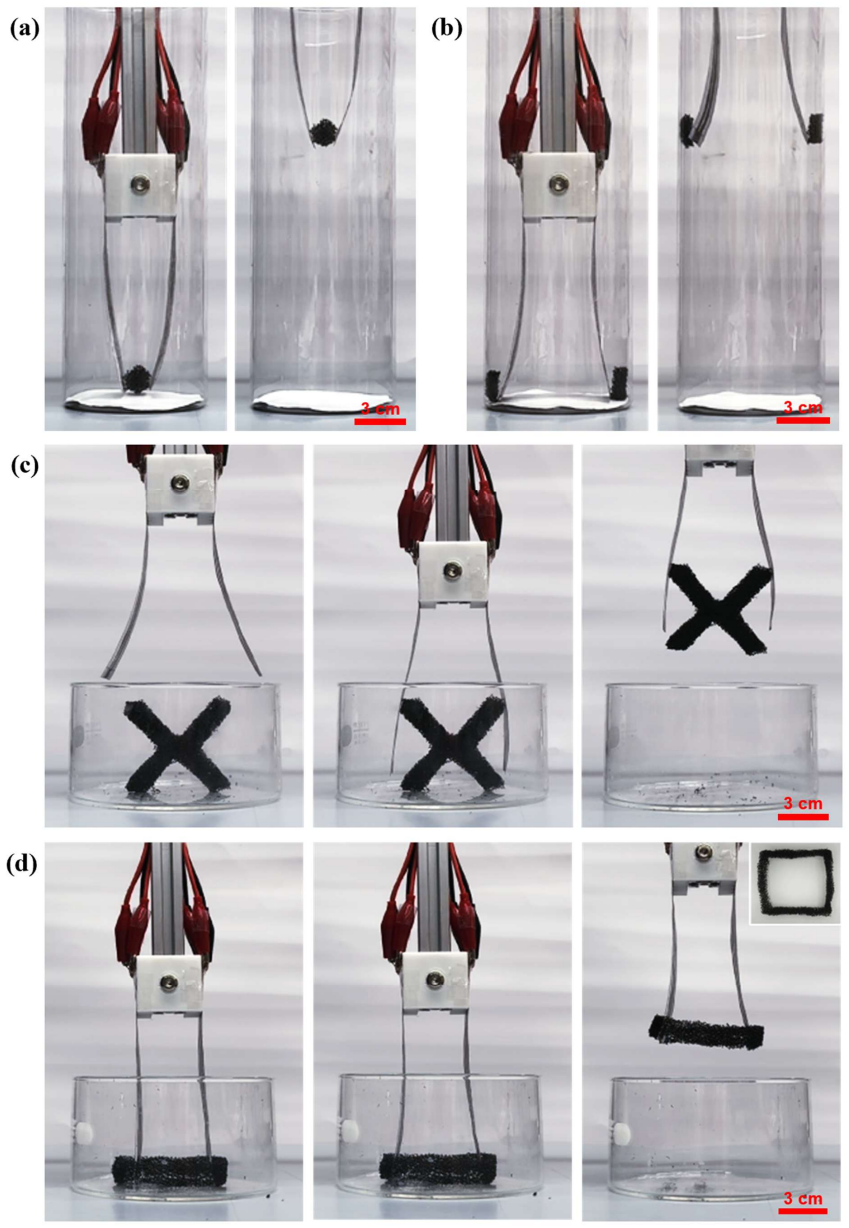
The paper's central claim is that a double-sided thin-film design removes the three standard limitations of electrothermal actuators at once. Two carbon nanotube heater loops, one larger and one smaller, are printed on opposite faces of a 100 µm paper substrate and covered with high-expansion BOPP strips; the loops are spaced and sized so that convection to the air dominates over conduction through the film. Powering the outer loop bends the actuator one way, powering the inner loop bends it the other way, ambient temperature changes heat both faces symmetrically and leave the rest shape nearly unchanged, and switching power to the opposite loop forces the actuator back to rest instead of waiting for passive cooling. The authors report a deflection of at least 28% of actuator length at 0.75 W, a thermal sensitivity coefficient about 100 times smaller than a conventional one-sided actuator, and a forced return that reaches the rest state in about 30 seconds compared with hundreds of seconds for passive cooling. They also show that a two-fingered gripper built from these actuators can widen its jaws, press objects against a tube wall, and lift oversized or hollow objects.
Load-bearing premise
The load-bearing premise is that the two heater loops are thermally independent, so powering one side does not appreciably heat the other; the design criterion for this is an order-of-magnitude estimate with an assumed convection coefficient, and if cross-talk is significant the bidirectional control and forced return would fail.
Editorial extensions
If this is right
- An electrothermal actuator can bend in either direction purely by choosing which heater loop to energize, without changing materials or environment.
- Because ambient heat reaches both faces equally, the rest shape of a meta-actuator stays nearly constant over a roughly 20 °C ambient range, in contrast to a one-sided actuator that curls enough to become unusable.
- Activating the opposite loop returns the actuator to rest in about 30–34 seconds, about an order of magnitude faster than passive cooling, and enables repeatable fast bidirectional cycling.
- A two-fingered meta-actuator gripper can open its jaws to press objects against tube walls, pick up objects wider than its resting jaw opening, and lift hollow objects by expanding from inside.
- The design transfers to other material pairs, so choosing materials with a larger expansion mismatch should yield larger deflections than the paper-and-BOPP demonstration.
Reading between the lines
- The thermal-independence criterion implies a scaling rule: thinner and lower-conductivity substrates permit tighter heater spacing, so the approach could be pushed toward faster and denser actuator arrays than the demonstrated 100 µm paper device.
- The symmetric cancellation principle is not limited to heat; the same double-sided layout could stabilize actuators driven by light, magnetic fields, or other symmetric ambient disturbances.
- The forced-return mode gives a single film two independent control inputs, so arrays of such films could act as programmable shape-memory surfaces that do not require external cooling.
- A direct measurement of whether inner- and outer-loop deflections remain equal in magnitude at elevated ambient temperatures would separate materials nonlinearity from a possible loss of heater independence as the cause of the reduced range reported at 40 °C.
Editorial analysis
A structured set of objections, weighed in public.
Referee Report
Summary. The paper introduces a soft electrothermal meta-actuator consisting of a thin paper substrate with two independently addressable carbon nanotube heater loops printed on opposite faces. By selectively heating one loop, the actuator bends in either direction; by heating both sides symmetrically, the authors argue that the rest state becomes insensitive to ambient temperature changes; and by switching power from one loop to the other, they propose an active 'forced return' that is faster than passive cooling. The manuscript reports characterization of deflection versus power and time, cyclic actuation, curvature response to ambient temperature, forced-return dynamics, and a set of gripper demonstrations (tube retrieval, oversized objects, hollow rings). The central qualitative demonstrations are visually convincing and the use of inexpensive, commercially available materials is attractive. However, several headline quantitative claims need additional support or qualification, particularly the '10× faster forced return' metric and the extension of the ambient-insensitivity claim to active actuation.
Significance. If the quantitative claims are properly supported, the meta-actuator architecture is a useful contribution to soft electrothermal actuation: it addresses three recognized limitations (unidirectionality, ambient sensitivity, slow passive return) in a single thin-film device, and the gripper demonstrations show genuinely new manipulation modalities enabled by bidirectionality. The paper is experimental, with no fitted model parameters feeding back into the measurements, and the qualitative evidence (bidirectional bending, rest-state stability in a temperature-controlled enclosure, field test, and gripping videos) is reproducible in principle from the Methods. The main value is conceptual: using heat-transfer engineering in a thin film rather than a new material to obtain multifunctionality. The paper would be strengthened substantially by error bars and by aligning the reported metrics with the claims made in the abstract.
major comments (3)
- [§4, Figs. 4a/4b, Abstract] The claim that forced return reaches the rest state '10 times faster' than passive cooling is not supported by the reported measurement. The 30 s and 34 s values in Fig. 4 are times at which the normalized displacement first crosses zero while the opposite heater loop remains powered; as the text itself notes, the inner-loop forced return exhibits snap-through buckling, meaning the trajectory continues past zero to an opposite-side deflection. Passive cooling, by contrast, is an overdamped relaxation that asymptotically approaches and then stays at the rest state. Comparing a transient zero-crossing to a settling process is a metric mismatch. To support the abstract's wording, the authors should either measure and report the settling time of the forced-return trajectory to a defined tolerance (e.g., <0.1 mm as used earlier for passive return) or explicitly redefine 'return' as a crossing event and remove the comparison to passive settling. This issue is load-bearing because the 10× claim is one of the three headline results.
- [§3, Fig. 3c, Abstract] The >100× lower thermal sensitivity claim is derived only from rest-state curvature measurements (Fig. 3b), but the active actuation range degrades dramatically with ambient temperature: the text reports that the maximum actuation range drops from 56 mm at T=25°C to about 13 mm at T=40°C, a roughly 77% reduction. The abstract and introduction characterize the device as insensitive to environmental perturbations and 'robust', which readers will reasonably interpret as applying to actuation performance, not only to the no-power rest state. The authors should explicitly qualify the insensitivity claim as applying to the rest state, and should quantify and discuss the temperature dependence of the active actuation range, ideally with a comparison to a conventional actuator under the same active-heating conditions.
- [Figs. 2-4, §3 Quantitative claims] The headline quantitative comparisons lack error bars and replicate counts. In particular, the thermal sensitivity coefficients c_conv ≃ 0.047 cm⁻¹K⁻¹ and c_meta ≃ 0.00041 cm⁻¹K⁻¹ (from which the >100× factor is computed) appear to be extracted from single measurements, and the 30 s/34 s forced-return times are single traces. Without at least three independent samples and reported standard deviations, the reader cannot assess whether the reported factors are statistically meaningful. Please add error bars and sample sizes for all quantitative claims that support the abstract (deflection percentage, sensitivity ratio, return-time improvement).
minor comments (6)
- [§1, design criterion] The equation for the thermal cross-talk criterion is garbled in the manuscript (the symbols appear as '௪ௗ௧' rather than a properly typeset expression). Please correct the equation and define each symbol in the text; it appears to be h w²/(k t Δd) ≫ 1 based on the surrounding definition, but the printed form should be unambiguous.
- [§1, design criterion] The numerical value ≈123 depends on an assumed convective heat transfer coefficient h = 10 W m⁻² K⁻¹, which is stated without justification. This is acceptable as an order-of-magnitude estimate, but the manuscript should label it as such and note the sensitivity of the criterion to this assumption.
- [§2, Fig. 2b caption] The caption says 'Tip displacement as a function of input power' while the text specifies that displacement was measured 1 cm from the tip; please align the caption and text by stating the measurement location in the caption.
- [§2, §4, passive vs forced return] The passive relaxation is reported as reaching <0.1 mm deviation after over 400 s, whereas Fig. 4 uses normalized displacement with a different measurement convention (sensor fixed 75 mm below the actuator's highest point). Please make explicit in the text that the two observables are not directly comparable, especially since the forced-return data use a different sensor configuration.
- [§4, Fig. 4c] The text mentions alternating activation of inner (30 s) and outer (50 s) loops, but does not explain why the two intervals differ or whether the displacement values in Fig. 4c correspond to saturated states; a brief sentence clarifying the protocol would help.
- [References [84–87]] The statement 'We attribute this reduction in performance to the nonlinearity of the material properties' cites references on BOPP dielectric breakdown and electrical insulation, which are not the relevant temperature-dependent mechanical properties (CTE, modulus, hygroscopic response). Please cite appropriate sources for temperature-dependent thermal expansion or mechanical behavior of paper and BOPP.
Circularity Check
No circularity: the paper's headline claims are measured outputs, not predictions derived from inputs that contain them.
full rationale
This is an experimental demonstration paper. The headline claims (bidirectional deflection, >100x lower thermal sensitivity, and >10x faster forced return) are all presented as directly measured quantities from displacement, curvature, and time-series experiments (Figs. 2-4), not as outputs of a model whose inputs encode those same claims. The thermal cross-talk criterion h w^2/(k t Delta d) >> 1 is an order-of-magnitude design heuristic with an assumed convection coefficient, but it is not used to retroactively fabricate the measured performance values; thermal-camera images corroborate heater independence empirically. The ambient-insensitivity claim is supported by direct comparison of measured curvature versus temperature for meta-actuators and conventional single-sided actuators (Fig. 3b), and the >100x figure is a slope comparison of those measurements. The forced-return claim compares the time to reach the rest state under counter-heating with the residual displacement of a passively cooled sample at the same elapsed time; while the reader's note that the forced-return 'zero crossing' is a transient rather than a settled equilibrium is a metric-interpretation or correctness concern, it is not a circular derivation. No load-bearing argument reduces to a self-citation: the reference list contains no self-citations by the present authors, and the cited prior work (e.g., fabrication adapted from [76], twisting-minimization guidance [73]) is external or methodological rather than a uniqueness theorem that forces the conclusion. Therefore no circular step is present.
Assumptions & free parameters
assumptions (4)
- domain assumption Thermal cross-talk between the two heater loops is negligible when h w^2/(k t Δd) >> 1, with h assumed 10 W m-2 K-1.
- domain assumption Paper substrate shrinks with increasing temperature due to hygroscopic response, driving the strain-mismatch actuation with BOPP.
- domain assumption Ambient temperature changes heat both sides of the double-sided actuator equally, so thermally induced stresses cancel.
- domain assumption The actuator bends with approximately constant curvature, allowing three points to define a unique curvature circle.
Cite this review
Pith. "Pith review of Soft Electrothermal Meta-Actuator for Robust Multifunctional Control." pith.science (2026). https://pith.science/paper/S7RXDDAY
@misc{pith2026250521992,
  author       = {Pith},
  title        = {Pith review of: Soft Electrothermal Meta-Actuator for Robust Multifunctional Control},
  year         = {2026},
  howpublished = {\url{https://pith.science/paper/S7RXDDAY}},
  note         = {Machine review of arXiv:2505.21992}
}
abstract
Soft electrothermal actuators are of great interest in diverse application domains for their simplicity, compliance, and ease of control. However, the very nature of thermally induced mechanical actuation sets inherent operation constraints: unidirectional motion, environmental sensitivity, and slow response times limited by passive cooling. To overcome these constraints, we propose a meta-actuator architecture, which uses engineered heat transfer in thin films to achieve multifunctional operation. We demonstrate electrically selectable bidirectional motion with large deflection ($ \geq $28% of actuator length at 0.75 W), suppressed thermal sensitivity to ambient temperature changes when compared to conventional actuators (>100$ \times $ lower), and actively forced return to the rest state, which is 10 times faster than that with passive cooling. We further show that our meta-actuator approach enables extended ranges of motions for manipulating complex objects. Versatile soft gripper operations highlight the meta-actuator's potential for soft robotics and devices.
Figures


Figures from the paper (2 more)

Reference graph
Works this paper leans on
-
[1]
Caterpillar-inspired soft crawling robot with distributed programmable thermal actuation
Wu, Shuang, Yaoye Hong, Yao Zhao, Jie Yin, and Yong Zhu. "Caterpillar-inspired soft crawling robot with distributed programmable thermal actuation." Science Advances 9, no. 12 (2023): eadf8014
2023
-
[2]
Highly dynamic shape memory alloy actuator for fast moving soft robots
Huang, Xiaonan, Kitty Kumar, Mohammad K. Jawed, Amir Mohammadi Nasab, Zisheng Ye, Wanliang Shan, and Carmel Majidi. "Highly dynamic shape memory alloy actuator for fast moving soft robots." Advanced Materials Technologies 4, no. 4 (2019): 1800540
2019
-
[3]
Biomimetic color changing anisotropic soft actuators with 16 integrated metal nanowire percolation network transparent heaters for soft robotics
Kim, Hyeonseok, Habeom Lee, Inho Ha, Jinwook Jung, Phillip Won, Hyunmin Cho, Junyeob Yeo et al. "Biomimetic color changing anisotropic soft actuators with 16 integrated metal nanowire percolation network transparent heaters for soft robotics." Advanced Functional Materials 28, no. 32 (2018): 1801847
2018
-
[4]
Laser‐induced graphene for electrothermally controlled, mechanically guided, 3d assembly and human–soft actuators interaction
Ling, Yun, Wenbo Pang, Xiaopeng Li, Shivam Goswami, Zheng Xu, David Stroman, Yachao Liu et al. "Laser‐induced graphene for electrothermally controlled, mechanically guided, 3d assembly and human–soft actuators interaction." Advanced Materials 32, no. 17 (2020): 1908475
2020
-
[5]
Untethered soft actuators for soft standalone robotics
Jung, Yeongju, Kangkyu Kwon, Jinwoo Lee, and Seung Hwan Ko. "Untethered soft actuators for soft standalone robotics." Nature Communications 15, no. 1 (2024): 3510
2024
-
[6]
Liu, Xiaoya, Xiuxiu Jin, Lei Li, Jianfeng Wang, Yanyu Yang, Yanxia Cao, and Wanjie Wang. "Air-permeable, multifunctional, dual-energy-driven MXene- decorated polymeric textile-based wearable heaters with exceptional electrothermal and photothermal conversion performance." Journal of Materials Chemistry A 8, no. 25 (2020): 12526-12537
2020
-
[7]
Recent Advances of Soft Actuators in Smart Wearable Electronic‐Textile
Peng, Chang, Yahui Chen, Bao Yang, Zhenyu Jiang, Yiping Liu, Zejia Liu, Licheng Zhou, and Liqun Tang. "Recent Advances of Soft Actuators in Smart Wearable Electronic‐Textile." Advanced Materials Technologies 9, no. 15 (2024): 2400079
2024
-
[8]
Soft sensors and actuators for wearable human–machine interfaces
Park, Jonghwa, Youngoh Lee, Seungse Cho, Ayoung Choe, Jeonghee Yeom, Yun Goo Ro, Jinyoung Kim, Dong-hee Kang, Seungjae Lee, and Hyunhyub Ko. "Soft sensors and actuators for wearable human–machine interfaces." Chemical Reviews 124, no. 4 (2024): 1464-1534
work page 2024
Show all 87 references
-
[9]
A multipurpose electrothermal microgripper for biological micro-manipulation
Zhang, Ran, Jinkui Chu, Haixiang Wang, and Zhaopeng Chen. "A multipurpose electrothermal microgripper for biological micro-manipulation." Microsystem technologies 19 (2013): 89-97
2013
-
[10]
A review on actuation and sensing techniques for MEMS-based microgrippers
Yang, Sijie, and Qingsong Xu. "A review on actuation and sensing techniques for MEMS-based microgrippers." Journal of Micro-Bio Robotics 13, no. 1 (2017): 1-14
2017
-
[11]
Fourier transform infrared spectrometer based on an electrothermal MEMS mirror
Wang, Donglin, Hongqiong Liu, Jicheng Zhang, Qiao Chen, Wei Wang, Xiaoyang Zhang, and Huikai Xie. "Fourier transform infrared spectrometer based on an electrothermal MEMS mirror." Applied Optics 57, no. 21 (2018): 5956-5961
2018
-
[12]
On the design of piezoelectric MEMS scanning mirror for large reflection area and wide scan angle
Cheng, Hao-Chien, Shi-Chi Liu, Chih-Chen Hsu, Hung-Yu Lin, Fuchi Shih, Mingching Wu, Kai-Chih Liang, Mei-Feng Lai, and Weileun Fang. "On the design of piezoelectric MEMS scanning mirror for large reflection area and wide scan angle." Sensors and Actuators A: Physical 349 (2023...
2023
-
[13]
Soft electrothermal actuators using silver nanowire heaters
Yao, Shanshan, Jianxun Cui, Zheng Cui, and Yong Zhu. "Soft electrothermal actuators using silver nanowire heaters." Nanoscale 9, no. 11 (2017): 3797-3805
2017
-
[14]
Dual-mode biomimetic soft actuator with electrothermal and magneto-responsive performance
Li, Wenwen, Min Sang, Shuai Liu, Bochao Wang, Xufeng Cao, Guanghui Liu, Xinglong Gong, Lingyun Hao, and Shouhu Xuan. "Dual-mode biomimetic soft actuator with electrothermal and magneto-responsive performance." Composites Part B: Engineering 238 (2022): 109880
2022
-
[15]
Soft actuators for real-world applications
Li, Meng, Aniket Pal, Amirreza Aghakhani, Abdon Pena-Francesch, and Metin Sitti. "Soft actuators for real-world applications." Nature Reviews Materials 7, no. 3 (2022): 235-249
2022
-
[16]
Electrically controlled soft actuators with multiple and reprogrammable actuation modes
Wang, Yang, Zhijian Wang, Qiguang He, Prajval Iyer, and Shengqiang Cai. "Electrically controlled soft actuators with multiple and reprogrammable actuation modes." Advanced Intelligent Systems 2, no. 6 (2020): 1900177
2020
-
[17]
Rewritable electrically controllable liquid crystal actuators
Liu, Yawen, Yahe Wu, Huan Liang, Hongtu Xu, Yen Wei, and Yan Ji. "Rewritable electrically controllable liquid crystal actuators." Advanced Functional Materials 33, no. 44 (2023): 2302110
2023
-
[18]
Somatosensory actuator based on stretchable conductive photothermally responsive hydrogel
Zhao, Yusen, Chiao-Yueh Lo, Lecheng Ruan, Chen-Huan Pi, Cheolgyu Kim, Yousif Alsaid, Imri Frenkel, Rossana Rico, Tsu-Chin Tsao, and Ximin He. "Somatosensory actuator based on stretchable conductive photothermally responsive hydrogel." Science Robotics 6, no. 53 (2021): eabd5483
2021
-
[19]
Somatosensory, light‐driven, thin‐film robots capable of integrated perception and motility
Wang, Xiao‐Qiao, Kwok Hoe Chan, Yin Cheng, Tianpeng Ding, Tongtao Li, Sippanat Achavananthadith, Selman Ahmet, John S. Ho, and Ghim Wei Ho. "Somatosensory, light‐driven, thin‐film robots capable of integrated perception and motility." Advanced Materials 32, no. 21 (2020): 2000351
2020
-
[20]
Somatosensory Electrothermal Actuator through the Laser‐Induced Graphene Technology
Wang, Hao, Xuyang Li, Xiaoyue Wang, Yong Qin, Yang Pan, and Xiaogang Guo. "Somatosensory Electrothermal Actuator through the Laser‐Induced Graphene Technology." Small 20, no. 21 (2024): 2310612
2024
-
[21]
Electrothermally activated soft materials: Mechanisms, methods and applications
Long, Chengyun, Rui Wang, Yongyu Wang, Hongbo Lan, Xiaoyang Zhu, and Yuan- Fang Zhang. "Electrothermally activated soft materials: Mechanisms, methods and applications." Progress in Materials Science (2024): 101406
2024
-
[22]
High-performance low-voltage soft electrothermal actuator with directly printed micro-heater
Cao, Yang, and Jingyan Dong. "High-performance low-voltage soft electrothermal actuator with directly printed micro-heater." Sensors and Actuators A: Physical 297 (2019): 111546. 18
2019
-
[23]
Soft bimorph actuator with real-time multiplex motion perception
Zhao, Hongtao, Run Hu, Pan Li, Anzhu Gao, Xuantong Sun, Xiaohui Zhang, Xiangjun Qi et al. "Soft bimorph actuator with real-time multiplex motion perception." Nano Energy 76 (2020): 104926
2020
-
[24]
Electrothermal actuation based on carbon nanotube network in silicone elastomer
Chen, Lu-Zhuo, C. H. Liu, C. H. Hu, and S. S. Fan. "Electrothermal actuation based on carbon nanotube network in silicone elastomer." Applied Physics Letters 92, no. 26 (2008)
2008
-
[25]
Fast thermal actuators for soft robotics
Wu, Shuang, Gregory Langston Baker, Jie Yin, and Yong Zhu. "Fast thermal actuators for soft robotics." Soft Robotics 9, no. 6 (2022): 1031-1039
2022
-
[26]
Pre-programmed tri-layer electro- thermal actuators composed of shape memory polymer and carbon nanotubes
Sachyani Keneth, Ela, Giulia Scalet, Michael Layani, Gal Tibi, Amir Degani, Ferdinando Auricchio, and Shlomo Magdassi. "Pre-programmed tri-layer electro- thermal actuators composed of shape memory polymer and carbon nanotubes." Soft Robotics 7, no. 2 (2020): 123-129
2020
-
[27]
Electrothermally‐Driven Elongating‐Contracting Film Actuators Based on Two‐Way Shape Memory Carbon Nanotube/Ethylene‐Vinyl Acetate Composites
Xu, Lu, et al. "Electrothermally‐Driven Elongating‐Contracting Film Actuators Based on Two‐Way Shape Memory Carbon Nanotube/Ethylene‐Vinyl Acetate Composites." Advanced Materials Technologies 7.7 (2022): 2101229
2022
-
[28]
Reprogrammable recovery and actuation behaviour of shape-memory polymers
Lendlein, Andreas, and Oliver EC Gould. "Reprogrammable recovery and actuation behaviour of shape-memory polymers." Nature Reviews Materials 4, no. 2 (2019): 116-133
2019
-
[29]
Flexible active skin: large reconfigurable arrays of individually addressed shape memory polymer actuators
Besse, Nadine, Samuel Rosset, Juan Jose Zarate, and Herbert Shea. "Flexible active skin: large reconfigurable arrays of individually addressed shape memory polymer actuators." Advanced Materials Technologies 2, no. 10 (2017): 1700102
2017
-
[30]
An electrically actuated soft artificial muscle based on a high-performance flexible electrothermal film and liquid-crystal elastomer
Liu, Haoran, Hongmiao Tian, Jinyou Shao, Zhijian Wang, Xiangming Li, Chunhui Wang, and Xiaoliang Chen. "An electrically actuated soft artificial muscle based on a high-performance flexible electrothermal film and liquid-crystal elastomer." ACS Applied Materials & Interfaces 12...
2020
-
[31]
Direct‐Ink‐Written Shape‐Programmable Micro‐Supercapacitors with Electrothermal Liquid Crystal Elastomers
Yang, Le, et al. "Direct‐Ink‐Written Shape‐Programmable Micro‐Supercapacitors with Electrothermal Liquid Crystal Elastomers." Advanced Functional Materials (2025): 2504979
2025
-
[32]
Liquid crystalline elastomers as actuators and sensors
Ohm, Christian, Martin Brehmer, and Rudolf Zentel. "Liquid crystalline elastomers as actuators and sensors." Advanced materials 22, no. 31 (2010): 3366-3387
2010
-
[33]
Voxelated liquid crystal elastomers
Ware, Taylor H., Michael E. McConney, Jeong Jae Wie, Vincent P. Tondiglia, and Timothy J. White. "Voxelated liquid crystal elastomers." Science 347, no. 6225 (2015): 982-984. 19
2015
-
[34]
Layered liquid crystal elastomer actuators
Guin, Tyler, Michael J. Settle, Benjamin A. Kowalski, Anesia D. Auguste, Richard V. Beblo, Gregory W. Reich, and Timothy J. White. "Layered liquid crystal elastomer actuators." Nature communications 9, no. 1 (2018): 2531
2018
-
[35]
Mouldable liquid-crystalline elastomer actuators with exchangeable covalent bonds
Pei, Zhiqiang, Yang Yang, Qiaomei Chen, Eugene M. Terentjev, Yen Wei, and Yan Ji. "Mouldable liquid-crystalline elastomer actuators with exchangeable covalent bonds." Nature materials 13, no. 1 (2014): 36-41
2014
-
[36]
Flexible mechanical metamaterials
Bertoldi, Katia, Vincenzo Vitelli, Johan Christensen, and Martin Van Hecke. "Flexible mechanical metamaterials." Nature Reviews Materials 2, no. 11 (2017): 1- 11
2017
-
[37]
Metamaterials: a new frontier of science and technology
Liu, Yongmin, and Xiang Zhang. "Metamaterials: a new frontier of science and technology." Chemical Society Reviews 40, no. 5 (2011): 2494-2507
2011
-
[38]
Mechanical metamaterials and beyond
Jiao, Pengcheng, Jochen Mueller, Jordan R. Raney, Xiaoyu Zheng, and Amir H. Alavi. "Mechanical metamaterials and beyond." Nature communications 14, no. 1 (2023): 6004
2023
-
[39]
Overview on metamaterial: History, types and applications
Kumar, Rakesh, Manoj Kumar, Jasgurpreet Singh Chohan, and Santosh Kumar. "Overview on metamaterial: History, types and applications." Materials Today: Proceedings 56 (2022): 3016-3024
2022
-
[40]
Mechanical properties of architected nanomaterials made from organic–inorganic nanocrystals
Gu, X. Wendy. "Mechanical properties of architected nanomaterials made from organic–inorganic nanocrystals." JOM 70, no. 10 (2018): 2205-2217
2018
-
[41]
Ultralight, ultrastiff mechanical metamaterials
Zheng, Xiaoyu, Howon Lee, Todd H. Weisgraber, Maxim Shusteff, Joshua DeOtte, Eric B. Duoss, Joshua D. Kuntz et al. "Ultralight, ultrastiff mechanical metamaterials." Science 344, no. 6190 (2014): 1373-1377
2014
-
[42]
Mechanical metamaterials: a state of the art
Barchiesi, Emilio, Mario Spagnuolo, and Luca Placidi. "Mechanical metamaterials: a state of the art." Mathematics and Mechanics of Solids 24, no. 1 (2019): 212-234
2019
-
[43]
DNA-silica nanolattices as mechanical metamaterials
Kulikowski, John, Shuang Wang, Zachary Aitken, Jack Grimm, Baisen Gao, Melody M. Wang, David Doan et al. "DNA-silica nanolattices as mechanical metamaterials." Matter 7, no. 6 (2024): 2144-2160
2024
-
[44]
Ultra-strong architected Cu meso-lattices
Gu, X. Wendy, and Julia R. Greer. "Ultra-strong architected Cu meso-lattices." Extreme Mechanics Letters 2 (2015): 7-14
2015
-
[45]
On anisotropic versions of three-dimensional pentamode metamaterials
Kadic, Muamer, Tiemo Bückmann, Robert Schittny, and Martin Wegener. "On anisotropic versions of three-dimensional pentamode metamaterials." New Journal of Physics 15, no. 2 (2013): 023029
2013
-
[46]
Bridging hard and soft: Mechanical metamaterials 20 enable rigid torque transmission in soft robots
Carton, Molly, Jakub F. Kowalewski, Jiani Guo, Jacob F. Alpert, Aman Garg, Daniel Revier, and Jeffrey Ian Lipton. "Bridging hard and soft: Mechanical metamaterials 20 enable rigid torque transmission in soft robots." Science Robotics 10, no. 100 (2025): eads0548
2025
-
[47]
Fabrication-Directed Entanglement for Designing Chiral and Anisotropic Metamaterial Foams
Revier, Daniel, and Jeffrey Ian Lipton. "Fabrication-Directed Entanglement for Designing Chiral and Anisotropic Metamaterial Foams." arXiv preprint arXiv:2505.03064 (2025)
2025 arXiv
-
[48]
Negative Poisson's ratio in modern functional materials
Huang, Chuanwei, and Lang Chen. "Negative Poisson's ratio in modern functional materials." Advanced Materials 28, no. 37 (2016): 8079-8096
2016
-
[49]
Double‐negative mechanical metamaterials displaying simultaneous negative stiffness and negative Poisson's ratio properties
Hewage, Trishan AM, Kim L. Alderson, Andrew Alderson, and Fabrizio Scarpa. "Double‐negative mechanical metamaterials displaying simultaneous negative stiffness and negative Poisson's ratio properties." Advanced Materials 28, no. 46 (2016): 10323-10332
2016
-
[50]
Multi-material additive manufacturing of metamaterials with giant, tailorable negative Poisson’s ratios
Chen, Da, and Xiaoyu Zheng. "Multi-material additive manufacturing of metamaterials with giant, tailorable negative Poisson’s ratios." Scientific reports 8, no. 1 (2018): 1-8
2018
-
[51]
Magneto‐ mechanical metamaterials with widely tunable mechanical properties and acoustic bandgaps
Montgomery, S. Macrae, Shuai Wu, Xiao Kuang, Connor D. Armstrong, Cole Zemelka, Qiji Ze, Rundong Zhang, Ruike Zhao, and H. Jerry Qi. "Magneto‐ mechanical metamaterials with widely tunable mechanical properties and acoustic bandgaps." Advanced Functional Materials 31, no. 3 (20...
2021
-
[52]
Programmable gear-based mechanical metamaterials
Fang, Xin, Jihong Wen, Li Cheng, Dianlong Yu, Hongjia Zhang, and Peter Gumbsch. "Programmable gear-based mechanical metamaterials." Nature Materials 21, no. 8 (2022): 869-876
2022
-
[53]
Stretchable and transparent kirigami conductor of nanowire percolation network for electronic skin applications
Won, Phillip, Jung Jae Park, Taemin Lee, Inho Ha, Seonggeun Han, Mansoo Choi, Jinhwan Lee, Sukjoon Hong, Kyu-Jin Cho, and Seung Hwan Ko. "Stretchable and transparent kirigami conductor of nanowire percolation network for electronic skin applications." Nano letters 19, no. 9 (2...
2019
-
[54]
Ultrastretchable kirigami bioprobes
Morikawa, Yusuke, Shota Yamagiwa, Hirohito Sawahata, Rika Numano, Kowa Koida, Makoto Ishida, and Takeshi Kawano. "Ultrastretchable kirigami bioprobes." Advanced healthcare materials 7, no. 3 (2018): 1701100
2018
-
[55]
Super stretchable hexagonal boron nitride Kirigami
Han, Tongwei, Fabrizio Scarpa, and Neil L. Allan. "Super stretchable hexagonal boron nitride Kirigami." Thin Solid Films 632 (2017): 35-43
2017
-
[56]
3d printer-based encapsulated origami electronics for extreme system stretchability and high areal coverage
Jo, Mansik, et al. "3d printer-based encapsulated origami electronics for extreme system stretchability and high areal coverage." ACS nano 13.11 (2019): 12500- 12510. 21
2019
-
[57]
Kirigami enabled reconfigurable three-dimensional evaporator arrays for dynamic solar tracking and high efficiency desalination
Li, Hao, Weixin Zhang, Xi Liao, and Lizhi Xu. "Kirigami enabled reconfigurable three-dimensional evaporator arrays for dynamic solar tracking and high efficiency desalination." Science Advances 10, no. 26 (2024): eado1019
2024
-
[58]
Programming shape using kirigami tessellations
Choi, Gary PT, Levi H. Dudte, and Lakshminarayanan Mahadevan. "Programming shape using kirigami tessellations." Nature materials 18, no. 9 (2019): 999-1004
2019
-
[59]
Boundary curvature guided programmable shape-morphing kirigami sheets
Hong, Yaoye, Yinding Chi, Shuang Wu, Yanbin Li, Yong Zhu, and Jie Yin. "Boundary curvature guided programmable shape-morphing kirigami sheets." Nature communications 13, no. 1 (2022): 530
2022
-
[60]
Shape-morphing architected sheets with non-periodic cut patterns
Celli, Paolo, Connor McMahan, Brian Ramirez, Anton Bauhofer, Christina Naify, Douglas Hofmann, Basile Audoly, and Chiara Daraio. "Shape-morphing architected sheets with non-periodic cut patterns." Soft matter 14, no. 48 (2018): 9744-9749
2018
-
[61]
Dynamic kirigami structures for integrated solar tracking
Lamoureux, Aaron, Kyusang Lee, Matthew Shlian, Stephen R. Forrest, and Max Shtein. "Dynamic kirigami structures for integrated solar tracking." Nature communications 6, no. 1 (2015): 8092
2015
-
[62]
Origami-inspired active structures: a synthesis and review
Peraza-Hernandez, Edwin A., Darren J. Hartl, Richard J. Malak Jr, and Dimitris C. Lagoudas. "Origami-inspired active structures: a synthesis and review." Smart Materials and Structures 23, no. 9 (2014): 094001
2014
-
[63]
Active materials for functional origami
Leanza, Sophie, Shuai Wu, Xiaohao Sun, H. Jerry Qi, and Ruike Renee Zhao. "Active materials for functional origami." Advanced Materials 36, no. 9 (2024): 2302066
2024
-
[64]
Kirigami‐based light‐induced shape‐morphing and locomotion
Cheng, Yu‐Chieh, Hao‐Chuan Lu, Xuan Lee, Hao Zeng, and Arri Priimagi. "Kirigami‐based light‐induced shape‐morphing and locomotion." Advanced Materials 32, no. 7 (2020): 1906233
2020
-
[65]
Modular multi-degree- of-freedom soft origami robots with reprogrammable electrothermal actuation
Wu, Shuang, Tuo Zhao, Yong Zhu, and Glaucio H. Paulino. "Modular multi-degree- of-freedom soft origami robots with reprogrammable electrothermal actuation." Proceedings of the National Academy of Sciences 121, no. 20 (2024): e2322625121
2024
-
[66]
Self-folding origami: shape memory composites activated by uniform heating
Tolley, Michael T., Samuel M. Felton, Shuhei Miyashita, Daniel Aukes, Daniela Rus, and Robert J. Wood. "Self-folding origami: shape memory composites activated by uniform heating." Smart Materials and Structures 23, no. 9 (2014): 094006
2014
-
[67]
Programmable active kirigami metasheets with more freedom of actuation
Tang, Yichao, Yanbin Li, Yaoye Hong, Shu Yang, and Jie Yin. "Programmable active kirigami metasheets with more freedom of actuation." Proceedings of the National Academy of Sciences 116, no. 52 (2019): 26407-26413
2019
-
[68]
Active W-VO2-based Kirigami-structured films with digital control for energy 22 efficient smart window
Chen, Zhengjie, Chengchen Feng, Lin Jiang, Yujie Ke, Xiaoxue Han, and Xinghai Liu. "Active W-VO2-based Kirigami-structured films with digital control for energy 22 efficient smart window." Solar Energy Materials and Solar Cells 285 (2025): 113551
2025
-
[69]
Switchable Kirigami structures as window envelopes for energy- efficient buildings
Yin, Hanzhi, Xishu Zhou, Zhengui Zhou, Rong Liu, Xiwei Mo, Zewen Chen, Erqi Yang et al. "Switchable Kirigami structures as window envelopes for energy- efficient buildings." Research 6 (2023): 0103
2023
-
[70]
Self-deployable origami stent grafts as a biomedical application of Ni-rich TiNi shape memory alloy foil
Kuribayashi, Kaori, Koichi Tsuchiya, Zhong You, Dacian Tomus, Minoru Umemoto, Takahiro Ito, and Masahiro Sasaki. "Self-deployable origami stent grafts as a biomedical application of Ni-rich TiNi shape memory alloy foil." Materials Science and Engineering: A 419, no. 1-2 (2006)...
2006
-
[71]
Self-folding polymeric containers for encapsulation and delivery of drugs
Fernandes, Rohan, and David H. Gracias. "Self-folding polymeric containers for encapsulation and delivery of drugs." Advanced drug delivery reviews 64, no. 14 (2012): 1579-1589
2012
-
[72]
Kirigami artificial muscles with complex biologically inspired morphologies
Sareh, Sina, and Jonathan Rossiter. "Kirigami artificial muscles with complex biologically inspired morphologies." Smart Materials and Structures 22, no. 1 (2012): 014004
2012
-
[73]
Fabrication, modeling, and characterization of soft twisting electrothermal actuators with directly printed oblique heater
Cao, Yang, and Jingyan Dong. "Fabrication, modeling, and characterization of soft twisting electrothermal actuators with directly printed oblique heater." Journal of Micromechanics and Microengineering 32, no. 3 (2022): 035001
2022
-
[74]
Thermal properties of copy paper sheets
Lavrykov, Sergiy A., and B. V. Ramarao. "Thermal properties of copy paper sheets." Drying Technology 30, no. 3 (2012): 297-311
2012
-
[75]
Capacitive temperature sensing via displacement amplification
Taniker, Semih, Vincenzo Costanza, Paolo Celli, and Chiara Daraio. "Capacitive temperature sensing via displacement amplification." IEEE Sensors Journal 22, no. 11 (2022): 10388-10395
2022
-
[76]
Self‐sensing paper actuators based on graphite– carbon nanotube hybrid films
Amjadi, Morteza, and Metin Sitti. "Self‐sensing paper actuators based on graphite– carbon nanotube hybrid films." Advanced science 5, no. 7 (2018): 1800239
2018
-
[77]
Graphene‐based actuator with integrated‐sensing function
Chen, Luzhuo, Mingcen Weng, Peidi Zhou, Feng Huang, Changhong Liu, Shoushan Fan, and Wei Zhang. "Graphene‐based actuator with integrated‐sensing function." Advanced Functional Materials 29, no. 5 (2019): 1806057
2019
-
[78]
Bioinspired bilayer hydrogel-based actuator with rapidly bidirectional actuation, programmable deformation and devisable functionality
Xu, Weizhong, Pengli Dong, Senpeng Lin, Zhongwen Kuang, Zhiqin Zhang, Shunli Wang, Fangmin Ye, Lin Cheng, Huaping Wu, and Aiping Liu. "Bioinspired bilayer hydrogel-based actuator with rapidly bidirectional actuation, programmable deformation and devisable functionality." Senso...
2022
-
[79]
Multiresponsive bidirectional bending actuators fabricated by a pencil‐on‐paper method
Weng, Mingcen, Peidi Zhou, Luzhuo Chen, Lingling Zhang, Wei Zhang, Zhigao Huang, Changhong Liu, and Shoushan Fan. "Multiresponsive bidirectional bending actuators fabricated by a pencil‐on‐paper method." Advanced Functional Materials 26, no. 40 (2016): 7244-7253
2016
-
[80]
Vapor and light responsive biocompatible soft actuator
Kumar, Vipin, and Dillip K. Satapathy. "Vapor and light responsive biocompatible soft actuator." Langmuir 40, no. 21 (2024): 11206-11214
2024
-
[81]
An ultra-large deformation bidirectional actuator based on a carbon nanotube/PDMS composite and a chitosan film
Xu, Hang, Xiuzhu Xu, Jiawei Xu, Shengping Dai, Xu Dong, Feng Han, Ningyi Yuan, and Jianning Ding. "An ultra-large deformation bidirectional actuator based on a carbon nanotube/PDMS composite and a chitosan film." Journal of Materials Chemistry B 7, no. 47 (2019): 7558-7565
2019
-
[82]
A multi- responsive bidirectional bending actuator based on polypyrrole and agar nanocomposites
Wang, Taoping, Mingtong Li, Hui Zhang, Yunyu Sun, and Bin Dong. "A multi- responsive bidirectional bending actuator based on polypyrrole and agar nanocomposites." Journal of Materials Chemistry C 6, no. 24 (2018): 6416-6422
2018
-
[83]
Twistable and bendable actuator: a CNT/polymer sandwich structure driven by thermal gradient
Seo, Dong Kyun, Tae June Kang, Dae Weon Kim, and Yong Hyup Kim. "Twistable and bendable actuator: a CNT/polymer sandwich structure driven by thermal gradient." Nanotechnology 23, no. 7 (2012): 075501
2012
-
[84]
The effect of temperature on the energy storage performance of BOPP film
Zhang, Chi, Yuetao Zhao, Hu Ye, Jing-Jie Xu, Yujiu Zhou, Feixue Luo, Qifeng Pan, and Jianhua Xu. "The effect of temperature on the energy storage performance of BOPP film." Materials Letters (2025): 138230
2025
-
[85]
Temperature dependence of DC dielectric strength and voltage endurance of BOPP
Werner, S., M. Kellner, J. Kaschta, and D. W. Schubert. "Temperature dependence of DC dielectric strength and voltage endurance of BOPP." In 2023 IEEE Conference on Electrical Insulation and Dielectric Phenomena (CEIDP), pp. 1-5. IEEE, 2023
2023
-
[86]
Dielectric performance improvement of polypropylene film modified by γ-ray irradiation for HVDC capacitors
Xiao, Meng, Kaixu Wang, Yuning Song, and Boxue Du. "Dielectric performance improvement of polypropylene film modified by γ-ray irradiation for HVDC capacitors." Journal of Physics D: Applied Physics 57, no. 12 (2023): 125503
2023
-
[87]
The thermal expansion of cellulose, hemicellulose, and lignin
Ramiah, M. V., and D. A. I. Goring. "The thermal expansion of cellulose, hemicellulose, and lignin." In Journal of Polymer Science Part C: Polymer Symposia, vol. 11, no. 1, pp. 27-48. New York: Wiley Subscription Services, Inc., A Wiley Company, 1965
1965
Reviewed August 7, 2026 · model on record in the stance chip above.
Discussion (0). Sign in to comment.