REVIEW 2 minor 1 cited by
Exact and Fast Subset Selection Algorithms for the Bi-objective Integral R2 Indicator
T0 review · 0 major / 2 minor · reviewed 2026-06-26 · grok-4.3
Pith's one-line read The transition matrix for the integral R2 indicator is Monge, enabling exact subset selection in O(kn) time.
desk verdict The paper gives a clean O(kn) exact algorithm for continuous integral R2 subset selection by proving the DP transition matrix is Monge. read the letter →
The pith
A machine-rendered reading of the paper's core claim, the machinery that carries it, and where it could break.
The reading
What carries the argument
The Monge property of the transition matrix, which permits staircase matrix search for the dynamic programming recurrence.
What would settle it
Running the matrix-search algorithm on a small instance where exhaustive search is feasible and observing a different selected subset or objective value would falsify the correctness claim.
Extended reading notes
Core claim
For a sorted set of n points, an adjacent-neighbor decomposition yields a Bellman dynamic program with O(kn^2) time for selecting k points. The transition matrix is Monge, which the paper proves via a lower-envelope sweep over single-crossing functions together with the triangular feasibility condition i < j. This yields a divide-and-conquer implementation in O(kn log n) time and a staircase matrix-search implementation in O(kn) time under constant-time comparisons. The algorithms compute the exact continuous integral rather than a finite-sample approximation.
Load-bearing premise
The candidate points must be pre-sorted by increasing first objective and decreasing second objective, and the transition functions must satisfy the single-crossing property with the triangular condition i < j.
Editorial extensions
If this is right
- The exact integral R2 can be optimized without discretizing the weight space.
- Subset selection for this indicator becomes feasible at larger scales due to the linear time per point.
- The approach extends prior dynamic programming work on hypervolume and other indicators to the continuous R2 case.
- Consistency checks with exhaustive enumeration are possible for small instances.
Reading between the lines
- The same Monge structure might appear in other scalarization-based indicators, allowing similar speed-ups.
- This could lead to practical implementations in multi-objective evolutionary algorithms for bi-objective problems.
- Extensions to three or more objectives would require generalizing the Monge property or finding analogous structures.
- Testing on real-world Pareto fronts could reveal whether the theoretical speed-up translates to observed performance gains.
Editorial analysis
A structured set of objections, weighed in public.
Referee Report
Summary. The paper derives an exact adjacent-neighbor decomposition of the continuous integral bi-objective R2 indicator (area under the lower envelope of Tchebycheff scalarizations) into boundary, unary, and transition terms for sorted Pareto fronts. This yields a Bellman DP solvable in O(kn^2) time; the authors then prove the transition matrix is Monge via a lower-envelope sweep argument on single-crossing functions together with the i < j triangular condition, enabling a staircase matrix-search implementation in O(kn) time under constant-time comparisons. Reproducible Python code is supplied that verifies consistency against exhaustive enumeration, the direct DP, and the divide-and-conquer variant.
Significance. If the Monge property and single-crossing conditions hold, the work supplies the first exact O(kn) algorithm for continuous integral R2 subset selection, improving on prior quadratic DP approaches while remaining parameter-free and self-contained from the integral definition. The explicit matrix-search proof, the distinction from finite-weight approximations, and the provision of reproducible code with consistency checks are concrete strengths that advance exact methods in indicator-based multi-objective subset selection.
minor comments (2)
- [Algorithms section] The assumption that input points are already sorted by increasing first objective and decreasing second objective is stated in the abstract and introduction but should be restated explicitly as a precondition in the algorithm descriptions and pseudocode sections.
- [Abstract] The phrase 'under constant-time arithmetic comparisons' in the abstract and complexity claims could be clarified with a brief remark on the computational model (e.g., real-RAM) to avoid ambiguity for readers outside computational geometry.
Simulated Author's Rebuttal
We thank the referee for the positive assessment and recommendation to accept. The summary accurately captures the core technical contributions of the adjacent-neighbor decomposition, the Monge property proof via single-crossing lower envelopes, and the resulting O(kn) matrix-search algorithm.
Circularity Check
Derivation is self-contained from integral definition via explicit DP construction and Monge proof
full rationale
The paper derives the adjacent-neighbor decomposition directly from the continuous integral R2 definition over the weight space, constructs the Bellman DP from that decomposition, and proves the Monge property of the transition matrix via a lower-envelope sweep argument on single-crossing functions plus the i<j triangular condition. No parameters are fitted to data and then renamed as predictions; the O(kn) matrix-search follows from the established matrix properties rather than by construction from the target runtime. The input sorting assumption is standard preprocessing for bi-objective fronts and is not smuggled in as a result. No self-citation chain is load-bearing for the central claims, and the manuscript provides reproducible code for external verification. The derivation chain therefore reduces to standard dynamic programming and matrix-search techniques applied to an explicitly stated objective, with no reduction of outputs to inputs by definition.
Assumptions & free parameters
assumptions (2)
- domain assumption Points are provided already sorted by increasing first objective and decreasing second objective.
- domain assumption Transition functions satisfy the single-crossing property with triangular feasibility i < j.
Cite this review
Pith. "Pith review of Exact and Fast Subset Selection Algorithms for the Bi-objective Integral R2 Indicator." pith.science (2026). https://pith.science/paper/S7XEPM4H
@misc{pith2026260623365,
  author       = {Pith},
  title        = {Pith review of: Exact and Fast Subset Selection Algorithms for the Bi-objective Integral R2 Indicator},
  year         = {2026},
  howpublished = {\url{https://pith.science/paper/S7XEPM4H}},
  note         = {Machine review of arXiv:2606.23365}
}
abstract
We study fixed-cardinality subset selection for the exact integral bi-objective $R_2$ indicator with a uniform continuum of weighted Tchebycheff scalarizing functions. The indicator measures the area under the lower envelope of scalarizing losses over weight space, rather than a finite sample average over weight vectors. For a sorted bi-objective Pareto-front approximation, represented by points ordered by increasing first objective and decreasing second objective, we derive an exact adjacent-neighbor decomposition of this integral objective into boundary terms, unary diagonal corrections, and selected-neighbor transition terms. This yields an exact Bellman dynamic program with $O(kn^2)$ running time for selecting $k$ of $n$ candidate points. We then prove that the transition matrix is Monge. This gives a divide-and-conquer implementation with $O(kn\log n)$ running time and, more strongly, a staircase matrix-search implementation with $O(kn)$ running time under constant-time arithmetic comparisons. The matrix-search proof is presented through a lower-envelope sweep over single-crossing transition functions and includes the triangular feasibility condition $i<j$. The algorithms are exact for the continuous integral $R_2$ setting and are distinct from finite-weight-vector approximations, although they are related to earlier exact and dynamic-programming work on two-dimensional indicator-based subset selection, including hypervolume subset selection. Reproducible Python code compares exhaustive enumeration, the direct left-to-right dynamic program, the divide-and-conquer dynamic program, and the matrix-search implementation under explicit consistency checks.
Figures

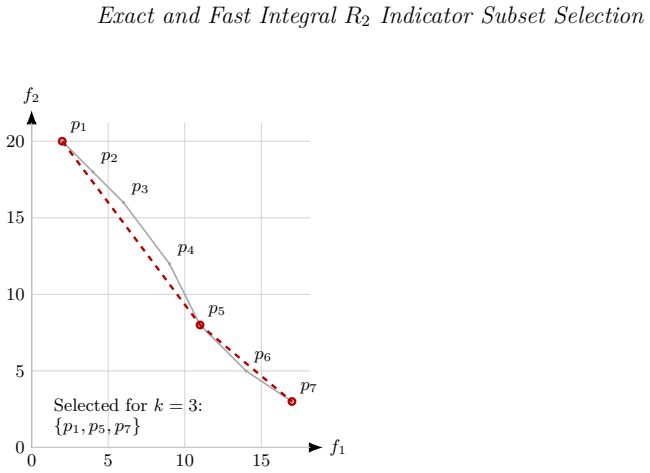

Figures from the paper (3 more)


Forward citations
Cited by 1 Pith paper
-
Three-Objective Integral R2 Subset Selection: NP-Hardness and Submodular Approximation
Proves NP-hardness of exact 3-objective integral R2 subset selection and shows the improvement function is monotone submodular for greedy approximation.
Reference graph
Works this paper leans on
-
[1]
M. P. Hansen and A. Jaszkiewicz. Evaluating the quality of approximations to the non-dominated set. Technical Report IMM-REP-1998-7, Department of Mathematical Modelling, Technical University of Denmark, 1998.https://www.imm.dtu.dk/documents/ftp/tr98/tr07_98.abstract.html
1998
-
[2]
L. Schäpermeier and P. Kerschke. Reinvestigating theR2 indicator: Achieving Pareto compliance by integration. InParallel Problem Solving from Nature – PPSN XVIII, pages 202–216. Springer, 2024. https://doi.org/10.1007/978-3-031-70085-9_13
-
[3]
L. Schäpermeier and P. Kerschke.R2 v2: The Pareto-compliantR2 indicator for better benchmarking in bi-objective optimization.Evolutionary Computation, 2025.https://doi.org/10.1162/EVCO.a.366
-
[4]
Jaszkiewicz and P
A. Jaszkiewicz and P. Zielniewicz. Exact calculation and properties of theR2 multiobjective quality indicator.IEEE Transactions on Evolutionary Computation, 29(4):1227–1238, 2025
2025
-
[5]
D. Brockhoff, T. Wagner, and H. Trautmann.R2 indicator-based multiobjective search.Evolutionary Computation, 23(3):369–395, 2015.https://doi.org/10.1162/EVCO_a_00135
-
[6]
T. Kuhn, C. M. Fonseca, L. Paquete, S. Ruzika, M. M. Duarte, and J. R. Figueira. Hypervolume subset selection in two dimensions: Formulations and algorithms.Evolutionary Computation, 24(3):411–425, 2016
2016
-
[7]
Two-dimensionalsubsetselectionforhypervolumeandepsilon- indicator
K.Bringmann, T.Friedrich, andP.Klitzke. Two-dimensionalsubsetselectionforhypervolumeandepsilon- indicator. InProceedings of the 2014 Annual Conference on Genetic and Evolutionary Computation (GECCO ’14), pages 589–596. ACM, 2014.https://doi.org/10.1145/2576768.2598276
-
[8]
Korogi and R
K. Korogi and R. Tanabe. Dynamic programming for the indicator-based subset selection problem with IGD, IGD+, R2, and NR2 in bi-objective optimization. InProceedings of the 39th Annual Conference of the Japanese Society for Artificial Intelligence, article 4P2-OS-17b-04, 2025.https://www.jstage.jst. go.jp/article/pjsai/JSAI2025/0/JSAI2025_4P2OS17b04/_arti...
2025
Show all 12 references
-
[9]
Aggarwal, M
A. Aggarwal, M. M. Klawe, S. Moran, P. Shor, and R. Wilber. Geometric applications of a matrix- searching algorithm.Algorithmica, 2:195–208, 1987
1987
-
[10]
R. E. Burkard, B. Klinz, and R. Rudolf. Perspectives of Monge properties in optimization.Discrete Applied Mathematics, 70(2):95–161, 1996
1996
-
[11]
M. T. M. Emmerich. Preference-shaped expected hypervolume andR2 improvement: Exact computation and monotonicity. arXiv preprint arXiv:2605.28746, 2026.https://arxiv.org/abs/2605.28746
2026 arXiv
-
[12]
M. T. M. Emmerich. Polynomial-time Riesz-energy subset selection for ordered point sets on lines and ℓ1-staircases. arXiv preprint arXiv:2606.16946, 2026.https://arxiv.org/abs/2606.16946. 22
2026 arXiv
Reviewed June 26, 2026 · model on record in the stance chip above.
Discussion (0). Continue with ORCID to comment.