REVIEW 2 major objections 3 minor 1 cited by
A $\mu$-$\tau$-philic Higgs doublet confronted with the muon g-2, $\tau$ decays and LHC data
T0 review · 2 major / 3 minor · reviewed 2026-08-14 · deepseek-v4-flash
Pith's one-line read A second Higgs doublet that couples only to muon and tau flavours can simultaneously explain the muon g-2 and tau-decay lepton-universality anomalies while surviving LHC multilepton searches, provided the heavy CP-even Higgs is above 560…
desk verdict A solid recast paper that should be reviewed, but the large radiative correction to the muon mass is the real soft spot, not tau->mu gamma. read the letter →
The pith
A machine-rendered reading of the paper's core claim, the machinery that carries it, and where it could break.
The reading
What carries the argument
The central object is the inert second Higgs doublet $\Phi_2$, which changes sign under a $Z_4$ discrete symmetry, has zero vacuum expectation value, and carries the only new Yukawa interaction $\mathcal{L}_{\mathrm{LFV}} = \sqrt{2}\rho_{\mu\tau}L_\mu^L\Phi_2\tau_R + \sqrt{2}\rho_{\tau\mu}L_\tau^L\Phi_2\mu_R + \mathrm{h.c.}$, with $\rho_{\mu\tau}=\rho_{\tau\mu}=\rho$ and all parameters real. Because $\Phi_2$ has no quark or diagonal-lepton couplings, the neutral scalars $H$ and $A$ decay dominantly to $\tau^\pm\mu^\mp$, and the charged scalar $H^\pm$ decays to $\tau^\pm\nu_\mu$ or $\mu^\pm\nu_\tau$, when the mass splittings are small. That same $\rho$ generates the muon g-2 shift through one-loop $H$ and $A$ diagrams, corrects $\tau\to\mu\nu\bar\nu$ through tree-level $H^\pm$ exchange, and shifts the $Z\to\tau^+\tau^-$ and $Z\to\mu^+\mu^-$ widths through loops; the condition $m_A>m_H$ is what makes the g-2 contribution positive.
What would settle it
Compute the one-loop branching ratio $B(\tau\to\mu\gamma)$ for the surviving points with $\rho>0.36$, $m_H\in[560,800]$ GeV and $\Delta m<50$ GeV, and compare it with the current experimental upper bound of a few $10^{-8}$; any point exceeding that bound falsifies the paper's claim that the two anomalies can be simultaneously explained in this model.
Extended reading notes
Core claim
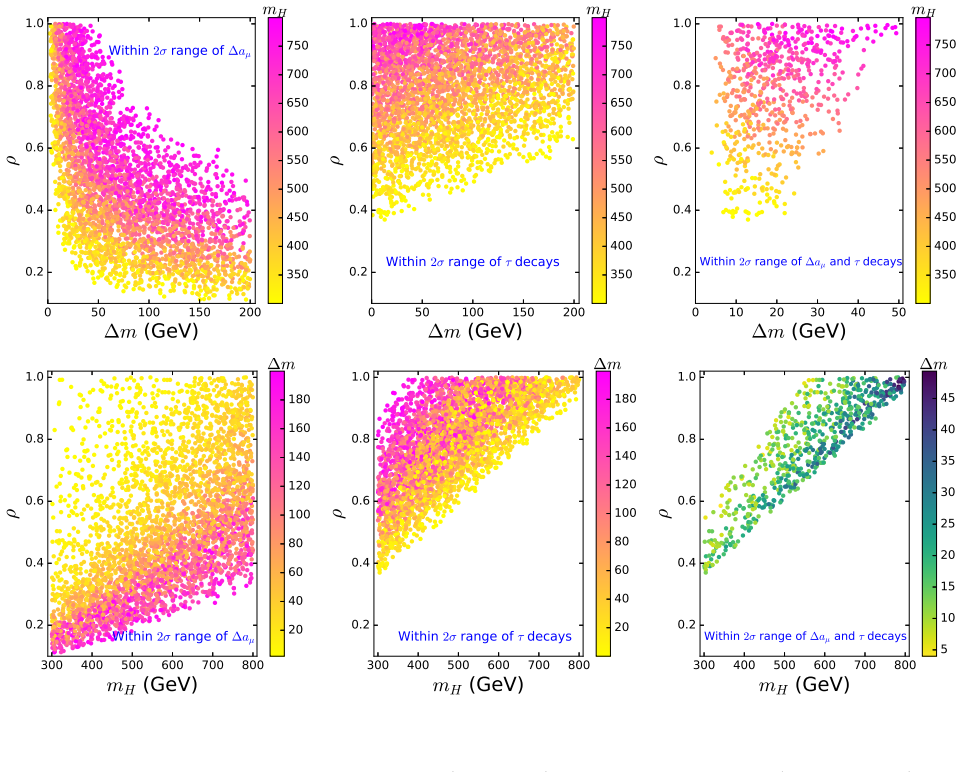
The paper's central claim is that a single real mu-tau Yukawa coupling $\rho$ can account for both anomalies. The one-loop contribution to the muon anomalous magnetic moment, $\delta a_\mu = \frac{m_\mu m_\tau \rho^2}{8\pi^2}\left[\frac{\log(m_H^2/m_\tau^2)-3/2}{m_H^2}-\frac{\log(m_A^2/m_\tau^2)-3/2}{m_A^2}\right]$, is positive only for $m_A>m_H$, while the tree-level charged-Higgs exchange in $\tau\to\mu\nu\bar\nu$ increases $\Gamma(\tau\to\mu\nu\bar\nu)$ by $\delta_{\mathrm{tree}}=4m_W^4\rho^4/(g^4 m_{H^\pm}^4)$, pulling the $g_\tau/g_e$ ratio toward its measured value. The complementary parameter dependence forces the simultaneous fit into a narrow band with $\Delta m\equiv m_A-m_{H^\pm}<50$ GeV and $\rho>0.36$. Applying LHC multilepton searches cuts this band to $m_H>560$ GeV and $\rho\gtrsim 0.68$, with the most restrictive bins being three-lepton and hadronic-tau plus two-lepton signal regions.
Load-bearing premise
The whole result depends on the assumption that the constraints listed in the scan are the only ones that matter; in particular, the radiative decay of a tau into a muon and a photon, generated by the very same $\rho$ coupling, is not imposed, and applying it could shrink or remove the allowed region.
Editorial extensions
If this is right
- If the model is correct, the extra scalars should appear as a nearly degenerate trio with $m_A\simeq m_{H^\pm}$ and $m_A-m_H<50$ GeV, decaying mostly to $\tau\mu$, $\tau\nu$, and $\mu\nu$ final states.
- The LHC multilepton limit is the controlling constraint: the paper finds $m_H>560$ GeV and $\rho\gtrsim 0.68$, so dedicated searches in three-lepton and hadronic-tau channels should see an excess or push the bound higher.
- The model predicts exact equality of the semihadronic ratios, $(g_\tau/g_\mu)_\pi=(g_\tau/g_\mu)_K=g_\tau/g_\mu$, because the new physics only enters the pure leptonic vertices.
- Extrapolating the most sensitive signal regions, the paper estimates that $m_H\lesssim 645$ GeV would be excluded at $2\sigma$ with 139 fb$^{-1}$ of LHC data, and $m_H\lesssim 700$ GeV with 300 fb$^{-1}$.
Reading between the lines
- An unlisted constraint the paper does not apply is $\tau\to\mu\gamma$: the same $\rho$ coupling that produces the g-2 and tau-decay corrections generates this radiative decay at one loop, and the surviving region (large $\rho$, scalar masses near 500-800 GeV) is precisely where it can be sizable; imposing the current limit could shrink or eliminate the allowed band.
- Because the surviving parameter space is so degenerate, a dedicated search for $\tau\mu$ plus missing transverse momentum, rather than generic multilepton bins, may be a more sensitive probe of this model than the searches used here.
- The mechanism is generic to any new scalar with mu-tau flavour-violating Yukawa couplings: the same positivity condition $m_A>m_H$ and the same $\rho$-versus-$\Delta m$ tension would reappear in other models with an additional scalar doublet, so the 560 GeV lower bound is a useful target for model-building.
Signed reviews
Editorial analysis
A structured set of objections, weighed in public.
Referee Report
Summary. The paper considers a two-Higgs-doublet model in which the second doublet Φ2 is inert and carries only off-diagonal μ-τ Yukawa couplings. Assuming real, symmetric couplings ρμτ=ρτμ=ρ, the authors compute the one-loop contribution to the muon anomalous magnetic moment and the tree/loop corrections to tau-lepton universality ratios, and scan the parameter space 300 GeV < mH < 800 GeV, mH < mA = mH± < mH + 200 GeV, 0.1 < ρ < 1.0. After imposing theoretical constraints, oblique parameters, Z-decay universality, and a suite of LHC multilepton searches implemented with CheckMATE and related tools, they find a surviving region with small mass splittings Δm ≡ mA(mH±) − mH < 50 GeV and ρ > 0.36, and claim that LHC searches require mH > 560 GeV and ρ > 0.68. The central claim is that both the muon g-2 and tau LFU anomalies can be simultaneously explained while passing current direct searches.
Significance. If correct, the model would be an economical simultaneous explanation of the muon g-2 and tau LFU discrepancies, and the detailed LHC recasting with cut-flow tables would be a useful reference for similar LFV-Higgs models. The one-loop g-2 and tau LFU formulas are standard, the scan logic is clear, and the LHC analysis uses public tools in a transparent way. However, the paper omits a decisive constraint: the same ρ coupling generates τ→μγ at one loop, and the surviving parameter space appears to predict Br(τ→μγ) at the 10^{-6}–10^{-5} level, far above the BaBar bound of 4.4×10^{-8}. In addition, the Z4 charge assignment as printed does not allow the defining interaction of Eq. (8). I also checked the radiative-muon-mass concern and find that it does not land: the one-loop correction to mμ vanishes because the two off-diagonal Yukawa vertices project the internal tau line with P_R and P_L, annihilating the tau-mass term. The strengths of the paper do not compensate for the missing charged-lepton flavor-violating constraint.
major comments (2)
- [Sec. III.A (constraint list); Sec. III.B/Fig. 2] The scan constraints listed in Sec. III.A do not include any charged-lepton flavor-violating observable, in particular the very strong limit Br(τ→μγ) < 4.4×10^{-8} (BaBar). This is a load-bearing omission. The ρ coupling of Eq. (8) generates τ→μγ at one loop: the transition τ_L → μ_R requires only a single flavor-changing Yukawa vertex, with the photon emitted from the internal tau (or muon) line. The H and A contributions cancel in the mA=mH limit, but the g-2-favored region has mA−mH = 10–50 GeV, ρ ≈ 0.7–1.0, and mH ≈ 560–800 GeV, so the cancellation is incomplete. Using the standard one-loop dipole formula with L = ln(mH^2/mτ^2) − 3/2 ≈ 10, the residual rate is approximately Br(τ→μγ) ≈ [α mτ^5/(4 Γτ)] [ρ L (mA^2−mH^2)/(16π^2 mH^4)]^2. At the illustrative point mH = 600 GeV, Δm = 30 GeV, ρ = 0.7, this gives Br(τ→μγ) ≈ 2×10^{-6}, more than one order of magnitude above the experimental bound. The surviving samples shown in Fig. 2 (ρ > 0.68, mH > 560 GeV) therefore appear to be excluded once this constraint is imposed. I request a full one-loop computation of τ→μγ (and also of Z→τμ, which receives a similar one-loop contribution) and a rerun of the scan with these constraints included.
- [Table I and Eq. (8)] The Z4 charge assignment in Table I is inconsistent with the interaction in Eq. (8). With the entries as printed, q(Lμ) = i, q(τR) = −i, q(Φ2) = −1, so q(Lμ Φ2 τR) = i · (−1) · (−i) = −1, and similarly q(Lτ Φ2 μR) = −1. Neither product is invariant under the Z4 symmetry. Unless the table is a typographical error and the correct charges are supplied, the model's defining LFV Yukawa interaction is forbidden by the very symmetry that is introduced to justify it. This should be corrected and the charges verified explicitly.
minor comments (3)
- [Eq. (12)] There is a missing parenthesis in the second term of Eq. (12): it should read (log(mA^2/mτ^2) − 3/2)/mA^2 rather than log(mA^2/mτ^2 − 3/2)/mA^2.
- [Eq. (17)] The function H(x) has a removable singularity at x = 1, and the paper sets mA = mH± so that xA = 1. The limiting value H(1) = −2 should be stated explicitly so that the numerical evaluation is unambiguous.
- [Throughout] The text sometimes uses 'LUF' for 'LFU' (e.g., in the Sec. III heading and in the discussion of Fig. 1). This should be corrected for consistency.
Circularity Check
No significant circularity: the model's coupling is an active parameter fitted to the two anomalies, and the LHC mass bound is derived from external direct-search data.
full rationale
The paper does not claim to predict the muon g-2 and tau LFU excesses from first principles; instead it scans the free coupling rho and the extra-Higgs masses and selects points that simultaneously satisfy the 2-sigma windows of both measured anomalies (Eqs. (12), (15)-(17), and the scan range in Eq. (9)). That is a parameter-fit/consistency analysis, not a circular derivation: rho is not defined by the anomalies, and the resulting 'allowed region' is the intersection of two independent experimental constraints, not a tautology. The central new result, mH > 560 GeV, comes from ATLAS/CMS direct multilepton and slepton searches implemented with CheckMATE and experimental signal regions; it does not reuse the anomaly fits as an input. The self-citations in the paper (Refs. [14], [16], [22], [36]) are background references or a recasting of external experimental searches, and none functions as an unverified premise that forces the conclusion. Possible physics concerns, such as the omitted one-loop correction to the muon mass from the same rho coupling or the consistency of the Z4 charge assignments, are correctness/completeness issues, not circularity; they do not make the derivation equivalent to its inputs. Therefore no circular step is identified.
Assumptions & free parameters
free parameters (4)
- rho (mu-tau Yukawa coupling of Phi2) =
0.36 < rho < 1.0 (allowed region, not a single fit)
- m_H (heavy CP-even Higgs mass) =
greater than 560 GeV after LHC constraints
- Delta m = m_A (m_H+/-) - m_H mass splittings =
less than 50 GeV
- lambda_3 (quartic coupling) =
not specified, adjusted to satisfy theoretical constraints
assumptions (5)
- ad hoc to paper Second doublet Phi2 has zero vacuum expectation value and no mixing with Phi1, making it inert except for LFV Yukawa interactions.
- ad hoc to paper Lepton Yukawa matrix of Phi2 is real and symmetric, rho_mu_tau = rho_tau_mu = rho.
- ad hoc to paper The Z4 discrete symmetry with charge assignment in Table I forbids all other new fermion couplings and quark couplings.
- domain assumption The theoretical constraints from 2HDMC, oblique parameters, and Z-decay LFU are satisfied and do not reduce the scan region.
- domain assumption CheckMATE recasting with MG5, Pythia, and Delphes reliably models the LHC signal regions used.
invented entities (1)
-
Second Higgs doublet Phi2 with mu-tau flavor-violating couplings (H, A, H+/-)
independent evidence
Cite this review
Pith. "Pith review of A $\mu$-$\tau$-philic Higgs doublet confronted with the muon g-2, $\tau$ decays and LHC data." pith.science (2026). https://pith.science/paper/SAD666HG
@misc{pith2026190803755,
  author       = {Pith},
  title        = {Pith review of: A $\mu$-$\tau$-philic Higgs doublet confronted with the muon g-2, $\tau$ decays and LHC data},
  year         = {2026},
  howpublished = {\url{https://pith.science/paper/SAD666HG}},
  note         = {Machine review of arXiv:1908.03755}
}
abstract
We propose a two-Higgs-doublet model in which one Higgs doublet has the same interactions with fermions as the SM, and another Higgs doublet only has the $\mu$-$\tau$ LFV interactions. Assuming that the Yukawa matrices are real and symmetric, we impose various relevant theoretical and experimental constraints, and find that the excesses of muon $g-2$ and lepton flavour universality in the $\tau$ decays can be simultaneously explained in the region of small mass splittings between the heavy CP-even Higgs and the CP-odd Higgs ($m_A > m_H$). The multi-lepton event searches at the LHC can sizably reduce the mass ranges of extra Higgses, and $m_H$ is required to be larger than 560 GeV.
Figures


Forward citations
Cited by 1 Pith paper
-
Higgs lepton flavor violating decays in Two Higgs Doublet Models
A mini-review explaining that the type-III two Higgs doublet model can produce h to tau mu branching ratios near the present CMS bound while remaining compatible with tau to mu gamma and related flavor constraints.
Reference graph
Works this paper leans on
-
[23]
Y. Abe, T. Toma, K. Tsumura, JHEP 1906, (2019) 142
work page 2019
-
[1]
H. N. Brown et al. [Muon g-2 Collaboration], Phys. Rev. Lett. 86, (2001) 2227
work page 2001
-
[2]
T. Blum et al. [RBC and UKQCD Collaborations], Phys. Rev. Lett. 121, (2018) 022003
work page 2018
-
[3]
Y. Amhis et al. [Heavy Flavor Averaging Group (HFAG) Collaboration], arXiv:1412.7515
-
[4]
D. Chang, W.-F. Chang, C.-H. Chou, and W.-Y. Keung, Phys. Rev. D 63, (2001) 091301
work page 2001
-
[5]
K. M. Cheung, C. H. Chou and O. C. W. Kong, Phys. Rev. D 64, (2001) 111301. 14 TABLE II: Cross sections, cut flows and event yields in each signal region for a benchmark point of (m˜𝓁,m ˜χ0 1 ) = (700 , 0) GeV in the simplified slepton model and a point in our model with mH = mA = mH ± = 700 GeV. ˜𝓁 stands the first two generations of mass-degenerate slepton...
work page 2001
- [6]
-
[7]
J. Cao, P. Wan, L. Wu and J. M. Yang, Phys. Rev. D 80, (2009) 071701
work page 2009
Show all 47 references
-
[8]
Broggio, E
A. Broggio, E. J. Chun, M. Passera, K. M. Patel and S. K. Vempati, JHEP 1411, (2014) 15 058
2014
-
[9]
Wang and X
L. Wang and X. F. Han, JHEP 05, (2015) 039
2015
-
[10]
T. Abe, R. Sato and K. Yagyu, JHEP 1507, (2015) 064
2015
-
[11]
E. J. Chun, Z. Kang, M. Takeuchi, Y.-L. Tsai, JHEP 1511, (2015) 099
2015
-
[12]
E. J. Chun, J. Kim, JHEP 1607, (2016) 110
2016
-
[13]
Crivellin, J
A. Crivellin, J. Heeck, P. Stoffer, Phys. Rev. Lett. 116, (2016) 081801
2016
-
[14]
L. Wang, J. M. Yang, M. Zheng, Y. Zhang, Phys. Lett. B 788, (2019) 519-529
2019
- [15]
-
[16]
X.-F. Han, T. Li, L. Wang, Y. Zhang, Phys. Rev. D 99, (2019) 095034
2019
-
[17]
Adikle Assamagan, A
K. Adikle Assamagan, A. Deandrea, P.-A. Delsart, Phys. Rev. D 67, (2003) 035001
2003
-
[18]
Davidson, G
S. Davidson, G. J. Grenier, Phys. Rev. D 81, (2010) 095016
2010
-
[19]
Omura, E
Y. Omura, E. Senaha, K. Tobe, JHEP 1505, (2015) 028
2015
-
[20]
Benbrik, C.-H
R. Benbrik, C.-H. Chen, T. Nomura, Phys. Rev. D 93, (2016) 095004
2016
-
[21]
Omura, E
Y. Omura, E. Senaha, K. Tobe, Phys. Rev. D 94, (2016) 055019
2016
-
[22]
L. Wang, S. Yang, X.-F. Han, Nucl. Phys. B 919, (2017) 123-141
2017
-
[24]
Eriksson, J
D. Eriksson, J. Rathsman, O. St˚ al, Comput. Phys. Commun.181, (2010) 189
2010
-
[25]
Tanabashi et al., [Particle Data Group], Phys
M. Tanabashi et al., [Particle Data Group], Phys. Rev. D 98, 030001 (2018)
2018
-
[26]
Schael et al
S. Schael et al. [ALEPH and DELPHI and L3 and OPAL and SLD and LEP Electroweak Working Group and SLD Electroweak Group and SLD Heavy Flavour Group Collaborations], Phys. Rept. 427, (2006) 257
2006
-
[27]
Alwall et al
J. Alwall et al. , JHEP 1407, (2014) 079
2014
-
[28]
Torrielli and S
P. Torrielli and S. Frixione, JHEP 1004, (2010) 110
2010
-
[29]
de Favereau et al
J. de Favereau et al. [DELPHES 3 Collaboration], JHEP 1402, (2014) 057
2014
-
[30]
Dercks, N
D. Dercks, N. Desai, J. S. Kim, K. Rolbiecki, J. Tattersall and T. Weber, Comput. Phys. Commun. 221, (2017) 383
2017
-
[31]
A. M. Sirunyan et al. [CMS Collaboration], JHEP 1711, (2017) 029
2017
-
[32]
A. M. Sirunyan et al. [CMS Collaboration], JHEP 1803, (2018) 076
2018
-
[33]
A. M. Sirunyan et al. [CMS Collaboration], JHEP 1803, (2018) 166
2018
-
[34]
A. M. Sirunyan et al. [CMS Collaboration], JHEP 1803, (2018) 160
2018
-
[35]
Aaboud et al
M. Aaboud et al. [ATLAS Collaboration], Eur. Phys. J. C 78, (2018) 154. 16
2018
-
[36]
Pozzo and Y
G. Pozzo and Y. Zhang, Phys. Lett. B 789, (2019) 582-591
2019
-
[37]
The ATLAS collaboration [ATLAS Collaboration], ATLAS-CONF-2019-018
2019
-
[38]
C. G. Lester and D. J. Summers, Phys. Lett. B 463, 99 (1999)
1999
-
[39]
A. Barr, C. Lester and P. Stephens, J. Phys. G 29, 2343 (2003)
2003
-
[40]
CMS Collaboration [CMS Collaboration], CMS-PAS-SUS-19-008
-
[41]
CMS Collaboration [CMS Collaboration], CMS-PAS-SUS-19-003
-
[42]
The ATLAS collaboration [ATLAS Collaboration], ATLAS-CONF-2019-015
2019
-
[43]
The ATLAS collaboration [ATLAS Collaboration], ATLAS-CONF-2019-014
2019
-
[44]
The ATLAS collaboration [ATLAS Collaboration], ATLAS-CONF-2019-020
2019
-
[45]
The ATLAS collaboration [ATLAS Collaboration], ATLAS-CONF-2019-031
2019
-
[46]
The ATLAS collaboration [ATLAS Collaboration], ATLAS-CONF-2019-008
2019
- [47]
Reviewed August 14, 2026 · model on record in the stance chip above.
Discussion (0). Continue with ORCID to comment.