REVIEW 3 major objections 4 minor 16 references
End-to-End Learning from Complex Multigraphs with Latent-Graph Convolutional Networks
T0 review · 3 major / 4 minor · reviewed 2026-08-14 · deepseek-v4-flash
Pith's one-line read Latent-Graph Convolutional Networks can learn node classes end-to-end from complex multigraphs by embedding every set of edges between two vertices into a latent adjacency tensor.
desk verdict A solid empirical proof-of-concept for learning from rich multigraphs, but the headline performance claim for L-GCN+ overstates the transductive results and needs a capacity-matched ablation and paired tests. read the letter →
The pith
A machine-rendered reading of the paper's core claim, the machinery that carries it, and where it could break.
The reading
What carries the argument
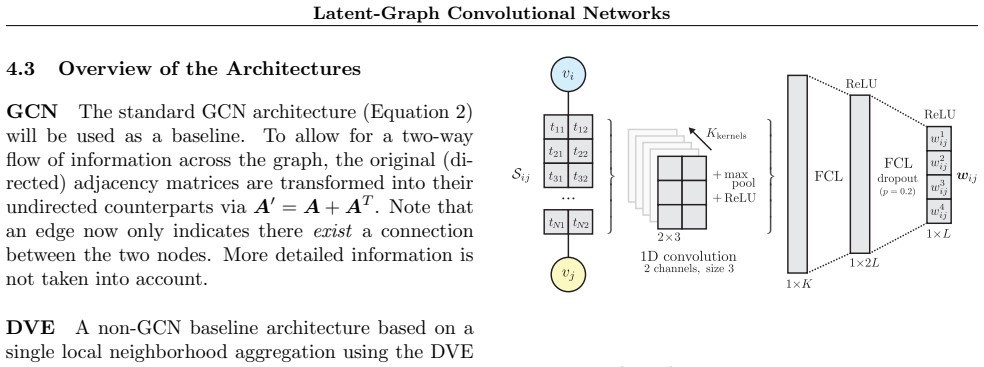
The load-bearing object is the latent adjacency tensor, built by replacing each edge weight with a learned vector $w_{ij} = \Gamma(S_{ij})$ (Equation 6), where $\Gamma$ is a task-appropriate differentiable function—here, a 1D convolution followed by max-pooling over transaction sequences, or an aggregation of hourly ride and tip profiles. These vectors are duplicated into two canonical blocks (Equations 7 and 8) so that each L-GCN layer can propagate along both directions through relation-specific weight matrices. The L-GCN+ variant replaces the relation-specific matrices with a shared matrix $W$ and inserts a two-layer MLP $f(x) = \sigma(xW_1)W_2$ inside the per-neighbor sum (Equations 10 to 12); the experiments credit this mechanism with the large inductive gains. Because $\Gamma$ is the only edge-specific component, the rest of the architecture is reusable across edge modalities.
What would settle it
Generate a synthetic multigraph where node class is an XOR-like condition on the transaction profiles of two distinct neighbors, such as a node being fraudulent exactly when the average amount sent to neighbor A and the average amount sent to neighbor B disagree in direction, while no single edge population carries the label alone. If L-GCN+ cannot beat random AUC on this graph, the local-independence premise of the latent adjacency tensor is falsified.
Extended reading notes
Core claim
The paper establishes that end-to-end learning from complex multigraphs is possible when each set of edges $S_{ij}$ is passed through a learning function $\Gamma$ to produce a latent relation vector $w_{ij} \in \mathbb{R}^L$, collected into a latent adjacency tensor. Propagation follows a GCN-style rule over $L$ pseudo-relations, with both canonical directions encoded so that incoming and outgoing edge populations are processed independently. The L-GCN+ modification inserts a two-layer MLP between the tensor product $w_{ij} \otimes h_j$ and the neighborhood sum, allowing per-neighbor nonlinear interaction between edge embeddings and node attributes. The experiments show this nonlinearity is decisive: on the 1-hop fraud network it raises inductive AUC for $L=4$ from 0.653 to 0.907, and on the real transportation data it gives the best zoning classification (macro-F1 0.637, against 0.549 for a plain GCN). The paper concludes that a suitable $\Gamma$ can be chosen for any edge representation, making the method applicable beyond transactions and taxi rides.
Load-bearing premise
The method assumes every useful signal is recoverable from each individual set of edges between two vertices, so that embedding each set separately and pooling locally is enough; tasks that require comparing the edge sets of different neighbors are outside its reach.
Editorial extensions
If this is right
- Node classification no longer fails when node features carry no class information: the model can pull discriminative signal from the edge populations themselves.
- The per-neighbor nonlinearity of L-GCN+ is not just extra capacity; it is the configuration that transfers to unseen graphs, suggesting that such interactions learn edge-attribute patterns rather than graph-specific accidents.
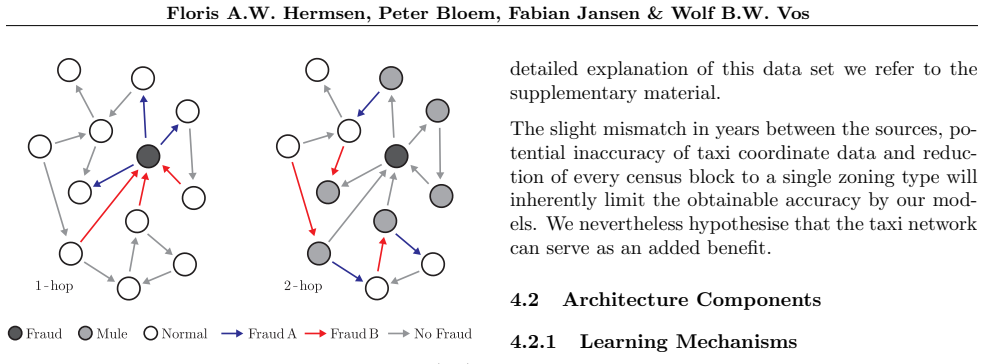
- Multihop signals are usable: on the 2-hop fraud network, L-GCN variants keep accuracy near 90 percent and AUC above 0.95 even though the class-correlated transaction patterns sit two hops from the target node.
- Any rich edge representation—text, images, or vector time series—can be plugged into the pipeline by choosing an appropriate $\Gamma$, so the method is not tied to financial or transportation data.
- A local pooling baseline that embeds edge sets directly into node features collapses in the inductive setting (AUC about 0.50), showing that graph propagation, not just local pooling, is needed for generalization.
Reading between the lines
- If the inductive advantage of L-GCN+ is general, then inserting a small MLP before neighborhood aggregation could also improve other message-passing models when node-attribute distributions shift between train and test graphs; the paper leaves this as future work.
- The architecture embeds each $S_{ij}$ independently, so a sharp boundary follows: tasks whose label depends on comparing edge populations across different neighbors, such as an XOR condition on the amounts sent to two counterparties, would likely defeat it and would need a global readout over the latent tensor.
- On the transportation case, the gain from taxi activity and tip profiles is correlational; trip volume may serve as a proxy for land-use intensity rather than relational dynamics, so the real-world result is evidence of feasibility rather than of a causal mobility–zoning link.
- A natural extension is to replace the fixed 1D-convolution $\Gamma$ with a permutation-invariant set encoder or attention over individual transactions, which could handle longer or unordered edge populations and make the claimed generality to text or image edges more direct.
Signed reviews
Editorial analysis
A structured set of objections, weighed in public.
Referee Report
Summary. The manuscript proposes Latent-Graph Convolutional Networks (L-GCNs), a class of architectures for learning on complex multigraphs in which each multi-edge population S_ij is mapped through a differentiable function Γ to a latent vector w_ij ∈ R^L, forming a latent adjacency tensor over L pseudo-relations. A GCN-like propagation rule (Eqs. 5 and 10) then aggregates neighbor embeddings, and a variant called L-GCN+ (Eq. 11) introduces per-neighbor nonlinear interactions by passing the tensor product of the latent edge embedding and the neighbor embedding through a small MLP. The authors evaluate L-GCN and L-GCN+ against GCN and DVE baselines on two synthetic financial transaction networks with fraud signals at one-hop and two-hop distances, report transductive and inductive results, and demonstrate the approach on a real-world NYC taxi/zoning dataset. The paper also includes an embedding-inspection analysis and states that code and data are released.
Significance. The problem addressed—end-to-end learning from multigraphs with unbounded, richly labeled edge populations—is genuinely under-explored, and the proposed architecture is a clean and coherent way to tackle it. The experimental protocol is careful in several respects: test sets are held out until final settings are chosen, results are averaged over ten random initializations, standard errors are reported, and multiple baselines are included. The authors also provide reproducible code and data and an inspection of the learned convolutional filters, which strengthens the paper. If the performance claims hold, the model would be a useful tool for fraud detection, transportation analysis, and other edge-rich domains. However, the headline claim that L-GCN+ 'boosts performance significantly' is not robustly supported by the transductive results, and the comparison with L-GCN is confounded with model capacity. The inductive-setting results are the most interesting and original finding, but even those would benefit from statistical analysis.
major comments (3)
- [Abstract; §5.1; Tables 2 and 3; footnote 7] The central claim that per-neighbor nonlinear interactions (L-GCN+) 'boost performance significantly' is not robustly supported by the transductive results. In Table 2, at the best latent size L=4, L4-GCN+ versus L4-GCN gives 97.30±0.41 vs 97.10±0.29 accuracy and 0.983±0.002 vs 0.972±0.004 AUC on the 1-hop set, but on the 2-hop set the accuracy is 87.34±1.26 vs 89.65±0.34 (worse) and the AUC is 0.951±0.004 vs 0.952±0.004 (a tie). The large differences appear in the inductive setting (Table 3) and for smaller L. Footnote 7 declines statistical tests because the runs share the same split; that reasoning does not rule out paired or permutation tests across the ten independently initialized runs. Without such tests, or at least a clear statement of which differences are within noise, the abstract overstates the evidence.
- [§3.2; §5.1; Table 2] The L-GCN versus L-GCN+ comparison is confounded by model capacity. Table 2 reports 6370 parameters for L4-GCN+ versus 3118 for L4-GCN, roughly a factor of two; the additional parameters come from the MLP in Eq. 11. The inductive gains could therefore be due to capacity or optimization rather than to the nonlinear per-neighbor interaction per se. The paper needs a capacity-matched ablation (for example, an L-GCN with wider hidden layers and/or more latent relations so that parameter counts are comparable) before attributing the improvements to the mechanism in Eq. 11. This is load-bearing for the abstract's causal statement.
- [§1; §4.1; Appendix D.4] The empirical scope is narrower than the title and abstract suggest. In the synthetic datasets the class signal is encoded per edge population: Appendix D.4 applies fraud mutations to each S_ij depending on the class of one endpoint (or of an adjacent mule in the 2-hop version), so Γ(S_ij) alone is sufficient to recover the signal for a given neighbor, and the 2-hop task only requires propagating that per-edge evidence to the target node. A setting in which the relevant information requires comparing several edge populations simultaneously (e.g., a node is fraud because it has many anomalous outgoing edges relative to its normal incoming edges) is not covered by the experiments. The manuscript should state this scope limitation explicitly, or provide a synthetic experiment with cross-edge comparisons.
minor comments (4)
- [§5.2; Table 4] The text near the transportation results says 'see Table 3', but the urban transportation results are in Table 4; the cross-reference should be corrected.
- [Eq. 12] Calling f a 'two-layer MLP' is unconventional: with a single nonlinear activation followed by a linear output, it is more standardly a one-hidden-layer MLP. Please clarify the terminology or explicitly count the affine layers.
- [§5.1.1; Table 2] The DVE baseline outperforms L4-GCN+ on 1-hop accuracy (97.41±0.15 vs 97.30±0.41) with far fewer parameters, and the paper only says the best L-GCN architectures are 'on par'. A brief discussion of why the graph-propagation component is not needed in the 1-hop setting would help readers interpret the architecture's contribution.
- [Abstract; §6] The word 'significantly' is used without a statistical test in several places (abstract, Section 5.1.1, Section 6). Consider replacing it with a quantitative statement or a properly tested claim.
Circularity Check
No significant circularity: the paper is an empirical architecture proposal whose model equations define, rather than derive, the latent-graph mechanism, and whose experimental benchmarks are disclosed rather than concealed.
full rationale
The paper does not contain a derivation chain in which a prediction reduces by construction to its inputs. Equation 6 defines the latent edge embedding wij = Gamma(Sij), and Equation 11 defines the L-GCN+ per-neighbor nonlinear aggregation; these are model definitions, not fitted parameters later renamed as predictions. The synthetic financial datasets encode class-correlated transaction mutations by construction, but this is an explicit experimental design choice described in Appendix D, not a hidden circular step: the model must still learn the mapping Gamma end-to-end, and the held-out inductive transfer tests and the embedding inspection in Section C provide out-of-sample or component-level checks. The only self-citation of note is the R-GCN paper, on which one coauthor appears, but R-GCN is used as a publicly available prior baseline and starting point rather than as a load-bearing uniqueness theorem or as the sole justification for the architecture. Claims that L-GCN+ 'boosts performance significantly' are empirical and may be questioned on statistical grounds because no paired significance tests are reported and the compared models differ in parameter count, but that is a correctness or robustness concern, not circularity. No equation or claim in the paper is equivalent to its own input by definition, and no prediction is statistically forced by a fitted parameter. Therefore the appropriate circularity score is 0.
Assumptions & free parameters
free parameters (3)
- Latent dimension L =
4 for transaction networks; 3 for transportation network
- Number of 1D convolution kernels K =
20
- Intermediate node embedding size H(1) =
20 for transactions; 6 for transportation
assumptions (4)
- domain assumption The GCN propagation rule provides a useful inductive bias for node classification
- domain assumption Class signal in the synthetic data is recoverable from each edge population independently
- domain assumption Taxi ride activity and tip profiles correlate with census-block zoning type
- domain assumption A fixed-dimensional embedding Γ(Sij) can compress arbitrarily long edge sequences without losing task-relevant information
Cite this review
Pith. "Pith review of End-to-End Learning from Complex Multigraphs with Latent-Graph Convolutional Networks." pith.science (2026). https://pith.science/paper/SAKUX32C
@misc{pith2026190805365,
  author       = {Pith},
  title        = {Pith review of: End-to-End Learning from Complex Multigraphs with Latent-Graph Convolutional Networks},
  year         = {2026},
  howpublished = {\url{https://pith.science/paper/SAKUX32C}},
  note         = {Machine review of arXiv:1908.05365}
}
read the original abstract
We study the problem of end-to-end learning from complex multigraphs with potentially very large numbers of edges between two vertices, each edge labeled with rich information. Examples range from communication networks to flights between airports or financial transaction graphs. We propose Latent-Graph Convolutional Networks (L-GCNs), which propagate information from these complex edges to a latent adjacency tensor, after which further downstream tasks can be performed, such as node classification. We evaluate the performance of several variations of the model on two synthetic datasets simulating fraud in financial transaction networks, ensuring the model must make use of edge labels in order to achieve good classification performance. We find that allowing for nonlinear interactions on a per-neighbor basis boosts performance significantly, while showing promising results in an inductive setting. Finally, we demonstrate the use of L-GCNs on real-world data in the form of an urban transportation network.
Figures

Figures from the paper (5 more)


Reference graph
Works this paper leans on
-
[1]
The resulting map of census blocks and their associ- ated most prevalent zoning type can be seen in Figure 5. B.3 Network Structure In order to assign each of the∼160M yellow taxi rides to a pair of vertices in our graph, we must map their pickup and drop-off locations to a census block. For- tunately, coordinates for these these locations are pro- vided i...
work page 2012
-
[2]
monthly payments of fixed amount,
-
[3]
Occupied Housing Units
-
[6]
Hermsen, Peter Bloem, F abian Jansen & W olf B.W
Owned Free Floris A.W. Hermsen, Peter Bloem, F abian Jansen & W olf B.W. V os Figure 5: 2012 Manhattan Yellow Taxi ride network be- tween census blocks as given by the 25k most popular block-to-block combinations, with the exception that each block is represented at least twice (a random 20% subset of edges is shown). Colors represent most prevalent zonin...
work page 2012
-
[7]
weekly payments of fixed amount,
-
[8]
We can conclude that with respect to our data sets, the Γ learning mechanism is able to generate effective latent representations of the multi-edge populations by extracting patterns from the transaction data, indicat- ing successful end-to-end learning. Floris A.W. Hermsen, Peter Bloem, F abian Jansen & W olf B.W. V os Figure 8: An example transaction set...
work page 2016
-
[9]
payments with random intervals and random amount. Types 1 and 2 receive additional small, randomized offsets on their time attributes in order to introduce a degree of noise. Depending on the classes of the source and target nodes, these transaction setsSij are modified. In case that vi∈ F andvj∈ N we introduce fraud type A, having the following effects (in ...
-
[10]
some weekly payments are missing,
Show all 16 references
-
[11]
some monthly payments are missing,
-
[12]
In case vi∈ N andvj∈ F we introduce fraud type B, having similar but opposite effects:
some payments have a decreased amount by a fac- tor 10. In case vi∈ N andvj∈ F we introduce fraud type B, having similar but opposite effects:
-
[13]
some weekly payments occur twice,
-
[14]
some monthly payments occur twice,
-
[15]
11All of these modifications take place with a per- transaction probability of 1/3
some payments have an increased amount by a factor 5. 11All of these modifications take place with a per- transaction probability of 1/3. For a summary of the transaction generator, see Al- gorithm 2. The exact probability distributions can be found in Section D.7 and the gener...
-
[16]
Values for|E| also differ slightly because of the removal of generated self-connections
Values for |V| differ from their initial values due to the removal of zero-degree nodes (see Section D.2). Values for|E| also differ slightly because of the removal of generated self-connections. Before the data sets are passed to the architectures, all node features are normali...
-
[2002]
doi: 10.1103/RevModPhys.74.47. P. Battaglia, R. Pascanu, M. Lai, D. J. Rezende, et al. Interaction networks for learning about objects, re- lations and physics. In Advances in neural informa- tion processing systems, pages 4502–4510, 2016. P. W. Battaglia, J. B. Hamrick, V. Ba...
-
[2016]
URL http://arxiv.org/abs/1606.09375. D. K. Duvenaud, D. Maclaurin, J. Aguilera- Iparraguirre, R. G´ omez-Bombarelli, T. Hirzel, A. Aspuru-Guzik, and R. P. Adams. Convolu- tional networks on graphs for learning molecular fingerprints. CoRR, abs/1509.09292, 2015. URL http://arxiv...
2015 arXiv
Reviewed August 14, 2026 · model on record in the stance chip above.
Discussion (0). Continue with ORCID to comment.