Real vs. Complex Spectral Bases for Neural Operators: The Role of Green's Function Alignment
Pith reviewed 2026-07-01 06:37 UTC · model grok-4.3
The pith
The optimal spectral basis for neural operators is set by the symmetry of the PDE solution operator's Green's function.
A machine-rendered reading of the paper's core claim, the machinery that carries it, and where it could break.
Core claim
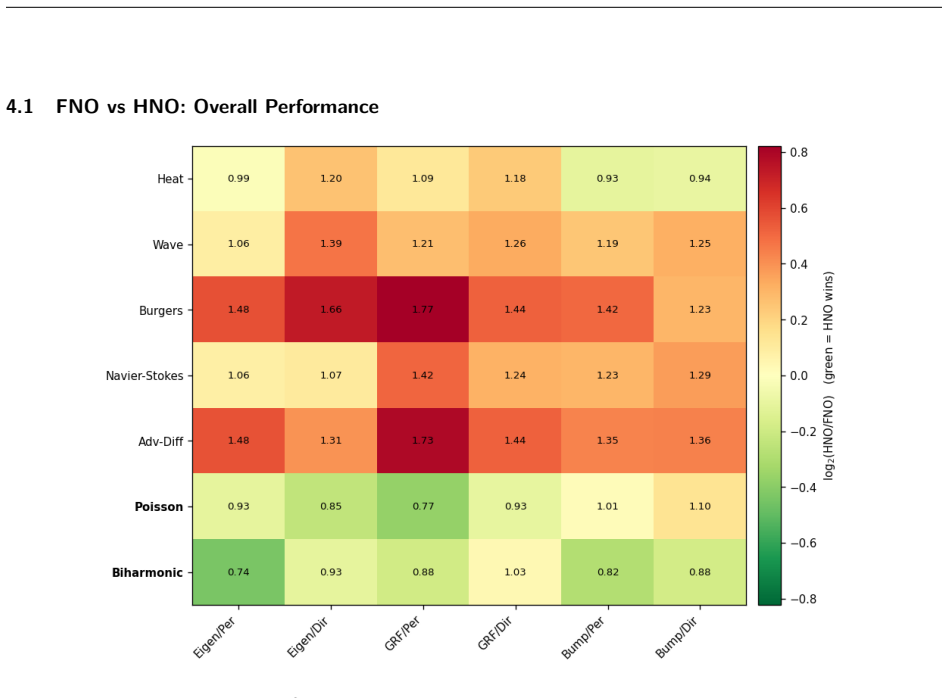
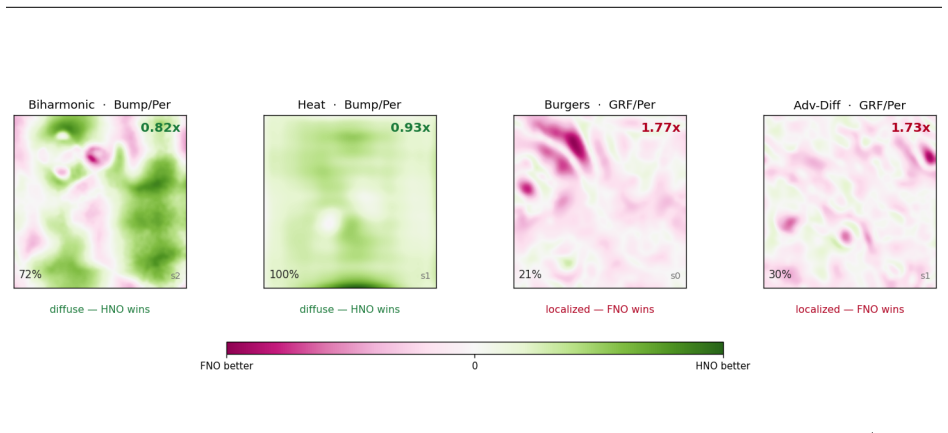
Rather than one basis always winning, the best spectral basis matches the symmetry of the solution operator: self-adjoint elliptic operators with real symmetric Green's functions favor the real Hartley multiplier, while time-dependent operators with phase favor the complex Fourier multiplier, with the advantage growing as phase content increases and the heat equation as the borderline case.
What carries the argument
Green's function alignment, the property that determines whether a real diagonal multiplier (Hartley) or complex multiplier (Fourier) can exactly represent the operator's action in spectral space.
If this is right
- For self-adjoint elliptic PDEs such as Poisson and biharmonic, the Hartley Neural Operator is favored.
- For time-dependent PDEs such as wave, advection, Burgers, and Navier-Stokes, the Fourier Neural Operator is favored.
- The performance difference is monotone in the operator's phase content.
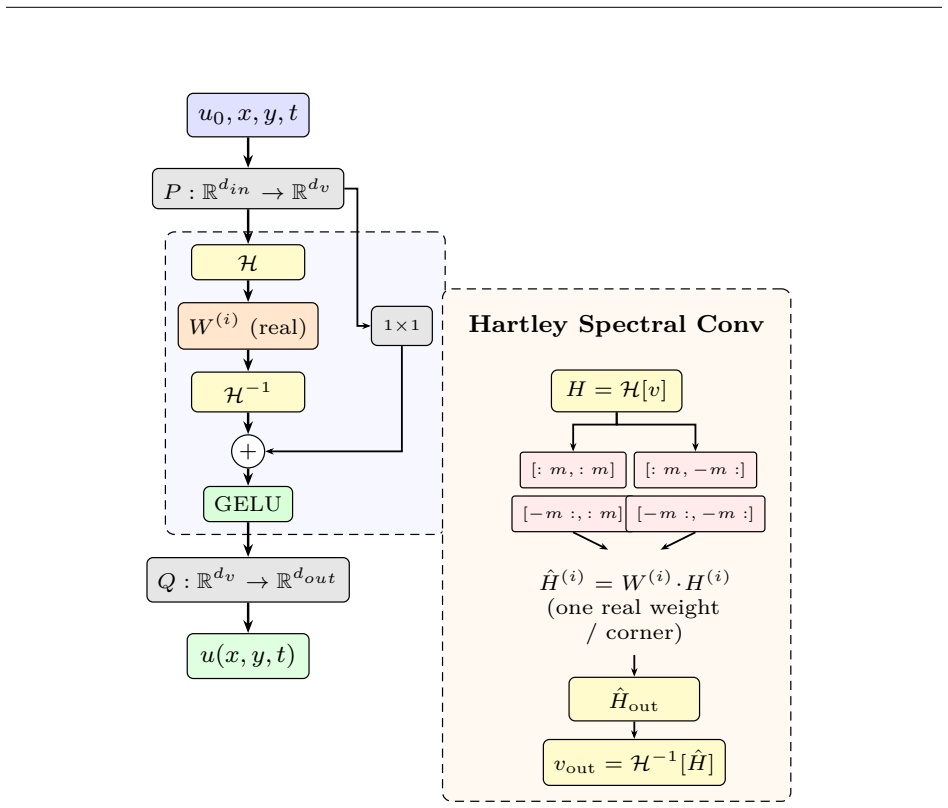
- The two operators are iso-parametric, differing only in the choice of real versus complex spectral basis.
Where Pith is reading between the lines
- Designers of new neural operator variants could use Green's function symmetry as a design criterion when selecting transforms.
- Extending the comparison to operators with mixed elliptic and hyperbolic character could test the boundaries of the predictive rule.
- The theory suggests that for purely real-valued problems without phase, real bases avoid unnecessary conjugate symmetry overhead.
Load-bearing premise
The observed performance differences across PDE classes arise specifically from alignment between the Green's function and the spectral basis rather than from differences in retained modes, training, or other implementation details.
What would settle it
Training both operators on a new PDE class whose Green's function symmetry contradicts the elliptic-versus-time-dependent pattern and finding that the performance ordering does not follow the predicted rule would falsify the claim.
Figures
read the original abstract
Fourier Neural Operators (FNO) learn solution operators of partial differential equations by parameterizing global convolutions in the complex Fourier domain. For real-valued PDE solutions, the complex FFT carries representational redundancy through conjugate symmetry. We introduce the Hartley Neural Operator (HNO), the exact real-valued mirror of FNO: it replaces the FFT with the purely real Discrete Hartley Transform and learns a single real multiplier per retained spectral mode, with no complex arithmetic. Because the real Hartley spectrum is not halved by conjugate symmetry, HNO retains twice as many frequency corners as FNO but one real weight where FNO carries a complex pair, so the two operators are iso-parametric at equal width and differ only in spectral basis. Our central thesis is that the best basis is a property of the operator. Self-adjoint elliptic operators (Poisson, biharmonic) have real, symmetric Green's functions that the real Hartley multiplier diagonalizes exactly, and HNO is favored there. Time-dependent operators carry phase, from oscillation in the wave equation to transport in advection, Burgers, and Navier-Stokes, which a real diagonal multiplier cannot represent, so FNO is favored there, and increasingly so with the operator's phase content, leaving the phaseless heat equation as the borderline case. Training both operators identically and benchmarking across PDE classes, initial-condition families, and boundary conditions, we find an elliptic-versus-time-dependent split that is monotone in operator phase content and matches the Green's-function theory we develop. Rather than a universal winner, our findings give a predictive rule: match the spectral basis to the symmetry of the solution operator.
Editorial analysis
A structured set of objections, weighed in public.
Referee Report
Summary. The paper introduces the Hartley Neural Operator (HNO) as the real-valued counterpart to the Fourier Neural Operator (FNO), replacing the complex FFT with the Discrete Hartley Transform while maintaining iso-parametric equivalence at equal width. It develops a Green's function alignment theory predicting that real symmetric Green's functions of self-adjoint elliptic operators (e.g., Poisson, biharmonic) favor HNO, while phase-carrying time-dependent operators (wave, advection, Burgers, Navier-Stokes) favor FNO, with the heat equation as a borderline case. Experiments across PDE classes, initial conditions, and boundaries report an elliptic-versus-time-dependent performance split that is monotone in operator phase content and matches the pre-derived theory, yielding the rule to match spectral basis to solution-operator symmetry.
Significance. If the central claim holds under rigorous controls, the work supplies a predictive, theory-driven rule for spectral-basis selection in neural operators instead of universal preference or post-hoc tuning. The explicit iso-parametric construction, the Green's-function derivation, and the cross-class experimental confirmation are strengths that could inform architecture choices for elliptic versus evolutionary PDEs.
major comments (2)
- [§4] §4 (Experimental Setup) and the iso-parametric claim in the abstract: the statement that HNO and FNO differ only in spectral basis requires explicit confirmation that retained modes match in physical frequency content. Because HNO retains twice the frequency corners, the manuscript must document the precise wavenumber cutoffs, boundary handling, and highest retained wavenumber for each operator; without this, the reported elliptic/time-dependent split could arise from unequal effective resolution or optimization landscape rather than Green's-function alignment.
- [§3] §3 (Green's Function Alignment Theory): the claim that a real diagonal Hartley multiplier exactly diagonalizes the real symmetric Green's function for elliptic operators needs a concrete verification step (e.g., explicit matrix representation or low-dimensional example for the Poisson operator) to show that the alignment is not merely formal but accounts for the discrete transform truncation used in the neural operator.
minor comments (2)
- Figure captions and axis labels should explicitly annotate which PDEs belong to the elliptic versus time-dependent categories to make the monotone phase-content trend immediately visible.
- Notation for the number of retained modes (e.g., k_max) should be unified between the FNO and HNO descriptions to avoid any ambiguity about parameter counting.
Simulated Author's Rebuttal
We thank the referee for the careful reading and constructive comments on the iso-parametric construction and the Green's function theory. We address each major comment below and will revise the manuscript accordingly to improve clarity and rigor.
read point-by-point responses
-
Referee: [§4] §4 (Experimental Setup) and the iso-parametric claim in the abstract: the statement that HNO and FNO differ only in spectral basis requires explicit confirmation that retained modes match in physical frequency content. Because HNO retains twice the frequency corners, the manuscript must document the precise wavenumber cutoffs, boundary handling, and highest retained wavenumber for each operator; without this, the reported elliptic/time-dependent split could arise from unequal effective resolution or optimization landscape rather than Green's-function alignment.
Authors: We agree that explicit documentation is required to substantiate that the operators differ only in spectral basis. In the revised manuscript we will add to §4 a table and text specifying, for every PDE: grid resolution, number of retained modes, highest wavenumber k_max (matched across FNO and HNO so that the same physical frequencies are covered), and boundary handling (periodic in all cases). This will confirm identical effective resolution and isolate the performance differences to the choice of real versus complex basis. revision: yes
-
Referee: [§3] §3 (Green's Function Alignment Theory): the claim that a real diagonal Hartley multiplier exactly diagonalizes the real symmetric Green's function for elliptic operators needs a concrete verification step (e.g., explicit matrix representation or low-dimensional example for the Poisson operator) to show that the alignment is not merely formal but accounts for the discrete transform truncation used in the neural operator.
Authors: We agree that a concrete low-dimensional verification would strengthen the claim and address truncation concerns. In the revision we will insert into §3 an explicit 1D Poisson example: the discrete Green's function matrix on a periodic grid, its DHT representation, and the resulting real diagonal multiplier for the retained modes. This will demonstrate that the alignment holds under the same mode truncation employed by the neural operator. revision: yes
Circularity Check
No significant circularity; theory grounded in standard Green's function properties
full rationale
The paper states its central thesis directly from known properties of self-adjoint elliptic operators (real symmetric Green's functions diagonalized by real multipliers) versus phase-carrying time-dependent operators. Experiments are framed as confirmation of this pre-existing theory across PDE classes rather than the origin of any fitted prediction. The iso-parametric design (HNO vs FNO differing only in basis) is presented as an explicit construction choice, not derived from data. No self-citations, self-definitional loops, or renamings of known results appear in the abstract or described structure. The derivation chain remains self-contained against external mathematical benchmarks.
Axiom & Free-Parameter Ledger
axioms (2)
- domain assumption Self-adjoint elliptic operators have real, symmetric Green's functions that the real Hartley multiplier diagonalizes exactly
- domain assumption Time-dependent operators carry phase from oscillation or transport that a real diagonal multiplier cannot represent
invented entities (1)
-
Hartley Neural Operator (HNO)
no independent evidence
Reference graph
Works this paper leans on
-
[1]
Fourier Neural Operator for Parametric Partial Differential Equations
Fourier Neural Operator for Parametric Partial Differential Equations , author=. arXiv preprint arXiv:2010.08895 , year=
work page internal anchor Pith review Pith/arXiv arXiv 2010
-
[2]
Proceedings of the 37th International Conference on Machine Learning (ICML) , year=
Fourier Neural Operator for Parametric Partial Differential Equations , author=. Proceedings of the 37th International Conference on Machine Learning (ICML) , year=
-
[3]
Learning nonlinear operators via
Lu, Lu and Jin, Pengzhan and Pang, Guofei and Zhang, Zhongqiang and Karniadakis, George Em , journal=. Learning nonlinear operators via. 2021 , publisher=
2021
-
[4]
Neural operator: Learning maps between function spaces with applications to
Kovachki, Nikola and Li, Zongyi and Liu, Burigede and Azizzadenesheli, Kamyar and Bhattacharya, Kaushik and Stuart, Andrew and Anandkumar, Anima , journal=. Neural operator: Learning maps between function spaces with applications to
-
[5]
A comprehensive and fair comparison of two neural operators (with practical extensions) based on
Lu, Lu and Meng, Xuhui and Cai, Shengze and Mao, Zhiping and Goswami, Somdatta and Zhang, Zhongqiang and Karniadakis, George Em , journal=. A comprehensive and fair comparison of two neural operators (with practical extensions) based on. 2022 , publisher=
2022
-
[6]
IEEE Transactions on Neural Networks , volume=
Universal approximation to nonlinear operators by neural networks with arbitrary activation functions and its application to dynamical systems , author=. IEEE Transactions on Neural Networks , volume=. 1995 , publisher=
1995
-
[7]
Computer Methods in Applied Mechanics and Engineering , volume=
Wavelet neural operator for solving parametric partial differential equations in computational mechanics problems , author=. Computer Methods in Applied Mechanics and Engineering , volume=. 2022 , publisher=
2022
-
[8]
Advances in Neural Information Processing Systems , editor=
Multiwavelet-based Operator Learning for Differential Equations , author=. Advances in Neural Information Processing Systems , editor=. 2021 , url=
2021
-
[9]
, journal=
Hartley, R.V.L. , journal=. A More Symmetrical. 1942 , doi=
1942
-
[10]
Bracewell, R. N. , journal=. Discrete. 1983 , doi=
1983
-
[11]
Bracewell, R. N. , publisher=. The
-
[12]
The Regularized Fast
Jones, Keith John , edition=. The Regularized Fast. 2022 , isbn=
2022
-
[13]
IEEE Transactions on Computers , volume=
Discrete Cosine Transform , author=. IEEE Transactions on Computers , volume=
-
[14]
Communications on Pure and Applied Mathematics , volume=
Orthonormal bases of compactly supported wavelets , author=. Communications on Pure and Applied Mathematics , volume=
-
[15]
Decomposition of
Grossmann, Alex and Morlet, Jean , journal=. Decomposition of
-
[16]
1992 , publisher=
Multiresolution Signal Decomposition: Transforms, Subbands, and Wavelets , author=. 1992 , publisher=
1992
-
[17]
1994 , publisher=
A Friendly Guide to Wavelets , author=. 1994 , publisher=
1994
-
[18]
Wallace, Gregory K , journal=. The
-
[19]
Discrete-Time Signal Processing , author=
-
[20]
2007 , publisher=
Finite Difference Methods for Ordinary and Partial Differential Equations , author=. 2007 , publisher=
2007
-
[21]
2009 , publisher=
Numerical Solution of Partial Differential Equations by the Finite Element Method , author=. 2009 , publisher=
2009
-
[22]
2006 , publisher=
Spectral Methods: Fundamentals in Single Domains , author=. 2006 , publisher=
2006
-
[23]
2007 , publisher=
Partial Differential Equations: An Introduction , author=. 2007 , publisher=
2007
-
[24]
2002 , publisher=
Computational Methods for Fluid Dynamics , author=. 2002 , publisher=
2002
-
[25]
2007 , publisher=
Numerical Recipes: The Art of Scientific Computing , author=. 2007 , publisher=
2007
-
[26]
2002 , publisher=
Finite Volume Methods for Hyperbolic Problems , author=. 2002 , publisher=
2002
-
[27]
1986 , publisher=
Spatial Variation , author=. 1986 , publisher=
1986
-
[28]
Gneiting, Tilmann and Kleiber, William and Schlather, Martin , journal=. Mat\'. 2010 , doi=
2010
-
[29]
Foundations of Physics , volume=
Gaussian random fields , author=. Foundations of Physics , volume=. 1978 , doi=
1978
-
[30]
Paszke, Adam and Gross, Sam and Massa, Francisco and Lerer, Adam and Bradbury, James and Chanan, Gregory and Killeen, Trevor and Lin, Zeming and Gimelshein, Natalia and Antiga, Luca and others , journal=
-
[31]
Adam: A Method for Stochastic Optimization
Adam: A Method for Stochastic Optimization , author=. arXiv preprint arXiv:1412.6980 , year=
work page internal anchor Pith review Pith/arXiv arXiv
-
[32]
Loshchilov, Ilya and Hutter, Frank , journal=
-
[33]
Gaussian Error Linear Units (GELUs)
Hendrycks, Dan and Gimpel, Kevin , year=. Gaussian Error Linear Units (. 1606.08415 , archivePrefix=
work page internal anchor Pith review Pith/arXiv arXiv
-
[34]
Proceedings of the 25th ACM SIGKDD International Conference on Knowledge Discovery & Data Mining , pages=
Optuna: A Next-generation Hyperparameter Optimization Framework , author=. Proceedings of the 25th ACM SIGKDD International Conference on Knowledge Discovery & Data Mining , pages=. 2019 , doi=
2019
-
[35]
Pathak, Jaideep and Subramanian, Shashank and Harrington, Peter and Raja, Sanjeev and Chattopadhyay, Ashesh and Mardani, Morteza and Kurth, Thorsten and Hall, David and Li, Zongyi and Azizzadenesheli, Kamyar and Hassanzadeh, Pedram and Kashinath, Karthik and Anandkumar, Animashree , year=. 2202.11214 , archivePrefix=
work page internal anchor Pith review Pith/arXiv arXiv
-
[36]
SIAM Journal on Scientific Computing , volume=
Understanding and Mitigating Gradient Flow Pathologies in Physics-informed Neural Networks , author=. SIAM Journal on Scientific Computing , volume=. 2020 , publisher=
2020
-
[37]
Machine Learning: Science and Technology , volume=
Applications of physics informed neural operators , author=. Machine Learning: Science and Technology , volume=. 2023 , doi=
2023
-
[38]
2023 , eprint=
Physics-Informed Neural Operator for Learning Partial Differential Equations , author=. 2023 , eprint=
2023
-
[39]
Fourier, J. , year=. Th\'
-
[40]
Annalen der Physik und Chemie , volume=
Ueber Diffusion , author=. Annalen der Physik und Chemie , volume=. 1855 , doi=
-
[41]
Cavallazzi, Giorgio M. and P\'. Walsh-Hadamard Neural Operators for Solving. arXiv preprint arXiv:2511.07347 , year=
work page internal anchor Pith review Pith/arXiv arXiv
-
[42]
Raoni\'c , title =
B. Raoni\'c , title =. NeurIPS , year =
-
[43]
Wong, Ken C. L. and Wang, Hongzhi and Syeda-Mahmood, Tanveer , journal=. 2025 , doi=
2025
-
[44]
Wong, Ken C. L. and Wang, Hongzhi and Syeda-Mahmood, Tanveer , booktitle=
discussion (0)
Sign in with ORCID, Apple, or X to comment. Anyone can read and Pith papers without signing in.