REVIEW 2 major objections 8 minor 71 references
The Ebb and Flow of Multimodal Focus: Scheduling Visual Relay Windows for Grounded VLM Reasoning
T0 review · 2 major / 8 minor · reviewed 2026-08-02 · deepseek-v4-flash
Pith's one-line read Mid-depth visual relay window decides if VLM answers stay grounded
desk verdict Solid benchmark work and a genuinely new operational target, but the causal 'relay' interpretation is ahead of the evidence; referee it with a request for CIs and replication. read the letter →
The pith
A machine-rendered reading of the paper's core claim, the machinery that carries it, and where it could break.
The reading
What carries the argument
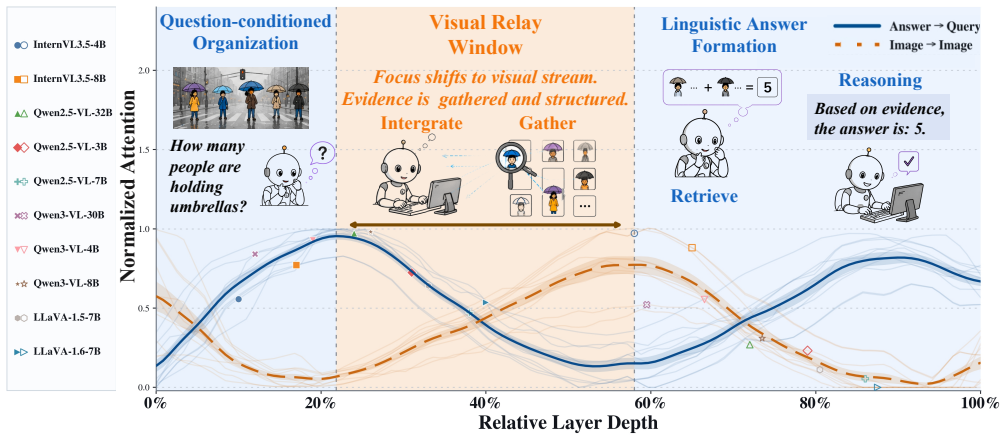
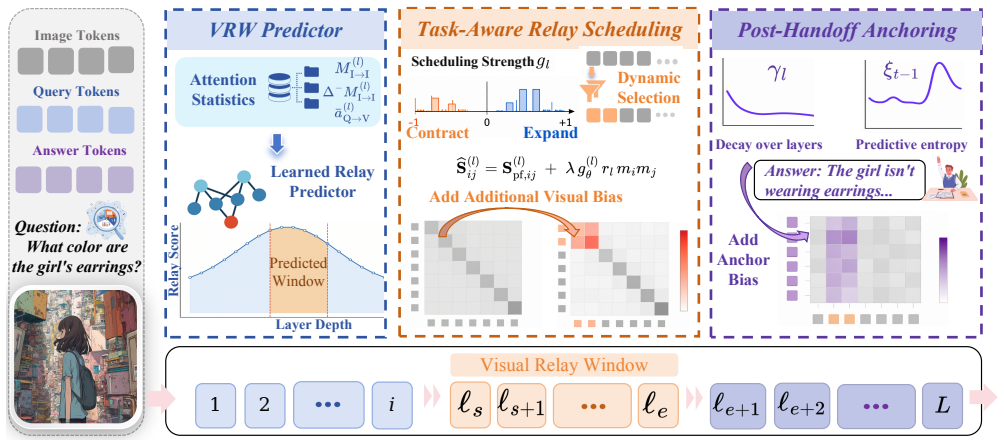
The load-bearing object is the Visual Relay Window (VRW): an estimated middle-layer segment in which image-token self-attention dominates question-directed attention, summarized by VRW-Width=(e−s+1)/L and VRW-End=e/L. The argument is carried by two attention probes—M_A→Q (answer tokens attending to question tokens) and M_I→I (image tokens attending to image tokens)—joined into R(l)=M_I→I−M_A→Q after per-sample min-max normalization. TRACE operationalizes the window with three lightweight components: a two-layer MLP predictor that reads compact prefill attention statistics; a task-aware scheduler that adds a scaled bias to visual-to-visual logits inside predicted relay layers, acting only on
What would settle it
Run the same residual-patching protocol across at least five backbones and several thousand pairs, and for each sample compare recovery rates for the estimated VRW against every possible contiguous window of the same width; if maximum recovery is not sharply concentrated at the attention-derived VRW, or if patching the estimated interval no longer beats same-width shifted controls, the causal-load-bearing claim is falsified.
Extended reading notes
Core claim
The central claim is that VLM reasoning passes through a stable three-stage redistribution of multimodal attention—early question-conditioned organization, a middle visual-dominant relay, late answer formation—and that the middle interval, operationalized as the Visual Relay Window (VRW), is where visual evidence is assembled. The authors define the VRW from two attention probes: answer-to-question attention and image-to-image attention, combined into a relay-dominance score R(l) = M_I→I − M_A→Q after min-max normalization, with the peak sought within relative depth [0.2, 0.8] and a tolerance margin of 0.1. They establish causality by residual patching: replacing visual-token residual activa
Load-bearing premise
The whole structure is read through attention-mass probes, and the causal bridge rests on a single patching study (one 4-billion-parameter model, 200 image-question pairs, five decodes each); if attention mass is not where the functionally critical evidence assembly happens, the relay window is a correlate rather than the control point, even if the benchmark gains hold.
Editorial extensions
If this is right
- If the VRW is causally load-bearing, hallucination is not only a decoding-stage failure; it can originate in a mid-depth evidence-assembly phase, so interventions should target prefill and middle layers rather than only the final output distribution.
- Because TRACE adds only roughly 300 thousand parameters on frozen backbones, the claimed gains are portable across VLM families without retraining the base model.
- Since relay geometry adapts to task demand, a single control mechanism can expand the relay for grounding-sensitive tasks and contract it for reasoning-heavy tasks, unifying hallucination mitigation and reasoning improvement.
- The Instruct-versus-Thinking comparison suggests that 'thinking' training improves groundedness partly through better relay matching and stronger post-handoff anchoring, giving a concrete mechanistic target for future training or fine-tuning.
- VRW statistics—width, end depth, and post-handoff anchor strength—could serve as internal diagnostics for when a model is about to produce an unsupported answer.
Reading between the lines
- The relay pattern resembles evidence-accumulation stage models from cognitive psychology: the VRW behaves like an internal evidence-integration phase, and TRACE like a timing controller; a testable extension is to compare VRW geometry with confidence or response-time patterns across tasks.
- The paper's own limitation statement notes that the analysis relies on attention-derived probes; a natural check is to re-estimate the VRW using causal or activation-based importance measures and ask whether the attention-defined interval coincides with the functionally critical span.
- Because VRW geometry shifts with task demand, the learned predictor could double as a lightweight task classifier, or be extended to schedule relay per token or per segment in long-form, multi-image, or video settings where the current single-image assumption breaks.
- If the patching result generalizes beyond one backbone and 200 pairs, the VRW could become a training objective—rewarding models for matching task-typical relay geometry—rather than only an inference-time control target.
Editorial analysis
A structured set of objections, weighed in public.
Referee Report
Summary. The paper investigates the internal dynamics of vision-language models (VLMs) and claims to identify a stable three-stage pattern of attention allocation across depth, with a critical middle 'Visual Relay Window' (VRW) where visual attention dominates. It operationalizes the VRW via attention probes (Answer→Query and Image→Image), shows task-dependent geometry, and presents a causal patching study on Qwen3-VL-4B suggesting that the VRW is the functionally important interval for grounded generation. Based on this, the authors propose TRACE, a lightweight inference-time controller that predicts and reshapes the relay window during prefill and anchors selected visual tokens after handoff. Across four open-weight VLMs (Qwen3-VL 4B/8B, InternVL3.5 4B/8B) and seven benchmarks, TRACE reports improved grounding-sensitive settings by 4.33 points on average and reasoning-heavy tasks by 3.05 points, with total trainable parameters under 300k.
Significance. If the mechanistic and causal claims are correct, the paper offers a unified explanation for hallucination and reasoning failures in VLMs and a practical, lightweight intervention. The empirical contribution is strong: the headline averages in Table 4 are reproducible, the method is simple and efficient, and the paper includes extensive robustness checks (Table 9), component ablations (Table 7), and hyperparameter sensitivity (Table 8). The analysis of relay structure across ten checkpoints is a useful descriptive result. However, the causal claim that the attention-defined VRW is the load-bearing interval for grounded generation currently rests on a single patching experiment on one backbone with a small sample and no confidence intervals, and the VRW is estimated in a way that is partially self-referential. The benchmark gains may well survive even if the mechanistic interpretation is not fully established, but the paper's central narrative depends on that interpretation.
major comments (2)
- [§3.5, Table 2] The causal claim that the VRW is functionally important for grounded generation is not fully supported. The patching study estimates the VRW from the grounded (source) branch's attention via Eq. (4), then patches that interval into the unsupported branch. Thus the patched interval is, by construction, the interval of maximal visual dominance in the source branch; replacing residual states there is expected to have the largest effect on any branch-specific information, not necessarily on visual evidence assembly. The same-width shifted controls are still defined relative to the source branch's peak, so they do not break this circularity. In addition, the experiment uses one backbone, 200 HaloQuest pairs, and 5 decodes per pair, and the recovery rate of 41.4% is reported without confidence intervals or a significance test against the 27.6% average of shifted windows. The paper's own limita
- [§3.3 and §3.8] The VRW definition (Eqs. 4–7) is used both to generate the pseudo-labels for the TRACE relay predictor (Eq. 13) and to evaluate whether TRACE produces the intended internal shifts (Figure 6, Table 3). Consequently, the training and evaluation of TRACE are tied to the same attention-based operationalization of the "relay." This does not invalidate the measured benchmark gains—which may reflect genuine improvements—but it means the mechanistic interpretation ("scheduling the VRW") is not uniquely identified. The generic-controller ablation (Table 6) helps, but it does not settle whether the gains come from the VRW structure per se or from a learned input-dependent attention bias. I recommend testing whether TRACE's gains are robust to alternative VRW definitions (different δ, search range, or even a window defined by an independent activation-based method), and softening the mechanistic la
minor comments (8)
- [Table 2 caption] The caption contains a garbled byte sequence (the long "/uni..." string). This appears to be an encoding artifact and should be fixed.
- [Author line] "Wencheng Y e" appears to have an erroneous space; it should likely be "Wencheng Ye".
- [§3.4] "one-way ANOV A" has a stray space; should be "ANOVA".
- [Table 4] The "A verage" rows and the presence of "HallusionBench (Guan et al., 2024)" inside table body cells are formatting artifacts that should be cleaned up.
- [§4.5, Table 8] Hyperparameters p, τ_r, and λ_anchor appear to be selected by sweeping on the same benchmarks that are used for the main results. Please clarify whether a separate validation set was used; if not, discuss the potential for selection bias.
- [§3.5] The paper does not report the number of unsupported branches used in the patching study. Please include the denominator for the recovery rates.
- [Eq. (13)] BCE is used but not explicitly defined; please spell it out (binary cross-entropy) and define the formula.
- [Figure 1] The caption says "ten open VLMs" but the text does not enumerate them. A list of the ten checkpoints would be helpful.
Circularity Check
No significant circularity: the VRW is an attention-derived operational measure, the causal claims are tested with external behavioral outcomes and controls, and benchmark gains are external to the definition.
full rationale
The central constructs are defined before any correctness labels are used. The VRW is formally defined in Eqs. 4-8 solely from attention probes (M_I->I and M_A->Q), and the grounded/unsupported comparison in Fig. 4 is an empirical correlation between that measure and HaloQuest correctness, not a definitional identity. The causal patching study (Table 2) intervenes on visual-token residual activations at the estimated window and uses pre-relay, post-relay, and same-width shifted controls; recovery is measured on an external behavioral criterion, so the causal claim is not forced by construction. TRACE's benchmark gains come from external benchmarks, and the learned relay predictor is a control-target proxy rather than a fitted prediction of those outcomes. No load-bearing self-citations or imported uniqueness theorems are present. Section 5 does acknowledge the limitation that the analysis relies primarily on attention-derived probes, which is a validity concern, not a circularity: the paper's own evidence does not reduce to its inputs by construction.
Assumptions & free parameters
free parameters (9)
- VRW tolerance margin delta =
0.1
- VRW middle search range =
rho in [0.2, 0.8]
- Support ratio p =
0.3
- Relay-exit threshold tau_r =
0.7
- Anchoring loss weight lambda_anchor =
0.05
- Prefill scheduling scale lambda =
0.6
- Gate sharpness alpha / operating point beta =
13 / 0.5
- Anchor decay gamma0, kappa =
0.4 / 2.0
- Entropy threshold eta / smoothing mu =
0.7 / 0.15
assumptions (6)
- domain assumption Attention mass is a faithful functional proxy for evidence assembly in VLMs (the probes M_A->Q and M_I->I in Eqs. 2-3 capture what computation does).
- domain assumption Residual-stream patching of visual-token activations transfers 'groundedness' cleanly from source to target branch without introducing confounds.
- domain assumption Grounded and unsupported branches are comparable at aligned token positions t >= t_div after divergence.
- domain assumption The four task families (detail-heavy perception, recognition, relation/spatial, high-level reasoning) exhaust the evidence-demand structure.
- domain assumption HaloQuest correctness labels validly define 'grounded' for the correlation and causal analyses.
- domain assumption Training on 20k FineVision samples (with benchmark-overlapping data excluded) teaches task-adaptive relay scheduling that generalizes to the seven evaluation benchmarks.
invented entities (1)
-
Visual Relay Window (VRW)
independent evidence
Cite this review
Pith. "Pith review of The Ebb and Flow of Multimodal Focus: Scheduling Visual Relay Windows for Grounded VLM Reasoning." pith.science (2026). https://pith.science/paper/SBEKSNTK
@misc{pith2026260711436,
  author       = {Pith},
  title        = {Pith review of: The Ebb and Flow of Multimodal Focus: Scheduling Visual Relay Windows for Grounded VLM Reasoning},
  year         = {2026},
  howpublished = {\url{https://pith.science/paper/SBEKSNTK}},
  note         = {Machine review of arXiv:2607.11436}
}
read the original abstract
Vision-language models increasingly succeed on multimodal reasoning benchmarks, yet their visual evidence often becomes unstable once it enters the language stack, weakening evidence-grounded reasoning. To understand this fragility, we examine the internal dynamics of VLMs through a mechanistic lens and uncover a stable three-stage redistribution of multimodal attention focus across depth: an early question-conditioned organization, a critical middle visual-dominant relay, and a late return to answer formation. We operationalize the middle phase as the Visual Relay Window (VRW), and show that its geometry varies with task demand, is causally tied to grounded generation, and distinguishes unsupported answers from stronger reasoning trajectories. Guided by this internal rhythm, we propose TRACE, a task-adaptive inference-time control framework with lightweight trained modules. It reshapes relay allocation during prefill and preserves assembled visual support after handoff during decoding. Across four open-weight VLM backbones and seven benchmarks, TRACE delivers large gains on grounding-sensitive settings, improving them by 4.33 points on average and by up to 6.6 points, while also improving reasoning-heavy tasks. These results show that explicitly controlling multimodal focus across depth offers a unified and effective mechanism for strengthening evidence-grounded multimodal reasoning.
Figures


Figures from the paper (3 more)


Reference graph
Works this paper leans on
-
[1]
2026 , eprint=
FineVision: Open Data Is All You Need , author=. 2026 , eprint=
2026
-
[2]
Findings of the Association for Computational Linguistics: ACL 2025 , pages=
Llamav-o1: Rethinking step-by-step visual reasoning in llms , author=. Findings of the Association for Computational Linguistics: ACL 2025 , pages=
2025
-
[3]
Proceedings of the IEEE/CVF Conference on Computer Vision and Pattern Recognition , pages=
When visualizing is the first step to reasoning: Mira, a benchmark for visual chain-of-thought , author=. Proceedings of the IEEE/CVF Conference on Computer Vision and Pattern Recognition , pages=
-
[4]
International Conference on Learning Representations , volume=
Mathvista: Evaluating mathematical reasoning of foundation models in visual contexts , author=. International Conference on Learning Representations , volume=
-
[5]
arXiv preprint arXiv:2404.18930 , year=
Hallucination of multimodal large language models: A survey , author=. arXiv preprint arXiv:2404.18930 , year=
-
[6]
arXiv preprint arXiv:2402.00253 , year=
A survey on hallucination in large vision-language models , author=. arXiv preprint arXiv:2402.00253 , year=
-
[7]
Journal of Computing and Information Science in Engineering , volume=
Designqa: A multimodal benchmark for evaluating large language models’ understanding of engineering documentation , author=. Journal of Computing and Information Science in Engineering , volume=. 2025 , publisher=
2025
-
[8]
arXiv preprint arXiv:2509.11986 , volume=
Lost in embeddings: Information loss in vision-language models , author=. arXiv preprint arXiv:2509.11986 , volume=
Show all 71 references
-
[9]
Findings of the association for computational linguistics: emnlp 2024 , pages=
Difficult task yes but simple task no: Unveiling the laziness in multimodal LLMs , author=. Findings of the association for computational linguistics: emnlp 2024 , pages=
2024
-
[10]
Annual review of vision science , volume=
Scene perception in the human brain , author=. Annual review of vision science , volume=. 2019 , publisher=
2019
-
[11]
Computational brain & behavior , volume=
The discovery and interpretation of evidence accumulation stages , author=. Computational brain & behavior , volume=. 2021 , publisher=
2021
-
[12]
2025 , eprint=
Qwen2.5 Technical Report , author=. 2025 , eprint=
2025
-
[13]
arXiv preprint arXiv:2501.02189 , volume=
Benchmark evaluations, applications, and challenges of large vision language models: A survey , author=. arXiv preprint arXiv:2501.02189 , volume=
-
[14]
Proceedings of the IEEE/CVF Conference on Computer Vision and Pattern Recognition , pages=
Circuit tracing in vision-language models: Understanding the internal mechanisms of multimodal thinking , author=. Proceedings of the IEEE/CVF Conference on Computer Vision and Pattern Recognition , pages=
-
[15]
European Conference on Computer Vision , pages=
Haloquest: A visual hallucination dataset for advancing multimodal reasoning , author=. European Conference on Computer Vision , pages=. 2024 , organization=
2024
-
[16]
arXiv preprint arXiv:2601.06521 , year=
BabyVision: Visual Reasoning Beyond Language , author=. arXiv preprint arXiv:2601.06521 , year=
-
[17]
Proceedings of the IEEE/CVF conference on computer vision and pattern recognition , pages=
Mmmu: A massive multi-discipline multimodal understanding and reasoning benchmark for expert agi , author=. Proceedings of the IEEE/CVF conference on computer vision and pattern recognition , pages=
-
[18]
arXiv preprint arXiv:2503.03321 , year=
See what you are told: Visual attention sink in large multimodal models , author=. arXiv preprint arXiv:2503.03321 , year=
-
[19]
Proceedings of the 2025 Conference on Empirical Methods in Natural Language Processing , pages=
Sharp: Steering hallucination in lvlms via representation engineering , author=. Proceedings of the 2025 Conference on Empirical Methods in Natural Language Processing , pages=
2025
-
[20]
European Conference on Computer Vision , pages=
Paying more attention to image: A training-free method for alleviating hallucination in lvlms , author=. European Conference on Computer Vision , pages=. 2024 , organization=
2024
-
[21]
Advances in neural information processing systems , volume=
Chain-of-thought prompting elicits reasoning in large language models , author=. Advances in neural information processing systems , volume=
-
[22]
arXiv preprint arXiv:2203.11171 , year=
Self-consistency improves chain of thought reasoning in language models , author=. arXiv preprint arXiv:2203.11171 , year=
-
[23]
Advances in Neural Information Processing Systems , volume=
Countgd: Multi-modal open-world counting , author=. Advances in Neural Information Processing Systems , volume=
-
[24]
Proceedings of the Asian Conference on Computer Vision , pages=
Vision language models are blind , author=. Proceedings of the Asian Conference on Computer Vision , pages=
-
[25]
Proceedings of the IEEE/CVF conference on computer vision and pattern recognition , pages=
Hallusionbench: an advanced diagnostic suite for entangled language hallucination and visual illusion in large vision-language models , author=. Proceedings of the IEEE/CVF conference on computer vision and pattern recognition , pages=
-
[26]
Grok-1.5 Vision Preview: Connecting the Digital and Physical Worlds with Our First Multimodal Model , year =
-
[27]
Findings of the association for computational linguistics: ACL 2022 , pages=
Chartqa: A benchmark for question answering about charts with visual and logical reasoning , author=. Findings of the association for computational linguistics: ACL 2022 , pages=
2022
-
[28]
Proceedings of the IEEE/CVF winter conference on applications of computer vision , pages=
Docvqa: A dataset for vqa on document images , author=. Proceedings of the IEEE/CVF winter conference on applications of computer vision , pages=
-
[29]
Proceedings of the IEEE/CVF conference on computer vision and pattern recognition , pages=
Improved baselines with visual instruction tuning , author=. Proceedings of the IEEE/CVF conference on computer vision and pattern recognition , pages=
-
[30]
5: Advancing open-source multimodal models in versatility, reasoning, and efficiency , author=
Internvl3. 5: Advancing open-source multimodal models in versatility, reasoning, and efficiency , author=. arXiv preprint arXiv:2508.18265 , year=
-
[31]
IEEE transactions on pattern analysis and machine intelligence , volume=
Vision-language models for vision tasks: A survey , author=. IEEE transactions on pattern analysis and machine intelligence , volume=. 2024 , publisher=
2024
-
[32]
Findings of the Association for Computational Linguistics: EMNLP 2025 , pages=
SteerVLM: Robust Model Control through Lightweight Activation Steering for Vision Language Models , author=. Findings of the Association for Computational Linguistics: EMNLP 2025 , pages=
2025
-
[33]
arXiv preprint arXiv:2511.21631 , year=
Qwen3-vl technical report , author=. arXiv preprint arXiv:2511.21631 , year=
-
[34]
Proceedings of the IEEE/CVF Conference on Computer Vision and Pattern Recognition , pages=
Diagnosing and Repairing Unsafe Channels in Vision-Language Models via Causal Discovery and Dual-Modal Safety Subspace Projection , author=. Proceedings of the IEEE/CVF Conference on Computer Vision and Pattern Recognition , pages=
-
[35]
arXiv preprint arXiv:2601.05547 , year=
VIB-Probe: Detecting and Mitigating Hallucinations in Vision-Language Models via Variational Information Bottleneck , author=. arXiv preprint arXiv:2601.05547 , year=
-
[36]
Proceedings of the IEEE/CVF International Conference on Computer Vision , pages=
AVAM: a Universal Training-free Adaptive Visual Anchoring Embedded into Multimodal Large Language Model for Multi-image Question Answering , author=. Proceedings of the IEEE/CVF International Conference on Computer Vision , pages=
-
[37]
arXiv preprint arXiv:2605.18359 , year=
RAVE: Re-Allocating Visual Attention in Large Multimodal Models , author=. arXiv preprint arXiv:2605.18359 , year=
-
[38]
Proceedings of the IEEE/CVF Conference on Computer Vision and Pattern Recognition , pages=
Prefill-Time Intervention for Mitigating Hallucination in Large Vision-Language Models , author=. Proceedings of the IEEE/CVF Conference on Computer Vision and Pattern Recognition , pages=
-
[39]
Advances in neural information processing systems , volume=
Visual instruction tuning , author=. Advances in neural information processing systems , volume=
-
[40]
International Journal on Digital Libraries , volume=
Scienceqa: A novel resource for question answering on scholarly articles , author=. International Journal on Digital Libraries , volume=. 2022 , publisher=
2022
-
[41]
Language Resources and Evaluation , volume=
Ai2d-rst , author=. Language Resources and Evaluation , volume=. 2021 , publisher=
2021
-
[42]
Proceedings of the 33rd ACM International Conference on Multimedia , pages=
Vqa2: visual question answering for video quality assessment , author=. Proceedings of the 33rd ACM International Conference on Multimedia , pages=
-
[43]
International journal of computer vision , volume=
Visual genome: Connecting language and vision using crowdsourced dense image annotations , author=. International journal of computer vision , volume=. 2017 , publisher=
2017
-
[44]
Proceedings of the IEEE international conference on computer vision , pages=
Vqa: Visual question answering , author=. Proceedings of the IEEE international conference on computer vision , pages=
-
[45]
5-coder technical report , author=
Qwen2. 5-coder technical report , author=. arXiv preprint arXiv:2409.12186 , year=
-
[46]
Advances in neural information processing systems , volume=
Learn to explain: Multimodal reasoning via thought chains for science question answering , author=. Advances in neural information processing systems , volume=
-
[47]
The Fourteenth International Conference on Learning Representations , year=
Dynamic Multimodal Activation Steering for Hallucination Mitigation in Large Vision-Language Models , author=. The Fourteenth International Conference on Learning Representations , year=
-
[48]
Proceedings of the AAAI Conference on Artificial Intelligence , volume=
RFI: Rectified Flow Intervention for Mitigating Object Hallucination in Large Vision-Language Models , author=. Proceedings of the AAAI Conference on Artificial Intelligence , volume=
-
[49]
Proceedings of the ACM on Web Conference 2025 , pages=
Adaptive activation steering: A tuning-free llm truthfulness improvement method for diverse hallucinations categories , author=. Proceedings of the ACM on Web Conference 2025 , pages=
2025
-
[50]
Proceedings of the 63rd Annual Meeting of the Association for Computational Linguistics (Volume 1: Long Papers) , pages=
Activation steering decoding: Mitigating hallucination in large vision-language models through bidirectional hidden state intervention , author=. Proceedings of the 63rd Annual Meeting of the Association for Computational Linguistics (Volume 1: Long Papers) , pages=
-
[51]
International Conference on Learning Representations , volume=
Reducing hallucinations in large vision-language models via latent space steering , author=. International Conference on Learning Representations , volume=
-
[52]
arXiv preprint arXiv:2602.04268 , year=
KVSmooth: Mitigating Hallucination in Multi-modal Large Language Models through Key-Value Smoothing , author=. arXiv preprint arXiv:2602.04268 , year=
-
[53]
arXiv preprint arXiv:2506.08391 , year=
Second: Mitigating perceptual hallucination in vision-language models via selective and contrastive decoding , author=. arXiv preprint arXiv:2506.08391 , year=
-
[54]
arXiv e-prints , pages=
Mitigating object hallucination in large vision-language models via classifier-free guidance , author=. arXiv e-prints , pages=
-
[55]
Proceedings of the IEEE/CVF Conference on Computer Vision and Pattern Recognition , pages=
Mitigating object hallucinations in large vision-language models through visual contrastive decoding , author=. Proceedings of the IEEE/CVF Conference on Computer Vision and Pattern Recognition , pages=
-
[56]
Vocabulary Fixation Reveals Visual Attention Sink for Hallucination Mitigation in LVLMs , author=
-
[57]
arXiv preprint arXiv:2411.09968 , year=
Seeing clearly by layer two: Enhancing attention heads to alleviate hallucination in lvlms , author=. arXiv preprint arXiv:2411.09968 , year=
-
[58]
Proceedings of the 63rd Annual Meeting of the Association for Computational Linguistics (Volume 1: Long Papers) , pages=
Response Wide Shut? Surprising Observations in Basic Vision Language Model Capabilities , author=. Proceedings of the 63rd Annual Meeting of the Association for Computational Linguistics (Volume 1: Long Papers) , pages=
-
[59]
arXiv preprint arXiv:2601.09954 , year=
The Spatial Blindspot of Vision-Language Models , author=. arXiv preprint arXiv:2601.09954 , year=
-
[60]
arXiv preprint arXiv:2605.05668 , year=
Large vision-language models get lost in attention , author=. arXiv preprint arXiv:2605.05668 , year=
-
[61]
arXiv preprint arXiv:2602.07025 , year=
The Geometry of Representational Failures in Vision Language Models , author=. arXiv preprint arXiv:2602.07025 , year=
-
[62]
From redundancy to relevance: Information flow in lvlms across reasoning tasks , author=. Proceedings of the 2025 Conference of the Nations of the Americas Chapter of the Association for Computational Linguistics: Human Language Technologies (Volume 1: Long Papers) , pages=
2025
-
[63]
Advances in Neural Information Processing Systems , volume=
Understanding information storage and transfer in multi-modal large language models , author=. Advances in Neural Information Processing Systems , volume=
-
[64]
Proceedings of the AAAI Conference on Artificial Intelligence , volume=
Causal tracing of object representations in large vision language models: Mechanistic interpretability and hallucination mitigation , author=. Proceedings of the AAAI Conference on Artificial Intelligence , volume=
-
[65]
Winter Conference on Applications of Computer Vision 2026 , year=
FG-TRACER: Tracing Information Flow in Multimodal Large Language Models in Free-Form Generation , author=. Winter Conference on Applications of Computer Vision 2026 , year=
2026
-
[66]
Proceedings of the IEEE/CVF Conference on Computer Vision and Pattern Recognition , pages=
Devils in middle layers of large vision-language models: Interpreting, detecting and mitigating object hallucinations via attention lens , author=. Proceedings of the IEEE/CVF Conference on Computer Vision and Pattern Recognition , pages=
-
[67]
Proceedings of the Computer Vision and Pattern Recognition Conference , pages=
What's in the Image? A Deep-Dive into the Vision of Vision Language Models , author=. Proceedings of the Computer Vision and Pattern Recognition Conference , pages=
-
[68]
Proceedings of the Computer Vision and Pattern Recognition Conference , pages=
Cross-modal information flow in multimodal large language models , author=. Proceedings of the Computer Vision and Pattern Recognition Conference , pages=
-
[69]
Process-then-Retrieve: A Mechanistic Study of Cross-Modal Alignment in Vision-Language Models , author=
-
[70]
Proceedings of the 62nd Annual Meeting of the Association for Computational Linguistics (Volume 1: Long Papers) , pages=
Investigating and mitigating the multimodal hallucination snowballing in large vision-language models , author=. Proceedings of the 62nd Annual Meeting of the Association for Computational Linguistics (Volume 1: Long Papers) , pages=
-
[71]
Advances in Neural Information Processing Systems , volume=
More thinking, less seeing? assessing amplified hallucination in multimodal reasoning models , author=. Advances in Neural Information Processing Systems , volume=
Reviewed August 2, 2026 · model on record in the stance chip above.
Discussion (0). Continue with ORCID to comment.