REVIEW 4 major objections 5 minor 41 references
Language Models Coupled with Metacognition Can Outperform Reasoning Models
T0 review · 4 major / 5 minor · reviewed 2026-08-15 · deepseek-v4-flash
Pith's one-line read A training-free metacognitive feedback loop lets a fast LLM match or beat a dedicated reasoning model on graph coloring and code debugging while using less time.
desk verdict Plausible hybrid architecture with a genuinely useful domain-contrast finding, but the headline accuracy claim is undercut by an undefined treatment of unsolvable graph instances and post-hoc configuration picking. read the letter →
The pith
A machine-rendered reading of the paper's core claim, the machinery that carries it, and where it could break.
The reading
What carries the argument
The load-bearing mechanism is the metacognitive governance module (MC) interposed between the System-1 LLM and the System-2 LRM. MC computes a correctness score—fraction of properly colored edges or test pass ratio—turns the specific failures into feedback, and re-prompts the LLM for up to T iterations, tracking stagnation and storing the episode in memory. When the LLM loop fails, MC invokes the LRM with one of three prompt levels: problem-only, best LLM attempt, or full feedback history. The same module, without model fine-tuning, applies to both domains; only the evaluation and feedback-generation pieces are domain-specific.
What would settle it
Run SOFAI-LM and the standalone LRM on the same set of known-unsolvable graph instances with 5-25 vertices and count how often each emits exactly 'NOT SOLVABLE' rather than an invalid coloring; if the pipeline is not reliably correct on those instances, the claimed advantage over the LRM applies only to the solvable subset and the decision-problem claim fails.
Extended reading notes
Core claim
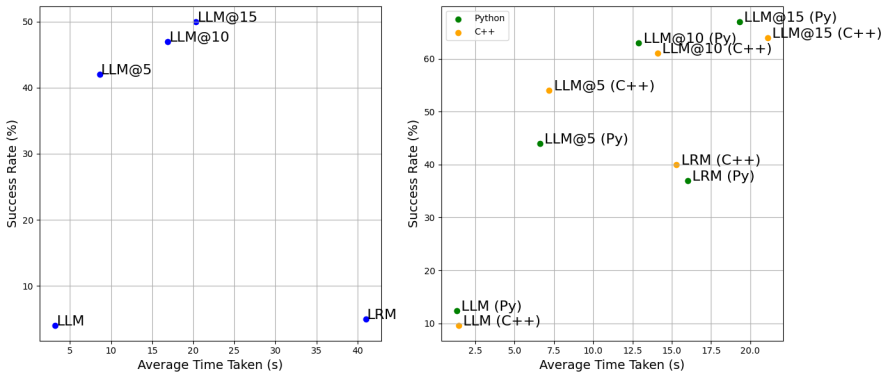
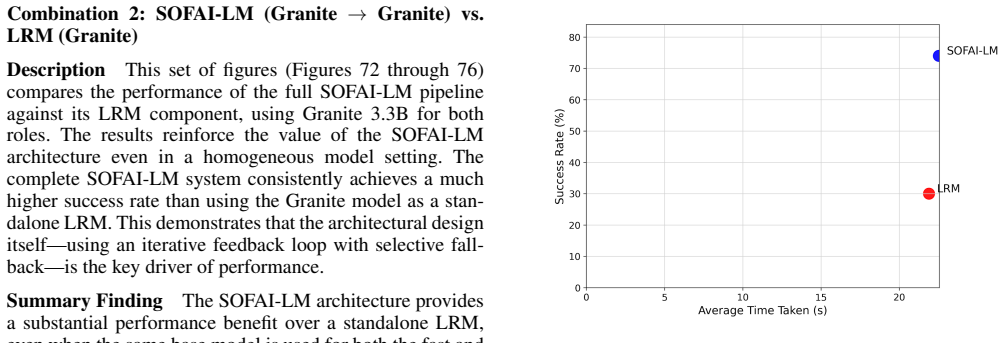
SOFAI-LM's central claim is that a metacognitive controller can make a fast LLM surpass a standalone reasoning model on two contrasting reasoning tasks. The controller evaluates each candidate answer with a domain-specific correctness function, generates iterative feedback (structured multi-line feedback or compressed single-line feedback, plus adaptive subproblems), stores a limited episodic memory, and after a fixed number of iterations decides whether to invoke the slower LRM. In the paper's head-to-head comparison, the complete pipeline solves 70% of Python and 73% of C++ debugging problems while taking less time, versus 37% and 40% for the standalone LRM; on size-25 graph coloring it solves 42% versus 2%. The authors also report that feedback format changes outcomes: multi-line feedback beats single-line feedback and minimal memory beats extended history, and that passing failed-attempt history to the LRM helps in code debugging but hurts in graph coloring.
Load-bearing premise
The load-bearing premise is that the graph-coloring correctness score—the fraction of properly colored edges—adequately captures success on the decision problem, even though the paper never specifies how a 'NOT SOLVABLE' answer is scored and reports results only for solvable instances.
Editorial extensions
If this is right
- Increasing the number of feedback iterations (5, 10, 15) monotonically improves LLM success rate in both domains, with the largest jump at LLM@5.
- The architecture is model-agnostic: the same feedback loop raises success rates for different base LLMs, and the selective fallback outperforms multiple standalone LRMs.
- Feedback design is consequential: multi-line feedback with minimal episodic memory is the best configuration tested on graph coloring, while single-line feedback is used for debugging.
- For local-repair tasks like debugging, giving the LRM the LLM's best attempt or full history raises success; for global-consistency tasks like graph coloring, it lowers success.
- Because the slow LRM is invoked only after the LLM loop fails, average inference cost per solved instance can fall even while accuracy rises.
Reading between the lines
- An implication not developed in the paper: the same architecture could be applied to any domain with an external verifier that can name concrete failures—formal proof checking, constraint satisfaction, database query repair—so the feedback loop would replace task-specific fine-tuning.
- A testable extension suggested by the global/local asymmetry: measure the locality of corrections automatically and use it to choose PO versus BA/FH prompting for the fallback, potentially eliminating the need to hand-tune the strategy per domain.
- If unsolvable graph instances were scored explicitly, the graph-coloring advantage might narrow, because the correctness function currently gives no separate credit for correctly answering 'NOT SOLVABLE'; this is the main unresolved boundary of the decision-problem claim.
- The authors leave implicit that iteration count T is a cost lever: at small T the loop is cheap but may under-perform, at large T it approaches LRM-level compute; a policy that stops early on detected stagnation may be the real driver of the efficiency gain.
Signed reviews
Editorial analysis
A structured set of objections, weighed in public.
Referee Report
Summary. The paper introduces SOFAI-LM, a training-free metacognitive architecture that pairs a fast LLM (System 1) with a slower LRM (System 2) under a metacognitive governance module. The LLM iteratively refines solutions using correctness feedback from a domain-specific evaluator, optionally with episodic memory; if the LLM does not converge within a fixed number of iterations, the LRM is invoked with one of three prompting strategies (problem-only, best attempt, or full history). The authors evaluate the architecture on the graph coloring decision problem and on DebugBench (Python and C++ subsets), across multiple LLM/LRM combinations. They report that the feedback-driven LLM alone can match or exceed standalone LRMs (RQ1), that multi-line feedback with minimal memory is best in graph coloring while single-line feedback is used for code debugging (RQ2), that the value of passing LLM context to the LRM differs by domain (RQ3), and that the full SOFAI-LM pipeline outperforms standalone LRMs in both accuracy and inference time (RQ4).
Significance. If the empirical claims hold, the paper makes a practical contribution: a training-free, model-agnostic way to raise the accuracy of a fast LLM on constraint-heavy reasoning tasks while using the expensive LRM only selectively. The strengths include the use of exact verifiers for graph coloring, execution-based evaluation via the LeetCode API for code debugging, comparisons against external benchmarks (DebugBench), and ablations across multiple LLM and LRM combinations. The central claim is plausible but the supporting evidence is weakened by an undefined evaluation protocol for unsolvable graph coloring instances, post-hoc selection of feedback, memory, and prompting variants on the test sets, and inconsistent timing statements. These issues directly affect the headline RQ4 numbers, which carry the paper's main argument.
major comments (4)
- [Problem domains; Supplementary Algorithm 1] Eq. (2) defines C(y) as the fraction of properly colored edges, so a response of 'NOT SOLVABLE' cannot be assigned a score by this function. Algorithm 1 (lines 3-30) contains no branch that recognizes the 'NOT SOLVABLE' token; it always calls ParseColoring on the final response and returns a coloring. Since the Experimental Setting states that both solvable and unsolvable graph instances are generated, the RQ4 solve rates (e.g., 42% vs 2% for size 25) are ambiguous as decision-problem rates: if unsolvable instances are in the denominator, the pipeline as specified cannot solve them; if they are excluded, the claim about solving the decision problem is narrower than stated. Please specify how unsolvable instances were handled and report the success rates separately for solvable and unsolvable instances.
- [Results RQ2/RQ3/RQ4] The headline RQ4 comparison uses per-domain variants chosen from the same test sets: MLF+MEM for graph coloring (Fig. 3) and SLF+MEM for code debugging (adopted 'because of this analysis'), and LRM prompting with PO for graph coloring versus FH for code debugging (Fig. 4). No held-out validation split is described, and no significance tests or error bars are reported; with 100 graph instances per size, the RQ4 advantage could be substantially inflated by selection. Please provide a validation protocol or report how sensitive the RQ4 conclusions are to the choice of feedback, memory, and prompting variants.
- [Results RQ1 and footnote 2] The timing statements are inconsistent. The RQ1 text says 'the LRM, though faster on average, performs substantially worse on larger graph sizes,' while footnote 2 says 'iterating the use of the LLM dominates the LRM, since it can solve many more problem instances while using much less time.' These two statements cannot both be true as written. Please clarify which configuration is faster on average, and define the sense in which one configuration dominates another (e.g., Pareto dominance on success rate and time), so that the efficiency claim is unambiguous.
- [Supplementary Algorithm 1, lines 18-30] Algorithm 1 invokes all three LRM prompting variants (PO, BA, FH) on every fallback and only afterward selects a final response ('Choose final r* based on selected variant'). This contradicts the described 'selective fallback' mechanism and, if all three calls are executed, would triple the LRM inference cost. Please specify which variant is actually executed in each reported experiment and how the reported time accounts for any unused LRM calls.
minor comments (5)
- [Introduction; Experimental Setting] There are typographical errors: 'stduy' should be 'study' and 'employes' should be 'employed' (or 'employees' depending on intent).
- [Figure 5 caption] The caption says the comparison is between 'SOFAI-LM and LLM approaches,' but the comparison is actually against the LRM; the caption should refer to the LRM.
- [Supplementary Figure 6 sample prompt] The sample graph coloring prompt says 'Graph Coloring Decision Problem (< 5 colors)' and 'Use < 5 distinct colors' while the instance has k=4; the formal definition is 'at most k colors.' The phrasing should be rendered as at most 4, or equivalently less than 5, to avoid confusion.
- [Equation (2)] The numerator of Eq. (2) appears to contain a sum that is typeset as a bare 'P'; please typeset it as a summation symbol.
- [References] Several related-work references use a truncated format (e.g., 'Wei, J. e. a. 2022'), which is inconsistent with the full author lists in the main reference list; the bibliography should be unified.
Circularity Check
No circularity detected: the SOFAI-LM claims are supported by external-benchmark experiments and deterministic evaluation functions, not by self-referential definitions or fitted predictions.
full rationale
I walked the paper's claimed derivation chain. The central claims (RQ1-RQ4) are empirical comparisons on DebugBench and generated graph-coloring instances, with success measured by deterministic checkers: the graph-coloring correctness function C(y) in Eq. 2 (fraction of properly colored edges), the code-debugging pass ratio Pass(y) in Eq. 3, and measured per-instance runtime. No parameter is fitted to the comparison data and then relabeled as a prediction; the S1 and S2 models are off-the-shelf, the iteration limit T is an experimental design choice, and the feedback is generated by rule-based checkers rather than learned from the test outcomes. The SOFAI prior work is cited as architectural inspiration, but the paper does not rely on a SOFAI result to establish its own empirical outcome; the experiments are self-contained against external benchmarks. The unsolvable-instance ambiguity in the graph-coloring evaluation is a correctness or measurement concern, not a circularity concern, because no equation or fitted parameter reduces the reported solve rate to an input of the derivation. Thus no circular step is present.
Assumptions & free parameters
free parameters (5)
- Max iterations T =
5, 10, 15; full pipeline T not specified
- Feedback type (MLF vs SLF) =
MLF for graph coloring, SLF for code debugging
- Episodic memory type (MEM vs EEM) =
MEM (minimal memory)
- LRM prompting strategy (PO vs BA vs FH) =
PO for graph coloring, FH for code debugging
- Correctness threshold theta =
1.0 (implicit)
assumptions (5)
- domain assumption The fraction of properly colored edges correctly measures solution quality for graph coloring.
- domain assumption The LeetCode API's pass ratio over hidden tests correctly measures program correctness.
- domain assumption Greedy decoding with temperature 0 is a representative inference setting.
- domain assumption Random graphs with edge probabilities in [0.1,0.9] are representative of graph coloring difficulty.
- domain assumption The stagnation detection mechanism in the metacognitive module works as intended.
Cite this review
Pith. "Pith review of Language Models Coupled with Metacognition Can Outperform Reasoning Models." pith.science (2026). https://pith.science/paper/SBUVN2LM
@misc{pith2026250817959,
  author       = {Pith},
  title        = {Pith review of: Language Models Coupled with Metacognition Can Outperform Reasoning Models},
  year         = {2026},
  howpublished = {\url{https://pith.science/paper/SBUVN2LM}},
  note         = {Machine review of arXiv:2508.17959}
}
read the original abstract
Large language models (LLMs) excel in speed and adaptability across various reasoning tasks, but they often struggle when strict logic or constraint enforcement is required. In contrast, Large Reasoning Models (LRMs) are specifically designed for complex, step-by-step reasoning, although they come with significant computational costs and slower inference times. To address these trade-offs, we employ and generalize the SOFAI (Slow and Fast AI) cognitive architecture into SOFAI-LM, which coordinates a fast LLM with a slower but more powerful LRM through metacognition. The metacognitive module actively monitors the LLM's performance and provides targeted, iterative feedback with relevant examples. This enables the LLM to progressively refine its solutions without requiring the need for additional model fine-tuning. Extensive experiments on graph coloring and code debugging problems demonstrate that our feedback-driven approach significantly enhances the problem-solving capabilities of the LLM. In many instances, it achieves performance levels that match or even exceed those of standalone LRMs while requiring considerably less time. Additionally, when the LLM and feedback mechanism alone are insufficient, we engage the LRM by providing appropriate information collected during the LLM's feedback loop, tailored to the specific characteristics of the problem domain and leads to improved overall performance. Evaluations on two contrasting domains: graph coloring, requiring globally consistent solutions, and code debugging, demanding localized fixes, demonstrate that SOFAI-LM enables LLMs to match or outperform standalone LRMs in accuracy while maintaining significantly lower inference time.
Figures


Figures from the paper (64 more)




Reference graph
Works this paper leans on
-
[1]
Amizadeh, S. e. a. 2020. NeuroSAT: End-to-End SAT Solver Learning. ICLR
work page 2020
-
[2]
Besta, M. e. a. 2023. ThinkGPT: Enhancing LLM Reasoning with Chain-of-Thought Fine-Tuning. arXiv preprint arXiv:2309.02664
work page Pith review arXiv 2023
-
[3]
Booch, G.; Fabiano, F.; Horesh, L.; Kate, K.; Lenchner, J.; Linck, N.; Loreggia, A.; Murugesan, K.; Mattei, N.; and Rossi, F. e. a. 2021. Thinking fast and slow in AI. In Proceedings of the AAAI Conference on Artificial Intelligence, volume 35, 15042--15046
work page 2021
-
[4]
Brown, T. B.; Mann, B.; Ryder, N.; Subbiah, M.; Kaplan, J.; Dhariwal, P.; Neelakantan, A.; Shyam, P.; Sastry, G.; and Askell, A. e. a. 2020. Language Models are Few-Shot Learners. arXiv preprint arXiv:2005.14165
arXiv 2020
-
[5]
Chen, M.; Tworek, J.; Jun, H.; Yuan, Q.; Pinto, H. P. D. O.; Kaplan, J.; Edwards, H.; Burda, Y.; Joseph, N.; Brockman, G.; et al. 2021. Evaluating large language models trained on code. arXiv preprint arXiv:2107.03374
arXiv 2021
-
[6]
Dubey, A.; Jauhri, A.; Pandey, A.; Kadian, A.; Al-Dahle, A.; Letman, A.; Mathur, A.; Schelten, A.; Yang, A.; and Fan, A. e. a. 2024. The Llama 3 Herd of Models. CoRR
work page 2024
-
[7]
Evans, R. e. a. 2021. Making Neural Deduction Differentiable. Nature Machine Intelligence
work page 2021
-
[8]
Fabiano, F.; Ganapini, M. B.; Loreggia, A.; Mattei, N.; Murugesan, K.; Pallagani, V.; Rossi, F.; Srivastava, B.; and Venable, K. B. 2025. Thinking Fast and Slow in Human and Machine Intelligence. Commun. ACM, 68(8): 72–79
work page 2025
Show all 41 references
-
[9]
B.; Horesh, L.; Loreggia, A.; Murugesan, K.; Rossi, F.; and Srivastava, B
Fabiano, F.; Pallagani, V.; Ganapini, M. B.; Horesh, L.; Loreggia, A.; Murugesan, K.; Rossi, F.; and Srivastava, B. 2023. Plan-SOFAI: A Neuro-Symbolic Planning Architecture. In Neuro-Symbolic Learning and Reasoning in the era of Large Language Models
2023
-
[10]
B.; Campbell, M.; Fabiano, F.; Horesh, L.; Lenchner, J.; Loreggia, A.; Mattei, N.; Rossi, F.; Srivastava, B.; and Venable, K
Ganapini, M. B.; Campbell, M.; Fabiano, F.; Horesh, L.; Lenchner, J.; Loreggia, A.; Mattei, N.; Rossi, F.; Srivastava, B.; and Venable, K. B. e. a. 2022. Combining Fast and Slow Thinking for Human-like and Efficient Decisions in Constrained Environments. In NeSy, 171--185
2022
-
[11]
Guo, D.; Yang, D.; Zhang, H.; Song, J.; Zhang, R.; Xu, R.; Zhu, Q.; Ma, S.; Wang, P.; and Bi, X. e. a. 2025. Deepseek-r1: Incentivizing reasoning capability in llms via reinforcement learning. arXiv preprint arXiv:2501.12948
2025 arXiv
-
[12]
Han, J. e. a. 2023. PiVe: Prompting with iterative verification improving graph-based generative capability of LLMs. arXiv:2305.12392
2023 arXiv
-
[13]
IBM Research . 2025. Granite 3.3 8B Instruct Model Card . https://huggingface.co/ibm-granite/granite-3.3-8b-instruct. Accessed on 2025-08-01
2025
-
[14]
Jiang, Y.; Wang, Y.; Zeng, X.; Zhong, W.; Li, L.; Mi, F.; Shang, L.; Jiang, X.; Liu, Q.; and Wang, W. 2023. FollowBench: A Multi-Level Fine-Grained Constraints Following Benchmark for Large Language Models. arXiv preprint arXiv:2310.20410
2023 arXiv
-
[15]
S.; and Trick, M
Johnson, D. S.; and Trick, M. A. 1996. Cliques, coloring, and satisfiability: second DIMACS implementation challenge, October 11-13, 1993, volume 26. American Mathematical Soc
1996
-
[16]
Kahneman, D. 2011. Thinking, fast and slow. Farrar, Straus and Giroux
2011
-
[17]
Kambhampati, S. 2024. Can large language models reason and plan? Annals of the New York Academy of Sciences, 1534(1): 15--18
2024
-
[18]
S.; Reid, M.; Matsuo, Y.; and Iwasawa, Y
Kojima, T.; Gu, S. S.; Reid, M.; Matsuo, Y.; and Iwasawa, Y. 2022. Large language models are zero-shot reasoners. Advances in neural information processing systems, 35: 22199--22213
2022
-
[19]
Li, Y. e. a. 2023. Improving Factuality via Multi-Agent Debate and Self-Consistency. arXiv preprint arXiv:2305.14325
2023 arXiv
-
[20]
Lightman, A. e. a. 2023. Let's Verify Step by Step. arXiv preprint arXiv:2305.20050
2023 arXiv
-
[21]
Y.; Fu, Y.; Yang, K.; Brahman, F.; Huang, S.; Bhagavatula, C.; Ammanabrolu, P.; Choi, Y.; and Ren, X
Lin, B. Y.; Fu, Y.; Yang, K.; Brahman, F.; Huang, S.; Bhagavatula, C.; Ammanabrolu, P.; Choi, Y.; and Ren, X. 2024. Swiftsage: A generative agent with fast and slow thinking for complex interactive tasks. Advances in Neural Information Processing Systems, 36
2024
-
[22]
Madaan, A. e. a. 2023. Self-Refine: Iterative Refinement with Self-Feedback. arXiv preprint arXiv:2303.17651
2023 arXiv
-
[23]
S.; Gala, A.; Magalh \ a es, R.; Perez de Britto, F.; Dur \ a es, D.; and Novais, P
Marcondes, F. S.; Gala, A.; Magalh \ a es, R.; Perez de Britto, F.; Dur \ a es, D.; and Novais, P. 2025. Using ollama. In Natural Language Analytics with Generative Large-Language Models: A Practical Approach with Ollama and Open-Source LLMs, 23--35. Springer
2025
-
[24]
McConnell, S. 2004. Code complete. Pearson Education
2004
-
[25]
Nye, M. e. a. 2021. Show your work: Scratchpads for intermediate computation with language models. arXiv:2112.00114
2021 arXiv
-
[26]
Paranjape, A.; and Chen, X. e. a. 2023. Hindsight Chain-of-Thought Reasoning. In NeurIPS
2023
-
[27]
Paul, D. e. a. 2023. Chain-of-Verification Reduces Hallucination in LLM Reasoning. arXiv preprint arXiv:2309.11495
2023 arXiv
-
[28]
Polu, S.; and Sutskever, I. 2022. Minerva: Solving Quantitative Reasoning Problems with Language Models. arXiv preprint arXiv:2206.14858
2022 arXiv
-
[29]
Schick, T.; Dwivedi-Yu, J.; and Lazaridou, A. e. a. 2023. Toolformer: Language Models Can Teach Themselves to Use Tools. arXiv preprint arXiv:2302.04761
2023 arXiv
-
[30]
Selsam, D. e. a. 2019. Learning a SAT Solver from Single-Bit Supervision. ICML
2019
-
[31]
Shinn, N.; and Cassano, F. e. a. 2023. Reflexion: An Autonomous Agent with Dynamic Memory and Self-Reflection. arXiv preprint arXiv:2303.11366
2023 arXiv
-
[32]
Stechly, K.; Valmeekam, K.; and Kambhampati, S. 2024. On the self-verification limitations of large language models on reasoning and planning tasks. arXiv preprint arXiv:2402.08115
2024 arXiv
-
[33]
Tian, R.; Ye, Y.; Qin, Y.; Cong, X.; Lin, Y.; Pan, Y.; Wu, Y.; Haotian, H.; Weichuan, L.; and Liu, Z. e. a. 2024. DebugBench: Evaluating Debugging Capability of Large Language Models. In Findings of the Association for Computational Linguistics ACL 2024, 4173--4198
2024
-
[34]
Valmeekam, K.; Olmo, A.; Sreedharan, S.; and Kambhampati, S. 2022. Large Language Models Still Can’t Plan: A Benchmark for LLMs on Planning and Reasoning about Change. In NeurIPS 2022 Foundation Models for Decision Making Workshop
2022
-
[35]
Valmeekam, K. e. a. 2022. Large language models still can’t plan: A benchmark for LLMs on planning and reasoning about change. In NeurIPS Foundation Models for Decision Making Workshop
2022
-
[36]
Wang, X. e. a. 2022. Self-consistency improves chain-of-thought reasoning in language models. arXiv:2203.11171
2022 arXiv
-
[37]
Wei, J. e. a. 2022. Chain-of-thought prompting elicits reasoning in large language models. In NeurIPS
2022
-
[38]
Welleck, S. e. a. 2022. NaturalProofs: Formal Theorem Proving with LLMs. In ICML
2022
-
[39]
Yang, A.; Li, A.; Yang, B.; Zhang, B.; Hui, B.; Zheng, B.; Yu, B.; Gao, C.; Huang, C.; and Lv, C. e. a. 2025. Qwen3 technical report. arXiv preprint arXiv:2505.09388
2025 arXiv
-
[40]
, " * write output.state after.block = add.period write newline
ENTRY address archivePrefix author booktitle chapter edition editor eid eprint howpublished institution isbn journal key month note number organization pages publisher school series title type volume year label extra.label sort.label short.list INTEGERS output.state before.all...
-
[41]
write newline
" write newline "" before.all 'output.state := FUNCTION n.dashify 't := "" t empty not t #1 #1 substring "-" = t #1 #2 substring "--" = not "--" * t #2 global.max substring 't := t #1 #1 substring "-" = "-" * t #2 global.max substring 't := while if t #1 #1 substring * t #2 gl...
Reviewed August 15, 2026 · model on record in the stance chip above.
Discussion (0). Continue with ORCID to comment.