REVIEW 3 major objections 5 minor 2 cited by
Anisotropic electron populations in BL Lac jets: consequences for the observed emission
T0 review · 3 major / 5 minor · reviewed 2026-08-14 · deepseek-v4-flash
Pith's one-line read This paper claims that if the most energetic electrons in BL Lac jets keep small pitch angles, the observed spectrum of Mkn 421 can be fitted with the magnetic field in equipartition with the electrons, and that a hard TeV inverse-Compton…
desk verdict A useful proof-of-concept: anisotropic pitch-angle distributions can get Mkn 421 to equipartition, but the result leans entirely on the adopted theta_max(gamma) ansatz. read the letter →
The pith
A machine-rendered reading of the paper's core claim, the machinery that carries it, and where it could break.
The reading
What carries the argument
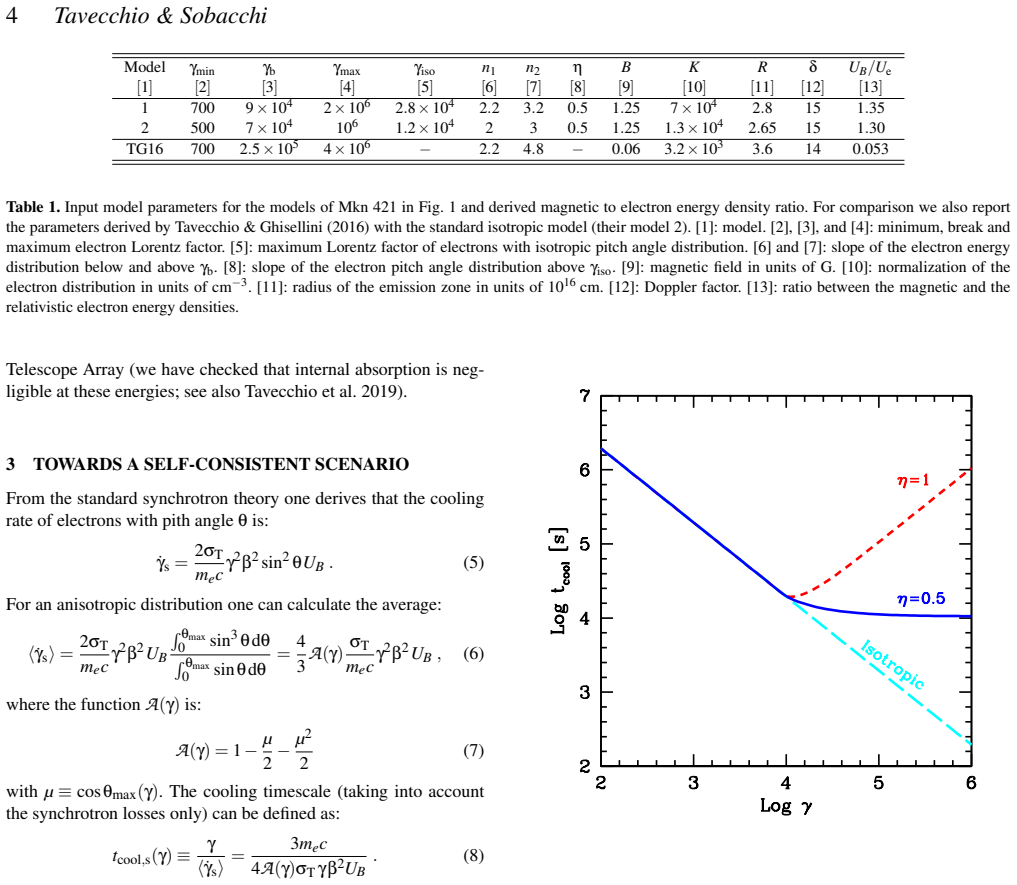
The load-bearing element is the phenomenological pitch-angle distribution of Eq. (2): electrons with Lorentz factor $\gamma$ below $\gamma_{\rm iso} \sim 10^4$ keep an isotropic distribution ($\theta_{\max} = \pi/2$), whereas above $\gamma_{\rm iso}$ their maximum pitch angle shrinks as $\theta_{\max} \propto (\gamma/\gamma_{\rm iso})^{-\eta}$. Since the local magnetic field is tangled, the electron population is locally anisotropic but globally isotropic, so only the pitch-angle-dependent synchrotron process is modified, while the inverse-Compton emissivity keeps the isotropic treatment. This energy-dependent anisotropy suppresses the synchrotron emissivity of the highest-energy electrons, shifting the synchrotron peak to the electrons at $\gamma_{\rm iso}$ while the inverse-Compton peak remains at $\gamma_{\rm b}$, and it lengthens the synchrotron cooling time above $\gamma_{\rm iso}$ by roughly $1/\theta_{\max}^2$, making the cooling time grow as $\gamma^{2\eta-1}$. The same ingredient changes the synchrotron spectral index above the frequency emitted by the $\gamma_{\rm iso}$ electrons to $\alpha = (n-1+\eta)/(2-\eta)$, which is what allows a harder electron slope $n_2 \simeq 3$ and the construction of a self-consistent cooled distribution.
What would settle it
Measure the TeV spectrum of Mkn 421 during a low state: the anisotropic model predicts a distinctly hard inverse-Compton continuum with fluxes a factor 2–3 higher at a few TeV than the standard isotropic model, so a measured spectrum as soft as the isotropic prediction would rule the mechanism out for this source.
Extended reading notes
Core claim
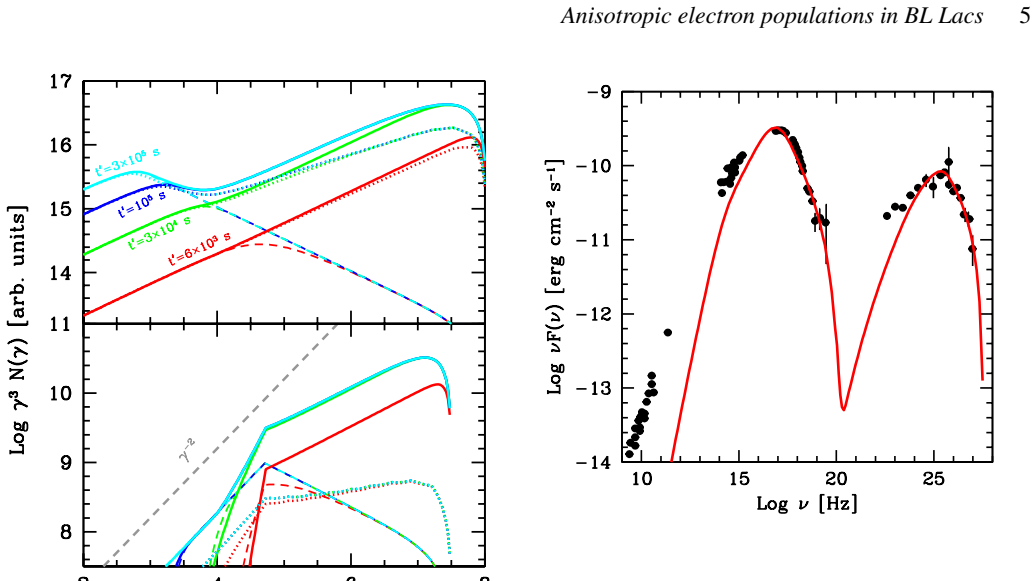
On the paper's own terms, the central discovery is that the broadband SED of Mkn 421, previously fit by the isotropic one-zone model with $B$ around 0.06 G and a magnetic-to-electron energy ratio of about 0.05, is reproduced equally well when electrons above $\gamma_{\rm iso} \sim 10^4$ have pitch angles that shrink as $\theta_{\max} \propto \gamma^{-\eta}$ with $\eta = 0.5$. In this anisotropic model the synchrotron peak is produced by electrons around $\gamma_{\rm iso}$ rather than by the same particles that make the inverse-Compton peak, the magnetic field can be raised to about 1 G, and the magnetic-to-electron energy density ratio reaches $U_B/U_e \sim 1.3$ to $2.1$, i.e. equipartition. A self-consistent cooling calculation, in which injection and radiative losses balance and synchrotron cooling is suppressed by the small pitch angles, also reproduces the SED under equipartition when inverse-Compton losses are effective around $\gamma_{\rm iso}$. The paper further claims that the anisotropic model predicts a harder SSC spectrum at very high energies, with fluxes larger by a factor of 2–3 at a few TeV, and proposes that hard spectrum as a discriminating test.
Load-bearing premise
The central claim rests on the assumed pitch-angle law $\theta_{\max} \propto \gamma^{-\eta}$ for $\gamma > \gamma_{\rm iso}$ and on the existence of a physical mechanism that maintains that anisotropy, which the paper itself says is not established.
Editorial extensions
If this is right
- BL Lac emission-site parameters shift from low magnetisation to equipartition, removing the conflict with jets launched as Poynting-dominated flows.
- The high-energy electron slope can be $n_2 \simeq 3$ with continuous injection and cooling, in place of the very soft slope $n_2 \simeq 4$ to $4.2$ required by the isotropic model.
- The smaller Doppler factor allowed by the anisotropic fits implies a larger radiation energy density in the emission site, with consequences for TeV transparency and for the multimessenger role of high-peaked BL Lacs.
- A hard, potentially detectable TeV inverse-Compton spectrum, with fluxes 2–3 times higher at a few TeV than the isotropic prediction, becomes a direct observational test.
Reading between the lines
- If the anisotropic picture is right, the same equipartition fit should work for other well-sampled high-peaked BL Lacs, so applying it to objects such as Mrk 501 and PKS 2155-304 would reveal whether equipartition is a general property of the class or a special fit for Mkn 421.
- The low-energy isotropisation invoked by the model requires a proton component, and that same baryon load may be the population responsible for BL Lac neutrino associations, connecting this SED model to high-energy neutrino detections.
- The model predicts a spectral break in the synchrotron continuum at the frequency emitted by the $\gamma_{\rm iso}$ electrons, which could be searched for in existing optical and X-ray data as a way to distinguish anisotropic from standard cooling breaks.
Signed reviews
Editorial analysis
A structured set of objections, weighed in public.
Referee Report
Summary. The paper presents a one-zone SSC model for BL Lac SEDs in which the electron momentum distribution is anisotropic, with a maximum pitch angle θmax(γ) = π/2 for γ < γiso and θmax ∝ γ^{-η} for γ > γiso, following Sobacchi & Lyubarsky (2019). The model is applied to the low-state SED of Mkn 421 in two variants: a phenomenological broken power-law electron distribution (Section 2) and a time-dependent injection-plus-cooling distribution (Section 3). The authors claim that both variants reproduce the observed SED with magnetic-to-electron energy density ratios UB/Ue ~ 1.3–2.1, i.e., near equipartition, in contrast to the standard isotropic model which requires low magnetization and low radiative efficiency. They further predict a hard inverse-Compton spectrum at TeV energies as a test of the anisotropic scenario.
Significance. If the central claim holds, the paper offers a way to reconcile one-zone SSC fits of BL Lacs with Poynting-flux-dominated jet models, addressing a long-standing tension in blazar modeling. The hard-TeV spectral prediction is falsifiable with CTA-class instruments, and the cooling-rate derivation for anisotropic electrons (Eqs. 6–8) together with the spectral slope derivation in Appendix A are useful, internally plausible technical contributions. The manuscript is also unusually honest in acknowledging its limitations, explicitly stating in Section 4 that the pitch-angle distribution is purely phenomenological and the scenario is not fully self-consistent. However, the result is a proof-of-concept: it rests on the unvalidated ansatz of Eq. (2), and the SED fits are performed by eye with a large number of free parameters, so the significance is real but conditional.
major comments (3)
- [§2, Eq. (2) and §4] The equipartition conclusion (Table 1, UB/Ue = 1.30–2.1) and the hard-TeV prediction (Fig. 2) rest entirely on the assumed functional form θmax(γ) = (π/2)(γ/γiso)^{-η} for γ > γiso, with η = 0.5 and γiso ~ 10^4. The authors themselves acknowledge in Section 4 that this choice is 'purely phenomenological' and that the scenario 'is not fully self-consistent.' Because γiso, η, and the uniform-in-cone angular distribution used in Eqs. (3) and (6) are not derived from a physical model or independently constrained, the central claim is conditional: a different θmax(γ) or a different intra-cone angular distribution could erase the equipartition result. I ask for either a physical derivation of θmax(γ) from pitch-angle scattering rates or kinetic simulations, or a sensitivity study showing how UB/Ue and the predicted TeV spectrum vary for plausible alternative forms of the ansatz.
- [§2, Fig. 1 and Table 1] The statement that the SED is 'satisfactorily reproduced' is supported only by visual inspection; no goodness-of-fit statistic, parameter uncertainties, or degeneracy analysis is provided. With roughly ten free parameters in Table 1 (γmin, γb, γmax, γiso, n1, n2, η, B, K, R, δ), the two models shown are not uniquely determined, and the derived UB/Ue values are therefore not robust. A quantitative fit, such as a chi-square or likelihood scan with confidence regions on the key parameters (at least B, K, γiso, and η), is needed to substantiate the claim that the anisotropic model achieves equipartition.
- [§3, Fig. 5] The self-consistent scenario requires IC cooling to be effective for electrons with γ ≳ γiso; the authors explicitly state in Section 4 that the Sobacchi–Lyubarsky mechanism can operate only in this case. In the numerical calculation, the IC losses are computed using the synchrotron photon field from the phenomenological model of Section 2 (as described in the discussion of Fig. 4) rather than from the time-dependent electron distribution being evolved. This partial self-consistency should be stated more prominently in Section 3, and the sensitivity of the derived UB/Ue = 2.1 to the assumed photon field should be discussed.
minor comments (5)
- [§3, Eq. (7)] The displayed formula for A(γ) is ambiguous; it should be written as A(γ) = 1 − μ/2 − μ²/2.
- [§3, Eq. (5)] There is a typo: 'pith angle' should be 'pitch angle.'
- [Table 1] The caption lists the last column as the magnetic-to-electron energy density ratio; it would be helpful to note that 'equipartition' is used loosely for ratios of order unity, since the self-consistent model gives UB/Ue = 2.1.
- [Fig. 2] The VHE zoom would benefit from explicit axis labels (νFν versus photon energy) and a shaded band indicating the factor 2–3 flux difference mentioned in the text.
- [§1] The statement that 'reconnection is unlikely to produce such a universal energy distribution' would benefit from a direct citation to kinetic simulation results, rather than relying on the preceding discussion alone.
Circularity Check
Main equipartition claim is a genuine forward fit to an external SED; the 'hard TeV spectrum' prediction reduces to the fitted electron index n2, and the anisotropic input itself is an acknowledged phenomenological ansatz.
-
fitted input called prediction
[Section 2, paragraph 'A last point concerns the IC spectrum' (text around Fig. 2), with parameters in Table 1.]
"Since in the anisotropic case the underlying electron distribution required to produce the high-energy tail of the synchrotron peak is harder than in the isotropic case, one expects a harder SSC spectrum at high-energy (i.e. after the SSC peak). Indeed, harder spectra are predicted in the VHE by the anisotropic model (Fig. 2). Quite interestingly, in this case, fluxes differences by a factor 2−3 are expected at few TeV, a prediction that could be easily tested by the upcoming Cherenkov Telescope Array."
The VHE IC slope is set by the same electron index n2 that is chosen to reproduce the synchrotron continuum: the paper states that the anisotropic scenario 'allows us to use a harder slope, n2≃ 3', while n2 is constrained by 'the observed slope of the optical-UV and X-ray continua'. In the one-zone SSC model the synchrotron and IC branches are produced by the same N(γ), so the IC spectral hardness is an algebraic consequence of the fitted n2, not an independent output of the pitch-angle anisotropy (the anisotropy affects only the synchrotron emissivity through Eq. 3, not the IC emissivity). Thus the 'hard TeV spectrum' advertised as a testable prediction is forced by the fit input rather than being an independent model prediction.
full rationale
The central equipartition claim is not circular by construction: B and K are free parameters, and the reported UB/Ue ratios (1.30, 1.35, 2.1 in Table 1 and Section 3) are computed after fitting the SED of Mkn 421, not imposed as constraints. The fit is checked against external observational data (Abdo et al. 2011), so the main result has independent content. The model's input pitch-angle function (Eq. 2) is an assumption, and the paper explicitly labels it 'purely phenomenological' and says the scenario 'is not fully self-consistent'; this is a robustness limitation, not an equation-level circularity. The same holds for the choice γiso ~ 10^4, taken to be 'consistent with the value suggested by Sobacchi & Lyubarsky (2019)': this is a self-citation that supplies an input parameter, but the paper also tests the fit against the external SED, so the citation is not the sole justification. The one genuine circular element is the VHE 'prediction': the hard IC spectrum is the forced SSC consequence of the n2 index fitted to the lower-energy continuum, so presenting it as a potential test of the anisotropic model overstates its independence. No uniqueness theorem, no renaming of a known result, and no definitional identity between input and output are present. Score 3 reflects one secondary fitted-input-called-prediction while the central equipartition claim remains externally anchored.
Assumptions & free parameters
free parameters (8)
- gamma_iso =
1.2e4 - 2.8e4 (models 1, 2); 1.5e4 (self-consistent)
- eta =
0.5
- n1, n2 =
n1 = 2.0 - 2.2, n2 = 3.0 - 3.2 (phenomenological); self-consistent model uses injection slopes
- B =
1.25 G (models 1, 2); 0.9 G (self-consistent)
- K =
7e4 cm^-3 (model 1); 1.3e4 cm^-3 (model 2)
- R =
2.65e16 cm (models 1, 2); 4e15 cm (self-consistent)
- delta =
15 (models 1, 2); 10.5 (self-consistent)
- gamma_inj, n_inj, t_inj =
gamma_inj = 5e4 - 6e4, n_inj = 2.5 - 2.75, t_inj = 2R/c
assumptions (5)
- domain assumption The electron momentum distribution is locally anisotropic but globally isotropic in the emission region because the magnetic field is tangled on small scales.
- ad hoc to paper The pitch-angle distribution follows Eq. (2): theta_max = pi/2 for gamma < gamma_iso and theta_max proportional to gamma^{-eta} for gamma > gamma_iso.
- domain assumption Gyro-resonant scattering isotropizes electrons below gamma_iso, while the highest-energy electrons retain small pitch angles.
- domain assumption The standard one-zone SSC geometry applies: a single spherical emission region of radius R, Doppler factor delta, with co-spatial electrons and synchrotron photons.
- domain assumption Inverse Compton scattering does not significantly diffuse the electron pitch angles.
Cite this review
Pith. "Pith review of Anisotropic electron populations in BL Lac jets: consequences for the observed emission." pith.science (2026). https://pith.science/paper/SDUTFLEU
@misc{pith2026190802183,
  author       = {Pith},
  title        = {Pith review of: Anisotropic electron populations in BL Lac jets: consequences for the observed emission},
  year         = {2026},
  howpublished = {\url{https://pith.science/paper/SDUTFLEU}},
  note         = {Machine review of arXiv:1908.02183}
}
read the original abstract
We investigate the impact on the properties of high-energy emitting BL Lac objects of a population of electrons with an anisotropic momentum distribution. We adopt a simple phenomenological description of the anisotropy, in which the most energetic electrons have a small pitch angle and the least energetic electrons are isotropic, as proposed by Sobacchi \& Lyubarsky (2019). We explore (i) a simple model that assumes a phenomenological shape for the electron energy distribution, and (ii) a self-consistent scheme in which the electrons follow a distribution which is the result of the balance between injection and radiative losses (we include the effects of the anisotropy on the synchrotron cooling rate). Considering the BL Lac object Mkn 421 as representative of the entire class, we show that in both cases the emission can be satisfactorily reproduced under equipartition between the magnetic field and the relativistic electrons. This is in better agreement with the idea that jets are launched as Poynting dominated flows with respect to the standard isotropic scenario, which requires both a low magnetization and a low radiative efficiency to reproduce the observed emission. The hard spectrum predicted for the inverse Compton continuum at TeV energies could be used as a potential test of the anisotropic model.
Figures

Forward citations
Cited by 2 Pith papers
-
Inter-Plasmoid Compton Scattering and the Compton Dominance of BL Lacs
Inter-plasmoid Compton scattering, seeded by synchrotron photons from large plasmoids, can raise BL Lac flare Compton ratios by factors of about 1.5 to 3, matching observations without invoking particle-dominated regions.
-
The interplay of magnetically-dominated turbulence and magnetic reconnection in producing nonthermal particles
In relativistic pair-plasma turbulence, particles are first injected by parallel electric fields at plasmoid-mediated reconnecting current sheets, then accelerated stochastically by perpendicular electric fields, yiel...
Reference graph
Works this paper leans on
-
[1]
, " * write output.state after.block = add.period write newline
ENTRY address author booktitle chapter edition editor howpublished institution journal key month note number organization pages publisher school series title type volume year label extra.label sort.label short.list INTEGERS output.state before.all mid.sentence after.sentence after.block FUNCTION init.state.consts #0 'before.all := #1 'mid.sentence := #2 '...
-
[2]
write newline
" write newline "" before.all 'output.state := FUNCTION n.dashify 't := "" t empty not t #1 #1 substring "-" = t #1 #2 substring "--" = not "--" * t #2 global.max substring 't := t #1 #1 substring "-" = "-" * t #2 global.max substring 't := while if t #1 #1 substring * t #2 global.max substring 't := if while FUNCTION word.in bbl.in " " * FUNCTION format....
-
[3]
Abdo A. A. et al. , 2011, , 736, 131
work page 2011
-
[4]
Barniol Duran R., Tchekhovskoy A., Giannios D., 2017, , 469, 4957
work page 2017
- [5]
-
[6]
Bromberg O., Tchekhovskoy A., 2016, , 456, 1739
work page 2016
-
[7]
S., Cooper G., 1970, Journal of Computational Physics, 6, 1
Chang J. S., Cooper G., 1970, Journal of Computational Physics, 6, 1
work page 1970
-
[8]
Chiaberge M., Ghisellini G., 1999, , 306, 551
work page 1999
Show all 38 references
-
[9]
M., Petropoulou M., Sironi L., Giannios D., 2019, arXiv e-prints, arXiv:1908.02764
Christie I. M., Petropoulou M., Sironi L., Giannios D., 2019, arXiv e-prints, arXiv:1908.02764
2019 arXiv
-
[10]
Comisso L., Sironi L., 2018, Physical Review Letters, 121, 255101
2018
-
[11]
Costamante L., Bonnoli G., Tavecchio F., Ghisellini G., Tagliaferri G., Khangulyan D., 2018, , 477, 4257
2018
-
[12]
Fossati G., Maraschi L., Celotti A., Comastri A., Ghisellini G., 1998, , 299, 433
1998
-
[13]
Ghisellini G., 1989, , 236, 341
1989
-
[14]
Ghisellini G., Celotti A., Fossati G., Maraschi L., Comastri A., 1998, , 301, 451
1998
-
[15]
Ghisellini G., Righi C., Costamante L., Tavecchio F., 2017, , 469, 255
2017
-
[16]
Ghisellini G., Tavecchio F., 2010, , 409, L79
2010
-
[17]
Ghisellini G., Tavecchio F., Foschini L., Ghirlanda G., Maraschi L., Celotti A., 2010, , 402, 497
2010
-
[18]
Ghisellini G., Tavecchio F., Maraschi L., Celotti A., Sbarrato T., 2014, , 515, 376
2014
-
[19]
Guo F., Li H., Daughton W., Liu Y.-H., 2014, Physical Review Letters, 113, 155005
2014
-
[20]
, 2018, Science, 361, eaat1378
IceCube Collaboration et al. , 2018, Science, 361, eaat1378
2018
-
[21]
T., 2016, , 828, 13
Inoue Y., Tanaka Y. T., 2016, , 828, 13
2016
-
[22]
S., Vlahakis N., K \"o nigl A., Barkov M
Komissarov S. S., Vlahakis N., K \"o nigl A., Barkov M. V., 2009, , 394, 1182
2009
-
[23]
E., 2010, , 402, 353
Lyubarsky Y. E., 2010, , 402, 353
2010
-
[24]
Maraschi L., Tavecchio F., 2003, , 593, 667
2003
-
[25]
Nalewajko K., Gupta M., 2017, , 606, A44
2017
-
[26]
Petropoulou M., Sironi L., Spitkovsky A., Giannios D., 2019, , 880, 37
2019
-
[27]
B., Lightman A
Rybicki G. B., Lightman A. P., 1979, Radiative processes in astrophysics . Wiley, New York
1979
-
[28]
C., Rees M
Sikora M., Begelman M. C., Rees M. J., 1994, , 421, 153
1994
-
[29]
M., 2000, , 534, 109
Sikora M., Madejski G. M., 2000, , 534, 109
2000
-
[30]
M., 2009, , 704, 38
Sikora M., Stawarz ., Moderski R., Nalewajko K., Madejski G. M., 2009, , 704, 38
2009
-
[31]
Sironi L., Spitkovsky A., 2014, , 783, L21
2014
-
[32]
E., 2019, , 484, 1192
Sobacchi E., Lyubarsky Y. E., 2019, , 484, 1192
2019
-
[33]
Tavecchio F., Ghisellini G., 2016, , 456, 2374
2016
-
[34]
Tavecchio F., Ghisellini G., Ghirlanda G., Foschini L., Maraschi L., 2010, , 401, 1570
2010
-
[35]
Tavecchio F., Maraschi L., Ghisellini G., 1998, , 509, 608
1998
-
[36]
Tavecchio F., Oikonomou F., Righi C., 2019, , 1890
2019
-
[37]
M., Padovani P., 1995, , 107, 803
Urry C. M., Padovani P., 1995, , 107, 803
1995
-
[38]
R., Uzdensky D
Werner G. R., Uzdensky D. A., 2017, , 843, L27
2017
Reviewed August 14, 2026 · model on record in the stance chip above.
Discussion (0). Continue with ORCID to comment.