Graph Neural Networks Are Not Continuous Across Graph Resolutions
Pith reviewed 2026-06-28 23:06 UTC · model grok-4.3
The pith
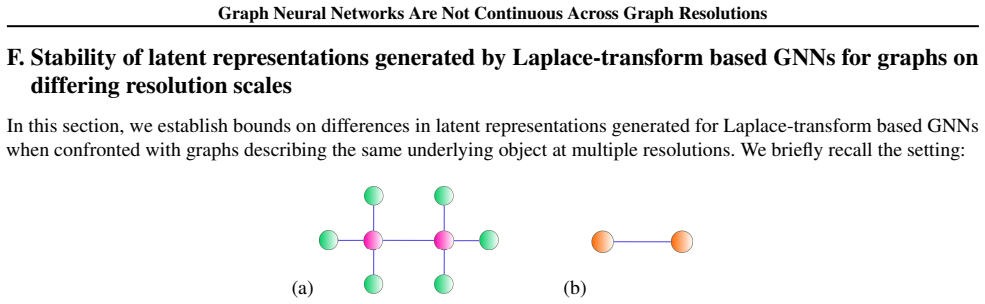
Graph neural networks are not continuous across graph resolutions and assign different embeddings to the same object at different scales.
A machine-rendered reading of the paper's core claim, the machinery that carries it, and where it could break.
Core claim
Contrary to conventional wisdom, graph neural networks are not continuous with respect to all natural modes of graph convergence. As a result, GNNs may generate substantially different latent representations for graphs that are very similar. In particular they assign vastly different latent embeddings to graphs that represent the same underlying object at different resolution scales. We trace this failure of continuity back to a structural obstruction arising from commonly used information-propagation schemes. Building on this insight we then derive a principled modification to standard GNN architectures which equips models with continuity across scales. The proposed modification enables con
What carries the argument
Structural obstruction in standard information-propagation schemes of GNNs, removed by a derived architectural modification that enforces continuity across graph resolutions.
If this is right
- GNNs generate substantially different latent representations for graphs that are very similar under standard convergence notions.
- Without the modification, models cannot reliably generalize between graphs of the same object observed at different resolutions.
- The modification permits consistent integration of data from multiple resolution scales within a single model.
- Numerical experiments across a range of tasks confirm that the modified models behave continuously where standard models do not.
Where Pith is reading between the lines
- Tasks that routinely combine graphs at multiple granularities, such as molecular property prediction at atom versus residue level, would benefit directly from the continuity fix.
- The same structural issue may appear in other message-passing architectures and could be diagnosed by checking embedding stability under successive coarsening operations.
- Future work could test whether the modification also improves robustness when graphs are obtained from noisy or incomplete observations at varying densities.
Load-bearing premise
The discontinuity is produced by the information-propagation rules themselves rather than by other parts of the model or by properties of the input data.
What would settle it
A controlled test in which the modified architecture produces nearly identical embeddings for two graphs of the same object at different resolutions while an unmodified GNN produces markedly different embeddings.
Figures



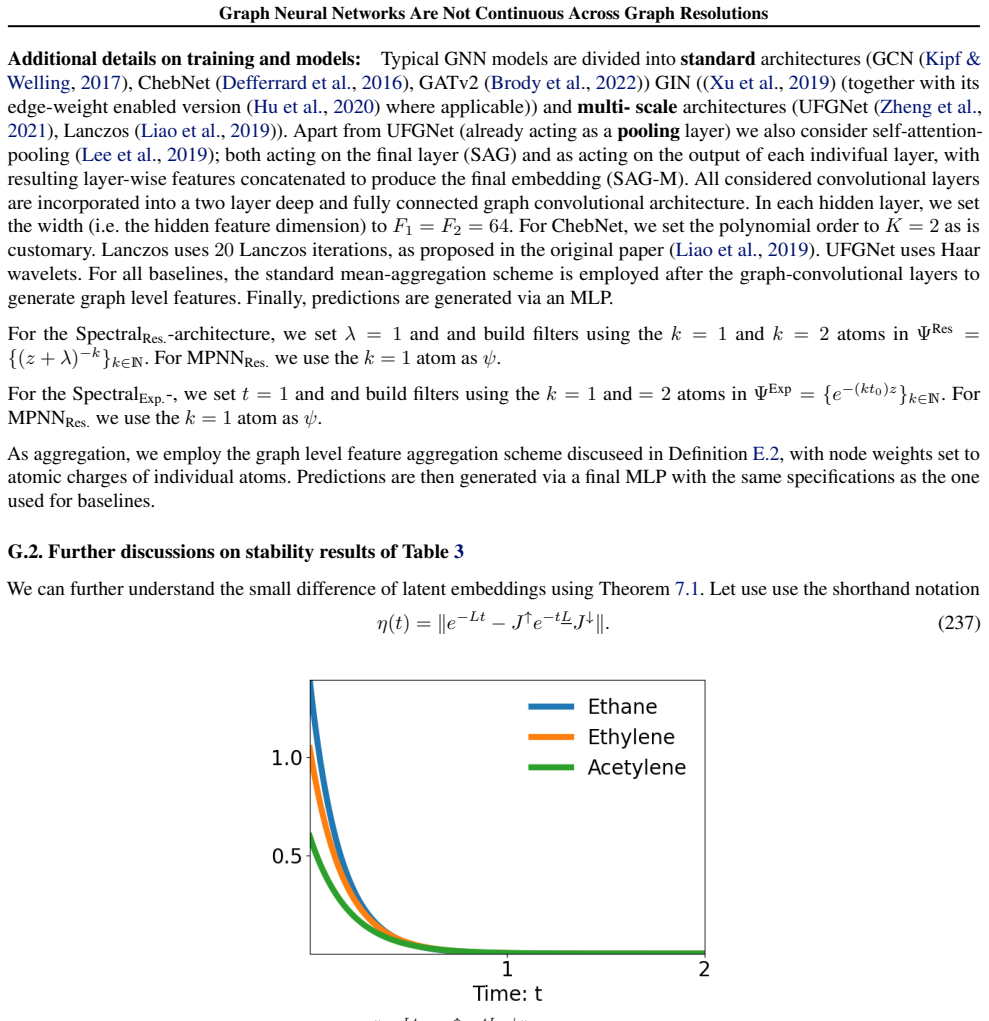
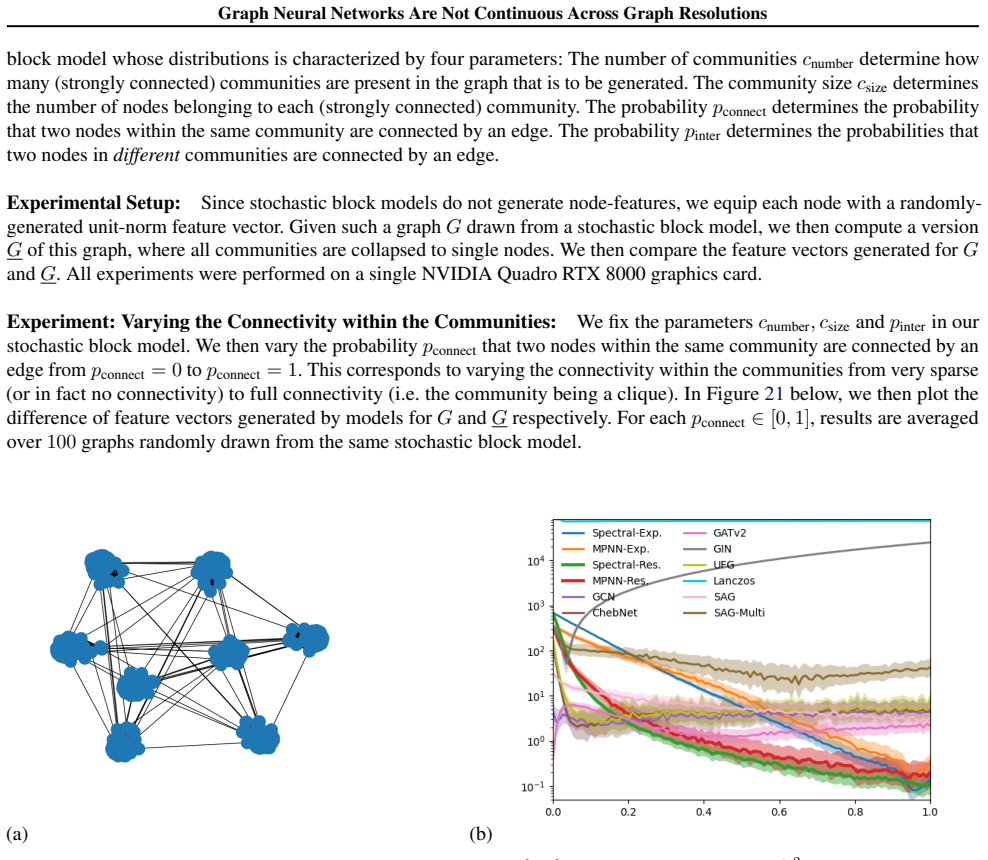
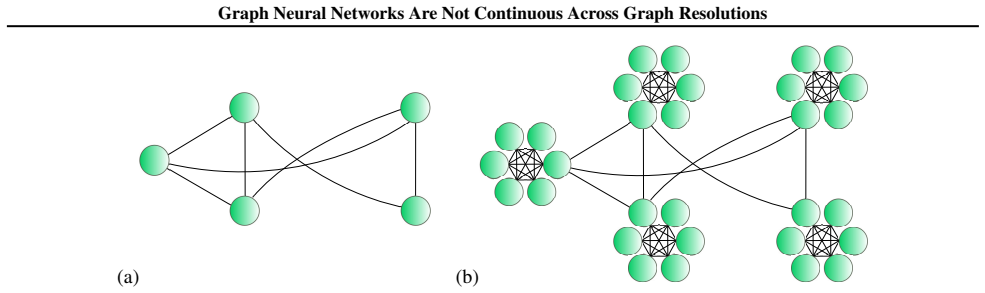
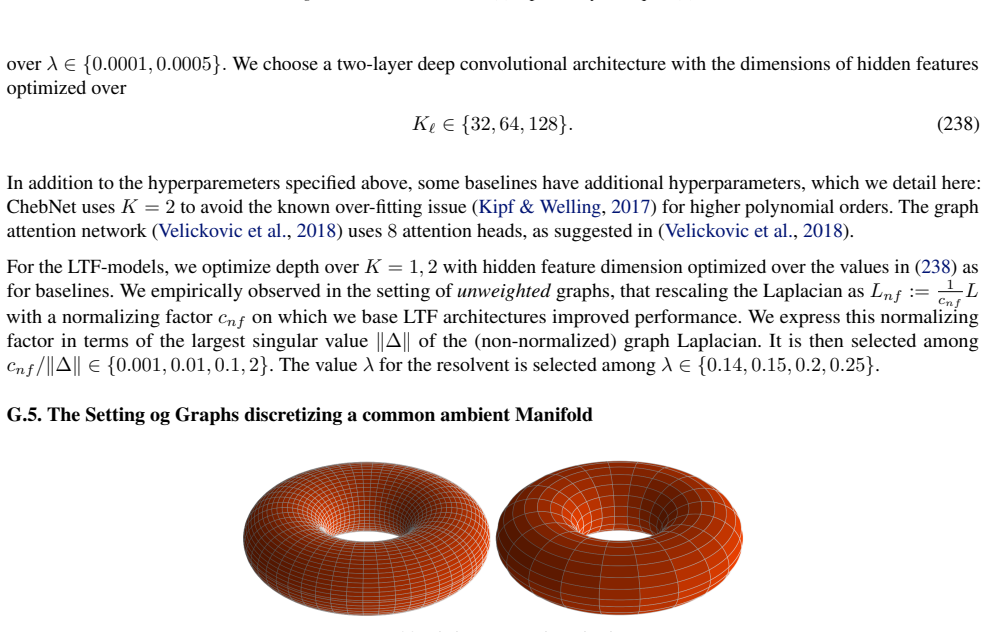
read the original abstract
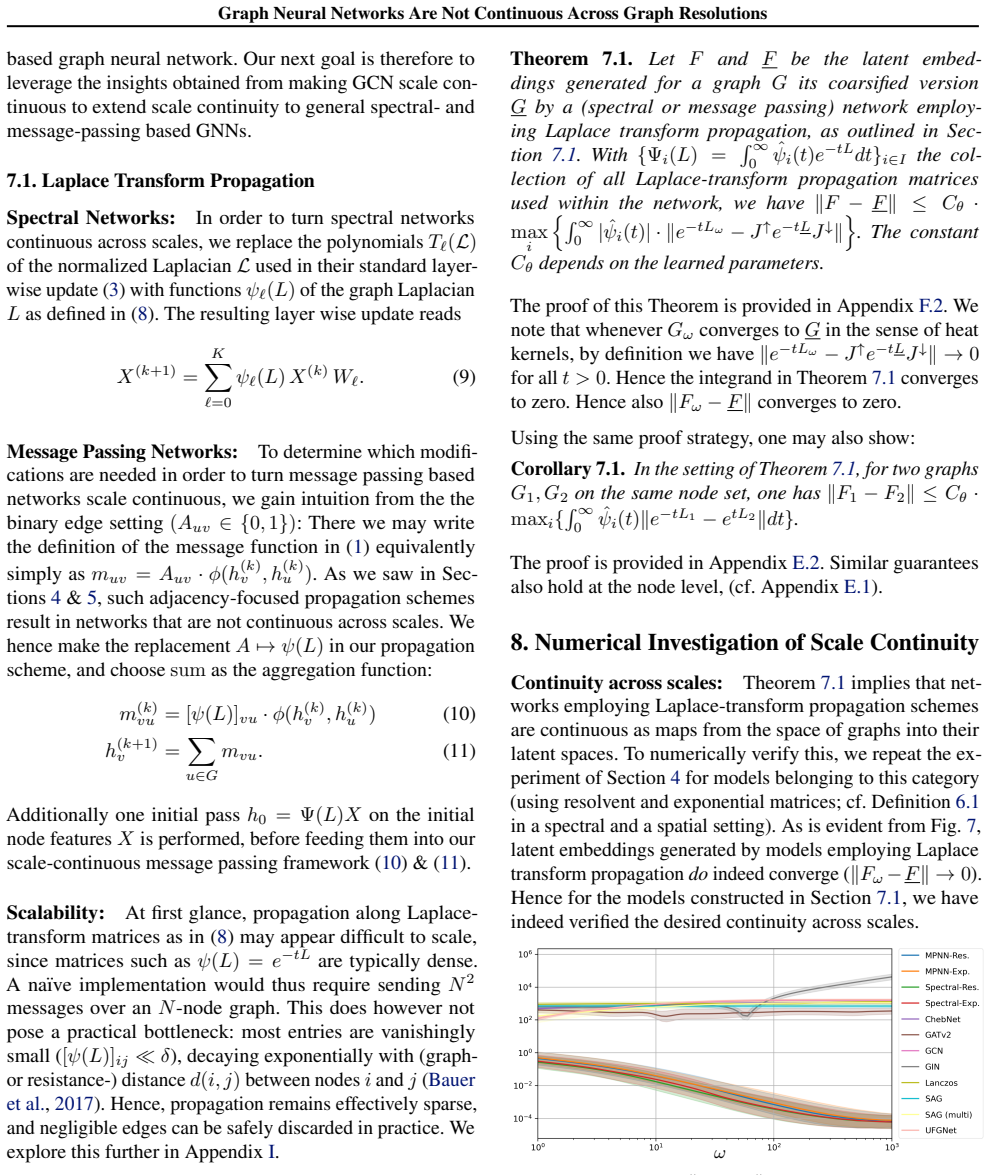
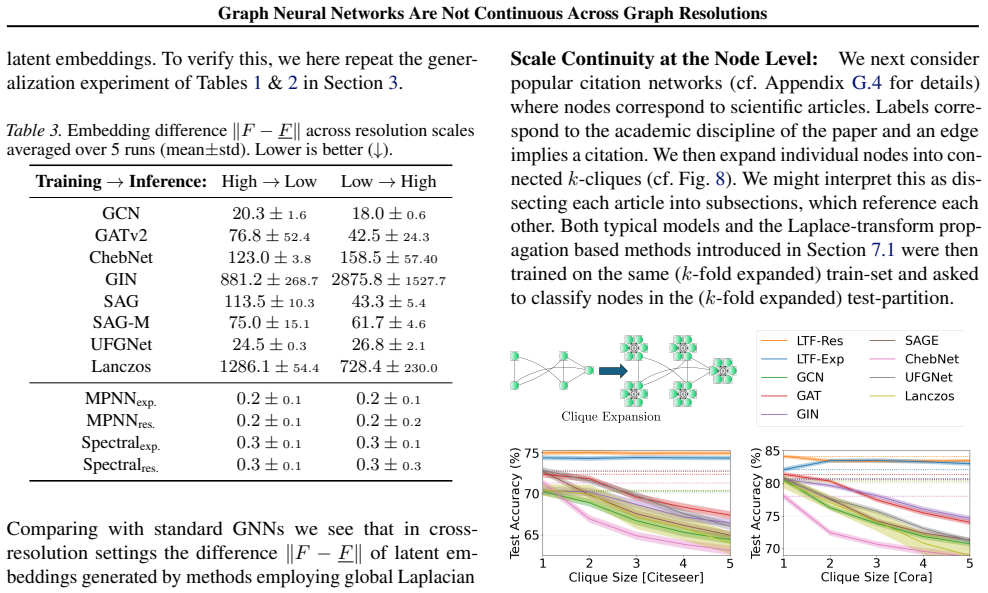
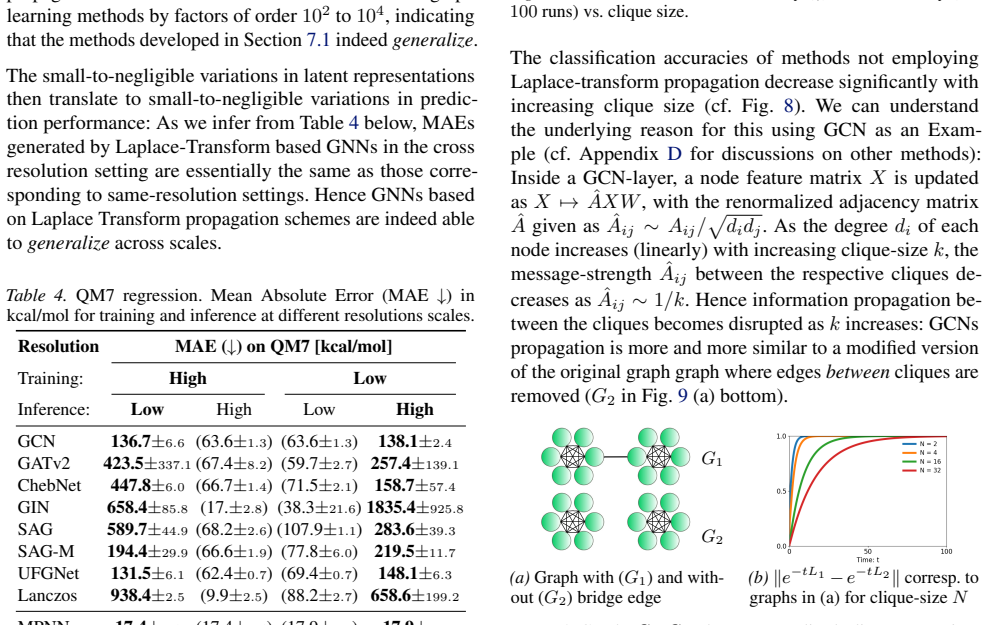
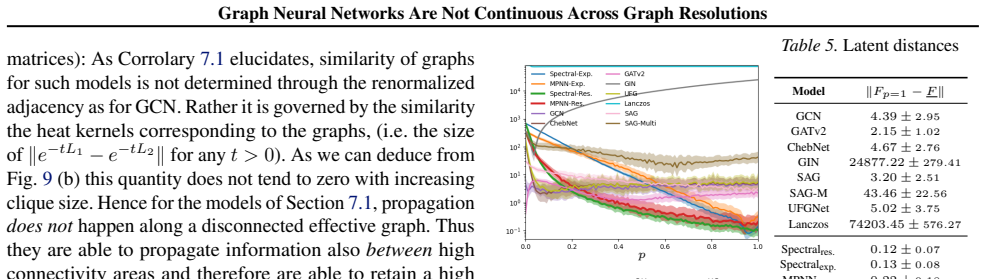
We show that contrary to conventional wisdom in the community, graph neural networks (GNNs) are not continuous with respect to all natural modes of graph convergence. As a result, GNNs may generate substantially different latent representations for graphs that are very similar. In particular they assign vastly different latent embeddings to graphs that represent the same underlying object at different resolution scales. We trace this failure of continuity back to a structural obstruction arising from commonly used information-propagation schemes. Building on this insight we then derive a principled modification to standard GNN architectures which equips models with continuity across scales. The proposed modification enables consistent integration of distinct resolutions and reliable generalization between them. We systematically validate our theoretical findings in a wide range of numerical experiments.
Editorial analysis
A structured set of objections, weighed in public.
Referee Report
Summary. The paper claims that, contrary to conventional wisdom, GNNs are not continuous with respect to all natural modes of graph convergence (especially resolution scaling), because standard message-passing schemes contain a structural obstruction that produces substantially different latent embeddings for graphs representing the same underlying object at different scales. The authors derive a principled architectural modification that restores continuity across scales and validate the theoretical findings with a wide range of numerical experiments.
Significance. If the derivation of the obstruction and the proposed fix are correct, the result would be significant: it identifies a concrete limitation in how GNNs handle multi-resolution data and supplies a modification that enables consistent cross-scale generalization. The systematic experimental validation is a positive feature that strengthens the practical relevance of the claim.
major comments (2)
- [Abstract] Abstract and theoretical tracing: the central claim that discontinuity arises from a structural feature of standard propagation schemes (rather than other architectural or data factors) is load-bearing, yet the abstract provides no explicit definition of continuity, no statement of the precise convergence modes, and no derivation. Without these elements the support for the claim cannot be verified.
- [Abstract] Proposed modification: the manuscript states that a principled change equips models with continuity across scales, but the abstract gives no indication of whether the modification is parameter-free, whether it preserves the original GNN expressivity, or how it interacts with the original propagation rule. These details are required to evaluate whether the fix actually resolves the identified obstruction.
minor comments (1)
- [Abstract] The phrase 'natural modes of graph convergence' should be defined at the first use with a short formal statement or reference to the relevant literature on graph limits.
Simulated Author's Rebuttal
We thank the referee for the constructive feedback and positive assessment of the paper's significance. We address the two major comments on the abstract below and will revise the abstract in the resubmitted version to incorporate the suggested clarifications.
read point-by-point responses
-
Referee: [Abstract] Abstract and theoretical tracing: the central claim that discontinuity arises from a structural feature of standard propagation schemes (rather than other architectural or data factors) is load-bearing, yet the abstract provides no explicit definition of continuity, no statement of the precise convergence modes, and no derivation. Without these elements the support for the claim cannot be verified.
Authors: We agree that the abstract would be strengthened by including a brief definition of continuity with respect to graph resolutions and an explicit reference to the resolution-scaling convergence mode. The structural obstruction in message-passing is derived in Section 3; we will add a short parenthetical note directing readers to this section while keeping the abstract concise. revision: yes
-
Referee: [Abstract] Proposed modification: the manuscript states that a principled change equips models with continuity across scales, but the abstract gives no indication of whether the modification is parameter-free, whether it preserves the original GNN expressivity, or how it interacts with the original propagation rule. These details are required to evaluate whether the fix actually resolves the identified obstruction.
Authors: The modification is parameter-free, acts by rescaling the aggregation operator in a manner that commutes with the original propagation rule, and preserves the original expressivity class. We will insert a single sentence in the revised abstract stating these properties to make the nature of the fix transparent. revision: yes
Circularity Check
No significant circularity detected
full rationale
The paper derives discontinuity of standard GNN message-passing from first-principles analysis of information propagation under graph resolution changes, then proposes an explicit architectural modification and validates it experimentally. No quoted step reduces a claimed result to a fitted parameter, self-definition, or load-bearing self-citation chain; the central argument is presented as an independent structural observation supported by external numerical checks rather than by construction from its own inputs.
Axiom & Free-Parameter Ledger
Reference graph
Works this paper leans on
-
[1]
@esa (Ref
\@ifxundefined[1] #1\@undefined \@firstoftwo \@secondoftwo \@ifnum[1] #1 \@firstoftwo \@secondoftwo \@ifx[1] #1 \@firstoftwo \@secondoftwo [2] @ #1 \@temptokena #2 #1 @ \@temptokena \@ifclassloaded agu2001 natbib The agu2001 class already includes natbib coding, so you should not add it explicitly Type <Return> for now, but then later remove the command n...
-
[2]
\@lbibitem[] @bibitem@first@sw\@secondoftwo \@lbibitem[#1]#2 \@extra@b@citeb \@ifundefined br@#2\@extra@b@citeb \@namedef br@#2 \@nameuse br@#2\@extra@b@citeb \@ifundefined b@#2\@extra@b@citeb @num @parse #2 @tmp #1 NAT@b@open@#2 NAT@b@shut@#2 \@ifnum @merge>\@ne @bibitem@first@sw \@firstoftwo \@ifundefined NAT@b*@#2 \@firstoftwo @num @NAT@ctr \@secondoft...
-
[3]
1.0" encoding=
@open @close @open @close and [1] URL: #1 \@ifundefined chapter * \@mkboth \@ifxundefined @sectionbib * \@mkboth * \@mkboth\@gobbletwo \@ifclassloaded amsart * \@ifclassloaded amsbook * \@ifxundefined @heading @heading NAT@ctr thebibliography [1] @ \@biblabel @NAT@ctr \@bibsetup #1 @NAT@ctr @ @openbib .11em \@plus.33em \@minus.07em 4000 4000 `\.\@m @bibit...
2022
-
[4]
write newline
" write newline "" before.all 'output.state := FUNCTION n.dashify 't := "" t empty not t #1 #1 substring "-" = t #1 #2 substring "--" = not "--" * t #2 global.max substring 't := t #1 #1 substring "-" = "-" * t #2 global.max substring 't := while if t #1 #1 substring * t #2 global.max substring 't := if while FUNCTION format.date year duplicate empty "emp...
-
[5]
Sharp davies--gaffney--grigor’yan lemma on graphs
Bauer, F., Hua, B., and Yau, S.-T. Sharp davies--gaffney--grigor’yan lemma on graphs. Mathematische Annalen, 368 0 (3--4): 0 1429--1437, 2017. doi:10.1007/s00208-017-1529-z
-
[6]
M., Grattarola, D., Livi, L
Bianchi, F. M., Grattarola, D., Livi, L. F., and Alippi, C. Graph neural networks with convolutional arma filters. IEEE Transactions on Pattern Analysis and Machine Intelligence, 44: 0 3496--3507, 2019
2019
-
[7]
Blum, L. C. and Reymond, J.-L. 970 million druglike small molecules for virtual screening in the chemical universe database GDB-13 . J. Am. Chem. Soc., 131: 0 8732, 2009
2009
-
[8]
How attentive are graph attention networks? In The Tenth International Conference on Learning Representations, ICLR 2022, Virtual Event, April 25-29, 2022
Brody, S., Alon, U., and Yahav, E. How attentive are graph attention networks? In The Tenth International Conference on Learning Representations, ICLR 2022, Virtual Event, April 25-29, 2022 . OpenReview.net, 2022. URL https://openreview.net/forum?id=F72ximsx7C1
2022
-
[9]
M., Bruna, J., Cohen, T., and Veličković, P
Bronstein, M. M., Bruna, J., Cohen, T., and Veličković, P. Geometric deep learning: Grids, groups, graphs, geodesics, and gauges, 2021
2021
-
[10]
Spectral networks and locally connected networks on graphs
Bruna, J., Zaremba, W., Szlam, A., and Lecun, Y. Spectral networks and locally connected networks on graphs. In International Conference on Learning Representations (ICLR2014), CBLS, April 2014, 2014
2014
-
[11]
Chung, F. R. K. Spectral Graph Theory. American Mathematical Society, 1997
1997
-
[12]
Convolutional neural networks on graphs with fast localized spectral filtering
Defferrard, M., Bresson, X., and Vandergheynst, P. Convolutional neural networks on graphs with fast localized spectral filtering. Advances in neural information processing systems, 29, 2016
2016
-
[13]
and Lenssen, J
Fey, M. and Lenssen, J. E. Fast graph representation learning with PyTorch Geometric . In ICLR Workshop on Representation Learning on Graphs and Manifolds, 2019
2019
-
[14]
Fey, M., Sunil, J., Nitta, A., Puri, R., Shah, M., Stojanovič, B., Bendias, R., Barghi, A., Kocijan, V., Zhang, Z., He, X., Lenssen, J. E., and Leskovec, J. Pyg 2.0: Scalable learning on real world graphs. arXiv preprint arXiv:2507.16991, 2025. URL https://arxiv.org/abs/2507.16991
-
[15]
Diffusion scattering transforms on graphs
Gama, F., Ribeiro, A., and Bruna, J. Diffusion scattering transforms on graphs. In 7th International Conference on Learning Representations, ICLR 2019, New Orleans, LA, USA, May 6-9, 2019 . OpenReview.net, 2019. URL https://openreview.net/forum?id=BygqBiRcFQ
2019
-
[16]
Stability properties of graph neural networks
Gama, F., Bruna, J., and Ribeiro, A. Stability properties of graph neural networks. IEEE Trans. Signal Process. , 68: 0 5680--5695, 2020. doi:10.1109/TSP.2020.3026980. URL https://doi.org/10.1109/TSP.2020.3026980
-
[17]
Predict then propagate: Graph neural networks meet personalized pagerank
Gasteiger, J., Bojchevski, A., and G \" u nnemann, S. Predict then propagate: Graph neural networks meet personalized pagerank. In 7th International Conference on Learning Representations, ICLR 2019, New Orleans, LA, USA, May 6-9, 2019 . OpenReview.net, 2019. URL https://openreview.net/forum?id=H1gL-2A9Ym
2019
-
[18]
S., Riley, P
Gilmer, J., Schoenholz, S. S., Riley, P. F., Vinyals, O., and Dahl, G. E. Neural message passing for quantum chemistry. In International conference on machine learning, pp.\ 1263--1272. PMLR, 2017
2017
-
[19]
L., Ying, Z., and Leskovec, J
Hamilton, W. L., Ying, Z., and Leskovec, J. Inductive representation learning on large graphs. In Guyon, I., von Luxburg, U., Bengio, S., Wallach, H. M., Fergus, R., Vishwanathan, S. V. N., and Garnett, R. (eds.), Advances in Neural Information Processing Systems 30: Annual Conference on Neural Information Processing Systems 2017, December 4-9, 2017, Long...
2017
-
[20]
Bernnet: Learning arbitrary graph spectral filters via bernstein approximation
He, M., Wei, Z., Huang, Z., and Xu, H. Bernnet: Learning arbitrary graph spectral filters via bernstein approximation. In Ranzato, M., Beygelzimer, A., Dauphin, Y. N., Liang, P., and Vaughan, J. W. (eds.), Advances in Neural Information Processing Systems 34: Annual Conference on Neural Information Processing Systems 2021, NeurIPS 2021, December 6-14, 202...
2021
-
[21]
Convolutional neural networks on graphs with chebyshev approximation, revisited
He, M., Wei, Z., and Wen, J. Convolutional neural networks on graphs with chebyshev approximation, revisited. In NeurIPS, 2022. URL http://papers.nips.cc/paper\_files/paper/2022/hash/2f9b3ee2bcea04b327c09d7e3145bd1e-Abstract-Conference.html
2022
-
[22]
Graph laplacians and their convergence on random neighborhood graphs
Hein, M., Audibert, J.-Y., and von Luxburg, U. Graph laplacians and their convergence on random neighborhood graphs. J. Mach. Learn. Res., 8: 0 1325--1368, 2006. URL https://api.semanticscholar.org/CorpusID:1355782
2006
-
[23]
Holland, P. W., Laskey, K. B., and Leinhardt, S. Stochastic blockmodels: First steps. Social Networks, 5 0 (2): 0 109--137, 1983. ISSN 0378-8733. doi:https://doi.org/10.1016/0378-8733(83)90021-7. URL https://www.sciencedirect.com/science/article/pii/0378873383900217
-
[24]
Horn, R. A. and Johnson, C. R. Matrix analysis. Cambridge university press, 2012
2012
-
[25]
Hu, W., Liu, B., Gomes, J., Zitnik, M., Liang, P., Pande, V., and Leskovec, J. Strategies for pre-training graph neural networks. In International Conference on Learning Representations (ICLR), 2020. doi:10.48550/arXiv.1905.12265. URL https://arxiv.org/abs/1905.12265
-
[26]
Highly accurate protein structure prediction with alphafold
Jumper, J., Evans, R., Pritzel, A., Green, T., Figurnov, M., Ronneberger, O., Tunyasuvunakool, K., Bates, R., Zidek, A., Potapenko, A., et al. Highly accurate protein structure prediction with alphafold. Nature, 596 0 (7873): 0 583--589, 2021. doi:10.1038/s41586-020-03085-1
-
[27]
Perturbation theory for linear operators; 2nd ed
Kato, T. Perturbation theory for linear operators; 2nd ed. Grundlehren der mathematischen Wissenschaften : a series of comprehensive studies in mathematics. Springer, Berlin, 1976. URL https://cds.cern.ch/record/101545
1976
-
[28]
On the stability of graph convolutional neural networks under edge rewiring
Kenlay, H., Thanou, D., and Dong, X. On the stability of graph convolutional neural networks under edge rewiring. In ICLR 2021 Workshop on Geometrical and Topological Representation Learning, 2021. URL https://openreview.net/forum?id=NG7Eb2_zR6K
2021
-
[29]
Kipf, T. N. and Welling, M. Semi-supervised classification with graph convolutional networks. In 5th International Conference on Learning Representations, ICLR 2017, Toulon, France, April 24-26, 2017, Conference Track Proceedings . OpenReview.net, 2017. URL https://openreview.net/forum?id=SJU4ayYgl
2017
-
[30]
Limitless stability for graph convolutional networks
Koke, C. Limitless stability for graph convolutional networks. In 11th International Conference on Learning Representations, ICLR 2023, Kigali, Rwanda, May 1-5, 2023 . OpenReview.net, 2023. URL https://openreview.net/forum?id=XqcQhVUr2h0
2023
-
[31]
Large coupling convergence beyond definiteness
Koke, C. Large coupling convergence beyond definiteness. arXiv preprint arXiv:2601.18055, 2026 a . URL https://arxiv.org/abs/2601.18055
-
[32]
Di-graphs with tightly connected clusters: effective graph laplacians and resolvent convergence
Koke, C. Di-graphs with tightly connected clusters: effective graph laplacians and resolvent convergence. arXiv preprint arXiv:2601.18057, 2026 b . URL https://arxiv.org/abs/2601.18057
-
[33]
and Cremers, D
Koke, C. and Cremers, D. Holonets: Spectral convolutions do extend to directed graphs. In The Twelfth International Conference on Learning Representations, 2024. URL https://openreview.net/forum?id=EhmEwfavOW
2024
-
[34]
and Kutyniok, G
Koke, C. and Kutyniok, G. Graph scattering beyond wavelet shackles. In Advances in Neural Information Processing Systems 35: Annual Conference on Neural Information Processing Systems 2022, NeurIPS 2020, November 28 - December 9, 2022, New Orleans, 2022. URL https://openreview.net/forum?id=ptUZl8xDMMN
2022
-
[35]
Resolvnet: A graph convolutional network with multi-scale consistency
Koke, C., Saroha, A., Shen, Y., Eisenberger, M., and Cremers, D. Resolvnet: A graph convolutional network with multi-scale consistency. In NeurIPS 2023 Workshop on New Frontiers in Graph Learning (GLFrontiers). OpenReview, October 2023. URL https://openreview.net/forum?id=V5eDwEDfXT
2023
-
[36]
M., and Cremers, D
Koke, C., Saroha, A., Shen, Y., Eisenberger, M., Bronstein, M. M., and Cremers, D. Transferability for graph convolutional networks. In ICML 2024 Workshop on Geometry-grounded Representation Learning and Generative Modeling, 2024. URL https://openreview.net/forum?id=rKEdfcaqYX
2024
-
[37]
M., and Cremers, D
Koke, C., Schnaus, D., Shen, Y., Saroha, A., Eisenberger, M., Rieck, B., Bronstein, M. M., and Cremers, D. On multi-scale graph representation learning. In Learning Meaningful Representations of Life (LMRL) Workshop at ICLR 2025, 2025 a . URL https://openreview.net/forum?id=X3OMHwfsxk
2025
-
[38]
M., and Cremers, D
Koke, C., Shen, Y., Saroha, A., Eisenberger, M., Rieck, B., Bronstein, M. M., and Cremers, D. Graph networks struggle with variable scale. In ICLR 2025 Workshop ICBINB. OpenReview, March 2025 b . URL https://openreview.net/forum?id=N5n6SAfnU0
2025
-
[39]
M., and Cremers, D
Koke, C., Shen, Y., Saroha, A., Eisenberger, M., Rieck, B., Bronstein, M. M., and Cremers, D. On incorporating scale into graph networks. In ICLR 2025 Workshop on Machine Learning for Multiscale Physics (MLMP). OpenReview, March 2025 c . URL https://openreview.net/forum?id=SRCsyJafgP
2025
-
[40]
M., and Cremers, D
Koke, C., Rieck, B., Bronstein, M. M., and Cremers, D. Scale continuity in graph learning: Going beyond spectral methods. In ICLR 2026 Workshop on Geometry-grounded Representation Learning and Generative Modeling, 2026. URL https://openreview.net/forum?id=RYl2VWfIRI
2026
-
[41]
Learning skillful medium-range global weather forecasting
Lam, R., Sanchez-Gonzalez, A., Willson, M., Wirnsberger, P., Fortunato, M., Alet, F., Ravuri, S., Ewalds, T., Eaton-Rosen, Z., Hu, W., Merose, A., Hoyer, S., Holland, G., Vinyals, O., Stott, J., Pritzel, A., Mohamed, S., and Battaglia, P. Learning skillful medium-range global weather forecasting. Science, 382 0 (6677): 0 1416--1421, 2023. doi:10.1126/scie...
-
[42]
and Jegelka, S
Le, T. and Jegelka, S. Limits, approximation and size transferability for GNN s on sparse graphs via graphops. In Thirty-seventh Conference on Neural Information Processing Systems, 2023. URL https://openreview.net/forum?id=kDQwossJuI
2023
-
[43]
Self-attention graph pooling
Lee, J., Lee, I., and Kang, J. Self-attention graph pooling. In Chaudhuri, K. and Salakhutdinov, R. (eds.), Proceedings of the 36th International Conference on Machine Learning, volume 97 of Proceedings of Machine Learning Research, pp.\ 3734--3743. PMLR, 09--15 Jun 2019. URL https://proceedings.mlr.press/v97/lee19c.html
2019
-
[44]
Levie, R., Bronstein, M. M., and Kutyniok, G. Transferability of spectral graph convolutional neural networks. CoRR, abs/1907.12972, 2019 a . URL http://arxiv.org/abs/1907.12972
-
[45]
On the Transferability of Spectral Graph Filters
Levie, R., Isufi, E., and Kutyniok, G. On the transferability of spectral graph filters. CoRR, abs/1901.10524, 2019 b . URL http://arxiv.org/abs/1901.10524
work page internal anchor Pith review Pith/arXiv arXiv 1901
-
[46]
Levie, R., Monti, F., Bresson, X., and Bronstein, M. M. Cayleynets: Graph convolutional neural networks with complex rational spectral filters. IEEE Trans. Signal Process. , 67 0 (1): 0 97--109, 2019 c . doi:10.1109/TSP.2018.2879624. URL https://doi.org/10.1109/TSP.2018.2879624
-
[47]
Liao, R., Zhao, Z., Urtasun, R., and Zemel, R. S. Lanczosnet: Multi-scale deep graph convolutional networks. In 7th International Conference on Learning Representations, ICLR 2019, New Orleans, LA, USA, May 6-9, 2019 . OpenReview.net, 2019. URL https://openreview.net/forum?id=BkedznAqKQ
2019
-
[48]
Graph reduction with spectral and cut guarantees
Loukas, A. Graph reduction with spectral and cut guarantees. J. Mach. Learn. Res., 20: 0 116:1--116:42, 2019. URL https://jmlr.org/papers/v20/18-680.html
2019
-
[49]
and Vandergheynst, P
Loukas, A. and Vandergheynst, P. Spectrally approximating large graphs with smaller graphs. In Dy, J. G. and Krause, A. (eds.), Proceedings of the 35th International Conference on Machine Learning, ICML 2018, Stockholmsm \" a ssan, Stockholm, Sweden, July 10-15, 2018 , volume 80 of Proceedings of Machine Learning Research, pp.\ 3243--3252. PMLR , 2018 a ....
2018
-
[50]
and Vandergheynst, P
Loukas, A. and Vandergheynst, P. Spectrally approximating large graphs with smaller graphs. In Dy, J. and Krause, A. (eds.), Proceedings of the 35th International Conference on Machine Learning, volume 80 of Proceedings of Machine Learning Research, pp.\ 3237--3246. PMLR, 10--15 Jul 2018 b . URL https://proceedings.mlr.press/v80/loukas18a.html
2018
-
[51]
Mallat, S. Group invariant scattering. Communications on Pure and Applied Mathematics, 65 0 (10): 0 1331--1398, 2012. doi:https://doi.org/10.1002/cpa.21413. URL https://onlinelibrary.wiley.com/doi/abs/10.1002/cpa.21413
-
[52]
Transferability of graph neural networks: an extended graphon approach
Maskey, S., Levie, R., and Kutyniok, G. Transferability of graph neural networks: an extended graphon approach. CoRR, abs/2109.10096, 2021. URL https://arxiv.org/abs/2109.10096
-
[53]
Automating the construction of internet portals with machine learning
McCallum, A., Nigam, K., Rennie, J., and Seymore, K. Automating the construction of internet portals with machine learning. Inf. Retr., 3 0 (2): 0 127--163, 2000. doi:10.1023/A:1009953814988. URL https://doi.org/10.1023/A:1009953814988
-
[54]
Understanding graph neural networks with asymmetric geometric scattering transforms, 2019
Perlmutter, M., Gao, F., Wolf, G., and Hirn, M. Understanding graph neural networks with asymmetric geometric scattering transforms, 2019. URL https://arxiv.org/abs/1911.06253
-
[55]
Spectral Analysis on Graph-like Spaces / by Olaf Post
Post, O. Spectral Analysis on Graph-like Spaces / by Olaf Post. Lecture Notes in Mathematics, 2039. Springer Berlin Heidelberg, Berlin, Heidelberg, 1st ed. 2012. edition, 2012. ISBN 3-642-23840-8
2039
-
[56]
Price, C. C., Singh, A., Frey, N. C., and Shenoy, V. B. Efficient catalyst screening using graph neural networks to predict strain effects on adsorption energy. Science Advances, 8 0 (47): 0 eabq5944, 2022. doi:10.1126/sciadv.abq5944. URL https://www.science.org/doi/abs/10.1126/sciadv.abq5944
-
[57]
Roddenberry, T. M., Gama, F., Baraniuk, R. G., and Segarra, S. On local distributions in graph signal processing. IEEE Trans. Signal Process. , 70: 0 5564--5577, 2022. doi:10.1109/TSP.2022.3223217. URL https://doi.org/10.1109/TSP.2022.3223217
-
[58]
Ruiz, L., Chamon, L. F. O., and Ribeiro, A. Graphon neural networks and the transferability of graph neural networks. In Larochelle, H., Ranzato, M., Hadsell, R., Balcan, M., and Lin, H. (eds.), Advances in Neural Information Processing Systems 33: Annual Conference on Neural Information Processing Systems 2020, NeurIPS 2020, December 6-12, 2020, virtual,...
2020
-
[59]
Rupp, M., Tkatchenko, A., M\"uller, K.-R., and von Lilienfeld, O. A. Fast and accurate modeling of molecular atomization energies with machine learning. Physical Review Letters, 108: 0 058301, 2012
2012
-
[60]
Scarselli, F., Gori, M., Tsoi, A. C., Hagenbuchner, M., and Monfardini, G. The graph neural network model. IEEE Transactions on Neural Networks, 20 0 (1): 0 61--80, 2009. doi:10.1109/TNN.2008.2005605
-
[61]
Collective classification in network data
Sen, P., Namata, G., Bilgic, M., Getoor, L., Galligher, B., and Eliassi-Rad, T. Collective classification in network data. AI Magazine, 29 0 (3): 0 93, Sep. 2008. doi:10.1609/aimag.v29i3.2157. URL https://ojs.aaai.org/index.php/aimagazine/article/view/2157
-
[62]
An Introduction to Measure Theory
Tao, T. An Introduction to Measure Theory. Graduate studies in mathematics. American Mathematical Society, 2013. ISBN 9781470409227. URL https://books.google.de/books?id=SPGJjwEACAAJ
2013
-
[63]
Mathematical Methods in Quantum Mechanics
Teschl, G. Mathematical Methods in Quantum Mechanics. American Mathematical Society, 2014
2014
-
[64]
Graph attention networks
Velickovic, P., Cucurull, G., Casanova, A., Romero, A., Li \` o , P., and Bengio, Y. Graph attention networks. In 6th International Conference on Learning Representations, ICLR 2018, Vancouver, BC, Canada, April 30 - May 3, 2018, Conference Track Proceedings . OpenReview.net, 2018. URL https://openreview.net/forum?id=rJXMpikCZ
2018
-
[65]
Stability of neural networks on riemannian manifolds
Wang, Z., Ruiz, L., and Ribeiro, A. Stability of neural networks on riemannian manifolds. 2021 29th European Signal Processing Conference (EUSIPCO), pp.\ 1845--1849, 2021. URL https://api.semanticscholar.org/CorpusID:232110514
2021
-
[66]
Stability to deformations of manifold filters and manifold neural networks
Wang, Z., Ruiz, L., and Ribeiro, A. Stability to deformations of manifold filters and manifold neural networks. IEEE Trans. Signal Process. , 72: 0 2130--2146, 2024 a . doi:10.1109/TSP.2024.3378379. URL https://doi.org/10.1109/TSP.2024.3378379
-
[67]
Geometric graph filters and neural networks: Limit properties and discriminability trade-offs
Wang, Z., Ruiz, L., and Ribeiro, A. Geometric graph filters and neural networks: Limit properties and discriminability trade-offs. IEEE Trans. Signal Process. , 72: 0 2244--2259, 2024 b . doi:10.1109/TSP.2024.3392360. URL https://doi.org/10.1109/TSP.2024.3392360
-
[68]
On the hölder continuity of matrix functions for normal matrices
Wihler, T. On the hölder continuity of matrix functions for normal matrices. Journal of inequalities in pure and applied mathematics, 10 0 (4), Dec 2009. ISSN 1443-5756. URL https://www.emis.de/journals/JIPAM/images/276_09_JIPAM/276_09_www.pdf
2009
-
[69]
Xie, T. and Grossman, J. C. Crystal graph convolutional neural networks for an accurate and interpretable prediction of material properties. Physical Review Letters, 120 0 (14): 0 145301, 2018. doi:10.1103/PhysRevLett.120.145301
-
[70]
How powerful are graph neural networks? In 7th International Conference on Learning Representations, ICLR 2019, New Orleans, LA, USA, May 6-9, 2019
Xu, K., Hu, W., Leskovec, J., and Jegelka, S. How powerful are graph neural networks? In 7th International Conference on Learning Representations, ICLR 2019, New Orleans, LA, USA, May 6-9, 2019 . OpenReview.net, 2019. URL https://openreview.net/forum?id=ryGs6iA5Km
2019
-
[71]
How framelets enhance graph neural networks
Zheng, X., Zhou, B., Gao, J., Wang, Y., Li \' o , P., Li, M., and Mont \' u far, G. How framelets enhance graph neural networks. In Meila, M. and Zhang, T. (eds.), Proceedings of the 38th International Conference on Machine Learning, ICML 2021, 18-24 July 2021, Virtual Event , volume 139 of Proceedings of Machine Learning Research, pp.\ 12761--12771. PMLR...
2021
-
[72]
Zou, D. and Lerman, G. Graph convolutional neural networks via scattering. Applied and Computational Harmonic Analysis, 49 0 (3): 0 1046--1074, nov 2020. doi:10.1016/j.acha.2019.06.003. URL https://doi.org/10.1016
discussion (0)
Sign in with ORCID, Apple, or X to comment. Anyone can read and Pith papers without signing in.