REVIEW 3 major objections 5 minor 22 references
Efficient Estimation of Pathwise Differentiable Target Parameters with the Undersmoothed Highly Adaptive Lasso
T0 review · 3 major / 5 minor · reviewed 2026-08-14 · deepseek-v4-flash
Pith's one-line read A single over-fitted HAL-MLE is asymptotically efficient for every smooth target at once.
desk verdict The undersmoothed HAL efficiency theorem is a real and useful step forward, but the paper's two headline applications rest on unproved nuisance-approximation rates that are exactly what the main theorem was supposed to deliver. read the letter →
The pith
A machine-rendered reading of the paper's core claim, the machinery that carries it, and where it could break.
The reading
What carries the argument
The load-bearing object is the m-th order spline basis representation and the score equations it generates. A cadlag function with finite sectional variation norm is represented as $Q(x)=Q(0)+\sum_{\bar{s}(m)}\int \varphi_{\bar{s}(m),x}(z_{s_m})\,dQ^m_{\bar{s}(m)}(z_{s_m})$, an infinitesimal linear combination of tensor products of up to m-th order splines, with the $L_1$-norm of the coefficients equal to the m-th order sectional variation norm. The HAL-MLE minimizes empirical risk over such representations with $\|\beta\|_1 \le C_n$. Because it is an MLE, it solves the score equation $P_n S_h(Q_n)=0$ for every direction $h$ that preserves the $L_1$ constraint; the undersmoothing condition (7) makes one of these directions match the canonical gradient score, yielding $P_n D^*_n(Q_n,G_0)=o_P(n^{-1/2})$.
What would settle it
Simulate an ATE model in which $G_0$ has a narrow local feature not aligned with the observed support points (for example, a steep dip in the propensity score between two observed covariate values), while $Q_0$ is smooth; compute $\|G_{0n}-G_0\|_{P_0}$ for $n=10^3,10^4,10^5$ and the scaled quantities $\sqrt{n}\,\|P_nD^*(Q_n,G_0)\|$ and $\sqrt{n}(\Psi(Q_n)-\Psi(Q_0))$. If the empirical projection rate is slower than $n^{-1/4}$, the scaled bias and score will not vanish, giving a concrete instance where Theorem 3's assumption fails even though condition (7) holds.
Extended reading notes
Core claim
The central claim, Theorem 2, is that if the m-th order Spline HAL-MLE $Q_n$ is computed with an $L_1$-bound $C_n$ large enough that the sparsest selected basis function satisfies condition (7), then the plug-in estimator $\Psi(Q_n)$ is asymptotically efficient for the target parameter $\Psi(Q_0)$: its scaled bias vanishes faster than $n^{-1/2}$ and its variance reaches the efficiency bound, provided the second-order remainder is $o_P(n^{-1/2})$ and the canonical gradients stay in a Donsker class. Because condition (7) is global and not parameter specific, the same over-fitted $Q_n$ is efficient for every smooth pathwise differentiable functional at once. The representation theorem for the class $D^m[0,\tau]$—functions with finite m-th order sectional variation norm—is what makes this concrete: each such function is an infinitesimal linear combination of tensor-product spline bases, so the HAL-MLE is literally a lasso on spline basis coefficients.
Load-bearing premise
The examples rely on the assumption, stated but not proved in Section 4.4 and Theorem 4, that the projection of the true nuisance $G_0$ onto the basis functions selected by the undersmoothed HAL fit converges to $G_0$ at rate $O_P(n^{-1/4})$ (or an analogous projection-residual condition); if that projection is slower, the second-order remainder is not $o_P(n^{-1/2})$ and the efficiency conclusion for those examples fails.
Editorial extensions
If this is right
- With one HAL-MLE computed at a large enough $L_1$ bound, every pathwise differentiable smooth functional of the fitted function is estimated efficiently, so no separate targeted step per target is needed.
- Condition (7) can be checked from the data alone, which yields a concrete rule: take the smallest $C_n$ above the cross-validated choice for which $\min_{s,j} \|P_n \frac{d}{dQ_n}L(Q_n)(\varphi_{s,j})\| = o_P(n^{-1/2})$.
- Undersmoothing does not sacrifice the HAL-MLE's own rate: the $L_1$ bound may even grow slowly with $n$ while preserving the faster-than-$n^{-1/4}$ convergence and the Donsker property.
- The smoothness-adaptive version (selecting $m$ by cross-validation) inherits the efficiency result, since under separated rates the cross-validation selector picks the true smoothness order $m_0$ with probability tending to 1.
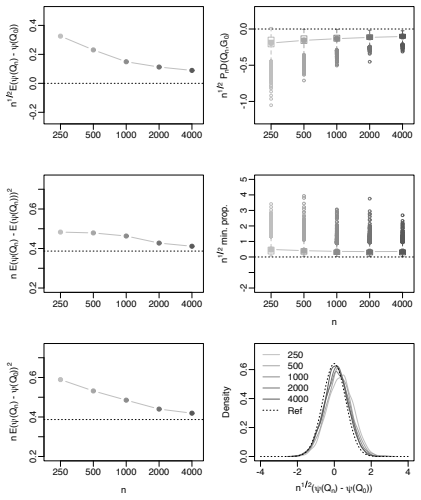
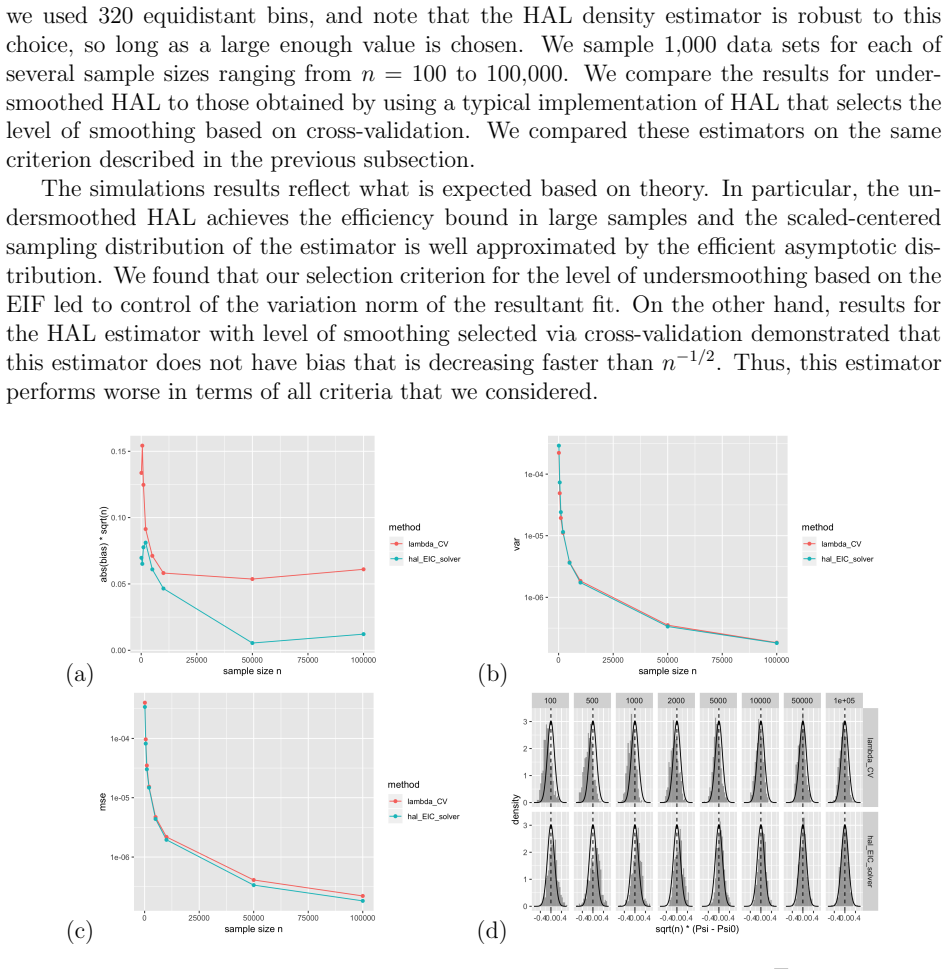
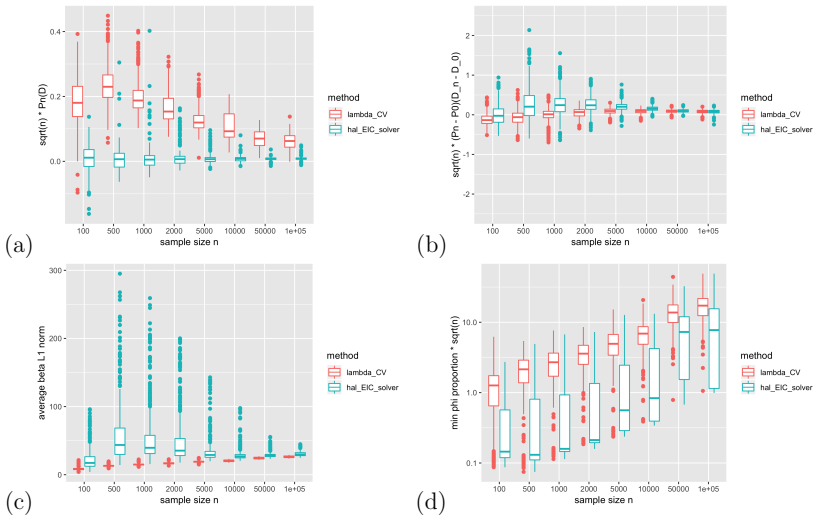
- In the two worked examples—average treatment effect and the integral of the square of the density—the undersmoothed plug-in reaches the efficiency bound in simulations, while the cross-validated HAL-MLE does not.
Reading between the lines
- A testable consequence of the paper's logic is that you could post-select any number of target parameters after seeing one undersmoothed HAL fit and report efficient estimates for all of them; this would invert the usual TMLE workflow where the target must be declared before estimation.
- The unproved $n^{-1/4}$ projection-rate assumption suggests a practical diagnostic: track $\|G_{0n}-G_0\|_{P_0}$ (and the residual in condition (14)) across sample sizes; if the empirical rate is slower, enlarging $C_n$ alone may not restore efficiency and the basis itself may need to be enriched near rough parts of $G_0$.
- The paper's discussion implies a comparative conjecture that could be settled by simulation: undersmoothed HAL-MLE should beat HAL-TMLE when the nuisance $G_0$ is as hard to estimate as $Q_0$ or when positivity is weak, and lose when $G_0$ is strongly constrained.
- A refinement of condition (7) suggested by the proof—checking the projection residual of $D^*(Q_n,G_0)$ onto the span of selected basis functions rather than only the minimum score—might give a more stable finite-sample undersmoothing selector than the paper's global rate condition.
Signed reviews
Editorial analysis
A structured set of objections, weighed in public.
Referee Report
Summary. The paper defines an m-th order Spline HAL-MLE over a class of cadlag functions with bounded m-th order sectional variation norm, proves a spline representation theorem, and studies when a single undersmoothed HAL-MLE plug-in is asymptotically efficient for a pathwise differentiable target parameter. The main device is Theorem 1: if the HAL-MLE solves score equations for a sufficiently rich set of submodels, measured by the data-checkable undersmoothing condition (7), then the empirical mean of an approximation D*_n(Qn,G0) of the efficient influence curve is oP(n^{-1/2}). Theorem 2 then gives the standard TMLE-style efficiency argument under second-order remainder, Donsker, and L2-consistency conditions. The paper applies the result to the average treatment effect (Section 4, Theorem 3) and to the integral of the square of a density (Section 5, Theorem 4), and reports simulations for both examples.
Significance. If the main theorem is correct, the undersmoothing condition is a useful and non-parameter-specific criterion: a single HAL-MLE can be efficient for many smooth functionals simultaneously without a separate TMLE update. The paper ships self-contained proofs of the spline representation theorem (Appendix A), of Theorem 1 (Appendix C), and of the TMLE-style efficiency argument (Appendix D), and the simulation evidence supports the finite-sample behavior. The central gap is the unproved rate at which the span of basis functions selected for Qn approximates the nuisance parameter G0 in the ATE example, and the analogous projection condition in the density example; this makes the example theorems conditional rather than unconditional.
major comments (3)
- [§4.4, Theorem 3] The assumption ||G0n - G0||_{P0} = OP(n^{-1/4}) is load-bearing and is not proved. In the text this is justified only by the statement that the condition 'appears to be a reasonable condition' and that the selected basis functions 'should generally also be rich enough' to approximate G0 at that rate. This matters because R20(...,...) <= (1/delta)||Qn - Q0||_{P0} ||G0n - G0||_{P0}; combined with the established ||Qn - Q0||_{P0} = OP(n^{-1/4-alpha}), the n^{-1/4} rate on G0n is exactly the threshold for R20 = oP(n^{-1/2}). The selected span is chosen to fit Q0, not G0; if Q0 and G0 depend on different coordinates, the span can be rich for Q0 and poor for G0, so no argument from the rate of Qn establishes the required rate for G0n. The theorem should be restated as conditional on this projection rate, or the rate should be proved under explicit additional conditions on G0 and the basis selection.
- [§5, Theorem 4, Eq. (14)] The density example contains the same structural gap. Theorem 4 assumes P0{Π_perp_n(D*(Qn) - D*(Q0))} = oP(n^{-1/2}) in equation (14), with only a parenthetical sufficient condition that the projection operator norm ||Π_perp_n|| = OP(n^{-1/4}), and the construction also simply states 'We will assume that ||fn(Qn) - f(Qn)||_{P0} = oP(n^{-1/4})'. None of these projection or residual rates is proved for the HAL basis selected for Qn. Since this condition is exactly what makes the approximation D*_n(Qn) - D*(Qn) negligible in the proof of Theorem 2, the efficiency conclusion for this example is conditional on an unverified structural assumption. As with Theorem 3, the paper should either prove the required rate or state the theorem with the projection condition as an explicit assumption rather than as a parenthetical remark.
- [Abstract and Section 1] The abstract and introduction state the efficiency result as an unconditional claim for the undersmoothed HAL-MLE in the two examples. Given the unproved nuisance approximation rates in Theorems 3 and 4, the present version supports only conditional efficiency statements for those examples. The claims should be softened until the missing rates are supplied, or the theorems should be presented as conditional results with the projection conditions listed among the assumptions.
minor comments (5)
- [Theorem 1] In the statement of Theorem 1, 'PnD*_n(Qn,G0) = oP(n^{-1.2})' should be 'PnD*_n(Qn,G0) = oP(n^{-1/2})'; the same typo appears in the inline text following condition (7).
- [§4.4 and §5] Both sections refer to 'condition (25)' before any equation (25) has appeared; equation (25) is only defined later in Appendix E. The numbering should be changed so that the referenced condition appears in the main text or the cross-reference is clarified.
- [Appendix B, Lemma 2] In the proof of Lemma 2, after supposing P(mn < m0) > delta, the proof defines A = {m : m > m0} and then asserts P(mn in A) > delta; the intended set is A = {m : m < m0}. This is a typo but makes the proof difficult to follow.
- [§4.4 and §5] The phrase 'this reduces to the assumption that O(min_{s,j} Pn(W(s) >= ws,j)) = OP(...)' is awkward and formally incorrect; the min of the empirical probabilities is already a random variable, so it should not be wrapped in O(). The intended statement is that the minimum itself is OP(...).
- [Section 6] The simulation section correctly acknowledges that the practical undersmoothing selector requires a constant that the theory does not specify, and that the choice of constant affects performance. This is a useful caveat, but the paper should state explicitly that the simulation-based targeted criterion is a heuristic for the theoretical condition (7), not a proven instance of it.
Circularity Check
No significant circularity: the undersmoothing condition is a data-checkable sufficient condition and the efficiency theorem is a standard TMLE-type decomposition; the unproved n^-1/4 projection rates are gaps, not circularities.
full rationale
The derivation chain is self-contained conditional on explicitly stated assumptions. Theorem 1 proves PnD*_n(Qn,G0)=oP(n^-1/2) from the global undersmoothing condition (7) via a one-dimensional perturbation argument (Appendix C), not by assuming the conclusion. Theorem 2 then supplies the standard TMLE-style decomposition: exact second-order expansion, Donsker-class equicontinuity, and control of the empirical mean of the efficient influence curve. The condition (7) is directly verifiable from the fitted basis and is not a fitted quantity that is then relabeled as a prediction. The ATE theorem (Theorem 3) and density theorem (Theorem 4) rely on unproved approximation rates for the projection G0n and for the residual (14); the paper itself says the ATE rate 'appears to be reasonable' and 'should generally also be rich enough' (Section 4.4). These are genuine correctness gaps if the rates fail, but they are not circular: G0n is an external nuisance approximation, not the target parameter, and no equation defining the estimator is identical to the efficiency claim. Self-citations to van der Laan (2015), Benkeser and van der Laan (2016), and van der Laan and Bibaut supply the HAL-MLE rate and supremum-norm consistency; these are prior parameter-free results with stated assumptions and do not assume the target efficiency result. Hence no circular step is exhibited.
Assumptions & free parameters
free parameters (1)
- constant in practical undersmoothing selector
assumptions (5)
- domain assumption The parameter space Q(M) consists of cadlag functions on [0,tau] with sectional variation norm bounded by Cu, and the loss function satisfies finite universal bounds M1 and M20.
- domain assumption The target parameter Psi is pathwise differentiable with canonical gradient D*(P) depending only on (Q,G), and the loss L(Q) admits submodels whose score equals the canonical gradient.
- standard math Classes of cadlag functions with uniformly bounded sectional variation norm are P0-Donsker, and standard empirical process equicontinuity results apply.
- ad hoc to paper In the ATE example, the projection G0n of the true propensity score onto the span of basis functions selected by Qn satisfies ||G0n-G0||_P0 = OP(n^{-1/4}).
- ad hoc to paper In the density example, the projection residual P0{Π⊥n(D*(Qn)-D*(Q0))} is oP(n^{-1/2}), with a sufficient condition that the projection operator norm is OP(n^{-1/4}).
Cite this review
Pith. "Pith review of Efficient Estimation of Pathwise Differentiable Target Parameters with the Undersmoothed Highly Adaptive Lasso." pith.science (2026). https://pith.science/paper/SEBWSZOM
@misc{pith2026190805607,
  author       = {Pith},
  title        = {Pith review of: Efficient Estimation of Pathwise Differentiable Target Parameters with the Undersmoothed Highly Adaptive Lasso},
  year         = {2026},
  howpublished = {\url{https://pith.science/paper/SEBWSZOM}},
  note         = {Machine review of arXiv:1908.05607}
}
abstract
We consider estimation of a functional parameter of a realistically modeled data distribution based on observing independent and identically distributed observations. We define an $m$-th order Spline Highly Adaptive Lasso Minimum Loss Estimator (Spline HAL-MLE) of a functional parameter that is defined by minimizing the empirical risk function over an $m$-th order smoothness class of functions. We show that this $m$-th order smoothness class consists of all functions that can be represented as an infinitesimal linear combination of tensor products of $\leq m$-th order spline-basis functions, and involves assuming $m$-derivatives in each coordinate. By selecting $m$ with cross-validation we obtain a Spline-HAL-MLE that is able to adapt to the underlying unknown smoothness of the true function, while guaranteeing a rate of convergence faster than $n^{-1/4}$, as long as the true function is cadlag (right-continuous with left-hand limits) and has finite sectional variation norm. The $m=0$-smoothness class consists of all cadlag functions with finite sectional variation norm and corresponds with the original HAL-MLE defined in van der Laan (2015). In this article we establish that this Spline-HAL-MLE yields an asymptotically efficient estimator of any smooth feature of the functional parameter under an easily verifiable global undersmoothing condition. A sufficient condition for the latter condition is that the minimum of the empirical mean of the selected basis functions is smaller than a constant times $n^{-1/2}$, which is not parameter specific and enforces the selection of the $L_1$-norm in the lasso to be large enough to include sparsely supported basis. We demonstrate our general result for the $m=0$-HAL-MLE of the average treatment effect and of the integral of the square of the data density. We also present simulations for these two examples confirming the theory.
Figures
Reference graph
Works this paper leans on
-
[1]
D. Benkeser and M.J. van der Laan. The highly adaptive lasso estimator. Proceedings of the IEEE Conference on Data Science and Advanced Analytics, 2016. To appear
work page 2016
-
[2]
P.J. Bickel, C.A.J. Klaassen, Y. Ritov, and J. Wellner. Efficient and adaptive estimation for semiparametric models. Springer, Berlin Heidelberg New York, 1997
work page 1997
- [3]
-
[4]
Super learner based conditional density estimation with application to marginal structural models
Ivan Diaz Munoz and Mark J van der Laan. Super learner based conditional density estimation with application to marginal structural models. The International Journal of Biostatistics, 7 0 (1): 0 1--20, 2011
work page 2011
-
[5]
W. Newey. The asymptotic variance of semiparametric estimators. Econometrica, 62 0 (6): 0 1349--1382, 2014
work page 2014
- [6]
-
[7]
J.M. Robins and A. Rotnitzky. Recovery of information and adjustment for dependent censoring using surrogate markers. In AIDS Epidemiology. Birkh\" a user, Basel, 1992
work page 1992
-
[8]
X. Shen. On methods of sieves and penalization. Annals of Statitics, 252 0 (6): 0 2555--2591, 1997
work page 1997
Show all 22 references
-
[9]
X. Shen. Large sample sieve estimation of semiparametric models. Chapter in Handbook of Econometrics, 76 0 (00): 0 0000, 2007
2007
-
[10]
van der Laan
M.J. van der Laan. Causal effect models for intention to treat and realistic individualized treatment rules. Technical report 203, Division of Biostatistics, University of California, Berkeley, 2006
2006
-
[11]
van der Laan
M.J. van der Laan. Estimation based on case-control designs with known prevalance probability. Int J Biostat, 4 0 (1): 0 Article 17, 2008
2008
-
[12]
van der Laan
M.J. van der Laan. A generally efficient targeted minimum loss-based estimator. Technical Report 300, UC Berkeley, 2015. http://biostats.bepress.com/ucbbiostat/paper343, to appear in IJB, 2017
2015
-
[13]
van der Laan and A
M.J. van der Laan and A. Bibaut. Technical report, U.C. Berkeley Division of Biostatistics, https://arxiv.org/abs/1709.06256
-
[14]
van der Laan and S
M.J. van der Laan and S. Dudoit. Unified cross-validation methodology for selection among estimators and a general cross-validated adaptive epsilon-net estimator: finite sample oracle inequalities and examples. Technical Report 130, Division of Biostatistics, University of Cal...
2003
-
[15]
van der Laan and S
M.J. van der Laan and S. Gruber. One-step targeted minimum loss-based estimation based on universal least favorable one-dimensional submodels. to appear in International Journal of Biostatistics, 2015
2015
-
[16]
van der Laan and J.M
M.J. van der Laan and J.M. Robins. Unified Methods for Censored Longitudinal Data and Causality. Springer, Berlin Heidelberg New York, 2003
2003
-
[17]
van der Laan and S
M.J. van der Laan and S. Rose. Targeted Learning: Causal Inference for Observational and Experimental Data. Springer, Berlin Heidelberg New York, 2011
2011
-
[18]
van der Laan and Daniel B
M.J. van der Laan and Daniel B. Rubin. Targeted maximum likelihood learning. Int J Biostat, 2 0 (1): 0 Article 11, 2006
2006
-
[19]
van der Laan, S
M.J. van der Laan, S. Dudoit, and A.W. van der Vaart. The cross-validated adaptive epsilon-net estimator. Stat Decis, 24 0 (3): 0 373--395, 2006
2006
-
[20]
van der Laan, E.C
M.J. van der Laan, E.C. Polley, and A.E. Hubbard. Super learner. Stat Appl Genet Mol, 6 0 (1): 0 Article 25, 2007
2007
-
[21]
van der Vaart
A.W. van der Vaart. Asymptotic statistics. Cambridge, New York, 1998
1998
-
[22]
van der Vaart, S
A.W. van der Vaart, S. Dudoit, and M.J. van der Laan. Oracle inequalities for multi-fold cross-validation. Stat Decis, 24 0 (3): 0 351--371, 2006
2006
Reviewed August 14, 2026 · model on record in the stance chip above.
Discussion (0). Continue with ORCID to comment.