REVIEW 4 major objections 5 minor 26 references
Tikhonov regularized exterior penalty methods for hierarchical variational inequalities
T0 review · 4 major / 5 minor · reviewed 2026-08-05 · deepseek-v4-flash
Pith's one-line read A double-loop Tikhonov-penalty algorithm is claimed to converge, weakly in the outer loop and strongly in the inner loop, to a solution of a hierarchical variational inequality.
desk verdict The inertial inexact inner-loop idea is a genuine extension, but Theorem 8's Lyapunov argument needs Q_k<1, which the assumptions don't ensure; the main convergence guarantee is unproven as written. read the letter →
The pith
A machine-rendered reading of the paper's core claim, the machinery that carries it, and where it could break.
The reading
What carries the argument
The central object is the parametric auxiliary operator Φ_{α,β}(v,w) = F(v) + βG(v) + α(v−w), which is α-strongly monotone and Lipschitz, so the auxiliary inclusion zer(A + Φ_{α,β}(·,w)) has a unique solution ū_{α,β}(w). The inner loop tracks this solution with an inexact, inertial, relaxed forward-backward iteration v_{k+1} = (1−θ_k)z_k + θ_k(J_{γA}(z_k − γΦ_{α,β}(z_k,w)) + δ_k), z_k = v_k + τ_k(v_k−v_{k−1}). The proof builds a Lyapunov function V_k from squared distances and successive-difference penalties, converting the recurrence V_{k+1} ≤ Q_k V_k + E(δ_k) into strong convergence. The outer loop updates w_{t+1} to the stopping-time iterate and sends β_t to zero slowly (β_t not summable,
What would settle it
Run the paper's zero-sum game with its reported setting α=0.1, L≈1.2, γ=α/L² and any constant θ_k=θ∈(0,1); compute q²=1−α²/L²≈0.993 and Q=1−θ+2θq²>1. If the inner loop is run without the stopping criterion, this puts the iterates in the regime where the proof's Lyapunov inequality does not apply. A concrete divergence, or a proof of convergence in this regime, would settle whether the unconditional strong-convergence claim holds.
Extended reading notes
Core claim
For a maximally monotone operator A with bounded domain and monotone Lipschitz maps F and G, the paper's double-loop method IKM produces a bounded outer sequence (w_t) whose weak limit points all lie in S1 = zer(G + N_{S0}), the solution set of the upper-level variational inequality over the lower-level solution set. Inside each loop, when the forward-backback operator is a contraction and resolvent errors are summable, the inertial relaxed iterates converge strongly to the unique solution of the auxiliary inclusion zer(A + F + β_t G + α(·−w_t)). The claimed novelty is that F need not be cocoercive, the inner computations may be inexact, the discrete velocities need not be assumed summable,
Load-bearing premise
The inner-loop convergence proof depends on the forward-backward step reducing the squared error by at least half at every iteration; the assumptions stated in the paper do not guarantee this, and in parameter regimes where it fails the key recurrence becomes non-contracting, so the strong-convergence conclusion is not established there.
Editorial extensions
If this is right
- Hierarchical problems with merely monotone Lipschitz lower-level operators become algorithmically tractable, including structured bilevel convex problems and saddle-point reformulations where cocoercivity-based methods fail.
- The inner loop tolerates inexact resolvent evaluations, so proximal operators computed by auxiliary internal algorithms can be used without breaking the convergence guarantees.
- Outer iterates asymptotically approach the upper-level solution set: any weak cluster point of the bounded outer sequence lies in S1, so the algorithm selects a solution of the nested variational inequality.
- The Tikhonov parameter β_t may decay nonsummably as long as the inner accuracy e_t goes to zero faster than β_t, permitting a persistent regularizing effect that drives the hierarchical selection.
Reading between the lines
- The successful numerics in a regime where the proof's contraction-strength condition fails suggest the algorithm may converge beyond the provable range; that is an empirical hint rather than a claim of the paper.
- If the Q_k < 1 condition is genuinely necessary, the strong-convergence theorem covers only strongly contractive inner maps; extending it to weakly contractive maps would require a different Lyapunov construction or an averaged stopping rule.
- The same outer-loop anchor update could plausibly be paired with other inner splittings for zer(A + F), such as Douglas–Rachford or ADMM, yielding hierarchical algorithms for problems where forward-backward contractions are unavailable.
Editorial analysis
A structured set of objections, weighed in public.
Referee Report
Summary. The paper proposes a double-loop algorithm (IKM) for hierarchical variational inequalities in real Hilbert spaces: the lower-level problem is a monotone inclusion zer(A+F), and the upper-level problem is VI(G,S0) with S0 = zer(A+F). The inner loop is a relaxed-inertial inexact forward-backward method aimed at the unique solution of the strongly monotone auxiliary inclusion zer(A + F + βG + α(I - w_t)), with a stopping rule based on the discrepancy ∥v_{k+1} - z_k∥. The outer loop updates the anchor w_t and the Tikhonov parameter β_t. The paper claims strong convergence of the inner iterates and weak convergence of the outer sequence to the solution set S1 = zer(G + N_{S0}), together with numerical experiments on a zero-sum game. The main technical innovation is a Lyapunov analysis of the inertial-relaxed inner scheme without assuming summability of the discrete velocity.
Significance. If the proofs were correct, the paper would extend proximal-penalization methods for hierarchical VIs to monotone Lipschitz operators without cocoercivity, in infinite-dimensional Hilbert spaces, with inexact inner solves. The Lyapunov treatment of the inertial-relaxed scheme and the explicit stopping criterion are potentially useful. However, the central inner-loop convergence proof contains a gap: it invokes Lemma 5 with a coefficient Q_k that is not shown to lie in (0,1) and, in the authors' own numerical setting, actually satisfies Q_k > 1. Consequently, the inner-loop strong convergence, the finiteness of the stopping time, and the error bound used in the outer loop are not established. The outer-loop proof also has unjustified limit-passing steps. The abstract overstates the result by claiming strong convergence to the nested solution when only weak convergence of the outer sequence is proved.
major comments (4)
- [Section IV-A, Theorem 8] The proof asserts 'Q_k ∈ (0,1)' without support. With Q_k = 1 - θ_k + 2θ_k q_k^2, Q_k < 1 requires q_k^2 < 1/2, i.e., γ_k(2α - γ_k L^2_{α,β_t}) > 1/2. This condition is not part of Assumptions 3–4; equation (11) does not control Q_k's magnitude. In the numerical experiment (Section V), α=0.1, L ≈ 0.2 + β_t, γ = α/L^2, giving q^2 = 1 - α^2/L^2 ≈ 0.993 at t=0 and still > 0.5 later, so Q_k > 1 for any θ_k > 0. Lemma 5 cannot be applied, and the conclusions ∑∥v_k - ū∥^2 < ∞ and strong convergence of (z_k,v_k) are unproven. This also undermines the finiteness of K(ε), on which the outer-loop update relies.
- [Section IV-B, Theorem 9] The paper's abstract claims 'strong convergence guarantees towards a solution of the nested VI problem', but Theorem 9 only shows that weak limit points of the outer sequence lie in S1. This is a qualitative mismatch. More importantly, the proof of Theorem 9 depends on condition (6) and the error bound (10), which rest on the unproven inner-loop convergence. Without a finite stopping time, the outer loop is not well-defined and the subsequent limit-passing arguments lack foundation.
- [Section IV-B, Case 1 proof] The passage 'By the definition of h_m, which we know to converges, we deduce that Π_{S1}(w_m) − w_m converges weakly and in norm Therefore it converges strongly' is not justified. Convergence of h_m gives only convergence of the norm of the difference; it does not identify the norm limit with the norm of the weak limit, so strong convergence does not follow. This step is used to obtain 0 = ⟨G(ẅ), ŵ − ẅ⟩, which is essential for concluding ẅ ∈ S1 via Lemma 2. The subsequent invocation of Lemma 2 is also unclear, since Lemma 2 requires an element u* ∈ zer(G+N_{S0}), which is exactly what is being proved.
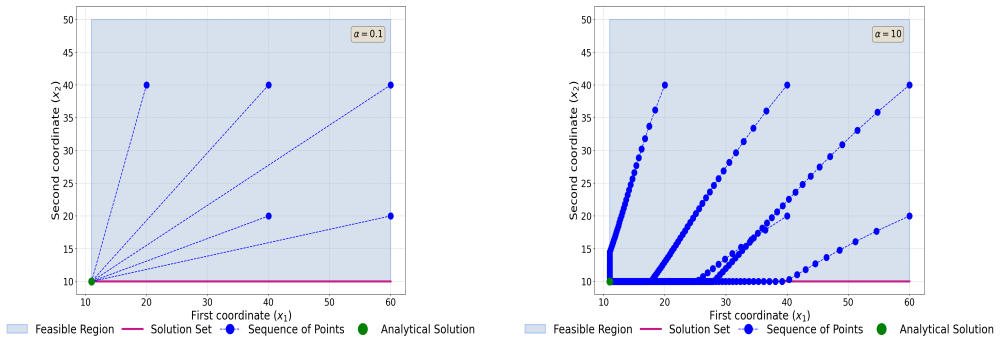
- [Section V, Numerical experiments] The experiment uses α=0.1 and γ=α/L^2 with L≈0.2+β_t, which yields q_k^2 > 1/2 and hence Q_k > 1. Thus the tested parameter regime is outside the (missing) sufficient condition for Theorem 8. The experiment therefore does not illustrate the convergence regime claimed by the theory, and the paper should either add the missing condition and choose parameters satisfying it, or revise the theory to cover the tested regime.
minor comments (5)
- [Lemma 7 proof] In the display after the monotonicity inequality, the intermediate term γ⟨g, Φ(v,w) - Φ(ū,w)⟩ is upper-bounded by γL_{α,β}∥v-ū∥, omitting the factor ∥g∥. The final bound is correct, but the line is a typo that should be fixed.
- [Abstract] Typo: 'various application' should be 'various applications'. Also the phrase 'strong convergence guarantees towards a solution of the nested VI problem' overstates Theorem 9, which establishes weak convergence of the outer sequence.
- [Section III-B] The derivation before the stopping time uses a bound ε/[θ_k(1 - q_k)] but the stopping time K(ε) is defined by ∥v_{k+1} - z_k∥ ≤ ε. Please clarify the relation between the two; as written, the bound with 1/(1-q_k) is not reflected in the stopping rule or in the error estimate (10).
- [Section V] The sentence 'Across inner loops, we consider the acceleration parameter τ_k ≡ τ to be constant and to be the largest value satisfying equation (11)' is ambiguous because equation (11) involves Q_k, which depends on β_t and therefore varies with the outer iteration t. Please specify whether τ is chosen uniformly over all t or re-tuned per inner loop.
- [Algorithm 1] Algorithm 1 sets v_0 = v_1 = w_1 and returns v_{K+1}; the update w_{t+1} = v_{K+1} is consistent with the text, but the pseudocode should specify how K_t is computed in practice and how the parameter sequences θ_k, τ_k are reset or continued across outer loops.
Circularity Check
No circularity found; the Q_k<1 gap in Theorem 8 is a proof correctness issue, not a circular dependency.
full rationale
The paper does not fit any parameter to data, rename a known result, or import a load-bearing assertion from a self-citation. The inner-loop convergence proof (Theorem 8) is derived from the contraction property of the forward-backward operator, Assumptions 3–4, and a Lyapunov-type analysis attributed to external works ([16], [23]); the outer-loop convergence proof (Theorem 9) derives weak convergence to S1 from monotonicity and weak sequential continuity, without assuming the target solution. The regularization template Φα,β is explicitly adopted from [1], but [1] is not a self-citation, and borrowing a construct is standard tool reuse, not circularity. The numerical experiments are illustrative and do not feed back into the analysis. The reviewer's concern about the unproven condition Q_k ∈ (0,1) needed to apply Lemma 5 in Theorem 8 is a legitimate correctness gap: the paper's own displayed formula Q_k = 1 − θ_k + 2θ_k q_k^2 and the parameter choices allowed by Assumptions 3–4 do not force Q_k < 1. However, that is a failure to verify a hypothesis of an external lemma, not a reduction of the theorem to its own assumptions. No equation is equivalent to its input by construction, and no claim is justified solely by a self-citation. Therefore the circularity score is 0.
Assumptions & free parameters
free parameters (5)
- alpha =
not fixed; numerics use 0.1, 1, 10
- beta_t =
(t+1)^(-0.55) in numerics
- epsilon_t =
10^(-3)(t+1)^(-2) in numerics
- gamma_t =
alpha/L^2 in numerics
- theta_k, tau_k =
constants in numerics, tau largest satisfying (11)
assumptions (6)
- domain assumption Assumption 1: G,F are monotone Lipschitz weakly sequentially continuous; A maximally monotone with bounded domain; S0 nonempty.
- ad hoc to paper Assumption 2: beta_t is not summable and e_t/beta_t -> 0.
- ad hoc to paper Assumption 3: theta_k, tau_k are bounded and tau_k is increasing.
- ad hoc to paper Assumption 4: the Lyapunov coefficient inequality (11) holds.
- ad hoc to paper Implicit Q_k < 1 requirement.
- standard math Standard monotone operator facts: resolvents nonexpansive, zer sets closed and convex, Lemma 2 and Lemma 5.
Cite this review
Pith. "Pith review of Tikhonov regularized exterior penalty methods for hierarchical variational inequalities." pith.science (2026). https://pith.science/paper/SEVIF6EB
@misc{pith2026250820872,
  author       = {Pith},
  title        = {Pith review of: Tikhonov regularized exterior penalty methods for hierarchical variational inequalities},
  year         = {2026},
  howpublished = {\url{https://pith.science/paper/SEVIF6EB}},
  note         = {Machine review of arXiv:2508.20872}
}
read the original abstract
We consider nested variational inequalities con- sisting in a (upper-level) variational inequality whose feasible set is given by the solution set of another (lower-level) variational inequality. This class of hierarchical equilibrium contains a wealth of important applications, including purely hierarchical convex bilevel optimization problems and certain multi-follower games. Working within a real Hilbert space setting, we develop a double loop prox-penalization algorithm with strong conver- gence guarantees towards a solution of the nested VI problem. We present various application that fit into our framework and present also some preliminary numerical results.
Figures

Reference graph
Works this paper leans on
-
[1]
F. Facchinei, J.-S. Pang, G. Scutari, and L. Lampariello, “Vi- constrained hemivariational inequalities: distributed algorithms and power control in ad-hoc networks,” Mathematical Programming , vol. 145, no. 1, pp. 59–96, 2014. [Online]. Available: https: //doi.org/10.1007/s10107-013-0640-5
-
[2]
On the optimal selection of generalized nash equilibria in linearly coupled aggregative games,
E. Benenati, W. Ananduta, and S. Grammatico, “On the optimal selection of generalized nash equilibria in linearly coupled aggregative games,” IEEE 61st Conference on Decision and Control (CDC) , pp. 6389–6394, 2022
work page 2022
-
[3]
A semi-decentralized tikhonov-based algorithm for optimal generalized nash equilibrium selection,
——, “A semi-decentralized tikhonov-based algorithm for optimal generalized nash equilibrium selection,” 62nd IEEE Conference on Decision and Control (CDC) , pp. 4243–4248, 2023
work page 2023
-
[4]
A method with convergence rates for optimization problems with variational inequality constraints,
H. D. Kaushik and F. Yousefian, “A method with convergence rates for optimization problems with variational inequality constraints,” SIAM Journal on Optimization , vol. 31, no. 3, pp. 2171–2198, 2021
work page 2021
-
[5]
I. Yamada, M. Yukawa, and M. Yamagishi, “Minimizing the moreau envelope of nonsmooth convex functions over the fixed point set of certain quasi-nonexpansive mappings,” in Fixed-Point Algorithms Fig. 3. Iterates for various initial points and α = 10. for Inverse Problems in Science and Engineering , 2011. [Online]. Available: https://api.semanticscholar.or...
work page 2011
-
[6]
An explicit descent method for bilevel convex optimiza- tion,
M. Solodov, “An explicit descent method for bilevel convex optimiza- tion,” Journal of Convex Analysis , vol. 14, no. 2, p. 227, 2007
work page 2007
-
[7]
Bilevel distributed optimization in directed networks,
F. Yousefian, “Bilevel distributed optimization in directed networks,” in 2021 American Control Conference (ACC). IEEE, 2021, pp. 2230– 2235
work page 2021
-
[8]
Distributed power allocation with rate constraints in gaussian parallel interference channels,
J. S. Pang, G. Scutari, F. Facchinei, and C. Wang, “Distributed power allocation with rate constraints in gaussian parallel interference channels,” IEEE Transactions on Information Theory , vol. 54, no. 8, pp. 3471–3489, 2008
work page 2008
Show all 26 references
-
[9]
Optimality conditions for a simple convex bilevel programming problem,
S. Dempe, N. Dinh, and J. Dutta, “Optimality conditions for a simple convex bilevel programming problem,” in Variational Analysis and Generalized Differentiation in Optimization and Control: In Honor of Boris S. Mordukhovich . Springer, 2010, pp. 149–161
2010
-
[10]
Simple bilevel programming and extensions,
S. Dempe, N. Dinh, J. Dutta, and T. Pandit, “Simple bilevel programming and extensions,” Mathematical Programming , vol. 188, no. 1, pp. 227–253, 2021. [Online]. Available: https: //doi.org/10.1007/s10107-020-01509-x
2021 doi
-
[11]
A first order method for solving convex bilevel optimization problems,
S. Sabach and S. Shtern, “A first order method for solving convex bilevel optimization problems,” SIAM Journal on Optimization , vol. 27, no. 2, pp. 640–660, 2017. [Online]. Available: https: //doi.org/10.1137/16M105592X
2017 doi
-
[12]
Penalization in non-classical convex programming via variational convergence,
P. Alart and B. Lemaire, “Penalization in non-classical convex programming via variational convergence,” Mathematical Programming, vol. 51, no. 1, pp. 307–331, 1991. [Online]. Available: https://doi.org/10.1007/BF01586942
1991 doi
-
[13]
Convergence of diagonally stationary sequences in convex optimization,
M. A. Bahraoui and B. Lemaire, “Convergence of diagonally stationary sequences in convex optimization,” Set-Valued Analysis , vol. 2, no. 1, pp. 49–61, 1994. [Online]. Available: https: //doi.org/10.1007/BF01027092
1994 doi
-
[14]
Coupling the proximal point algorithm with approximation methods,
R. Cominetti, “Coupling the proximal point algorithm with approximation methods,” Journal of Optimization Theory and Applications, vol. 95, no. 3, pp. 581–600, 1997. [Online]. Available: https://doi.org/10.1023/A:1022621905645
1997 doi
-
[15]
An inertial forward-backward algorithm for monotone inclusions,
D. A. Lorenz and T. Pock, “An inertial forward-backward algorithm for monotone inclusions,” Journal of Mathematical Imaging and Vision, vol. 51, no. 2, pp. 311–325, 2015. [Online]. Available: https://doi.org/10.1007/s10851-014-0523-2
2015 doi
-
[16]
Krasnoselskii-mann iterations: Inertia, perturbations and approximation,
D. Cortild and J. Peypouquet, “Krasnoselskii-mann iterations: Inertia, perturbations and approximation,” arXiv preprint arXiv:2401.16870 , 2024
2024 arXiv
-
[17]
Accelerated and inexact forward-backward algorithms,
S. Villa, S. Salzo, L. Baldassarre, and A. Verri, “Accelerated and inexact forward-backward algorithms,”SIAM Journal on Optimization, vol. 23, no. 3, pp. 1607–1633, 2013
2013
-
[18]
Convergence rate of inertial forward–backward algorithm beyond nesterov’s rule,
V . Apidopoulos, J.-F. Aujol, and C. Dossal, “Convergence rate of inertial forward–backward algorithm beyond nesterov’s rule,” Mathematical Programming , vol. 180, no. 1, pp. 137–156, 2020. [Online]. Available: https://doi.org/10.1007/s10107-018-1350-9
2020 doi
-
[19]
Towards viscosity approximations of hierarchical fixed-point problems,
A. Moudafi and P.-E. Maing ´e, “Towards viscosity approximations of hierarchical fixed-point problems,” Fixed Point Theory and Applica- tions, vol. 2006, pp. 1–10, 2006
2006
-
[20]
Strong convergence of an iterative method for hierarchical fixed-point problems,
P.-E. Maing ´e and A. Moudafi, “Strong convergence of an iterative method for hierarchical fixed-point problems,” Pacific Journal of Optimization, vol. 3, no. 3, pp. 529–538, 2007
2007
-
[21]
Explicit hierarchical fixed point approach to variational inequalities,
G. Marino and H.-K. Xu, “Explicit hierarchical fixed point approach to variational inequalities,” Journal of Optimization Theory and Applications, vol. 149, no. 1, pp. 61–78, 2011. [Online]. Available: https://doi.org/10.1007/s10957-010-9775-1
2011 doi
-
[22]
H. H. Bauschke and P. L. Combettes, Convex Analysis and Monotone Operator Theory in Hilbert Spaces . Springer - CMS Books in Mathematics, 2016
2016
-
[23]
An inertial proximal method for maximal monotone operators via discretization of a nonlinear oscillator with damping,
F. Alvarez and H. Attouch, “An inertial proximal method for maximal monotone operators via discretization of a nonlinear oscillator with damping,” Set-Valued Analysis , vol. 9, no. 1, pp. 3–11, 2001. [Online]. Available: https://doi.org/10.1023/A:1011253113155
2001 doi
-
[24]
An algorithm for total variation minimization and applications,
A. Chambolle, “An algorithm for total variation minimization and applications,” Journal of Mathematical Imaging and Vision , vol. 20, no. 1, pp. 89–97, 2004. [Online]. Available: https://doi.org/10.1023/B: JMIV .0000011325.36760.1e
2004
-
[25]
The composite absolute penalties family for grouped and hierarchical variable selection,
P. Zhao, G. Rocha, and B. Yu, “The composite absolute penalties family for grouped and hierarchical variable selection,” The Annals of Statistics , vol. 37, no. 6A, pp. 3468–3497, 12 2009. [Online]. Available: https://doi.org/10.1214/07-AOS584
2009 doi
-
[26]
Improved guarantees for optimal nash equilibrium seeking and bilevel variational inequalities,
S. Samadi and F. Yousefian, “Improved guarantees for optimal nash equilibrium seeking and bilevel variational inequalities,”SIAM Journal on Optimization, vol. 35, no. 1, pp. 369–399, 2025
2025
Reviewed August 5, 2026 · model on record in the stance chip above.
Discussion (0). Continue with ORCID to comment.