REVIEW 3 major objections 5 minor 55 references
Keep the Future, Drop the Rollout: RIFT for World Action Models
T0 review · 3 major / 5 minor · reviewed 2026-08-16 · deepseek-v4-flash
Pith's one-line read Robot actions need the future representation, not the video rollout that produces it, and RIFT builds that future in one pass.
desk verdict Strong empirical case that WAM action experts need only a fixed future cache, not the rollout that builds it; the main open question is whether the cache is truly action-independent, and there is no code to verify. read the letter →
The pith
A machine-rendered reading of the paper's core claim, the machinery that carries it, and where it could break.
The reading
What carries the argument
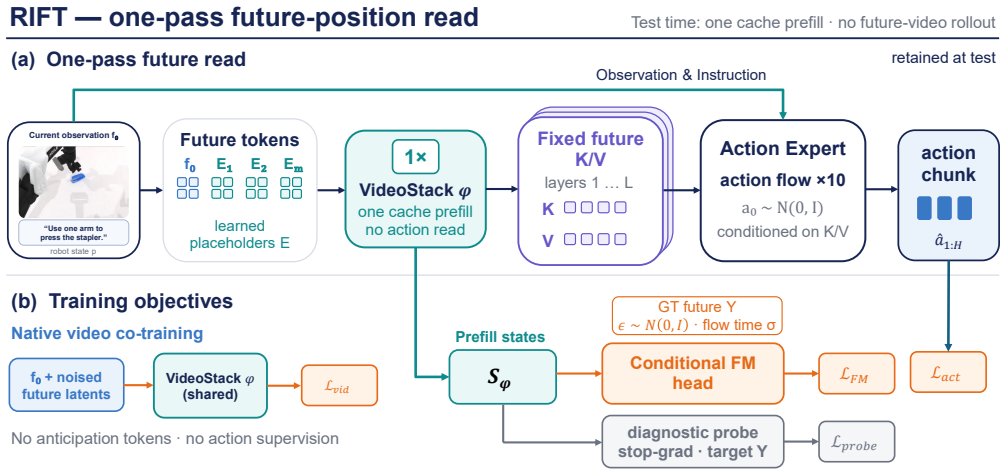
The load-bearing object is the future-position K/V cache: the per-layer key/value pairs at future temporal positions through which the video branch conditions the action expert in a world action model. The argument's leverage comes from the attention mask that forbids video tokens from attending to action tokens, making the cache an action-independent intervention site and enabling clean record-and-replay edits. The decisive experimental move is final-clean replay, substituting one cached final clean K/V pair for the entire evolving trajectory at every action-denoising step. On the production side, RIFT inserts learned anticipation tokens at future spatiotemporal positions and maps them, in one video-backbone pass, to a complete K/V cache; these tokens are trained with conditional flow matching rather than direct L2 regression to avoid averaging over distinct valid futures.
What would settle it
A concrete test: at deployment, replace RIFT's learned anticipation tokens with random noise while keeping the same keys and values at future positions; if success stays near 98.8%, the future content is not load-bearing and the sensitivity findings are contradicted. A second check: remove the attention mask so video tokens can attend to action tokens, then repeat the final-clean replay; if execution is still preserved, the earlier replay effect would be an artifact of the masked cache rather than evidence about the action expert's causal dependence.
Extended reading notes
Core claim
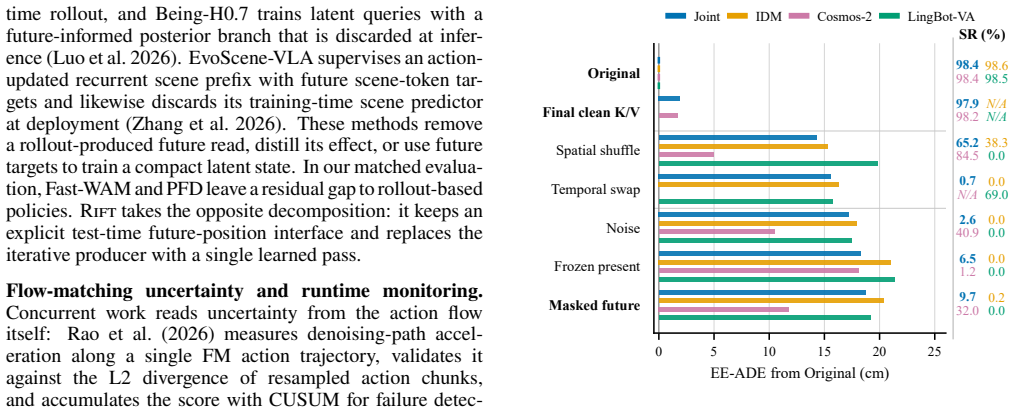
The central claim is causal: in the studied world-action-model family, action generation depends on the future representation's content and its assignment to fixed positions, but not on the denoising trajectory that constructs it. The evidence comes from the future-position K/V cache, the per-layer keys and values through which video tokens condition action tokens. Because the attention mask prevents video tokens from attending to action tokens, the cache is action-independent given observation, language, and video-generation randomness, making it a clean intervention site. Masking the future read collapses success from roughly 98% to 0–32%; spatial shuffling or temporal swapping of future values also disrupts execution. Yet replacing the entire evolving cache with one fixed final-clean cache leaves Joint and Cosmos-2 at 97.9–98.2% success with 1.7–1.9 cm end-effector average displacement error. The paper therefore separates consumption from production, and RIFT replaces the rollout producer with a one-pass learned prefill, achieving 98.8% success on LIBERO while retaining the original future-read interface.
Load-bearing premise
The intervention and replay conclusions hold only if the future K/V cache is truly action-independent given observation, language, and video-generation randomness; any leakage of action information into the cache despite the attention mask would confound the final-clean replay result and the claim that the rollout trajectory is unnecessary.
Editorial extensions
If this is right
- If only the final-clean future representation matters, any one-shot future producer—learned, distilled, or otherwise—can replace iterative video diffusion without retraining the action expert's read interface.
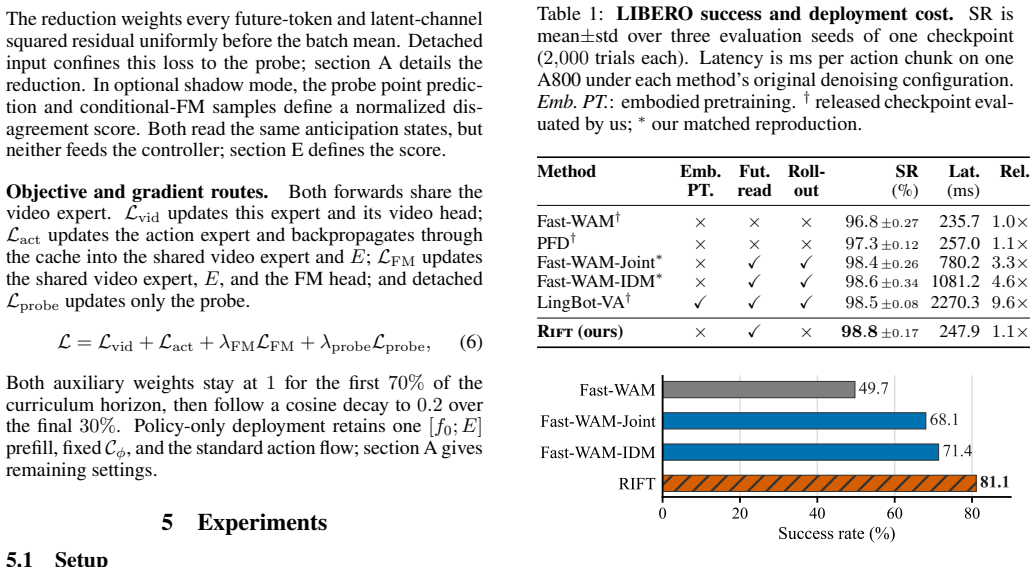
- Deployment latency of future-conditioned policies drops from 3.3–9.6× current-only cost to about 1.1×, turning a planning-speed computation into an interactive-control-speed one.
- Because the future cache is action-independent, future prediction and action generation can be trained, and in principle deployed, asynchronously or in parallel, with no feedback from actions into the video branch.
- The latency saving per chunk should grow with chunk horizon, since one prefill serves all action steps; the paper uses H=32 and the same cache for every denoising evaluation.
- On the out-of-distribution LIBERO-Plus set, the one-pass cache outperforms the rollout-based checkpoints tested (81.1% overall vs 68.1% and 71.4%), suggesting the single-pass interface may also transfer more cleanly to unseen perturbations.
Reading between the lines
- If the consumption–production separation holds beyond the four architectures studied, then video-generation quality at deployment becomes a non-issue: research effort can shift from faster diffusion samplers to single-shot future-latent estimators that leave the action head untouched.
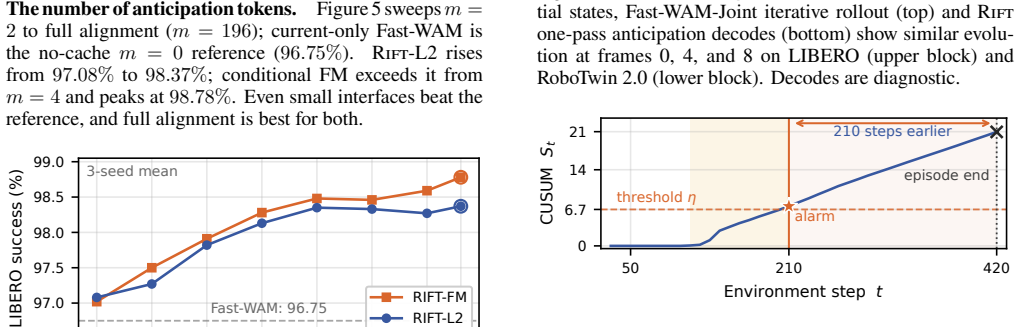
- The optional L2–FM disagreement monitor points to a testable extension: the same anticipation states that drive the controller could drive online failure detection in a rollout-free system, giving a risk signal that does not require video generation.
- A direct ablation RIFT does not report: replacing the learned anticipation tokens with random noise at test time, while keeping the same cache structure; if success stayed near 98.8%, the future content itself would be shown to be non-causal, contradicting the sensitivity findings.
- If the future cache is truly action-independent, a single prefill might be reusable across multiple action experts or even multiple robot embodiments sharing the same observation stream, which would amortize the one-pass cost further.
Signed reviews
Editorial analysis
A structured set of objections, weighed in public.
Referee Report
Summary. The paper asks whether world action models (WAMs) require the iterative video rollout trajectory at deployment or only some final future representation. To answer this, the authors introduce a paired closed-loop intervention protocol on the per-layer future K/V cache of four WAMs, running 2,000 paired trials across all 40 LIBERO tasks. Masking or scrambling future values substantially degrades success, but for Joint and Cosmos-2 replaying one fixed final-clean K/V cache at every action-denoising step nearly preserves execution (1.7--1.9 cm EE-ADE, 97.9--98.2% success). The paper interprets this as separating consumption-sufficiency from production: the action expert can reuse a fixed cache, even though such a cache is normally produced by iterative rollout. To exploit this, the paper proposes RIFT, which replaces rolled-out future tokens with learned anticipation tokens that fill the complete future K/V cache in one backbone pass. On LIBERO, RIFT achieves 98.8% success at 1.1x current-only latency, and on RoboTwin 2.0 it reaches 92.9%/92.6% success on clean/randomized scenes, the highest among the evaluated methods.
Significance. If the claims hold, the paper makes two contributions: a mechanistic decomposition of WAM future conditioning, showing that the evolving rollout trajectory is not causally required for action generation once a final clean future cache is available; and a practical method (RIFT) that retains explicit future conditioning without iterative video generation, cutting deployment latency by 68--89% while matching or exceeding the success of rollout-based baselines. The intervention methodology is a strength: interventions are paired, use 2,000 trials per condition, report both success and end-effector displacement, and provide bootstrap confidence intervals for EE-ADE. The paper is also careful to limit the causal interpretation of the intervention to consumption-sufficiency and to state that production-side sufficiency is a separate hypothesis tested by RIFT. However, the load-bearing action-independence assumption is not empirically verified, RIFT's use of the cache is not causally confirmed, and the RoboTwin comparison rests on single-seed evaluation. These gaps require attention before the central claims are fully supported.
major comments (3)
- [Section 3.1 and Section 3.5] The final-clean replay result that underpins the separation of 'future representation' from 'rollout trajectory' relies on the assertion that the video-to-action attention mask makes the future K/V cache action-independent. The paper states that 'video tokens never attend action tokens' but does not provide any empirical check of this property, and no code is released to allow reviewers to inspect the implementation for leakage paths such as shared normalization, positional embeddings, or conditioning injections that might still couple the cache to the action sequence. If action-dependent information leaks into the cache, then replaying the final-clean cache recorded from Original would bias the action expert toward the original actions, trivially explaining the 1.7--1.9 cm EE-ADE and 97.9--98.2% success. Please verify action-independence directly: for fixed observation, language, and video noise, show that the recorded per-layer K/V cache is invariant to the action sequence (e.g., by running two rollouts with different action trajectories and comparing the caches), or release the implementation so that the mask can be audited.
- [Section 5.2 and Section 4.3] The claim that RIFT achieves 'rollout-free future conditioning' requires evidence that the action expert in RIFT actually depends on the produced cache at test time. The frozen-model intervention study does not transfer to RIFT because RIFT is a newly trained architecture; the success gain over Fast-WAM could in principle come from the auxiliary training objectives (L_FM and L_probe) reshaping the shared video expert rather than from the action expert reading the future-position cache. An ablation that masks or corrupts the RIFT future cache at inference, measuring success and EE-ADE against the unmodified RIFT, is needed to confirm that the cache is causally used. Without such a check, the paper has not shown that the future read--rather than the training signal--is responsible for RIFT's performance.
- [Table 2 and Section 5.2] The RoboTwin 2.0 comparison reports RIFT as the 'highest observed' method (92.9/92.6 clean/randomized, average 92.8) but uses a single checkpoint per method with no multiple evaluation seeds and no confidence intervals. The margin over PFD (92.5/92.1, average 92.3) and LingBot-VA (92.4/91.4, average 91.9) is small relative to the 100-trial-per-task protocol, which yields roughly 0.3--0.5 percentage-point standard errors per task average. Please either add multi-seed replication with reported dispersion or temper the claim to 'competitive with' rather than 'the highest observed' for RoboTwin 2.0.
minor comments (5)
- [Throughout] The method name is inconsistently typeset as both 'RIFT' and 'Rift'; please standardize to one form.
- [Figure 2] The compact block listing SR values is very small and difficult to read; a table or a larger inset would improve legibility.
- [Section 2] The paragraph on 'Flow-matching uncertainty and runtime monitoring' reads as a digression from the paper's main narrative; consider abbreviating it or moving it to an appendix, since the L2--FM warning is an optional side result.
- [Section 5.4 and Appendix E] The L2--FM uncertainty warning is calibrated on 1,967 successful episodes and evaluated on only 33 failed rollouts; this is a very small sample and the 210-step average advance should be described as a preliminary observation rather than a validated detector.
- [Table 3 caption] The N/A entries for final-clean replay in IDM and temporal swap in Cosmos-2 are structural and correctly explained, but the caption could note explicitly that these are not missing runs for the reader's convenience.
Circularity Check
No significant circularity: the paper's central claims are tested by direct interventions and external benchmarks, with only a non-load-bearing self-citation.
full rationale
The paper's central diagnostic claim—that WAM action experts consume a future representation with position-bound value content but do not require the evolving rollout trajectory—is established by direct paired closed-loop interventions (masking, spatial/temporal edits, final-clean K/V replay) measured against unmodified execution, rather than derived from assumptions containing the result. The action-independence of the cache is an architectural premise (video tokens never attend action tokens), not a conclusion equivalent to the paper's thesis; it is an implementation assumption that could be empirically wrong, which is a correctness/validity risk, not circularity. The paper explicitly limits Finding 2 to consumption-side sufficiency and states the cache remains rollout-produced, so the production question is tested separately by RIFT's one-pass prefill trained with a conditional-flow-matching objective and evaluated on external benchmarks (LIBERO, LIBERO-Plus, RoboTwin 2.0). The only self-citation (EvoScene-VLA) appears in related work and is not load-bearing; the shared backbone is the externally published Fast-WAM. No equation or fitted parameter is renamed as a prediction, and no uniqueness theorem is invoked.
Assumptions & free parameters
free parameters (4)
- Anticipation token count m =
196 (LIBERO), 240 (RoboTwin 2.0)
- Curriculum perturbation probability =
0.3 (after 70% of horizon)
- Curriculum perturbation scale =
0.06 times latent standard deviation
- Auxiliary loss weights lambda_FM and lambda_probe =
1.0 decaying to 0.2
assumptions (4)
- domain assumption Future K/V cache is the sole channel by which predicted futures influence action tokens.
- domain assumption LIBERO and RoboTwin 2.0 closed-loop success and EE-ADE are valid proxies for policy quality.
- domain assumption The Wan2.2-5B video backbone and Fast-WAM training recipe constitute a fair base for comparison.
- standard math Standard flow-matching and attention mathematics hold as implemented.
invented entities (1)
-
Anticipation tokens E (RIFT)
independent evidence
Cite this review
Pith. "Pith review of Keep the Future, Drop the Rollout: RIFT for World Action Models." pith.science (2026). https://pith.science/paper/SEZYVPRP
@misc{pith2026260811521,
  author       = {Pith},
  title        = {Pith review of: Keep the Future, Drop the Rollout: RIFT for World Action Models},
  year         = {2026},
  howpublished = {\url{https://pith.science/paper/SEZYVPRP}},
  note         = {Machine review of arXiv:2608.11521}
}
abstract
World action models (WAMs) condition robot actions on predicted futures, but iterative video rollout increases deployment latency. We ask whether action generation requires the evolving rollout trajectory or only its future representation. Across four WAMs on all 40 LIBERO tasks, paired closed-loop interventions show that masking or reassigning future-cache values changes execution and reduces success, indicating sensitivity to future values and their assigned positions. For Joint and Cosmos-2, however, replaying one fixed final-clean key/value (K/V) cache nearly preserves unmodified execution, with $1.7$ to $1.9$~cm end-effector average displacement error and $97.9\%$ to $98.2\%$ success. This separates cache consumption from production: these models can reuse a fixed cache but still require iterative rollout to construct it. We therefore propose RIFT (\emph{Rollout-free Imagination via Future Tokens}), which uses learned anticipation tokens to construct a complete future K/V cache in one backbone pass while retaining the original future-read interface. On LIBERO, RIFT achieves $98.8\%$ success, close to rollout-based Joint, IDM, and LingBot-VA at $98.4\%$ to $98.6\%$, while reducing action-chunk latency by $68.2\%$ to $89.1\%$. On RoboTwin~2.0, RIFT reaches $92.9/92.6\%$ on clean/randomized scenes, the highest observed among the evaluated methods. These results support rollout-free future conditioning without iterative video generation at deployment.
Figures

Figures from the paper (5 more)



Reference graph
Works this paper leans on
-
[1]
arXiv preprint arXiv:2604.25859 , year =
Pengcheng Fang and Hongli Chen and Xiaohao Cai , title =. arXiv preprint arXiv:2604.25859 , year =
-
[2]
arXiv preprint arXiv:2603.16666 , year =
Tianyuan Yuan and Zibin Dong and Yicheng Liu and Hang Zhao , title =. arXiv preprint arXiv:2603.16666 , year =
-
[3]
arXiv preprint arXiv:2605.00078 , year =
Hao Luo and Wanpeng Zhang and Yicheng Feng and Sipeng Zheng and Haiweng Xu and Chaoyi Xu and Ziheng Xi and Yuhui Fu and Zongqing Lu , title =. arXiv preprint arXiv:2605.00078 , year =
-
[4]
EvoScene-VLA: Evolving Scene Beliefs Inside the Action Decoder for Chunked Robot Control
Chushan Zhang and Ruihan Lu and Jinguang Tong and Xuesong Li and Yikai Wang and Hongdong Li , title =. arXiv preprint arXiv:2605.21862 , year =. doi:10.48550/arXiv.2605.21862 , url =
-
[5]
Wan: Open and Advanced Large-Scale Video Generative Models , journal =. 2025 , url =
work page 2025
-
[6]
arXiv preprint arXiv:2602.15922 , year =
Seonghyeon Ye and Yunhao Ge and Kaiyuan Zheng and Shenyuan Gao and Sihyun Yu and George Kurian and others , title =. arXiv preprint arXiv:2602.15922 , year =
-
[7]
arXiv preprint arXiv:2601.21998 , year =
Lin Li and Qihang Zhang and Yiming Luo and Shuai Yang and Ruilin Wang and Fei Han and Mingrui Yu and Zelin Gao and Nan Xue and Xing Zhu and Yujun Shen and Yinghao Xu , title =. arXiv preprint arXiv:2601.21998 , year =
-
[8]
arXiv preprint arXiv:2512.13030 , year =
Hongzhe Bi and Hengkai Tan and Shenghao Xie and Zeyuan Wang and Shuhe Huang and Haitian Liu and Ruowen Zhao and Yao Feng and Chendong Xiang and Yinze Rong and Hongyan Zhao and Hanyu Liu and Zhizhong Su and Lei Ma and Hang Su and Jun Zhu , title =. arXiv preprint arXiv:2512.13030 , year =
Show all 55 references
-
[9]
Robotics: Science and Systems (RSS) , year =
Cheng Chi and Siyuan Feng and Yilun Du and Zhenjia Xu and Eric Cousineau and Benjamin Burchfiel and Shuran Song , title =. Robotics: Science and Systems (RSS) , year =
-
[10]
Conference on Robot Learning (CoRL) , year =
Moo Jin Kim and Karl Pertsch and Siddharth Karamcheti and Ted Xiao and Ashwin Balakrishna and Suraj Nair and Rafael Rafailov and Ethan Foster and Grace Lam and Pannag Sanketi and Quan Vuong and Thomas Kollar and Benjamin Burchfiel and Russ Tedrake and Dorsa Sadigh and Sergey L...
-
[11]
arXiv preprint arXiv:2410.07864 , year =
Songming Liu and Lingxuan Wu and Bangguo Li and Hengkai Tan and Huayu Chen and Zhengyi Wang and Ke Xu and Hang Su and Jun Zhu , title =. arXiv preprint arXiv:2410.07864 , year =
-
[12]
arXiv preprint arXiv:2502.05855 , year =
Junjie Wen and Yichen Zhu and Jinming Li and Zhibin Tang and Chaomin Shen and Feifei Feng , title =. arXiv preprint arXiv:2502.05855 , year =
-
[13]
Conference on Robot Learning (CoRL) , year =
Brianna Zitkovich and Tianhe Yu and Sichun Xu and Peng Xu and Ted Xiao and Fei Xia and Jialin Wu and Paul Wohlhart and Stefan Welker and Ayzaan Wahid and others , title =. Conference on Robot Learning (CoRL) , year =
-
[14]
arXiv preprint arXiv:2410.24164 , year =
Kevin Black and Noah Brown and Danny Driess and Adnan Esmail and Michael Equi and Chelsea Finn and Niccolo Fusai and Lachy Groom and Karol Hausman and Brian Ichter and others , title =. arXiv preprint arXiv:2410.24164 , year =
-
[15]
arXiv preprint arXiv:2504.16054 , year =
-
[16]
arXiv preprint arXiv:2503.14734 , year =
Johan Bjorck and Fernando Casta. arXiv preprint arXiv:2503.14734 , year =
-
[17]
arXiv preprint arXiv:2506.01844 , year =
Mustafa Shukor and Dana Aubakirova and Francesco Capuano and Pepijn Kooijmans and Steven Palma and Adil Zouitine and Michel Aractingi and Caroline Pascal and Martino Russi and Andres Marafioti and others , title =. arXiv preprint arXiv:2506.01844 , year =
-
[18]
arXiv preprint arXiv:2503.20020 , year =
Gemini Robotics: Bringing. arXiv preprint arXiv:2503.20020 , year =
-
[19]
Nature , volume =
Julian Schrittwieser and Ioannis Antonoglou and Thomas Hubert and Karen Simonyan and Laurent Sifre and Simon Schmitt and Arthur Guez and Edward Lockhart and Demis Hassabis and Thore Graepel and Timothy Lillicrap and David Silver , title =. Nature , volume =. 2020 , doi =
2020
-
[20]
arXiv preprint arXiv:2301.04104 , year =
Danijar Hafner and Jurgis Pasukonis and Jimmy Ba and Timothy Lillicrap , title =. arXiv preprint arXiv:2301.04104 , year =
-
[21]
International Conference on Learning Representations (ICLR) , year =
Nicklas Hansen and Hao Su and Xiaolong Wang , title =. International Conference on Learning Representations (ICLR) , year =
-
[22]
Tenenbaum and Dale Schuurmans and Pieter Abbeel , title =
Yilun Du and Mengjiao Yang and Bo Dai and Hanjun Dai and Ofir Nachum and Joshua B. Tenenbaum and Dale Schuurmans and Pieter Abbeel , title =. Advances in Neural Information Processing Systems (NeurIPS) , year =
-
[23]
International Conference on Learning Representations (ICLR) , year =
Kevin Black and Mitsuhiko Nakamoto and Pranav Atreya and Homer Walke and Chelsea Finn and Aviral Kumar and Sergey Levine , title =. International Conference on Learning Representations (ICLR) , year =
-
[24]
arXiv preprint arXiv:2508.00795 , year =
Junbang Liang and Pavel Tokmakov and Ruoshi Liu and Sruthi Sudhakar and Paarth Shah and Rares Ambrus and Carl Vondrick , title =. arXiv preprint arXiv:2508.00795 , year =
-
[25]
arXiv preprint arXiv:2409.16283 , year =
Homanga Bharadhwaj and Debidatta Dwibedi and Abhinav Gupta and Shubham Tulsiani and Carl Doersch and Ted Xiao and Dhruv Shah and Fei Xia and Dorsa Sadigh and Sean Kirmani , title =. arXiv preprint arXiv:2409.16283 , year =
-
[26]
arXiv preprint arXiv:2404.12377 , year =
Siyuan Zhou and Yilun Du and Jiaben Chen and Yandong Li and Dit-Yan Yeung and Chuang Gan , title =. arXiv preprint arXiv:2404.12377 , year =
-
[27]
International Conference on Learning Representations (ICLR) , year =
Hongtao Wu and Ya Jing and Chilam Cheang and Guangzeng Chen and Jiafeng Xu and Xinghang Li and Minghuan Liu and Hang Li and Tao Kong , title =. International Conference on Learning Representations (ICLR) , year =
-
[28]
arXiv preprint arXiv:2410.06158 , year =
Chi-Lam Cheang and Guangzeng Chen and Ya Jing and Tao Kong and Hang Li and Yifeng Li and Yuxiao Liu and Hongtao Wu and Jiafeng Xu and Yichu Yang and Hanbo Zhang and Minzhao Zhu , title =. arXiv preprint arXiv:2410.06158 , year =
-
[29]
International Conference on Machine Learning (ICML) , year =
Yucheng Hu and Yanjiang Guo and Pengchao Wang and Xiaoyu Chen and Yen-Jen Wang and Jianke Zhang and Koushil Sreenath and Chaochao Lu and Jianyu Chen , title =. International Conference on Machine Learning (ICML) , year =
-
[30]
arXiv preprint arXiv:2503.00200 , year =
Shuang Li and Yihuai Gao and Dorsa Sadigh and Shuran Song , title =. arXiv preprint arXiv:2503.00200 , year =
-
[31]
arXiv preprint arXiv:2504.02792 , year =
Chuning Zhu and Raymond Yu and Siyuan Feng and Benjamin Burchfiel and Paarth Shah and Abhishek Gupta , title =. arXiv preprint arXiv:2504.02792 , year =
-
[32]
arXiv preprint arXiv:2507.12898 , year =
Yao Feng and Hengkai Tan and Xinyi Mao and Chendong Xiang and Guodong Liu and Shuhe Huang and Hang Su and Jun Zhu , title =. arXiv preprint arXiv:2507.12898 , year =
-
[33]
arXiv preprint arXiv:2512.15692 , year =
Jonas Pai and Liam Achenbach and Victoriano Montesinos and Benedek Forrai and Oier Mees and Elvis Nava , title =. arXiv preprint arXiv:2512.15692 , year =
-
[34]
arXiv preprint arXiv:2510.27607 , year =
John Won and Kyungmin Lee and Huiwon Jang and Dongyoung Kim and Jinwoo Shin , title =. arXiv preprint arXiv:2510.27607 , year =
-
[35]
arXiv preprint arXiv:2505.12705 , year =
Joel Jang and Seonghyeon Ye and Zongyu Lin and Jiannan Xiang and Johan Bjorck and Yu Fang and Fengyuan Hu and Spencer Huang and Kaushil Kundalia and Yen-Chen Lin and others , title =. arXiv preprint arXiv:2505.12705 , year =
-
[36]
arXiv preprint arXiv:2503.22020 , year =
Qingqing Zhao and Yao Lu and Moo Jin Kim and Zipeng Fu and Zhuoyang Zhang and Yecheng Wu and Zhaoshuo Li and Qianli Ma and Song Han and Chelsea Finn and Ankur Handa and Ming-Yu Liu and Donglai Xiang and Gordon Wetzstein and Tsung-Yi Lin , title =. arXiv preprint arXiv:2503.220...
-
[37]
arXiv preprint arXiv:2511.17502 , year =
Jun Cen and Siteng Huang and Yuqian Yuan and Kehan Li and Hangjie Yuan and Chaohui Yu and Yuming Jiang and Jiayan Guo and Xin Li and Hao Luo and Fan Wang and Fan Wang and Deli Zhao , title =. arXiv preprint arXiv:2511.17502 , year =
-
[38]
arXiv preprint arXiv:2505.15659 , year =
Ruijie Zheng and Jing Wang and Scott Reed and Johan Bjorck and Yu Fang and Fengyuan Hu and Joel Jang and Kaushil Kundalia and Zongyu Lin and Loic Magne and others , title =. arXiv preprint arXiv:2505.15659 , year =
-
[39]
CoRR , volume =
Wenyao Zhang and Hongsi Liu and Zekun Qi and Yunan Wang and Xinqiang Yu and Jiazhao Zhang and Runpei Dong and Jiawei He and He Wang and Zhizheng Zhang and Li Yi and Wenjun Zeng and Xin Jin , title =. CoRR , volume =. 2025 , doi =
2025
-
[40]
arXiv preprint arXiv:2601.16163 , year =
Moo Jin Kim and Yihuai Gao and Tsung-Yi Lin and Yen-Chen Lin and Yunhao Ge and Grace Lam and Percy Liang and Shuran Song and Ming-Yu Liu and Chelsea Finn and Jinwei Gu , title =. arXiv preprint arXiv:2601.16163 , year =
-
[41]
arXiv preprint arXiv:2508.05635 , year =
Yue Liao and Pengfei Zhou and Siyuan Huang and Donglin Yang and Shengcong Chen and Yuxin Jiang and Yue Hu and Jingbin Cai and Si Liu and Jianlan Luo and Liliang Chen and Shuicheng Yan and Maoqing Yao and Guanghui Ren , title =. arXiv preprint arXiv:2508.05635 , year =
-
[42]
Advances in Neural Information Processing Systems , volume =
Kevin Meng and David Bau and Alex Andonian and Yonatan Belinkov , title =. Advances in Neural Information Processing Systems , volume =. 2022 , doi =
2022
-
[43]
arXiv preprint arXiv:1610.01644 , year =
Guillaume Alain and Yoshua Bengio , title =. arXiv preprint arXiv:1610.01644 , year =
-
[44]
Computational Linguistics , volume =
Yonatan Belinkov , title =. Computational Linguistics , volume =
-
[45]
Wallace , title =
Sarthak Jain and Byron C. Wallace , title =. Conference of the North American Chapter of the Association for Computational Linguistics (NAACL) , year =
-
[46]
Smith , title =
Sofia Serrano and Noah A. Smith , title =. Annual Meeting of the Association for Computational Linguistics (ACL) , year =
-
[47]
Neural Networks , volume =
Vladimir Vapnik and Akshay Vashist , title =. Neural Networks , volume =. 2009 , doi =
2009
-
[48]
Learning by Cheating , booktitle =
Dian Chen and Brady Zhou and Vladlen Koltun and Philipp Kr. Learning by Cheating , booktitle =. 2019 , url =
2019
-
[49]
arXiv preprint arXiv:2506.18088 , year =
Tianxing Chen and Zanxin Chen and Baijun Chen and Zijian Cai and Yibin Liu and Zixuan Li and Qiwei Liang and Xianliang Lin and Yiheng Ge and Zhenyu Gu and others , title =. arXiv preprint arXiv:2506.18088 , year =
-
[50]
Advances in Neural Information Processing Systems (NeurIPS) , year =
Bo Liu and Yifeng Zhu and Chongkai Gao and Yihao Feng and Qiang Liu and Yuke Zhu and Peter Stone , title =. Advances in Neural Information Processing Systems (NeurIPS) , year =
-
[51]
Proceedings of the IEEE/CVF Conference on Computer Vision and Pattern Recognition (CVPR) , pages =
Senyu Fei and Siyin Wang and Junhao Shi and Zihao Dai and Jikun Cai and Pengfang Qian and Li Ji and Xinzhe He and Shiduo Zhang and Zhaoye Fei and Jinlan Fu and Jingjing Gong and Xipeng Qiu , title =. Proceedings of the IEEE/CVF Conference on Computer Vision and Pattern Recogni...
-
[52]
European Conference on Computer Vision (ECCV) , year =
Nicolas Carion and Francisco Massa and Gabriel Synnaeve and Nicolas Usunier and Alexander Kirillov and Sergey Zagoruyko , title =. European Conference on Computer Vision (ECCV) , year =
-
[53]
Vision Transformers Need Registers , booktitle =
Timoth. Vision Transformers Need Registers , booktitle =
-
[54]
Yaron Lipman and Ricky T. Q. Chen and Heli Ben-Hamu and Maximilian Nickel and Matt Le , title =. International Conference on Learning Representations (ICLR) , year =
- [55]
Reviewed August 16, 2026 · model on record in the stance chip above.
Discussion (0). Continue with ORCID to comment.