REVIEW 4 major objections 6 minor 68 references
Learning from the Good Ones: Risk Profiling-Based Defenses Against Evasion Attacks on DNNs
T0 review · 4 major / 6 minor · reviewed 2026-08-15 · deepseek-v4-flash
Pith's one-line read A risk-profiling framework selects resilient patients to train anomaly detectors, lifting recall by up to 27.5%.
desk verdict A plausible risk-profiling idea for training static anomaly detectors, but the headline recall gain rests on an evaluation protocol that likely includes training patients in the test set, so the central claim is not yet established. read the letter →
The pith
A machine-rendered reading of the paper's core claim, the machinery that carries it, and where it could break.
The reading
What carries the argument
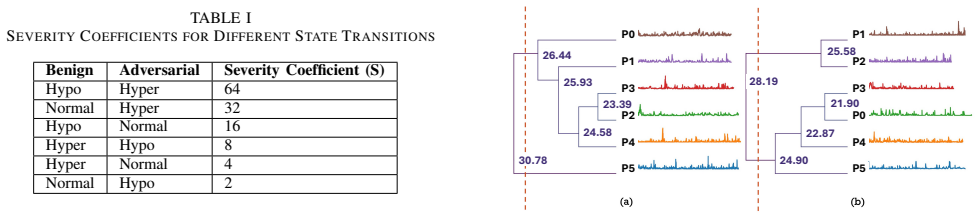
The central object is the risk profile, a time series of instantaneous risk values $R_t = S * Z_t$, where $Z_t$ is the squared difference between benign and adversarial glucose predictions and $S$ is a hand-assigned severity coefficient for the state transition (e.g., hypoglycemia to hyperglycemia gets 64). These profiles are computed for every patient, then clustered with hierarchical clustering to separate 'less vulnerable' from 'more vulnerable' victims. The framework's final step trains existing anomaly detectors (kNN, OneClassSVM, MAD-GAN) only on the data of the less-vulnerable cluster. The risk profile and clustering carry the argument because they identify which instances the defense should learn from.
What would settle it
Train the same three anomaly detectors on the 'less vulnerable' patients identified using a different severity-coefficient set (e.g., linear coefficients or values from a clinician) and a different clustering threshold; if the recall gain over indiscriminate training disappears or reverses, the result is an artifact of the specific coefficient and clustering choices rather than of vulnerability-based selective training.
Extended reading notes
Core claim
The central discovery is that training static anomaly detectors on the instances least vulnerable to a specific evasion attack improves their ability to catch that attack, compared with training on the full dataset. The paper demonstrates this on the OhioT1DM blood glucose dataset using the URET attack: patients whom the risk framework labels 'less vulnerable' produce detectors with recall increases of 27.5% (kNN), 16.8% (OneClassSVM), and unchanged perfect recall for MAD-GAN at 75% less training data. The authors interpret this as evidence that less vulnerable instances better represent typical benign data, so detectors learn to distinguish benign from malicious abnormalities.
Load-bearing premise
The hand-picked exponential severity coefficients and the hierarchical clustering cut decide which patients are called 'less vulnerable,' and the entire recall improvement depends on those choices marking out the same patients that are actually hardest to attack.
Editorial extensions
If this is right
- Static anomaly detectors can become more adaptable to evolving attacks without the computational cost of dynamic defenses, by retraining on freshly profiled low-risk instances.
- In safety-critical medical settings, reducing false negatives through selective training may prevent missed attack detections that could lead to insulin overdose or underdose.
- Training on a smaller, curated subset can cut training cost and data requirements; the MAD-GAN result shows maintained recall with a 75% reduction in training-set size.
- The framework's reliance on attack simulation means the selected 'less vulnerable' instances are attack-specific, so the defense is tied to the threat model used in profiling.
Reading between the lines
- The same selective-training principle could apply beyond healthcare: any static detector facing evasion attacks in cyber-physical systems (e.g., autonomous driving) might benefit from profiling instances for vulnerability and training on the most typical ones.
- The paper validates its clusters against the very attack success rates the defense is meant to detect; a cleaner future test would profile with one attack and evaluate with a different attack, to see whether the identified 'less vulnerable' instances generalize.
- If the risk coefficients are clinician-specified, the framework could become a practical tool for personalized medicine, where each patient's physiology determines their training weight.
- The reported recall gains might partly reflect a decrease in training-set noise rather than vulnerability per se; an ablation that trains on random small subsets of equal size would isolate the effect of the risk-based selection.
Signed reviews
Editorial analysis
A structured set of objections, weighed in public.
Referee Report
Summary. The paper proposes a risk profiling framework for selectively training static anomaly detectors on victim instances (patients) judged less vulnerable to evasion attacks, with the goal of reducing false negatives while retaining precision. The framework simulates a URET evasion attack, computes an instantaneous risk R_t = S * Z_t (Eq. 1), constructs patient risk profiles, hierarchically clusters the profiles, labels clusters by cross-checking against attack success percentages, and trains kNN, OneClassSVM, and MAD-GAN detectors on the less-vulnerable cluster. On an OhioT1DM blood-glucose case study, the authors report recall increases of 27.5% for kNN and 16.8% for OneClassSVM with small precision penalty, and unchanged recall for MAD-GAN at a 75% training-set reduction.
Significance. Selective data selection for training anomaly detectors is a practical and under-explored idea, and the risk-profiling formulation is a plausible way to identify a 'robust subset' without modifying the underlying DNN. The paper extends prior work by reproducing the URET attack on Subset A and by comparing three detectors under four training regimes. If the reported recall gains survive a clean held-out evaluation, the approach would be an inexpensive complement to dynamic defenses for safety-critical systems. However, the current evaluation protocol and the circular cluster labeling leave the central quantitative claim unsupported; the contribution is best described as a promising approach needing validation rather than an established result.
major comments (4)
- [Section IV, Step 5 / Appendix D] The evaluation protocol does not establish an out-of-sample test. The text says detectors were trained on the less vulnerable patients and 'independently tested the entire set of patients and then averaged the results'; this test set includes the training patients, so for kNN, OneClassSVM, and MAD-GAN, memorization of training points can inflate recall. The claim that testing only on the held-out more vulnerable patients gives 'similar' rates is asserted without a figure, table, or numeric result. Please report recall, precision, and F1 separately for (i) the less-vulnerable training patients alone, (ii) the more-vulnerable held-out patients alone, and (iii) the pooled test set, and clearly identify which of these supports the 27.5% recall-increase figure.
- [Section IV, Step 4] The vulnerability labels are derived from the very attack outcomes the detectors are meant to catch. The clusters are labeled 'less vulnerable' by cross-checking with URET misclassification percentages, and the subsequent evaluation measures detection of URET adversarial samples on the same patients. This selection circularity means the reported improvement partly reflects the selection criterion rather than a general property of the resulting detector. Please validate the cluster labels on a held-out condition (e.g., a different attack budget, a different attack algorithm, or unseen patients) and justify how the method would be applied when ground-truth attack success is not available at deployment time.
- [Appendix B] The kNN detector is implemented via KNeighborsClassifier, which is a supervised classifier, not a standard anomaly detector; the paper never states what training labels are used for this classifier or what decision rule (distance threshold, k-neighborhood density, etc.) flags a test point as adversarial. Without this specification, the recall and precision values for the headline kNN result are not interpretable and cannot be compared with OneClassSVM and MAD-GAN. Please specify the detection rule and how it maps to anomaly detection.
- [Equations (1)-(2) and Table I] The risk profiles and hence the less-vulnerable clusters depend on hand-picked exponential severity coefficients; Section V concedes this as a validity threat, but no sensitivity analysis is provided. Since the central selection step is driven by these coefficients, a small perturbation of Table I could change which patients fall into the less-vulnerable cluster and potentially erase the claimed 27.5% recall increase. Please report robustness of the clusters and of the downstream recall to alternative coefficient sets and to different cuts of the hierarchical clustering dendrogram.
minor comments (6)
- [Equation (1)] Equation (1) uses 't ⊂ N'; this should be 't ∈ N' (or the intended set membership should be stated clearly).
- [Figure 3] The dendrograms lack a distance axis and clear cluster labels; readers cannot verify the 'maximum distance' cut that produces the two-cluster split.
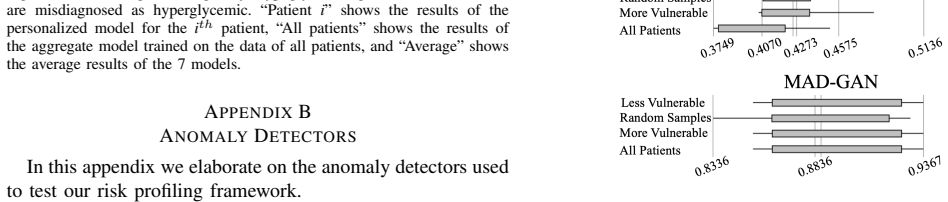
- [Figures 7, 8, and 11] The box plots do not state whether they summarize per-patient or per-sample recall and precision, nor the number of replicates; please specify the aggregation unit and sample size.
- [Section III] In the description of the target glucose model, 'Rubine-Falcone et al.' should be 'Rubin-Falcone et al.'
- [References] Reference [65] appears incomplete, consisting only of the text 'Hypoglycemia (low blood sugar)'; please provide full bibliographic details.
- [Throughout] The paper uses 'indiscriminately trained on the entire dataset' without specifying whether the 'entire set' means all 12 patients or all training samples from all patients; please clarify the baseline training set.
Circularity Check
The 'less vulnerable' training subset is labeled using URET attack success rates and then evaluated on the same URET attack and the same patients, so the headline recall gains are partially forced by construction.
-
fitted input called prediction
[Section IV, Step 4 (Cluster Labeling), after Figure 3]
"By cross-checking the resulting clusters with the misclassification percentages due to the attack reported in Elnawawy et al. [49], on Subset B and our extended experiments on Subset A (Appendix A), we notice that patient 5 from Subset A and patients 1 and 2 from Subset B (placed in separate clusters by our risk profiling framework) tend to have the lowest misclassification percentage, meaning that these patients were less vulnerable to the URET attack. ..."
The 'less vulnerable' training subset is defined by the URET attack's success rates (misclassification percentages). The same URET attack is then used to generate the malicious samples whose detection recall is reported (Figure 7: recall increase of 27.5% for kNN, 16.8% for OneClassSVM). Thus the selection of training patients is not an independent first-principles risk model; it is fitted to the very attack outcomes the detectors are supposed to catch. Training on patients known to be hard for URET and then measuring URET detection on those patients makes the recall gain partly an artifact of the selection oracle rather than a prediction about detector generalization.
-
fitted input called prediction
[Appendix D (Discussion)]
"In our experiments, we trained anomaly detectors on the less vulnerable patients and independently tested the entire set of patients and then averaged the results to aggregate them in box plots. That means that we conducted experiments where the test set consisted of only the more vulnerable patients that were not seen during the training stage."
The main-text recall figures lack a stated test split, and this appendix states that the test set was 'the entire set of patients'—which includes the less-vulnerable patients used for training. For kNN, OneClassSVM, and MAD-GAN, evaluating on training instances can reward memorization rather than a better decision boundary, so the headline 27.5% recall improvement is not a held-out prediction. The appendix's unsupported assertion that testing only on unseen more-vulnerable patients gave 'similar' rates cannot repair the reported numbers, which are the paper's central evidence.
1 more flagged steps
-
self citation load bearing
[Section IV, Step 1 (Attack Simulation) and Step 4 (Cluster Labeling)]
"In their demonstration of the URET evasion attack on the OhioT1DM dataset using the attack settings presented earlier, Elnawawy et al. [49] show that patients respond differently to the same attack settings as they show different vulnerability levels to the attack. In particular, Elnawawy et al. [49] report attack success rates ... This suggests that it is more challenging for URET to attack specific patients who show more resilience to the attack [49]."
The framework's load-bearing premise—that patients divide into less/more vulnerable groups—and the actual cluster labels for Subset B are taken from the authors' own prior paper [49], not from an independent or machine-checked source. The current paper's Appendix A extends URET experiments to Subset A, but for Subset B the labels rest entirely on [49]. Because [49] is by the same research group and is used to define 'less vulnerable' before the same attack is used for evaluation, the self-citation is load-bearing rather than independent support.
full rationale
The derivation chain for the headline claim has two points where an input is reused as the predicted output. First, the 'less vulnerable' clusters are labeled using URET misclassification percentages from the authors' prior paper [49] and their own Appendix A; this label is then used to select training data, and the evaluation measures recall on URET-generated attacks. This makes the vulnerability grouping an oracle informed by the attack outcomes rather than an independent risk model. Second, Appendix D states the detectors were tested on the entire set of patients, which includes the training patients, so the reported 27.5% recall improvement is not a clean out-of-sample prediction; for memory-based detectors (kNN, OneClassSVM, MAD-GAN) this can inflate the result. The severity coefficients in Eq. (1) are hand-set and acknowledged as a threat to validity, but they are not circular—they are a stated assumption. The framework's clustering step is unsupervised and not itself circular, and the detectors are standard external methods, so the paper is not wholly reducible to its inputs. Overall, partial circularity: the central claim is partly forced by construction and by self-citation. Score 6.
Assumptions & free parameters
free parameters (4)
- Severity coefficients S for state transitions =
64, 32, 16, 8, 4, 2
- Number of vulnerability clusters =
2
- Exponent in deviation term Z_t =
2
- Less-vulnerable training subset size =
3 patients
assumptions (5)
- domain assumption The OhioT1DM dataset and the Rubin-Falcone LSTM model accurately represent a real BGMS for evaluation purposes.
- domain assumption The URET attack with glucose constraints (125-499 mg/dL fasting, 180-499 mg/dL postprandial) is a valid model of realistic evasion attacks on CGM systems.
- domain assumption The three anomaly detectors are correctly implemented and can be trained in the described selective manner.
- ad hoc to paper Hierarchical clustering with the chosen distance metric and linkage produces meaningful risk groups.
- ad hoc to paper Exponential severity coefficients reflect the true clinical risk ordering of state transitions.
invented entities (2)
-
Victim risk profile
-
Less-vulnerable cluster
Cite this review
Pith. "Pith review of Learning from the Good Ones: Risk Profiling-Based Defenses Against Evasion Attacks on DNNs." pith.science (2026). https://pith.science/paper/SF3YBOEM
@misc{pith2026250506477,
  author       = {Pith},
  title        = {Pith review of: Learning from the Good Ones: Risk Profiling-Based Defenses Against Evasion Attacks on DNNs},
  year         = {2026},
  howpublished = {\url{https://pith.science/paper/SF3YBOEM}},
  note         = {Machine review of arXiv:2505.06477}
}
read the original abstract
Safety-critical applications such as healthcare and autonomous vehicles use deep neural networks (DNN) to make predictions and infer decisions. DNNs are susceptible to evasion attacks, where an adversary crafts a malicious data instance to trick the DNN into making wrong decisions at inference time. Existing defenses that protect DNNs against evasion attacks are either static or dynamic. Static defenses are computationally efficient but do not adapt to the evolving threat landscape, while dynamic defenses are adaptable but suffer from an increased computational overhead. To combine the best of both worlds, in this paper, we propose a novel risk profiling framework that uses a risk-aware strategy to selectively train static defenses using victim instances that exhibit the most resilient features and are hence more resilient against an evasion attack. We hypothesize that training existing defenses on instances that are less vulnerable to the attack enhances the adversarial detection rate by reducing false negatives. We evaluate the efficacy of our risk-aware selective training strategy on a blood glucose management system that demonstrates how training static anomaly detectors indiscriminately may result in an increased false negative rate, which could be life-threatening in safety-critical applications. Our experiments show that selective training on the less vulnerable patients achieves a recall increase of up to 27.5\% with minimal impact on precision compared to indiscriminate training.
Figures


Figures from the paper (7 more)


Reference graph
Works this paper leans on
-
[1]
Using machine learning for healthcare challenges and opportunities
Abdullah Alanazi. Using machine learning for healthcare challenges and opportunities. Informatics in Medicine Unlocked , 30:100924, 2022
work page 2022
-
[2]
Machine learning in healthcare
Hafsa Habehh and Suril Gohel. Machine learning in healthcare. Current genomics, 22(4):291, 2021
work page 2021
-
[3]
Machine learning for healthcare: on the verge of a major shift in healthcare epidemiology
Jenna Wiens and Erica S Shenoy. Machine learning for healthcare: on the verge of a major shift in healthcare epidemiology. Clinical infectious diseases, 66(1):149–153, 2018
work page 2018
-
[4]
Deep neural networks in healthcare systems
Biswajit R Bhowmik, Shrinidhi Anil Varna, Adarsh Kumar, and Rahul Kumar. Deep neural networks in healthcare systems. In Machine learning and deep learning in efficacy improvement of healthcare systems, pages 195–226. CRC Press, 2022
work page 2022
-
[5]
U.S. FDA. AI-Rad Companion (Cardiovascular). URL: https://www. accessdata.fda.gov/scripts/cdrh/cfdocs/cfpmn/pmn.cfm?ID=K183268, Last accessed: Dec 20, 2023
work page 2023
-
[6]
Autonomous driving ar- chitectures: insights of machine learning and deep learning algorithms
Mrinal R Bachute and Javed M Subhedar. Autonomous driving ar- chitectures: insights of machine learning and deep learning algorithms. Machine Learning with Applications , 6:100164, 2021
work page 2021
-
[7]
Exploring the mechanism of crashes with autonomous vehi- cles using machine learning
Hengrui Chen, Hong Chen, Ruiyu Zhou, Zhizhen Liu, and Xiaoke Sun. Exploring the mechanism of crashes with autonomous vehi- cles using machine learning. Mathematical problems in engineering , 2021(1):5524356, 2021
work page 2021
-
[8]
Deep neural networks with koopman operators for modeling and control of autonomous vehicles
Yongqian Xiao, Xinglong Zhang, Xin Xu, Xueqing Liu, and Jiahang Liu. Deep neural networks with koopman operators for modeling and control of autonomous vehicles. IEEE transactions on intelligent vehicles , 8(1):135–146, 2022
work page 2022
Show all 68 references
-
[9]
Simple black- box adversarial attacks on deep neural networks
Nina Narodytska and Shiva Prasad Kasiviswanathan. Simple black- box adversarial attacks on deep neural networks. In CVPR Workshops, volume 2, 2017
2017
-
[10]
Adversarial attacks on deep neural networks for time series classification
Hassan Ismail Fawaz, Germain Forestier, Jonathan Weber, Lhassane Idoumghar, and Pierre-Alain Muller. Adversarial attacks on deep neural networks for time series classification. In 2019 International Joint Conference on Neural Networks (IJCNN) , pages 1–8. IEEE, 2019
2019
-
[11]
Fast adversarial attacks to deep neural networks through gradual sparsifica- tion
Sajjad Amini, Alireza Heshmati, and Shahrokh Ghaemmaghami. Fast adversarial attacks to deep neural networks through gradual sparsifica- tion. Engineering Applications of Artificial Intelligence , 127:107360, 2024
2024
-
[12]
Goodfellow, and Samy Bengio
Alexey Kurakin, Ian J. Goodfellow, and Samy Bengio. Adversarial machine learning at scale. CoRR, abs/1611.01236, 2016
2016 arXiv
-
[13]
Are self-driving cars secure? evasion attacks against deep neural networks for steering angle prediction
Alesia Chernikova, Alina Oprea, Cristina Nita-Rotaru, and BaekGyu Kim. Are self-driving cars secure? evasion attacks against deep neural networks for steering angle prediction. In 2019 IEEE Security and Privacy Workshops (SPW), pages 132–137. IEEE, 2019
2019
-
[14]
Real-time evasion attacks against deep learning-based anomaly detection from distributed system logs
J Dinal Herath, Ping Yang, and Guanhua Yan. Real-time evasion attacks against deep learning-based anomaly detection from distributed system logs. In Proceedings of the Eleventh ACM Conference on Data and Application Security and Privacy , pages 29–40, 2021
2021
-
[15]
What is adversarial machine learning? attack methods in 2024, June 2024
Gaudenz Boesch. What is adversarial machine learning? attack methods in 2024, June 2024
2024
-
[16]
Evasion attacks against machine-learning based behavioral authentication
Marco Farinetti. Evasion attacks against machine-learning based behavioral authentication. PhD thesis, Politecnico di Torino, 2018
2018
-
[17]
Intriguing properties of neural networks
Christian Szegedy, Wojciech Zaremba, Ilya Sutskever, Joan Bruna, Dumitru Erhan, Ian Goodfellow, and Rob Fergus. Intriguing properties of neural networks. arXiv preprint arXiv:1312.6199 , 2013
2013 arXiv
-
[18]
Explaining and harnessing adversarial examples
Ian J Goodfellow, Jonathon Shlens, and Christian Szegedy. Explaining and harnessing adversarial examples. arXiv preprint arXiv:1412.6572 , 2014
2014 arXiv
-
[19]
Personalized insulin dose manipulation attack and its detection using interval-based temporal patterns and machine learning algorithms
Tamar Levy-Loboda, Eitam Sheetrit, Idit F Liberty, Alon Haim, and Nir Nissim. Personalized insulin dose manipulation attack and its detection using interval-based temporal patterns and machine learning algorithms. Journal of Biomedical Informatics , 132:104129, 2022
2022
-
[20]
Adversarial training against adversarial attacks for machine learning-based intrusion detection systems
Muhammad Shahzad Haroon and Husnain Mansoor Ali. Adversarial training against adversarial attacks for machine learning-based intrusion detection systems. Computers, Materials & Continua , 73(2), 2022
2022
-
[21]
Defending evasion attacks via adversarially adaptive training
Minh-Hao Van, Wei Du, Xintao Wu, Feng Chen, and Aidong Lu. Defending evasion attacks via adversarially adaptive training. In 2022 IEEE International Conference on Big Data (Big Data) , pages 1515–
2022
-
[22]
Adversarial training methods for deep learning: A systematic review
Weimin Zhao, Sanaa Alwidian, and Qusay H Mahmoud. Adversarial training methods for deep learning: A systematic review. Algorithms, 15(8):283, 2022
2022
-
[23]
Feature denoising for improving adversarial robustness
Cihang Xie, Yuxin Wu, Laurens van der Maaten, Alan L Yuille, and Kaiming He. Feature denoising for improving adversarial robustness. In Proceedings of the IEEE/CVF conference on computer vision and pattern recognition, pages 501–509, 2019
2019
-
[24]
Evaluating and improving ad- versarial robustness of machine learning-based network intrusion detec- tors
Dongqi Han, Zhiliang Wang, Ying Zhong, Wenqi Chen, Jiahai Yang, Shuqiang Lu, Xingang Shi, and Xia Yin. Evaluating and improving ad- versarial robustness of machine learning-based network intrusion detec- tors. IEEE Journal on Selected Areas in Communications , 39(8):2632– 2647, 2021
2021
-
[25]
Adversarial feature alignment: Balancing robustness and accuracy in deep learning via adversarial training, 2024
Leo Hyun Park, Jaeuk Kim, Myung Gyo Oh, Jaewoo Park, and Taeky- oung Kwon. Adversarial feature alignment: Balancing robustness and accuracy in deep learning via adversarial training, 2024
2024
-
[26]
The more the merrier: adding hidden measurements to secure industrial control systems
Jairo Giraldo, David Urbina, CheeYee Tang, and Alvaro A Cardenas. The more the merrier: adding hidden measurements to secure industrial control systems. In Proceedings of the 7th Symposium on Hot Topics in the Science of Security , pages 1–10, 2020
2020
-
[27]
Ad- versarial regression for detecting attacks in cyber-physical systems
Amin Ghafouri, Yevgeniy V orobeychik, and Xenofon Koutsoukos. Ad- versarial regression for detecting attacks in cyber-physical systems. arXiv preprint arXiv:1804.11022 , 2018
2018 arXiv
-
[28]
Lunar: Unifying local outlier detection methods via graph neural networks
Adam Goodge, Bryan Hooi, See-Kiong Ng, and Wee Siong Ng. Lunar: Unifying local outlier detection methods via graph neural networks. In Proceedings of the AAAI Conference on Artificial Intelligence , vol- ume 36, pages 6737–6745, 2022
2022
-
[29]
Robustness test- ing of data and knowledge driven anomaly detection in cyber-physical systems
Xugui Zhou, Maxfield Kouzel, and Homa Alemzadeh. Robustness test- ing of data and knowledge driven anomaly detection in cyber-physical systems. In 2022 52nd Annual IEEE/IFIP International Conference on Dependable Systems and Networks Workshops (DSN-W) , pages 44–51, 2022
2022
-
[30]
Adversarial attack mitigation strategy for machine learning-based network attack detection model in power system
Rong Huang and Yuancheng Li. Adversarial attack mitigation strategy for machine learning-based network attack detection model in power system. IEEE Transactions on Smart Grid , 14(3):2367–2376, 2022
2022
-
[31]
Mad-gan: Multivariate anomaly detection for time series data with generative adversarial networks
Dan Li, Dacheng Chen, Baihong Jin, Lei Shi, Jonathan Goh, and See- Kiong Ng. Mad-gan: Multivariate anomaly detection for time series data with generative adversarial networks. In International conference on artificial neural networks , pages 703–716. Springer, 2019
2019
-
[32]
Deep reinforcement learning based evasion generative adversarial network for botnet detection.Future Generation Computer Systems , 150:294–302, 2024
Rizwan Hamid Randhawa, Nauman Aslam, Mohammad Alauthman, Muhammad Khalid, and Husnain Rafiq. Deep reinforcement learning based evasion generative adversarial network for botnet detection.Future Generation Computer Systems , 150:294–302, 2024
2024
-
[33]
Strengthening ids against evasion attacks with gan-based adversarial samples in sdn-enabled network
Cao Phan Xuan Qui, Dang Hong Quang, Phan The Duy, Van-Hau Pham, et al. Strengthening ids against evasion attacks with gan-based adversarial samples in sdn-enabled network. In 2021 RIVF International Conference on Computing and Communication Technologies (RIVF) , pages 1–6. IEEE, 2021
2021
-
[34]
Omni: Au- tomated ensemble with unexpected models against adversarial evasion attack
Rui Shu, Tianpei Xia, Laurie Williams, and Tim Menzies. Omni: Au- tomated ensemble with unexpected models against adversarial evasion attack. Empirical Software Engineering , 27:1–32, 2022
2022
-
[35]
Clustering and ensemble based approach for securing electricity theft detectors against evasion attacks
Islam Elgarhy, Mahmoud M Badr, Mohamed MEA Mahmoud, Mostafa M Fouda, Maazen Alsabaan, and Hisham A Kholidy. Clustering and ensemble based approach for securing electricity theft detectors against evasion attacks. IEEE Access, 11:112147–112164, 2023
2023
-
[36]
Mitigating adversarial evasion attacks of ransomware using ensemble learning
Usman Ahmed, Jerry Chun-Wei Lin, and Gautam Srivastava. Mitigating adversarial evasion attacks of ransomware using ensemble learning. Computers and Electrical Engineering , 100:107903, 2022
2022
-
[37]
Evasion attack and defense on machine learn- ing models in cyber-physical systems: A survey
Shunyao Wang, Ryan KL Ko, Guangdong Bai, Naipeng Dong, Taejun Choi, and Yanjun Zhang. Evasion attack and defense on machine learn- ing models in cyber-physical systems: A survey. IEEE Communications Surveys & Tutorials, 2023
2023
-
[38]
Adversarial attacks and defenses in machine learning-powered networks: A contemporary survey
Y Wang, T Sun, S Li, X Yuan, W Ni, E Hossain, and HV Poor. Adversarial attacks and defenses in machine learning-powered networks: A contemporary survey. arXiv preprint arXiv:2303.06302 , 2023
2023 arXiv
-
[39]
Evaluating the adversarial robustness of adaptive test-time defenses
Francesco Croce, Sven Gowal, Thomas Brunner, Evan Shelhamer, Matthias Hein, and Taylan Cemgil. Evaluating the adversarial robustness of adaptive test-time defenses. In International Conference on Machine Learning, pages 4421–4435. PMLR, 2022
2022
-
[40]
Adversarial attacks to machine learning-based smart healthcare systems
AKM Iqtidar Newaz, Nur Imtiazul Haque, Amit Kumar Sikder, Mo- hammad Ashiqur Rahman, and A Selcuk Uluagac. Adversarial attacks to machine learning-based smart healthcare systems. In GLOBECOM 2020-2020 IEEE Global Communications Conference, pages 1–6. IEEE, 2020
2020
-
[41]
Xin Li, Deng Pan, and Dongxiao Zhu. Defending against adversarial attacks on medical imaging ai system, classification or detection? In 2021 IEEE 18th International Symposium on Biomedical Imaging (ISBI), pages 1677–1681. IEEE, 2021
2021
-
[42]
Machine learning with electronic health records is vulnerable to backdoor trigger attacks
Byunggill Joe, Akshay Mehra, Insik Shin, and Jihun Hamm. Machine learning with electronic health records is vulnerable to backdoor trigger attacks. arXiv preprint arXiv:2106.07925 , 2021
2021 arXiv
-
[43]
Dealing with noise problem in machine learning data-sets: A systematic review
Shivani Gupta and Atul Gupta. Dealing with noise problem in machine learning data-sets: A systematic review. Procedia Computer Science , 161:466–474, 2019. The Fifth Information Systems International Con- ference, 23-24 July 2019, Surabaya, Indonesia
2019
-
[44]
Adversarial learning with cost-sensitive classes
Haojing Shen, Sihong Chen, Ran Wang, and Xizhao Wang. Adversarial learning with cost-sensitive classes. IEEE Transactions on Cybernetics , 53(8):4855–4866, 2022
2022
-
[45]
Adversarial training for privacy-preserving deep learning model distribution
Mohammed Alawad, Shang Gao, Xiao-Cheng Wu, Eric B Durbin, Linda Coyle, Lynne Penberthy, and Georgia Tourassi. Adversarial training for privacy-preserving deep learning model distribution. In 2019 IEEE International Conference on Big Data (Big Data) , pages 5705–5710. IEEE, 2019
2019
-
[46]
Robust- ness, privacy, and generalization of adversarial training
Fengxiang He, Shaopeng Fu, Bohan Wang, and Dacheng Tao. Robust- ness, privacy, and generalization of adversarial training. arXiv preprint arXiv:2012.13573, 2020
2012 arXiv
-
[47]
The ohiot1dm dataset for blood glucose level prediction: Update 2020
Cindy Marling and Razvan Bunescu. The ohiot1dm dataset for blood glucose level prediction: Update 2020. In CEUR workshop proceedings, volume 2675, page 71. NIH Public Access, 2020
2020
-
[48]
Deep Residual Time- Series Forecasting: Application to Blood Glucose Prediction
Harry Rubin-Falcone, Ian Fox, and Jenna Wiens. Deep Residual Time- Series Forecasting: Application to Blood Glucose Prediction. In KDH@ ECAI, pages 105–109, 2020
2020
-
[49]
Systematically assessing the security risks of ai/ml-enabled connected healthcare systems
Mohammed Elnawawy, Mohammadreza Hallajiyan, Gargi Mitra, Shahrear Iqbal, and Karthik Pattabiraman. Systematically assessing the security risks of ai/ml-enabled connected healthcare systems. arXiv preprint arXiv:2401.17136, 2024
2024 arXiv
-
[50]
BLURtooth: Exploiting Cross- Transport Key Derivation in Bluetooth Classic and Bluetooth Low Energy
Kasper Rasmussen. BLURtooth: Exploiting Cross- Transport Key Derivation in Bluetooth Classic and Bluetooth Low Energy. In AsiaCCS, 2022
2022
-
[51]
Medtronic MyCareLink Smart Vulnerability
CVE. Medtronic MyCareLink Smart Vulnerability. URL: https:// www.cve.org/CVERecord?id=CVE-2020-25183, Last accessed: Mar 10, 2025
2020
-
[52]
Securing automated insulin delivery systems: A review of security threats and protectives strategies
Yuchen Niu and Siew-Kei Lam. Securing automated insulin delivery systems: A review of security threats and protectives strategies. arXiv preprint arXiv:2503.14006, 2025
2025
-
[53]
Com- partmentation policies for android apps: A combinatorial optimization approach
Guillermo Suarez-Tangil, Juan E Tapiador, and Pedro Peris-Lopez. Com- partmentation policies for android apps: A combinatorial optimization approach. In NSS 2015, pages 63–77, 2015
2015
-
[54]
U.S. FDA. DreaMed Advisor Pro. URL: https://www.accessdata. fda.gov/scripts/cdrh/cfdocs/cfpmn/denovo.cfm?id=DEN170043, Last ac- cessed: Nov 30, 2023
2023
-
[55]
URET: Universal Robustness Evaluation Toolkit (for Evasion)
Kevin Eykholt, Taesung Lee, Douglas Schales, Jiyong Jang, and Ian Molloy. URET: Universal Robustness Evaluation Toolkit (for Evasion). In USENIX Security 23 , pages 3817–3833, 2023
2023
-
[56]
A review of anomaly detection techniques based on nearest neighbor
Ming Zhao, Jingchao Chen, and Yang Li. A review of anomaly detection techniques based on nearest neighbor. In 2018 International Conference on Computer Modeling, Simulation and Algorithm (CMSA 2018) , pages 290–292. Atlantis Press, 2018
2018
-
[57]
Sparse coding with anomaly detection
Amir Adler, Michael Elad, Yacov Hel-Or, and Ehud Rivlin. Sparse coding with anomaly detection. Journal of Signal Processing Systems , 79:179–188, 2015
2015
-
[58]
Detection and explanation of anomalies in healthcare data
Durgesh Samariya, Jiangang Ma, Sunil Aryal, and Xiaohui Zhao. Detection and explanation of anomalies in healthcare data. Health Information Science and Systems , 11(1):20, 2023
2023
-
[59]
Sparsity techniques in medical imaging
Ruogu Fang, Tsuhan Chen, Dimitris Metaxas, Pina Sanelli, and Shaoting Zhang. Sparsity techniques in medical imaging. Computerized medical imaging and graphics: the official journal of the Computerized Medical Imaging Society, 46(Pt 1):1, 2015
2015
-
[60]
Improv- ing one-class svm for anomaly detection
Kun-Lun Li, Hou-Kuan Huang, Sheng-Feng Tian, and Wei Xu. Improv- ing one-class svm for anomaly detection. In Proceedings of the 2003 international conference on machine learning and cybernetics (IEEE Cat. No. 03EX693) , volume 5, pages 3077–3081. IEEE, 2003
2003
-
[61]
Analyzing the non-linear relationship between fasting blood glucose levels and gensini score in patients with stemi
Han Li, Quanzhi Lin, Zhiyuan Jiang, and Guoqiang Zhong. Analyzing the non-linear relationship between fasting blood glucose levels and gensini score in patients with stemi. Frontiers in Cardiovascular Medicine, 11:1427567, 2024
2024
-
[62]
Nonlinear metabolic effect of insulin across the blood glucose range in patients with type 1 diabetes mellitus
Alice Chan, Lutz Heinemann, Stacey M Anderson, Marc D Breton, and Boris P Kovatchev. Nonlinear metabolic effect of insulin across the blood glucose range in patients with type 1 diabetes mellitus. Journal of diabetes science and technology , 4(4):873–881, 2010
2010
-
[63]
Somogyi effect: What it is, causes, symp- toms & treatment
Cleveland Clinic. Somogyi effect: What it is, causes, symp- toms & treatment. https://my.clevelandclinic.org/health/diseases/ 11443-somogyi-effect, January 2023. Accessed: March 31, 2025
2023
-
[64]
Hypoglycemia
Jean-Francois Yale, Breay Paty, Peter A Senior, Diabetes Canada Clinical Practice Guidelines Expert Committee, et al. Hypoglycemia. Canadian journal of diabetes , 42:S104–S108, 2018
2018
-
[65]
Hypoglycemia (low blood sugar)
-
[66]
Hypoglycemia (low blood sugar), February 2024
Mary Jo DiLonardo and Deanna Altomara. Hypoglycemia (low blood sugar), February 2024
2024
-
[67]
What is hierarchical clustering?, August 2024
Joshua Noble. What is hierarchical clustering?, August 2024
2024
-
[68]
Patient i
Xiaoge Zhang, Felix TS Chan, Chao Yan, and Indranil Bose. Towards risk-aware artificial intelligence and machine learning systems: An overview. Decision Support Systems , 159:113800, 2022. APPENDIX A SUBSET A R ESULTS Fig. 9. Percentage of originally normal glucose instances t...
2022
Reviewed August 15, 2026 · model on record in the stance chip above.
Discussion (0). Continue with ORCID to comment.