Transfer Operators, Canonical Center Dynamics, and Spectral Applications for Long-Range Operators
Pith reviewed 2026-06-30 02:23 UTC · model grok-4.3
The pith
A transfer operator framework for long-range operators defines a Canonical Center Bundle that reduces the spectral problem and establishes absolute continuity of the integrated density of states.
A machine-rendered reading of the paper's core claim, the machinery that carries it, and where it could break.
Core claim
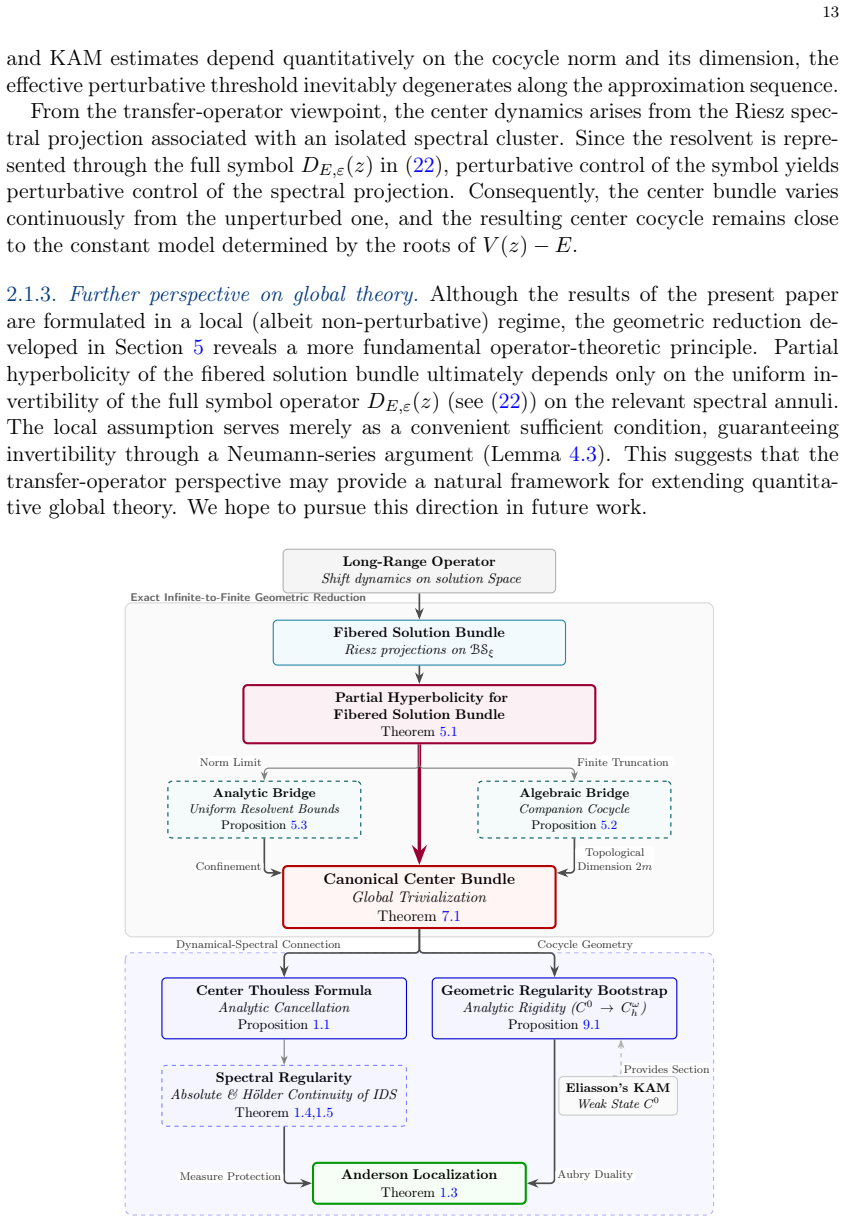
By establishing a partially hyperbolic splitting on the fibered solution bundle, the Canonical Center Bundle is defined as its center subbundle and shown to be globally trivial with a representation via Riesz spectral projections of the transfer operator. In the local regime the center bundle coincides in the sense of gap convergence with the intrinsic center bundles from finite-range approximations. The partially hyperbolic structure reduces the spectral problem to the center cocycle, which for the quasi-periodic Schrödinger operators considered is analytic and satisfies a Center Thouless formula. This leads to absolute continuity of the integrated density of states, quantitative Hölder con
What carries the argument
The Canonical Center Bundle, the center subbundle of the partially hyperbolic splitting on the fibered solution bundle of the transfer operator, which is globally trivial and represented by Riesz spectral projections.
If this is right
- The spectral problem for the operators reduces to a Johnson-type characterization in terms of the center cocycle.
- The integrated density of states is absolutely continuous.
- Quantitative Hölder continuity holds for the integrated density of states.
- Anderson localization is obtained for the Schrödinger operators.
- In the local regime the Canonical Center Bundle coincides with intrinsic center bundles from finite-range approximations in the sense of gap convergence.
Where Pith is reading between the lines
- The coincidence in the local regime suggests that finite-range approximations capture the essential spectral features of the infinite-range case.
- The global triviality of the center bundle implies that the center dynamics can be studied on a fixed bundle independent of the base point.
- The representation via Riesz projections could provide a way to study the center dynamics through spectral properties of the transfer operator.
Load-bearing premise
The existence of a partially hyperbolic splitting on the fibered solution bundle for long-range operators with analytic hopping and small potential.
What would settle it
A specific long-range operator with analytic hopping and small potential for which no partially hyperbolic splitting exists on the fibered solution bundle, or for which the integrated density of states fails to be absolutely continuous.
Figures
read the original abstract
We introduce an operator-theoretic framework for long-range operators over general dynamical systems with analytic hopping and small potential. By establishing a partially hyperbolic splitting on the fibered solution bundle, we define the Canonical Center Bundle (CCB) as the center subbundle of this splitting, which is shown to be globally trivial. The center bundle admits a representation via Riesz spectral projections of the transfer operator. Furthermore, we show that, in the local regime, the center bundle arising in this framework essentially coincides, in the sense of gap convergence, with the Intrinsic Center Bundles (ICB) obtained from finite-range approximations in \cite{GJ}. The partially hyperbolic structure thereby reduces the spectral problem to the center bundle, leading to a Johnson-type characterization of the spectrum in terms of the associated center cocycle. We then apply this framework to quasi-periodic Schr\"odinger operators with analytic hopping, large analytic potentials and Diophantine frequency. In this setting, the center cocycle is analytic and satisfies a Center Thouless formula. As consequences, we establish the absolute continuity of the integrated density of states (IDS), resolving a problem of Eliasson; prove quantitative H\"older continuity of the IDS, partially answering a question of You; and obtain Anderson localization for the original Schr\"odinger operators.
Editorial analysis
A structured set of objections, weighed in public.
Referee Report
Summary. The manuscript introduces an operator-theoretic framework for long-range operators with analytic hopping and small potentials. It establishes a partially hyperbolic splitting on the fibered solution bundle, defines the Canonical Center Bundle (CCB) as the center subbundle (shown to be globally trivial and representable via Riesz spectral projections), and proves that in the local regime this CCB coincides in the sense of gap convergence with the Intrinsic Center Bundles from finite-range approximations in \cite{GJ}. The framework reduces the spectral problem to the associated center cocycle via a Johnson-type characterization. The authors then apply the framework to quasi-periodic Schrödinger operators with analytic hopping, large analytic potentials, and Diophantine frequency, obtaining a Center Thouless formula for the analytic center cocycle; as consequences they claim absolute continuity of the IDS (resolving Eliasson's problem), quantitative Hölder continuity of the IDS (partially answering a question of You), and Anderson localization.
Significance. If the extension of the partially hyperbolic structure and gap convergence to the large-potential regime can be justified, the results would constitute a substantial advance in the spectral theory of quasi-periodic long-range operators, supplying the first resolution of Eliasson's absolute-continuity question and a quantitative Hölder estimate on the IDS.
major comments (2)
- [Abstract] Abstract: the partially hyperbolic splitting and CCB are constructed only under a small-potential assumption, yet the Johnson-type characterization, Center Thouless formula, absolute continuity of the IDS, Hölder continuity, and Anderson localization are asserted for large analytic potentials; no additional theorem or reduction is indicated that would extend the splitting or the gap convergence beyond the small-potential regime, rendering the strongest claims load-bearing on an unstated extension.
- [Abstract] Abstract (local-regime paragraph): the claimed gap convergence between the CCB and the ICB of \cite{GJ} is stated only inside the 'local regime'; if this regime is coextensive with the small-potential hypothesis used to obtain the splitting, then the reduction of the spectral problem for large potentials to the center cocycle lacks a supporting argument.
minor comments (1)
- [Abstract] Abstract contains LaTeX rendering artifacts (e.g., Schr"odinger, H"older) that should be cleaned for the published version.
Simulated Author's Rebuttal
We thank the referee for the careful reading and for identifying ambiguities in the abstract that could mislead readers about the scope of our results. We agree that the presentation requires clarification and will revise the abstract and add supporting remarks in the manuscript to accurately reflect the regimes in which each theorem holds.
read point-by-point responses
-
Referee: [Abstract] Abstract: the partially hyperbolic splitting and CCB are constructed only under a small-potential assumption, yet the Johnson-type characterization, Center Thouless formula, absolute continuity of the IDS, Hölder continuity, and Anderson localization are asserted for large analytic potentials; no additional theorem or reduction is indicated that would extend the splitting or the gap convergence beyond the small-potential regime, rendering the strongest claims load-bearing on an unstated extension.
Authors: The referee is correct that the partially hyperbolic splitting and CCB construction are proved under the small-potential hypothesis for general base dynamics. The Johnson-type characterization, Center Thouless formula, absolute continuity of the IDS, quantitative Hölder continuity, and Anderson localization are stated for the quasi-periodic Schrödinger operators with large analytic potentials. In the manuscript these consequences are derived from the analyticity of the center cocycle in the quasi-periodic setting rather than from a direct extension of the gap-convergence result. Nevertheless, the abstract does not make this distinction explicit, and no separate reduction theorem is highlighted. We will revise the abstract to separate the general small-potential framework from the large-potential application and will add a clarifying paragraph or remark indicating how the spectral conclusions for large potentials follow from the center-cocycle analysis. revision: yes
-
Referee: [Abstract] Abstract (local-regime paragraph): the claimed gap convergence between the CCB and the ICB of \cite{GJ} is stated only inside the 'local regime'; if this regime is coextensive with the small-potential hypothesis used to obtain the splitting, then the reduction of the spectral problem for large potentials to the center cocycle lacks a supporting argument.
Authors: We agree that the gap convergence is established only inside the local regime, which coincides with the small-potential setting. For the large-potential quasi-periodic application the reduction to the center cocycle is asserted via the Johnson-type characterization, but the manuscript does not supply an explicit argument showing that this characterization remains valid when the gap convergence is unavailable. This point requires additional clarification. We will revise the relevant paragraph and, if necessary, insert a short lemma or remark that justifies the applicability of the center-cocycle reduction in the large-potential regime. revision: yes
Circularity Check
Minor self-citation to prior finite-range work; central derivation remains independent of fitted inputs or self-referential definitions.
full rationale
The paper constructs a transfer-operator framework and partially hyperbolic splitting explicitly for small potentials on analytic long-range operators, then defines the Canonical Center Bundle via Riesz projections and shows gap convergence to the ICB of the cited finite-range work in the local regime. This coincidence is stated as a comparison result rather than an identity by construction. The subsequent Johnson-type characterization, Center Thouless formula, and spectral conclusions (absolute continuity of IDS, Hölder continuity, Anderson localization) are derived from the center cocycle properties under the stated Diophantine and analyticity assumptions; none of these steps reduce a prediction to a fitted parameter or rename an input as an output. The single citation to <cite>GJ</cite> supplies an external benchmark for the local-regime comparison and is not invoked as a uniqueness theorem that forces the present choice. The extension to large potentials is presented as an application of the framework rather than a re-derivation that collapses into the small-potential hypothesis. No self-definitional, fitted-input, or ansatz-smuggling patterns appear in the provided derivation chain.
Axiom & Free-Parameter Ledger
axioms (2)
- domain assumption The frequency is Diophantine
- domain assumption Hopping functions are analytic
invented entities (2)
-
Canonical Center Bundle (CCB)
no independent evidence
-
Center cocycle
no independent evidence
Reference graph
Works this paper leans on
-
[1]
Aizenman and G
M. Aizenman and G. Graf, Localization bounds for an electron gas. J. Phys. A: Math. Gen.31 (1998), 6783
1998
-
[2]
Aizenman and S
M. Aizenman and S. A. Molchanov, Localization at large disorder and at extreme energies: an elementary derivation, Comm. Math. Phys.157(1993), no. 2, 245–278
1993
-
[3]
Hadj Amor, Hölder continuity of the rotation number for quasi-periodic co-cycles inSL(2,R), Comm
S. Hadj Amor, Hölder continuity of the rotation number for quasi-periodic co-cycles inSL(2,R), Comm. Math. Phys.287(2009), no. 2, 565–588
2009
-
[4]
Anderson, Absence of diffusion in certain random lattices
P. Anderson, Absence of diffusion in certain random lattices. Phys. Rev.109(1958), 1492-1505
1958
-
[5]
S. J. Aubry and G. André, Analyticity breaking and Anderson localization in incommensurate lattices, inGroup theoretical methods in physics (Proc. Eighth Internat. Colloq., Kiryat Anavim, 1979), pp. 133–164, Ann. Israel Phys. Soc., 3, Hilger, Bristol
1979
-
[6]
Almost reducibility and absolute continuity I
A. Avila, Almost reducibility and absolute continuity I, arXiv:1006.0704 (2010)
work page internal anchor Pith review Pith/arXiv arXiv 2010
-
[7]
Avila, Density of positive Lyapunov exponents forSL(2,R)-cocycles, J
A. Avila, Density of positive Lyapunov exponents forSL(2,R)-cocycles, J. Amer. Math. Soc.24 (2011), no. 4, 999–1014
2011
-
[8]
Avila, Global theory of one-frequency Schrödinger operators, Acta Math.215(2015), no
A. Avila, Global theory of one-frequency Schrödinger operators, Acta Math.215(2015), no. 1, 1–54
2015
-
[9]
A. Avila, KAM, Lyapunov exponents, and the spectral dichotomy for typical one-frequency Schrödinger operators, arXiv:2307.1107 (2023)
-
[10]
Avila and D
A. Avila and D. Damanik, Absolute continuity of the integrated density of states for the almost Mathieu operator with non-critical coupling, Invent. Math.172(2008), no. 2, 439–453
2008
-
[11]
Avila and S
A. Avila and S. Y. Jitomirskaya, Almost localization and almost reducibility, J. Eur. Math. Soc. (JEMS)12(2010), no. 1, 93–131
2010
-
[12]
Avila and S
A. Avila and S. Y. Jitomirskaya, The Ten Martini Problem, Ann. of Math. (2)170(2009), no. 1, 303–342
2009
-
[13]
Avila, S
A. Avila, S. Y. Jitomirskaya and C. Sadel, Complex one-frequency cocycles, J. Eur. Math. Soc. (JEMS)16(2014), no. 9, 1915–1935
2014
-
[14]
Avila, S
A. Avila, S. Y. Jitomirskaya and Q. Zhou, Second phase transition line, Math. Ann.370(2018), no. 1-2, 271–285
2018
-
[15]
Avila, Y
A. Avila, Y. Last, M. Shamis and Q. Zhou, On the abominable properties of the almost Mathieu operator with well-approximated frequencies, Duke Math. J.173(2024), no. 4, 603–672
2024
-
[16]
Avila, J
A. Avila, J. You and Q. Zhou, Sharp phase transitions for the almost Mathieu operator, Duke Math. J.166(2017), no. 14, 2697–2718. 65
2017
- [17]
-
[18]
Avila, B
A. Avila, B. R. Fayad and R. Krikorian, A KAM scheme forSL(2,R)cocycles with Liouvillean frequencies, Geom. Funct. Anal.21(2011), no. 5, 1001–1019
2011
-
[19]
Avila and R
A. Avila and R. Krikorian, Reducibility or nonuniform hyperbolicity for quasi-periodic Schrödinger cocycles, Ann. of Math. (2)164(2006), no. 3, 911–940
2006
-
[20]
Avila and R
A. Avila and R. Krikorian, Monotonic cocycles, Invent. Math.202(2015), no. 1, 271–331
2015
-
[21]
J. E. Avron and B. Simon, Almost periodic Schrödinger operators. II. The integrated density of states, Duke Math. J.50(1983), no. 1, 369–391
1983
-
[22]
Baladi and M
V. Baladi and M. Tsujii, Anisotropic Hölder and Sobolev spaces for hyperbolic diffeomorphisms, Ann. Inst. Fourier (Grenoble)57(2007), no. 1, 127–154
2007
-
[23]
Blank, G
M. Blank, G. Keller and C. Liverani, Ruelle-Perron-Frobenius spectrum for Anosov maps, Nonlin- earity15(2002), no. 6, 1905–1973
2002
-
[24]
Bourgain,On the spectrum of lattice Schrödinger operators with deterministic potential, J
J. Bourgain,On the spectrum of lattice Schrödinger operators with deterministic potential, J. Anal. Math.87(2002), 37–75
2002
-
[25]
Bourgain,On the spectrum of lattice Schrödinger operators with deterministic potential (II), J
J. Bourgain,On the spectrum of lattice Schrödinger operators with deterministic potential (II), J. Anal. Math.88(2002), 221–254
2002
-
[26]
Bourgain, Anderson localization for quasi-periodic lattice Schrödinger operators onZd,darbi- trary, Geom
J. Bourgain, Anderson localization for quasi-periodic lattice Schrödinger operators onZd,darbi- trary, Geom. Funct. Anal.17(2007), no. 3, 682–706
2007
-
[27]
Bourgain, Hölder regularity of integrated density of states for the almost Mathieu operator in a perturbative regime, Lett
J. Bourgain, Hölder regularity of integrated density of states for the almost Mathieu operator in a perturbative regime, Lett. Math. Phys.51(2000), no. 2, 83–118
2000
-
[28]
Bourgain and M
J. Bourgain and M. Goldstein, On nonperturbative localization with quasi-periodic potential, Ann. of Math. (2)152(2000), no. 3, 835–879
2000
-
[29]
Bourgain, M
J. Bourgain, M. Goldstein and W. Schlag, Anderson localization for Schrödinger operators onZ2 with quasi-periodic potential, Acta Math.188(2002), no. 1, 41–86
2002
-
[30]
Math.148(2002), no
J.BourgainandS.Y.Jitomirskaya, Absolutelycontinuousspectrumfor1Dquasi-periodicoperators, Invent. Math.148(2002), no. 3, 453–463
2002
-
[31]
Bourgain and S
J. Bourgain and S. Y. Jitomirskaya, Anderson localization for the band model, inGeometric aspects of functional analysis, 67–79, Lecture Notes in Math., 1745, Springer, Berlin
-
[32]
Bourgain, S
J. Bourgain, S. Jitomirskaya and I. Kachkovskiy, in preparation
-
[33]
A. Cai, C. Chavaudret, J, You and Q. Zhou, Sharp Hölder continuity of the Lyapunov exponent of finitely differentiable quasi-periodic cocycles, Math. Z.291(2019), no. 3-4, 931–958
2019
-
[34]
H. Cao, Y. Shi and Z. F. Zhang, Localization and regularity of the integrated density of states for Schrödinger operators onZd withC 2-cosine like quasi-periodic potential, Comm. Math. Phys.404 (2023), no. 1, 495–561
2023
-
[35]
H. Cao, Y. Shi and Z. F. Zhang, On the spectrum of quasi-periodic Schrödinger operators onZd withC 2-cosine type potentials, Comm. Math. Phys.405(2024), no. 8, Paper No. 174, 84 pp
2024
-
[36]
H. Cao, Y. Shi and Z. F. Zhang, Anderson localization and Hölder regularity of IDS for analytic quasi-periodic Schrödinger operators, arXiv: 2603.07180 (2026)
work page internal anchor Pith review Pith/arXiv arXiv 2026
-
[37]
R. A. Carmona and J. Lacroix,Spectral theory of random Schrödinger operators, Probability and its Applications, Birkhäuser Boston, Boston, MA, 1990
1990
-
[38]
Damanik, M
D. Damanik, M. Goldstein, W. Schlag and M. Voda, Homogeneity of the spectrum for quasi-periodic Schrödinger operators, J. Eur. Math. Soc. (JEMS)20(2018), no. 12, 3073–3111
2018
-
[39]
Chulaevsky and E
V. Chulaevsky and E. I. Dinaburg, Methods of KAM-theory for long-range quasi-periodic operators onZ ν. Pure point spectrum, Comm. Math. Phys.153(1993), no. 3, 559–577
1993
-
[40]
E. I. Dinaburg, Some problems in the spectral theory of discrete operators with quasi-periodic coefficients, Russian Math. Surveys52(1997), no. 3, 451–499; translated from Uspekhi Mat. Nauk 52(1997), no. 3(315), 3–52
1997
-
[41]
E. I. Dinaburg and Y. G. Sina˘i, The one-dimensional Schrödinger equation with quasi-periodic potential, Funkcional. Anal. i Priložen.9(1975), no. 4, 8–21
1975
-
[42]
Damanik and J
D. Damanik and J. Fillman,One-dimensional ergodic Schrödinger operators—I. General theory, Graduate Studies in Mathematics, 221, Amer. Math. Soc., Providence, RI, [2022]©2022
2022
-
[43]
Damanik and J
D. Damanik and J. Fillman,One-dimensional ergodic Schrödinger operators—II. Specific classes, Graduate Studies in Mathematics, 249, Amer. Math. Soc., Providence, RI, [2024]©2024. 66 XIANZHE LI, ZHENFU WANG, JIANGONG YOU, AND QI ZHOU
2024
-
[44]
Duarte and S
P. Duarte and S. Klein,Continuity of the Lyapunov exponents of linear cocycles, Publicações Matemáticas do IMPA 31o Colóquio Brasileiro de Matemática, Inst. Nac. Mat. Pura Apl. (IMPA), Rio de Janeiro, 2017
2017
-
[45]
Hasselblatt, Regularity of the Anosov splitting and of horospheric foliations, Ergodic Theory Dynam
B. Hasselblatt, Regularity of the Anosov splitting and of horospheric foliations, Ergodic Theory Dynam. Systems14(1994), no. 4, 645–666
1994
-
[46]
M. W. Hirsch, C. C. Pugh and M. Shub,Invariant manifolds, Lecture Notes in Mathematics, Vol. 583, Springer, Berlin-New York, 1977
1977
-
[47]
D. H. Husemoller,Fibre bundles, third edition, Graduate Texts in Mathematics, 20, Springer, New York, 1994
1994
-
[48]
L. H. Eliasson, Discrete one-dimensional quasi-periodic Schrödinger operators with pure point spec- trum, Acta Math.179(1997), no. 2, 153–196
1997
-
[49]
L. H. Eliasson, Floquet solutions for the1-dimensional quasi-periodic Schrödinger equation, Comm. Math. Phys.146(1992), no. 3, 447–482
1992
-
[50]
L. H. Eliasson, Linear quasi-periodic systems—reducibility and almost reducibility, inXIVth Inter- national Congress on Mathematical Physics, 195–205, World Sci. Publ., Hackensack, NJ, 2005
2005
-
[51]
L. H. Eliasson, Perturbations of linear quasi-periodic system, inDynamical systems and small divisors (Cetraro, 1998), 1–60, Lecture Notes in Math. Fond. CIME/CIME Found. Subser., 1784, Springer, Berlin
1998
-
[52]
Faure and J
F. Faure and J. Sjöstrand, Upper bound on the density of Ruelle resonances for Anosov flows, Comm. Math. Phys.308(2011), no. 2, 325–364
2011
-
[53]
Forman and T
Y. Forman and T. VandenBoom, Localization and Cantor spectrum for quasi-periodic discrete Schrödinger operators with asymmetric, smooth, cosine-like sampling functions, Mem. Amer. Math. Soc.312(2025), no. 1583, v+86 pp
2025
-
[54]
Forstnerič,Stein manifolds and holomorphic mappings, second edition, Ergebnisse der Mathe- matik und ihrer Grenzgebiete
F. Forstnerič,Stein manifolds and holomorphic mappings, second edition, Ergebnisse der Mathe- matik und ihrer Grenzgebiete. 3. Folge. A Series of Modern Surveys in Mathematics, 56, Springer, Cham, 2017
2017
-
[55]
Fröhlich, T
J. Fröhlich, T. C. Spencer and P. Wittwer, Localization for a class of one-dimensional quasi-periodic Schrödinger operators, Comm. Math. Phys.132(1990), no. 1, 5–25
1990
- [56]
- [57]
-
[58]
L. Ge, S. Y. Jitomirskaya and X. Zhao, Stability of the non-critical spectral properties I: Arithmetic absolute continuity of the integrated density of states, Comm. Math. Phys.402(2023), no. 1, 213–229
2023
-
[59]
L. Ge, S. Y. Jitomirskaya, J. You and Q. Zhou, Multiplicative Jensen’s formula and quantitative global theory of one-frequency Schrödinger operators, Forum Math. Pi14(2026), Paper No. e1, 47 pp
2026
-
[60]
Ge and J
L. Ge and J. You, Arithmetic version of Anderson localization via reducibility, Geom. Funct. Anal. 30(2020), no. 5, 1370–1401
2020
-
[61]
L. Ge, J. You and X. Zhao, Hölder regularity of the integrated density of states for quasi-periodic long-range operators onℓ2(Zd), Comm. Math. Phys.392(2022), no. 2, 347–376
2022
-
[62]
L. Ge, J. You and Q. Zhou, Exponential dynamical localization: criterion and applications, Ann. Sci. Éc. Norm. Supér. (4)56(2023), no. 1, 91–126
2023
- [63]
-
[64]
Goldstein and W
M. Goldstein and W. Schlag, Hölder continuity of the integrated density of states for quasi-periodic Schrödinger equations and averages of shifts of subharmonic functions, Ann. of Math. (2)154 (2001), no. 1, 155–203
2001
-
[65]
Goldstein and W
M. Goldstein and W. Schlag, Fine properties of the integrated density of states and a quantitative separation property of the Dirichlet eigenvalues, Geom. Funct. Anal.18(2008), no. 3, 755–869
2008
-
[66]
A. Y. Gordon, S. Y. Jitomirskaya, Y. Last and B. Simon, Duality and singular continuous spectrum in the almost Mathieu equation, Acta Math.178(1997), no. 2, 169–183. 67
1997
-
[67]
Halperin, Quantized Hall conductance, current-carrying edge states, and the existence of ex- tended states in a two-dimensional disordered potential
B. Halperin, Quantized Hall conductance, current-carrying edge states, and the existence of ex- tended states in a two-dimensional disordered potential. Phys. Rev. B25(1982), 2185
1982
-
[68]
R. Han, Sharp localization on the first supercritical stratum for Liouville frequencies, arXiv:2405.07810 (2024)
-
[69]
Han and W
R. Han and W. Schlag, Avila’s acceleration via zeros of determinants and applications to Schrödinger cocycles, Comm. Pure Appl. Math.79(2026), no. 3, 729–761
2026
-
[70]
Han and W
R. Han and W. Schlag, Hölder continuity of the integrated density of states for Liouville frequencies, J. Spectr. Theory
- [71]
-
[72]
Han and W
R. Han and W. Schlag, Non-perturbative localization for quasi-periodic Jacobi block matrices, Adv. Math.490(2026), Paper No. 110832, 74 pp
2026
- [73]
-
[74]
Han and S
R. Han and S. Zhang, Large deviation estimates and Hölder regularity of the Lyapunov exponents for quasi-periodic Schrödinger cocycles, Int. Math. Res. Not. IMRN2022, no. 3, 1666–1713
-
[75]
Haro and J
À. Haro and J. Puig, A Thouless formula and Aubry duality for long-range Schrödinger skew- products, Nonlinearity26(2013), no. 5, 1163–1187
2013
-
[76]
Harper, Single band motion of conduction electrons in a uniform magnetic field
P. Harper, Single band motion of conduction electrons in a uniform magnetic field. Proc. Phys. Soc. 68(10)(1955), 874-878
1955
-
[77]
Haro and R
À. Haro and R. de la Llave, Spectral theory and dynamical systems
-
[78]
1, 219–251
R.Jentzsch, UntersuchungenzurTheoriederFolgenanalytischerFunktionen, ActaMath.41(1916), no. 1, 219–251
1916
-
[79]
S. Y. Jitomirskaya, Anderson localization for the almost Mathieu equation: a nonperturbative proof, Comm. Math. Phys.165(1994), no. 1, 49–57
1994
-
[80]
S. Y. Jitomirskaya, Metal-insulator transition for the almost Mathieu operator, Ann. of Math. (2) 150(1999), no. 3, 1159–1175
1999
discussion (0)
Sign in with ORCID, Apple, or X to comment. Anyone can read and Pith papers without signing in.