Sub-Kelvin Cryogenics for a Super-Pressure Balloon-Borne CMB Polarimeter: Taurus
Pith reviewed 2026-06-30 02:03 UTC · model grok-4.3
The pith
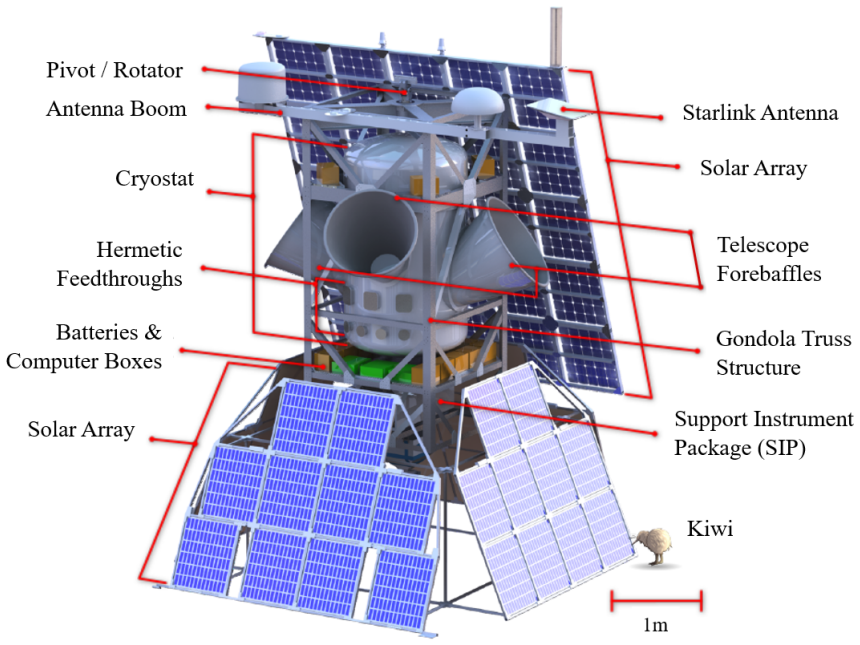
Taurus cools over 10,000 bolometers to 100 mK using independent multi-stage cryogenic chains for each receiver during long balloon flights.
A machine-rendered reading of the paper's core claim, the machinery that carries it, and where it could break.
Core claim
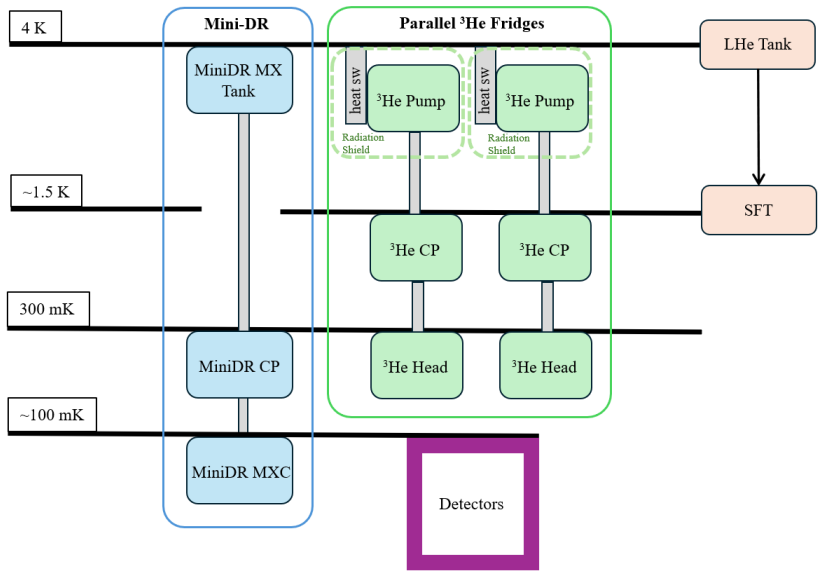
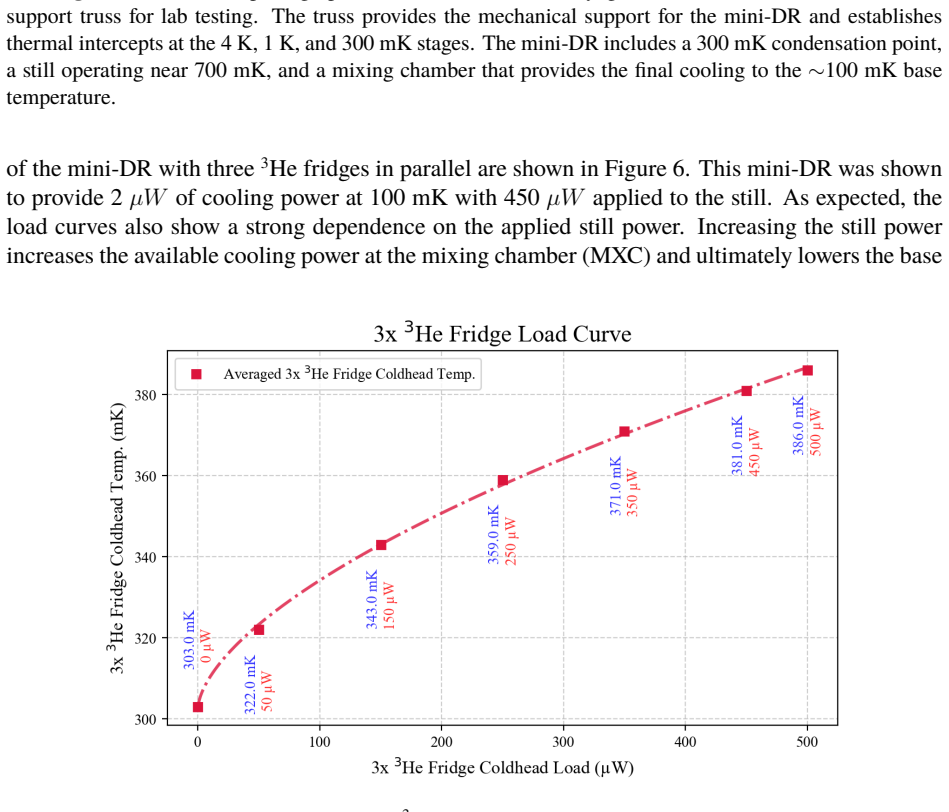
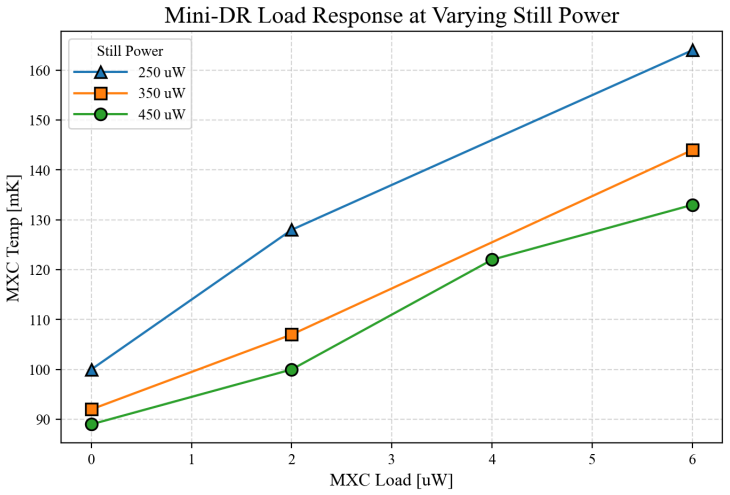
Taurus achieves base temperatures near 100 mK for its bolometer arrays through a 660 L liquid helium tank providing a 4 K reservoir, vapor-cooled shields at approximately 40 K and 80 K, a superfluid helium tank at 1.5 K, and for each of three receivers an independent sub-Kelvin chain consisting of closed-cycle 3He sorption refrigerators cooling to 300 mK that then feed miniature dilution refrigerators reaching approximately 100 mK, with early performance tests confirming the system meets requirements for mass, power, and robustness over extended flights.
What carries the argument
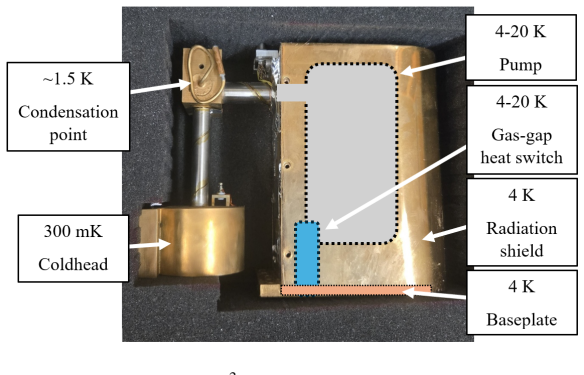
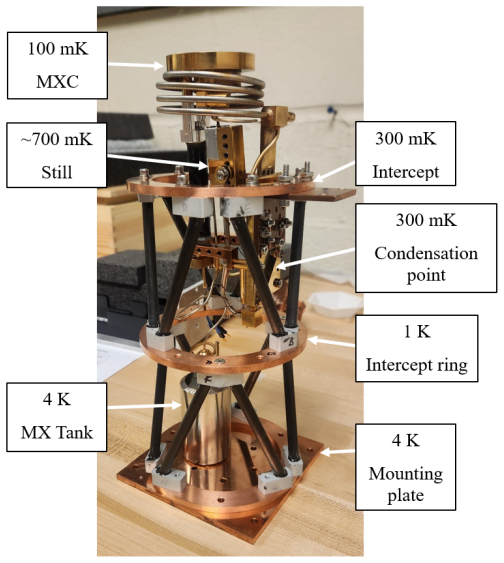
The independent sub-Kelvin cooling chain per receiver, each using a 3He sorption refrigerator as thermal intercept followed by a miniature dilution refrigerator.
If this is right
- Stable 100 mK operation becomes feasible for over 10,000 bolometers across multi-week balloon flights.
- Each receiver can operate with its own dedicated cooling chain, limiting the impact of any single failure.
- The combination of liquid helium tanks, sorption refrigerators, and dilution refrigerators satisfies balloon constraints on mass and power.
- Early tests indicate the architecture meets the robustness needed for stratospheric conditions.
Where Pith is reading between the lines
- The per-receiver independence may reduce overall mission risk if applied to other long-duration balloon instruments.
- The same staged approach could be tested for scaling to even larger detector counts by increasing tank or refrigerator capacity.
- Vapor-cooled shield performance under varying balloon altitudes remains a key factor for overall hold time that could be measured in follow-on tests.
Load-bearing premise
That early laboratory performance tests of the sub-Kelvin cooling chain will translate directly to stable 100 mK operation throughout an actual multi-week stratospheric balloon flight.
What would settle it
An integrated system test or actual flight in which any of the miniature dilution refrigerators fails to reach or hold approximately 100 mK for the full planned duration under flight-like mass, power, and vibration conditions.
Figures
read the original abstract
Taurus is a balloon-borne cosmic microwave background (CMB) experiment designed to operate more than 10,000 transition-edge sensor bolometers at a base temperature near 100 mK during a multi-week stratospheric balloon flight. This platform provides near-space observing conditions while imposing stringent constraints on mass, power, and system robustness, driving the need for a lightweight and highly reliable cryogenic system. To meet these requirements, Taurus employs a multi-stage cryogenic architecture. A 660 L liquid helium tank provides a stable 4 K reservoir, with vapor-cooled shields establishing intermediate stages at approximately 40 K and 80 K. A superfluid helium tank provides an approximately 1.5 K takeoff point for the sub-Kelvin cooling systems. Each of the instrument's three receivers is supported by an independent sub-Kelvin cooling chain that includes closed-cycle 3He sorption refrigerators that cool to 300 mK. These provide the thermal intercept and takeoff for a Chase Research Cryogenics miniature dilution refrigerator that cools the detectors to approximately 100 mK. Here we discuss the requirements and challenges of the Taurus sub-Kelvin cryogenic system and present results of early performance tests.
Editorial analysis
A structured set of objections, weighed in public.
Referee Report
Summary. The manuscript describes the multi-stage cryogenic architecture for the Taurus super-pressure balloon-borne CMB polarimeter, designed to cool more than 10,000 TES bolometers to ~100 mK over multi-week flights. It details a 660 L liquid helium tank providing a 4 K reservoir with vapor-cooled shields at ~40 K and ~80 K, a superfluid helium tank at ~1.5 K, independent per-receiver chains using closed-cycle 3He sorption refrigerators to 300 mK, and Chase Research Cryogenics miniature dilution refrigerators to ~100 mK. The paper discusses requirements, challenges, and results from early performance tests.
Significance. If the early performance tests provide quantitative validation of stable 100 mK operation under relevant heat loads and durations, the work would represent a practical engineering advance for scaling sub-Kelvin instrumentation to large detector arrays in long-duration balloon flights, where mass, power, and reliability constraints are severe. The independent cooling chains per receiver enhance fault tolerance, a strength for flight systems.
major comments (1)
- [Abstract] Abstract: The central claim that the architecture meets Taurus requirements for stable ~100 mK operation over multi-week flights rests on 'early performance tests,' yet no quantitative results (e.g., hold times, temperature stability metrics, measured heat loads, or test durations) are reported. This leaves the extrapolation from lab conditions to stratospheric flight unverified and is load-bearing for the manuscript's engineering validation.
minor comments (1)
- The temperatures (e.g., 'approximately 40 K', 'approximately 100 mK') are stated without accompanying error bars, specific measured values from tests, or references to figures/tables showing time-series data.
Simulated Author's Rebuttal
We thank the referee for their review and for highlighting the need for quantitative support in the abstract. We address the single major comment below and will revise the manuscript accordingly.
read point-by-point responses
-
Referee: [Abstract] Abstract: The central claim that the architecture meets Taurus requirements for stable ~100 mK operation over multi-week flights rests on 'early performance tests,' yet no quantitative results (e.g., hold times, temperature stability metrics, measured heat loads, or test durations) are reported. This leaves the extrapolation from lab conditions to stratospheric flight unverified and is load-bearing for the manuscript's engineering validation.
Authors: We agree that the abstract's reference to early performance tests requires supporting quantitative metrics to substantiate the central claims. The body of the manuscript presents the test results, but these are not summarized numerically in the abstract. In the revised version we will expand the abstract to include specific values such as achieved base temperature, hold time under representative heat loads, temperature stability, and test duration. This will make the engineering validation explicit and address the concern about extrapolation to flight conditions. revision: yes
Circularity Check
No circularity: purely descriptive engineering architecture with no derivations or fitted predictions
full rationale
The manuscript contains no equations, no claimed derivations, no parameters fitted to data then re-presented as predictions, and no load-bearing self-citations. The central content is a straightforward description of a multi-stage cryogenic chain (660 L LHe tank, vapor shields, superfluid tank, 3He sorption refrigerators, miniature dilution refrigerators) together with a statement that early performance tests were performed. Design choices are presented as direct engineering responses to stated mass/power/robustness requirements; nothing reduces to its own inputs by construction. This is the normal case for an instrumentation paper and receives the default non-circularity finding.
Axiom & Free-Parameter Ledger
axioms (1)
- domain assumption Standard thermodynamic and heat transfer properties of liquid helium, superfluid helium, sorption refrigerators, and dilution refrigerators apply under balloon flight conditions.
Reference graph
Works this paper leans on
-
[1]
Performance highlights of NASA super pressure balloon mid-latitude flights
Cathey, Henry M, Fairbrother, Debora A, and Said, Magdi A, “Performance highlights of NASA super pressure balloon mid-latitude flights”, AIAA Balloon Systems Conference (2017), p. 3091
2017
-
[2]
Reionization inference from the CMB optical depth and E-mode polarization power spectra
Qin, Yuxiang et al., “Reionization inference from the CMB optical depth and E-mode polarization power spectra”, Monthly Notices of the Royal Astronomical Society 499.1 (2020), pp. 550–558
2020
-
[3]
Towards a cosmological neutrino mass detection
Allison, Rupert et al., “Towards a cosmological neutrino mass detection”, Physical Review D 92.12 (2015), p. 123535
2015
-
[4]
Instrument overview of Taurus: a balloon-borne CMB and dust polarization ex- periment
May, Jared L et al., “Instrument overview of Taurus: a balloon-borne CMB and dust polarization ex- periment”, Ground-based and Airborne Telescopes X, Vol. 13094, SPIE (2024), pp. 1319–1333
2024
-
[5]
Thermal architecture for a cryogenic super-pressure balloon payload: design and development of the Taurus flight cryostat
Tartakovsky, Simon et al., “Thermal architecture for a cryogenic super-pressure balloon payload: design and development of the Taurus flight cryostat”, Ground-based and Airborne Telescopes X , Vol. 13094, SPIE (2024), pp. 1716–1724
2024
-
[6]
The thermal design, characterization, and performance of the SPIDER long- duration balloon cryostat
Gudmundsson, JE et al., “The thermal design, characterization, and performance of the SPIDER long- duration balloon cryostat”, Cryogenics 72 (2015), pp. 65–76
2015
-
[7]
Chase Research Cryogenics
Chase Research Cryogenics. Chase Research Cryogenics. https://www.chasecryogenics.com/ . Accessed: 2026-06-02
2026
-
[8]
A cryogen-free miniature dilution refrigerator for low- temperature detector applications
Teleberg, Gustav, Chase, ST, and Piccirillo, L., “A cryogen-free miniature dilution refrigerator for low- temperature detector applications”, Journal of Low Temperature Physics 151.3 (2008), pp. 669–674
2008
discussion (0)
Sign in with ORCID, Apple, or X to comment. Anyone can read and Pith papers without signing in.