REVIEW 4 major objections 6 minor 1 cited by
A new Phase-Field Model for Anisotropic Surface Diffusion: Anisotropic Cahn-Hilliard Equation with Improved Conservation (ACH-IC)
T0 review · 4 major / 6 minor · reviewed 2026-08-06 · deepseek-v4-flash
Pith's one-line read An anisotropic Cahn-Hilliard model with a modified conserved quantity achieves second-order volume conservation while still recovering the anisotropic surface-diffusion sharp-interface limit.
desk verdict Genuinely improved phase-field model with a real second-order volume-conservation proof, but the headline theorem's regularity assumption is too weak for the pinch-off case the paper advertises. read the letter →
The pith
A machine-rendered reading of the paper's core claim, the machinery that carries it, and where it could break.
The reading
What carries the argument
The load-bearing object is the modified conserved quantity $Q(u)$, a normalized integral of $(1-z^2)^k$, together with its reciprocal $N(u)=1/Q'(u)$. In the evolution equation $u_t = \varepsilon^{-1} N(u) \nabla \cdot (M(u)\nabla(N(u)\mu))$, the factor $N(u)$ forces the flux to vanish in the bulk phases because it blows up at $u = \pm 1$, confining diffusion to the interface; the mobility $M(u)=(1-u^2)^l$ controls the rate there. The parameter condition $1 \le k \le l \le 2k+1$ is what the asymptotic analysis requires for the sharp-interface limit and the $O(\varepsilon^2)$ volume bound.
What would settle it
For an initially smooth anisotropic shape that develops a cusp or self-intersection in finite time, compute $|\,|\Omega_\varepsilon^+(T)| - |\Omega_\varepsilon^+(0)|\,|$ for a sequence of decreasing $\varepsilon$ before and after the singularity; if the error after the singularity scales like $\varepsilon$ rather than $\varepsilon^2$, the $O(\varepsilon^2)$ bound does not extend to the pinch-off regime. A direct check is to repeat the thin-tube pinch-off test of Section 4.6 with $\varepsilon = 0.01$ and $0.005$ and measure whether second-order convergence persists after the drops detach.
Extended reading notes
Core claim
The central claim is that for the ACH-IC solution the volume of the domain enclosed by the zero level set satisfies $|\Omega_\varepsilon^+(t)| = |\Omega_\varepsilon^+(0)| + O(\varepsilon^2)$, and that the interface normal velocity obeys $V_\varepsilon = C_l \Delta_s(\nabla_s \cdot \xi(\nu)) + O(\varepsilon)$. The model is derived from Onsager's variational principle with the conservation law $\partial_t Q + \nabla \cdot J = 0$, where $Q(u) = \int_0^u (1-z^2)^k \, dz \; / \; \int_0^1 (1-z^2)^k \, dz$ approximates the step function of the two phases more closely than $u$ itself. Matched asymptotic expansions show that the leading-order profile remains a tanh interface, the first-order correction is uniformly bounded, and the degeneracy condition $1 \le k \le l \le 2k+1$ suffices for the sharp-interface limit. Numerical tests in two and three dimensions show second-order real-volume convergence and agreement with sharp-interface reference solutions, whereas the classical ACH shows first-order drift and spontaneous shrinkage.
Load-bearing premise
The proof of second-order volume conservation assumes the interface $\partial\Omega_\varepsilon^+(t)$ is finite and $C^2$-smooth at every time, an assumption that fails exactly at the pinch-off and topological-change events the model is advertised to simulate.
Editorial extensions
If this is right
- If Eq. (18) is correct, phase-field simulations of anisotropic surface diffusion can use larger interface thickness $\varepsilon$ and coarser meshes while matching the volume accuracy of classical models run at much smaller $\varepsilon$.
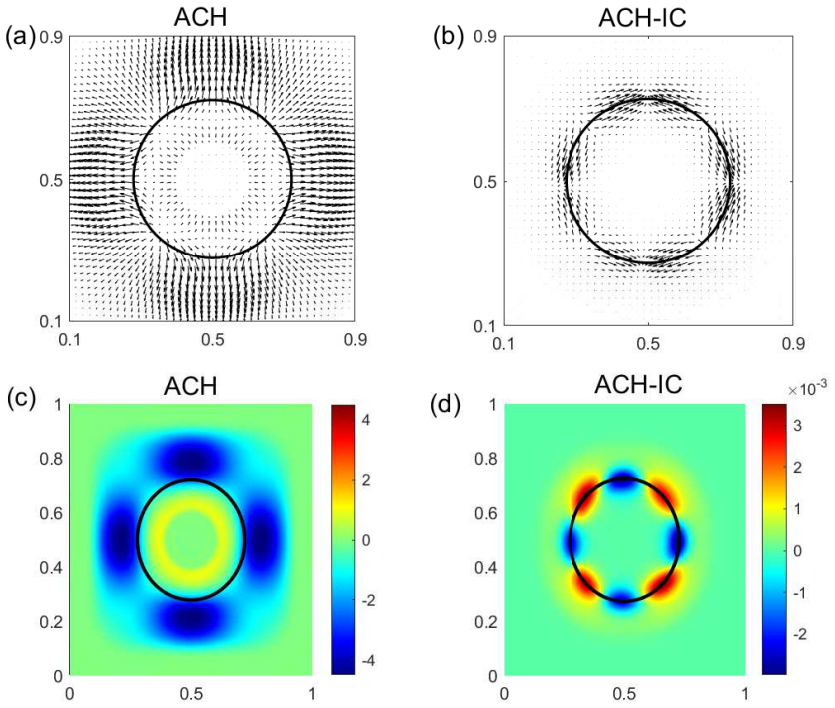
- The spontaneous shrinkage of small drops is mitigated and the critical radius below which drops vanish is drastically reduced, allowing stable simulation of thin tubes and pinch-off where the classical ACH collapses.
- The model preserves energy dissipation for the classical anisotropic surface energy, so the improved conservation does not come at the cost of thermodynamic consistency.
- For isotropic energy with $k=1$ and $l=2$, the ACH-IC recovers the second-order variational Cahn-Hilliard model of Ref. [7], placing that earlier model inside the new variational framework.
- With a Willmore-type regularization for strongly anisotropic energies, the volume-conservation and approximation properties persist, with only the normal-velocity relation modified.
Reading between the lines
- The same device, conserving a steeper approximation of the step function instead of the phase variable, could be applied to other volume-preserving phase-field dynamics such as two-phase flow or solid-state dewetting, where first-order volume drift is a known limitation.
- Because the $O(\varepsilon^2)$ theorem assumes $C^2$ regularity for all times, the good pinch-off behavior shown numerically is not covered by the proof; whether it holds uniformly through topological change is an open question that can be settled by the numerical convergence test proposed above.
- The paper does not locate the ACH-IC critical radius analytically; measuring it as a function of $k$ and $l$ would give a practical design rule for choosing the model parameters.
- The volume bound is proved for the difference $|\Omega_\varepsilon^+(t)| - |\Omega_\varepsilon^+(0)|$; a stronger statement about monotone volume loss at intermediate times, or about the volume of each connected component after pinch-off, is not established.
Editorial analysis
A structured set of objections, weighed in public.
Referee Report
Summary. The paper proposes a variational phase-field model (ACH-IC) for anisotropic surface diffusion in which a generalized conserved quantity Q(u)=∫_0^u(1−z^2)^k dz / ∫_0^1(1−z^2)^k dz replaces u in the conservation constraint. The model is derived from Onsager's variational principle, and matched asymptotic expansions are used to show that the zero level set evolves according to V = C_l Δ_s(∇_s·ξ(ν)) + O(ε) and that the enclosed volume satisfies |Ω_ε^+(t)| = |Ω_ε^+(0)| + O(ε^2), i.e., second-order rather than first-order volume conservation. The paper supports these claims with a coarea-formula proof and with numerical experiments in two and three dimensions, including spontaneous-shrinkage, flower-shape, strongly anisotropic, and pinch-off examples.
Significance. If the main theorem holds on the claimed range of applicability, the ACH-IC model is a substantial improvement over classical anisotropic Cahn-Hilliard models: it preserves the variational/energy-dissipation structure while reducing volume drift from O(ε) to O(ε^2), and the numerics suggest that it permits larger ε for similar accuracy. The variational derivation via an improved conserved quantity is general and could be transferred to other phase-field settings. The matched asymptotic analysis is detailed and internally coherent, and the mobility constant C_l is derived rather than fitted. The paper also includes careful convergence tables and comparisons against a sharp-interface parametric FEM. However, the second-order conservation theorem is proved under regularity and uniformity assumptions that are not met in the pinch-off regime advertised in Section 4.6, and the strong-anisotropy case is asserted rather than proved; these gaps do not undermine the core model but require a substantial restatement of the theorem.
major comments (4)
- [Section 3.4, Eqs. (42)–(46)] The proof of Property 3 uses the first-variation expansion h(ζ)=h(0)+ζh'(0)+O(ζ^2) and, uniformly for ζ∈[0,|log ε|], writes h(εζ)−h(−εζ)=2ζεh'(0)+O(ε^2ζ^2) with a constant C1 independent of ζ. For a C^2 interface whose minimum radius of curvature is O(ε), the remainder in the first-variation formula is O(εζ^2), not O(ε^2ζ^2), because the constant in the O(ζ^2) term depends on curvature. Since C^2 regularity alone does not exclude curvature blow-up as ε→0, the estimate (43) and hence Eq. (18) are not uniform in interface geometry. The hypothesis in Property 3 must be strengthened (e.g., a uniform curvature bound) or the theorem must be restricted to time intervals on which curvature is O(1).
- [Section 3.2 and Section 4.6] The matched asymptotic expansion (16) relies on local normal coordinates in which ερ κ_i is treated as small, as seen in the expansions following Eq. (25). When a tube neck reaches radius O(ε), the principal curvature is O(1/ε) and ερ κ_i is not uniformly small for ρ up to O(|log ε|); hence Eq. (16) and the subsequent volume estimate are not valid in the pinch-off regime. Section 4.6 uses exactly this regime to advertise the model's conservation properties, so the theoretical guarantee stated in Property 3 does not cover the motivating application; a separate near-pinch analysis or an explicit exclusion of this regime is needed.
- [Section 2.2 and Appendix B, Remark B.3] The asymptotic analysis in Section 3 uses the unregularized N(u)=1/Q'(u) and assumes u≠±1 throughout, while the numerical scheme does not enforce |u|≤1 and no maximum principle or a priori bound is proved. The regularized Ñ(u) is introduced in Section 2.2 to avoid the singularity, but the matched asymptotics are not redone for the regularized model. Consequently Properties 1–3 are conditional on a solution regularity that is not established as part of the theorem; this should be stated explicitly among the hypotheses of Property 3.
- [Section 2.3 and Section 4.2] The proof in Section 3.4 is carried out for the unregularized model, whereas the paper states in Section 2.3 that in the strongly anisotropic case with Willmore regularization all properties except the normal velocity are retained 'by similar arguments.' No such analysis is supplied. Since Table 2 reports second-order volume conservation for α=0.2 with β=ε^2, the numerical claim for strong anisotropy is not covered by the theorem as proved and should be either proved or explicitly labeled as a numerical observation.
minor comments (6)
- [Eq. (5) and Eq. (7)] The phase field u is scalar, but the text writes u ∈ R^d in the display of the energy functional; this should be corrected to u ∈ R or u: Ω→[−1,1].
- [References] Reference [57] is listed as J. Comput. Phys. 223 (2017) 1–9; the actual publication year is 2007, so the citation should be corrected.
- [Section 2.2] The sentence 'The function 1/M(u) plays a role of friction coefficient' should read 'plays the role of a friction coefficient.'
- [Figure 9 caption] The caption contains the typo 'Sharp-inerface model'; it should be 'Sharp-interface model.'
- [Section 4.6] The statement that 'the thickness of the thin tube must be greater than 2ε when the ACH model is employed' appears to be an observation from a single simulation; it should be qualified or supported by a systematic study.
- [Section 3.3] The notation (N μ̄)_k is introduced in a parenthetical remark and is easy to miss; it would be clearer as a displayed definition before Eq. (29).
Circularity Check
No significant circularity: the O(ε²) volume-conservation result is proved from the exact conservation law for Q and matched-asymptotic expansions, not assumed or fitted.
full rationale
The paper's central claims—uniform expansion (16), sharp-interface velocity (17), and second-order volume conservation (18)—are derived in Section 3 via matched asymptotic expansions from the model (15). The conserved quantity Q is chosen in Section 2.2 so that Q(u) approximates the step function faster than u, but the O(ε²) bound in Section 3.4 is then established by a coarea-formula argument using the exact identity ∫Q(uε)dx = const, the first-variation expansion h(ζ) = h(0) + ζh'(0) + O(ζ²), and exponential decay of 1−Q(σ(ζ)); the proof is not an assumption of the conclusion. The mobility coefficient Cl is computed from an integral of M(U0), not fitted. The recovery of Bretin's model in the isotropic quadratic-mobility case is explicitly disclosed and does not smuggle in the result. Self-citations appear only as background or numerical-benchmark references and are not load-bearing for the asymptotic derivation. Concerns about the C2 regularity hypothesis in Property 3 (e.g., possible curvature blow-up near pinch-off) are legitimate rigor/completeness issues but are not circularity: the theorem is conditional on a regularity assumption and does not reduce to its inputs by construction.
Assumptions & free parameters
free parameters (4)
- k (exponent in conserved quantity Q) =
1 (numerics)
- l (mobility exponent) =
2 (numerics)
- α (anisotropy strength) =
0.05 (weak), 0.2 (strong)
- β (Willmore regularization strength) =
ε^2 (strong anisotropy tests)
assumptions (5)
- domain assumption The interface Γ_ε(t) is a smooth (C^2) closed hypersurface for all times in the asymptotic analysis.
- domain assumption The phase variable u stays away from ±1 in the asymptotic expansions, so N(u)=1/Q'(u) is nonsingular.
- ad hoc to paper The parameters satisfy 1 ≤ k ≤ l ≤ 2k+1 and l−2k < 1+1/w so the outer expansion closes.
- standard math Standard matched asymptotic expansion machinery: outer/inner expansions, matching of flux, and solvability conditions are valid.
- domain assumption The Torabi-type energy (5) with regularized normal vector n̂ is the correct phase-field approximation of the anisotropic surface energy (2).
invented entities (1)
-
Conserved quantity Q(u)
Cite this review
Pith. "Pith review of A new Phase-Field Model for Anisotropic Surface Diffusion: Anisotropic Cahn-Hilliard Equation with Improved Conservation (ACH-IC)." pith.science (2026). https://pith.science/paper/SFO6J6P2
@misc{pith2026250718048,
  author       = {Pith},
  title        = {Pith review of: A new Phase-Field Model for Anisotropic Surface Diffusion: Anisotropic Cahn-Hilliard Equation with Improved Conservation (ACH-IC)},
  year         = {2026},
  howpublished = {\url{https://pith.science/paper/SFO6J6P2}},
  note         = {Machine review of arXiv:2507.18048}
}
read the original abstract
As popular approximations to sharp-interface models, the Cahn-Hilliard type phase-field models are usually used to simulate interface dynamics with volume conservation. However, the convergence rate of the volume enclosed by the interface to its sharp-interface limit is usually at first order of the interface thickness in the classical Cahn-Hilliard model with constant or degenerate mobilities. In this work, we propose a variational framework for developing new Cahn-Hilliard dynamics with enhanced volume conservation by introducing a more general conserved quantity. In particular, based on Onsager's variational principle (OVP) and a modified conservation law, we develop an anisotropic Cahn-Hilliard equation with improved conservation (ACH-IC) for approximating anisotropic surface diffusion. The ACH-IC model employs a new conserved quantity that approximates a step function more effectively, and yields second-order volume conservation while preserving energy dissipation for the classical anisotropic surface energy. The second-order volume conservation as well as the convergence to the sharp-interface surface diffusion dynamics is derived through comprehensive asymptotic analysis. Numerical evidence not only reveals the underlying physics of the proposed model in comparison with the classical one, but also demonstrates its exceptional performance in simulating anisotropic surface diffusion dynamics.
Figures


Figures from the paper (7 more)




Forward citations
Cited by 1 Pith paper
-
Variable-preconditioned transformed primal-dual method for generalized Wasserstein Gradient Flows
VPTPD is a variable-preconditioned transformed primal-dual algorithm for dynamic JKO schemes that reports large speedups over prior primal-dual methods in 1D to 3D numerical tests.
Reference graph
Works this paper leans on
-
[1]
Geometric evolution problems, distance function and viscosity solutions
Luigi Ambrosio, Norman Dancer, and L Ambrosio. Geometric evolution problems, distance function and viscosity solutions . Springer, 2000
work page 2000
-
[2]
Convexity splitting in a phase field model for surface diffusion
Rainer Backofen, Steven M Wise, Marco Salvalaglio, and Axel Voigt . Convexity splitting in a phase field model for surface diffusion. Int. J. Numer. Anal. Model. , 16:192–209, 2019
work page 2019
-
[3]
Weizhu Bao, Wei Jiang, David J. Srolovitz, and Yan Wang. Stable eq uilibria of anisotropic particles on substrates: A generalized Winterbottom construction. SIAM J. Appl. Math. , 77(6):2093–2118, 2017
work page 2017
-
[4]
Weizhu Bao, Wei Jiang, Yan Wang, and Quan Zhao. A parametric fin ite element method for solid-state dewetting problems with anisotropic surface energies. J. Comput. Phys. , 330:380–400, 2017
work page 2017
-
[5]
Numer ical approximation of anisotropic geo- metric evolution equations in the plane
John W Barrett, Harald Garcke, and Robert N¨ urnberg. Numer ical approximation of anisotropic geo- metric evolution equations in the plane. IMA J. Numer. Anal. , 28(2):292–330, 2008
work page 2008
-
[6]
Stress-induced acceleration and ordering in solid-state dew etting
Francesco Boccardo, Fabrizio Rovaris, Ashwani Tripathi, Fran cesco Montalenti, and Olivier Pierre- Louis. Stress-induced acceleration and ordering in solid-state dew etting. Phys. Rev. Lett., 128(2):026101, 2022. 29
work page 2022
-
[7]
Elie Bretin, Simon Masnou, Arnaud Sengers, and Garry Terii. Appr oximation of surface diffusion flow: A second-order variational Cahn-Hilliard model with degenerate mo bilities. Math. Mod. Meth. Appl. S., 32(04):793–829, 2022
work page 2022
-
[8]
John W Cahn, Charles M Elliott, and Amy Novick-Cohen. The Cahn–H illiard equation with a concen- tration dependent mobility: motion by minus the laplacian of the mean c urvature. Eur. J. Appl Math. , 7(3):287–301, 1996
work page 1996
Show all 60 references
-
[9]
Efficient energy stable schemes with spec tral discretization in space for anisotropic Cahn-Hilliard systems
Feng Chen and Jie Shen. Efficient energy stable schemes with spec tral discretization in space for anisotropic Cahn-Hilliard systems. Commun. Comput. Phys. , 13(5):1189–1208, 2013
2013
-
[10]
Coarsening mechanism for systems gove rned by the Cahn–Hilliard equation with degenerate diffusion mobility
Shibin Dai and Qiang Du. Coarsening mechanism for systems gove rned by the Cahn–Hilliard equation with degenerate diffusion mobility. Multiscale Model. Sim. , 12(4):1870–1889, 2014
2014
-
[11]
Computat ion of geometric partial differential equations and mean curvature flow
Klaus Deckelnick, Gerhard Dziuk, and Charles M Elliott. Computat ion of geometric partial differential equations and mean curvature flow. Acta Numer. , 14:139–232, 2005
2005
-
[12]
Onsager’s variational principle in soft matter
Masao Doi. Onsager’s variational principle in soft matter. J. Phys. Condens. Matter , 23(28):284118, 2011
2011
-
[13]
Application of the O nsager-Machlup integral in solving dynamic equations in nonequilibrium systems
Masao Doi, Jiajia Zhou, Yana Di, and Xianmin Xu. Application of the O nsager-Machlup integral in solving dynamic equations in nonequilibrium systems. Phys. Rev. E , 99(6):063303, 2019
2019
-
[14]
Recent developments in the theory of sur face diffusion
JD Doll and AF Voter. Recent developments in the theory of sur face diffusion. Annu. Rev. Phys. Chem. , 38(1):413–431, 1987
1987
-
[15]
An aniso tropic phase-field model for solid-state dewetting and its sharp-interface limit
Marion Dziwnik, Andreas M¨ unch, and Barbara Wagner. An aniso tropic phase-field model for solid-state dewetting and its sharp-interface limit. Nonlinearity, 30(4):1465, 2017
2017
-
[16]
Surface diffusion
Gert Ehrlich and Kaj Stolt. Surface diffusion. Annu. Rev. Phys. Chem. , 31(1):603–637, 1980
1980
-
[17]
A diffuse-interface approach for solid-state dewetting with anisotropic surface energies
Harald Garcke, Patrik Knopf, Robert N¨ urnberg, and Quan Zh ao. A diffuse-interface approach for solid-state dewetting with anisotropic surface energies. J. Nonlinear Sci. , 33(2):34, 2023
2023
-
[18]
Phase-field investigation of the coarsening of porous structures by surface diffusion
Pierre-Antoine Geslin, Mickael Buchet, Takeshi Wada, and Hide mi Kato. Phase-field investigation of the coarsening of porous structures by surface diffusion. Phys. Rev. Mater. , 3(8):083401, 2019
2019
-
[19]
Comparison of phase-field models for surface diffusion
Clemens Gugenberger, Robert Spatschek, and Klaus Kassner . Comparison of phase-field models for surface diffusion. Phys. Rev. E , 78(1):016703, 2008
2008
-
[20]
A vector thermodynamics for a nisotropic surfaces: I
David W Hoffman and John W Cahn. A vector thermodynamics for a nisotropic surfaces: I. fundamentals and application to plane surface junctions. Surf. Sci. , 31:368–388, 1972
1972
-
[21]
Jiang, Q
W. Jiang, Q. Zhao, and W. Bao. Sharp-interface model for simu lating solid-state dewetting in three dimensions. SIAM J. Appl. Math. , 80:1654–1677, 2020
2020
-
[22]
P hase field approach for simulating solid-state dewetting problems
Wei Jiang, Weizhu Bao, Carl V Thompson, and David J Srolovitz. P hase field approach for simulating solid-state dewetting problems. Acta Mater., 60(15):5578–5592, 2012
2012
-
[23]
A perimeter-decreasing and area-con serving algorithm for surface diffusion flow of curves
Wei Jiang and Buyang Li. A perimeter-decreasing and area-con serving algorithm for surface diffusion flow of curves. J. Comput. Phys. , 443:110531, 2021
2021
-
[24]
Sharp-interface approach for simula ting solid-state dewetting in two dimen- sions: A Cahn–Hoffman ξ-vector formulation
Wei Jiang and Quan Zhao. Sharp-interface approach for simula ting solid-state dewetting in two dimen- sions: A Cahn–Hoffman ξ-vector formulation. Phys. D , 390:69–83, 2019
2019
-
[25]
Application of Onsager’s variational principle to the dynamics of a solid toroidal island on a subs trate
Wei Jiang, Quan Zhao, Tiezheng Qian, David J Srolovitz, and Weizh u Bao. Application of Onsager’s variational principle to the dynamics of a solid toroidal island on a subs trate. Acta Mater., 163:154–160, 2019. 30
2019
-
[26]
Degenerate mob ilities in phase field models are insuffi- cient to capture surface diffusion
Alpha A Lee, Andreas M¨ unch, and Endre S¨ uli. Degenerate mob ilities in phase field models are insuffi- cient to capture surface diffusion. Appl. Phys. Lett. , 107(8):081603, 2015
2015
-
[27]
A numerical study of ele ctro-migration voiding by evolving level set functions on a fixed cartesian grid
Zhilin Li, Hongkai Zhao, and Huajian Gao. A numerical study of ele ctro-migration voiding by evolving level set functions on a fixed cartesian grid. J. Comput. Phys. , 152(1):281–304, 1999
1999
-
[28]
A note on a phase-field model for anisotropic sy stems
Luca Lussardi. A note on a phase-field model for anisotropic sy stems. Asymptotic Analysis, 94:241–254, 2015
2015
-
[29]
Sets of finite perimeter and geometric variational problems : an introduction to Geo- metric Measure Theory
Francesco Maggi. Sets of finite perimeter and geometric variational problems : an introduction to Geo- metric Measure Theory . Cambridge University Press, 2012
2012
-
[30]
Existence of solutions for anisot ropic Cahn-Hilliard and Allen-Cahn systems in higher space dimensions
Ahmad Makki and Alain Miranville. Existence of solutions for anisot ropic Cahn-Hilliard and Allen-Cahn systems in higher space dimensions. Discrete Cont. Dyn-S , 9(3):759, 2016
2016
-
[31]
Un esempio di γ-convergenza
Modica and Mortola. Un esempio di γ-convergenza. Boll. Un. Mat. Ital. A , 14:526, 1977
1977
-
[32]
Theory of thermal grooving
William W Mullins. Theory of thermal grooving. J. Appl. Phys. , 28(3):333–339, 1957
1957
-
[33]
Reciprocal relations in irreversible processes
Lars Onsager. Reciprocal relations in irreversible processes. I. Phys. Rev. , 37(4):405, 1931
1931
-
[34]
Reciprocal relations in irreversible processes
Lars Onsager. Reciprocal relations in irreversible processes. II. Phys. Rev. , 38(12):2265, 1931
1931
-
[35]
A variational app roach to moving contact line hydrodynamics
Tiezheng Qian, Xiao-Ping Wang, and Ping Sheng. A variational app roach to moving contact line hydrodynamics. J. Fluid Mech. , 564:333–360, 2006
2006
-
[36]
Surface evolut ion of elastically stressed films under deposition by a diffuse interface model
Andreas R¨ atz, Angel Ribalta, and Axel Voigt. Surface evolut ion of elastically stressed films under deposition by a diffuse interface model. J. Comput. Phys. , 214(1):187–208, 2006
2006
-
[37]
Faceting of equilibrium and metastable nanostructures: a phase-fi eld model of surface diffusion tackling realistic shapes
Marco Salvalaglio, Rainer Backofen, Roberto Bergamaschini, Fr ancesco Montalenti, and Axel Voigt. Faceting of equilibrium and metastable nanostructures: a phase-fi eld model of surface diffusion tackling realistic shapes. Cryst. Growth Des. , 15(6):2787–2794, 2015
2015
-
[38]
Morphological evolution of pit-patterned si (001) substrates driven by surface-energy r eduction
Marco Salvalaglio, Rainer Backofen, Axel Voigt, and Francesco Montalenti. Morphological evolution of pit-patterned si (001) substrates driven by surface-energy r eduction. Nanoscale Res. Lett., 12:1–8, 2017
2017
-
[39]
Phase-field simulations of faceted Ge/Si-crystal arrays, me rging into a suspended film
Marco Salvalaglio, Roberto Bergamaschini, Rainer Backofen, Ax el Voigt, Francesco Montalenti, and Leo Miglio. Phase-field simulations of faceted Ge/Si-crystal arrays, me rging into a suspended film. Appl. Surf. Sci. , 391:33–38, 2017
2017
-
[40]
D oubly degenerate diffuse inter- face models of anisotropic surface diffusion
Marco Salvalaglio, Maximilian Selch, Axel Voigt, and Steven M Wise. D oubly degenerate diffuse inter- face models of anisotropic surface diffusion. Math. Method. Appl. Sci. , 44(7):5406–5417, 2021
2021
-
[41]
Doubly degener ate diffuse interface models of surface diffusion
Marco Salvalaglio, Axel Voigt, and Steven M Wise. Doubly degener ate diffuse interface models of surface diffusion. Math. Method. Appl. Sci. , 44(7):5385–5405, 2021
2021
-
[42]
Stabilized predictor-corrector schemes fo r gradient flows with strong anisotropic free energy
Jie Shen and Jie Xu. Stabilized predictor-corrector schemes fo r gradient flows with strong anisotropic free energy. Commun. Comput. phys. , 2018
2018
-
[43]
A new class of efficient and robus t energy stable schemes for gradient flows
Jie Shen, Jie Xu, and Jiang Yang. A new class of efficient and robus t energy stable schemes for gradient flows. SIAM Rev. , 61(3):474–506, 2019
2019
-
[44]
Interfaces in crystalline materials
Adrian P Sutton. Interfaces in crystalline materials. Monographs on the Physice and Chemistry of Materials, pages 414–423, 1995
1995
-
[45]
Linking anisotropic sharp and diffu se surface motion laws via gradient flows
Jean E Taylor and John W Cahn. Linking anisotropic sharp and diffu se surface motion laws via gradient flows. J. Stat. Phys. , 77:183–197, 1994. 31
1994
-
[46]
A new phase-field model for strongly anisotropic systems
Solmaz Torabi, John Lowengrub, Axel Voigt, and Steven Wise. A new phase-field model for strongly anisotropic systems. Proc. R. Soc. A , 465(2105):1337–1359, 2009
2009
-
[47]
Voorhees
Peter W. Voorhees. The theory of ostwald ripening. J. Stat. Phys. , 38(1):231–252, 1985
1985
-
[48]
Onsager’s variationa l principle in active soft matter
Haiqin Wang, Tiezheng Qian, and Xinpeng Xu. Onsager’s variationa l principle in active soft matter. Soft Matter , 17(13):3634–3653, 2021
2021
-
[49]
Cahn–Hoffman ξ-vector and its relation to diffuse interface models of phase transit ions
AA Wheeler. Cahn–Hoffman ξ-vector and its relation to diffuse interface models of phase transit ions. J. Stat. Phys. , 95:1245–1280, 1999
1999
-
[50]
Solving the reg ularized, strongly anisotropic Cahn– Hilliard equation by an adaptive nonlinear multigrid method
Steven Wise, Junseok Kim, and John Lowengrub. Solving the reg ularized, strongly anisotropic Cahn– Hilliard equation by an adaptive nonlinear multigrid method. J. Comput. Phys. , 226(1):414–446, 2007
2007
-
[51]
G. Wulff. Zur frage der geschwindigkeit des wachstums und dera ufl¨ osung der krystallfl¨ achen.Z. Kristal- logr, 34(1):449–530, 1901
1901
-
[52]
A finite element analysis of t he motion and evolution of voids due to strain and electromigration induced surface diffusion
L Xia, Allan F Bower, Z Suo, and CF Shih. A finite element analysis of t he motion and evolution of voids due to strain and electromigration induced surface diffusion. J. Mech. Phys. Solids , 45(9):1473–1493, 1997
1997
-
[53]
Anisotropic surfac e diffusion of CO on Ni (110)
Xu-Dong Xiao, XD Zhu, W Daum, and YR Shen. Anisotropic surfac e diffusion of CO on Ni (110). Phys. Rev. Lett. , 66(18):2352, 1991
1991
-
[54]
Efficient and lin ear schemes for anisotropic Cahn– Hilliard model using the stabilized-invariant energy quadratization (S -IEQ) approach
Zhen Xu, Xiaofeng Yang, Hui Zhang, and Ziqing Xie. Efficient and lin ear schemes for anisotropic Cahn– Hilliard model using the stabilized-invariant energy quadratization (S -IEQ) approach. Comput. Phys. Commun., 238:36–49, 2019
2019
-
[55]
Xiaofeng Yang. Efficient and energy stable scheme for the hydr odynamically coupled three components Cahn-Hilliard phase-field model using the stabilized-invariant energy quadratization (S-IEQ) approach. Journal of Computational Physics , 438:110342, 2021
2021
-
[56]
Numerical approximation s for the molecular beam epitaxial growth model based on the invariant energy quadratization metho d
Xiaofeng Yang, Jia Zhao, and Qi Wang. Numerical approximation s for the molecular beam epitaxial growth model based on the invariant energy quadratization metho d. J. Comput. Phys. , 333:104–127, 2017
2017
-
[57]
Pengtao Yue, Chunfeng Zhou, and James J. Feng. Spontaneo us shrinkage of drops and mass conservation in phase-field simulations. J. Comput. Phys. , 223(1):1–9, 2017
2017
-
[58]
Variational approach to droplet transport via bendotaxis: thin film dynamics and model reduction
Zhen Zhang and Tiezheng Qian. Variational approach to droplet transport via bendotaxis: thin film dynamics and model reduction. Phys. Rev. Fluids , 7(4):044002, 2022
2022
-
[59]
A parametric finite elemen t method for solid-state dewetting problems in three dimensions
Quan Zhao, Wei Jiang, and Weizhu Bao. A parametric finite elemen t method for solid-state dewetting problems in three dimensions. SIAM J. Sci. Comput. , 42(1):B327–B352, 2020
2020
-
[60]
Dynamics of small solid particles on substrates of arbitrary topography
Quan Zhao, Wei Jiang, Yan Wang, David J Srolovitz, Tiezheng Qian , and Weizhu Bao. Dynamics of small solid particles on substrates of arbitrary topography. Acta Mater., 281:120407, 2024. 32
2024
Reviewed August 6, 2026 · model on record in the stance chip above.
Discussion (0). Continue with ORCID to comment.