REVIEW 2 major objections 5 minor 27 references
Matched-Filter based Backscatter Communication for IoT Devices over Ambient OFDM Carrier
T0 review · 2 major / 5 minor · reviewed 2026-08-14 · deepseek-v4-flash
Pith's one-line read A matched filter at the backscatter tag turns the unknown backscatter channel into a common-phase diagonal gain, and an EM receiver approaches ideal known-channel performance.
desk verdict A solid subfield contribution: CAMF gives ambient-backscatter receivers a low-complexity path to near-coherent detection, but the load-bearing assumption that the battery-free tag can accurately estimate its own CSI is never stress-tested. read the letter →
The pith
A machine-rendered reading of the paper's core claim, the machinery that carries it, and where it could break.
The reading
What carries the argument
The central object is the matched-filter transmitter at the backscatter device, b_m = κg^*s_m with κ = √L/||g||, which produces the effective channel V = diag(|G_0|^2, ..., |G_{L-1}|^2). This imposes the constraint set V = {diag(ṽ_0, ..., ṽ_{L-1}) : ṽ_l = β̃ a_l, β̃ ∈ C, a_l ≥ 0}, meaning all diagonal phases are equal. The receiver exploits this constraint inside an EM algorithm that alternates soft detection of the ambient OFDM symbols with estimation of Ṽ, costing O(N_iter M L |X|) per iteration, and the paper shows a few iterations suffice.
What would settle it
Run the same EM receiver with a backscatter device whose matched filter is built from a noisy or quantized estimate of G, increasing the estimation error variance from zero; if the BER curve develops an error floor similar to the unfiltered scheme once the error exceeds a small threshold, the claimed advantage depends on an accuracy the paper does not quantify. A prototype with a low-power tag would also show whether the matched-filtering computation fits within the tag's energy budget.
Extended reading notes
Core claim
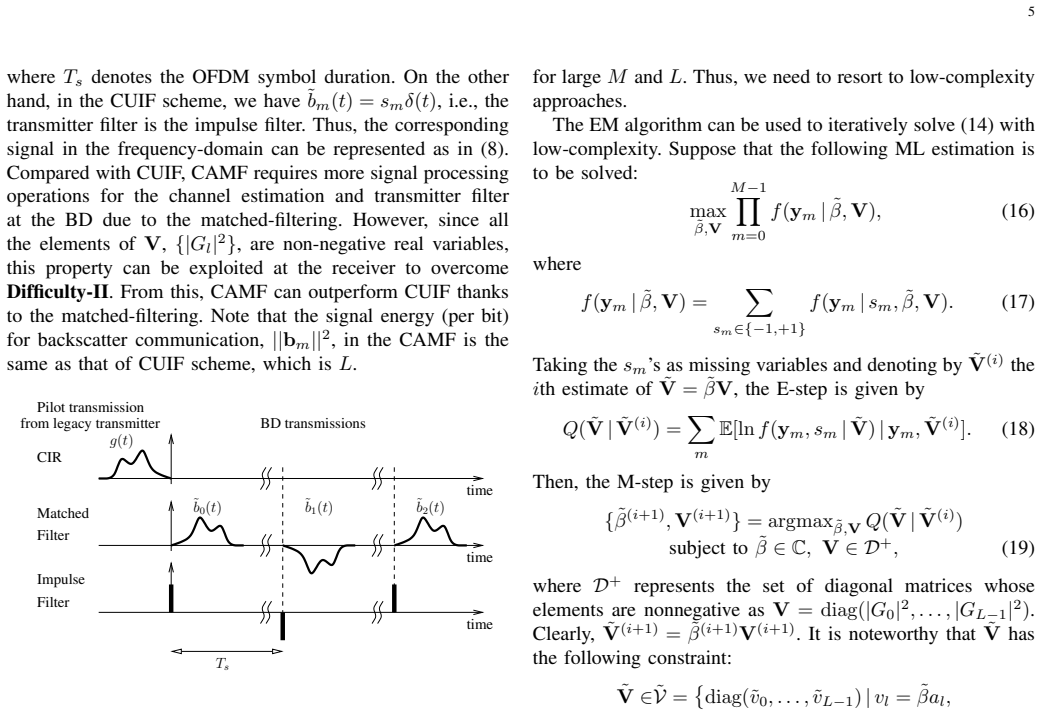
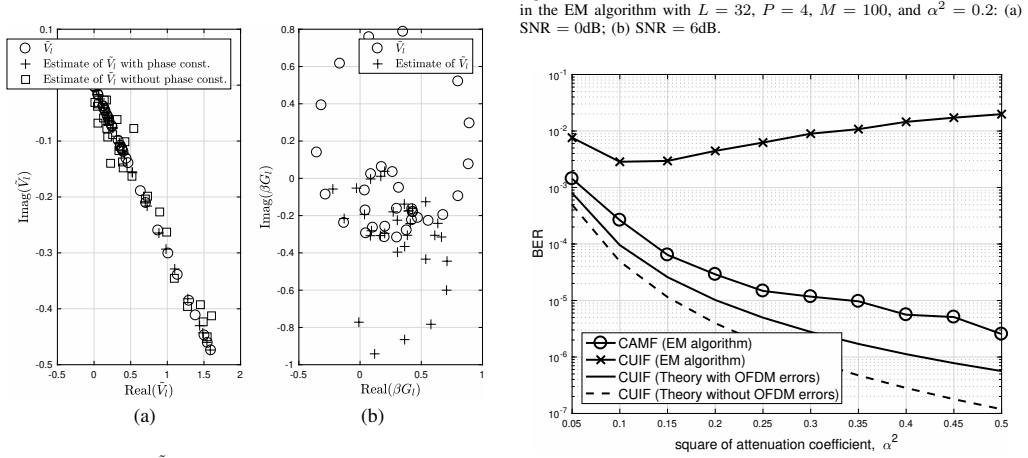
If the backscatter device knows its channel G from the legacy OFDM transmitter, then using the time-reversal matched filter b_m = κg^*s_m turns the received backscattered signal into βκ diag(|G_0|^2, ..., |G_{L-1}|^2) x_m s_m. The effective unknown channel therefore becomes a diagonal matrix whose entries are nonnegative real numbers scaled by a single complex factor, so all diagonal elements share one phase. This common-phase constraint is the key: it lets the receiver's EM algorithm estimate the backscatter channel reliably, removing the error floor that appears when the unconstrained channel βG must be estimated. The paper proves under ideal conditions that the matched-filter scheme has bit-error probability no worse than the unfiltered scheme, and simulations show it tracks the theoretical known-channel lower bound.
Load-bearing premise
The whole scheme rests on the backscatter device being able to accurately estimate its own channel G from the legacy transmitter's pilots and implement the time-reversal matched filter; the paper assumes this CSI is available at the device and does not analyze the effect of estimation error there.
Editorial extensions
If this is right
- Coherent detection of ambient backscatter becomes feasible at the receiver without direct observation of the backscatter device's channel, as long as the device can estimate its own channel.
- The matched-filter scheme removes the high-SNR error floor that the unfiltered impulse-filter scheme exhibits.
- The approach does not rely on the cyclic-prefix repeating structure, so it works with short cyclic prefixes and multiple OFDM symbols in a slot.
- Longer OFDM symbols and more multipath taps improve the bit-error rate, giving diversity gain.
- The EM receiver has complexity linear in the OFDM symbol length and number of symbols, using only about five iterations.
Reading between the lines
- The paper leaves open how sensitive the scheme is to imperfect channel estimation at the backscatter device; quantifying the BER degradation versus G-estimation error would directly test practical feasibility.
- A natural extension is to use the same common-phase constraint with simpler estimators than EM, since the hard problem is reduced to estimating one complex scalar and a positive real diagonal.
- The matched-filter idea could extend to multiple backscatter devices if each device applies a distinct channel-dependent filter, potentially enabling multi-tag ambient backscatter.
- The scheme's gain is largest when the per-subcarrier channel magnitudes |G_l|^2 vary strongly; in near-flat fading the matched filter offers little advantage, as the paper's Theorem 1 notes.
Signed reviews
Editorial analysis
A structured set of objections, weighed in public.
Referee Report
Summary. The paper studies ambient backscatter communication (AmBC) where a battery-free backscatter device (BD) modulates ambient OFDM signals from a legacy transmitter, and a receiver jointly estimates the BD's effective channel and detects the BD's bits. The proposed scheme, CAMF, uses a matched filter at the BD based on its own estimate of the transmitter-to-BD channel G, so that the frequency-domain backscatter channel becomes V = diag(|G_l|^2) with a common phase across subcarriers. The receiver then runs an EM algorithm that exploits this common-phase constraint (Eq. (20)) to estimate the effective channel and detect bits. The paper provides a BER analysis for the baseline CUIF scheme (Section V), a proof that CAMF's ideal BER is no worse than CUIF's (Theorem 1, via Cauchy-Schwarz), and simulations (Figs. 3-8) showing that CAMF approaches the ideal lower bound while CUIF exhibits an error floor. The central claim is that the matched-filter structure enables reliable joint estimation and detection, giving a large performance improvement over CUIF.
Significance. If the central claim holds, the paper offers a useful way to enable coherent detection in AmBC with ambient OFDM carriers, with a low-complexity EM receiver (O(N_iter M L |X|) per iteration) and a clearly stated structural advantage (the common-phase constraint). The paper's strengths include a clean, self-contained proof of Theorem 1, an explicit complexity characterization, and a reasonably standard BER analysis for CUIF that is validated by simulation. The significance is, however, conditional: the entire CAMF advantage rests on the BD having accurate CSI of G, and the paper does not analyze or simulate the effect of BD-side channel estimation error. Since the receiver's EM projections rely on the exact common-phase structure, imperfect BD CSI will bias the estimate and degrade the claimed gains. This missing robustness analysis is the main gap between the paper's promise and its evidence.
major comments (2)
- [Section IV-A, Eqs. (10)-(11) and constraint (20)] The central mechanism of CAMF is that the BD implements b_m = κg^* s_m in Eq. (10), yielding the effective channel \tilde β V with V = diag(|G_l|^2) in Eq. (11). This requires the BD to know G exactly. Section IV-A asserts that the BD can estimate G from the legacy transmitter's pilots, but no analysis or simulation accounts for BD-side channel estimation error. If the BD only has an imperfect estimate \hat g, the effective diagonal entries become βκ G_l \hat G_l^*, whose phases are ∠G_l − ∠\hat G_l and are generally not identical across l. The constraint set \tilde{\mathcal{V}} in (20) then no longer contains the true effective channel, and the EM projection in (28) enforces a common-phase structure that is biased. Since the paper explicitly attributes CAMF's advantage to this common-phase property (Section IV-B and Figs. 3-8), the absence of any robustness analysis for imperfect BD CSI is a load-bearing gap, not a cosmetic one.
- [Section V and Section VI] The paper claims that CAMF enables reliable estimation of the BD's effective channel, but this is supported only by simulation results (Figs. 3-8) and not by any analysis of the EM estimator. In particular, there is no proof of EM convergence, no characterization of the estimation error of \tilde V as a function of SNR, M, L, or N_iter, and no closed-form bound for the CAMF BER in the actual joint-estimation setting. Section V explicitly assumes that the receiver knows G (and, under A0, also knows the OFDM symbols), so Theorem 1 and the CUIF analysis do not cover the regime in which the CAMF advantage is claimed. Because the CUIF error floor in Fig. 3 is attributed to estimation error of βG, the paper should provide at least a convergence analysis or an MSE bound for the EM estimate when the constraint (20) holds; otherwise the central claim that CAMF reliably overcomes Difficulty-II remains a conjecture supported by simulations under ideal BD-side CSI.
minor comments (5)
- [Section IV-A, paragraph after Eq. (10)] The phrase 'the time-reversal and complex conjugate CIR' is grammatically awkward; 'the time-reversed and complex-conjugated CIR' would be clearer.
- [Section IV-C, Eq. (28) and step C2] Equation (28) defines \tilde V^{(i+1)}, but the surrounding text and step C2 say 'update V as in (28)'. Since V is defined as a diagonal matrix with nonnegative real elements, this is confusing; please consistently refer to updating \tilde V = \tilde β V.
- [Section IV-C, Eqs. (23)-(24)] In Eq. (23), \tilde V appears without an iteration index, while Eq. (24) uses \tilde V^{(i)}_l. Align the notation to make clear that the E-step at iteration i uses the current estimate \tilde V^{(i)}.
- [Section VI, first paragraph] The simulation assumes |\hat θ^{(0)} − θ| ≤ π/4, but no explanation is given for how the receiver obtains this rough initial phase estimate. A brief justification (e.g., via a known pilot bit from the BD) would improve reproducibility.
- [Section IV-C, complexity discussion] The statement that 'N_iter is small (e.g., 5 iterations are required in general)' is supported only by Fig. 5 for two SNR values. Please state the conditions (SNR, L, M, α²) under which this claim is expected to hold.
Circularity Check
No significant circularity: the CAMF common-phase property is an explicitly designed construction, not a hidden restatement of the paper's inputs.
full rationale
The paper's central claim is that matched-filtering at the backscatter device (BD) turns the effective channel into V = diag(|G_0|^2, ..., |G_{L-1}|^2), whose scaled version has a common phase across subcarriers, and that this constraint enables reliable joint estimation and detection at the receiver. This is not circular: the matched-filter design b_m = kappa g^* s_m is stated as a proposed transmitter structure in Eq. (10), and Eq. (11) deterministically follows from substituting that structure into the earlier signal model. The common-phase constraint in Eq. (20) is therefore a direct consequence of the proposed construction, not an assumption smuggled in from the result being predicted. The performance advantage of CAMF over CUIF is then established by Theorem 1, whose proof is an independent Cauchy-Schwarz argument, and by simulations that compare the EM-based estimators under the stated constraints. The analysis does not fit parameters to the data being predicted; theoretical BER expressions are derived from the channel model and used as lower bounds. The only self-citation is [24], a standard textbook on adaptive and iterative signal processing, used for the EM algorithm; this is a generic algorithmic reference and not load-bearing for the paper's specific claims. The paper does assume, without analysis, that the BD can estimate its own CSI from legacy pilots, but that is a missing robustness analysis and an assumption about implementation, not a circular derivation. Accordingly, no circular step can be exhibited, and the appropriate score is 0.
Assumptions & free parameters
assumptions (8)
- domain assumption The BD can estimate its own CSI, G, from the legacy transmitter's pilots.
- domain assumption The receiver knows its own CSI, H, from the legacy transmitter.
- domain assumption The channel from the BD to the receiver is flat fading, f_l = f.
- domain assumption Channels are time-invariant over a slot of M OFDM symbols.
- domain assumption Rayleigh multipath fading with independent taps for G and H.
- domain assumption OFDM data symbols have constant amplitude, e.g., 4-QAM.
- domain assumption The receiver has an initial phase estimate of theta = angle(f) within +-pi/4.
- domain assumption The EM algorithm converges to a useful estimate with about 5 iterations.
Cite this review
Pith. "Pith review of Matched-Filter based Backscatter Communication for IoT Devices over Ambient OFDM Carrier." pith.science (2026). https://pith.science/paper/SFX6J5AF
@misc{pith2026190807108,
  author       = {Pith},
  title        = {Pith review of: Matched-Filter based Backscatter Communication for IoT Devices over Ambient OFDM Carrier},
  year         = {2026},
  howpublished = {\url{https://pith.science/paper/SFX6J5AF}},
  note         = {Machine review of arXiv:1908.07108}
}
read the original abstract
In this paper, we study backscatter communication (BC) for power-limited devices that are connected to a network for the Internet of Things (IoT), where joint estimation and detection is carried out at a receiver to detect signals from a backscatter device (BD) with ambient orthogonal frequency division multiplexing (OFDM) carrier. In conventional BC, in order to avoid the difficulty of the carrier estimation, the energy detector is usually considered at a receiver at the cost of poor performance. To improve the performance, in this paper, we consider a novel approach that allows the carrier estimation at the receiver via joint estimation and detection. In particular, in the proposed approach, the matched-filtering at the BD (for the transmitter filter) is employed to impose a certain property that allows efficient and reliable carrier estimation via joint estimation and detection. Through the performance analysis and simulation results, we show that the matched-filtering at the BD in the proposed approach can improve the performance.
Figures


Figures from the paper (3 more)


Reference graph
Works this paper leans on
-
[11]
Ambient backscatter communication systems: Detection and performance analysis,
G. Wang, F. Gao, R. Fan, and C. Tellambura, “Ambient backscatter communication systems: Detection and performance analysis,” IEEE Trans. Communications, vol. 64, pp. 4836–4846, Nov 2016
work page 2016
-
[24]
Choi, Adaptive and Iterative Signal Processing in Communications
J. Choi, Adaptive and Iterative Signal Processing in Communications . Cambridge University Press, 2006
work page 2006
-
[1]
ITU-T, Y.2060: Overview of the Internet of things , June 2012
work page 2012
-
[2]
Securing the Internet of Things: A standardization perspective,
S. L. Keoh, S. S. Kumar, and H. Tschofenig, “Securing the Internet of Things: A standardization perspective,”IEEE Internet of Things Journal, vol. 1, pp. 265–275, June 2014
work page 2014
-
[3]
The emergence of RF-powered computing,
S. Gollakota, M. S. Reynolds, J. R. Smith, and D. J. Wetherall, “The emergence of RF-powered computing,” Computer, vol. 47, pp. 32–39, Jan 2014
work page 2014
-
[4]
D. M. Dobkin, The RF in RFID, Second Edition: UHF RFID in Practice. Newton, MA, USA: Newnes, 2nd ed., 2012
2012
-
[5]
Backscatter communication and RFID: Coding, energy, and MIMO analysis,
C. Boyer and S. Roy, “Backscatter communication and RFID: Coding, energy, and MIMO analysis,” IEEE Trans. Communications , vol. 62, pp. 770–785, March 2014
work page 2014
-
[6]
On efficient tree-based tag search in large-scale rfid systems,
J. Yu, W. Gong, J. Liu, L. Chen, and K. Wang, “On efficient tree-based tag search in large-scale rfid systems,” IEEE/ACM Trans. Netw., vol. 27, pp. 42–55, Feb. 2019
work page 2019
Show all 27 references
-
[7]
3d backscatter localization for fine-grained robotics,
Z. Luo, Q. Zhang, Y . Ma, M. Singh, and F. Adib, “3d backscatter localization for fine-grained robotics,” in Proceedings of the 16th USENIX Conference on Networked Systems Design and Implementation, NSDI’19, (Berkeley, CA, USA), pp. 765–781, USENIX Association, 2019
2019
-
[8]
Enabling deep- tissue networking for miniature medical devices,
Y . Ma, Z. Luo, C. Steiger, G. Traverso, and F. Adib, “Enabling deep- tissue networking for miniature medical devices,” in Proceedings of the 2018 Conference of the ACM Special Interest Group on Data Communication, SIGCOMM ’18, (New York, NY , USA), pp. 417–431, ACM, 2018
2018
-
[9]
Ambient backscatter: Wireless communication out of thin air,
V . Liu, A. Parks, V . Talla, S. Gollakota, D. Wetherall, and J. R. Smith, “Ambient backscatter: Wireless communication out of thin air,” SIGCOMM Comput. Commun. Rev. , vol. 43, pp. 39–50, Aug. 2013
2013
-
[10]
Wi-fi backscatter: Internet connectivity for RF-powered devices,
B. Kellogg, A. Parks, S. Gollakota, J. R. Smith, and D. Wetherall, “Wi-fi backscatter: Internet connectivity for RF-powered devices,” SIGCOMM Comput. Commun. Rev., vol. 44, pp. 607–618, Aug. 2014
2014
-
[12]
BackFi: High throughput WiFi backscatter,
D. Bharadia, K. R. Joshi, M. Kotaru, and S. Katti, “BackFi: High throughput WiFi backscatter,” SIGCOMM Comput. Commun. Rev. , vol. 45, pp. 283–296, Aug. 2015
2015
-
[13]
Signal detection scheme in ambient backscatter system with multiple antennas,
C. Kang, W. Lee, Y . You, and H. Song, “Signal detection scheme in ambient backscatter system with multiple antennas,”IEEE Access, vol. 5, pp. 14543–14547, 2017
2017
-
[14]
Cooperative ambient backscatter communications for green internet-of-things,
G. Yang, Q. Zhang, and Y . Liang, “Cooperative ambient backscatter communications for green internet-of-things,” IEEE Internet of Things Journal, vol. 5, pp. 1116–1130, April 2018
2018
-
[15]
Optimal resource allocation in full-duplex ambient backscatter communication networks for wireless-powered IoT,
G. Yang, D. Yuan, Y . Liang, R. Zhang, and V . C. M. Leung, “Optimal resource allocation in full-duplex ambient backscatter communication networks for wireless-powered IoT,” IEEE Internet of Things Journal , pp. 1–1, 2019
2019
-
[16]
Modulation in the air: Backscatter communication over ambient OFDM carrier,
G. Yang, Y . Liang, R. Zhang, and Y . Pei, “Modulation in the air: Backscatter communication over ambient OFDM carrier,” IEEE Trans. Communications, vol. 66, pp. 1219–1233, March 2018
2018
-
[17]
Dahlman, S
E. Dahlman, S. Parkvall, and J. Skold, 4G: LTE/LTE-Advanced for Mobile Broadband, 2nd Edition . Academic Press, 2013
2013
-
[18]
DVB-T2: The second generation of terrestrial digital video broadcasting system,
I. Eizmendi, M. Velez, D. Gmez-Barquero, J. Morgade, V . Baena- Lecuyer, M. Slimani, and J. Zoellner, “DVB-T2: The second generation of terrestrial digital video broadcasting system,” IEEE Trans. Broadcast- ing, vol. 60, pp. 258–271, June 2014. 11
2014
-
[19]
Proakis, Digital Communications
J. Proakis, Digital Communications. McGraw-Hill, fourth ed., 2000
2000
-
[20]
Maximum likelihood from incomplete data via the em algorithm,
A. P. Dempster, N. M. Laird, and D. B. Rubin, “Maximum likelihood from incomplete data via the em algorithm,” J. of The Royal Statistical Society, Series B , vol. 39, no. 1, pp. 1–38, 1977
1977
-
[21]
McLachlan and T
G. McLachlan and T. Krishnan, The EM Algorithm and Extensions. John Wiley & Sons, 1997
1997
-
[22]
Semi-coherent detection and performance analysis for ambient backscatter system,
J. Qian, F. Gao, G. Wang, S. Jin, and H. Zhu, “Semi-coherent detection and performance analysis for ambient backscatter system,” IEEE Trans. Communications, vol. 65, pp. 5266–5279, Dec 2017
2017
-
[23]
Y . S. Cho, J. Kim, W. Y . Yang, and C. G. Kang,MIMO-OFDM Wireless Communications with MATLAB . Wiley-IEEE Press, 2010
2010
-
[25]
L. L. Scharf, Statistical Signal Processing: Detection, Estimation, and Time Series Analysis . Addison-Wesley, 1991
1991
-
[26]
Improved exponential bounds and approx- imation for the Q-function with application to average error proba- bility computation,
M. Chiani and D. Dardari, “Improved exponential bounds and approx- imation for the Q-function with application to average error proba- bility computation,” in Global Telecommunications Conference, 2002. GLOBECOM ’02. IEEE, vol. 2, pp. 1399–1402 vol.2, Nov 2002
2002
-
[27]
M. K. Simon and M. Alouini, Digital Communication over Fading Channels: A Unified Approach to Performance Analysis . John Willey, 2000
2000
Reviewed August 14, 2026 · model on record in the stance chip above.
Discussion (0). Continue with ORCID to comment.