Probabilistic Inversion with Flow Matching
Pith reviewed 2026-07-01 06:19 UTC · model grok-4.3
The pith
Flow Matching from generative AI adapts directly to produce posterior distributions over velocity models in geophysical inversion.
A machine-rendered reading of the paper's core claim, the machinery that carries it, and where it could break.
Core claim
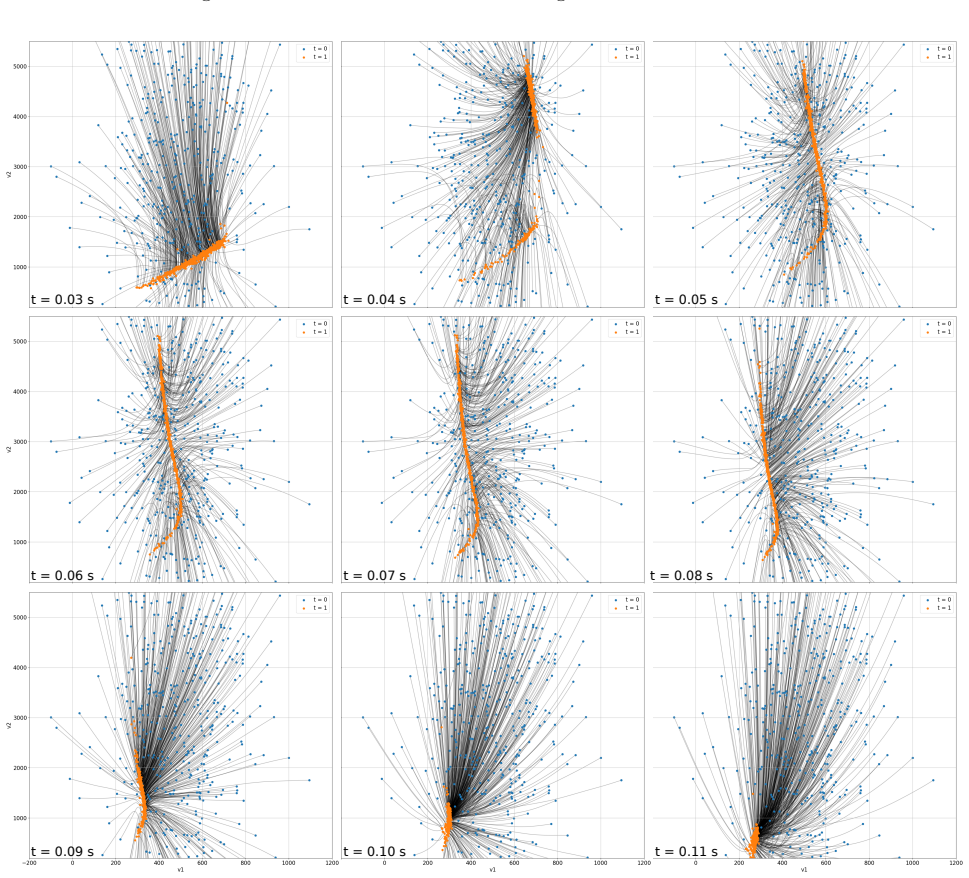
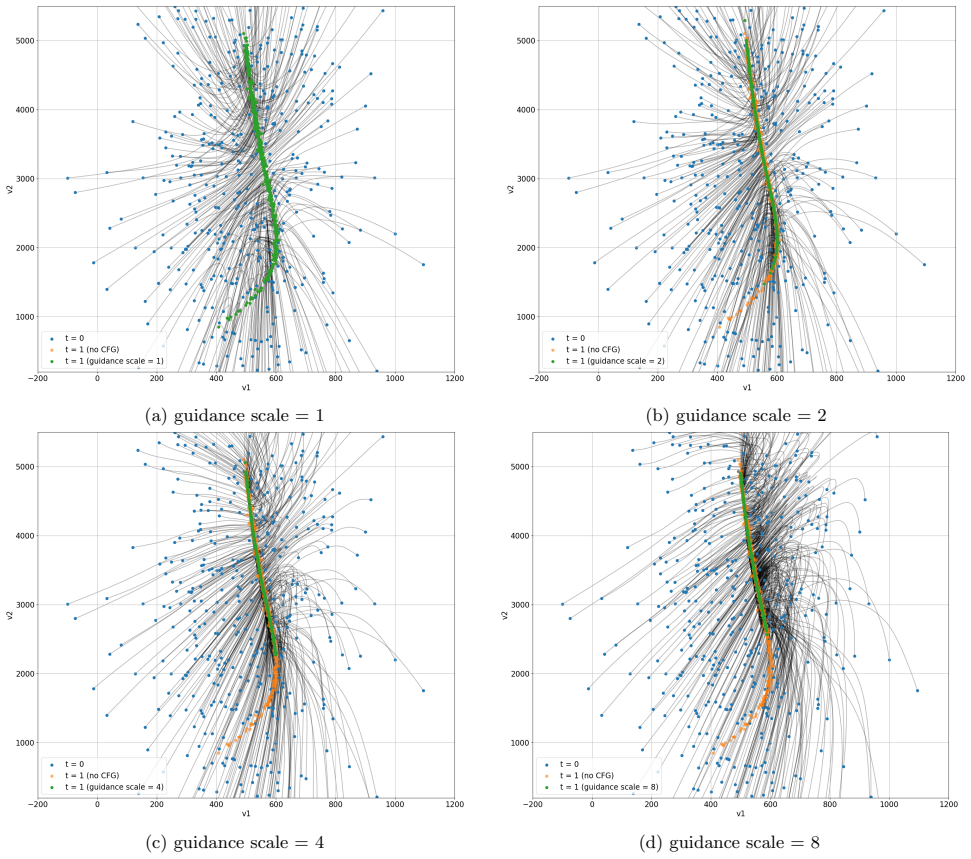
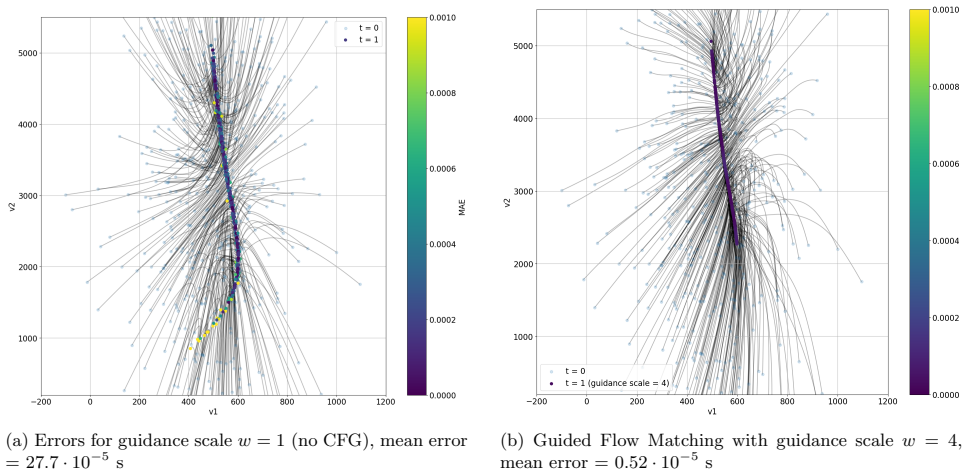
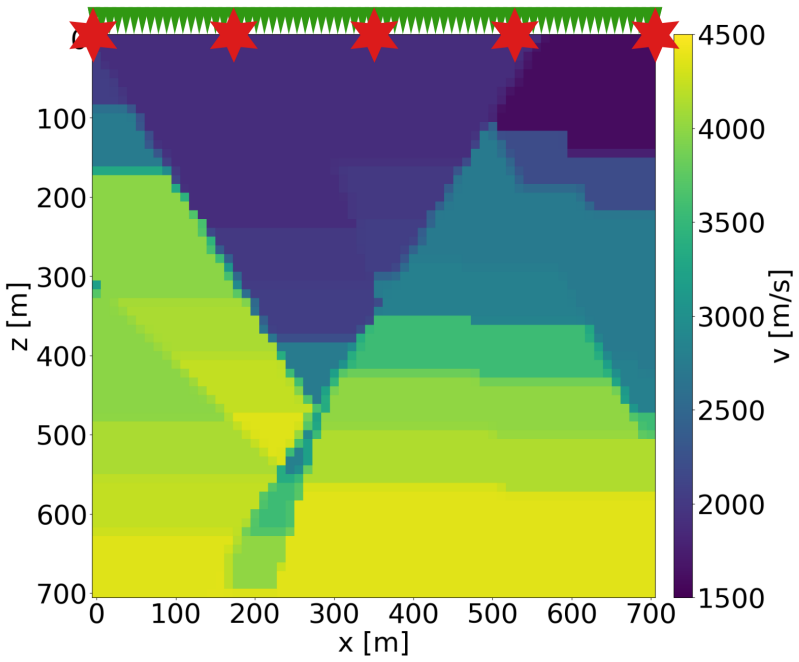
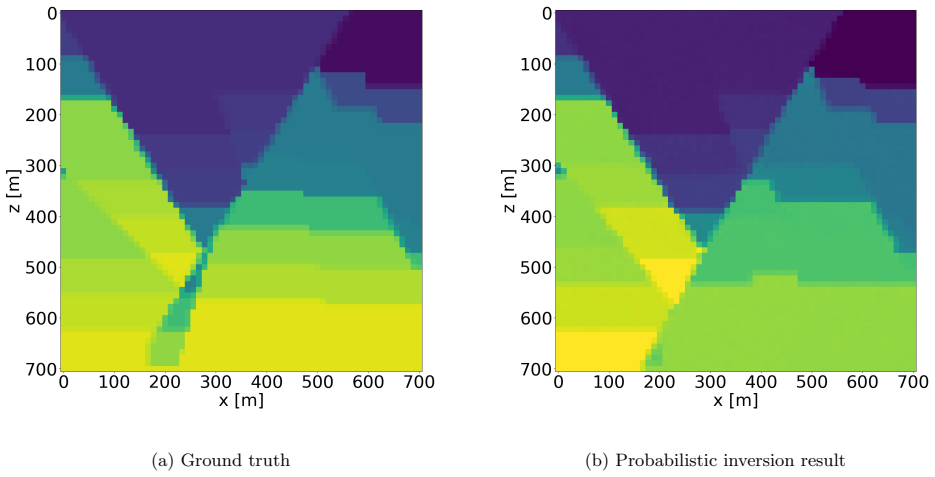
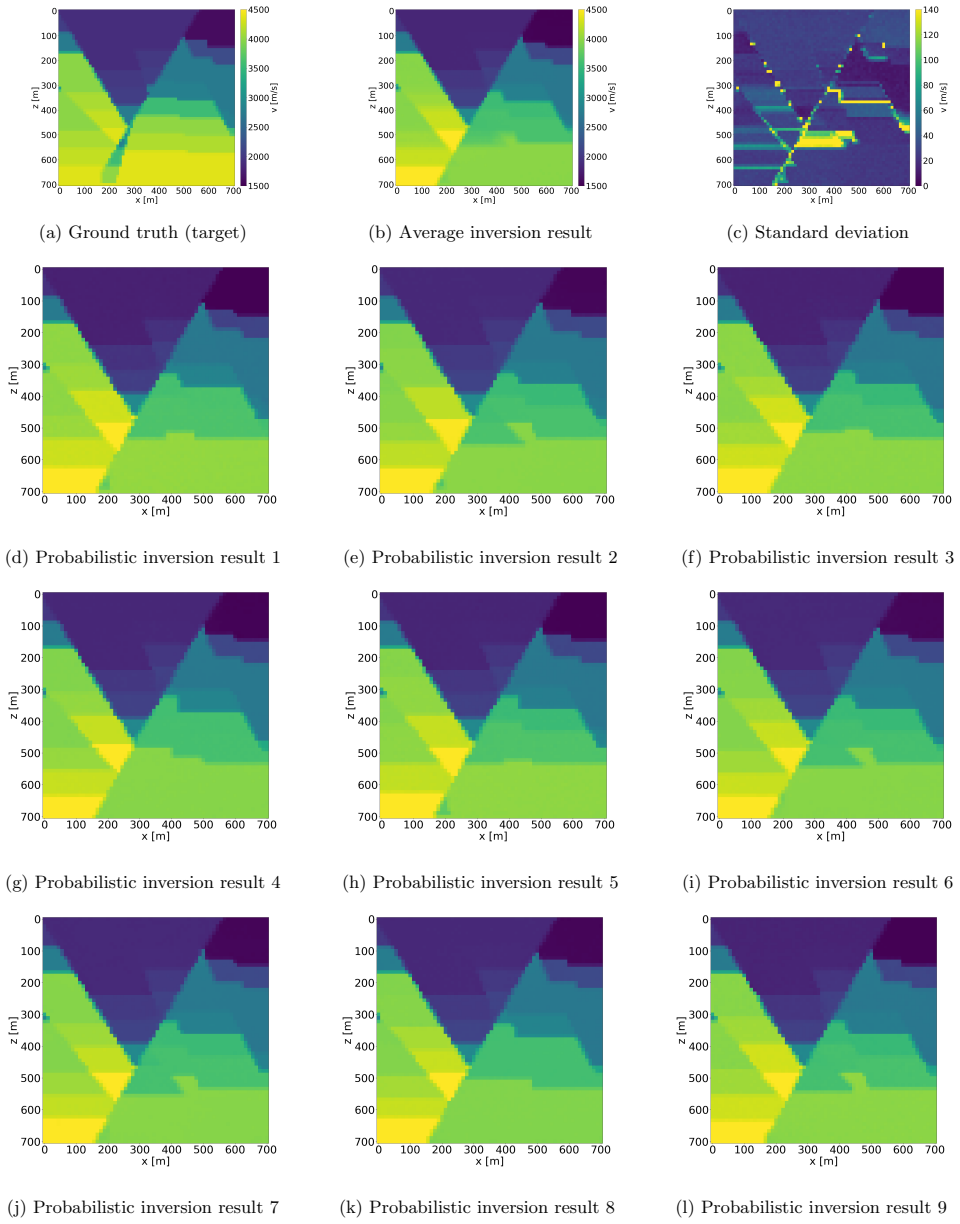
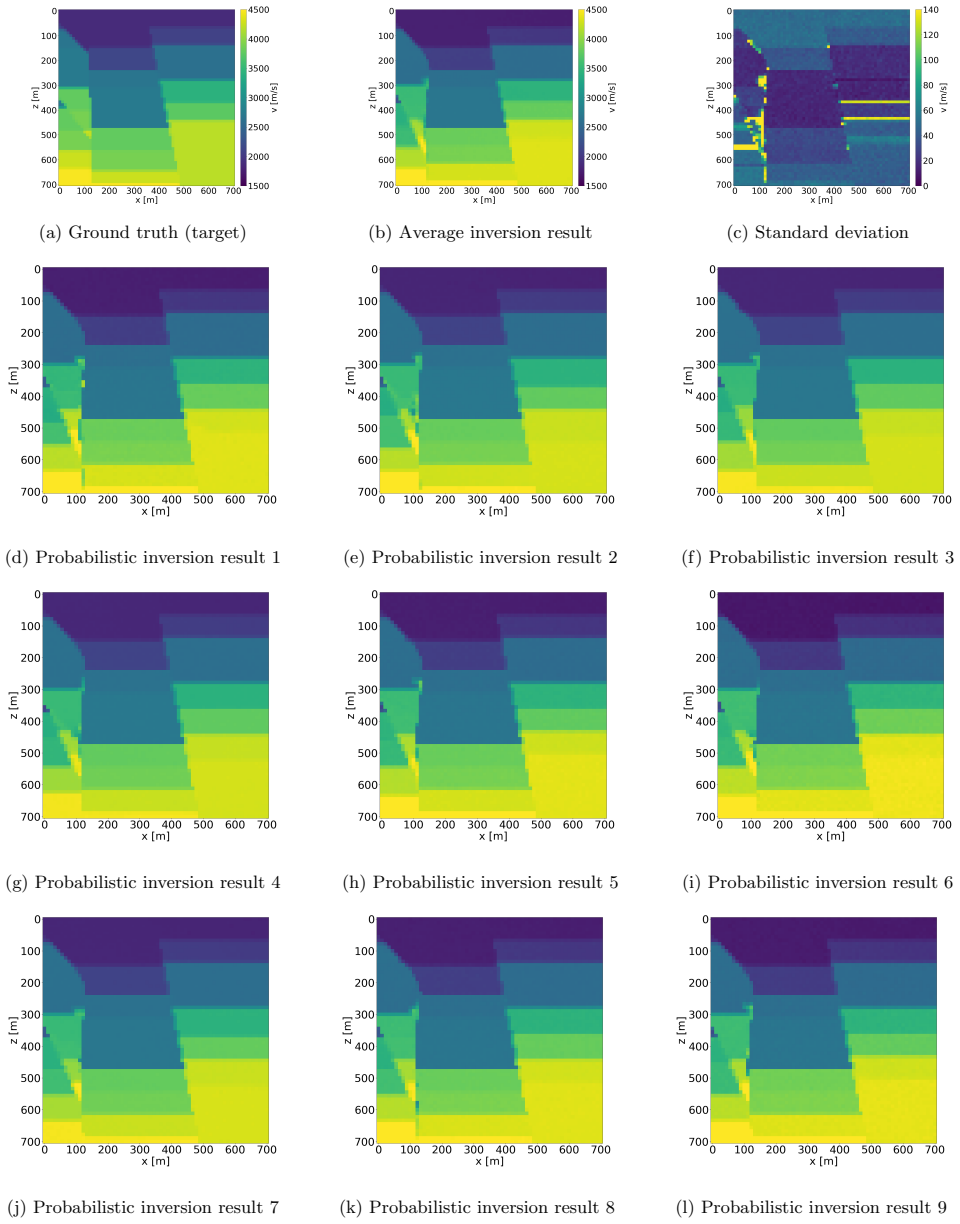
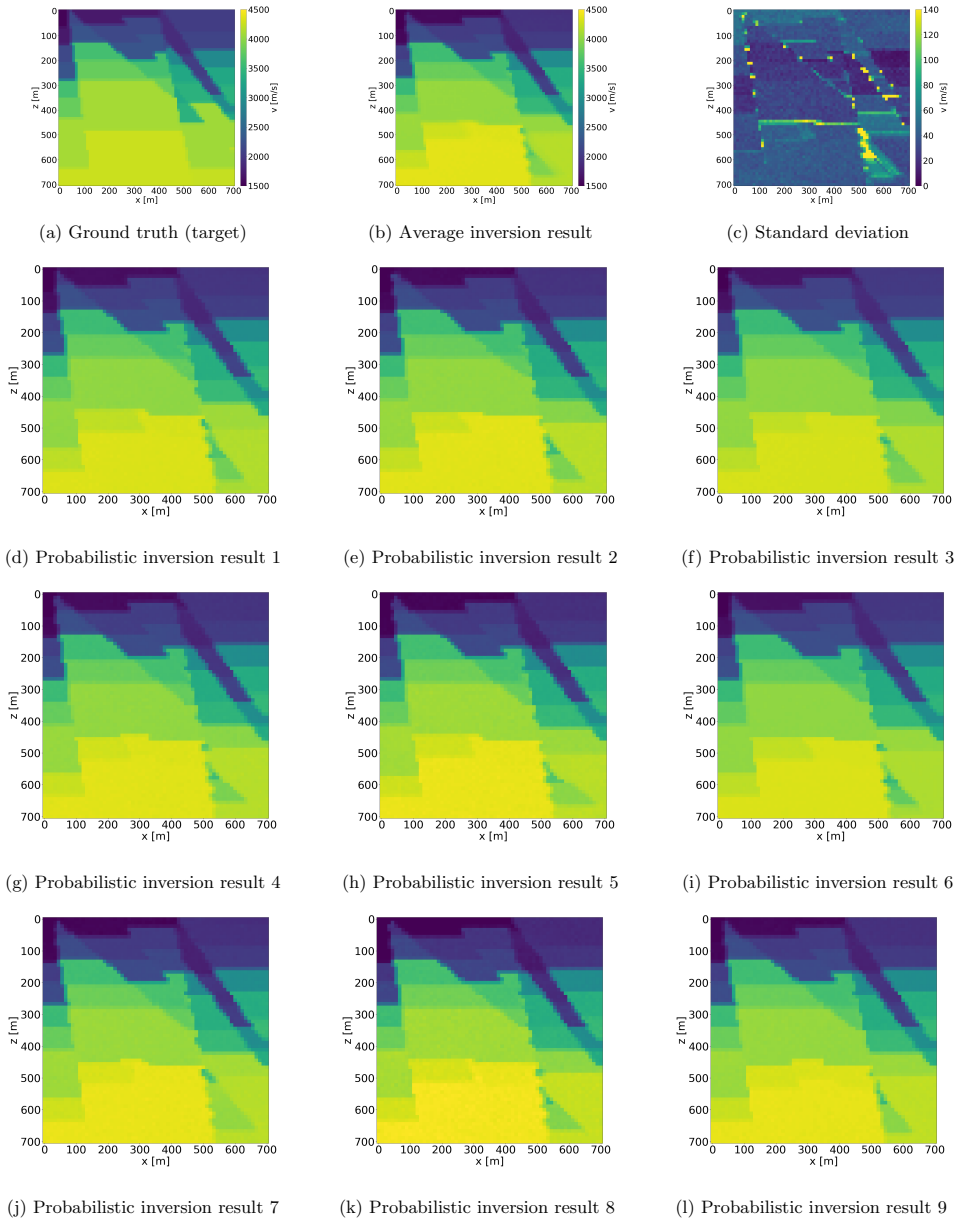
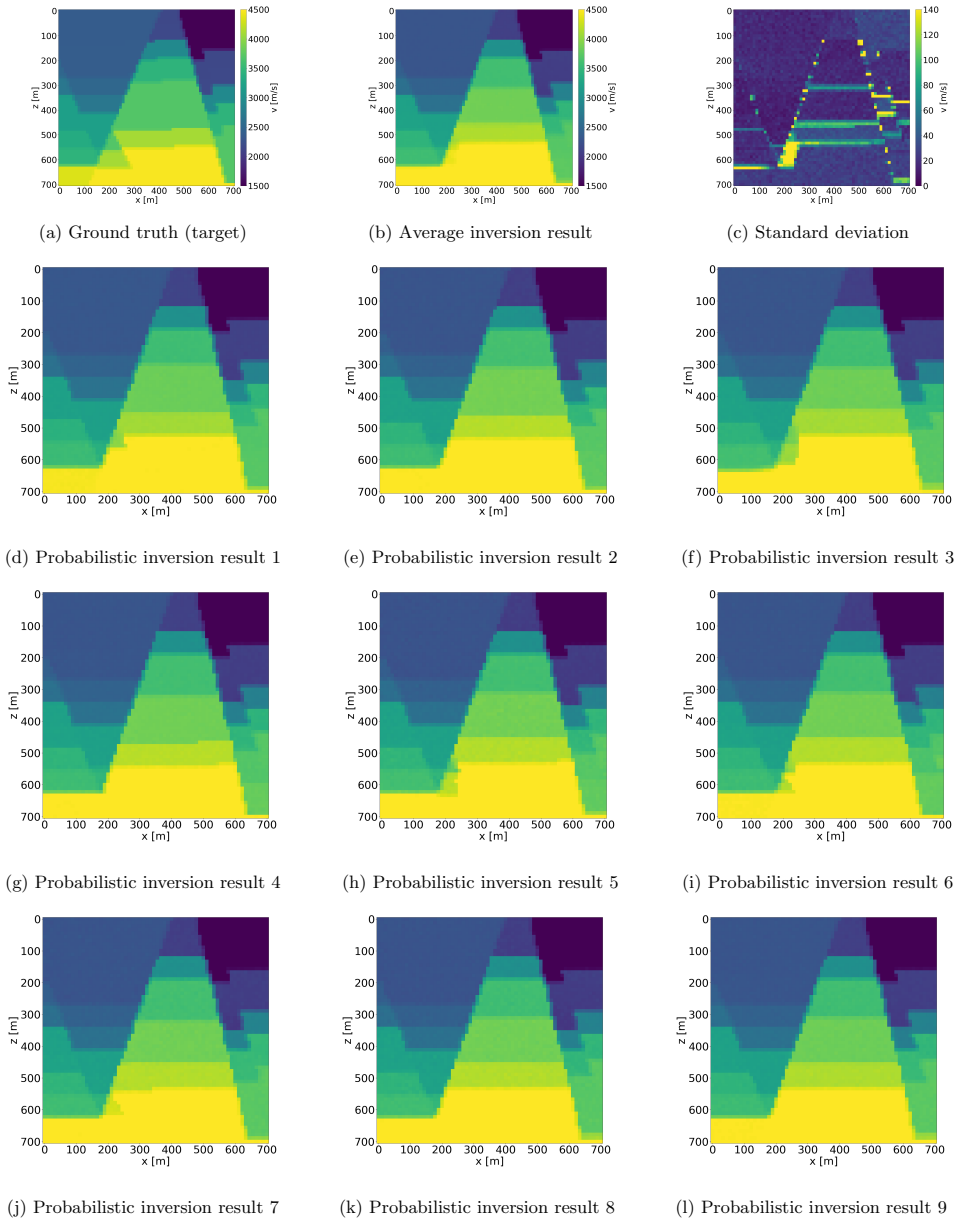
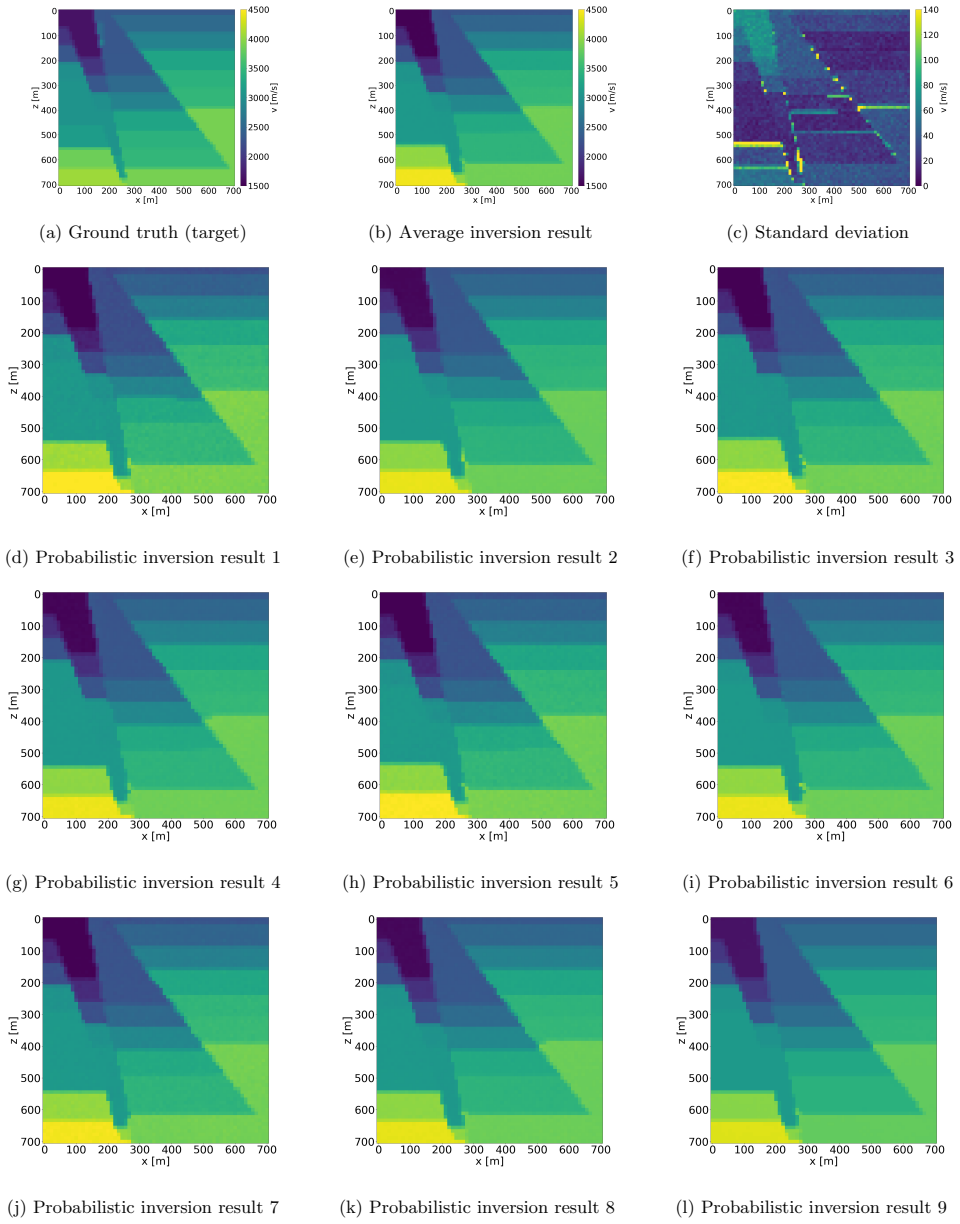
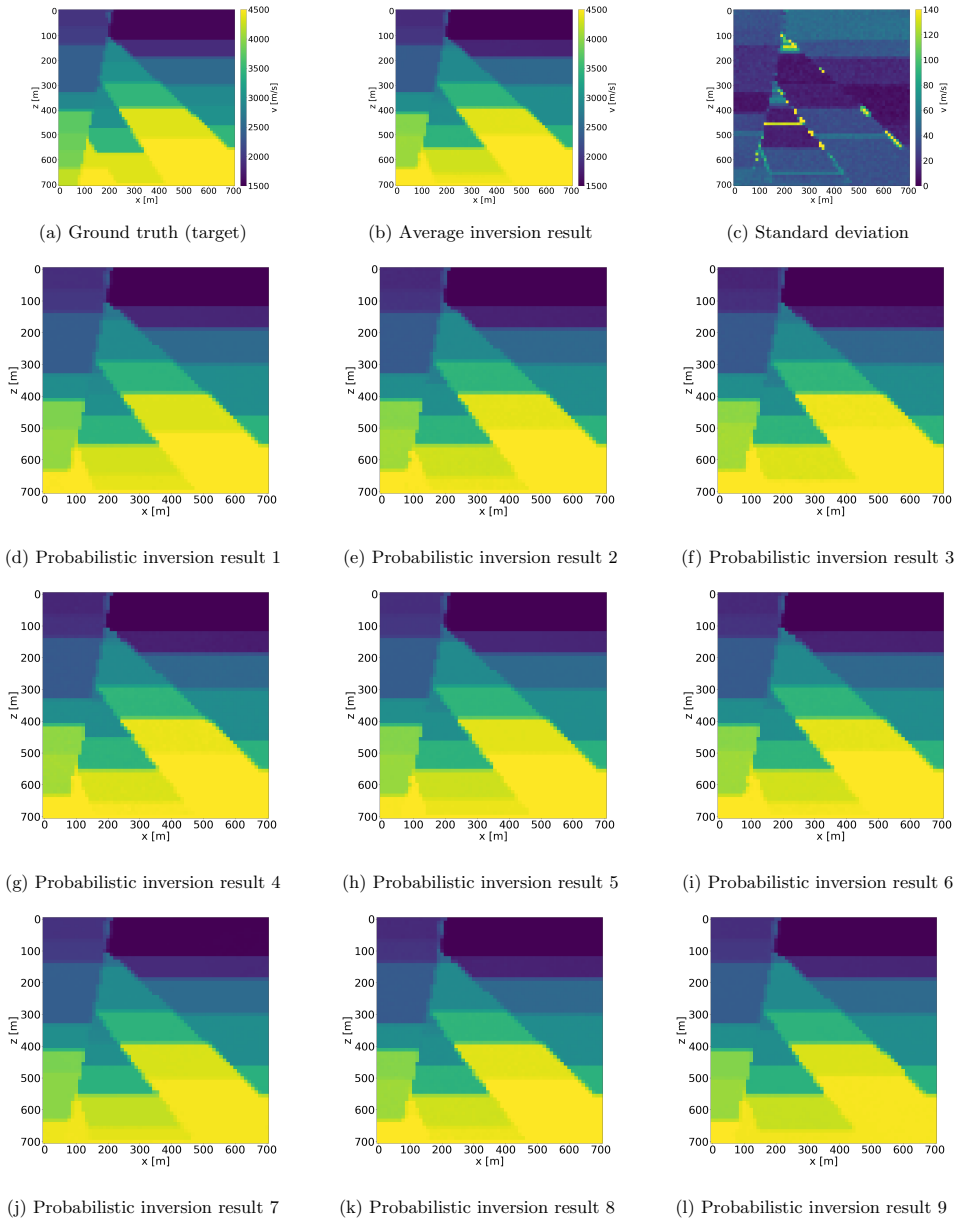
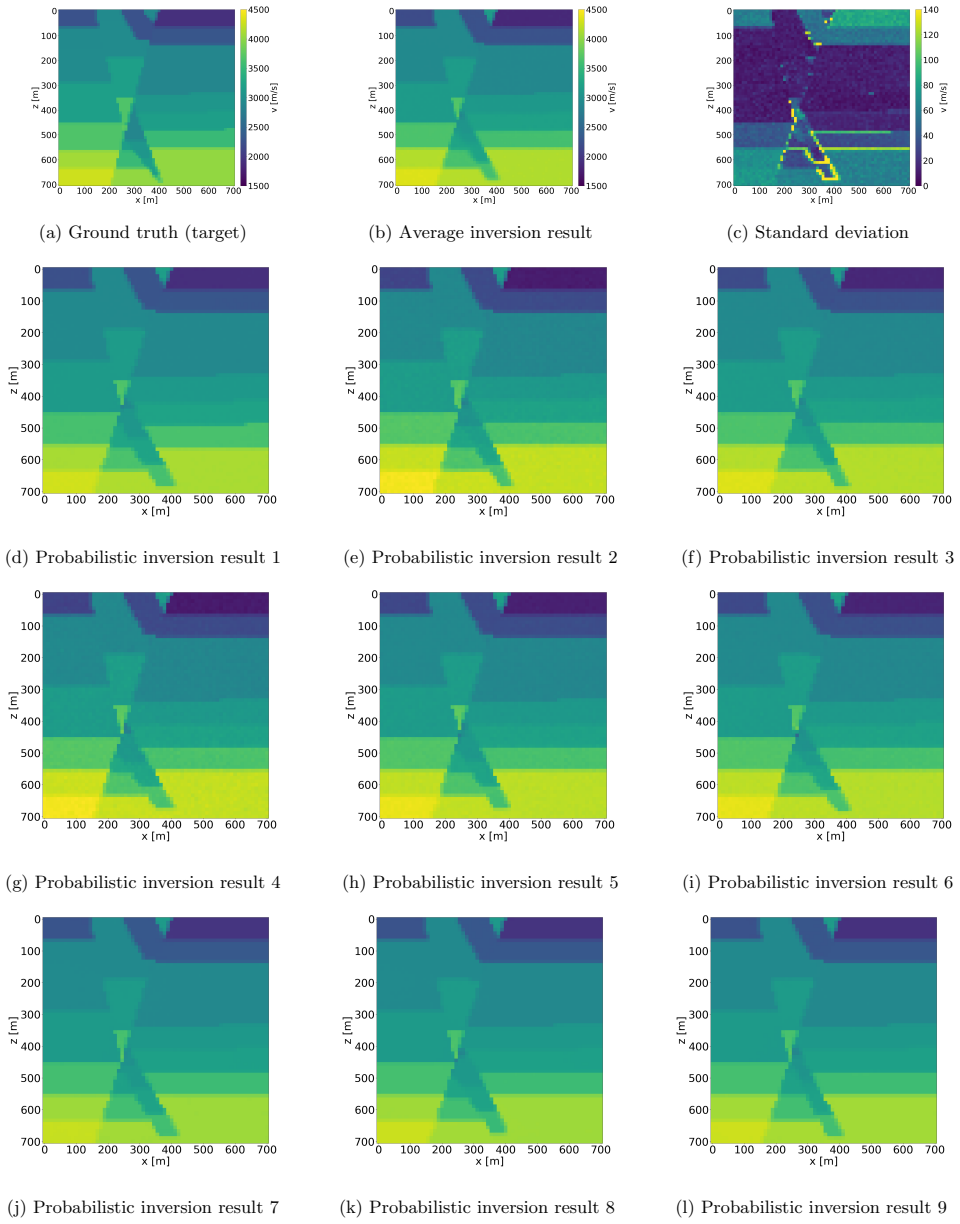
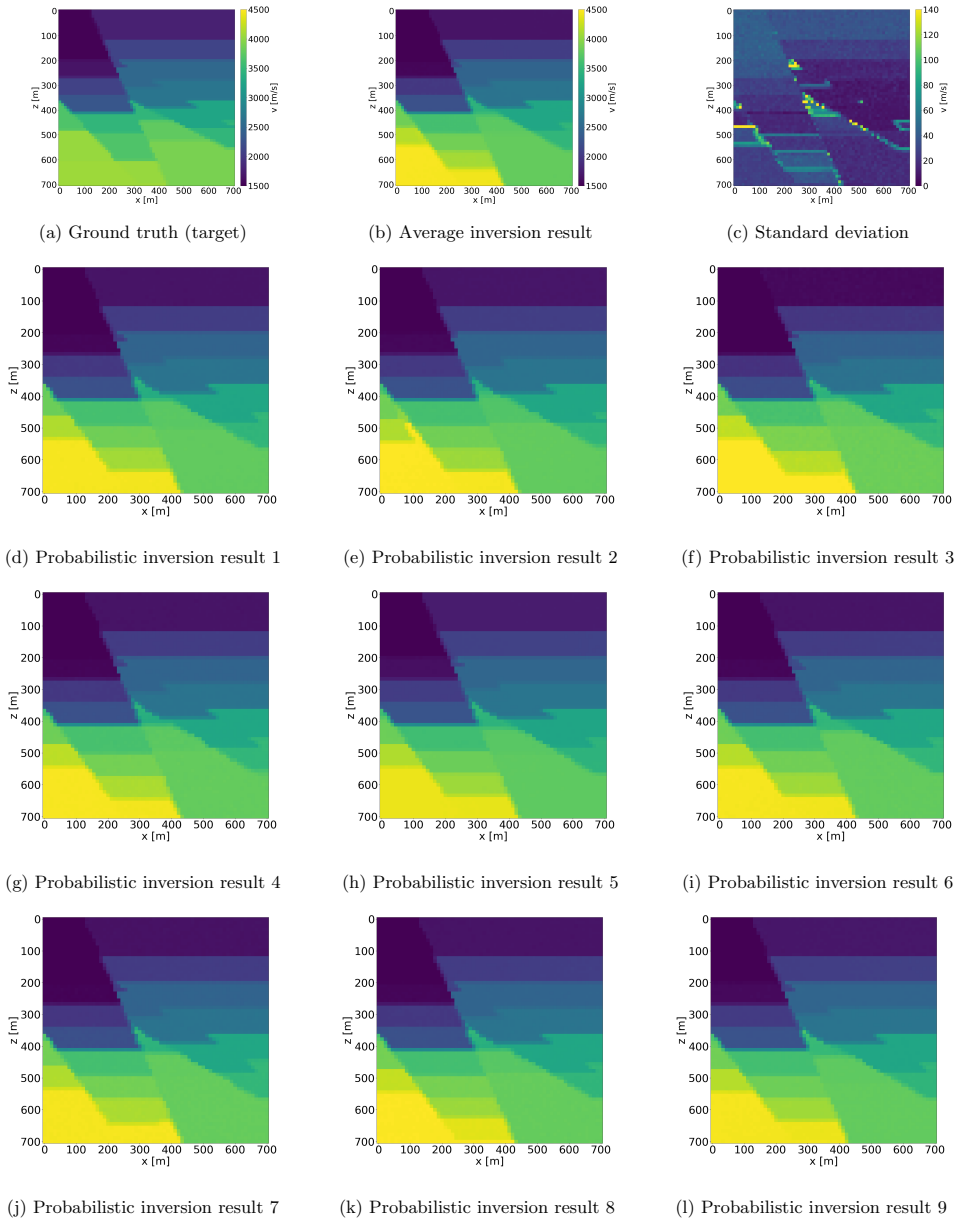
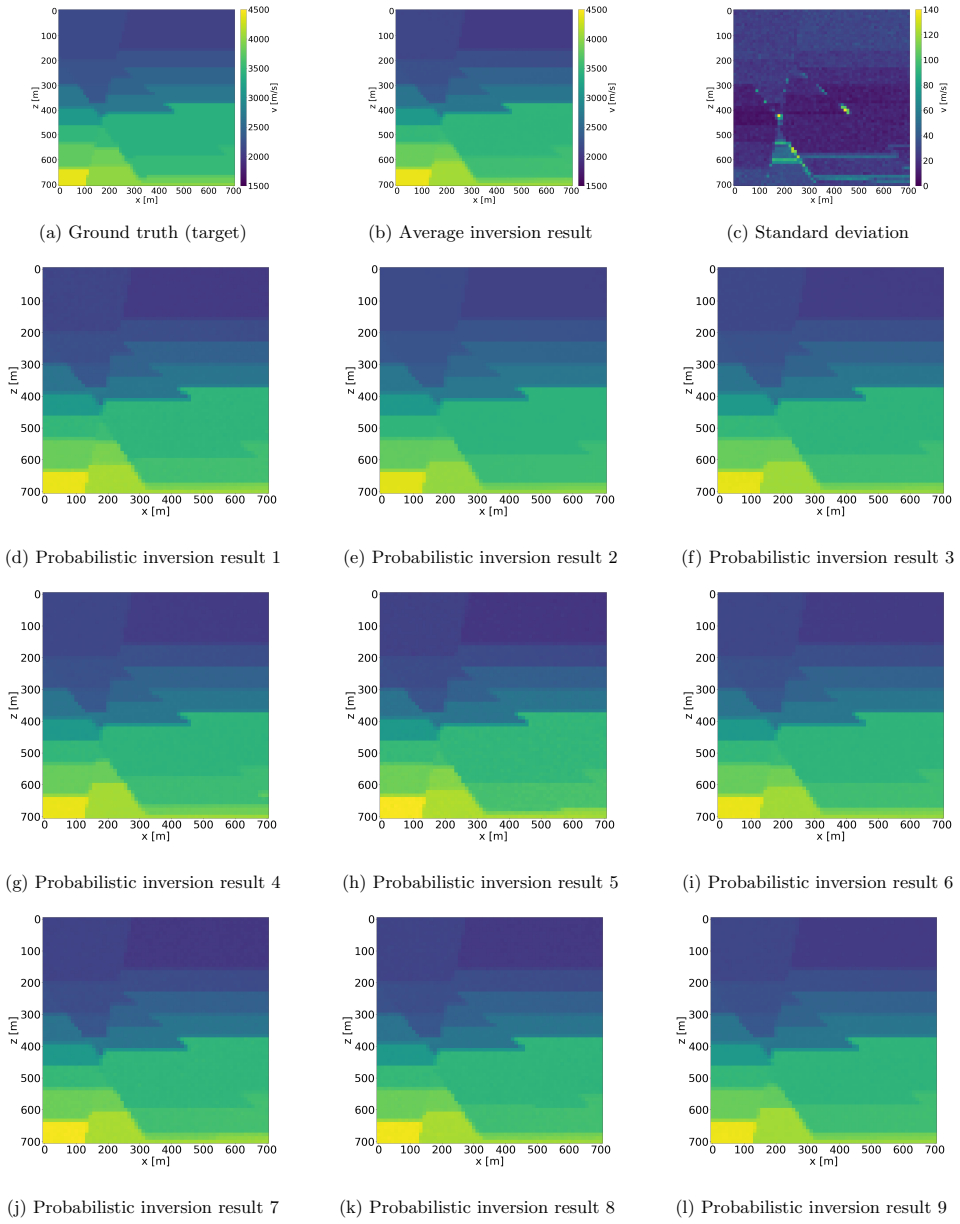
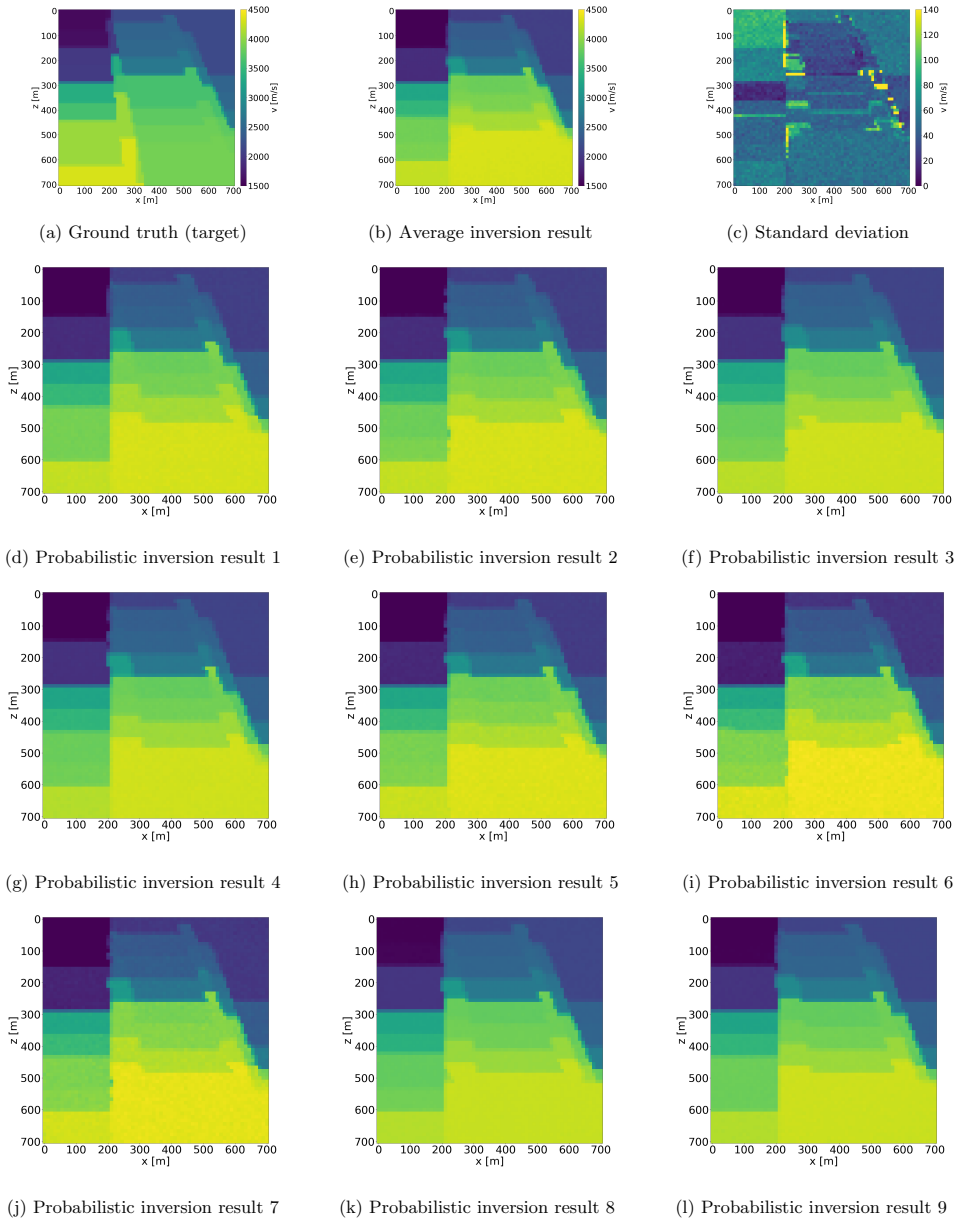
We adapt the well-established mathematical theory of Flow Matching from generative Artificial Intelligence to the context of probabilistic inversion. We evaluate the approach with two case studies: a simple 2D velocity model to illustrate the general features of the method, and the OpenFWI dataset to show its capabilities for probabilistic inversion of more complex seismic velocity models.
What carries the argument
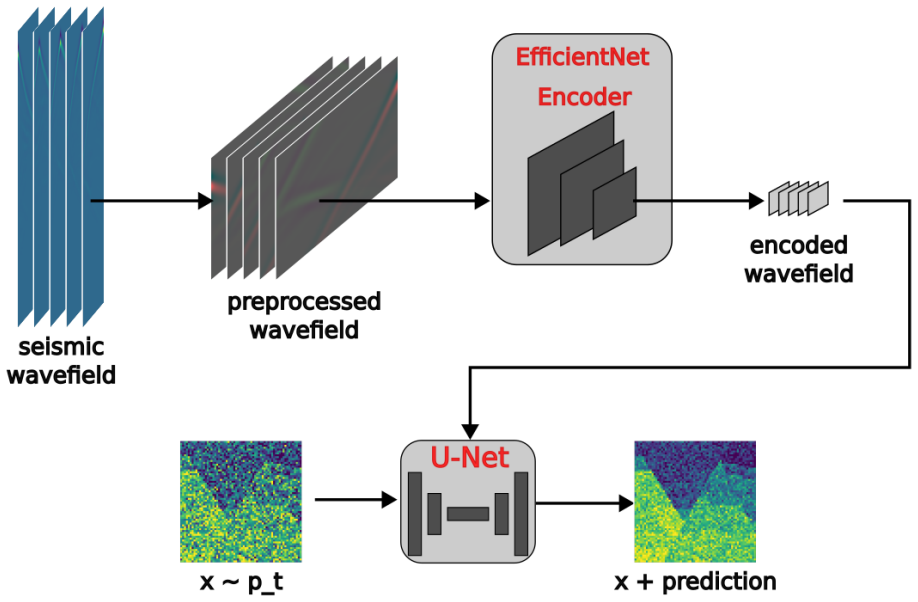
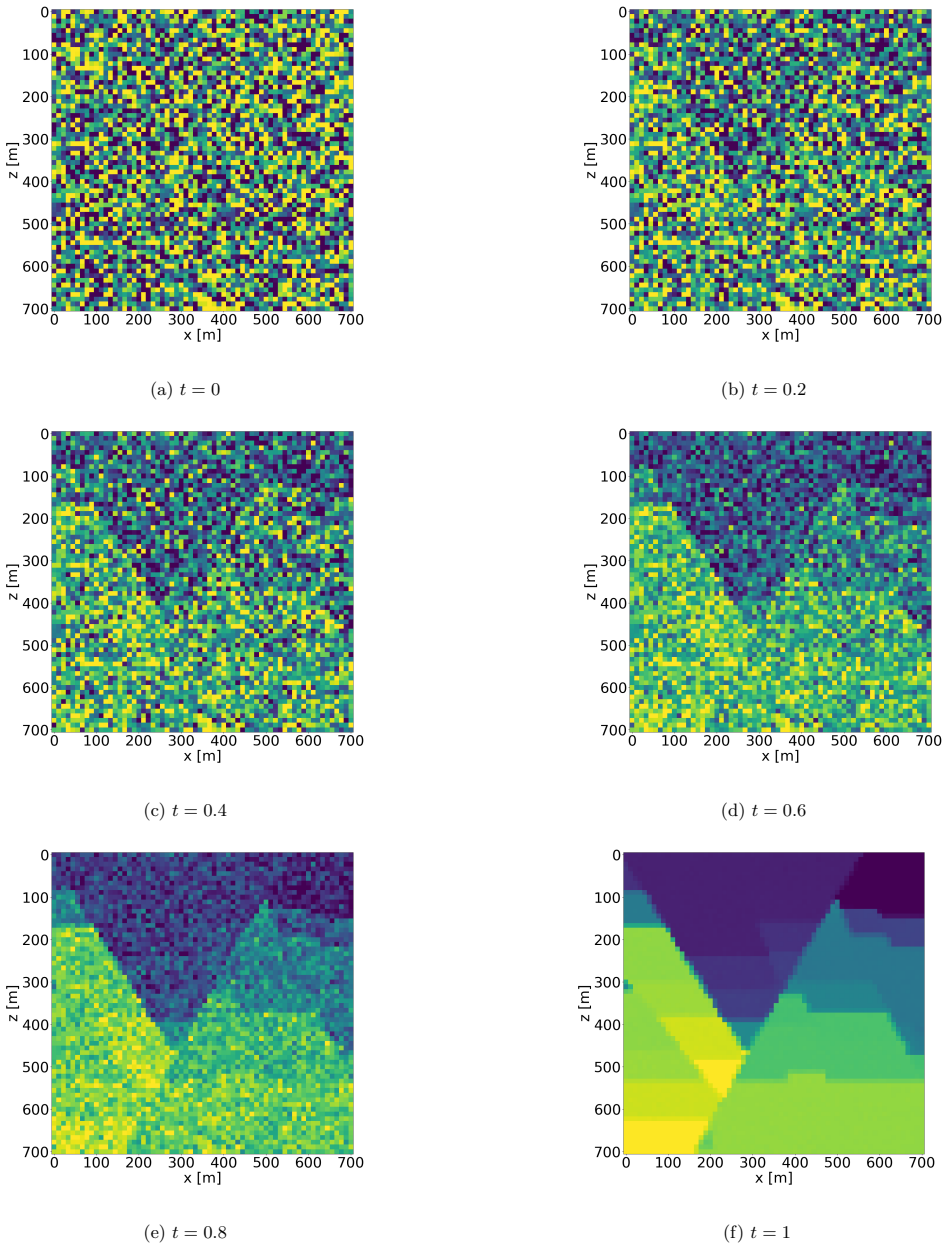
Flow Matching, which learns a time-dependent vector field to transport samples from a simple base distribution to a target data distribution, here repurposed to map noise or prior samples onto posterior velocity models conditioned on seismic observations.
If this is right
- The method yields multiple velocity models drawn from the posterior rather than a single deterministic solution.
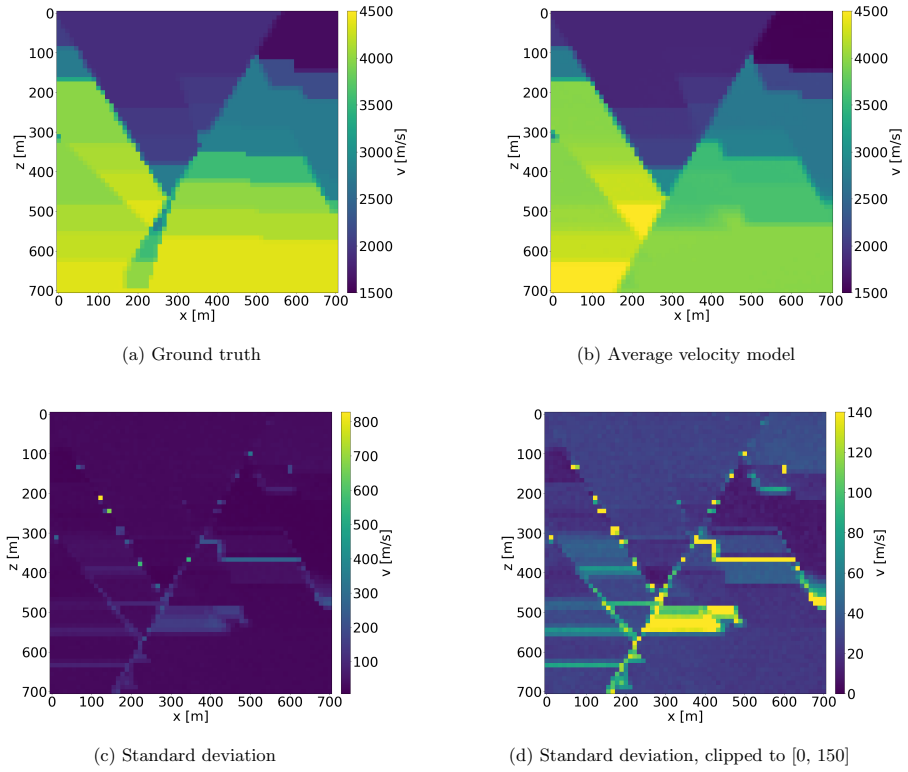
- Uncertainty quantification becomes available through the spread of the generated ensemble.
- The same adapted framework scales from toy 2D cases to the more complex velocity structures in the OpenFWI benchmark.
- Only small modifications to the original AI training procedure are required for the geophysical setting.
Where Pith is reading between the lines
- The same transport mechanism might be applied to other inverse problems that admit a probabilistic formulation, such as electromagnetic or gravity data inversion.
- Combining the learned flow with explicit wave-equation constraints during training could reduce the number of samples needed for accurate posteriors.
- Efficiency comparisons against existing sampling methods on identical datasets would quantify any computational advantage.
Load-bearing premise
The Flow Matching framework transfers directly to geophysical probabilistic inversion settings with only minor adaptations and produces meaningful posterior distributions on velocity models.
What would settle it
Generate samples with the adapted Flow Matching on a test case whose true posterior is known from exhaustive MCMC sampling and observe whether the generated velocity-model ensemble matches the reference distribution in statistical moments and coverage.
Figures
read the original abstract
We demonstrate the application of Flow Matching, a technique originating from generative Artificial Intelligence, to probabilistic inversion in geophysical settings, such as seismic Full-Waveform inversion. We adapt the well-established mathematical theory of Flow Matching from generative Artificial Intelligence to the context of probabilistic inversion. We evaluate the approach with two case studies: a simple 2D velocity model to illustrate the general features of the method, and the OpenFWI dataset to show its capabilities for probabilistic inversion of more complex seismic velocity models.
Editorial analysis
A structured set of objections, weighed in public.
Referee Report
Summary. The paper adapts the Flow Matching framework from generative AI to the task of probabilistic inversion in geophysical settings such as seismic full-waveform inversion. It presents the mathematical adaptation and demonstrates the method on two case studies: a simple 2D velocity model to illustrate general features, and the OpenFWI dataset to show applicability to more complex velocity models.
Significance. If the adapted Flow Matching procedure produces samples from the true posterior p(m|d), the work could provide a scalable alternative to MCMC for uncertainty quantification in geophysical inversions. The significance is currently limited by the absence of any quantitative validation that the generated distributions match an independent reference sampler on the same forward and noise model.
major comments (1)
- [Abstract / Case studies] The central claim that the adapted Flow Matching yields samples from the Bayesian posterior requires verification against an independent sampler (e.g., MCMC) on identical forward and noise models; the two case studies are described only as illustrations and contain no such quantitative checks (moments, KL divergence, coverage, or posterior predictive tests).
Simulated Author's Rebuttal
We thank the referee for the detailed review and the constructive suggestion to strengthen the validation of the method. We address the major comment below.
read point-by-point responses
-
Referee: [Abstract / Case studies] The central claim that the adapted Flow Matching yields samples from the Bayesian posterior requires verification against an independent sampler (e.g., MCMC) on identical forward and noise models; the two case studies are described only as illustrations and contain no such quantitative checks (moments, KL divergence, coverage, or posterior predictive tests).
Authors: We agree that the current case studies are presented as illustrations rather than as quantitative benchmarks, and that direct comparison against MCMC (or equivalent) on the same forward operator and noise model would provide stronger evidence that the generated samples match the target posterior. The manuscript's mathematical section derives the flow-matching objective from the conditional probability path that targets p(m|d), so that, under the assumption of exact training, the procedure samples from the posterior by construction. In practice, however, training is approximate and no error metrics are reported. We will revise the abstract, introduction, and conclusions to explicitly state that the experiments are illustrative and to qualify the central claim accordingly. For the simple 2D velocity model we will add a limited quantitative check (e.g., comparison of first and second moments or a posterior-predictive test) against a reference MCMC run performed with identical forward and noise models; such a comparison is computationally feasible in 2-D. For the OpenFWI example, MCMC remains prohibitive, so we will note this limitation and leave a full benchmark for future work. revision: partial
Circularity Check
No circularity detected; derivation chain not visible in provided text
full rationale
The abstract and description adapt an established Flow Matching framework to geophysical inversion without presenting any equations, derivations, or load-bearing steps. No self-definitional mappings, fitted inputs renamed as predictions, or self-citation chains appear. The central claim is an application of prior theory to new settings, with case studies described only illustratively. This is the common honest finding when no mathematical reduction to inputs is exhibited.
Axiom & Free-Parameter Ledger
Reference graph
Works this paper leans on
-
[1]
Lipman, Yaron and Chen, Ricky T. Q. and Ben-Hamu, Heli and Nickel, Maximilian and Le, Matt , month = feb, year =. Flow. doi:10.48550/arXiv.2210.02747 , abstract =
work page internal anchor Pith review Pith/arXiv arXiv doi:10.48550/arxiv.2210.02747
-
[2]
doi:10.48550/arXiv.2111.02926 , abstract =
Deng, Chengyuan and Feng, Shihang and Wang, Hanchen and Zhang, Xitong and Jin, Peng and Feng, Yinan and Zeng, Qili and Chen, Yinpeng and Lin, Youzuo , month = jun, year =. doi:10.48550/arXiv.2111.02926 , abstract =
-
[3]
EfficientNet: Rethinking Model Scaling for Convolutional Neural Networks
Tan, Mingxing and Le, Quoc V. , month = sep, year =. doi:10.48550/arXiv.1905.11946 , abstract =
work page internal anchor Pith review Pith/arXiv arXiv doi:10.48550/arxiv.1905.11946 1905
-
[4]
An overview of full-waveform inversion in exploration geophysics , volume =. GEOPHYSICS , author =. 2009 , pages =. doi:10.1190/1.3238367 , abstract =
-
[5]
Pernias, Pablo and Rampas, Dominic and Richter, Mats L. and Pal, Christopher J. and Aubreville, Marc , month = sep, year =. Wuerstchen:. doi:10.48550/arXiv.2306.00637 , abstract =
-
[6]
and Liu, Ziwei , month = mar, year =
Fan, Weichen and Zheng, Amber Yijia and Yeh, Raymond A. and Liu, Ziwei , month = mar, year =. doi:10.48550/arXiv.2503.18886 , abstract =
-
[7]
Lipman, Yaron and Havasi, Marton and Holderrieth, Peter and Shaul, Neta and Le, Matt and Karrer, Brian and Chen, Ricky T. Q. and Lopez-Paz, David and Ben-Hamu, Heli and Gat, Itai , month = dec, year =. Flow. doi:10.48550/arXiv.2412.06264 , abstract =
work page internal anchor Pith review Pith/arXiv arXiv doi:10.48550/arxiv.2412.06264
-
[8]
Voicebox:
Le, Matthew and Vyas, Apoorv and Shi, Bowen and Karrer, Brian and Sari, Leda and Moritz, Rashel and Williamson, Mary and Manohar, Vimal and Adi, Yossi and Mahadeokar, Jay and Hsu, Wei-Ning , year =. Voicebox:
-
[9]
Decoupled Weight Decay Regularization
Loshchilov, Ilya and Hutter, Frank , month = jan, year =. Decoupled. doi:10.48550/arXiv.1711.05101 , abstract =
work page internal anchor Pith review Pith/arXiv arXiv doi:10.48550/arxiv.1711.05101
-
[10]
Bayesian seismic tomography using normalizing flows , volume =
Zhao, Xuebin and Curtis, Andrew and Zhang, Xin , month = sep, year =. Bayesian seismic tomography using normalizing flows , volume =. Geophysical Journal International , publisher =. doi:10.1093/gji/ggab298 , abstract =
-
[11]
Fichtner, Andreas , year =. Full. doi:10.1007/978-3-642-15807-0 , language =
-
[12]
Introduction to
Holderrieth, Peter and Shprints, Ron , year =. Introduction to
-
[13]
doi:10.48550/arXiv.2410.21776 , abstract =
Zhang, Hao and Li, Yuanyuan and Huang, Jianping , month = oct, year =. doi:10.48550/arXiv.2410.21776 , abstract =
-
[14]
Tarantola, Albert , month = jan, year =. Inverse. doi:10.1137/1.9780898717921 , language =
-
[15]
Zheng, Qinqing and Le, Matt and Shaul, Neta and Lipman, Yaron and Grover, Aditya and Chen, Ricky T. Q. , month = dec, year =. Guided. doi:10.48550/arXiv.2311.13443 , abstract =
-
[16]
Multiscale seismic waveform inversion , volume =. Geophysics , author =. doi:https://doi.org/10.1190/1.1443880 , number =
-
[17]
Davtyan, Aram and Sameni, Sepehr and Favaro, Paolo , month = aug, year =. Efficient. doi:10.48550/arXiv.2211.14575 , abstract =
-
[18]
Wu, Lemeng and Wang, Dilin and Gong, Chengyue and Liu, Xingchao and Xiong, Yunyang and Ranjan, Rakesh and Krishnamoorthi, Raghuraman and Chandra, Vikas and Liu, Qiang , month = dec, year =. Fast. doi:10.48550/arXiv.2212.01747 , abstract =
-
[19]
Chen, Ricky T. Q. and Lipman, Yaron , month = feb, year =. Flow. doi:10.48550/arXiv.2302.03660 , abstract =
-
[20]
Equivariant
Song, Yuxuan and Gong, Jingjing and Xu, Minkai and Cao, Ziyao and Lan, Yanyan and Ermon, Stefano and Zhou, Hao and Ma, Wei-Ying , editor =. Equivariant. Advances in. 2023 , pages =
2023
discussion (0)
Sign in with ORCID, Apple, or X to comment. Anyone can read and Pith papers without signing in.