Noisy quantum circuit simulation with the tensor jump method
Pith reviewed 2026-07-03 20:37 UTC · model grok-4.3
The pith
Projector sampling in the tensor jump method reduces variance and bond growth for noisy quantum circuit simulation on matrix product states.
A machine-rendered reading of the paper's core claim, the machinery that carries it, and where it could break.
Core claim
The tensor jump method with local TDVP evolution on matrix product states and sparse Pauli-Lindblad noise models supports two unbiased variance-aware unravelings. The projector-jump unraveling yields state-independent hazards and closed-form variance laws that retain 1/sqrt(N) Monte Carlo convergence but with smaller prefactors, enabling accurate simulation of 25-qubit noisy XY quenches and 127-qubit kicked-Ising circuits with long-range depolarizing noise while reducing variance and bond-dimension growth relative to Kraus-insertion baselines.
What carries the argument
Tensor jump method with projector-jump unraveling on matrix product states for sparse Pauli-Lindblad noise models
If this is right
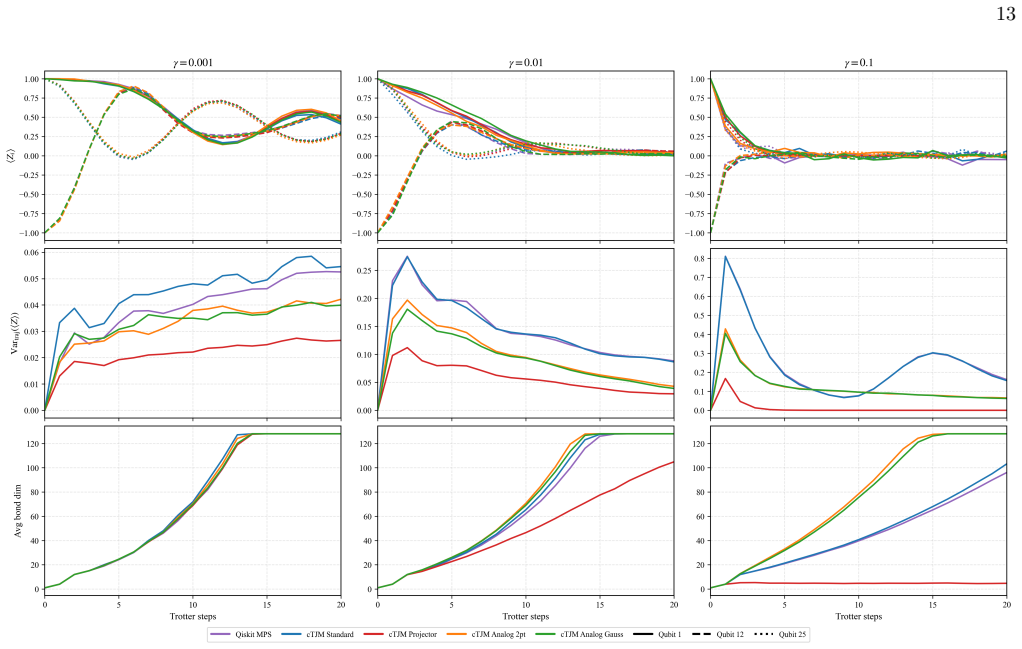
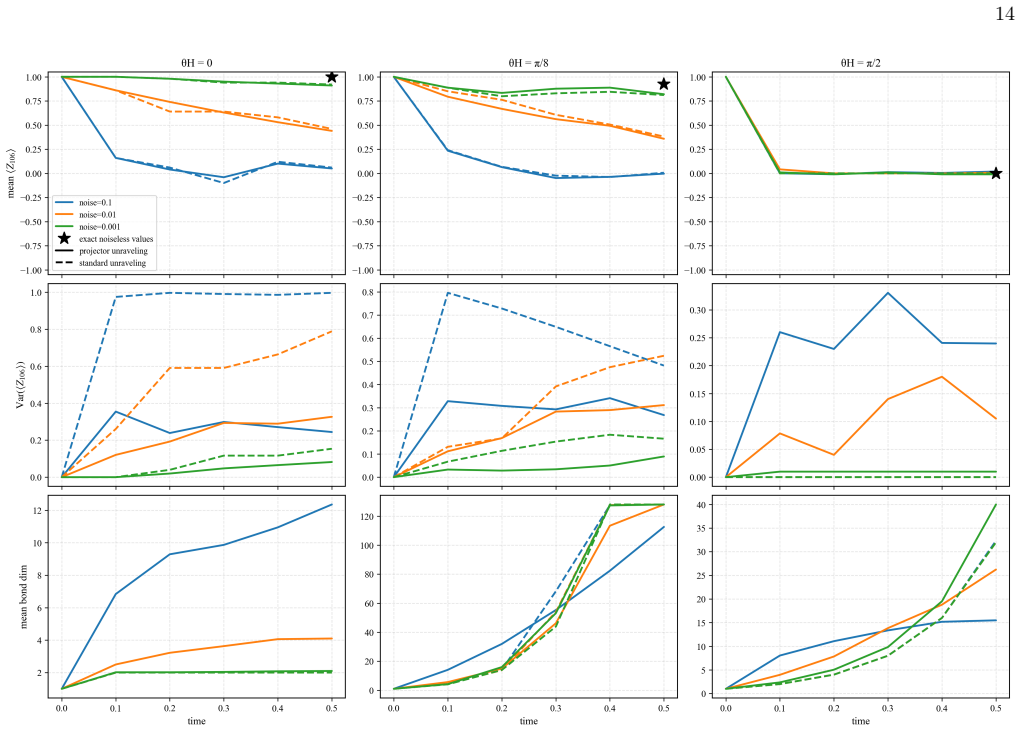
- Projector sampling yields lower Monte Carlo variance than standard Kraus insertion across many circuit architectures.
- The framework directly simulates long-range and correlated multi-qubit Lindblad noise consistent with hardware connectivity.
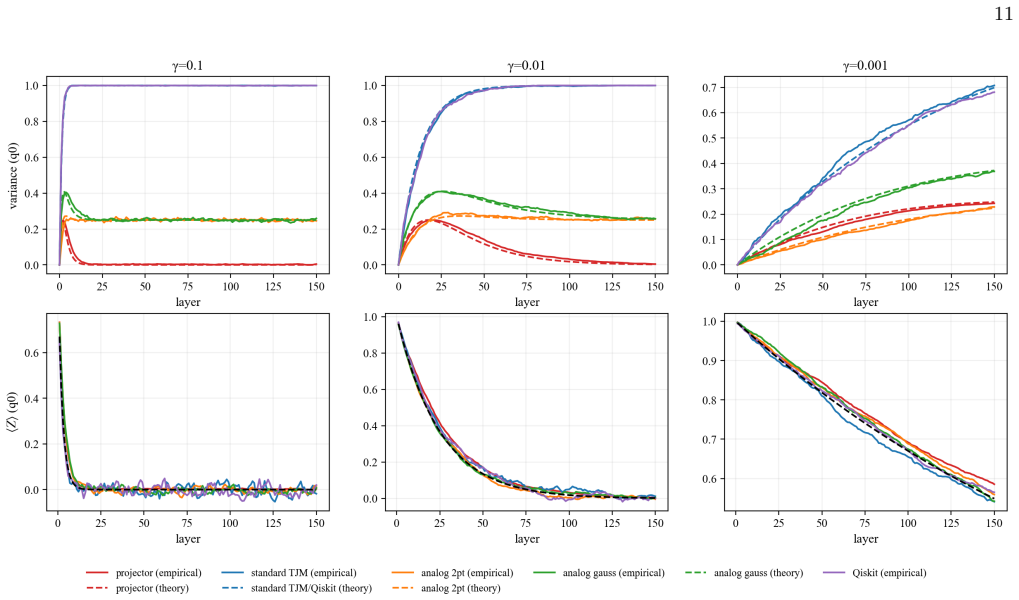
- Analog sampling matches the Lindblad generator exactly under symmetric Gaussian or two-point angle laws and performs best at weak noise.
- Both unravelings preserve unbiased 1/sqrt(N) convergence while cutting the variance prefactor.
Where Pith is reading between the lines
- The reduced bond-dimension growth could allow the same hardware to validate deeper circuits or longer evolution times than current trajectory methods.
- Because the method supports non-local noise operators, it could be used to quantify crosstalk effects that local noise models miss.
- The state-independent hazard property may generalize to other open-system simulators that currently rely on state-dependent sampling.
- Combining the approach with existing error-mitigation post-processing could tighten bounds on achievable circuit fidelity.
Load-bearing premise
The noise admits sparse Pauli-Lindblad representations whose jump sets have state-independent hazards and dissipative contractions that reduce to global factors after renormalization, keeping the Monte Carlo sampling unbiased.
What would settle it
Apply the method to the 127-qubit kicked-Ising benchmark; if variance reduction disappears or bond dimensions grow exponentially compared with standard baselines, the central scalability claim is false.
Figures
read the original abstract
Classical simulation of noisy quantum circuits is essential for validating algorithms, benchmarking hardware, and assessing error-mitigation strategies, but remains limited by the exponential cost of density-matrix methods and the high variance of standard trajectory sampling. We introduce a variance-aware tensor network framework that combines the tensor jump method with local TDVP gate evolution on matrix product states and sparse Pauli-Lindblad hardware noise models. Gates are applied as short variational evolutions on the MPS manifold, while noise is sampled per circuit window from Pauli-Lindblad jump sets with state-independent hazards and dissipative contractions that reduce to irrelevant global factors after renormalization. The method supports correlated multi-qubit Lindblad noise consistent with hardware connectivity, including long-range operators on non-adjacent qubits, enabling direct simulation of crosstalk and other connectivity-induced errors beyond local noise models. We develop two unbiased variance-aware unravelings. An analog unitary-mixture unraveling matches the Lindblad generator exactly under symmetric Gaussian or two-point angle laws, while a projector-jump unraveling yields state-independent hazards and closed-form variance laws. Both retain the standard 1/sqrt(N) Monte Carlo convergence but with reduced prefactors. Empirically, projector sampling strongly reduces trajectory variance and bond-dimension growth across many circuit architectures, whereas analog sampling is most effective at weak noise. We demonstrate accurate, scalable noisy-circuit simulation on a 25-qubit noisy XY quench and IBM's 127-qubit kicked-Ising benchmark with long-range depolarizing noise, achieving reduced Monte Carlo variance and favorable MPS bond-dimension growth compared with standard Kraus-insertion baselines.
Editorial analysis
A structured set of objections, weighed in public.
Referee Report
Summary. The manuscript introduces the tensor jump method, a variance-aware tensor-network framework for classical simulation of noisy quantum circuits. It combines matrix-product-state (MPS) representations evolved via local time-dependent variational principle (TDVP) gates with sparse Pauli-Lindblad noise models that support long-range operators. Two unbiased Monte Carlo unravelings are developed: an analog unitary-mixture unraveling and a projector-jump unraveling that is asserted to admit state-independent hazards and closed-form variance laws. The method is demonstrated on a 25-qubit noisy XY quench and IBM’s 127-qubit kicked-Ising benchmark, reporting reduced trajectory variance and favorable MPS bond-dimension growth relative to standard Kraus-insertion baselines.
Significance. If the central claims of unbiasedness and variance reduction hold for long-range Lindblad noise, the work would provide a practically useful advance for scalable simulation of hardware-relevant noisy circuits at sizes (127 qubits) that remain challenging for density-matrix methods. The explicit construction of closed-form variance laws and the empirical demonstration on a real-device benchmark constitute concrete strengths that would be of interest to the quantum-information simulation community.
major comments (2)
- [§4] §4 (projector-jump unraveling): The central claim that the unraveling yields state-independent hazards whose dissipative contractions reduce to global renormalization factors (preserving unbiasedness) is load-bearing for all reported variance reductions and for the 127-qubit benchmark results. No derivation is supplied showing that this factorization continues to hold when the jump set contains non-local Pauli operators; if state dependence appears for long-range terms, the Monte Carlo estimator ceases to be unbiased while the reported variance reduction may become an artifact.
- [§5.3] §5.3 and Table 2 (127-qubit benchmark): The accuracy claims rest on the assumption that the long-range depolarizing noise admits the same state-independent hazards used in the 25-qubit XY quench. Without an explicit check (e.g., comparison of the renormalized hazard against the exact Lindblad generator for a representative non-local jump), it is unclear whether the observed agreement with the reference is due to the method or to the specific noise instances tested.
minor comments (2)
- The abstract states that both unravelings “retain the standard 1/sqrt(N) Monte Carlo convergence but with reduced prefactors,” yet no explicit expression for the prefactor is given; adding the closed-form variance law promised for the projector-jump case would strengthen the presentation.
- Figure 4 (bond-dimension growth): the y-axis scaling and the precise definition of “effective bond dimension” after renormalization should be stated explicitly so that the comparison with the Kraus-insertion baseline can be reproduced.
Simulated Author's Rebuttal
We thank the referee for the careful reading, positive assessment of significance, and constructive major comments. We address each point below and will incorporate revisions to strengthen the derivations and validations.
read point-by-point responses
-
Referee: [§4] §4 (projector-jump unraveling): The central claim that the unraveling yields state-independent hazards whose dissipative contractions reduce to global renormalization factors (preserving unbiasedness) is load-bearing for all reported variance reductions and for the 127-qubit benchmark results. No derivation is supplied showing that this factorization continues to hold when the jump set contains non-local Pauli operators; if state dependence appears for long-range terms, the Monte Carlo estimator ceases to be unbiased while the reported variance reduction may become an artifact.
Authors: We agree that an explicit derivation is required to substantiate the claim for non-local operators. The state-independent hazards follow from the projector-jump construction and the trace properties of Pauli-Lindblad operators, but the manuscript does not include the full algebraic steps for long-range terms. In the revised manuscript we will add a detailed derivation in §4 (with an accompanying appendix) proving that the hazard remains state-independent and the contraction reduces to a global renormalization factor for arbitrary Pauli strings, including non-local ones. This will confirm preservation of unbiasedness. revision: yes
-
Referee: [§5.3] §5.3 and Table 2 (127-qubit benchmark): The accuracy claims rest on the assumption that the long-range depolarizing noise admits the same state-independent hazards used in the 25-qubit XY quench. Without an explicit check (e.g., comparison of the renormalized hazard against the exact Lindblad generator for a representative non-local jump), it is unclear whether the observed agreement with the reference is due to the method or to the specific noise instances tested.
Authors: We acknowledge that an explicit numerical check for a non-local jump would strengthen the presentation. In the revised manuscript we will add a short validation (in §5.3 or a new appendix) that compares the renormalized hazard against the exact Lindblad generator for a representative long-range Pauli jump on a small test system, confirming consistency with the 25-qubit case and supporting applicability to the 127-qubit benchmark. revision: yes
Circularity Check
No significant circularity in derivation chain
full rationale
The paper presents a new tensor-jump framework whose core technical steps (projector-jump and analog unravelings, state-independent hazards, renormalization to global factors) are introduced as direct mathematical constructions from the Lindblad generator and MPS evolution rules. No equations or procedures are shown that define a target quantity in terms of itself or that rename a fitted parameter as a prediction. The 25-qubit and 127-qubit benchmarks are external empirical tests rather than self-referential fits. The derivation therefore remains self-contained against external benchmarks and does not reduce to its inputs by construction.
Axiom & Free-Parameter Ledger
axioms (2)
- standard math The Lindblad master equation governs the evolution of the density matrix under Markovian noise
- domain assumption Matrix product states with local TDVP provide a faithful variational manifold for short-time gate evolution
Reference graph
Works this paper leans on
-
[1]
with (ii) tensor network MCWF sampling in the spirit of the tensor jump method (TJM) [13]. Relative to Pauli propagation, the method evolves full (pure) trajectory states so many observables can be extracted from the same trajectories without observable-specific branching overhead [4, 10]. Relative to density-matrix MPO/M- PDO approaches, it trades determ...
-
[2]
One time step of TJM Fix a step sizeδtand let|ψ⟩be the (normalized) input MPS for this step. Define the non-Hermitian effective Hamiltonian Heff =H− i 2 kX m=1 γmL† mLm.(2) The TJM realizes the drifte −iHeff δt via Strang splitting into a Hermitian unitary step and a dissipative contrac- tion, e−iHeff δt =e − 1 2 δt P m γmL† mLm | {z } :=D[δt/2] e−iH δt |...
-
[3]
Definition Consider ann-qubit noise channel Λ arising from a sparse set of local noise interactions. The SPLM assumes that the channel is Markovian and can be written in Lind- blad form with Pauli jump operators L(ρ) = kX m=1 γm PmρP † m −ρ ,(8) withP m ∈ {1 2, X, Y, Z}⊗n,γ m ≥0 are non-negative rates, and the support of eachP m is restricted to match the...
-
[4]
II B, the Lindblad part is written in terms of generic jump operatorsL m and ratesγ m
Motivation for combination with TJM In the TJM formulation of Sec. II B, the Lindblad part is written in terms of generic jump operatorsL m and ratesγ m. For an SPLM channel, we simply take Lm :=P m so that (1) reduces to the Pauli-Lindblad form (8). In particular, PmP † m =1∀m,(11) which is exploited to simplify both the jump sampling and the dissipative...
-
[5]
To avoid any hazard increase under one-jump sampling, use the conservative choice θ0 = π 2 ⇒s= 1, λ p =γ p, such that the per-layer hazard equals the physical Γ
Two-point law Takeθ 0 ∈(0, π/2] withs= sin 2 θ0 and set λp =γ p/s. To avoid any hazard increase under one-jump sampling, use the conservative choice θ0 = π 2 ⇒s= 1, λ p =γ p, such that the per-layer hazard equals the physical Γ
-
[6]
Gaussian law If a Gaussian mixture is explicitly requested, pick an s∈(0, 1 2] and set σ= q − 1 2 ln(1−2s), λ p =γ p/s. For a discretized Gaussian quadrature{(θ k, wk)}M k=1, computes= P k wk sin2 θk and again setλ p =γ p/s, which preserves the generator exactly.strades fewer but larger kicks (larges, smallλ:p) against more fre- quent but milder kicks (sm...
-
[7]
Each channelpis unraveled by an analog unitary mixture with a symmetric angle lawwand L(ℓ) p,θ = q λp w(θ)e iθP (ℓ) p , λp =γ p/s, s:=E w[sin2 θ]∈(0,1]
Dissipative contraction for analog unraveling Assume all active single-site Pauli-Lindblad channels on siteℓare indexed byp∈S(ℓ) with physical rates {γp}p∈S(ℓ) and single-site Paulis{P (ℓ) p }p∈S(ℓ). Each channelpis unraveled by an analog unitary mixture with a symmetric angle lawwand L(ℓ) p,θ = q λp w(θ)e iθP (ℓ) p , λp =γ p/s, s:=E w[sin2 θ]∈(0,1]. Note...
-
[8]
after gateg
Circuit relevance via absorbing windows We use the term absorbing window to describe a gate- aligned noise window with an absorbing-state behavior for a chosen readout observableOunder projector sam- pling. Concretely, consider one noise application window (e.g. “after gateg”). Let{(γ k, Pk)}be the active Pauli- string channels in that window and assume t...
2000
-
[9]
Simulating quantum circuits with arbitrary local noise using Pauli Propagation
A. Angrisani, A. A. Mele, M. S. Rudolph, M. Cerezo, and Z. Holmes, Simulating quantum circuits with ar- bitrary local noise using pauli propagation (2025), arXiv:2501.13101 [quant-ph]
work page internal anchor Pith review Pith/arXiv arXiv 2025
-
[10]
S. Aaronson and D. Gottesman, Physical Review A70, 10.1103/physreva.70.052328 (2004)
-
[11]
G. Vidal, Physical Review Letters91, 10.1103/phys- revlett.91.147902 (2003)
-
[12]
A. Angrisani, A. Schmidhuber, M. S. Rudolph, M. Cerezo, Z. Holmes, and H.-Y. Huang, Physical Re- view Letters135, 10.1103/lh6x-7rc3 (2025)
- [13]
-
[14]
A. Javadi-Abhari, M. Treinish, K. Krsulich, C. J. Wood, J. Lishman, J. Gacon, S. Martiel, P. D. Na- tion, L. S. Bishop, A. W. Cross, B. R. Johnson, and J. M. Gambetta, Quantum computing with qiskit (2024), arXiv:2405.08810 [quant-ph]
work page internal anchor Pith review Pith/arXiv arXiv 2024
-
[15]
M. Zwolak and G. Vidal, Phys. Rev. Lett.93, 207205 (2004), arXiv:cond-mat/0406440
work page internal anchor Pith review Pith/arXiv arXiv 2004
-
[16]
F. Verstraete, J. J. Garc´ ıa-Ripoll, and J. I. Cirac, Phys- ical Review Letters93, 10.1103/physrevlett.93.207204 (2004)
-
[17]
Gidney, Quantum5, 497 (2021)
C. Gidney, Quantum5, 497 (2021)
2021
-
[18]
M. S. Rudolph, T. Jones, Y. Teng, A. Angrisani, and Z. Holmes, Pauli propagation: A computational framework for simulating quantum systems (2025), arXiv:2505.21606 [quant-ph]
work page internal anchor Pith review Pith/arXiv arXiv 2025
-
[19]
M. B. Plenio and P. L. Knight, Rev. Mod. Phys.70, 101 (1998)
1998
-
[20]
Dalibard, Y
J. Dalibard, Y. Castin, and K. Mølmer, Phys. Rev. Lett. 68, 580 (1992)
1992
-
[21]
Sander, M
A. Sander, M. Fr¨ ohlich, M. Eigel, J. Eisert, P. Gelß, M. Hinterm¨ uller, R. M. Milbradt, R. Wille, and C. B. Mendl, Nature Communications16, 11074 (2025)
2025
-
[22]
van den Berg and P
E. van den Berg and P. Wocjan, Quantum8, 1556 (2024)
2024
-
[23]
van den Berg, Z
E. van den Berg, Z. K. Minev, A. Kandala, and K. Temme, Nature Physics19, 1116–1121 (2023)
2023
-
[24]
J. J. Wallman and J. Emerson, Physical Review A94, 052325 (2016)
2016
-
[25]
T. Vovk and H. Pichler, Phys. Rev. Lett.128, 243601 (2022), arXiv:2111.12048 [quant-ph]
-
[26]
T. Vovk and H. Pichler, Phys. Rev. A (2024), arXiv:2404.12167 [quant-ph]
-
[27]
Granet, K
E. Granet, K. H´ emery, and H. Dreyer, Phys. Rev. Res. 7, 013213 (2025)
2025
-
[28]
Z. Chen, Y. Bao, and S. Choi, Physical Review Letters 133, 10.1103/physrevlett.133.230403 (2024)
-
[29]
Haegeman, T
J. Haegeman, T. J. Osborne, and F. Verstraete, Phys. Rev. B88, 075133 (2013)
2013
-
[30]
Haegeman, C
J. Haegeman, C. Lubich, I. Oseledets, B. Vandereycken, and F. Verstraete, Phys. Rev. B94, 165116 (2016)
2016
-
[31]
Haegeman, J
J. Haegeman, J. I. Cirac, T. J. Osborne, and I. Piˇ zorn, Phys. Rev. Lett.107, 070601 (2011)
2011
-
[32]
Strang, SIAM Journal on Numerical Analysis5, 506 (1968)
G. Strang, SIAM Journal on Numerical Analysis5, 506 (1968)
1968
-
[33]
Haegeman, M
J. Haegeman, M. Mari¨ en, T. J. Osborne, and F. Ver- straete, J. Math. Phys.55, 021902 (2014)
2014
-
[34]
Wiseman and L
H. Wiseman and L. Di´ osi, Chemical Physics268, 91–104 (2001)
2001
-
[35]
Mølmer, K
K. Mølmer, K. Berg-Sørensen, Y. Castin, and J. Dal- ibard, inOptical Society of America Annual Meeting (Optica Publishing Group, 1992) p. MFF1
1992
-
[36]
Barouch and B
E. Barouch and B. M. McCoy, Phys. Rev. A3, 786 (1971)
1971
-
[37]
Y. Kim, A. Eddins, S. Anand, K. X. Wei, E. van den Berg, S. Rosenblatt, H. Nayfeh, Y. Wu, M. Zaletel, K. Temme, and A. Kandala, Nature618, 500 (2023), epub 2023 Jun 14
2023
-
[38]
Xiong, D
Y. Xiong, D. Chandra, S. X. Ng, and L. Hanzo, IEEE Access8, 228967–228991 (2020)
2020
-
[39]
H. P. Breuer and F. Petruccione,The theory of open quantum systems(Oxford University Press, Great Clarendon Street, 2002)
2002
-
[40]
Fr¨ ohlich, yaqs-julia,https://github.com/ MaxFroehlich1410/yaqs-julia/tree/repo-cleanup (2026), code availability repository, accessed 2026-03-10
M. Fr¨ ohlich, yaqs-julia,https://github.com/ MaxFroehlich1410/yaqs-julia/tree/repo-cleanup (2026), code availability repository, accessed 2026-03-10
2026
-
[41]
Sander, Yaqs: Yet another quantum simulator,https: //github.com/munich-quantum-toolkit/yaqs
A. Sander, Yaqs: Yet another quantum simulator,https: //github.com/munich-quantum-toolkit/yaqs
-
[42]
Wille, L
R. Wille, L. Berent, T. Forster, J. Kunasaikaran, K. Mato, T. Peham, N. Quetschlich, D. Rovara, A. Sander, L. Schmid, D. Sch¨ onberger, Y. Stade, and L. Burgholzer, in2024 IEEE International Conference on Quantum Software (QSW)(IEEE, 2024) p. 1–8
2024
-
[43]
Lindbladian Evolution with Selfadjoint Lindblad Operators as Averaged Random Unitary Evolution
D. Salgado and J. L. Sanchez-Gomez, Lindbladian evolu- tion with selfadjoint lindblad operators as averaged ran- dom unitary evolution (2002), arXiv:quant-ph/0208175 [quant-ph]
work page internal anchor Pith review Pith/arXiv arXiv 2002
-
[44]
noise-only
J. Watrous,The Theory of Quantum Information(Cam- bridge University Press, Cambridge, 2018) online ISBN: 9781316848142. 16 Appendix A: Closed-form variance for analog two-point and Gaussian schemes (two-qubit IX/XI/XX test) We derive the across-trajectory variance of localZ-observables under the analog-unitary unraveling for the two-qubit “noise-only” ben...
2018
discussion (0)
Sign in with ORCID, Apple, or X to comment. Anyone can read and Pith papers without signing in.