REVIEW 1 major objections 4 minor
Residual Algebra for Representation-Preserving Learning
T0 review · 1 major / 4 minor · reviewed 2026-08-10 · deepseek-v4-flash
Pith's one-line read Typing residuals by their generating representation and composing them in a fixed order—relax, aggregate, close—lifts net return from 13.52% to 19.10% on a frozen 2023–2026 Chinese A-share test.
desk verdict A thoughtful architecture study with clean math and careful controls, but its headline gains are compromised by architectural choices made on the evaluation window. read the letter →
The pith
A machine-rendered reading of the paper's core claim, the machinery that carries it, and where it could break.
The reading
What carries the argument
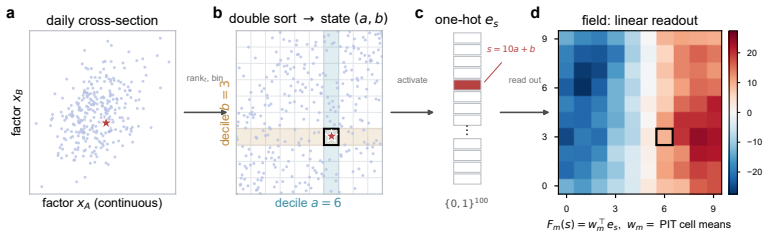
The central object is a typed residual: a residual is owned by the representation that generated it and can be corrected only in that representation's own coordinates. Fold realizes representations as $10\times10$ point-in-time conditional-mean grids; FPRC-PQ realizes the algebra as relax–aggregate–close. The load-bearing identities are the telescoping decomposition $\hat S=\bar F+\hat\rho+\widehat{(\rho-\hat\rho)}$, which partitions capacity across stages, and the control-variate form $B_{PQ}=\bar F+\hat\rho$, whose population analogue weakly reduces residual second moment. A further identity fixes the analytical rumination gain $\lambda^\star=\langle e_0,q\rangle/\langle q,q\rangle$ by orthogonal projection, making the reflective extension parameter-free.
What would settle it
A preregistered replication on a different market that fixes all architectural choices using only data before the evaluation window and then runs the same matched controls—direct, unified-residual, identity-free two-stage, pairwise-only—would settle the claim, since the central claim predicts FPRC-PQ should beat those controls out of sample and a null or reversal would falsify it.
Extended reading notes
Core claim
Formally, a Fold field $F_m$ is the point-in-time conditional-mean map over a $10\times10$ grid of daily rank deciles, and the population residual $r-F_m$ is what that representation leaves unresolved. The algebra composes three typed operators: relaxation corrects each field in its own coordinates, aggregation $A$ takes the equal-mean interface and is the only step that erases representation identity, and closure fits the aggregate's fresh residual without rereading local state. The composition telescopes to $\bar F+\hat\rho+\widehat{(\rho-\hat\rho)}$, so capacity is partitioned across stages, and the aggregate $B_{PQ}=\bar F+\hat\rho$ is a learned control-variate interface. The central discovery is that this ordering, not raw capacity, is what separates the architecture from pooling: the same features, the same tree budget, and the same pairwise interaction class all fail to match FPRC-PQ, which asserts that representation-preserving residual composition is the cause of the reported 5.58 pp net-return improvement and the 0.67 Sharpe improvement.
Load-bearing premise
Everything rests on the claim that no 2023–2026 label or outcome influenced any architectural choice, because if the audits used evaluation-window data to choose the structure, the compared systems are no longer independent of the test set.
Editorial extensions
If this is right
- Each correction stage should fit only the fresh residual left by its predecessor; letting the shared closer reread local states or the aggregate's own rank is significantly harmful.
- Capacity placement matters more than capacity size: a matched-capacity direct learner with exactly the combined tree budget trails FPRC-PQ by 2.13 pp net and loses in all four years.
- Preserving representation identity through local correction is necessary: collapsing the three fields into one concatenated representation and fitting a unified residual trails by 2.27 pp in 4/4 years, and an identity-free two-stage booster trails by 1.69 pp.
- The equal-mean aggregation interface is already sufficient: learned coefficient reweighting moves net return by less than 0.05 pp within noise, while doubling the anchor harms all three chains.
- Side information cannot repair a mistyped residual target: eight meta-information channels all fail, several significantly, and an error-correlated drift scalar destroys 1.13 pp when exposed after identity erasure.
Reading between the lines
- A testable transfer consequence: the same relax–aggregate–close routing could be applied to heterogeneous representations outside finance—for example, different model families or feature blocks in a tabular benchmark—provided each operator is fitted only to its own residual and the identity-erasure boundary is fixed; the paper leaves this extension implicit.
- Reflective rumination is an unevaluated theoretical member of the algebra; a natural next experiment is to fit the reconstruction $T$ and the analytical gain $\lambda^\star$ on data strictly before the evaluation window and compare the $\lambda^\star$ member against the base backbone, which would tell whether the algebra has a second working mechanism beyond the evaluated relax–aggregate–close ins
- The reported margin could depend on the field-selection rule in Appendix A, which orders candidate triples by pre-2023 residual-error standard deviation; a replication that randomizes field selection while fixing the algebra would separate the contribution of the selected fields from the contribution of the composition itself.
Signed reviews
Editorial analysis
A structured set of objections, weighed in public.
Referee Report
Summary. The paper introduces 'residual algebra' as a representation-learning principle: each Fold field is a 10x10 point-in-time conditional-mean table that owns both a coordinate system and the residual it leaves; FPRC-PQ composes a typed relaxation, an equal-mean aggregation boundary, and a fresh-residual shared closer. The authors derive an exact telescoping decomposition, a control-variate interpretation, a Neyman-style coupled-refit orthogonality, and an analytical 'reflective rumination' extension (explicitly not evaluated). On 3.67M Chinese A-share stock-day rows (2023-2026) under a claimed frozen protocol, FPRC-PQ earns 19.10% net return and Sharpe 2.09 versus 13.52% and 1.42 for the pooled-field baseline, with matched-capacity, unified-residual, identity-free, pairwise-only, and side-information controls trailing. The central empirical claim is that the gain is caused by explicit residual ownership and ordered composition, not by more features or more trees.
Significance. Conditional on the frozen-protocol claim being true, the paper is a valuable and unusually disciplined contribution: the algebraic identities are clean and exactly stated; the matched-capacity direct control, the unified-residual identity control, and the eight side-information channels are the right kinds of falsifiable contrasts; paired 21-day block-bootstrap inference is appropriate; the reflective rumination is honestly scoped as not part of the empirical headline; and the bit-exact reproduction audit is a strong reproducibility promise. The main significance risk is that the architecture-selection audits in §5.2 are reported on the 2023-2026 evaluation window, which, if they were used to choose the architecture, makes the headline comparisons post-selection and undermines the causal attribution. The contribution's value therefore depends on resolving that contradiction.
major comments (1)
- [§5.2, Table 2; §3.2; §4] The manuscript asserts in §4 that 'no 2023–2026 label influenced any choice' and in §3.2 that five preregistered audits selected (9)–(11), but Table 2 reports the audit contrasts as paired block-bootstrap deltas on the strict 2023–2026 book (e.g., A1: typed local-PQ vs. pooled fields +4.78 pp; A4: local-only vs. dual-layer Q +0.30 pp; A5: self-state vs. empty −0.45 pp). These realized-window outcomes are used to select the architecture, so the headline comparison FPRC-PQ versus pooled fields and versus matched-capacity direct is post-selection. The bootstrap CIs in Tables 1 and 9 do not condition on this selection and therefore overstate confidence. This directly undermines the paper's strongest claim in the Abstract and §5.1 that the gain is due to residual ownership rather than features or capacity. Please either (i) show that every A1–A5 decision was made from data through 2022-12-31 alone, with the evaluation-window tables provided only as retrospective illustrations, or (ii) treat the audits as exploratory and re-estimate the headline comparisons under a genuinely fixed architecture with selection-adjusted inference.
minor comments (4)
- [Table 1] Several numeric columns run together in the printed table (for example, '5.012.0921.67' and '2.5719.10'), making the row values difficult to read; the table should be reformatted with explicit column spacing.
- [§2, Eq. (2)] The notation bE_PIT and the purge-gap label availability 'through t−h−1' are used before being defined; please define these terms at first use in Section 2 rather than only in the appendix.
- [Appendix A] The term 'strict-OOF modular-FPRC experts' is introduced without definition; please clarify the out-of-fold construction used to score all 1,330 candidate triples.
- [§5.2] The reported Pr[Δ>0] values are one-sided probabilities; please state explicitly which direction each probability refers to so that a reader cannot mistake them for two-sided p-values.
Circularity Check
No material circularity: the algebraic identities are definitional and the reported gains are measured, not derived from the algebra.
full rationale
The paper's load-bearing empirical claims are the net-of-cost return and Sharpe improvements (Table 1) measured under a frozen protocol, not quantities derived from the residual algebra. The exact telescoping (Eq. 13), the control-variate inequality (Eq. 16), and the reflective-rumination gain (Prop. 3.1) are identities or standard projection results that hold by construction; the paper explicitly states that reflective rumination is a theoretical extension and that all reported returns use the lambda=0 member (Sections 3.1 and 4). No self-citation is load-bearing: references to stagewise boosting, control variates, and bootstrap methods are standard external results, and the paper explicitly acknowledges its relationship to them rather than presenting them as novel. The only notable concern is that Section 5.2's audits use 2023-2026 outcomes to select architecture (9)-(11), which is a post-selection or statistical-validity issue rather than a circular derivation: the headline comparison to the pooled-field baseline is measured on the same window, not algebraically implied by the fit. That concern belongs in a correctness assessment, not in a finding of circularity. Limitations (one market, one asset class, two-dimensional fields) are stated in Section 7 and do not constitute circularity.
Assumptions & free parameters
free parameters (7)
- Field committee (F1, F2, F3) =
momentum x reversal, value x momentum, breakout x volume
- Purified Q-axis set =
volatility 20d, netprofit yoy, ocf to profit, profit stability
- Fold bin count (10x10) =
10 deciles per axis
- Number of fields M =
3
- XGBoost hyperparameters =
depth 5, lr 0.035, max_trees 600, min_child_weight 2000, lambda 10
- Time-decay half-life =
252 trading days
- Cost model =
blended 10/15 bp
assumptions (6)
- standard math L2 projection properties: the PIT conditional mean is the orthogonal projection onto the sigma-field generated by the grid
- standard math Control variate identity: for a zero-mean control variate, the variance-reduced estimator has lower or equal second moment
- standard math Neyman orthogonality of the coupled refit path
- domain assumption Point-in-time data availability: all inputs (factors, ranks, purified axes) are computable from data observable at deployment time
- ad hoc to paper The equal-mean aggregation captures all useful information across corrected fields
- ad hoc to paper The shared closer should not reread local state or the aggregate's own rank
invented entities (3)
-
Factor field F_m (10x10 PIT conditional-mean table)
-
Residual algebra operators (relax, aggregate, close)
-
Reflective rumination operator
Cite this review
Pith. "Pith review of Residual Algebra for Representation-Preserving Learning." pith.science (2026). https://pith.science/paper/SGE5PDVG
@misc{pith2026260807349,
  author       = {Pith},
  title        = {Pith review of: Residual Algebra for Representation-Preserving Learning},
  year         = {2026},
  howpublished = {\url{https://pith.science/paper/SGE5PDVG}},
  note         = {Machine review of arXiv:2608.07349}
}
read the original abstract
Learning from heterogeneous representations is often reduced to feature concatenation, erasing which representation produced each error. We propose residual algebra, in which each representation retains its coordinate system and owns its unresolved residual until an explicit aggregation boundary. Fold instantiates representations as point-in-time conditional-mean fields on 10x10 rank grids, and FPRC-PQ composes them through relax-aggregate-close: each field first fits a correction to its own residual, corrected fields then meet at a fixed mean, and a shared learner closes only the aggregate's fresh residual. We formalize aggregation as a quotient by the zero-sum redistribution kernel, characterizing legal post-aggregation operators as those constant on its cosets. The resulting composition separates representation, local residual estimation, and residual-of-residual estimation, with population variance reduction and first-order coupled-path mean orthogonality. Rumination-B and Rumination-H extend the algebra with quotient-legal finite correction and feedback. On 3.67M Chinese A-share stock-day observations (2023-2026) under a frozen point-in-time protocol, FPRC-PQ raises net-of-cost return from 13.52% to 19.10% and Sharpe from 1.42 to 2.09, outperforming matched-capacity, unified-residual, identity-free two-stage, and pairwise-only controls. The gain is thus attributable to explicit residual ownership and composition rather than additional features or trees.
Figures


Figures from the paper (2 more)


Reviewed August 10, 2026 · model on record in the stance chip above.
Discussion (0). Continue with ORCID to comment.