REVIEW 4 major objections 6 minor 53 references
Emergence of Painting Ability via Recognition-Driven Evolution
T0 review · 4 major / 6 minor · reviewed 2026-08-10 · deepseek-v4-flash
Pith's one-line read A vector painting optimized solely for recognition accuracy develops human-like painting ability, beating CLIPasso and compressing images to 0.059 bits per pixel.
desk verdict A legitimate CLIPasso-plus-color-palette extension whose headline 'emergence' and recognition-superiority claims are undercut by evaluating with the same CLIP model used as the optimization objective. read the letter →
The pith
A machine-rendered reading of the paper's core claim, the machinery that carries it, and where it could break.
The reading
What carries the argument
The load-bearing object is the stroke-and-palette painting model built on a differentiable rasterizer (DiffVG), which lets gradients flow from the recognition loss back through rasterization into Bézier control points, widths, and RGB colors. The Stroke Branch optimizes one black set and one colored set of strokes simultaneously, and the Palette Branch learns a palette $P(I)\in\mathbb{R}^{C\times3}$ by localizing points in RGB space through cross-attention queries. The recognition module supplies the evolutionary pressure: $\mathcal{L}_{\text{semantic}} = \sum_l \cos(\phi(I), \phi(S))$ pushes the generated painting's CLIP embedding toward the original image's embedding, $\mathcal{L}_{\text{structure}}$ preserves low-level shape, and $\mathcal{L}_{\text{colour}}$ fits the reference palette. This joint loss is the mechanism that translates 'communicate with minimal strokes and colors' into concrete stroke adjustments.
What would settle it
Evaluate the generated paintings with a recognition encoder that was not used in the semantic loss—for example, a separately trained vision transformer or a human-labeled sketch recognition benchmark—and check whether accuracy against that held-out evaluator still exceeds the CLIPasso baseline.
Extended reading notes
Core claim
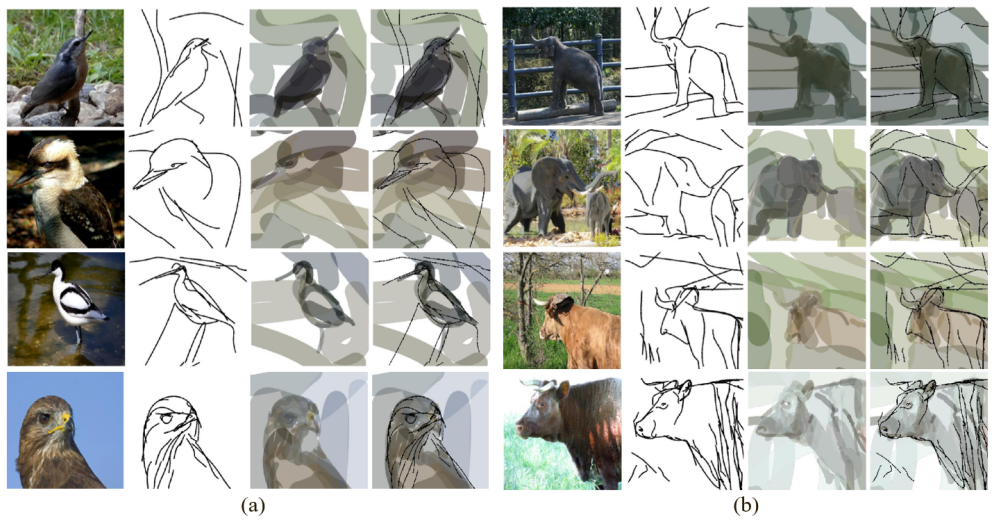
On the paper's own terms, the central discovery is that the combination of a differentiable stroke renderer, a learned color palette, and a recognition-driven loss is sufficient for human-like painting ability to emerge. The model renders each painting as two overlays: a black sketch and a colored sketch, both composed of Bézier strokes. A palette branch predicts C colors from the image through a transformer cross-attention module, and the whole system is optimized with a semantic loss $\sum_l \cos(\phi(I), \phi(S))$ plus structural and color losses. The paper reports that the final painting S reaches 50.53% top-3 zero-shot recognition accuracy at 32 strokes, surpassing CLIPasso's 48.42%, while also achieving aesthetic scores above those of either stroke set alone. The same representation yields a low-bit-rate compression result of 0.059 bpp with 74.51% recognition accuracy against JPEG's 0.433 bpp and 79.10%.
Load-bearing premise
The load-bearing premise is that a CLIP embedding's cosine similarity is the right measure of visual communication efficiency, and that recognition accuracy measured with that same CLIP model is an independent outcome; if that similarity is only a proxy, the 'emergence' is really an optimization artifact.
Editorial extensions
If this is right
- Increasing the stroke budget raises recognition accuracy monotonically in the reported range, from 7.89% top-3 at 4 strokes to 50.53% at 32 strokes for the combined painting S.
- Combining black and colored strokes outperforms each alone: S reaches 50.53% top-3 at 32 strokes, while Sblack and Scolour reach 48.42% and 39.47% respectively.
- The model's aesthetic score improves with stroke count, and the combined painting scores above its black-only and color-only variants on COCO and PASCAL VOC images.
- The vector representation functions as a low-bit-rate compression: 64 total strokes at 0.059 bpp yields 74.51% recognition accuracy, close to JPEG's 79.10% at 0.433 bpp.
- A scenario complexity estimator built on CLIP and the Sketchy dataset can select images that resemble historical painting scenes across complexity levels.
Reading between the lines
- The 'evolutionary' framing is an analogy: the actual mechanism is gradient descent on a fixed objective, not population-level variation and selection; a stronger test would let stroke counts and palette sizes vary dynamically under a fitness function.
- Because recognition is measured with the same CLIP encoder used in the loss, the headline numbers likely overstate general painting ability; a natural extension is to hold out the evaluator, or to test human recognition of the paintings.
- The compression comparison is task-specific: 0.059 bpp with recognition accuracy is not the same as reconstruction fidelity; pairing this vector representation with a learned decoder could make the compression claim testable on standard image-quality metrics.
- The reported stylistic resemblance to medieval art is post-hoc interpretation by the authors, not a measured property; a reader could test it with a controlled human study asking artists to date or attribute the generated paintings.
Signed reviews
Editorial analysis
A structured set of objections, weighed in public.
Referee Report
Summary. This paper proposes an optimization-based painting model that renders an input image as a set of Bézier-curve strokes, split into black and colored stroke groups, with a palette branch that learns a limited color palette. The loss combines a CLIP-based semantic term, a CLIP layer-wise structural term, and a color-palette term. The authors also introduce a scenario-complexity estimation system and a dataset of about 500 images selected from ImageNet, COCO, and PASCAL VOC to mimic artistic scenarios. Experiments report zero-shot CLIP recognition accuracy of generated paintings at 4, 8, 16, and 32 strokes, aesthetic scores, comparisons with CLIPasso, and a low-bit-rate compression demonstration. The paper argues that painting ability emerges from evolutionary pressure toward visual communication efficiency.
Significance. The method is technically concrete and the paper has useful ingredients: a differentiable rasterization pipeline with separate black and colored stroke branches, a compact palette-learning mechanism, a new complexity-filtered painting dataset, and comparisons with CLIPasso. The artistic analysis in Sec. 6 is thoughtful and could be of interest to the sketch and painting community. However, the central quantitative claim—that recognition accuracy improves because of emergent communication efficiency—is weakened by the fact that the same CLIP encoder is used both as the optimization objective and as the evaluation metric, and by the small, unpaired numerical differences. The method is best viewed, with the current evidence, as a CLIP-space vector-painting optimizer; independent evaluation would be needed to substantiate the emergence framing. Because the required fixes are substantial but feasible, the paper warrants major revision.
major comments (4)
- [Sec. 3.4 and Sec. 5.1] The recognition accuracy reported in Table 1 is not an independent outcome: L_semantic in Sec. 3.4 minimizes cosine(phi(I), phi(S)) using a pre-trained CLIP image encoder, and the zero-shot evaluation in Sec. 5.1 computes classification with the same CLIP ViT-B/32 encoder and prompts projected into the same space. Table 1 therefore largely verifies that the optimization increased CLIP cosine similarity to the source image, rather than demonstrating that the paintings are generally recognizable. I request evaluation with a different encoder (for example, CLIP ViT-L/14 or SigLIP), or with a classifier or human annotator not used in the loss, plus a direct report of CLIP cosine similarity to the source image as a sanity check; the emergence language should be softened unless such independent evidence is provided.
- [Table 1 (Sec. 5.1)] The headline advantage of S over CLIPasso at 32 strokes is 50.53% versus 48.42% top-3 accuracy, which is about 4 images out of 190. The manuscript reports no error bars, no multiple seeds, no statistical test, and no paired analysis; the Sblack row ties CLIPasso exactly at 48.42%, so the entire claimed benefit rests on the colored-stroke addition on a handful of images. Please add confidence intervals, repeated runs, and a paired significance test (for example, McNemar) before claiming superior performance in high-level recognition tasks.
- [Sec. 5.2, Fig. 7] The image-compression claim is supported by a single illustrative example: 0.059 bpp versus JPEG at 0.433 bpp and accuracies 74.51% versus 79.10% for one image. This does not substantiate the claim of outperforming traditional methods. A proper evaluation needs a rate-distortion or accuracy-rate comparison over the full evaluation set, with multiple compression ratios, standard codecs such as JPEG, WebP, and BPG, and a clear definition of how the vector painting is converted to bits, including control-point coordinates, colors, widths, and palette storage.
- [Table 2] In Table 2, two rows are both labeled Sblack but contain different numeric values; presumably one of them should be Scolour. This obscures the aesthetic-score comparison that supports the claim that colored strokes improve aesthetics. Please correct the labels and report scores for S, Sblack, and Scolour separately, ideally with standard deviations across images.
minor comments (6)
- [Sec. 3.4] The equation for L_semantic is written with a sum over layers but without layer indices in the cosine term, while L_structure explicitly uses phi_l; this should be made consistent and the final loss equation should be numbered for reference.
- [Sec. 5.1] The text says that optimization leads to higher accuracy in the final painting Scolour, but Table 1 reports the combined painting as row S; please clarify the naming of S, Sblack, and Scolour throughout the section.
- [References] Reference [34] is a placeholder (Author Name, Project title, Year); a full citation for the aesthetic indicator is needed.
- [Sec. 5.1] There is a broken figure reference (Figure ??) and a missing reference to Figure 5 in the text; these should be corrected.
- [General] There are several typos and grammatical errors, for example 'approch' in Sec. 2.1, 'amgutity' in Sec. 4.1, and 'evaluate' in Sec. 5.1; a careful proofreading pass is needed.
- [Sec. 5.2] The text says more comparison results with traditional compression methods are shown in the discussion section, but those results do not appear in the main text; either add them or remove the pointer.
Circularity Check
Reported recognition gains are measured with the same CLIP encoder used as the optimization objective, so the headline 'emergent' recognition claim is not independently established.
-
fitted input called prediction
[Sec. 3.4 (Recognition Module, L_semantic) and Sec. 5.1 (Quantitative Evaluation, Table 1)]
"The semantic loss Lsemantic is central to our method, as it reflects the recognition accuracy of the generated painting. It is computed by measuring the cosine similarity between the high-level embeddings of the generated painting and the input image. ... Specifically, recognition accuracy indicates how well a painting can be identified by a machine as belonging to the same category as the original image."
L_semantic is minimized by moving the CLIP embedding phi(S) of the painting toward the CLIP embedding phi(I) of the input image. The zero-shot evaluation then classifies the painting using the same pre-trained CLIP encoder, scoring cos(phi(S), text(class)). When the original image is correctly classified by CLIP, cos(phi(I), correct_text) exceeds the other text scores, and driving phi(S) toward phi(I) transfers that margin to the painting by construction. Table 1 therefore reports how well the optimizer satisfied its own CLIP-cosine objective, not recognition by an independent system; it is like reporting training accuracy as evidence of an emergent capability.
full rationale
The central quantitative evidence for 'emergence' is a closed loop: the strokes are optimized against CLIP cosine similarity to the source image, and the recognition metric is CLIP zero-shot accuracy on the same encoder. No independent recognizer, held-out evaluator, or non-CLIP measure is used to confirm that the paintings are recognizable as their categories. The comparison to CLIPasso is a comparison of two CLIP-space optimizers and does not establish emergent communicative value. The paper also reports aesthetic scores from a separate CLIP-based aesthetic predictor and a subjective art-historical analysis; those are not circular in the same way, but they do not rescue the recognition claim. The author self-citations (e.g., [8], [40], [49]) are used for technique or motivation and are not load-bearing. The 50.53% vs 48.42% top-3 difference at 32 strokes is also only about 4 images out of 190 with no error bars, which makes the headline margin fragile, but the main issue is the evaluator/objective identity. The method may be a legitimate CLIP-space painting and compression optimizer, but the 'emergent human-like painting ability' claim is not independently supported.
Assumptions & free parameters
free parameters (5)
- Loss weights lambda1, lambda2, lambda3 =
1.0, 1.0, 1.0
- Number of strokes N =
4, 8, 16, 32
- Number of colors C =
up to 16 (4 or 8 for low stroke counts)
- Stroke width and opacity =
width 1.0 for black, opacity 0.5 for colored
- Top-10 threshold in Composition Criterion =
10
assumptions (4)
- domain assumption CLIP embeddings capture semantic content sufficient for recognition and painting optimization.
- standard math The differentiable rasterizer diffVG provides accurate gradients for stroke optimization.
- domain assumption The Sketchy dataset complexity labels transfer to natural-image painting scenarios.
- domain assumption A painting that maximizes CLIP similarity to the input image also achieves high zero-shot recognition accuracy.
Cite this review
Pith. "Pith review of Emergence of Painting Ability via Recognition-Driven Evolution." pith.science (2026). https://pith.science/paper/SGPUOROF
@misc{pith2026250104966,
  author       = {Pith},
  title        = {Pith review of: Emergence of Painting Ability via Recognition-Driven Evolution},
  year         = {2026},
  howpublished = {\url{https://pith.science/paper/SGPUOROF}},
  note         = {Machine review of arXiv:2501.04966}
}
read the original abstract
From Paleolithic cave paintings to Impressionism, human painting has evolved to depict increasingly complex and detailed scenes, conveying more nuanced messages. This paper attempts to emerge this artistic capability by simulating the evolutionary pressures that enhance visual communication efficiency. Specifically, we present a model with a stroke branch and a palette branch that together simulate human-like painting. The palette branch learns a limited colour palette, while the stroke branch parameterises each stroke using B\'ezier curves to render an image, subsequently evaluated by a high-level recognition module. We quantify the efficiency of visual communication by measuring the recognition accuracy achieved with machine vision. The model then optimises the control points and colour choices for each stroke to maximise recognition accuracy with minimal strokes and colours. Experimental results show that our model achieves superior performance in high-level recognition tasks, delivering artistic expression and aesthetic appeal, especially in abstract sketches. Additionally, our approach shows promise as an efficient bit-level image compression technique, outperforming traditional methods.
Figures


Figures from the paper (14 more)




Reference graph
Works this paper leans on
-
[1]
Generative adversar- ial networks for extreme learned image compression
Eirikur Agustsson, Michael Tschannen, Fabian Mentzer, Radu Timofte, and Luc Van Gool. Generative adversar- ial networks for extreme learned image compression. In Proceedings of the IEEE/CVF International Conference on Computer Vision, pages 221–231, 2019. 3
work page 2019
-
[2]
Multi-realism image compression with a conditional generator
Eirikur Agustsson, David Minnen, George Toderici, and Fabian Mentzer. Multi-realism image compression with a conditional generator. In Proceedings of the IEEE/CVF Con- ference on Computer Vision and Pattern Recognition, pages 22324–22333, 2023. 4
work page 2023
-
[3]
An image is worth 16x16 words: Trans- formers for image recognition at scale
Dosovitskiy Alexey. An image is worth 16x16 words: Trans- formers for image recognition at scale. arXiv preprint arXiv: 2010.11929, 2020. 4
arXiv 2010
-
[4]
Basic color terms: Their univer- sality and evolution
Brent Berlin and Paul Kay. Basic color terms: Their univer- sality and evolution. Univ of California Press, 1991. 2
work page 1991
-
[5]
End-to- end object detection with transformers
Nicolas Carion, Francisco Massa, Gabriel Synnaeve, Nicolas Usunier, Alexander Kirillov, and Sergey Zagoruyko. End-to- end object detection with transformers. In European confer- ence on computer vision, pages 213–229. Springer, 2020. 5
2020
-
[6]
Communicating artificial neural net- works develop efficient color-naming systems
Rahma Chaabouni, Eugene Kharitonov, Emmanuel Dupoux, and Marco Baroni. Communicating artificial neural net- works develop efficient color-naming systems. Proceedings of the National Academy of Sciences, 118(12):e2016569118,
-
[7]
Learning to generate line drawings that convey geometry and semantics
Caroline Chan, Fr ´edo Durand, and Phillip Isola. Learning to generate line drawings that convey geometry and semantics. In Proceedings of the IEEE/CVF Conference on Computer Vision and Pattern Recognition, pages 7915–7925, 2022. 3
work page 2022
-
[8]
Ziteng Cui, Kunchang Li, Lin Gu, Shenghan Su, Peng Gao, Zhengkai Jiang, Yu Qiao, and Tatsuya Harada. You only need 90k parameters to adapt light: a light weight trans- former for image enhancement and exposure correction. arXiv preprint arXiv:2205.14871, 2022. 5
arXiv 2022
Show all 53 references
-
[9]
Imagenet: A large-scale hierarchical image database
Jia Deng, Wei Dong, Richard Socher, Li-Jia Li, Kai Li, and Li Fei-Fei. Imagenet: A large-scale hierarchical image database. In 2009 IEEE conference on computer vision and pattern recognition, pages 248–255. Ieee, 2009. 6
2009
-
[10]
Edge augmentation for large-scale sketch recognition with- out sketches
Nikos Efthymiadis, Giorgos Tolias, and Ond ˇrej Chum. Edge augmentation for large-scale sketch recognition with- out sketches. In 2022 26th International Conference on Pat- tern Recognition (ICPR), pages 3595–3602. IEEE, 2022. 3
2022
-
[11]
How do humans sketch objects? ACM Trans
Mathias Eitz, James Hays, and Marc Alexa. How do humans sketch objects? ACM Trans. Graph. (Proc. SIGGRAPH), 31 (4):44:1–44:10, 2012. 3
2012
-
[12]
The pascal visual object classes (voc) challenge
Mark Everingham, Luc Van Gool, Christopher KI Williams, John Winn, and Andrew Zisserman. The pascal visual object classes (voc) challenge. International journal of computer vision, 88:303–338, 2010. 6
2010
-
[13]
An adaptive algorithm for spatial gray- scale
Robert W Floyd. An adaptive algorithm for spatial gray- scale. In Proc. Soc. Inf. Disp., pages 75–77, 1976. 8
1976
-
[14]
Clipdraw: Exploring text-to-drawing synthesis through language-image encoders
Kevin Frans, Lisa Soros, and Olaf Witkowski. Clipdraw: Exploring text-to-drawing synthesis through language-image encoders. Advances in Neural Information Processing Sys- tems, 35:5207–5218, 2022. 2, 3, 5
2022
-
[15]
Sketchycoco: Image gener- ation from freehand scene sketches
Chengying Gao, Qi Liu, Qi Xu, Limin Wang, Jianzhuang Liu, and Changqing Zou. Sketchycoco: Image gener- ation from freehand scene sketches. In Proceedings of the IEEE/CVF conference on computer vision and pattern recognition, pages 5174–5183, 2020. 3
2020
-
[16]
A simple method for color quantization: Octree quantization
Michael Gervautz and Werner Purgathofer. A simple method for color quantization: Octree quantization. In New Trends in Computer Graphics: Proceedings of CG International’88, pages 219–231. Springer, 1988. 8
1988
-
[17]
Color naming across languages reflects color use
Edward Gibson, Richard Futrell, Julian Jara-Ettinger, Kyle Mahowald, Leon Bergen, Sivalogeswaran Ratnasingam, Mitchell Gibson, Steven T Piantadosi, and Bevil R Conway. Color naming across languages reflects color use. Proceed- ings of the National Academy of Sciences , 114(40)...
2017
-
[18]
Primal sketch: Integrating structure and texture
Cheng-en Guo, Song-Chun Zhu, and Ying Nian Wu. Primal sketch: Integrating structure and texture. Computer Vision and Image Understanding, 106(1):5–19, 2007. 4
2007
-
[19]
Color image quantization for frame buffer display
Paul Heckbert. Color image quantization for frame buffer display. ACM Siggraph Computer Graphics, 16(3):297–307,
-
[20]
Gaussian error linear units (gelus)
Dan Hendrycks and Kevin Gimpel. Gaussian error linear units (gelus). arXiv preprint arXiv:1606.08415, 2016. 5
2016 arXiv
-
[21]
Vectorpainter: A novel approach to stylized vector graphics synthesis with vectorized strokes
Juncheng Hu, Ximing Xing, Zhengqi Zhang, Jing Zhang, and Qian Yu. Vectorpainter: A novel approach to stylized vector graphics synthesis with vectorized strokes. arXiv preprint arXiv:2405.02962, 2024. 3
2024 arXiv
-
[22]
Image-to-image translation with conditional adver- sarial networks
Phillip Isola, Jun-Yan Zhu, Tinghui Zhou, and Alexei A Efros. Image-to-image translation with conditional adver- sarial networks. In Proceedings of the IEEE conference on computer vision and pattern recognition, pages 1125–1134,
-
[23]
Vectorfusion: Text-to-svg by abstracting pixel-based diffusion models
Ajay Jain, Amber Xie, and Pieter Abbeel. Vectorfusion: Text-to-svg by abstracting pixel-based diffusion models. In Proceedings of the IEEE/CVF Conference on Computer Vi- sion and Pattern Recognition, pages 1911–1920, 2023. 3
1911
-
[24]
Synthesizing human- like sketches from natural images using a conditional con- volutional decoder
Moritz Kampelmuhler and Axel Pinz. Synthesizing human- like sketches from natural images using a conditional con- volutional decoder. In Proceedings of the IEEE/CVF winter conference on applications of computer vision, pages 3203– 3211, 2020. 2, 3
2020
-
[25]
Diffu- sionclip: Text-guided diffusion models for robust image ma- nipulation
Gwanghyun Kim, Taesung Kwon, and Jong Chul Ye. Diffu- sionclip: Text-guided diffusion models for robust image ma- nipulation. In Proceedings of the IEEE/CVF conference on computer vision and pattern recognition, pages 2426–2435,
-
[26]
Egic: Enhanced low-bit-rate generative image compression guided by semantic segmentation
Nikolai K ¨orber, Eduard Kromer, Andreas Siebert, Sascha Hauke, Daniel Mueller-Gritschneder, and Bj ¨orn Schuller. Egic: Enhanced low-bit-rate generative image compression guided by semantic segmentation. In European Conference on Computer Vision, pages 202–220. Springer, 2025. 4
2025
-
[27]
Learning geometry- aware representations by sketching
Hyundo Lee, Inwoo Hwang, Hyunsung Go, Won-Seok Choi, Kibeom Kim, and Byoung-Tak Zhang. Learning geometry- aware representations by sketching. In Proceedings of the IEEE/CVF Conference on Computer Vision and Pattern Recognition, pages 23315–23326, 2023. 3
2023
-
[28]
Pose recognition with cascade transformers
Ke Li, Shijie Wang, Xiang Zhang, Yifan Xu, Weijian Xu, and Zhuowen Tu. Pose recognition with cascade transformers. In Proceedings of the IEEE/CVF conference on computer vi- sion and pattern recognition, pages 1944–1953, 2021. 5
1944
-
[29]
Photo-sketching: Inferring contour draw- ings from images
Mengtian Li, Zhe Lin, Radomir Mech, Ersin Yumer, and Deva Ramanan. Photo-sketching: Inferring contour draw- ings from images. In 2019 IEEE Winter Conference on Ap- plications of Computer Vision (WACV) , pages 1403–1412. IEEE, 2019. 2, 3
2019
-
[30]
Differentiable vector graphics rasterization for editing and learning
Tzu-Mao Li, Michal Luk ´aˇc, Micha ¨el Gharbi, and Jonathan Ragan-Kelley. Differentiable vector graphics rasterization for editing and learning. ACM Transactions on Graphics (TOG), 39(6):1–15, 2020. 3, 4
2020
-
[31]
Im2pencil: Controllable pencil illustra- tion from photographs
Yijun Li, Chen Fang, Aaron Hertzmann, Eli Shechtman, and Ming-Hsuan Yang. Im2pencil: Controllable pencil illustra- tion from photographs. In Proceedings of the IEEE/CVF Conference on Computer Vision and Pattern Recognition , pages 1525–1534, 2019. 3
2019
-
[32]
Microsoft coco: Common objects in context
Tsung-Yi Lin, Michael Maire, Serge Belongie, James Hays, Pietro Perona, Deva Ramanan, Piotr Doll´ar, and C Lawrence Zitnick. Microsoft coco: Common objects in context. In Computer Vision–ECCV 2014: 13th European Conference, Zurich, Switzerland, September 6-12, 2014, Proceeding...
2014
-
[33]
A computational investigation into the human representation and processing of visual information
D Man and A Vision. A computational investigation into the human representation and processing of visual information. WH San Francisco: Freeman and Company, San Francisco, 1:1, 1982. 4
1982
-
[34]
Project title, Year
Author Name. Project title, Year. Accessed: Month Day, Year. 6
-
[35]
Learning transferable visual models from natural language supervi- sion
Alec Radford, Jong Wook Kim, Chris Hallacy, Aditya Ramesh, Gabriel Goh, Sandhini Agarwal, Girish Sastry, Amanda Askell, Pamela Mishkin, Jack Clark, et al. Learning transferable visual models from natural language supervi- sion. In International conference on machine learning, ...
2021
-
[36]
Hierarchical text-conditional image gener- ation with clip latents
Aditya Ramesh, Prafulla Dhariwal, Alex Nichol, Casey Chu, and Mark Chen. Hierarchical text-conditional image gener- ation with clip latents. arXiv preprint arXiv:2204.06125, 1 (2):3, 2022. 2, 3
2022 arXiv
-
[37]
The sketchy database: learning to retrieve badly drawn bunnies
Patsorn Sangkloy, Nathan Burnell, Cusuh Ham, and James Hays. The sketchy database: learning to retrieve badly drawn bunnies. ACM Transactions on Graphics (TOG), 35(4):1–12,
-
[38]
Laion-5b: An open large-scale dataset for training next generation image-text models
Christoph Schuhmann, Romain Beaumont, Richard Vencu, Cade Gordon, Ross Wightman, Mehdi Cherti, Theo Coombes, Aarush Katta, Clayton Mullis, Mitchell Worts- man, et al. Laion-5b: An open large-scale dataset for training next generation image-text models. Advances in Neural In- f...
2022
-
[39]
Learning to sketch with shortcut cycle consistency
Jifei Song, Kaiyue Pang, Yi-Zhe Song, Tao Xiang, and Tim- othy M Hospedales. Learning to sketch with shortcut cycle consistency. In Proceedings of the IEEE conference on com- puter vision and pattern recognition , pages 801–810, 2018. 2, 3
2018
-
[40]
Name your colour for the task: Artificially discover colour naming via colour quantisation transformer
Shenghan Su, Lin Gu, Yue Yang, Zenghui Zhang, and Tat- suya Harada. Name your colour for the task: Artificially discover colour naming via colour quantisation transformer. In Proceedings of the IEEE/CVF International Conference on Computer Vision, pages 12021–12031, 2023. 1
2023
-
[41]
Clipasso: Semantically-aware object sketching
Yael Vinker, Ehsan Pajouheshgar, Jessica Y Bo, Ro- man Christian Bachmann, Amit Haim Bermano, Daniel Cohen-Or, Amir Zamir, and Ariel Shamir. Clipasso: Semantically-aware object sketching. ACM Transactions on Graphics (TOG), 41(4):1–11, 2022. 2, 3, 4, 5, 7
2022
-
[42]
Clipascene: Scene sketching with different types and levels of abstraction
Yael Vinker, Yuval Alaluf, Daniel Cohen-Or, and Ariel Shamir. Clipascene: Scene sketching with different types and levels of abstraction. In Proceedings of the IEEE/CVF International Conference on Computer Vision, pages 4146– 4156, 2023. 2, 3, 5
2023
-
[43]
Learning robust global representations by penalizing local predictive power.Advances in Neural Information Pro- cessing Systems, 32, 2019
Haohan Wang, Songwei Ge, Zachary Lipton, and Eric P Xing. Learning robust global representations by penalizing local predictive power.Advances in Neural Information Pro- cessing Systems, 32, 2019. 3
2019
-
[44]
Diffsketching: Sketch control image synthesis with diffusion models
Qiang Wang, Di Kong, Fengyin Lin, and Yonggang Qi. Diffsketching: Sketch control image synthesis with diffusion models. arXiv preprint arXiv:2305.18812, 2023. 3, 5
2023 arXiv
-
[45]
Xdog: An extended difference-of-gaussians com- pendium including advanced image stylization
Holger Winnem ¨oller, Jan Eric Kyprianidis, and Sven C Olsen. Xdog: An extended difference-of-gaussians com- pendium including advanced image stylization. Computers & Graphics, 36(6):740–753, 2012. 4
2012
-
[46]
Svgdreamer: Text guided svg gener- ation with diffusion model
Ximing Xing, Haitao Zhou, Chuang Wang, Jing Zhang, Dong Xu, and Qian Yu. Svgdreamer: Text guided svg gener- ation with diffusion model. In Proceedings of the IEEE/CVF Conference on Computer Vision and Pattern Recognition , pages 4546–4555, 2024. 3
2024
-
[47]
Drb-gan: A dynamic resblock generative adversar- ial network for artistic style transfer
Wenju Xu, Chengjiang Long, Ruisheng Wang, and Guanghui Wang. Drb-gan: A dynamic resblock generative adversar- ial network for artistic style transfer. In Proceedings of the IEEE/CVF international conference on computer vision, pages 6383–6392, 2021. 3
2021
-
[48]
On perceptual lossy compression: The cost of percep- tual reconstruction and an optimal training framework
Zeyu Yan, Fei Wen, Rendong Ying, Chao Ma, and Peilin Liu. On perceptual lossy compression: The cost of percep- tual reconstruction and an optimal training framework. InIn- ternational Conference on Machine Learning, pages 11682– 11692. PMLR, 2021. 4
2021
-
[49]
Im- proving fairness in image classification via sketching
Ruichen Yao, Ziteng Cui, Xiaoxiao Li, and Lin Gu. Im- proving fairness in image classification via sketching. arXiv preprint arXiv:2211.00168, 2022. 3
2022 arXiv
-
[50]
The evolution of color naming re- flects pressure for efficiency: Evidence from the recent past
Noga Zaslavsky, Karee Garvin, Charles Kemp, Naftali Tishby, and Terry Regier. The evolution of color naming re- flects pressure for efficiency: Evidence from the recent past. Journal of Language Evolution, 7(2):184–199, 2022. 1
2022
-
[51]
Inversion-based style transfer with diffusion models
Yuxin Zhang, Nisha Huang, Fan Tang, Haibin Huang, Chongyang Ma, Weiming Dong, and Changsheng Xu. Inversion-based style transfer with diffusion models. In Pro- ceedings of the IEEE/CVF conference on computer vision and pattern recognition, pages 10146–10156, 2023. 2, 3
2023
-
[52]
Unpaired image-to-image translation using cycle- consistent adversarial networks
Jun-Yan Zhu, Taesung Park, Phillip Isola, and Alexei A Efros. Unpaired image-to-image translation using cycle- consistent adversarial networks. In Proceedings of the IEEE international conference on computer vision , pages 2223– 2232, 2017. 3
2017
-
[53]
Sketchyscene: Richly-annotated scene sketches
Changqing Zou, Qian Yu, Ruofei Du, Haoran Mo, Yi-Zhe Song, Tao Xiang, Chengying Gao, Baoquan Chen, and Hao Zhang. Sketchyscene: Richly-annotated scene sketches. In Proceedings of the european conference on computer vision (ECCV), pages 421–436, 2018. 3
2018
Reviewed August 10, 2026 · model on record in the stance chip above.
Discussion (0). Continue with ORCID to comment.