REVIEW 5 major objections 5 minor 118 references
CoVE: Compressed Vocabulary Expansion Makes Better LLM-based Recommender Systems
T0 review · 5 major / 5 minor · reviewed 2026-08-06 · deepseek-v4-flash
Pith's one-line read By giving every item a single vocabulary token, CoVE turns recommendation into next-token prediction and claims up to 62 percent accuracy gains with roughly 100x faster inference than generating and retrieving titles.
desk verdict A plausible and clearly-written recipe for LLM sequential recommendation, with real same-backbone gains on Video Games, but the headline 62% is inflated by comparisons to quoted baselines on different backbones. read the letter →
The pith
A machine-rendered reading of the paper's core claim, the machinery that carries it, and where it could break.
The reading
What carries the argument
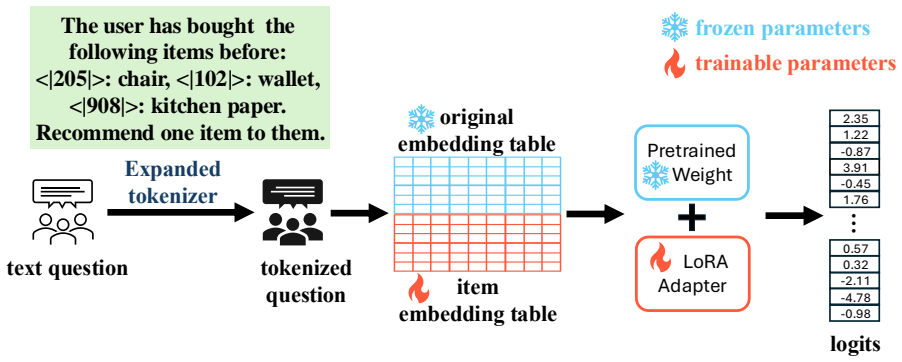
The object that carries the argument is the expanded tokenizer: each item ID such as <|205|> becomes a real token with its own embedding, making next-item prediction exactly next-token prediction over a sequence of user interactions. The supporting machinery is joint finetuning of the item embedding table, transformer weights, and language-model head via LoRA, plus a hashing-based embedding compression in which each item's embedding is the average of $k$ shared embeddings selected by hash functions $h(i) = ((ai+b) \bmod p) \bmod |S|$, letting the item embedding table shrink to $1/2$, $1/4$, $1/8$, or $1/16$ of its original size.
What would settle it
Re-run CoVE, BIGRec, and TIGER under identical data splits, LoRA ranks, learning rates, epoch budgets, and hardware, and check whether CoVE's margins persist; a concrete check is whether BIGRec's NG@10 on Video Games rises from 0.0216 toward CoVE's 0.0268 under a matched hyperparameter search.
Extended reading notes
Core claim
The paper's central claim is that an LLM-based recommender is best aligned not by generating an item's title and retrieving a matching catalog entry, but by expanding the tokenizer so each catalog item is one token and then predicting that token directly from the interaction history. CoVE assigns each item a unique ID in the expanded vocabulary, gives it a distinct embedding, and finetunes the item embeddings, the transformer weights, and the language-model head through a LoRA adapter. At inference, the model outputs logits over the whole vocabulary and ranks only the item-ID entries, so the recommendation is a single non-generative step with no autoregressive decoding and no retrieval step. On four Amazon benchmarks the paper reports up to 62 percent accuracy improvement over prior methods and roughly 100x faster inference than BIGRec, and it reports that a hashing-based compressed embedding table survives 16x compression while still beating prior methods on most metrics.
Load-bearing premise
The load-bearing premise is that the baseline numbers taken from earlier papers, rather than re-run under the same codebase and tuning budget, are the right comparison points; if those baselines were re-tuned with the same hyperparameter budget, the claimed 30 to 62 percent margins could shrink considerably.
Editorial extensions
If this is right
- Recommendations become rankable by logits over item IDs in a single forward pass, so hallucinated item titles are impossible and retrieval is unnecessary at inference.
- Inference speed rises roughly 100x over the finetune-and-retrieval framework while accuracy claims improve by 30 to 62 percent on Beauty, Toys & Games, and Sports & Outdoors, and by smaller positive margins on Video Games against BIGRec.
- Embedding memory can be cut by up to 16x through hashing with only partial accuracy loss; even 16x compression beats the strongest baseline on HR@5 and NG@5 across the three datasets, with one exception out of twelve comparisons.
- Both item titles in the prompt and a trainable item embedding table contribute substantially; removing either one degrades the reported gains.
Reading between the lines
- Editorial inference: the ID-token formulation suggests the same pattern could benefit any LLM task with a fixed finite output space, such as product classification, question routing, or entity linking, where a single-token output is faster and inherently non-hallucinatory.
- Editorial inference: because the prompt includes item titles, the model appears to learn both semantic associations and exact ID-title mappings; a testable extension would seed embeddings for yet-unseen items from their title text and measure cold-start recommendation quality, which the paper does not do.
- Editorial inference: the rough 100x speedup is measured for the particular item-space sizes and batch settings of these datasets; the practical speedup at industrial catalog sizes will depend on how much of the vocabulary is scored per request, which is a deployment detail the paper leaves open.
Editorial analysis
A structured set of objections, weighed in public.
Referee Report
Summary. The manuscript proposes CoVE, a method that expands an LLM tokenizer with one unique token per item, finetunes the item embedding table together with LoRA-adapted transformer weights and the lm_head, and makes recommendations by ranking the logits of item tokens rather than by generating product titles and retrieving embeddings. To keep the item embedding table memory-feasible, CoVE compresses it through hashing into a shared latent item space. Experiments on four Amazon datasets (Video Games, Beauty, Toys & Games, Sports & Outdoors) report accuracy improvements over TIGER and BIGRec, an approximately 100x inference speed-up over BIGRec, and ablations covering title information, trainable item embeddings, and compression rates up to 64x.
Significance. If the empirical claims hold, CoVE is a practically valuable design: it turns LLM-based sequential recommendation into single-token classification, avoids hallucinated item titles, and makes inference much cheaper than generative retrieval. The manuscript is clearly written, the proposed mechanism is simple and plausible, the code is released, and the ablation study usefully separates the contribution of trainable item embeddings from that of title text. However, the quantitative support is currently based on single point estimates with no variance, and the largest headline margins compare CoVE against baselines quoted from other papers that use different backbones and tuning setups. The significance therefore depends on additional controlled comparisons and statistical grounding.
major comments (5)
- [Section 3.1, Tables 3-4] The central claim that CoVE is superior to the finetune-and-retrieval framework is supported by only one same-backbone comparison. For Beauty, Toys, and Sports, the state-of-the-art results are quoted from Rajput et al. (2023), where TIGER is not an LLM-finetuning method, while CoVE uses LLaMA-3.2-3B; for Video Games, the comparison with BIGRec uses LLaMA-2-7B for both. The 'up to 62%' headline in the contributions and Figure 2a is therefore computed against a non-LLM baseline, whereas the same-backbone Video Games comparison in Table 4 shows improvements of 17-36%. This co-varies the proposed method with backbone capacity, tuning budget, and evaluation harness, and does not establish the categorical conclusion drawn in Section 3.2. Please re-run BIGRec on the other three datasets in the same codebase and evaluation harness, or substantially temper the claim.
- [Section 3.2 and Tables 3-4] No variance or multiple-seed results are reported anywhere in the paper. All tables present single point estimates, so the Video Games margins (e.g., NG@5 0.0221 vs. 0.0189, HR@20 0.0621 vs. 0.0457) cannot be distinguished from seed noise. This is load-bearing because the accuracy advantage is the paper's primary claim. Please report means and standard deviations over at least three random seeds and, where feasible, paired comparisons between CoVE and BIGRec under identical conditions.
- [Section 3.2, Inference Time] The inference-speed comparison is not sufficiently specified. The text states that BIGRec and CoVE achieve 0.066 and 6.5 samples per second respectively, but it does not state whether the BIGRec number includes the embedding-retrieval and reranking step, what batch size and GPU model were used, what decoding strategy and generation length were used, or how many samples were timed. Since 'approximately 100 times faster inference' is a headline contribution, these measurement details are required for the claim to be verifiable.
- [Section 2, Hashing-based Embedding Compression] The hashing compression method is not fully specified. The text says that k hash functions h1,...,hk are sampled from a universal hash family, but the concrete formula h(i) = ((ai+b) mod p) mod |S| defines one hash function; it is not stated whether each hj uses an independent (a,b) pair, how p and |S| are selected, or how k is chosen. Without these details, the compression-rate experiments in Figure 3 are not reproducible.
- [Section 3.3 and Figure 3] The compression-rate results are presented only in normalized form, with no absolute metric values and no explicit definition of the normalization base. The reader cannot verify the contribution statement that 'we can compress the embedding table by up to 16 times while still achieving better results than prior methods' against the underlying numbers, especially because the text notes one exception (HR@10 on Toys). Please provide absolute values, standard deviations, and a clear statement of what each normalized curve is divided by.
minor comments (5)
- [Section 2, Eq. (1)] The notation for the averaged item embedding uses e_{h_j(i)} without first defining e_s; please define the embedding of a shared item explicitly.
- [Table 5] The table header reads 'I./E.' but the caption defines 'I.' and 'E.'; please use consistent labels in the header itself so the table is readable without referring to the caption.
- [Figure 3] The y-axis label says 'Normalized Metric Value' but the caption does not state what the normalization is relative to; please specify whether values are normalized by the uncompressed CoVE result, by the baseline, or by some other quantity.
- [Section 4] In the case study, the generated output contains <|5|>, which already appears in the input history, followed by <|1441|>; the text should clarify whether this is a ranked-output format and whether outputting an item already in the user's history is possible.
- [References and Appendix B.2] Several references are duplicated (Achiam et al. 2023a/2023b, Desai et al. 2022a/2022b, Shi et al. 2020a/2020b, Touvron et al. 2023a/2023b), and Appendix B.2 contains a large block of citations that are not connected to the proposed method or experiments; please merge duplicates and trim or integrate the unrelated citations.
Circularity Check
No significant circularity: CoVE's reported gains are empirical measurements against external baselines, and the self-cited efficiency work in Section B.2 is not load-bearing for the paper's central claim.
full rationale
The paper's derivation chain is empirical rather than definitional. CoVE assigns each item a unique token, finetunes item embeddings, transformer weights, and lm_head via LoRA, and recommends by ranking logits over item IDs. There is no step where a fitted parameter is renamed as a prediction or where an output quantity is equal to an input by construction. The hash-based embedding compression formula e_i = (1/k) sum e_{h_j(i)} is a design choice for memory efficiency, and the reported accuracy numbers are compared with published results from Rajput et al. (2023) and Bao et al. (2023a), i.e., external benchmarks rather than quantities derived from CoVE's own fitted values. The only notable self-citation pattern is the block of author references in Section B.2, but those works are cited as related efficiency/optimization literature and are not used to justify CoVE's architecture, training procedure, or measured outcomes; under the hard rules, non-load-bearing self-citation does not constitute circularity. Concerns about baseline comparability or tuning budgets are correctness risks, not circularity, and do not raise the circularity score.
Assumptions & free parameters
free parameters (6)
- embedding compression rate =
2 for main results; 4, 8, 16, 32, 64 in ablations
- number of hash functions k
- LoRA rank =
8
- LoRA alpha =
16
- learning rate =
1e-4
- hash parameters a and b =
random
assumptions (4)
- domain assumption Pretrained LLMs possess transferable sequential reasoning that can be redirected to item recommendation via next-token prediction.
- domain assumption Averaging k hash-selected shared embeddings preserves enough item distinguishability for fine-grained ranking.
- domain assumption Baseline results copied from Rajput et al. (2023) and Bao et al. (2023a) are valid and comparable under the same train and test splits.
- domain assumption The next item in a user sequence is the correct supervised target for sequential recommendation.
Cite this review
Pith. "Pith review of CoVE: Compressed Vocabulary Expansion Makes Better LLM-based Recommender Systems." pith.science (2026). https://pith.science/paper/SHEBGCSB
@misc{pith2026250619993,
  author       = {Pith},
  title        = {Pith review of: CoVE: Compressed Vocabulary Expansion Makes Better LLM-based Recommender Systems},
  year         = {2026},
  howpublished = {\url{https://pith.science/paper/SHEBGCSB}},
  note         = {Machine review of arXiv:2506.19993}
}
read the original abstract
Recommender systems play a pivotal role in providing relevant content to users. With the rapid development of large language models (LLMs), researchers have begun utilizing LLMs to build more powerful recommender systems. However, existing approaches that focus on aligning LLMs with recommendation tasks do not fully leverage their sequential information processing capabilities, leading to suboptimal performance. In this paper, we propose a novel system called compressed vocabulary expansion (CoVE). In CoVE, each item is assigned a unique ID within the expanded vocabulary. Our framework effectively capitalizes on sequence understanding abilities of LLMs, significantly enhancing their performance on recommendation tasks. Additionally, we compress the embedding layer, making CoVE practical for large-scale industrial applications. The effectiveness and performance of CoVE are demonstrated through comprehensive experiments on multiple recommendation datasets and comparisons with prior works. Our code can be found at https://github.com/HaochenZhang717/CoVE-official-Repo.
Figures


Figures from the paper (1 more)

Reference graph
Works this paper leans on
-
[1]
online" 'onlinestring :=
ENTRY address archivePrefix author booktitle chapter edition editor eid eprint eprinttype howpublished institution journal key month note number organization pages publisher school series title type volume year doi pubmed url lastchecked label extra.label sort.label short.list INTEGERS output.state before.all mid.sentence after.sentence after.block STRING...
-
[2]
write newline
" write newline "" before.all 'output.state := FUNCTION n.dashify 't := "" t empty not t #1 #1 substring "-" = t #1 #2 substring "--" = not "--" * t #2 global.max substring 't := t #1 #1 substring "-" = "-" * t #2 global.max substring 't := while if t #1 #1 substring * t #2 global.max substring 't := if while FUNCTION word.in bbl.in capitalize " " * FUNCT...
-
[4]
Josh Achiam, Steven Adler, Sandhini Agarwal, Lama Ahmad, Ilge Akkaya, Florencia Leoni Aleman, Diogo Almeida, Janko Altenschmidt, Sam Altman, Shyamal Anadkat, et al. 2023 b . Gpt-4 technical report. arXiv preprint arXiv:2303.08774
arXiv 2023
-
[5]
Ebtesam Almazrouei, Hamza Alobeidli, Abdulaziz Alshamsi, Alessandro Cappelli, Ruxandra Cojocaru, M \'e rouane Debbah, \'E tienne Goffinet, Daniel Hesslow, Julien Launay, Quentin Malartic, et al. 2023. The falcon series of open language models. arXiv preprint arXiv:2311.16867
arXiv 2023
-
[6]
Keqin Bao, Jizhi Zhang, Wenjie Wang, Yang Zhang, Zhengyi Yang, Yancheng Luo, Chong Chen, Fuli Feng, and Qi Tian. 2023 a . A bi-step grounding paradigm for large language models in recommendation systems. arXiv preprint arXiv:2308.08434
arXiv 2023
-
[7]
Keqin Bao, Jizhi Zhang, Yang Zhang, Wenjie Wang, Fuli Feng, and Xiangnan He. 2023 b . Tallrec: An effective and efficient tuning framework to align large language model with recommendation. In Proceedings of the 17th ACM Conference on Recommender Systems, pages 1007--1014
2023
-
[8]
Tesfaye Fenta Boka, Zhendong Niu, and Rama Bastola Neupane. 2024. A survey of sequential recommendation systems: Techniques, evaluation, and future directions. Information Systems, page 102427
2024
-
[9]
Artun Boz, Wouter Zorgdrager, Zoe Kotti, Jesse Harte, Panos Louridas, Vassilios Karakoidas, Dietmar Jannach, and Marios Fragkoulis. 2024. Improving sequential recommendations with llms. ACM Transactions on Recommender Systems
2024
Show all 118 references
-
[10]
Tom Brown, Benjamin Mann, Nick Ryder, Melanie Subbiah, Jared D Kaplan, Prafulla Dhariwal, Arvind Neelakantan, Pranav Shyam, Girish Sastry, Amanda Askell, et al. 2020. Language models are few-shot learners. Advances in neural information processing systems, 33:1877--1901
2020
-
[11]
Tong Chen, Hongzhi Yin, Yujia Zheng, Zi Huang, Yang Wang, and Meng Wang. 2021 a . Learning elastic embeddings for customizing on-device recommenders. In Proceedings of the 27th ACM SIGKDD Conference on Knowledge Discovery & Data Mining, pages 138--147
2021
-
[12]
Yankai Chen, Yifei Zhang, Yingxue Zhang, Huifeng Guo, Jingjie Li, Ruiming Tang, Xiuqiang He, and Irwin King. 2021 b . Towards low-loss 1-bit quantization of user-item representations for top-k recommendation. arXiv preprint arXiv:2112.01944
2021 arXiv
-
[13]
Yifang Chen, Jiayan Huo, Xiaoyu Li, Yingyu Liang, Zhenmei Shi, and Zhao Song. 2024. Fast gradient computation for rope attention in almost linear time. arXiv preprint arXiv:2412.17316
2024
-
[14]
Yifang Chen, Xiaoyu Li, Yingyu Liang, Zhenmei Shi, and Zhao Song. 2025 a . https://openreview.net/forum?id=bImlLT3r62 The computational limits of state-space models and mamba via the lens of circuit complexity . In The Second Conference on Parsimony and Learning (Proceedings Track)
2025
-
[15]
Yifang Chen, Xiaoyu Li, Yingyu Liang, Zhenmei Shi, and Zhao Song. 2025 b . Universal approximation of visual autoregressive transformers. arXiv preprint arXiv:2502.06167
2025 arXiv
-
[16]
Yifang Chen, Xiaoyu Li, Yingyu Liang, Zhenmei Shi, Zhao Song, and Yu Tian. 2025 c . Time and memory trade-off of kv-cache compression in tensor transformer decoding. arXiv preprint arXiv:2503.11108
2025 arXiv
-
[17]
Weiyu Cheng, Yanyan Shen, and Linpeng Huang. 2020. Differentiable neural input search for recommender systems. arXiv preprint arXiv:2006.04466
2020 arXiv
-
[18]
Yiming Cui, Ziqing Yang, and Xin Yao. 2023. Efficient and effective text encoding for chinese llama and alpaca. arXiv preprint arXiv:2304.08177
2023 arXiv
-
[19]
Wei Deng, Junwei Pan, Tian Zhou, Deguang Kong, Aaron Flores, and Guang Lin. 2021. Deeplight: Deep lightweight feature interactions for accelerating ctr predictions in ad serving. In Proceedings of the 14th ACM international conference on Web search and data mining, pages 922--930
2021
-
[20]
Aditya Desai, Li Chou, and Anshumali Shrivastava. 2022 a . Random offset block embedding (robe) for compressed embedding tables in deep learning recommendation systems. Proceedings of Machine Learning and Systems, 4:762--778
2022
-
[21]
Aditya Desai, Li Chou, and Anshumali Shrivastava. 2022 b . Random offset block embedding (robe) for compressed embedding tables in deep learning recommendation systems. Proceedings of Machine Learning and Systems, 4:762--778
2022
-
[22]
Aditya Desai, Yanzhou Pan, Kuangyuan Sun, Li Chou, and Anshumali Shrivastava. 2021. Semantically constrained memory allocation (scma) for embedding in efficient recommendation systems. arXiv preprint arXiv:2103.06124
2021 arXiv
-
[23]
Abhimanyu Dubey, Abhinav Jauhri, Abhinav Pandey, Abhishek Kadian, Ahmad Al-Dahle, Aiesha Letman, Akhil Mathur, Alan Schelten, Amy Yang, Angela Fan, et al. 2024. The llama 3 herd of models. arXiv preprint arXiv:2407.21783
2024 arXiv
-
[24]
Ali Elahi and Armin Zirak. 2024. Online and offline evaluations of collaborative filtering and content based recommender systems. arXiv preprint arXiv:2411.01354
2024 arXiv
-
[25]
Yeqi Gao, Zhao Song, Weixin Wang, and Junze Yin. 2025 a . A fast optimization view: Reformulating single layer attention in llm based on tensor and svm trick, and solving it in matrix multiplication time. In The 41st Conference on Uncertainty in Artificial Intelligence
2025
-
[26]
Yeqi Gao, Zhao Song, and Junze Yin. 2023. Gradientcoin: A peer-to-peer decentralized large language models. arXiv preprint arXiv:2308.10502
2023 arXiv
-
[27]
Yeqi Gao, Zhao Song, and Junze Yin. 2025 b . An iterative algorithm for rescaled hyperbolic functions regression. In The 28th International Conference on Artificial Intelligence and Statistics
2025
-
[28]
Shijie Geng, Shuchang Liu, Zuohui Fu, Yingqiang Ge, and Yongfeng Zhang. 2022. Recommendation as language processing (rlp): A unified pretrain, personalized prompt & predict paradigm (p5). In Proceedings of the 16th ACM Conference on Recommender Systems, pages 299--315
2022
-
[29]
Lukas Gienapp, Benno Stein, Matthias Hagen, and Martin Potthast. 2020. Estimating topic difficulty using normalized discounted cumulated gain. In Proceedings of the 29th ACM international conference on information & knowledge management, pages 2033--2036
2020
-
[30]
Antonio A Ginart, Maxim Naumov, Dheevatsa Mudigere, Jiyan Yang, and James Zou. 2021. Mixed dimension embeddings with application to memory-efficient recommendation systems. In 2021 IEEE International Symposium on Information Theory (ISIT), pages 2786--2791. IEEE
2021
-
[31]
Hui Guan, Andrey Malevich, Jiyan Yang, Jongsoo Park, and Hector Yuen. 2019. Post-training 4-bit quantization on embedding tables. arXiv preprint arXiv:1911.02079
2019 arXiv
-
[32]
Daya Guo, Dejian Yang, Haowei Zhang, Junxiao Song, Ruoyu Zhang, Runxin Xu, Qihao Zhu, Shirong Ma, Peiyi Wang, Xiao Bi, et al. 2025. Deepseek-r1: Incentivizing reasoning capability in llms via reinforcement learning. arXiv preprint arXiv:2501.12948
2025 arXiv
-
[33]
Jesse Harte, Wouter Zorgdrager, Panos Louridas, Asterios Katsifodimos, Dietmar Jannach, and Marios Fragkoulis. 2023. Leveraging large language models for sequential recommendation. In Proceedings of the 17th ACM Conference on Recommender Systems, pages 1096--1102
2023
-
[34]
Ruining He and Julian McAuley. 2016. Ups and downs: Modeling the visual evolution of fashion trends with one-class collaborative filtering. In proceedings of the 25th international conference on world wide web, pages 507--517
2016
-
[35]
Stefan Hegselmann, Alejandro Buendia, Hunter Lang, Monica Agrawal, Xiaoyi Jiang, and David Sontag. 2023. Tabllm: Few-shot classification of tabular data with large language models. In International Conference on Artificial Intelligence and Statistics, pages 5549--5581. PMLR
2023
-
[36]
B Hidasi. 2015. Session-based recommendations with recurrent neural networks. arXiv preprint arXiv:1511.06939
2015 arXiv
-
[37]
Edward J Hu, Yelong Shen, Phillip Wallis, Zeyuan Allen-Zhu, Yuanzhi Li, Shean Wang, Lu Wang, and Weizhu Chen. 2021. Lora: Low-rank adaptation of large language models. arXiv preprint arXiv:2106.09685
2021 arXiv
-
[38]
Jun Hu, Wenwen Xia, Xiaolu Zhang, Chilin Fu, Weichang Wu, Zhaoxin Huan, Ang Li, Zuoli Tang, and Jun Zhou. 2024. Enhancing sequential recommendation via llm-based semantic embedding learning. In Companion Proceedings of the ACM on Web Conference 2024, pages 103--111
2024
-
[39]
Shaoyi Huang, Dongkuan Xu, Ian EH Yen, Yijue Wang, Sung-En Chang, Bingbing Li, Shiyang Chen, Mimi Xie, Sanguthevar Rajasekaran, Hang Liu, et al. 2022. Sparse progressive distillation: Resolving overfitting under pretrain-and-finetune paradigm. In Proceedings of the 60th Annual...
2022
-
[40]
R Jayashree and A Christy. 2015. Improving the enhanced recommended system using bayesian approximation method and normalized discounted cumulative gain. Procedia Computer Science, 50:216--222
2015
-
[41]
Gangwei Jiang, Hao Wang, Jin Chen, Haoyu Wang, Defu Lian, and Enhong Chen. 2021. xlightfm: Extremely memory-efficient factorization machine. In Proceedings of the 44th International ACM SIGIR Conference on Research and Development in Information Retrieval, pages 337--346
2021
-
[42]
Manas R Joglekar, Cong Li, Mei Chen, Taibai Xu, Xiaoming Wang, Jay K Adams, Pranav Khaitan, Jiahui Liu, and Quoc V Le. 2020. Neural input search for large scale recommendation models. In Proceedings of the 26th ACM SIGKDD International Conference on Knowledge Discovery & Data ...
2020
-
[43]
Teruno Kajiura, Shiho Takano, Tatsuya Hiraoka, and Kimio Kuramitsu. 2023. Vocabulary replacement in sentencepiece for domain adaptation. In Proceedings of the 37th Pacific Asia Conference on Language, Information and Computation, pages 645--652
2023
-
[44]
Wang-Cheng Kang, Derek Zhiyuan Cheng, Ting Chen, Xinyang Yi, Dong Lin, Lichan Hong, and Ed H Chi. 2020. Learning multi-granular quantized embeddings for large-vocab categorical features in recommender systems. In Companion Proceedings of the Web Conference 2020, pages 562--566
2020
-
[45]
Wang-Cheng Kang and Julian McAuley. 2018. Self-attentive sequential recommendation. In 2018 IEEE international conference on data mining (ICDM), pages 197--206. IEEE
2018
-
[46]
Wang-Cheng Kang and Julian McAuley. 2019. Candidate generation with binary codes for large-scale top-n recommendation. In Proceedings of the 28th ACM international conference on information and knowledge management, pages 1523--1532
2019
-
[47]
Jinming Li, Wentao Zhang, Tian Wang, Guanglei Xiong, Alan Lu, and Gerard Medioni. 2023 a . Gpt4rec: A generative framework for personalized recommendation and user interests interpretation. arXiv preprint arXiv:2304.03879
2023 arXiv
-
[48]
Shiwei Li, Huifeng Guo, Lu Hou, Wei Zhang, Xing Tang, Ruiming Tang, Rui Zhang, and Ruixuan Li. 2023 b . Adaptive low-precision training for embeddings in click-through rate prediction. In Proceedings of the AAAI Conference on Artificial Intelligence, volume 37, pages 4435--4443
2023
-
[49]
Shiwei Li, Huifeng Guo, Xing Tang, Ruiming Tang, Lu Hou, Ruixuan Li, and Rui Zhang. 2024. Embedding compression in recommender systems: A survey. ACM Computing Surveys, 56(5):1--21
2024
-
[50]
Zhihang Li, Zhao Song, Zifan Wang, and Junze Yin. 2023 c . Local convergence of approximate newton method for two layer nonlinear regression. arXiv preprint arXiv:2311.15390
2023 arXiv
-
[51]
Defu Lian, Rui Liu, Yong Ge, Kai Zheng, Xing Xie, and Longbing Cao. 2017. Discrete content-aware matrix factorization. In Proceedings of the 23rd ACM SIGKDD international conference on knowledge discovery and data mining, pages 325--334
2017
-
[52]
Defu Lian, Haoyu Wang, Zheng Liu, Jianxun Lian, Enhong Chen, and Xing Xie. 2020. Lightrec: A memory and search-efficient recommender system. In Proceedings of The Web Conference 2020, pages 695--705
2020
-
[53]
Jiehao Liang, Zhao Song, Zhaozhuo Xu, Junze Yin, and Danyang Zhuo. 2025. Dynamic maintenance of kernel density estimation data structure: From practice to theory. In The 41st Conference on Uncertainty in Artificial Intelligence
2025
-
[54]
Yingyu Liang, Heshan Liu, Zhenmei Shi, Zhao Song, Zhuoyan Xu, and Junze Yin. 2024. Conv-basis: A new paradigm for efficient attention inference and gradient computation in transformers. arXiv preprint arXiv:2405.05219
2024 arXiv
-
[55]
Chengyuan Liu, Shihang Wang, Lizhi Qing, Kun Kuang, Yangyang Kang, Changlong Sun, and Fei Wu. 2024 a . Gold panning in vocabulary: An adaptive method for vocabulary expansion of domain-specific llms. arXiv preprint arXiv:2410.01188
2024 arXiv
-
[56]
Han Liu, Xiangnan He, Fuli Feng, Liqiang Nie, Rui Liu, and Hanwang Zhang. 2018. Discrete factorization machines for fast feature-based recommendation. arXiv preprint arXiv:1805.02232
2018 arXiv
-
[57]
Haochen Liu, Xiangyu Zhao, Chong Wang, Xiaobing Liu, and Jiliang Tang. 2020. Automated embedding size search in deep recommender systems. In Proceedings of the 43rd International ACM SIGIR Conference on Research and Development in Information Retrieval, pages 2307--2316
2020
-
[58]
Mingjie Liu, Teodor-Dumitru Ene, Robert Kirby, Chris Cheng, Nathaniel Pinckney, Rongjian Liang, Jonah Alben, Himyanshu Anand, Sanmitra Banerjee, Ismet Bayraktaroglu, et al. 2023 a . Chipnemo: Domain-adapted llms for chip design. arXiv preprint arXiv:2311.00176
2023 arXiv
-
[59]
Qidong Liu, Xian Wu, Wanyu Wang, Yejing Wang, Yuanshao Zhu, Xiangyu Zhao, Feng Tian, and Yefeng Zheng. 2025. Llmemb: Large language model can be a good embedding generator for sequential recommendation. In Proceedings of the AAAI Conference on Artificial Intelligence, volume 3...
2025
-
[60]
Qidong Liu, Xian Wu, Yejing Wang, Zijian Zhang, Feng Tian, Yefeng Zheng, and Xiangyu Zhao. 2024 b . Llm-esr: Large language models enhancement for long-tailed sequential recommendation. In The Thirty-eighth Annual Conference on Neural Information Processing Systems
2024
-
[61]
Siyang Liu, Naihao Deng, Sahand Sabour, Yilin Jia, Minlie Huang, and Rada Mihalcea. 2023 b . Task-adaptive tokenization: Enhancing long-form text generation efficacy in mental health and beyond. In Proceedings of the 2023 Conference on Empirical Methods in Natural Language Pro...
2023
-
[62]
Siyi Liu, Chen Gao, Yihong Chen, Depeng Jin, and Yong Li. 2021 a . Learnable embedding sizes for recommender systems. arXiv preprint arXiv:2101.07577
2021 arXiv
-
[63]
Xianglong Liu, Junfeng He, Cheng Deng, and Bo Lang. 2014. Collaborative hashing. In Proceedings of the IEEE conference on computer vision and pattern recognition, pages 2139--2146
2014
-
[64]
Yiding Liu, Weixue Lu, Suqi Cheng, Daiting Shi, Shuaiqiang Wang, Zhicong Cheng, and Dawei Yin. 2021 b . Pre-trained language model for web-scale retrieval in baidu search. In Proceedings of the 27th ACM SIGKDD Conference on Knowledge Discovery & Data Mining, pages 3365--3375
2021
-
[65]
Fuyuan Lyu, Xing Tang, Hong Zhu, Huifeng Guo, Yingxue Zhang, Ruiming Tang, and Xue Liu. 2022. Optembed: Learning optimal embedding table for click-through rate prediction. In Proceedings of the 31st ACM International Conference on Information & Knowledge Management, pages 1399--1409
2022
-
[66]
Chen Ma, Peng Kang, and Xue Liu. 2019. Hierarchical gating networks for sequential recommendation. In Proceedings of the 25th ACM SIGKDD international conference on knowledge discovery & data mining, pages 825--833
2019
-
[67]
Julian McAuley. 2024. https://jmcauley.ucsd.edu/data/amazon/ Amazon product data . Accessed: 2025-02-15
2024
-
[68]
Cataldo Musto, Giovanni Semeraro, Marco De Gemmis, Pasquale Lops, et al. 2015. Word embedding techniques for content-based recommender systems: An empirical evaluation. Recsys posters, 1441
2015
-
[69]
Hoang Ngo and Dat Quoc Nguyen. 2024. Recgpt: Generative pre-training for text-based recommendation. arXiv preprint arXiv:2405.12715
2024 arXiv
-
[70]
Niketan Pansare, Jay Katukuri, Aditya Arora, Frank Cipollone, Riyaaz Shaik, Noyan Tokgozoglu, and Chandru Venkataraman. 2022. Learning compressed embeddings for on-device inference. Proceedings of Machine Learning and Systems, 4:382--397
2022
-
[71]
Liang Qu, Yonghong Ye, Ningzhi Tang, Lixin Zhang, Yuhui Shi, and Hongzhi Yin. 2022. Single-shot embedding dimension search in recommender system. In Proceedings of the 45th International ACM SIGIR conference on research and development in Information Retrieval, pages 513--522
2022
-
[72]
Alec Radford. 2018. Improving language understanding by generative pre-training
2018
-
[73]
Alec Radford, Jeffrey Wu, Rewon Child, David Luan, Dario Amodei, Ilya Sutskever, et al. 2019. Language models are unsupervised multitask learners. OpenAI blog, 1(8):9
2019
-
[74]
Rafael Rafailov, Archit Sharma, Eric Mitchell, Christopher D Manning, Stefano Ermon, and Chelsea Finn. 2024. Direct preference optimization: Your language model is secretly a reward model. Advances in Neural Information Processing Systems, 36
2024
-
[75]
Shashank Rajput, Nikhil Mehta, Anima Singh, Raghunandan Hulikal Keshavan, Trung Vu, Lukasz Heldt, Lichan Hong, Yi Tay, Vinh Tran, Jonah Samost, et al. 2023. Recommender systems with generative retrieval. Advances in Neural Information Processing Systems, 36:10299--10315
2023
-
[76]
J Ben Schafer, Dan Frankowski, Jon Herlocker, and Shilad Sen. 2007. Collaborative filtering recommender systems. In The adaptive web: methods and strategies of web personalization, pages 291--324. Springer
2007
-
[77]
Hao-Jun Michael Shi, Dheevatsa Mudigere, Maxim Naumov, and Jiyan Yang. 2020 a . Compositional embeddings using complementary partitions for memory-efficient recommendation systems. In Proceedings of the 26th ACM SIGKDD International Conference on Knowledge Discovery & Data Min...
2020
-
[78]
Hao-Jun Michael Shi, Dheevatsa Mudigere, Maxim Naumov, and Jiyan Yang. 2020 b . Compositional embeddings using complementary partitions for memory-efficient recommendation systems. In Proceedings of the 26th ACM SIGKDD International Conference on Knowledge Discovery & Data Min...
2020
-
[79]
Zhao Song, Chongxi Wang, Guangyi Xu, and Junze Yin. 2025. The expressibility of polynomial based attention scheme. In The 31st SIGKDD Conference on Knowledge Discovery and Data Mining
2025
-
[80]
Zhao Song, Weixin Wang, and Junze Yin. 2023. A unified scheme of resnet and softmax. arXiv preprint arXiv:2309.13482
2023 arXiv
-
[81]
Zhao Song, Junze Yin, and Lichen Zhang. 2024. Solving attention kernel regression problem via pre-conditioner. In International Conference on Artificial Intelligence and Statistics, pages 208--216. PMLR
2024
-
[82]
Fei Sun, Jun Liu, Jian Wu, Changhua Pei, Xiao Lin, Wenwu Ou, and Peng Jiang. 2019. Bert4rec: Sequential recommendation with bidirectional encoder representations from transformer. In Proceedings of the 28th ACM international conference on information and knowledge management, ...
2019
-
[83]
Yang Sun, Fajie Yuan, Min Yang, Guoao Wei, Zhou Zhao, and Duo Liu. 2020. A generic network compression framework for sequential recommender systems. In Proceedings of the 43rd International ACM SIGIR Conference on Research and Development in Information Retrieval, pages 1299--1308
2020
-
[84]
Qiaoyu Tan, Ninghao Liu, Xing Zhao, Hongxia Yang, Jingren Zhou, and Xia Hu. 2020. Learning to hash with graph neural networks for recommender systems. In Proceedings of The Web Conference 2020, pages 1988--1998
2020
-
[85]
Jiaxi Tang and Ke Wang. 2018. Personalized top-n sequential recommendation via convolutional sequence embedding. In Proceedings of the eleventh ACM international conference on web search and data mining, pages 565--573
2018
-
[87]
Hugo Touvron, Thibaut Lavril, Gautier Izacard, Xavier Martinet, Marie-Anne Lachaux, Timoth \'e e Lacroix, Baptiste Rozi \`e re, Naman Goyal, Eric Hambro, Faisal Azhar, et al. 2023 b . Llama: Open and efficient foundation language models. arXiv preprint arXiv:2302.13971
2023 arXiv
-
[88]
Hugo Touvron, Louis Martin, Kevin Stone, Peter Albert, Amjad Almahairi, Yasmine Babaei, Nikolay Bashlykov, Soumya Batra, Prajjwal Bhargava, Shruti Bhosale, et al. 2023 c . Llama 2: Open foundation and fine-tuned chat models. arXiv preprint arXiv:2307.09288
2023 arXiv
-
[89]
Haochun Wang, Chi Liu, Nuwa Xi, Zewen Qiang, Sendong Zhao, Bing Qin, and Ting Liu. 2023. Huatuo: Tuning llama model with chinese medical knowledge. arXiv preprint arXiv:2304.06975
2023 arXiv
-
[90]
Yining Wang, Liwei Wang, Yuanzhi Li, D He, W Chen, and TY Liu. 2013. A theoretical analysis of normalized discounted cumulative gain (ndcg) ranking measures. In Proc. 26th Annual Conference on Learning Theory (COLT 2013). Citeseer
2013
-
[91]
Yu Wang. 2024. On finetuning large language models. Political Analysis, 32(3):379--383
2024
-
[92]
Yuxiang Wang, Xin Shi, and Xueqing Zhao. 2024. Mllm4rec: multimodal information enhancing llm for sequential recommendation. Journal of Intelligent Information Systems, pages 1--17
2024
-
[93]
Jason Wei, Maarten Bosma, Vincent Y Zhao, Kelvin Guu, Adams Wei Yu, Brian Lester, Nan Du, Andrew M Dai, and Quoc V Le. 2021 a . Finetuned language models are zero-shot learners. arXiv preprint arXiv:2109.01652
2021 arXiv
-
[94]
Zhikun Wei, Xin Wang, and Wenwu Zhu. 2021 b . Autoias: Automatic integrated architecture searcher for click-trough rate prediction. In Proceedings of the 30th ACM International Conference on Information & Knowledge Management, pages 2101--2110
2021
-
[95]
Chuhan Wu, Fangzhao Wu, Tao Qi, and Yongfeng Huang. 2021 a . Empowering news recommendation with pre-trained language models. In Proceedings of the 44th international ACM SIGIR conference on research and development in information retrieval, pages 1652--1656
2021
-
[96]
Xiaorui Wu, Hong Xu, Honglin Zhang, Huaming Chen, and Jian Wang. 2020. Saec: Similarity-aware embedding compression in recommendation systems. In Proceedings of the 11th ACM SIGOPS Asia-Pacific Workshop on Systems, pages 82--89
2020
-
[97]
Yongji Wu, Defu Lian, Neil Zhenqiang Gong, Lu Yin, Mingyang Yin, Jingren Zhou, and Hongxia Yang. 2021 b . Linear-time self attention with codeword histogram for efficient recommendation. In Proceedings of the Web Conference 2021, pages 1262--1273
2021
-
[98]
Wei Xiong, Hanze Dong, Chenlu Ye, Ziqi Wang, Han Zhong, Heng Ji, Nan Jiang, and Tong Zhang. 2024. Iterative preference learning from human feedback: Bridging theory and practice for rlhf under kl-constraint. In Forty-first International Conference on Machine Learning
2024
-
[99]
Zhiqiang Xu, Dong Li, Weijie Zhao, Xing Shen, Tianbo Huang, Xiaoyun Li, and Ping Li. 2021. Agile and accurate ctr prediction model training for massive-scale online advertising systems. In Proceedings of the 2021 international conference on management of data, pages 2404--2409
2021
-
[100]
Bencheng Yan, Pengjie Wang, Jinquan Liu, Wei Lin, Kuang-Chih Lee, Jian Xu, and Bo Zheng. 2021 a . Binary code based hash embedding for web-scale applications. In Proceedings of the 30th ACM International Conference on Information & Knowledge Management, pages 3563--3567
2021
-
[101]
Bencheng Yan, Pengjie Wang, Kai Zhang, Wei Lin, Kuang-Chih Lee, Jian Xu, and Bo Zheng. 2021 b . Learning effective and efficient embedding via an adaptively-masked twins-based layer. In Proceedings of the 30th ACM International Conference on Information & Knowledge Management,...
2021
-
[102]
Jie Amy Yang, Jianyu Huang, Jongsoo Park, Ping Tak Peter Tang, and Andrew Tulloch. 2020. Mixed-precision embedding using a cache. arXiv preprint arXiv:2010.11305
2020 arXiv
-
[103]
Zhengyi Yang, Xiangnan He, Jizhi Zhang, Jiancan Wu, Xin Xin, Jiawei Chen, and Xiang Wang. 2023. A generic learning framework for sequential recommendation with distribution shifts. In Proceedings of the 46th International ACM SIGIR Conference on Research and Development in Inf...
2023
-
[104]
Wei Yuan, Chaoqun Yang, Guanhua Ye, Tong Chen, Nguyen Quoc Viet Hung, and Hongzhi Yin. 2024. Fellas: Enhancing federated sequential recommendation with llm as external services. ACM Transactions on Information Systems
2024
-
[105]
Zheng Yuan, Fajie Yuan, Yu Song, Youhua Li, Junchen Fu, Fei Yang, Yunzhu Pan, and Yongxin Ni. 2023. Where to go next for recommender systems? id-vs. modality-based recommender models revisited. In Proceedings of the 46th International ACM SIGIR Conference on Research and Devel...
2023
-
[106]
Caojin Zhang, Yicun Liu, Yuanpu Xie, Sofia Ira Ktena, Alykhan Tejani, Akshay Gupta, Pranay Kumar Myana, Deepak Dilipkumar, Suvadip Paul, Ikuhiro Ihara, et al. 2020. Model size reduction using frequency based double hashing for recommender systems. In Proceedings of the 14th AC...
2020
-
[107]
Hanwang Zhang, Fumin Shen, Wei Liu, Xiangnan He, Huanbo Luan, and Tat-Seng Chua. 2016. Discrete collaborative filtering. In Proceedings of the 39th International ACM SIGIR conference on Research and Development in Information Retrieval, pages 325--334
2016
-
[108]
Haochen Zhang, Xi Chen, and Lin F Yang. 2023 a . Adaptive liquidity provision in uniswap v3 with deep reinforcement learning. arXiv preprint arXiv:2309.10129
2023 arXiv
-
[109]
Haochen Zhang, Xingyu Lin, Sui Peng, Junjie Tang, Antonello Monti, et al. 2023 b . Surrogate-model-based sequential algorithm for weather-dependent probabilistic power flow with high calculation efficiency. Authorea Preprints
2023
-
[110]
Haochen Zhang, Zhiyun Peng, Junjie Tang, Ming Dong, Ke Wang, and Wenyuan Li. 2022. A multi-layer extreme learning machine refined by sparrow search algorithm and weighted mean filter for short-term multi-step wind speed forecasting. Sustainable Energy Technologies and Assessme...
2022
-
[111]
Haochen Zhang, Junze Yin, Guanchu Wang, Zirui Liu, Tianyi Zhang, Anshumali Shrivastava, Lin Yang, and Vladimir Braverman. 2025 a . I3s: Importance sampling subspace selection for low-rank optimization in llm pretraining. arXiv preprint arXiv:2502.05790
2025
-
[112]
Qi Zhang, Jingjie Li, Qinglin Jia, Chuyuan Wang, Jieming Zhu, Zhaowei Wang, and Xiuqiang He. 2021. Unbert: User-news matching bert for news recommendation. In IJCAI, volume 21, pages 3356--3362
2021
-
[113]
Tingting Zhang, Pengpeng Zhao, Yanchi Liu, Victor S Sheng, Jiajie Xu, Deqing Wang, Guanfeng Liu, Xiaofang Zhou, et al. 2019. Feature-level deeper self-attention network for sequential recommendation. In IJCAI, pages 4320--4326
2019
-
[114]
Xiaokun Zhang, Bo Xu, Youlin Wu, Yuan Zhong, Hongfei Lin, and Fenglong Ma. 2024. Finerec: Exploring fine-grained sequential recommendation. In Proceedings of the 47th International ACM SIGIR Conference on Research and Development in Information Retrieval, pages 1599--1608
2024
-
[115]
Yan Zhang, Defu Lian, and Guowu Yang. 2017. Discrete personalized ranking for fast collaborative filtering from implicit feedback. In Proceedings of the AAAI Conference on Artificial Intelligence, volume 31
2017
-
[116]
Zhi Zhang, Chris Chow, Yasi Zhang, Yanchao Sun, Haochen Zhang, Eric Hanchen Jiang, Han Liu, Furong Huang, Yuchen Cui, and Oscar Hernan Madrid Padilla. 2025 b . Statistical guarantees for lifelong reinforcement learning using pac-bayesian theory. In The 28th International Confe...
2025
-
[117]
Zhiwei Zhang, Qifan Wang, Lingyun Ruan, and Luo Si. 2014. Preference preserving hashing for efficient recommendation. In Proceedings of the 37th international ACM SIGIR conference on Research & development in information retrieval, pages 183--192
2014
-
[118]
Xiangyu Zhao, Haochen Liu, Hui Liu, Jiliang Tang, Weiwei Guo, Jun Shi, Sida Wang, Huiji Gao, and Bo Long. 2020. Memory-efficient embedding for recommendations. arXiv preprint arXiv:2006.14827
2020 arXiv
-
[119]
Xiangyu Zhaok, Haochen Liu, Wenqi Fan, Hui Liu, Jiliang Tang, Chong Wang, Ming Chen, Xudong Zheng, Xiaobing Liu, and Xiwang Yang. 2021. Autoemb: Automated embedding dimensionality search in streaming recommendations. In 2021 IEEE International Conference on Data Mining (ICDM),...
2021
-
[120]
Kun Zhou, Hui Wang, Wayne Xin Zhao, Yutao Zhu, Sirui Wang, Fuzheng Zhang, Zhongyuan Wang, and Ji-Rong Wen. 2020. S3-rec: Self-supervised learning for sequential recommendation with mutual information maximization. In Proceedings of the 29th ACM international conference on info...
2020
Reviewed August 6, 2026 · model on record in the stance chip above.
Discussion (0). Sign in to comment.