REVIEW 3 major objections 6 minor 24 references
Generative Neural Network for Simulating Radio Emission from Extensive Air Showers
T0 review · 3 major / 6 minor · reviewed 2026-08-06 · deepseek-v4-flash
Pith's one-line read A neural network trained on CoREAS showers can generate radio pulses and reconstruct Xmax with resolution close to full Monte Carlo.
desk verdict Promising neural surrogate for CoREAS radio pulses whose headline validation may be inflated by a per-run rather than per-shower train/test split. read the letter →
The pith
A machine-rendered reading of the paper's core claim, the machinery that carries it, and where it could break.
The reading
What carries the argument
The carrying mechanism is a fully connected neural network with 11 inputs, 8 hidden layers, about 4 million parameters, and 512 output nodes: 256 time bins at 1 ns resolution for each of the two polarisations. The network is trained directly on CoREAS pulses with an L1 loss, with the weaker $\vec{v}\times(\vec{v}\times\vec{B})$ polarisation weighted more heavily so that both polarisations are learned, and ADAM with weight decay is used for minimisation. Because the network outputs the pulse waveform itself at any antenna position in the shower plane, pulse shape information is retained rather than only integral fluence, which matters because pulse shape carries information about shower development.
What would settle it
Run the trained network on real AERA events whose $X_\mathrm{max}$ is independently known from fluorescence measurements and compare the reconstructed $X_\mathrm{max}$ values: if resolution or bias is substantially worse than the $37$–$40\ \mathrm{g\,cm^{-2}}$ seen on simulated CoREAS events, the paper's claim of comparable resolution on real data fails.
Extended reading notes
Core claim
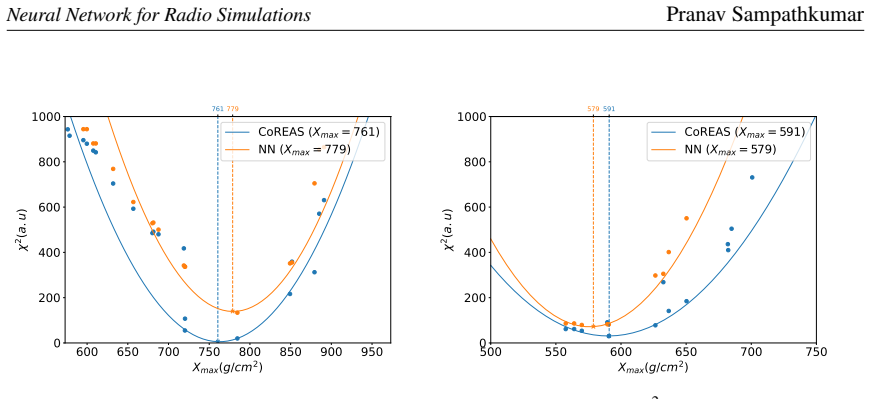
The paper's central claim is that radio pulses of extensive air showers can be generated by a trained neural network rather than by summing radiation from individual particle tracks, and that the generated pulses carry enough physical fidelity for $X_\mathrm{max}$ reconstruction. Trained on roughly 58,000 CoREAS simulations of AERA events (2158 shower configurations with 27 iterations each), the network reproduces 30–80 MHz radio pulses in both polarisations, with fluences that mostly match CoREAS within 10 percent and high pulse-wise correlation for strong signals. Running the same fluence-based $\chi^2$ reconstruction against both simulation types, the network gives $X_\mathrm{max}$ resolutions of $37.5$–$39.6\ \mathrm{g\,cm^{-2}}$ at 5–10 percent noise, compared with $30.7$–$31.6\ \mathrm{g\,cm^{-2}}$ for CoREAS, with comparable bias behaviour. The paper concludes that neural-network simulation is a viable tool for radio air-shower analyses and can be fine-tuned to other experiments and frequency bands.
Load-bearing premise
The demonstration assumes CoREAS Monte Carlo output is the true radio signal, since the network is trained on CoREAS pulses and benchmarked against CoREAS reconstructions; if CoREAS's emission model is biased for AERA conditions, the comparable resolution may not carry over to measured events.
Editorial extensions
If this is right
- Radio pulse simulation drops from per-event Monte Carlo runs to milliseconds per antenna, removing the main computational bottleneck in iterating over noisy radio measurements.
- $X_\mathrm{max}$ reconstruction on network pulses matches the resolution of full CoREAS-based reconstruction within the AERA training phase space, enabling fast analyses of many simulated event iterations.
- Because the network is small (about 4 million parameters, 19 MB footprint), it could run on FPGAs for near-instant pulse generation and triggering.
- The network is differentiable, so it can be combined with gradient-based inference frameworks such as Information Field Theory.
- Adding inputs such as the full longitudinal shower profile could extend the same setup to reconstructing the longitudinal development of air showers.
Reading between the lines
- If CoREAS's radio-emission model is biased under real AERA atmospheric conditions, the demonstrated comparable resolution may not transfer to measured events; the direct test is applying the network to real data with independently known $X_\mathrm{max}$ values.
- Because the training library follows AERA's measured phase-space distribution, the model is most reliable for typical events, while rare geometries and showers with $X_\mathrm{max}$ above $1000\ \mathrm{g\,cm^{-2}}$ need resampling or dedicated training sets.
- A waveform-generating model may support observables beyond fluence-based $X_\mathrm{max}$, such as pulse timing, width, or asymmetry, since the network outputs full pulses rather than summary statistics.
Editorial analysis
A structured set of objections, weighed in public.
Referee Report
Summary. This paper presents a fully connected neural network trained on ~58k CoREAS simulations (2158 shower parameter sets times 27 iterations) to predict 30-80 MHz radio pulses at 240 star-shaped antenna positions for AERA-like geometries. The authors evaluate the surrogate on a held-out 20% of the simulations, comparing pulse shapes, energy fluence, pulse correlations, and a fluence-based Xmax reconstruction against per-event CoREAS simulations. They report fluence agreement within roughly 10% for strong pulses and Xmax resolutions of about 37-40 g/cm2 for the network versus 31-32 g/cm2 for CoREAS at 5-10% noise, concluding that the neural network can serve as a fast surrogate for radio-emission simulation in this phase space.
Significance. If the evaluation is performed on showers whose full parameter sets were excluded from training, the paper is a useful proof of concept: a compact fully connected regressor can reproduce CoREAS pulse shapes and support a downstream Xmax reconstruction at a resolution close to, albeit somewhat worse than, full Monte Carlo, with much faster inference. The authors are appropriately explicit about the limited phase space, the AERA-specific atmosphere and frequency band, and the degradation beyond Xmax = 1000 g/cm2. The main risk is that the reported test performance may not measure generalization to unseen shower parameters, because the paper does not state that the train/test split was grouped by the 2158 underlying parameter sets.
major comments (3)
- [Section 2] The data split is not defined at the correct level. The library consists of 2158 shower parameter sets, each with 27 iterations, but the text says only that '80% of the simulations are used for training and the remaining 20% are used for testing.' If the split is made per CoREAS run, a typical test run will have 26 other iterations of the identical parameter set (same Xmax, energy, zenith, azimuth, and GDAS atmosphere) in the training sample, and because all of these quantities are explicit network inputs, the model has already been trained on the exact input vector. The pulse correlations in Figure 5 and the Xmax resolution comparison in Figure 7 and Table 1 would then measure reproduction of known parameter points rather than generalization to new showers. Please state explicitly that the split was performed on the 2158 parameter sets (or otherwise demonstrate test independence), and if it was not, repeat the evaluation with a grouped split.
- [Section 4.4 / Table 1] Table 1 reports total bias and resolution as single numbers with no statistical uncertainties, and Figure 7 shows no confidence bands. The sampling is not described beyond 'N=2000 simulations,' and it is not stated how these events relate to the training and test sets. The table shows network resolutions of 39.6 and 37.5 g/cm2 versus CoREAS resolutions of 31.6 and 30.7 g/cm2 at 5% and 10% noise, i.e., about 22-25% worse. The abstract's phrase 'comparable resolution' needs a quantitative justification and an uncertainty estimate; as written, the reader cannot tell whether these differences are statistically significant.
- [Sections 3 and 4] The network is deterministic: for a fixed input vector it always returns the same pulse, whereas the 27 CoREAS iterations at fixed shower parameters are stochastic realizations. The paper does not state whether the surrogate is intended to reproduce only the conditional mean pulse or also the event-by-event fluctuation distribution. This matters for the Xmax benchmark, because chi2 templates generated by the network cannot include shower-to-shower fluctuations that are present in CoREAS templates, and it also bears on the interpretation of the pulse-level correlations in Section 4.2. Please discuss this limitation and its effect on the reported resolution.
minor comments (6)
- [Eq. (1)] Please define P_ant and P_sim; the S^2 factor in Eq. (1) is inconsistent with the statement that S accounts for multiplicative deviations between fluence measurements and simulations.
- [Section 4.3] The noise model is not fully specified: the width of the Gaussian multiplicative noise is not given, and the additive noise is quoted as '1 muV/m^2' although fluences are in eV/m^2; please state the units and all noise parameters.
- [Section 2] Please report the criterion and fraction of weak pulses removed as dominated by thinning artifacts; this affects the training distribution and the comparability of the network output with full CoREAS pulses.
- [Figure 5] The vertical axis label 'N.Coorelation bw Pulses' contains typos; 'bw' should be 'between' and 'Coorelation' should be 'Correlation'.
- [Section 4.1] The pulse comparison in Figure 3 is qualitative; please state explicitly whether the events shown in Figures 3-5 are drawn from the held-out test set.
- [Section 3] The model is called 'generative,' but it is a deterministic function without a latent stochastic source; consider using 'surrogate' or 'emulator' in the title and text to avoid overstating the generative aspect.
Circularity Check
No circular derivation: the network is a CoREAS emulator evaluated on held-out CoREAS pulses; internal validation against the training simulator is a benchmark limitation, not a circular step.
full rationale
The paper claims that a neural network can simulate radio pulses and be used for Xmax reconstruction with resolution comparable to CoREAS. This is a surrogate-model claim, not a first-principles derivation. The network is trained on CoREAS pulses and tested on held-out CoREAS pulses; measuring fidelity against the same simulator that generated the training data is the standard and appropriate benchmark for an emulator, not a circular reduction. The Xmax reconstruction treats Xmax as an unknown scanning parameter and uses the network as a forward simulator in a chi-square template fit; because Xmax is an input to the network but is not supplied as truth during reconstruction, the procedure is a genuine inversion rather than a definitional identity. No load-bearing self-citation chain is present: the CoREAS citation defines the target simulator, and prior neural-network work is background. The only substantive concern is the ambiguity in the train/test split: the library has 2158 shower parameter sets with 27 iterations each, and the text says only that '80% of the simulations are used for training and the remaining 20% are used for testing.' If the split is at the level of individual runs rather than grouped by parameter set, test performance could be inflated by memorization. However, the paper does not state the split strategy, so under the hard rules this remains an unverified risk rather than an exhibited circular step. No quoted equation or described step makes an output equal to an input by construction, so the circularity score is low.
Assumptions & free parameters
free parameters (4)
- Neural network weights (~4 million) =
Trained on the CoREAS AERA library
- Loss weighting for v*v*B polarization =
Not specified numerically
- Input scaling nominal values =
Not specified
- Reconstruction noise model parameters =
5% and 10% multiplicative Gaussian noise, 1 uV/m^2 additive noise
assumptions (4)
- domain assumption CoREAS radio-emission simulations are an accurate ground truth for AERA radio pulses
- domain assumption The AERA simulation library's phase-space distribution is representative of events the network will see
- ad hoc to paper Weak pulses dominated by thinning artifacts can be removed without losing physical information
- ad hoc to paper A fully connected network with 11 scalar inputs can represent the position- and geometry-dependent pulse shape
Cite this review
Pith. "Pith review of Generative Neural Network for Simulating Radio Emission from Extensive Air Showers." pith.science (2026). https://pith.science/paper/SHKK62Z7
@misc{pith2026250707713,
  author       = {Pith},
  title        = {Pith review of: Generative Neural Network for Simulating Radio Emission from Extensive Air Showers},
  year         = {2026},
  howpublished = {\url{https://pith.science/paper/SHKK62Z7}},
  note         = {Machine review of arXiv:2507.07713}
}
abstract
Cosmic ray shower detection using large radio arrays has gained significant traction in recent years. With massive improvements in signal modelling and microscopic simulations, the analysis of incoming events is still severely limited by the simulation cost of radio emission to interpret the data. In this work, we show that a neural network can be used for simulating such radio pulses. We also demonstrate how such a neural network can be used for $X_\mathrm{max}$ reconstruction, while retaining comparable resolution to using full Monte-Carlo CORSIKA/CoREAS simulations for radio emission.
Figures


Figures from the paper (4 more)



Reference graph
Works this paper leans on
-
[1]
Benjamin Fuchs,NIM in Physics Research A 692(2012) 93
work page 2012
- [2]
- [3]
-
[4]
IceCube-Gen2collaboration, R. Abbasi et al. ,IceCube-Gen2 Technical Design Report, Part III, 2024
work page 2024
-
[5]
Windischhofer inPoS(ICHEP2024), vol
P. Windischhofer inPoS(ICHEP2024), vol. 476, p. 706, 2024, DOI
work page 2024
-
[6]
de Mello Neto inPoS(ICRC2023), ICRC2023, p
J.R. de Mello Neto inPoS(ICRC2023), ICRC2023, p. 1050, Aug., 2023, DOI
work page 2023
-
[7]
Pierre Augercollaboration, Phys. Rev. D 109(2024) 022002
work page 2024
- [8]
Show all 24 references
-
[9]
Sampathkumar, T
P. Sampathkumar, T. Pierog et al. inPoS(ICRC2023), vol. 444, p. 515, 2023, DOI
2023
- [10]
-
[11]
Corstanje, S
A. Corstanje, S. Buitink et al.Journal of Instrumentation 18 (2023) P09005
2023
-
[12]
Huege, M
T. Huege, M. Ludwig et al.AIP Conference Proceedings 1535(2013) 128
2013
-
[13]
D. Heck, J. Knapp et al. ,CORSIKA: A Monte Carlo code to simulate extensive air showers , (1998)
1998
-
[14]
Ostapchenko, Nuclear Physics B - Proceedings Supplements 151(2006) 143
S. Ostapchenko, Nuclear Physics B - Proceedings Supplements 151(2006) 143
2006
-
[15]
Abreu, M
P. Abreu, M. Aglietta et al.Astroparticle Physics 35 (2012) 591
2012
-
[16]
Mitra, A
P. Mitra, A. Bonardi et al.Astroparticle Physics 123(2020) 102470
2020
-
[17]
Stiben,Bachelor’s thesis, KIT, 2025
D. Stiben,Bachelor’s thesis, KIT, 2025
2025
- [18]
-
[19]
Paszke, S
A. Paszke, S. Gross et al. inAdvances in Neural IPS 32, pp. 8024–8035, Curran Associates, Inc. (2019)
2019
-
[20]
Harris, K.J
C.R. Harris, K.J. Millman et al.Nature 585(2020) 357
2020
-
[21]
Alves Junior, N
A.A. Alves Junior, N. Karastathis et al. inPoS(ICRC2023), vol. 444, p. 469, 2023, DOI
2023
-
[22]
Karastathis, S
N. Karastathis, S. Buitink et al. inPoS(ICRC2023), vol. 444, p. 487, 2023, DOI
2023
-
[23]
J. Li, C. Zhang et al. in2024 International Conference on EDPEE, pp. 192–194, 2024, DOI
2024
-
[24]
Watanabe et al
K. Watanabe et al. inPoS(ICRC2025)436, 2025. 8
2025
Reviewed August 6, 2026 · model on record in the stance chip above.
Discussion (0). Continue with ORCID to comment.