REVIEW 4 major objections 4 minor 15 references
Network Reconnaissance and Vulnerability Excavation of Secure DDS Systems
T0 review · 4 major / 4 minor · reviewed 2026-08-14 · deepseek-v4-flash
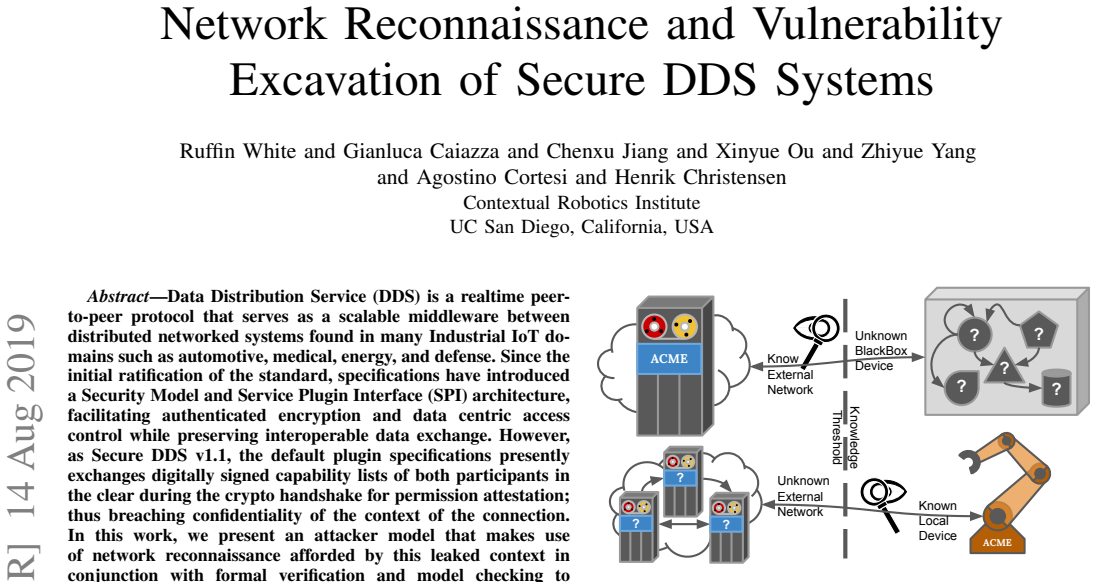
Pith's one-line read Secure DDS's authentication handshake sends each device's signed permission list in cleartext, letting a passive listener map and selectively cut data flows.
desk verdict Real protocol leak with a useful formal verification pipeline, but the evaluation oversells actual-flow disruption when the graph only knows permitted flows. read the letter →
The pith
A machine-rendered reading of the paper's core claim, the machinery that carries it, and where it could break.
The reading
What carries the argument
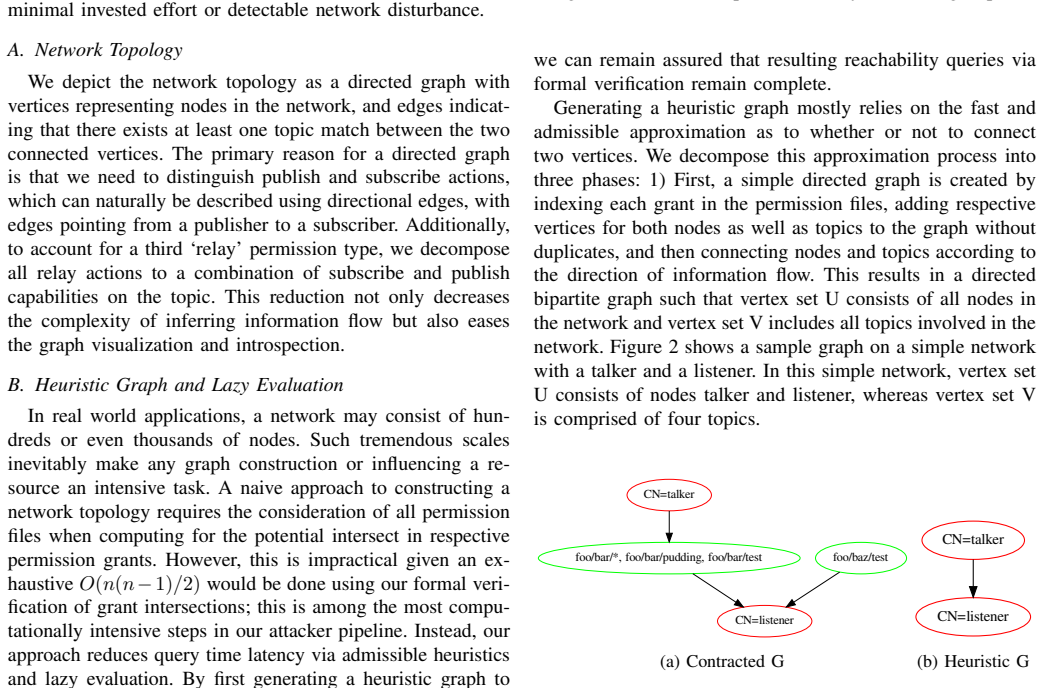
The load-bearing mechanism is the Domain Participant Permission token, the signed XML capability list that Secure DDS v1.1 sends verbatim during the authentication handshake, combined with a reconstruction-and-verification pipeline. The paper models DDS access-control evaluation as functional programs in a formal model-checking environment, turns 'can node A publish a topic that node B subscribes to' into a satisfiability query over permission grants, and uses a heuristic directed graph over topics connected by POSIX fnmatch to keep the number of expensive intersection checks small. The graph's bipartite construction, topic-component collapse, and lazy edge verification carry the argument from raw packet capture to provable reachability and minimal cut sets.
What would settle it
Run a clean-room capture of a Secure DDS v1.1 handshake between two compliant implementations and inspect the authentication request bytes for the Domain Participant Permission XML; if the token is absent, encrypted, or split behind a secure channel, the paper's central leak claim is false. The reachability results could also be checked by replaying the same captured permissions and asking whether the produced graph matches the actual system.
Extended reading notes
Core claim
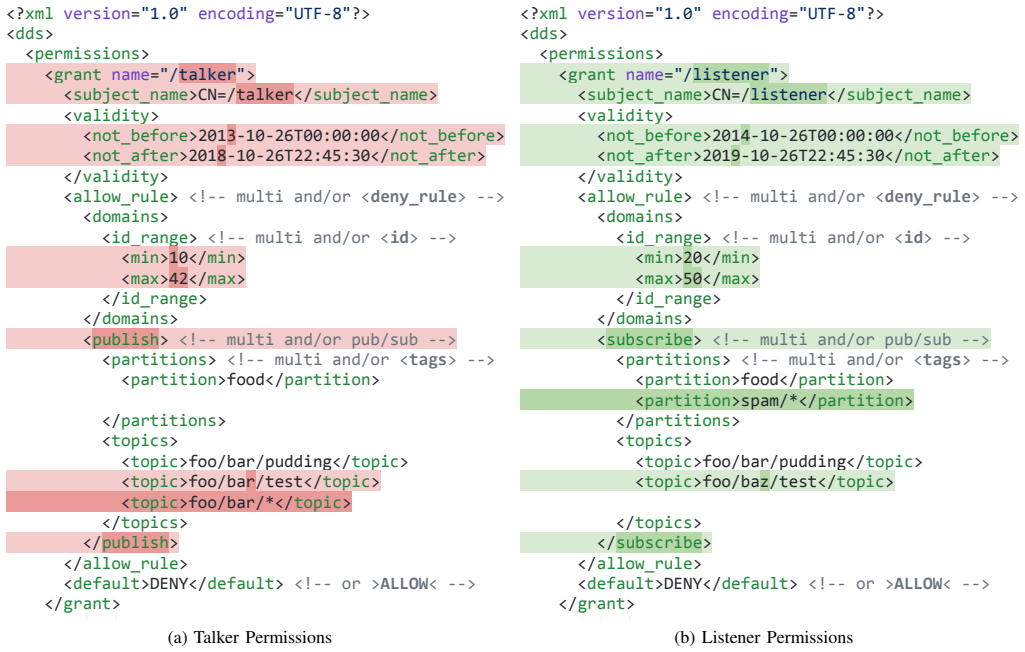
The central claim is that Secure DDS v1.1's default security plugin leaks the permissions of every DomainParticipant during the handshake phase. A DomainParticipant is a DDS node that publishes or subscribes in a domain, and its Domain Participant Permission token, an XML grant document signed by the Permissions CA, is exchanged in cleartext as part of the authentication handshake; the signature only prevents forgery, not disclosure. Because the document names concrete topics, partitions, data tags, and validity windows, a passive observer can reconstruct which participants can write to or read from which data objects. The paper argues this leaked context of the connection defeats the confidentiality of the overall system design, and demonstrates a pipeline that reconstructs a directed data-flow graph, verifies reachability between arbitrary participants with model checking, and computes minimum vertex cuts that selectively isolate information flow. It further uses the formal model to expose two deviations in a vendor implementation: a missing partition-permission check and reversed argument order in topic-expression matching.
Load-bearing premise
The attack's load-bearing premise is that the attacker can observe the DDS handshake traffic at all; if the whole link is wrapped in a VPN, tunnel, or other encryption, the plaintext permission token never reaches the attacker and the reconnaissance pipeline lacks its raw material.
Editorial extensions
If this is right
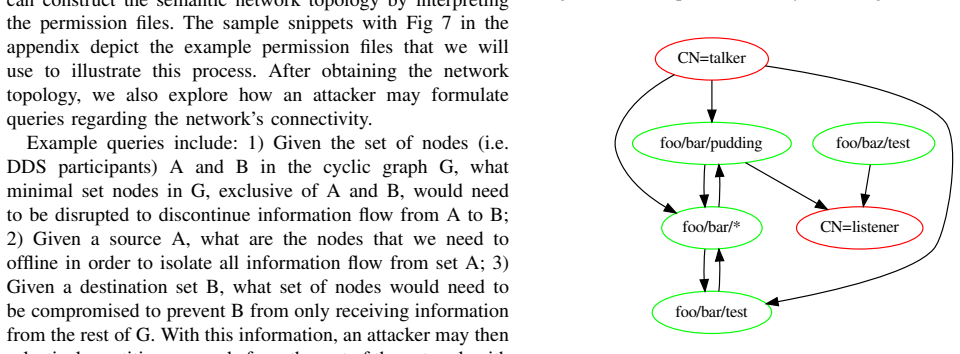
- An attacker who only records network traffic can build a directed map of who may publish and subscribe to each topic, without ever decrypting application data.
- Formal verification turns captured permissions into provable answers to reachability queries: given two participants, the attacker can decide whether any admissible data path exists.
- Minimum cut-set computation gives the attacker a precise list of nodes to disrupt in order to isolate a publisher from all subscribers or cut a target off from incoming data.
- The same formal model can audit vendor implementations; it already exposed two real deviations from the Secure DDS specification.
- Moving permission-token exchange into the secure channel after the crypto handshake, or obfuscating topic expressions with digests, would blunt but not eliminate the leak, because predictable topic names make digest brute-force feasible.
Reading between the lines
- The authors leave implicit that the same plaintext permissions enable fingerprinting of deployed software stacks: predictable topic namespaces used by robotics and automotive middleware let an observer identify unpatched or vulnerable components before any active step.
- A testable extension would apply the same graph-reconstruction pipeline to partial observations of a live system, quantifying how few handshake captures are needed before the reachability answers stabilize.
- If the permission token is moved behind a secure channel, the paper's own analysis implies a single compromised or malicious participant can still scrape the permissions of everyone else it talks to, so the confidentiality problem shifts rather than disappears.
- The zero-knowledge attestation direction suggests a concrete design target: a participant should be able to prove that its permission set contains a topic matching a request without revealing the rest of its grants; implementing that for fnmatch expression classes is the open problem.
Signed reviews
Editorial analysis
A structured set of objections, weighed in public.
Referee Report
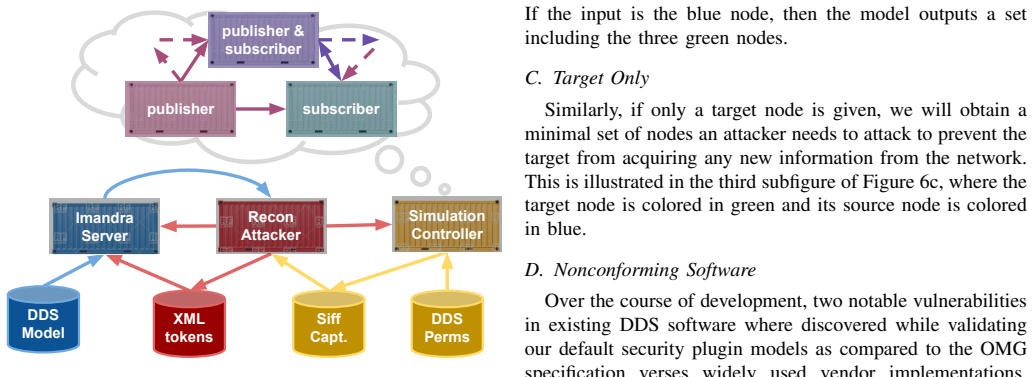
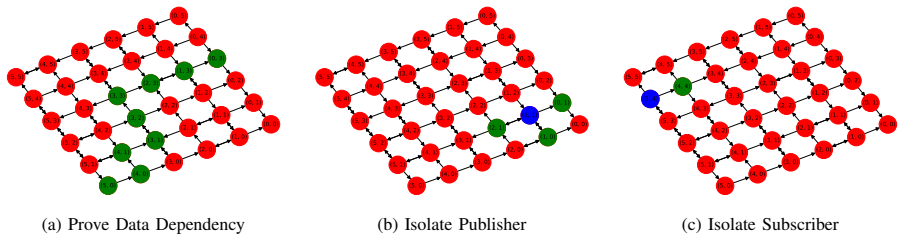
Summary. The paper identifies a confidentiality weakness in the OMG Secure DDS v1.1 default security plugin: during the authentication handshake, the signed Domain Participant Permission files are exchanged in cleartext, allowing a passive network observer to recover each participant's permitted topics, partitions, and data tags. Building on this leak, the authors propose an attack pipeline that constructs a directed graph of permitted publish/subscribe relationships, uses the Imandra formal verification tool with an OCaml model of the DDS access-control logic to verify permissive intersections, and answers reachability and 'minimal node set' queries for selective denial-of-service and adversarial partitioning. The paper describes a Docker-based test harness, demonstrates three queries on a synthetic 36-node grid, and reports two vendor implementation bugs found during validation, along with a discussion of potential mitigations.
Significance. If the cleartext permission-leak observation is correct, this is a genuine and previously underappreciated confidentiality gap in Secure DDS, and the paper's reconnaissance primitive is a useful contribution to the security analysis of industrial IoT middleware. The use of a formal verifier with an OCaml model of the access-control logic is a strength, as is the reproducible test harness, and the paper is honest about the environmental precondition that the attacker needs access to DDS network traffic. However, the operational significance is currently overstated: the reconstructed graph is a permission-based upper bound on data flow, not a record of actual information flow, and the experimental validation on a single synthetic grid does not yet support the paper's scaling and minimality claims.
major comments (4)
- [§IV-A, §IV-C, §V] The graph constructed from permission files describes permitted communication, not actual information flow. Edges are added whenever a publish-side topic expression and a subscribe-side expression both satisfy the access-control rules, and the formal check in Eqs. (1)–(3) only establishes that such a permissive pair of subject instances exists. The evaluation in Section V removes this distinction by using broadcast nodes that publish to every permitted topic and relay every subscribed message, so the validation does not support the Section VI claims about isolating information flow in a real deployment. The authors should either reframe the contribution as permission-topology recovery or quantify the overapproximation against deployments where endpoints use a subset of their permissions.
- [§VI] The experimental validation is too thin for the paper's claims. Only three illustrative queries on one synthetic 36-node grid are reported, with no quantitative accuracy or completeness measures, no running-time or SAT-query counts, no comparison against a baseline such as exhaustive enumeration of grant intersections, and no verification that the returned node sets are actually minimal. The 'minimal set' queries in Sections VI-B and VI-C also lack a formal problem definition and an algorithm description. This is load-bearing because the paper promises efficient, arbitrarily scalable reasoning about network topology.
- [§IV-B] The claim that 'resulting reachability queries via formal verification remain complete' is asserted without proof. Since the topic-collapsing step can merge topics that only match through a chain of pairwise intersections, the heuristic graph can contain paths that are not permissive, and it is not immediately obvious no permissive path is lost. Please state and prove the invariant that every permissive path in the original bipartite graph is preserved in the collapsed heuristic graph, or provide a counterexample and revise the completeness claim.
- [§VI-D] The two vendor vulnerabilities are reported only by referencing GitHub issues; no wire-level evidence, minimal triggering permission files, or reproduction steps are given. If 'vulnerability excavation' is part of the paper's contribution, these findings need to be substantiated in the manuscript or explicitly labeled as preliminary external reports rather than results of this work.
minor comments (4)
- [§IV-C, Eq. (3)] The disjunct repeats Match(ActA, ActB); it should presumably be Match(ActA, ActB) OR Match(ActB, ActA) to model directed information flow between two participants.
- [§VI and Fig. 6] The caption for Fig. 6 appears inconsistent with the text: the text says the source-only query prevents the source from passing data to its subscribers, while the caption says 'isolate incoming data'; please align the descriptions.
- [§V] The experimental setup should report the number of nodes and containers, the duration of the captured traffic, the number of permission tokens extracted, and whether all handshake messages were captured; this would help readers judge the practicality of the reconnaissance step.
- [§II-B] Please clarify exactly which handshake message carries the plaintext permission token and cite the relevant section of the Secure DDS specification, since this is the foundation of the entire attack.
Circularity Check
No load-bearing circularity: the handshake leak is grounded in the public DDS Security v1.1 specification and an OMG issue; self-citations are not load-bearing, and the topology-from-permissions step is an intended computation, not a hidden fit.
full rationale
The central claim, that Secure DDS v1.1 default plugins exchange signed Domain Participant Permission files in cleartext during the handshake, is anchored in the public OMG specification and the OMG issue DDSSEC12-13, not in the authors' own prior results. The graph construction in Section IV-A is explicitly defined as edges indicating 'at least one topic match between the two connected vertices' from the leaked permission documents, so the inferred topology is a direct computation from the captured tokens rather than a prediction fitted to an independent target. The reachability verification in Section IV-C checks permission intersections using an OCaml/Imandra model whose assumptions are stated and do not include the target result. The authors self-cite their earlier provisioning framework [10] and a ROS security chapter [14], but these appear only in related/future-work contexts and do not carry the main argument. The main qualification is that the paper labels permission-derived potential connectivity as 'data flow' or 'information flow' topology, and the experimental validation uses broadcast nodes that publish and relay on every permitted topic, so actual traffic coincides with permitted traffic by construction; this limits operational generalization but is a scope limitation, not a circular derivation. Overall the paper's load-bearing derivation is self-contained and externally grounded, so no significant circularity is found.
Assumptions & free parameters
assumptions (4)
- domain assumption The DDS Security v1.1 access control evaluation logic is correctly encoded in the OCaml model used with Imandra (Algorithm 1).
- domain assumption An attacker can passively capture the DDS security handshake messages containing the plaintext permission token.
- domain assumption The heuristic graph is an admissible overapproximation of true data flow connectivity (no false negatives).
- domain assumption The KeepAlive relay test harness faithfully represents information flow semantics in the simulated network.
Cite this review
Pith. "Pith review of Network Reconnaissance and Vulnerability Excavation of Secure DDS Systems." pith.science (2026). https://pith.science/paper/SHL7AHNQ
@misc{pith2026190805310,
  author       = {Pith},
  title        = {Pith review of: Network Reconnaissance and Vulnerability Excavation of Secure DDS Systems},
  year         = {2026},
  howpublished = {\url{https://pith.science/paper/SHL7AHNQ}},
  note         = {Machine review of arXiv:1908.05310}
}
read the original abstract
Distribution Service (DDS) is a realtime peer-to-peer protocol that serves as a scalable middleware between distributed networked systems found in many Industrial IoT domains such as automotive, medical, energy, and defense. Since the initial ratification of the standard, specifications have introduced a Security Model and Service Plugin Interface (SPI) architecture, facilitating authenticated encryption and data centric access control while preserving interoperable data exchange. However, as Secure DDS v1.1, the default plugin specifications presently exchanges digitally signed capability lists of both participants in the clear during the crypto handshake for permission attestation; thus breaching confidentiality of the context of the connection. In this work, we present an attacker model that makes use of network reconnaissance afforded by this leaked context in conjunction with formal verification and model checking to arbitrarily reason about the underlying topology and reachability of information flow, enabling targeted attacks such as selective denial of service, adversarial partitioning of the data bus, or vulnerability excavation of vendor implementations.
Figures

Figures from the paper (4 more)
Reference graph
Works this paper leans on
-
[1]
About the Data Distribution Service Specification Version 1.4 , Object Management Group, 04 2015
work page 2015
-
[2]
About the Data Distribution Service Security Specification Version 1.1 , Object Management Group, 07 2018
work page 2018
-
[3]
An empirical approach to economic intelli- gence in world war ii,
R. Ruggles and H. Brodie, “An empirical approach to economic intelli- gence in world war ii,” Journal of the American Statistical Association , vol. 42, no. 237, pp. 72–91, 1947
work page 1947
-
[4]
Hacking exposed: network security secrets and solutions,
S. McClure, J. Scambray, G. Kurtz, and Kurtz, “Hacking exposed: network security secrets and solutions,” 2009
work page 2009
-
[5]
Nethide: secure and practical network topology obfuscation,
R. Meier, P. Tsankov, V . Lenders, L. Vanbever, and M. Vechev, “Nethide: secure and practical network topology obfuscation,” in 27th {USENIX} Security Symposium ( {USENIX} Security 18), 2018, pp. 693–709
work page 2018
-
[6]
D. A. Ignatovich and G. O. Passmore, Creating Safe and Fair Markets , AESTHETIC INTEGRATION, LTD., 02 2015
work page 2015
-
[7]
Gear 2030 - high level group - final report,
D. GROW, “Gear 2030 - high level group - final report,” 2017
work page 2017
-
[8]
Publish/subscribe- enabled software defined networking for efficient and scalable iot communications,
A. Hakiri, P. Berthou, A. Gokhale, and S. Abdellatif, “Publish/subscribe- enabled software defined networking for efficient and scalable iot communications,” IEEE communications magazine , vol. 53, no. 9, pp. 48–54, 2015
work page 2015
Show all 15 references
-
[9]
Using positive tainting and syntax-aware evaluation to counter sql injection attacks,
W. G. Halfond, A. Orso, and P. Manolios, “Using positive tainting and syntax-aware evaluation to counter sql injection attacks,” in Proceedings of the 14th ACM SIGSOFT international symposium on Foundations of software engineering. ACM, 2006, pp. 175–185
2006
-
[10]
Procedurally provisioned access control for robotic systems,
R. White, G. Caiazza, H. I. Christensen, and A. Cortesi, “Procedurally provisioned access control for robotic systems,” in 2018 IEEE/RSJ International Conference on Intelligent Robots and Systems (IROS) , Oct 2018, pp. 1–9
2018
-
[11]
Bloom filter-based discovery protocol for dds middleware,
J. Sanchez-Monedero, J. Povedano-Molina, J. M. Lopez-Vega, and J. M. Lopez-Soler, “Bloom filter-based discovery protocol for dds middleware,” Journal of Parallel and Distributed Computing , vol. 71, no. 10, pp. 1305 – 1317, 2011. [Online]. Available: http://www.sciencedirect.co...
2011
-
[12]
Node discovery scheme of dds using dynamic bloom filters,
M. R. Khaefi and D. Kim, “Node discovery scheme of dds using dynamic bloom filters,” in Proceedings of the 2014 IEEE Emerging Technology and Factory Automation (ETFA), Sept 2014, pp. 1–4
2014
-
[13]
Formal analysis of xacml policies using smt,
F. Turkmen, J. den Hartog, S. Ranise, and N. Zannone, “Formal analysis of xacml policies using smt,” Computers and Security, vol. 66, pp. 185– 203, 5 2017
2017
-
[14]
Caiazza, R
G. Caiazza, R. White, and A. Cortesi, Enhancing Security in ROS: Volume Eight, 01 2019, pp. 3–15
2019
-
[15]
Snarks for c: Verifying program executions succinctly and in zero knowledge,
E. Ben-Sasson, A. Chiesa, D. Genkin, E. Tromer, and M. Virza, “Snarks for c: Verifying program executions succinctly and in zero knowledge,” in Advances in Cryptology – CRYPTO 2013, R. Canetti and J. A. Garay, Eds. Berlin, Heidelberg: Springer Berlin Heidelberg, 2013, pp. 90–1...
2013
Reviewed August 14, 2026 · model on record in the stance chip above.
Discussion (0). Continue with ORCID to comment.