REVIEW 3 major objections 4 minor 89 references
Coulomb Drag in Altermagnets
T0 review · 3 major / 4 minor · reviewed 2026-08-11 · deepseek-v4-flash
Pith's one-line read A bilayer of d-wave altermagnets should show Hall drag and spin Hall drag without any spin-orbit coupling, with orientation-angle dependences that serve as fingerprints of the spin-split Fermi surfaces.
desk verdict A genuinely new proposal for probing altermagnetic spin splitting with Coulomb drag, but the quantitative drag calculation rests on a diffusive polarization that is unjustified in the plotted parameter regime. read the letter →
The pith
A machine-rendered reading of the paper's core claim, the machinery that carries it, and where it could break.
The reading
What carries the argument
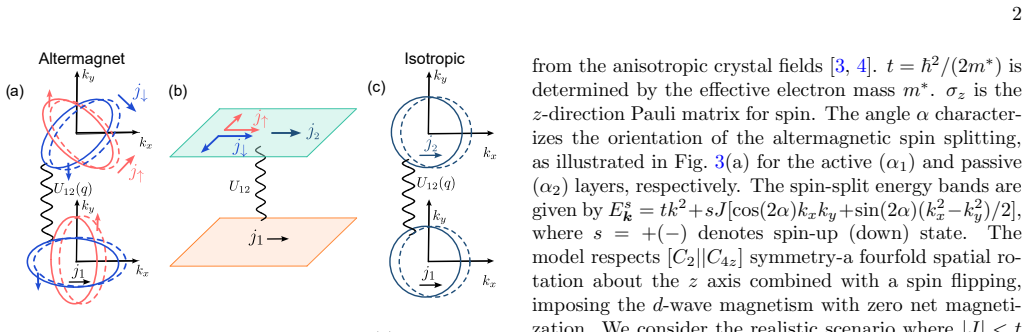
The argument is carried by the d-wave altermagnet model used for each layer, $H(k)=tk^2+J[\cos(2\alpha)k_xk_y+\sin(2\alpha)(k_x^2-k_y^2)/2]\sigma_z$, where $J$ is the altermagnetic exchange and $\alpha$ sets the orientation of the spin splitting. The velocity shift $v^{(\ell)}_{q}=v^{(\ell)}_{k+q}-v^{(\ell)}_{k}$ in this model has longitudinal and transverse parts whose magnitudes depend on $\alpha_\ell$ and on spin. Inserting this velocity shift into the drag resistivity formula $\rho^{ij}_D\propto\int d^2q\,d\omega\,|U_{12}(q)|^2\Gamma^i_1\Gamma^j_2/\sinh^2(\beta\omega/2)$, with nonlinear susceptibilities $\Gamma_\ell=-2\tau\,v^{(\ell)}_q\operatorname{Im}\Pi^R_\ell/\hbar$ and polarization $\Pi^R_\ell=(1+i\omega\tau/\hbar)/(2\pi\sqrt{4t^2-J^2})$, makes the transverse and spin components arise from the $J$-dependent part of $v_q$. The common prefactor $F_T\propto (k_BT)^2\varepsilon^2\tau^2(4t^2-J^2)^2/(\hbar e^6 d^6\mu_1\mu_2 t^2)$ collects the temperature, screening, interlayer distance, and chemical-potential dependence.
What would settle it
Measure the transverse drag voltage in a RuO2-based bilayer with $d\approx 12$ nm at $T\approx 2$ K while rotating the active-layer crystal orientation $\alpha_1$ relative to a spin-polarized drive current; the predicted Hall drag is proportional to $\cos(2\alpha_1)$ and changes sign at $\alpha_1=\pi/4$. A null result at all angles, or a modulation with the wrong period, would falsify the central claim.
Extended reading notes
Core claim
The central claim is that in a bilayer of two d-wave altermagnets separated by a dielectric, the Coulomb drag resistivity acquires transverse and spin-dependent components controlled by the altermagnetic exchange strength $J$ and the orientation angles $\alpha_1,\alpha_2$ of the two layers' spin-split Fermi surfaces. Starting from the minimal model $H(k)=tk^2+J[\cos(2\alpha)k_xk_y+\sin(2\alpha)(k_x^2-k_y^2)/2]\sigma_z$, the authors derive the analytic drag resistivities of Table I and show that the Hall drag of a fully spin-polarized drive is $\rho^{\uparrow}_{\mathrm{HD}}=4tJF_T\cos(2\alpha_1)$, so it is nonzero only when $J\neq 0$ and requires no spin-orbit coupling. The spin Hall drag voltage $V^s_{2y}\propto J F_T[\cos(2\alpha_1)+\eta J\sin(2\alpha_1+2\alpha_2)]$, with $\eta$ the spin polarization of the drive, survives even for an unpolarized driving current. All these signals are periodic in the orientation angles, which is what makes them usable as transport signatures of altermagnetism.
Load-bearing premise
The calculation assumes the electron layers respond in the diffusive regime, meaning the momentum transferred between layers is small compared with the inverse electron mean free path; outside that regime the simplified polarization used for the drag resistivities would need to be replaced by the full momentum-dependent response.
Editorial extensions
If this is right
- A spin-polarized driving current produces a transverse (Hall) drag voltage proportional to $\eta J F_T\cos(2\alpha_1)$, so the Hall drag is a direct test for nonzero altermagnetic exchange $J$ in the absence of spin-orbit coupling.
- The longitudinal drag voltage $V_{2x}\propto F_T[2t^2+\eta\, tJ\sin(2\alpha_1)]$ is $\pi$-periodic in the crystal orientation $\alpha_1$, which gives an orientation signature in a simple measurement.
- An unpolarized driving current still induces a spin Hall drag voltage proportional to $J F_T\cos(2\alpha_1)$, so the effect does not need ferromagnetic injection contacts.
- Since the angle period is $\pi$ for d-wave, $\pi/2$ for g-wave, and $\pi/3$ for i-wave altermagnets, Coulomb drag could distinguish the symmetry class of the altermagnetic order, as the paper notes.
- The dependence on both $\alpha_1$ and $\alpha_2$ through $\alpha_1\pm\alpha_2$ means the relative crystallographic alignment of the two layers can be read from the dragging signal.
Reading between the lines
- The paper does not emphasize that forming the ratio of Hall drag to longitudinal drag would cancel the common prefactor $F_T$; such a ratio would isolate $J/t$ and could make the signature robust to uncertainties in density, dielectric constant, and scattering time.
- A natural follow-up device would rotate the passive layer's crystal orientation in situ and record the transverse voltage; the predicted sign change under a $90^\circ$ rotation of $\alpha_1$ could be verified in one multiterminal sample.
- The authors' symmetry argument also implies that a normal-metal active layer with spin-polarized current should drag a transverse signal into an altermagnet passive layer, which would extend the probe to heterostructures without requiring altermagnet growth in both layers.
- Measuring the drag signal at several temperatures would discriminate the predicted $T^2$ diffusive drag from phonon- or magnon-mediated drag mechanisms that scale differently with temperature.
Editorial analysis
A structured set of objections, weighed in public.
Referee Report
Summary. The manuscript proposes Coulomb drag as an experimental probe of altermagnetism. The authors study a bilayer of two-dimensional d-wave altermagnets, modeled by a minimal quadratic Hamiltonian with a momentum-dependent spin splitting (Eq. 1), and compute the drag resistivities using the Aslamazov–Larkin diagrammatic formalism (Eq. 2, Fig. 3). They derive analytic expressions for longitudinal, Hall, and spin Hall drag resistivities (Table I) and show that the transverse components are proportional to the altermagnetic exchange coupling J and vanish for J=0, implying Hall drag without spin-orbit coupling. They further propose a multiterminal setup (Fig. 4) and identify angle dependences in α1 and α2 as signatures of altermagnetic spin-split Fermi surfaces.
Significance. If the results hold, the paper offers a non-contact transport signature for altermagnetic band splitting, which is timely given the ongoing controversy over candidate materials such as RuO2. The analytical treatment is complete and the proposed measurement scheme is concrete and falsifiable. The central advance—transverse drag generated by the intrinsic anisotropy of altermagnetic Fermi surfaces rather than by spin-orbit coupling—is an interesting and plausible idea that would be a valuable contribution to the altermagnetism literature. However, the quantitative predictions in Table I and Eqs. (6)–(8) rest on an uncontrolled approximation in the momentum integral, as detailed below, so the specific angle dependences and magnitudes are not yet established.
major comments (3)
- [Appendix B, Eq. (B8); Eq. (C6)] The q-independent, diffusive polarization Π_R(q,ω) = (1 + iωτ/ħ)/(2π√(4t²−J²)) is derived in Appendix B under the long-wavelength (q→0) limit and with an expansion in small ωτ (Eq. B7). Yet the final drag integral in Eq. (C6) integrates q from 0 to infinity without any restriction to q ≪ 1/d. The factor q²/sinh²(qd) is maximized near qd ≈ 1.5, so the integral is dominated by q ≈ 1/d. For the plotted parameters (d = 12 nm, τ = 10⁻¹⁰ s, v_F ≈ 6×10⁵ m/s), this implies q l ≈ q v_F τ ≈ 10³–10⁴, far outside the diffusive regime q l ≪ 1. In this collisionless regime the imaginary part of the polarization is of order νω/(v_F q), not νωτ/ħ, and it acquires q and angular dependence from the anisotropic Fermi surface. Because Eq. (C3) factors out the q-independent Im Π_R, the angular integrals that produce Table I and Eqs. (6)–(8) rely on an uncontrolled approximation. The reported angle signatures and magnitudes may be modified, weakened, or even reversed when a proper q- and angle-dependent polarization is used. The authors should either restrict the calculation to experimentally achievable parameters satisfying both q l ≪ 1 and q ≪ 1/d, or redo the derivation with the full polarization and show that the qualitative conclusions survive.
- [Main text, after Eq. (2); Appendix C] The manuscript states that the screened interaction U12(q) and the drag formula apply 'under the random phase approximation and q ≪ 1/d in the Boltzmann regime.' This condition is contradicted by the actual evaluation in Eq. (C6), which integrates over all q without any cutoff. The text should explicitly acknowledge that the q-integral samples the region qd ~ 1 and therefore the stated regime is violated. Either impose a momentum cutoff consistent with the diffusive approximation or justify the use of the full q range; otherwise the self-consistency of the derivation is not established.
- [Eq. (C3) and Table I] The nonlinear susceptibility Γ_ℓ is written as proportional to v_q^(ℓ) Im[Π_R(q,ω)]. For anisotropic Fermi surfaces, v_q^(ℓ) depends on the transferred momentum direction but not on the angle of k, which is why the angular integration over φ in Eq. (C6) can be done analytically. However, the correct nonlinear susceptibility involves an integral over the Fermi surface that also contains the energy denominator and the distribution functions; the factorization in Eq. (C3) is only valid if the polarization is q-independent in the relevant q range. Since that condition fails, the factorization itself is a load-bearing step. The authors should verify the factorization against a direct calculation of Γ_ℓ with the full Lindhard-type response for the altermagnetic model.
minor comments (4)
- [Reference [26]] The arXiv number in reference [26] appears as 'arXiv:408.00320', which is likely a typo for 'arXiv:2408.00320'.
- [Introduction, second paragraph] The phrase 'strongly dependent of the orientation' should be 'strongly dependent on the orientation'.
- [Fig. 4 caption] The labels ρCD, ρ↑CD, ρ↓CD in panels (e) and (f) are not explicitly defined in the caption; adding the spin-resolved definitions would improve readability.
- [Eq. (2) and Appendix B] The notation ω± = ω ± i0⁺ is introduced in the main text, but in Appendix B the analytic continuation is written as iω_m → ω + i0⁺; please ensure the sign convention is consistent throughout.
Circularity Check
No significant circularity: the drag resistivities are derived analytically from a standard altermagnet model and the standard Coulomb drag formalism, with no fitted parameters and no load-bearing self-citation.
full rationale
The derivation chain is self-contained. The starting Hamiltonian in Eq. (1) is the standard d-wave altermagnet model; although Ref. [43] is coauthored by S.-B. Zhang, the same model is independently cited in Refs. [3,4,7], so the self-citation is not load-bearing. Coulomb drag is evaluated with the standard diagrammatic formula, Eq. (2), and the nonlinear susceptibility is explicitly computed in Appendix C from the velocity shift v_q derived from the model, Eq. (C2), multiplied by Im of the retarded polarization. The q and omega integrals are then evaluated to produce Table I; no drag coefficient is fitted to data, and no parameter is renamed as a prediction. The transverse drag terms vanish when J=0, which is a derived consequence of the model, not an input. The main caveat, noted around Eq. (B8) and the momentum integral in Eq. (C6), is that the q-independent diffusive polarization is used for momenta q approximately 1/d, where the diffusive condition may fail for the plotted parameters; this is a validity and correctness concern for the numerical estimates, not a circularity, because the approximation does not encode the target angle dependences and the analytic derivation is exact within its stated assumptions. No circular step is identified.
Assumptions & free parameters
free parameters (5)
- J (altermagnetic exchange coupling) =
0.8t in figures
- tau (scattering time) =
10^-10 s in figures
- d (interlayer spacing) =
12 nm in figures
- alpha1 (active layer splitting orientation) =
varied
- alpha2 (passive layer splitting orientation) =
varied (pi/8 in figures)
assumptions (4)
- domain assumption d-wave altermagnet Hamiltonian H(k) = t k^2 + J[cos(2 alpha) kx ky + sin(2 alpha)(kx^2 - ky^2)/2] sigma_z (Eq. 1)
- standard math Standard Coulomb drag formula Eq. (2) from Aslamazov-Larkin diagrams
- ad hoc to paper q-independent diffusive polarization Pi_R = (1 + i omega tau / hbar) / (2 pi sqrt(4 t^2 - J^2)) (Eq. 4 and Eq. B8)
- domain assumption Strong-screening screened interlayer interaction U12 = e^2 q / [epsilon kappa^2 sinh(q d)] (Appendix B, used in Eqs. 2 and C6)
Cite this review
Pith. "Pith review of Coulomb Drag in Altermagnets." pith.science (2026). https://pith.science/paper/SHRLP62F
@misc{pith2026241213927,
  author       = {Pith},
  title        = {Pith review of: Coulomb Drag in Altermagnets},
  year         = {2026},
  howpublished = {\url{https://pith.science/paper/SHRLP62F}},
  note         = {Machine review of arXiv:2412.13927}
}
read the original abstract
An altermagnet is a newly discovered antiferromagnet, characterized by unique anisotropic spin-split energy bands. It has attracted tremendous interest, because of its promising potential in information storage and processing. However, measuring the distinctive spin-split energy bands arising from altermagnetism remains a challenge. Here, we propose to employ the Coulomb drag to probe altermagnetism. In the Coulomb drag, an electric current in an active layer of electron gases can induce currents in a close but well-isolated passive layer, due to interlayer Coulomb interactions. We find that the Coulomb drag effects in altermagnets are highly sensitive to the orientation of the spin-split Fermi surfaces. As a result, transverse currents can be dragged in the passive layer, leading to Hall drag effects even in absence of spin-orbit coupling, a feature quite different from all previous systems. More importantly, all the drag effects of altermagnets have unique angle dependence, which can be measured in a multi-terminal setup to serve as signatures for altermagnetism. This proposal will inspire increasing explorations on emergent magnetism.
Figures


Figures from the paper (1 more)

Reference graph
Works this paper leans on
-
[1]
Momentum- dependent spin splitting by collinear antiferromagnetic ordering
S. Hayami, Y. Yanagi, and H. Kusunose, “Momentum- dependent spin splitting by collinear antiferromagnetic ordering”, J. Phys. Soc. Jpn. 88, 123702 (2019)
2019
-
[2]
Bottom-up de- sign of spin-split and reshaped electronic band structures in antiferromagnets without spin-orbit coupling: Proce- dure on the basis of augmented multipoles
S. Hayami, Y. Yanagi, and H. Kusunose, “Bottom-up de- sign of spin-split and reshaped electronic band structures in antiferromagnets without spin-orbit coupling: Proce- dure on the basis of augmented multipoles”, Phys. Rev. B 102, 144441 (2020)
2020
-
[3]
Emerging Research Landscape of Altermagnetism
ˇSmejkal, Libor and Sinova, Jairo and Jungwirth, Tomas, “Emerging Research Landscape of Altermagnetism”, Phys. Rev. X 12, 040501 (2022)
2022
-
[4]
Beyond Conventional Ferromagnetism and Antiferro- magnetism: A Phase with Nonrelativistic Spin and Crystal Rotation Symmetry
ˇSmejkal, Libor and Sinova, Jairo and Jungwirth, Tomas, “Beyond Conventional Ferromagnetism and Antiferro- magnetism: A Phase with Nonrelativistic Spin and Crystal Rotation Symmetry”, Phys. Rev. X 12, 031042 (2022)
2022
-
[5]
Spin current generation in organic antiferromagnets
M. Naka, S. Hayami, H. Kusunose, Y. Yanagi, Y. Mo- tome, and H. Seo, “Spin current generation in organic antiferromagnets”, Nat. commun. 10, 4305 (2019)
2019
-
[6]
Anti- ferromagnetism in RuO 2 as d-wave Pomeranchuk insta- bility
K.-H. Ahn, A. Hariki, K.-W. Lee, and J. Kuneˇ s, “Anti- ferromagnetism in RuO 2 as d-wave Pomeranchuk insta- bility”, Phys. Rev. B 99, 184432 (2019)
2019
-
[7]
Giant momentum-dependent spin splitting in centrosymmetric low-Z antiferromagnets
L.-D. Yuan, Z. Wang, J.-W. Luo, E. I. Rashba, and A. Zunger, “Giant momentum-dependent spin splitting in centrosymmetric low-Z antiferromagnets”, Phys. Rev. B 102, 014422 (2020)
2020
-
[8]
Crystal time-reversal symmetry breaking and spontaneous Hall effect in collinear antiferromagnets
L. ˇSmejkal, R. Gonz´ alez-Hern´ andez, T. Jungwirth, and J. Sinova, “Crystal time-reversal symmetry breaking and spontaneous Hall effect in collinear antiferromagnets”, Sci. Adv. 6, eaaz8809 (2020)
2020
Show all 89 references
-
[9]
Spin-neutral currents for spintronics
D.-F. Shao, S.-H. Zhang, M. Li, C.-B. Eom, and E. Y. Tsymbal, “Spin-neutral currents for spintronics”, Nat. Commun. 12, 7061 (2021)
2021
-
[10]
Altermagnetism: Exploring new frontiers in magnetism and spintronics
L. Bai, W. Feng, S. Liu, L. ˇSmejkal, Y. Mokrousov, and Y. Yao, “Altermagnetism: Exploring new frontiers in magnetism and spintronics”, arXiv:2406.02123 (2024)
2024 arXiv
-
[11]
Multifunctional antiferromagnetic materi- als with giant piezomagnetism and noncollinear spin cur- rent
H.-Y. Ma, M. Hu, N. Li, J. Liu, W. Yao, J.-F. Jia, and J. Liu, “Multifunctional antiferromagnetic materi- als with giant piezomagnetism and noncollinear spin cur- rent”, Nat. commun. 12, 2846 (2021)
2021
-
[12]
Spin-split collinear antiferromagnets: A large-scale ab-initio study
Y. Guo, H. Liu, O. Janson, I. C. Fulga, J. van den Brink, and J. I. Facio, “Spin-split collinear antiferromagnets: A large-scale ab-initio study”, Mater. Today Phys. 32, 100991 (2023)
2023
-
[13]
Prediction of unconven- tional magnetism in doped FeSb 2
I. I. Mazin, K. Koepernik, M. D. Johannes, R. Gonz´ alez- Hern´ andez, and L. ˇSmejkal, “Prediction of unconven- tional magnetism in doped FeSb 2 ”, P. Natl. Acad. Sci. Usa. 118, e2108924118 (2021)
2021
-
[14]
Predictable Gate-Field Control of Spin in Altermagnets with Spin-Layer Coupling
R.-W. Zhang, C. Cui, R. Li, J. Duan, L. Li, Z.-M. Yu, and Y. Yao, “Predictable Gate-Field Control of Spin in Altermagnets with Spin-Layer Coupling”, Phys. Rev. Lett. 133, 056401 (2024)
2024
-
[15]
Observation of a giant band splitting in altermagnetic MnTe
T. Osumi, S. Souma, T. Aoyama, K. Yamauchi, A. Honma, K. Nakayama, T. Takahashi, K. Ohgushi, and T. Sato, “Observation of a giant band splitting in altermagnetic MnTe”, Phys. Rev. B 109, 115102 (2024)
2024
-
[16]
Altermagnetic lifting of Kramers spin degeneracy
Krempask` y, Juraj andˇSmejkal, L and D’souza, SW and Hajlaoui, M and Springholz, G and Uhl ´ ıˇ rov´ a, K and Alarab, F and Constantinou, PC and Strocov, V and Usanov, D and others, “Altermagnetic lifting of Kramers spin degeneracy”, Nature 626, 517 (2024)
2024
-
[17]
Broken Kramers Degeneracy in Altermagnetic MnTe
S. Lee, S. Lee, S. Jung, J. Jung, D. Kim, Y. Lee, B. Seok, J. Kim, B. G. Park, L. ˇSmejkal, et al., “Broken Kramers Degeneracy in Altermagnetic MnTe”, Phys. Rev. Lett. 132, 036702 (2024)
2024
-
[18]
First-principles study of pressure- induced structural phase transitions in MnF 2
L´ opez-Moreno, S and Romero, AH and Mej ´ ıa-L´ opez, J and Mu˜ noz, A, “First-principles study of pressure- induced structural phase transitions in MnF 2”, Phys. Chem. Chem. Phys. 18, 33250 (2016)
2016
-
[19]
Interplay of altermagnetism and weak fer- romagnetism in two-dimensional RuF 4
M. Milivojevi, M. Orozovi, S. Picozzi, M. Gmitra, and S. Stavri, “Interplay of altermagnetism and weak fer- romagnetism in two-dimensional RuF 4”, 2D Mater. 11, 035025 (2024)
2024
-
[20]
Direct observation of altermagnetic band splitting in CrSb thin films
S. Reimers, L. Odenbreit, L. ˇSmejkal, V. N. Strocov, P. Constantinou, A. B. Hellenes, R. Jaeschke Ubiergo, W. H. Campos, V. K. Bharadwaj, A. Chakraborty, et al., “Direct observation of altermagnetic band splitting in CrSb thin films”, Nat. Commun. 15, 2116 (2024)
2024
-
[21]
Large band-splitting in g-wave type altermagnet CrSb
J. Ding, Z. Jiang, X. Chen, Z. Tao, Z. Liu, J. Liu, T. Li, J. Liu, Y. Yang, R. Zhang, et al., “Large band-splitting in g-wave type altermagnet CrSb”, arXiv:2405.12687 (2024)
2024 arXiv
-
[22]
Anomalous Hall effect in κ-type organic antiferromagnets
M. Naka, S. Hayami, H. Kusunose, Y. Yanagi, Y. Mo- tome, and H. Seo, “Anomalous Hall effect in κ-type organic antiferromagnets”, Phys. Rev. B 102, 075112 (2020)
2020
-
[23]
Realizing Al- 6 termagnetism in Fermi-Hubbard Models with Ultracold Atoms
P. Das, V. Leeb, J. Knolle, and M. Knap, “Realizing Al- 6 termagnetism in Fermi-Hubbard Models with Ultracold Atoms”, Phys. Rev. Lett. 132, 263402 (2024)
2024
-
[24]
Discovery of a metal- lic room-temperature d-wave altermagnet KV 2Se2O
B. Jiang, M. Hu, J. Bai, Z. Song, C. Mu, G. Qu, W. Li, W. Zhu, H. Pi, Z. Wei, et al., “Discovery of a metal- lic room-temperature d-wave altermagnet KV 2Se2O”, arXiv:2408.00320 (2024)
2024 arXiv
-
[25]
Crystal- symmetry-paired spin-valley locking in a layered room- temperature antiferromagnet
F. Zhang, X. Cheng, Z. Yin, C. Liu, L. Deng, Y. Qiao, Z. Shi, S. Zhang, J. Lin, Z. Liu, et al. , “Crystal- symmetry-paired spin-valley locking in a layered room- temperature antiferromagnet”, arXiv:2407.19555 (2024)
2024
-
[26]
Discovery of a metal- lic room-temperature d-wave altermagnet KV 2Se2O
B. Jiang, M. Hu, J. Bai, Z. Song, C. Mu, G. Qu, W. Li, W. Zhu, H. Pi, Z. Wei, et al., “Discovery of a metal- lic room-temperature d-wave altermagnet KV 2Se2O”, arXiv:408.00320 (2024)
2024
-
[28]
Topolog- ical superconductivity in two-dimensional altermagnetic metals
D. Zhu, Z.-Y. Zhuang, Z. Wu, and Z. Yan, “Topolog- ical superconductivity in two-dimensional altermagnetic metals”, Phys. Rev. B 108, 184505 (2023)
2023
-
[29]
Crystal Thermal Transport in Altermagnetic RuO 2
X. Zhou, W. Feng, R.-W. Zhang, L. ˇSmejkal, J. Sinova, Y. Mokrousov, and Y. Yao, “Crystal Thermal Transport in Altermagnetic RuO 2”, Phys. Rev. Lett. 132, 056701 (2024)
2024
-
[30]
Gapless superconducting state and mirage gap in altermagnets
M. Wei, L. Xiang, F. Xu, L. Zhang, G. Tang, and J. Wang, “Gapless superconducting state and mirage gap in altermagnets”, Phys. Rev. B 109, L201404 (2024)
2024
-
[31]
Quantum Ge- ometry Induced Nonlinear Transport in Altermagnets
Y. Fang, J. Cano, and S. A. A. Ghorashi, “Quantum Ge- ometry Induced Nonlinear Transport in Altermagnets”, Phys. Rev. Lett. 133, 106701 (2024)
2024
-
[32]
dc Josephson Effect in Altermagnets
J. A. Ouassou, A. Brataas, and J. Linder, “dc Josephson Effect in Altermagnets”, Phys. Rev. Lett. 131, 076003 (2023)
2023
-
[33]
RKKY in- teraction in Rashba altermagnets
M. Amundsen, A. Brataas, and J. Linder, “RKKY in- teraction in Rashba altermagnets”, Phys. Rev. B 110, 054427 (2024)
2024
-
[34]
Spin pumping from a ferromag- netic insulator into an altermagnet
C. Sun and J. Linder, “Spin pumping from a ferromag- netic insulator into an altermagnet”, Phys. Rev. B 108, L140408 (2023)
2023
-
[35]
Skyrmion Hall effect in altermagnets
Z. Jin, Z. Zeng, Y. Cao, and P. Yan, “Skyrmion Hall effect in altermagnets”, arXiv:2407.03959 (2024)
2024 arXiv
-
[36]
Tunable second-order Josephson response in altermag- nets
H.-P. Sun, S.-B. Zhang, C.-A. Li, and B. Trauzettel, “Tunable second-order Josephson response in altermag- nets”, arXiv:2407.19413 (2024)
2024 arXiv
-
[37]
Diagnosing Al- termagnetic Phases through Quantum Oscillations
Z.-X. Li, X. Wan, and W. Chen, “Diagnosing Al- termagnetic Phases through Quantum Oscillations”, arXiv:2406.04073 (2024)
2024 arXiv
-
[38]
Anomalous Hall effects in magnetic weak topological insulator films
R. Chen, X.-X. Yi, B. Zhou, and D.-H. Xu, “Anomalous Hall effects in magnetic weak topological insulator films”, arXiv:2409.02412 (2024)
2024 arXiv
-
[39]
Distinguish- ing between topological Majorana and trivial zero modes via transport and shot noise study in an altermagnet het- erostructure
D. Mondal, A. Pal, A. Saha, and T. Nag, “Distinguish- ing between topological Majorana and trivial zero modes via transport and shot noise study in an altermagnet het- erostructure”, arXiv:2409.08009 (2024)
2024 arXiv
-
[40]
Giant and Tunneling Magnetoresistance in Un- conventional Collinear Antiferromagnets with Nonrela- tivistic Spin-Momentum Coupling
ˇSmejkal, Libor and Hellenes, Anna Birk and Gonz´ alez- Hern´ andez, Rafael and Sinova, Jairo and Jungwirth, Tomas, “Giant and Tunneling Magnetoresistance in Un- conventional Collinear Antiferromagnets with Nonrela- tivistic Spin-Momentum Coupling”, Phys. Rev. X 12, 011028 (2022)
2022
-
[41]
Efficient Electri- cal Spin Splitter Based on Nonrelativistic Collinear An- tiferromagnetism
Gonz´ alez-Hern´ andez, Rafael andˇSmejkal, Libor and V´ yborn´ y, Karel and Yahagi, Yuta and Sinova, Jairo and Jungwirth, Tom´ aˇ s andˇZelezn´ y, Jakub, “Efficient Electri- cal Spin Splitter Based on Nonrelativistic Collinear An- tiferromagnetism”, Phys. Rev. Lett. 126, 1277...
2021
-
[42]
Tilted spin current generated by the collinear antiferromagnet ruthenium dioxide
A. Bose, N. J. Schreiber, R. Jain, D.-F. Shao, H. P. Nair, J. Sun, X. S. Zhang, D. A. Muller, E. Y. Tsymbal, D. G. Schlom, et al., “Tilted spin current generated by the collinear antiferromagnet ruthenium dioxide”, Nat. Electron. 5, 267 (2022)
2022
-
[43]
Finite- momentum Cooper pairing in proximitized altermag- nets
S.-B. Zhang, L.-H. Hu, and T. Neupert, “Finite- momentum Cooper pairing in proximitized altermag- nets”, Nat. Commun. 15, 1801 (2024)
2024
-
[44]
Fulde-Ferrell-Larkin- Ovchinnikov state induced by antiferromagnetic order in κ-type organic conductors
S. Sumita, M. Naka, and H. Seo, “Fulde-Ferrell-Larkin- Ovchinnikov state induced by antiferromagnetic order in κ-type organic conductors”, Phys. Rev. Res. 5, 043171 (2023)
2023
-
[45]
Zero-field finite-momentum and field-induced superconductivity in altermagnets
D. Chakraborty and A. M. Black-Schaffer, “Zero-field finite-momentum and field-induced superconductivity in altermagnets”, Phys. Rev. B 110, L060508 (2024)
2024
-
[46]
Pair Density Waves and Super- current Diode Effect in Altermagnets
G. Sim and J. Knolle, “Pair Density Waves and Super- current Diode Effect in Altermagnets”, arXiv:2407.01513 (2024)
2024 arXiv
-
[47]
Unconventional p-wave and finite-momentum superconductivity induced by altermagnetism through the formation of Bogoliubov fermi surface
S. Hong, M. Jip Park, and K.-M. Kim, “Unconventional p-wave and finite-momentum superconductivity induced by altermagnetism through the formation of Bogoliubov fermi surface”, arXiv:2407.02059 (2024)
2024 arXiv
-
[48]
Nonmagnetic Ground State in RuO2 Revealed by Muon Spin Rotation
M. Hiraishi, H. Okabe, A. Koda, R. Kadono, T. Muroi, D. Hirai, and Z. Hiroi, “Nonmagnetic Ground State in RuO2 Revealed by Muon Spin Rotation”, Phys. Rev. Lett. 132, 166702 (2024)
2024
-
[49]
Absence of magnetic order in RuO 2: insights from µ SR spectroscopy and neutron diffraction
P. Keßler, L. Garcia-Gassull, A. Suter, T. Prokscha, Z. Salman, D. Khalyavin, P. Manuel, F. Orlandi, I. I. Mazin, R. Valent ´ ı,et al., “Absence of magnetic order in RuO 2: insights from µ SR spectroscopy and neutron diffraction”, npj Spintronics 2, 50 (2024)
2024
-
[50]
Absence of Altermag- netic Spin Splitting Character in Rutile Oxide RuO 2
J. Liu, J. Zhan, T. Li, J. Liu, S. Cheng, Y. Shi, L. Deng, M. Zhang, C. Li, J. Ding, et al., “Absence of Altermag- netic Spin Splitting Character in Rutile Oxide RuO 2”, Phys. Rev. Lett. 133, 176401 (2024)
2024
-
[51]
Observation of Giant Spin Splitting and d-wave Spin Texture in Room Temperature Altermagnet RuO2
Z. Lin, D. Chen, W. Lu, X. Liang, S. Feng, K. Ya- magami, J. Osiecki, M. Leandersson, B. Thiagarajan, J. Liu, et al., “Observation of Giant Spin Splitting and d-wave Spin Texture in Room Temperature Altermagnet RuO2”, arXiv:2402.04995 (2024)
2024 arXiv
-
[52]
Coulomb drag
B. N. Narozhny and A. Levchenko, “Coulomb drag”, Rev. Mod. Phys. 88, 025003 (2016)
2016
-
[53]
Theory of spin Coulomb drag in spin-polarized transport
I. D’Amico and G. Vignale, “Theory of spin Coulomb drag in spin-polarized transport”, Phys. Rev. B 62, 4853 (2000)
2000
-
[54]
Spin Coulomb drag in the two-dimensional electron liquid
I. D’Amico and G. Vignale, “Spin Coulomb drag in the two-dimensional electron liquid”, Phys. Rev. B 68, 045307 (2003)
2003
-
[55]
Finite Width and Local Field Corrections to Spin Coulomb Drag in a Quasi-Two-Dimensional Electron Gas
S. M. Badalyan, C. S. Kim, and G. Vignale, “Finite Width and Local Field Corrections to Spin Coulomb Drag in a Quasi-Two-Dimensional Electron Gas”, Phys. Rev. Lett. 100, 016603 (2008)
2008
-
[56]
Diffusion equation and spin drag in spin- polarized transport
K. Flensberg, T. Stibius Jensen, and N. As- ger Mortensen, “Diffusion equation and spin drag in spin- polarized transport”, Phys. Rev. B 64, 245308 (2001)
2001
-
[57]
Observation of spin Coulomb drag in a two-dimensional electron gas
C. P. Weber, N. Gedik, J. Moore, J. Orenstein, J. Stephens, and D. Awschalom, “Observation of spin Coulomb drag in a two-dimensional electron gas”, Na- ture 437, 1330 (2005)
2005
-
[58]
Observing the spin Coulomb drag in spin- valve devices
G. Vignale, “Observing the spin Coulomb drag in spin- valve devices”, Phys. Rev. B 71, 125103 (2005). 7
2005
-
[59]
Spin Hall Drag in Elec- tronic Bilayers
S. M. Badalyan and G. Vignale, “Spin Hall Drag in Elec- tronic Bilayers”, Phys. Rev. Lett. 103, 196601 (2009)
2009
-
[60]
Spin- Drag Hall Effect in a Rotating Bose Mixture
H. J. van Driel, R. A. Duine, and H. T. C. Stoof, “Spin- Drag Hall Effect in a Rotating Bose Mixture”, Phys. Rev. Lett. 105, 155301 (2010)
2010
-
[61]
1D-1D Coulomb drag signature of a Luttinger liquid
D. Laroche, G. Gervais, M. Lilly, and J. Reno, “1D-1D Coulomb drag signature of a Luttinger liquid”, Science 343, 631 (2014)
2014
-
[62]
Giant fluctuations of coulomb drag in a bi- layer system
A. Price, A. Savchenko, B. Narozhny, G. Allison, and D. Ritchie, “Giant fluctuations of coulomb drag in a bi- layer system”, Science 316, 99 (2007)
2007
-
[63]
Investigating the superconductor-insulator transition in thin films using drag resistance: Theoretical analysis of a proposed ex- periment
Y. Zou, G. Refael, and J. Yoon, “Investigating the superconductor-insulator transition in thin films using drag resistance: Theoretical analysis of a proposed ex- periment”, Phys. Rev. B 80, 180503 (2009)
2009
-
[64]
Current Mirror Effect and Correlated Cooper-Pair Transport in Coupled Arrays of Small Josephson Junctions
H. Shimada and P. Delsing, “Current Mirror Effect and Correlated Cooper-Pair Transport in Coupled Arrays of Small Josephson Junctions”, Phys. Rev. Lett. 85, 3253 (2000)
2000
-
[65]
Excitonic superfluid phase in double bilayer graphene
J. Li, T. Taniguchi, K. Watanabe, J. Hone, and C. Dean, “Excitonic superfluid phase in double bilayer graphene”, Nat. Phys. 13, 751 (2017)
2017
-
[66]
Exciton condensation and perfect Coulomb drag
D. Nandi, A. Finck, J. Eisenstein, L. Pfeiffer, and K. West, “Exciton condensation and perfect Coulomb drag”, Nature 488, 481 (2012)
2012
-
[67]
Coulomb Drag in the Exciton Regime in Electron-Hole Bilayers
J. A. Seamons, C. P. Morath, J. L. Reno, and M. P. Lilly, “Coulomb Drag in the Exciton Regime in Electron-Hole Bilayers”, Phys. Rev. Lett. 102, 026804 (2009)
2009
-
[68]
Probing the Topological Exciton Conden- sate via Coulomb Drag
M. P. Mink, H. T. C. Stoof, R. A. Duine, M. Polini, and G. Vignale, “Probing the Topological Exciton Conden- sate via Coulomb Drag”, Phys. Rev. Lett. 108, 186402 (2012)
2012
-
[69]
Bose–Einstein con- densation of excitons in bilayer electron systems
J. Eisenstein and A. H. MacDonald, “Bose–Einstein con- densation of excitons in bilayer electron systems”, Nature 432, 691 (2004)
2004
-
[70]
Signature of quantum interference effect in inter-layer Coulomb drag in graphene-based electronic double-layer systems
L. Zhu, X. Liu, L. Li, X. Wan, R. Tao, Z. Xie, J. Feng, and C. Zeng, “Signature of quantum interference effect in inter-layer Coulomb drag in graphene-based electronic double-layer systems”, Nat. Commun. 14, 1465 (2023)
2023
-
[71]
Berry phases in coulomb drag of double-layer graphene system
J. Pan, L. Zhu, X. Liu, L. Li, C. Zeng, and J. Feng, “Berry phases in coulomb drag of double-layer graphene system”, arXiv:2407.08168 (2024)
2024 arXiv
-
[72]
Josephson–Coulomb drag effect between graphene and a LaAlO 3/SrTiO3 superconduc- tor
R. Tao, L. Li, H.-Y. Xie, X. Fan, L. Guo, L. Zhu, Y. Yan, Z. Zhang, and C. Zeng, “Josephson–Coulomb drag effect between graphene and a LaAlO 3/SrTiO3 superconduc- tor”, Nat. Phys. 19, 372 (2023)
2023
-
[73]
Magneto-Coulomb Drag: Interplay of Electron- Electron Interactions and Landau Quantization
M. C. Bønsager, K. Flensberg, B. Y.-K. Hu, and A.-P. Jauho, “Magneto-Coulomb Drag: Interplay of Electron- Electron Interactions and Landau Quantization”, Phys. Rev. Lett. 77, 1366 (1996)
1996
-
[74]
Coulomb drag in normal metals and superconductors: Diagrammatic approach
A. Kamenev and Y. Oreg, “Coulomb drag in normal metals and superconductors: Diagrammatic approach”, Phys. Rev. B 52, 7516 (1995)
1995
-
[75]
Hall Drag and Mag- netodrag in Graphene
J. C. W. Song and L. S. Levitov, “Hall Drag and Mag- netodrag in Graphene”, Phys. Rev. Lett. 111, 126601 (2013)
2013
-
[76]
High-quality conductive In 2O3〈Sn〉 and RuO 2 layers grown by mag- netron sputtering
R. Butkute, V. Lisauskas, and B. Vengalis, “High-quality conductive In 2O3〈Sn〉 and RuO 2 layers grown by mag- netron sputtering”, Surf. Coat. Technol. 100-101, 305 (1998)
1998
-
[77]
Quasiparticle Mass Enhancement and Tem- perature Dependence of the Electronic Structure of Fer- romagnetic SrRuO 3 Thin Films
D. E. Shai, C. Adamo, D. W. Shen, C. M. Brooks, J. W. Harter, E. J. Monkman, B. Burganov, D. G. Schlom, and K. M. Shen, “Quasiparticle Mass Enhancement and Tem- perature Dependence of the Electronic Structure of Fer- romagnetic SrRuO 3 Thin Films”, Phys. Rev. Lett. 110, 087004 (2013)
2013
-
[78]
Coulomb drag as a measure of trigonal warping in doped graphene
B. N. Narozhny, “Coulomb drag as a measure of trigonal warping in doped graphene”, Phys. Rev. B 76, 153409 (2007)
2007
-
[79]
Coulomb drag and spin drag in the presence of spin-orbit coupling
W.-K. Tse and S. Das Sarma, “Coulomb drag and spin drag in the presence of spin-orbit coupling”, Phys. Rev. B 75, 045333 (2007)
2007
-
[80]
Anomalous Hall Coulomb drag of massive Dirac fermions
H. Liu, W. E. Liu, and D. Culcer, “Anomalous Hall Coulomb drag of massive Dirac fermions”, Phys. Rev. B 95, 205435 (2017)
2017
-
[81]
G. D. Mahan, Many-Particle Physics, Physics of Solids and Liquids (Springer, New York, 2000)
2000
-
[82]
Linear-response theory of Coulomb drag in coupled electron systems
K. Flensberg, B. Y.-K. Hu, A.-P. Jauho, and J. M. Kinaret, “Linear-response theory of Coulomb drag in coupled electron systems”, Phys. Rev. B 52, 14761 (1995)
1995
-
[83]
Superconductivity in Uniquely Strained RuO2 Films
M. Uchida, T. Nomoto, M. Musashi, R. Arita, and M. Kawasaki, “Superconductivity in Uniquely Strained RuO2 Films”, Phys. Rev. Lett. 125, 147001 (2020)
2020
-
[84]
Strain-modulated anisotropic electronic structure in superconducting RuO2 films
C. A. Occhialini, L. G. P. Martins, S. Fan, V. Bisogni, T. Yasunami, M. Musashi, M. Kawasaki, M. Uchida, R. Comin, and J. Pelliciari, “Strain-modulated anisotropic electronic structure in superconducting RuO2 films”, Phys. Rev. Mater. 6, 084802 (2022)
2022
-
[85]
SI) Model and quantities, (Sec
See Supplemental Material at http://link.aps.org/ sup- plemental/10.1103/PhysRevLett.xx.xxxxxx for (Sec. SI) Model and quantities, (Sec. SII) Screening and nonlinear susceptibility, (Sec. SIII) Coulomb drag conductivity at low temperatures, (Sec. SIV) Influence of spin-orbit c...
-
[86]
Coulomb drag in graphene: Perturbation theory
B. N. Narozhny, M. Titov, I. V. Gornyi, and P. M. Ostro- vsky, “Coulomb drag in graphene: Perturbation theory”, Phys. Rev. B 85, 195421 (2012)
2012
-
[87]
Spin-Hall effect and spin- Coulomb drag in doped semiconductors
E. Hankiewicz and G. Vignale, “Spin-Hall effect and spin- Coulomb drag in doped semiconductors”, J. Phys: Con- dens. Matter 21, 253202 (2009)
2009
-
[88]
Theory of Coulomb drag in graphene
W.-K. Tse, B. Y.-K. Hu, and S. Das Sarma, “Theory of Coulomb drag in graphene”, Phys. Rev. B 76, 081401 (2007)
2007
-
[89]
Theory of Coulomb drag for massless Dirac fermions
M Carrega and T Tudorovskiy and A Principi and M I Katsnelson and M Polini, “Theory of Coulomb drag for massless Dirac fermions”, New J. Phys. 14, 063033 (2012)
2012
-
[90]
Anomalous hall antiferromagnets
L. ˇSmejkal, A. H. MacDonald, J. Sinova, S. Nakatsuji, and T. Jungwirth, “Anomalous hall antiferromagnets”, Nat. Rev. Mater. 7, 482 (2022). 8 End Matter Appendix A: Derivation of density of states. At low temperatures, the density of states νs is derived from the eigenvalues E...
2022
Reviewed August 11, 2026 · model on record in the stance chip above.
Discussion (0). Continue with ORCID to comment.