REVIEW 2 major objections 8 minor 131 references
Multi-Sender Bayesian Persuasion with Imperfect Information
T0 review · 2 major / 8 minor · reviewed 2026-07-10 · glm-5.2
Pith's one-line read Receiver commitment makes truthful signaling work for any prior
desk verdict Clean mechanism design result for multi-sender persuasion; worth a serious referee read the letter →
The pith
A machine-rendered reading of the paper's core claim, the machinery that carries it, and where it could break.
The reading
What carries the argument
Bayesian plausibility identity (posteriors average to prior) combined with posterior-linear upper bounds on action probabilities
What would settle it
If one could exhibit a full-support prior for which no GPA policy satisfying σ_A + σ_B = 1 induces truthful signaling, the main theorems would fail. The proof hinges on the Bayesian plausibility identity holding exactly, so any setting where posteriors do not average to the prior (e.g., bounded rationality in posterior updating) would break the mechanism.
Extended reading notes
Core claim
The paper introduces General Prior Admissible (GPA) policies—a class of randomized action policies the receiver commits to before senders move. Each GPA policy bounds sender T's probability of getting their favorable action by a posterior-linear expression: the probability of action a_T under posterior μ is at most σ_T · μ(ω_T = H, ω_{-T} = H) + μ(ω_T = H, ω_{-T} = L). Because Bayesian plausibility forces the expectation of any posterior-linear function to equal the corresponding prior quantity, the expected value of this cap is precisely the sender's truthful-revelation payoff. No signaling strategy can exceed this cap, so truthful reporting is a best response for every sender regardless of
Load-bearing premise
The receiver's utility takes a restricted canonical form: she gains a fixed positive amount when taking a sender's favorable action and that sender's state is high, loses the same amount when the state is low, and gets zero from the safe action. This structure is what makes the posterior-linear bound tight enough to coincide with the truthful payoff; richer utility functions could break the argument.
Editorial extensions
If this is right
- In markets with competing information providers (sellers, lobbyists, job candidates), a receiver-side commitment device can replace the need for natural alignment of sender incentives
- The posterior-linear bounding technique may transfer to other mechanism design problems where truthfulness must be induced without monetary transfers
- The extension to m senders shows the construction scales with the number of senders, though the action space grows linearly
- The gap between straightforward and GPA policies quantifies how much the receiver loses by being passive rather than committing
Reading between the lines
- The GPA mechanism functions like a virtual pricing scheme: by making the receiver's action probability linear in the posterior, it creates an incentive-compatible 'price' for each sender's information without money changing hands
- The restriction to binary states and canonical action spaces is likely essential to the clean linear bound; richer state spaces may require nonlinear bounds that could break the Bayesian plausibility argument
- The assumption that senders lack knowledge of other senders' states is load-bearing—if senders had side information about competitors, the posterior-linear bound might not bind correctly since a sender could exploit correlation structure the bound does not account for
Editorial analysis
A structured set of objections, weighed in public.
Referee Report
Summary. The paper studies a multi-sender Bayesian persuasion problem in which the ground truth is decomposable: each sender privately observes one component of a joint state, and the receiver holds a common prior over the full state space. The receiver commits to an action policy mapping posteriors to (possibly randomized) actions, and senders simultaneously choose signaling policies. The paper first analyzes the benchmark where the receiver uses a straightforward (posterior-optimal) action policy, characterizing conditions on the prior under which truthful signaling is a Bayes-Nash equilibrium (Theorem 1). The main contribution introduces General Prior Admissible (GPA) policies, which induce a fully informative equilibrium (FIE) for any full-support prior (Theorem 2) while simultaneously achieving the receiver's global payoff upper bound when sigma_A + sigma_B = 1 (Theorem 3). These results extend to m > 2 senders via MGPA policies (Theorems 4-5). The central technical argument uses Bayesian plausibility to upper-bound each sender's deviation payoff by a posterior-linear expression that exactly matches the truthful payoff.
Significance. The paper makes a clean and well-motivated contribution to the multi-sender persuasion literature by introducing a decomposable-state model with an active, commitment-empowered receiver. The GPA/MGPA policy construction is the key innovation: it provides a prior-independent sufficient condition for FIE that also achieves the receiver's payoff upper bound. The proof technique is elegant—using posterior-linearity and Bayesian plausibility to bound sender deviations without concavity or fixed-point arguments. The explicit linear GPA example following Theorem 3 and the uniform-prior counterexample for straightforward policies (Example 2) are valuable for grounding the results. The multi-sender extension demonstrates the generality of the approach.
major comments (2)
- Section 5, Definition 4 (GPA Policy): The GPA conditions require f_T(mu) = 0 when mu_T(H) = 0 and f_T(mu) = 1 when mu_T(H) = 1 and mu_{-T}(H) = 0. These are boundary conditions on posteriors. Under truthful signaling, the receiver always observes a degenerate posterior (a point mass on the realized state), so these conditions are directly applicable. However, under non-truthful signaling, the receiver may observe posteriors with mu_T(H) in (0,1). The proof of Theorem 2 only uses condition (iii) (the upper bound) for such posteriors. The paper should clarify whether conditions (i) and (ii) are needed only for the truthful payoff computation (Eq. 9) or whether they also play a role in bounding deviations. This is not an error but affects the reader's understanding of which conditions are load-bearing.
- Section 5, Theorem 2 proof: The proof shows that for any signaling profile pi (not just unilateral deviations), v_T(pi; f) <= v_T(pi^tr; f). This is stronger than needed for equilibrium—it shows truthful signaling is a global maximizer for each sender. The paper states this stronger property in the paragraph following the proof, but the result is not formally stated as a theorem or proposition. Consider elevating this to a formal statement, as it is a notable property of GPA policies that distinguishes them from mechanisms where truthful signaling is merely a local best response.
minor comments (8)
- Section 3, Eq. (3): The utility structure restricts the receiver to a canonical action space with one favorable action per sender and one safe action. The footnote mentions that richer action spaces can be reduced to this form when actions are payoff-equivalent, but no formal reduction is provided. A brief remark or reference would help readers gauge the scope.
- Section 4, Theorem 1: The necessity proof constructs explicit deviations for sender B when (1-p)x < z. The construction splits into cases z <= w and z > w. The case analysis is correct but dense; a brief verbal summary of the deviation strategy before the formal argument would improve clarity.
- Section 5, first paragraph: The statement 'GPA policies are prior-independent' is slightly imprecise. The GPA conditions themselves are prior-independent, but the choice of sigma_T values affects the receiver's payoff, and the optimal choice (sigma_A + sigma_B = 1) is prior-independent only in the sense that it holds for all priors. Consider rephrasing as a separate statement or a corollary.
- Section 6, Definition 6: The MGPA condition (iii) involves a sum over omega_{-i} in {H,L}^{m-1}, which grows exponentially in m. The paper does not discuss computational aspects of implementing MGPA policies for large m. A brief remark on this would be welcome, even if the focus is on existence.
- Section 7 (Discussion): The paper mentions future directions including non-binary ground truths and partially informed senders. A brief remark on whether the GPA approach extends to non-binary states (e.g., ternary) or whether the posterior-linearity argument breaks down would be informative.
- Notation: The use of angle brackets for inner products (e.g., <Sigma_T, Phi^mu_T>) is introduced in Section 5 without explicit definition. Adding a one-line definition would improve readability.
- Section 3.2, Definition 2: The term 'f-induced Equilibrium' is used before f is formally defined as a general action policy (as opposed to the straightforward policy f_p). A forward reference or a brief note that f ranges over all action policies would be clearer.
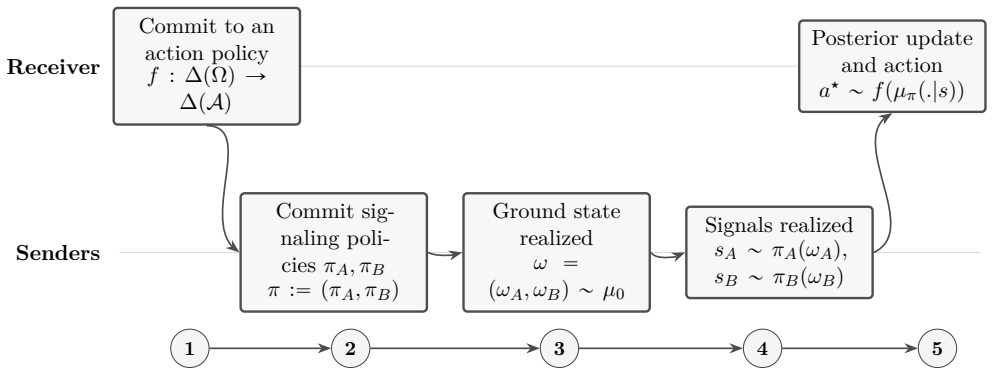
- The timeline in Figure 1 is helpful but the arrow from step 4 to step 5 could be labeled more explicitly to indicate that the posterior update uses Bayes' rule (Eq. 1). A minor cross-reference would help.
Circularity Check
No significant circularity identified
full rationale
The paper's central derivation is self-contained. The GPA policy (Definition 4) is defined by three explicit conditions on action probabilities: (i) zero selection when the sender's state is certainly low, (ii) certain selection when exactly one sender is certainly high, and (iii) a posterior-linear upper bound f_T(μ) ≤ ⟨Σ_T, Φ^μ_T⟩. The proof of Theorem 2 (FIE induction) proceeds from first principles: the sender's expected utility (Eq. 6) is bounded using GPA condition (iii), then Bayesian plausibility (Eq. 7) — a standard identity derived directly from Bayes' rule — is applied to replace the posterior-dependent sum with the prior, yielding v_T(π;f) ≤ v'_T⟨Σ_T, Φ^{μ_0}_T⟩ (Eq. 8). The truthful payoff (Eq. 9) is computed independently from GPA conditions (i) and (ii) under truthful signaling, and equals the same expression. No parameter is fitted to data and then 'predicted.' No self-citation is load-bearing for the mathematical argument. Theorem 3's optimality result follows by direct computation of the receiver's payoff under truthful signaling and comparison with the upper bound from Proposition 1, which itself is derived from the utility structure (Eq. 3) by a simple state-by-state argument. The multi-sender extension (Theorems 4-5) follows the identical proof template. The derivation chain is clean and does not reduce to its inputs by construction.
Assumptions & free parameters
free parameters (2)
- Tie-breaking parameter p =
N/A (exogenous choice in [0,1])
- Sigma_T (sigma_A, sigma_B) =
N/A (design parameters satisfying sigma_A + sigma_B <= 1)
assumptions (4)
- domain assumption Bayesian rationality of the receiver
- domain assumption Canonical utility structure (Eq. 3)
- domain assumption Binary state and signal spaces
- domain assumption Independent signaling conditional on state
invented entities (2)
-
General Prior Admissible (GPA) Policy
independent evidence
-
Multi-sender General Prior Admissible (MGPA) Policy
independent evidence
Cite this review
Pith. "Pith review of Multi-Sender Bayesian Persuasion with Imperfect Information." pith.science (2026). https://pith.science/paper/SHW6BOMU
@misc{pith2026260708675,
  author       = {Pith},
  title        = {Pith review of: Multi-Sender Bayesian Persuasion with Imperfect Information},
  year         = {2026},
  howpublished = {\url{https://pith.science/paper/SHW6BOMU}},
  note         = {Machine review of arXiv:2607.08675}
}
read the original abstract
We study a multi-sender Bayesian persuasion problem with one receiver and several strategic senders. The underlying ground state has multiple components, each privately observed by a different sender, while the receiver holds a common prior over the joint state space. Senders simultaneously choose signaling policies, and the receiver takes an action based on the posterior induced by the signals; each is sampled independently from the sender's signaling policy. We analyze the game induced by the receiver's straightforward policy, which selects a receiver-optimal action at every posterior. In particular, we characterize the senders' best responses under the straightforward policy and identify conditions on the prior that induce a fully informative equilibrium; i.e., truthfully reporting the ground truth is an equilibrium strategy for every sender. These conditions capture cases in which senders' incentives are sufficiently aligned to enable full revelation without additional commitment from the receiver. The important contribution of this paper is to analyze games induced by a more general (possibly randomized) class of action policies that the receiver commits to before senders choose their signaling strategies. We show that this commitment power fundamentally changes the problem. In particular, we show that for any prior over the joint state space, the receiver can construct action policies that maximize her payoff while ensuring a fully informative equilibrium.
Figures
Reference graph
Works this paper leans on
-
[1]
American Economic Review , volume=
Bayesian persuasion , author=. American Economic Review , volume=. 2011 , publisher=
work page 2011
-
[2]
Annual Review of Economics , volume=
Bayesian persuasion and information design , author=. Annual Review of Economics , volume=. 2019 , publisher=
work page 2019
-
[3]
Sequential Bayesian persuasion , journal =
Wenhao Wu , keywords =. Sequential Bayesian persuasion , journal =. 2023 , issn =. doi:https://doi.org/10.1016/j.jet.2023.105763 , url =
-
[4]
Algorithmic information structure design: a survey , author=. SIGecom Exch. , year=
-
[5]
Ricardo Alonso and Odilon Câmara , journal =. Persuading Voters , urldate =
-
[6]
Persuasion of a Privately Informed Receiver , journal =
Kolotilin, Anton and Mylovanov, Tymofiy and Zapechelnyuk, Andy and Li, Ming , year =. Persuasion of a Privately Informed Receiver , journal =
-
[7]
Unpublished manuscript, London School Econ , year=
Persuasion with correlation neglect , author=. Unpublished manuscript, London School Econ , year=
-
[8]
Private Bayesian persuasion , journal =
Itai Arieli and Yakov Babichenko , keywords =. Private Bayesian persuasion , journal =. 2019 , issn =. doi:https://doi.org/10.1016/j.jet.2019.04.008 , url =
Show all 131 references
-
[9]
SIGecom Exch
Dughmi, Shaddin , title =. SIGecom Exch. , month = feb, pages =. 2017 , issue_date =. doi:10.1145/3055589.3055591 , abstract =
2017 doi
-
[10]
2024 , eprint=
Majorized Bayesian Persuasion and Fair Selection , author=. 2024 , eprint=
2024
-
[11]
AEA Papers and Proceedings , volume=
Addressing strategic uncertainty with incentives and information , author=. AEA Papers and Proceedings , volume=. 2022 , organization=
2022
-
[12]
Journal of Economics & Management Strategy , volume=
Asymmetric-information allocation to avoid coordination failure , author=. Journal of Economics & Management Strategy , volume=. 2020 , publisher=
2020
-
[13]
Theoretical Economics , volume=
Persuasion with unknown beliefs , author=. Theoretical Economics , volume=. 2022 , publisher=
2022
-
[14]
2020 , journal=
Adversarial bilateral information design , author=. 2020 , journal=
2020
-
[15]
1926 , publisher=
Winnie-the-pooh , author=. 1926 , publisher=
1926
-
[16]
Theoretical Economics , volume=
Refined best reply correspondence and dynamics , author=. Theoretical Economics , volume=. 2013 , publisher=
2013
-
[17]
International Journal of Game Theory , volume=
The refined best-response correspondence in normal form games , author=. International Journal of Game Theory , volume=. 2015 , publisher=
2015
-
[18]
Available at SSRN 4531654 , year=
Adversarial coordination and public information design , author=. Available at SSRN 4531654 , year=
-
[19]
Games and Economic Behavior , volume=
Competitive information disclosure by multiple senders , author=. Games and Economic Behavior , volume=. 2020 , publisher=
2020
-
[20]
Mathematische Annalen , volume=
On the openness of the barycentre map , author=. Mathematische Annalen , volume=. 1976 , publisher=
1976
-
[21]
American Economic Review , volume=
Rank uncertainty in organizations , author=. American Economic Review , volume=. 2021 , publisher=
2021
-
[22]
Econometrica , volume=
Generalized Belief Operator and Robustness in Binary-Action Supermodular Games , author=. Econometrica , volume=. 2020 , publisher=
2020
-
[23]
Journal of Economic Theory , volume=
Global manipulation by local obfuscation , author=. Journal of Economic Theory , volume=. 2023 , publisher=
2023
-
[24]
Journal of Political Economy , volume=
On information design in games , author=. Journal of Political Economy , volume=. 2020 , publisher=
2020
-
[25]
Econometrica , volume=
Preparing for the worst but hoping for the best: Robust (Bayesian) persuasion , author=. Econometrica , volume=. 2022 , publisher=
2022
-
[26]
Available at SSRN 3697335 , year=
Implementation via information design in binary-action supermodular games , author=. Available at SSRN 3697335 , year=
-
[27]
CoRR , volume =
Matteo Castiglioni and Alberto Marchesi and Nicola Gatti , title =. CoRR , volume =. 2022 , url =. 2202.00605 , timestamp =
2022 arXiv
-
[28]
Preprint , title =
Yamashita, Takuro and Zhu, Shuguang , year =. Preprint , title =
-
[29]
Journal of Economic Literature , volume=
Information design: A unified perspective , author=. Journal of Economic Literature , volume=. 2019 , publisher=
2019
-
[30]
2022 , publisher=
Informed Information Design , author=. 2022 , publisher=
2022
-
[31]
Econometrica , volume=
Mechanism design with limited commitment , author=. Econometrica , volume=. 2022 , publisher=
2022
-
[32]
Available at SSRN 3281132 , year=
Mechanism design with limited commitment , author=. Available at SSRN 3281132 , year=
-
[33]
Price and Advertising Signals of Product Quality , urldate =
Paul Milgrom and John Roberts , journal =. Price and Advertising Signals of Product Quality , urldate =
-
[34]
arXiv preprint arXiv:2008.08517 , year=
Competing persuaders in zero-sum games , author=. arXiv preprint arXiv:2008.08517 , year=
2008 arXiv
-
[35]
Games and Economic Behavior , volume=
Bayesian persuasion with multiple senders and rich signal spaces , author=. Games and Economic Behavior , volume=. 2017 , publisher=
2017
-
[36]
The Review of Economic Studies , volume=
Competition in persuasion , author=. The Review of Economic Studies , volume=. 2016 , publisher=
2016
-
[37]
Journal of Political Economy , volume=
Persuasion via weak institutions , author=. Journal of Political Economy , volume=. 2022 , publisher=
2022
-
[38]
Sequential Bayesian Persuasion , author=
-
[39]
Journal of Mathematical Economics , volume=
An axiomatization of the inner core using appropriate reduced games , author=. Journal of Mathematical Economics , volume=. 2008 , publisher=
2008
-
[40]
American Economic Journal: Microeconomics , volume=
Disclosure to a psychological audience , author=. American Economic Journal: Microeconomics , volume=
-
[41]
1970 , publisher=
Convex Analysis , author=. 1970 , publisher=
1970
-
[42]
Annals of Economics and Statistics , number=
Games with incomplete information: from repetition to cheap talk and persuasion , author=. Annals of Economics and Statistics , number=. 2020 , publisher=
2020
-
[43]
The Review of Economic Studies , volume=
A continuous-time version of the principal-agent problem , author=. The Review of Economic Studies , volume=. 2008 , publisher=
2008
-
[44]
Working paper , year=
Reputation and Information Design , author=. Working paper , year=
-
[45]
Journal of Political Economy , volume=
The simple economics of optimal persuasion , author=. Journal of Political Economy , volume=. 2019 , publisher=
2019
-
[46]
Theoretical Economics , volume=
Optimal information disclosure: A linear programming approach , author=. Theoretical Economics , volume=. 2018 , publisher=
2018
-
[47]
Econometrica , volume=
Persuasion of a privately informed receiver , author=. Econometrica , volume=. 2017 , publisher=
2017
-
[48]
Journal of Economic Theory , volume=
Pivotal persuasion , author=. Journal of Economic Theory , volume=. 2019 , publisher=
2019
-
[49]
Theoretical Economics , volume=
Modes of persuasion toward unanimous consent , author=. Theoretical Economics , volume=. 2018 , publisher=
2018
-
[50]
Chakraborty, Archishman and Harbaugh, Rick , journal =
-
[51]
Crawford, Vincent P and Sobel, Joel , journal =
-
[52]
The American Economic Review , year =
Donald McCloskey and Arjo Klamer , title =. The American Economic Review , year =
-
[53]
The Journal of Law & Economics , year =
Grossman, Sanford J , title =. The Journal of Law & Economics , year =
-
[54]
and Dubra, Juan , title =
Benoit, J.P. and Dubra, Juan , title =. Econometrica , year =
-
[55]
Accounting Horizons , year =
Mercer, Molly , title =. Accounting Horizons , year =
-
[56]
The Accounting Review , year =
Rogers, Jonathan L and Stocken, Phillip C , title =. The Accounting Review , year =
-
[57]
Journal of Economic Theory , volume=
Informational control and organizational design , author=. Journal of Economic Theory , volume=. 2010 , publisher=
2010
-
[58]
Journal of Conflict Resolution , year =
Jordan, Donald L and Page, Benjamin I , title =. Journal of Conflict Resolution , year =
-
[59]
American Journal of Political Science , year =
Mondak, Jeffery J , title =. American Journal of Political Science , year =
-
[60]
Political Behavior , year =
Mondak, Jeffery J , title =. Political Behavior , year =
-
[61]
Journal of Marketing Communications , year =
Yoon, Kak and Pinkleton, Bruce E and Ko, Wonjun , title =. Journal of Marketing Communications , year =
-
[62]
American Political Science Review , year =
Page, Benjamin I and Shapiro, Robert Y and Dempsey, Glenn R , title =. American Political Science Review , year =
-
[63]
Journal of Applied Social Psychology , year =
Pornpitakpan, Chanthika , title =. Journal of Applied Social Psychology , year =
-
[64]
Journal of Empirical Generalizations in Marketing , year =
Eisend, Martin , title =. Journal of Empirical Generalizations in Marketing , year =
-
[65]
2010 , author =
Journalists, sources, and credibility: New perspectives , publisher =. 2010 , author =
2010
-
[66]
The Quarterly Journal of Economics , year =
Spence, Michael , title =. The Quarterly Journal of Economics , year =
-
[67]
The Bell Journal of Economics , year =
Milgrom, Paul , title =. The Bell Journal of Economics , year =
-
[68]
The Accounting Review , year =
Lo, Alvis K , title =. The Accounting Review , year =
-
[69]
1995 , author =
Repeated games with incomplete information , publisher =. 1995 , author =
1995
-
[70]
American Economic Review , year =
Ely, Jeffrey C , title =. American Economic Review , year =
-
[71]
Econometric Society 10th World Congress , year =
Sobel, Joel , title =. Econometric Society 10th World Congress , year =
-
[72]
Journal of Political Economy , year =
Rayo, Luis and Segal, Ilya , title =. Journal of Political Economy , year =
-
[73]
Journal of Economic Theory , year =
Green, Jerry R and Stokey, Nancy L , title =. Journal of Economic Theory , year =
-
[74]
Persuading voters , journal =
Alonso, Ricardo and C. Persuading voters , journal =. 2016 , volume =
2016
-
[75]
Econometrica , year =
Bergemann, Dirk and Morris, Stephen , title =. Econometrica , year =
-
[76]
American Economic Journal: Microeconomics , Volume =
Ellison, Glenn and Ellison, Sara Fisher , Title =. American Economic Journal: Microeconomics , Volume =. 2011 , Month =. doi:10.1257/mic.3.1.1 , URL =
2011 doi
-
[77]
Robust implementation in general mechanisms , journal =
Dirk Bergemann and Stephen Morris , keywords =. Robust implementation in general mechanisms , journal =. 2011 , issn =. doi:https://doi.org/10.1016/j.geb.2010.05.001 , url =
2011 doi
-
[78]
Multiple Referrals and Multidimensional Cheap Talk , urldate =
Marco Battaglini , journal =. Multiple Referrals and Multidimensional Cheap Talk , urldate =
-
[79]
American Economic Journal: Microeconomics , year=2019, volume=
Ina Taneva , title=. American Economic Journal: Microeconomics , year=2019, volume=. doi:, abstract=
2019
-
[80]
Theoretical Economics , year =
Bergemann, Dirk and Morris, Stephen , title =. Theoretical Economics , year =
-
[81]
Available at SSRN 1868066 , year=
Complicating to persuade , author=. Available at SSRN 1868066 , year=
-
[82]
Journal of Economic Literature , Volume =
Dranove, David and Jin, Ginger Zhe , Title =. Journal of Economic Literature , Volume =. 2010 , Month =. doi:10.1257/jel.48.4.935 , URL =
2010 doi
-
[83]
American Economic Review , Volume =
Gerardi, Dino and Yariv, Leeat , Title =. American Economic Review , Volume =. 2008 , Month =. doi:10.1257/aer.98.2.187 , URL =
2008 doi
-
[84]
American Economic Review , Volume =
Alonso, Ricardo and Dessein, Wouter and Matouschek, Niko , Title =. American Economic Review , Volume =. 2008 , Month =. doi:10.1257/aer.98.1.145 , URL =
2008 doi
-
[85]
Certifiable Pre-Play Communication: Full Disclosure , journal =
Hagenbach, Jeanne and Koessler, Fr. Certifiable Pre-Play Communication: Full Disclosure , journal =. 2014 , volume =
2014
-
[86]
Full revelation of information in Sender--Receiver games of persuasion , journal =
Mathis, J. Full revelation of information in Sender--Receiver games of persuasion , journal =. 2008 , volume =
2008
-
[87]
A definition , author=
Increasing risk: I. A definition , author=. Journal of Economic Theory , volume=. 1970 , publisher=
1970
-
[88]
American Economic Review , volume=
A Rothschild-Stiglitz approach to Bayesian persuasion , author=. American Economic Review , volume=. 2016 , publisher=
2016
-
[89]
Journal of Economic Theory , year =
Baliga, Sandeep and Morris, Stephen , title =. Journal of Economic Theory , year =
-
[90]
Margaria, Chiara and Smolin, Alex , title =
-
[91]
Dynamic sender--receiver games , journal =
Renault, J. Dynamic sender--receiver games , journal =. 2013 , volume =
2013
-
[92]
Journal of Economic Theory , year =
Golosov, Mikhail and Skreta, Vasiliki and Tsyvinski, Aleh and Wilson, Andrea , title =. Journal of Economic Theory , year =
-
[93]
2001 , author =
Lectures on Choquet's theorem , publisher =. 2001 , author =
2001
-
[94]
Econometrica: Journal of the Econometric Society , pages=
Incentive compatibility and the bargaining problem , author=. Econometrica: Journal of the Econometric Society , pages=
-
[95]
Econometrica: Journal of the Econometric Society , pages=
Mechanism design by an informed principal , author=. Econometrica: Journal of the Econometric Society , pages=. 1983 , publisher=
1983
-
[96]
2019 , MONTH = Jul, KEYWORDS =
Salamanca, Andr. 2019 , MONTH = Jul, KEYWORDS =
2019
-
[97]
Econometrica: Journal of the Econometric Society , pages=
Multistage games with communication , author=. Econometrica: Journal of the Econometric Society , pages=. 1986 , publisher=
1986
-
[98]
American Economic Review , volume=
Interim bayesian persuasion: First steps , author=. American Economic Review , volume=. 2014 , publisher=
2014
-
[99]
2006 , author =
Infinite Dimensional Analysis: A Hitchhiker's Guide , publisher =. 2006 , author =
2006
-
[100]
Econometrica , year =
Bester, Helmut and Strausz, Roland , title =. Econometrica , year =. doi:10.1111/1468-0262.00231 , file =
-
[101]
Journal of Economic Theory , year =
Austen-Smith, David and Banks, Jeffrey S , title =. Journal of Economic Theory , year =
-
[102]
Journal of Economic Theory , year =
Kartik, Navin , title =. Journal of Economic Theory , year =
-
[103]
Journal of Economic Theory , year =
Chakraborty, Archishman and Harbaugh, Rick , title =. Journal of Economic Theory , year =
-
[104]
Econometrica , year =
Battaglini, Marco , title =. Econometrica , year =. doi:10.1111/1468-0262.00336 , file =
-
[105]
Econometrica , year=2020, volume=
Elliot Lipnowski and Doron Ravid , title=. Econometrica , year=2020, volume=. doi:10.3982/ECTA15674 , abstract=
2020 doi
-
[106]
1979 , publisher=
Theory of games and statistical decisions , author=. 1979 , publisher=
1979
-
[107]
The Annals of Mathematical Statistics , year =
Blackwell, David , title =. The Annals of Mathematical Statistics , year =
-
[108]
Econometrica , volume=
The interval structure of optimal disclosure , author=. Econometrica , volume=. 2019 , publisher=
2019
-
[109]
2019 , month = jan, note =
Guo, Yingni and Shmaya, Eran , title =. 2019 , month = jan, note =
2019
-
[110]
Review of Economic Studies , year =
Kartik, Navin , title =. Review of Economic Studies , year =
-
[111]
Economic Theory , volume=
Bayesian persuasion under partial commitment , author=. Economic Theory , volume=. 2021 , publisher=
2021
-
[112]
Econometrica , volume=
Rules and commitment in communication: An experimental analysis , author=. Econometrica , volume=. 2022 , publisher=
2022
-
[113]
Theoretical Economics , year =
Blume, Andreas and Board, Oliver J and Kawamura, Kohei , title =. Theoretical Economics , year =
-
[114]
2017 , pages =
Best, James and Quigley, Daniel , title =. 2017 , pages =
2017
-
[115]
Journal of Economic Theory , year =
Alonso, Ricardo and C. Journal of Economic Theory , year =
-
[116]
Journal of Economic Theory , year =
Hedlund, Jonas , title =. Journal of Economic Theory , year =
-
[117]
2017 , pages =
Boleslavsky, Raphael and Kim, Kyungmin , title =. 2017 , pages =
2017
-
[118]
Sequentially Optimal Mechanisms , volume =
Vasiliki Skreta , journal =. Sequentially Optimal Mechanisms , volume =
-
[119]
Dynamic screening with limited commitment
Rahul Deb and Maher Said. Dynamic screening with limited commitment. Journal of Economic Theory. 2015. doi:https://doi.org/10.1016/j.jet.2015.05.015
2015 doi
-
[120]
Econometrica , volume=
Test design under falsification , author=. Econometrica , volume=. 2022 , publisher=
2022
-
[121]
American Economic Review , volume=
Evidence games: Truth and commitment , author=. American Economic Review , volume=
-
[122]
Econometrica , volume=
Mechanisms with evidence: Commitment and robustness , author=. Econometrica , volume=. 2019 , publisher=
2019
-
[123]
Games and Economic Behavior , volume=
Credibility and determinism in a game of persuasion , author=. Games and Economic Behavior , volume=. 2011 , publisher=
2011
-
[124]
2017 , note=
Evidence and Skepticism in Verifiable Disclosure Games , author=. 2017 , note=
2017
-
[125]
Full disclosure in competitive Bayesian persuasion , volume =
Li, Quan and Rong, Kang , year =. Full disclosure in competitive Bayesian persuasion , volume =. International Journal of Game Theory , doi =
-
[126]
Theoretical Economics , year =
Glazer, Jacob and Rubinstein, Ariel , title =. Theoretical Economics , year =
-
[127]
Nguyen, Anh and Tan, Yong Teck , title =
-
[128]
Games and Economic Behavior , volume=
Limiting Sender's information in Bayesian persuasion , author=. Games and Economic Behavior , volume=. 2019 , publisher=
2019
-
[129]
American Economic Review , year =
Liu, Qingmin and Mierendorff, Konrad and Shi, Xianwen and Zhong, Weijie , title =. American Economic Review , year =
-
[130]
Report of the US Arms Control and Disarmament Agency , year =
Aumann, Robert J and Maschler, M , title =. Report of the US Arms Control and Disarmament Agency , year =
-
[131]
Theoretical Economics , volume=
Sequential persuasion , author=. Theoretical Economics , volume=. 2021 , publisher=
2021
Reviewed July 10, 2026 · model on record in the stance chip above.
Discussion (0). Continue with ORCID to comment.