REVIEW 6 major objections 6 minor 71 references
Observational analysis of bulk viscous modified Chaplygin gas in (2+1)-dimensional universe using MCMC
T0 review · 6 major / 6 minor · reviewed 2026-08-16 · deepseek-v4-flash
Pith's one-line read A bulk-viscous modified Chaplygin gas in (2+1)-dimensional spacetime is claimed to reproduce the observed expansion history, yielding $H_0 = 67.90$ km s$^{-1}$ Mpc$^{-1}$, and to damp the structure-formation oscillations that have…
desk verdict The Friedmann equations are mutually inconsistent and not derivable from the stated field equations, so the solutions and the MCMC H0 rest on broken foundations; this should be desk-rejected. read the letter →
The pith
A machine-rendered reading of the paper's core claim, the machinery that carries it, and where it could break.
The reading
What carries the argument
The load-bearing object is the bulk-viscous modified Chaplygin gas: the equation of state $p = \gamma\rho - A/\rho^\beta$ with $A > 0$ and $0 < \beta \le 1$, modified by bulk viscosity through $\bar p = p - 2\xi H$, and inserted into the assumed (2+1)-dimensional Friedmann equations $H^2 = \rho/2$ and $\ddot a/a = -\bar p$. The Chaplygin term supplies late-time negative pressure; the viscous term shifts the deceleration parameter and, in perturbations, contributes the damping term $2\xi k^2\delta$ to the density-contrast equation. The MCMC stage enters through a $\chi^2$ built from the theoretical $H(z)$ and distance modulus against the Hubble and Pantheon datasets. All downstream results—the analytical solutions, the fitted $H_0$, and the claimed damping of structure oscillations—depend on this fluid prescription and on the 2+1 field equations.
What would settle it
Recompute the Einstein tensor for the FLRW metric (1) in 2+1 dimensions and compare $G_{00}$ and $G_{ab}$ with Eqs. (6)-(7); under the paper's own normalization $G_{ij}=2\pi G T_{ij}$, if $G_{00}$ is not $\rho/2$, the derived $\rho(z)$ and $H(z)$ used in the MCMC fit are invalid. A second check is to re-run the MCMC with the corrected Friedmann equations and see whether $H_0$ remains $67.90$ km s$^{-1}$ Mpc$^{-1}$.
Extended reading notes
Core claim
On its own terms, the paper's finding is that a (2+1)-dimensional FLRW universe filled with a modified Chaplygin gas $p = \gamma\rho - A/\rho^\beta$ and a bulk-viscous pressure $\bar p = p - 2\xi H$ obeys $H^2 = \rho/2$ and $\ddot a/a = -\bar p$, and that this system admits closed-form solutions for the energy density in both the $\xi = 0$ and constant-$\xi$ cases. The inviscid solution produces a smooth deceleration-to-acceleration transition; the viscous solution gives a consistently negative deceleration parameter. Fitting the resulting $H(z)$ and distance modulus to cosmic-chronometer and Pantheon data by MCMC yields $H_0 = 67.90$ km s$^{-1}$ Mpc$^{-1}$, which the authors take as consistency with Planck. In the perturbation sector, the viscous term $2\xi k^2\delta$ damps oscillations in the density contrast, presented as a way around the structure-formation problem that has disfavored Chaplygin cosmologies. The paper's own framing is that the whole construction is a theoretical laboratory rather than a direct model of the observable universe.
Load-bearing premise
The whole derivation rests on the assumed (2+1)-dimensional Friedmann equations $H^2 = \rho/2$ and $\ddot a/a = -\bar p$; if the standard reduction of the stated Einstein equations yields different equations, the analytical solutions, fitted parameters, and claimed Planck consistency do not follow.
Editorial extensions
If this is right
- A single bulk-viscous Chaplygin fluid would reproduce the observed deceleration-to-acceleration transition and sustain late-time accelerated expansion without a separate dark-energy component.
- The fitted $H_0 = 67.90$ km s$^{-1}$ Mpc$^{-1}$ would place the model in agreement with the Planck $\Lambda$CDM value, suggesting that low-redshift expansion data alone do not demand (3+1)-dimensional dynamics.
- The viscous damping term $2\xi k^2\delta$ would suppress small-scale oscillations in the density contrast, potentially easing the structure-formation tension that has ruled out non-viscous Chaplygin models.
- Because the viscous model approaches a de Sitter-like phase at late times, its late-time predictions become degenerate with $\Lambda$CDM, so future late-time observations would discriminate poorly between them.
Reading between the lines
- If the (2+1)-dimensional Friedmann equations were derived from the stated Einstein equation rather than assumed, the solutions and the fitted $H_0$ would likely change; re-running the MCMC with the standard reduction would test whether the Planck agreement survives.
- The structure-damping result is established in a 2+1 setting with no matter power spectrum; translating the same viscosity prescription to (3+1) perturbations would show whether oscillations disappear without over-suppressing structure growth.
- The authors' 'mathematical projection' caveat implies an implicit holographic or brane-world reading of the fits; making that mapping explicit would turn the Planck consistency from a numerical coincidence into a physical statement.
Signed reviews
Editorial analysis
A structured set of objections, weighed in public.
Referee Report
Summary. This paper studies a bulk-viscous modified Chaplygin gas (MCG) in a (2+1)-dimensional spatially flat FLRW spacetime. The authors claim to derive analytic solutions for the energy density, Hubble parameter, and deceleration parameter in non-viscous and viscous cases; to show that bulk viscosity dampens structure-growth oscillations; and to constrain the model by a Markov chain Monte Carlo fit to 30 cosmic-chronometer H(z) points and 1048 Pantheon supernova distances, obtaining H0 = 67.90 km s−1 Mpc−1, which the abstract presents as 'remarkable consistency with Planck LCDM estimations despite the dimensional reduction.' The derivation rests on the Friedmann pair H² = ρ/2 and ä/a = −p̄ (Eqs. (6)–(7)), a reduced conservation equation (Eq. (9)), and a viscous energy-density ansatz taken from Ref. [53]. The manuscript repeatedly cautions that the model is a theoretical laboratory rather than a direct alternative to the standard cosmological model.
Significance. If the derivations were sound, the paper would offer a tractable toy model in which a viscous Chaplygin gas in 2+1 dimensions reproduces the main features of cosmic expansion, a mechanism (bulk viscosity) for curing the matter-power-spectrum oscillations that afflict Chaplygin models, and a conventional two-dataset MCMC pipeline. The manuscript deserves credit for unusually candid limitation statements: it concedes that the fitted constraints are 'mathematical consistency checks rather than physically meaningful constraints' and that Chaplygin models are disfavored by current DESI-era data. These strengths do not carry the paper's central claims, because the equations do not support them: the foundational pair (6)–(7) is internally inconsistent, the claimed solution (11) does not solve (10), and the headline H0 agreement restates a fitted quantity rather than constituting a prediction. No machine-checked proofs or reproducible chains accompany the analysis, and the perturbation claim in the abstract is not backed by any displayed numerical result.
major comments (6)
- [§2, Eqs. (6)–(7)] The two Friedmann equations used throughout the paper are mutually inconsistent, independently of any coupling convention. Differentiating Eq. (6) with respect to cosmic time and inserting the paper's own conservation equation (8) gives 2Ḣ = −(ρ + p̄), whereas combining Eqs. (6) and (7) gives 2Ḣ = −(ρ + 2p̄) (using ä/a = Ḣ + H²); the two expressions agree only when p̄ = 0, which the modified Chaplygin gas is not. Additionally, Eqs. (6)–(7) do not follow from the stated field equations: a direct computation of G_ij for metric (1) yields G_00 = H² and G_ij = −(ä/a) g_ij (spatial), so that Eq. (2) with T_00 = ρ + 2p̄ from Eq. (3) cannot produce the coefficient 1/2 in (6) and the coefficient 1 in (7) simultaneously. The cited Ref. [19] is a (3+1)-dimensional paper and does not support Eqs. (6)–(7). Since every subsequent result, including Eqs. (9)–(27) and the fitted H0, rests on these equations, this is a load-bearing error.
- [§2, Eq. (9)] Eq. (9) is an incorrect reduction of Eq. (8). Substituting H = √(ρ/2) from Eq. (6) and p̄ = γρ − A ρ^{−β} − 2ξH from Eqs. (4)–(5) into Eq. (8) gives ρ̇ + √2(γ+1)ρ^{3/2} − 2ξρ − √2 A ρ^{1/2−β} = 0. The paper's Eq. (9) replaces √2 A ρ^{1/2−β} by √2 A, which is valid only for β = 1/2. Because β is a free parameter in the equation of state (5) and does not appear anywhere in the fitting formulas (25)–(27), the paper silently restricts the model to β = 1/2 without stating or justifying this. The MCMC constraints are therefore not for the model defined by Eq. (5).
- [§2, Eqs. (10)–(14)] Eq. (11) does not solve Eq. (10). Direct substitution of Eq. (11) into Eq. (10), using ȧ/a = √(ρ/2) from Eq. (6), leaves a non-vanishing residual for generic A, γ, c; the equality would hold only for special values such as A = ±1 and c = 0. The correct solution of Eq. (10) is ρ(a) = [A/(γ+1) + c a^{−3(γ+1)}]^{2/3}, which diverges as a → 0, whereas Eq. (11) tends to zero in that limit. Equation (13) is also not real-valued at high redshift for c > 0 because A − c(1+z)^{3(γ+1)} becomes negative, so the plotted curves in Figs. 1–2 are complex-valued over a substantial part of the displayed range. Equations (12)–(14) and the corresponding analysis therefore rest on an algebraic error.
- [§2, Eqs. (15)–(27)] The viscous solution is not derived or verified. The form ρ = E/t² + F/t + ht + De^{bt} is imported as an ansatz from Ref. [53], a paper co-authored by one of the current authors, and 'comparing like coefficients' in Eq. (16) is not a legitimate procedure because ρ^{3/2} of the ansatz is not a linear combination of 1/t², 1/t, t, and e^{bt}; the resulting expressions (17)–(23) are never checked by substitution into Eq. (9). Independently, the asserted redshift relation t(z) = (1/(nα)) ln(1 + (1+z)^{−n}) corresponds to a(t) = (e^{nαt} − 1)^{1/n}, for which H = αe^{nαt}/(e^{nαt} − 1) → α as t → ∞; Eq. (6) then requires ρ = 2H² → 2α², whereas Eq. (23) gives ρ ~ √2 A t at late times. Equations (6), (23), and the t(z) ansatz are mutually incompatible, so the model H(z) in Eq. (27) that feeds the MCMC fit is unsupported.
- [§4, §§4.1–4.3] The headline result is a fitted value, not a prediction, and the fit is under-documented. H0 is determined by the fit itself, through H(z) at z → 0 and through the distance-scale normalization in Eq. (39), so the abstract's 'remarkable consistency with Planck' restates the fit outcome rather than providing an independent check; the manuscript itself concedes that the constraints 'should be interpreted primarily as mathematical consistency checks rather than physically meaningful constraints.' Of the parameters entering Eq. (27) (n, α, γ, A, ξ, and the implicit unit normalization), only H0 and n are reported with uncertainties; no χ² minimum, priors, chain lengths, or convergence diagnostics are given. The analysis cannot be reproduced or checked as presented.
- [§3, Eq. (36) and §3.3] The perturbation analysis is asserted rather than demonstrated. Eq. (36) is presented without derivation from the perturbed Einstein equations in 2+1 dimensions, the viscous damping term 2ξk²δ is not derived and no dimensional analysis is given, and §3.3 states that the perturbation equations were 'numerically solved' without showing a single plot, parameter value, or table. The abstract's claim that 'bulk viscosity dampens the structure growth oscillations' is therefore unsupported by any displayed evidence, and §3.4 itself acknowledges that the analysis cannot be compared with observational data.
minor comments (6)
- [§2, Case (i)–(ii)] The cross-references are unreliable: 'After solving Eq. (24)' (before Eq. (30)) should refer to the equation just solved, Eq. (29); 'Eq. (25), becomes as ρ = 2/((γ+1)²t²)' refers to the same A = ξ = 0 result rather than to Eq. (25); 'From Eq. (27), it is observed that energy density ρ decreases' appears in a paragraph about ρ(t); and in Case (ii), 'using the value of ρ from Eq. (13) in Eq. (9)' should refer to the ansatz Eq. (15).
- [§1, §4] There are numerous typos and grammatical errors, including 'regardred' and 'severel' in Section 1, 'stranded error' for 'standard error' in §4.1, 'depreciate' for 'marginalized' in §4.2, and the abstract's opening 'This paper investigates regarding cosmological implications of...'. A thorough language edit is needed.
- [§2, Eqs. (21)–(26)] The notation O(γ^n) is defined in Eq. (22) as an explicit polynomial while n is simultaneously one of the fitted model parameters; the nested definitions X1–X5 and Δ1, Δ2 in Eqs. (25)–(26) are very difficult to track; and no statement is given about the units of α, ξ, or t needed to evaluate Eq. (27).
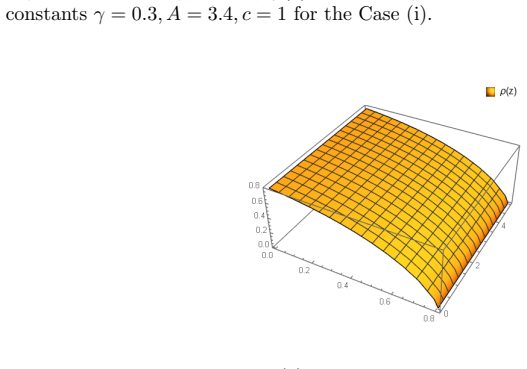
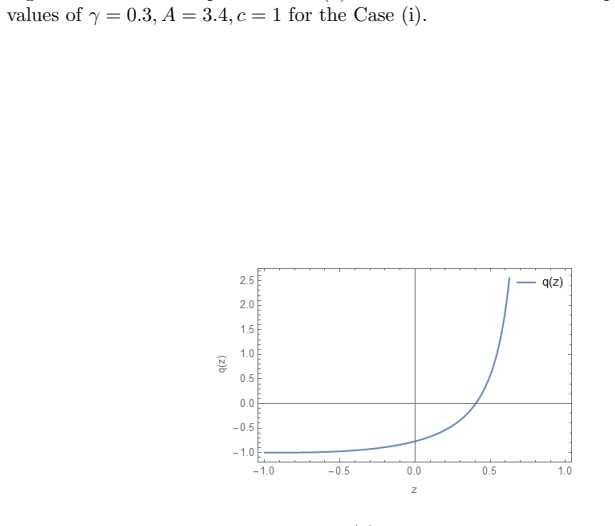
- [§4, Figs. 6–12] The model curves in Figs. 6–12 are computed for fixed illustrative values (γ = 0.3, A = 3.4, c = 1) rather than the MCMC best-fit values, and no χ², reduced χ², or other goodness-of-fit statistic is reported, so the claimed 'excellent agreement with observational data' cannot be assessed quantitatively.
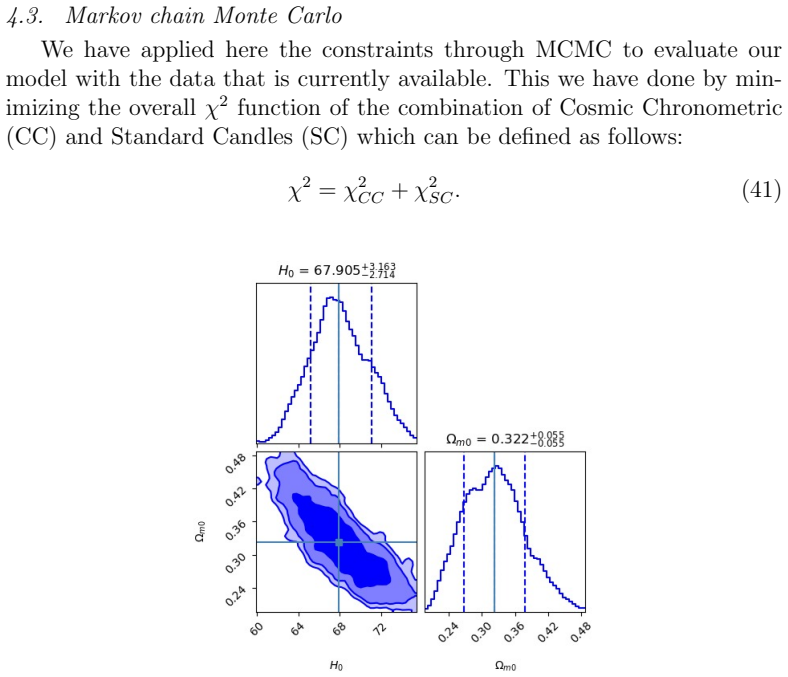
- [§4.3, Figs. 13–14] Figures 13–14 show contours for 'H0 and q' and for 'x, y, z', but q is not a parameter of the model H(z) in Eq. (27) and x, y, z are never defined; moreover the fitted q = 0.322 is positive, in apparent contradiction with the text's statement that q(z) is negative throughout the viscous model (Figs. 8–9).
- [§4.2, Eqs. (38)–(40)] The units are not specified: Eq. (27) evaluates H in natural units, yet the fit reports H0 in km s−1 Mpc−1, and Eq. (39) reintroduces c/H0 without stating the conversion convention; this needs to be specified for the quoted constraints to be reproducible.
Circularity Check
The headline Planck agreement is the fitted H0 itself, and the viscous solution is a same-author ansatz imported from Ref. [53].
-
fitted input called prediction
[Abstract and Section 4.3, MCMC analysis.]
"Using Markov chain Monte Carlo (MCMC) techniques with Hubble parameter and Pantheon supernova datasets, we impose constraints on our model parameters, obtaining H0 = 67.90 km/s/Mpc, showing remarkable consistency with Planck ΛCDM estimations despite the dimensional reduction. ... The outcome of this computational operation is that we can determine the best fit values of the model parameters as H0 = 67.90 and n = 3.036 due to effective application of the MCMC procedure."
H0 is one of the parameters being fitted by the MCMC procedure, not a quantity predicted before fitting. The 'remarkable consistency with Planck' is therefore a restatement of the best-fit value: the same data were used to set H0, and then the fitted H0 is presented as a successful consequence of the model. No independent prediction of H0 is made, so the agreement is forced by the fit rather than by the (2+1)-dimensional theory itself.
-
ansatz smuggled in via citation
[Section 2, Case (ii), Eq. (15).]
"In this case we follow the particular form of ρ given earlier by Saadat and Pourhassan [53] as ρ = E/t^2 + F/t + ht + De^{bt}."
The central viscous density profile that generates H(z) for the MCMC fit is imported verbatim from a prior paper coauthored by one of the current authors (Pourhassan). The subsequent derivation only matches coefficients of this pre-chosen functional form, so the output ρ in Eq. (23) has the same functional structure as the input ansatz by construction. Thus the 'analytical solution' for the viscous case is not independently derived from the Friedmann equations; it is a self-cited ansatz that determines the expansion history used later.
full rationale
The clearest circular element is the H0/Planck consistency claim: the abstract presents the fitted best-fit H0 as though the model had reproduced the Planck value, but H0 is a free parameter of the MCMC fit. The second circularity is the viscous solution: Eq. (15) is explicitly taken from Saadat and Pourhassan [53], a paper overlapping with the present authors, and the coefficient matching that follows does not derive the functional form independently. I did not count the inconsistency between Eqs. (6)-(7) and the stated field equation (2) as a circularity step: that is a correctness/foundational defect rather than a prediction reducing to an input. Similarly, the perturbation claim that viscosity damps oscillations follows from a damping term inserted by hand into Eq. (36); it is a model property, not an independent test, so it does not add a separate circular step. No machine-checked or externally falsifiable calibration is provided to break the self-citation chain for the viscous ansatz. Overall score 6 reflects that one headline prediction reduces to a fitted parameter and the central viscous solution is a load-bearing same-author ansatz.
Assumptions & free parameters
free parameters (8)
- H0 =
67.90 km/s/Mpc (best fit; 67.905+0.174-0.163 in Fig. 13)
- n =
3.036
- alpha
- gamma =
0.3 (chosen)
- A =
3.4 (chosen)
- xi
- beta =
1/2 (implied)
- c =
1 (chosen)
assumptions (4)
- domain assumption The Friedmann equations H² = ρ/2 and ä/a = -p̄ (Eqs. 6-7) are assumed to follow from G_ij = 2πG T_ij (Eq. 2) for the FLRW metric (Eq. 1).
- ad hoc to paper The conservation equation Eq. (8) reduces to Eq. (9) with -√2A rather than -√2A ρ^{1/2-β}.
- ad hoc to paper The viscous energy density has the form ρ = E/t² + F/t + ht + D e^{bt} from Ref. [53].
- ad hoc to paper The redshift-time relation t(z) = (1/(n α)) log(1+(1+z)^{-n}).
Cite this review
Pith. "Pith review of Observational analysis of bulk viscous modified Chaplygin gas in (2+1)-dimensional universe using MCMC." pith.science (2026). https://pith.science/paper/SK2BCETL
@misc{pith2026250418612,
  author       = {Pith},
  title        = {Pith review of: Observational analysis of bulk viscous modified Chaplygin gas in (2+1)-dimensional universe using MCMC},
  year         = {2026},
  howpublished = {\url{https://pith.science/paper/SK2BCETL}},
  note         = {Machine review of arXiv:2504.18612}
}
abstract
This paper investigates regarding cosmological implications of a bulk viscous modified Chaplygin gas (MCG) in (2+1)-dimensional Friedmann-Robertson-Walker spacetime, incorporating both theoretical analysis and observational constraints. We derive analytical solutions for both viscous and non-viscous cases, revealing distinct behavior in energy density evolution, Hubble parameter dynamics, and deceleration parameter transitions. A comprehensive perturbation analysis illustrates how bulk viscosity dampens the structure growth oscillations, addressing a key challenge faced by Chaplygin gas models in higher dimensions. Using Markov chain Monte Carlo (MCMC) techniques with Hubble parameter and Pantheon supernova datasets, we impose constraints on our model parameters, obtaining $H_0 = 67.90$ km s$^{-1}$ Mpc$^{-1}$, showing remarkable consistency with Planck $\Lambda$CDM estimations despite the dimensional reduction. Our findings suggest that lower-dimensional viscous cosmology captures essential features of cosmic evolution while providing valuable theoretical insights into the interplay between dissipative effects and exotic equations of state.
Figures


Figures from the paper (11 more)




Reference graph
Works this paper leans on
- [53]
- [19]
-
[1]
S. Giddings, J. Abbott, K. Kuchar, Einstein’s theory in a three- dimensional space-time, Gen. Rel. Grav. 16, 751 (1984)
work page 1984
-
[2]
J.D. Barrow, A.B. Burd, D. Lancaster, Three-dimensional classical spacetimes, Class. Quantum Grav. 3, 551 (1986)
work page 1986
-
[3]
Staruszkiewicz, Gravitation theory in three-dimensional space, Acta
A. Staruszkiewicz, Gravitation theory in three-dimensional space, Acta. Phys. Pol. 24, 734 (1963)
work page 1963
-
[4]
J.R. Gott, M. Alpert, General relativity in a (2+1)-dimensional space- time, Gen. Rel. Grav. 16, 751 (1984)
work page 1984
- [5]
- [6]
Show all 71 references
-
[7]
Deser, P
S. Deser, P. Mazur, Static solutions in D = 3 Einstein-Maxwell theory, Class. Quantum Grav. 2, L51 (1985)
1985
-
[8]
Deser, Relativity, Cosmology, Topological Mass and SUGR, Ed C
S. Deser, Relativity, Cosmology, Topological Mass and SUGR, Ed C. Aragone (Singapore: World Scientific) (1985). 35
1985
-
[9]
Ba˜nados, C
M. Ba˜nados, C. Teitelboim, J. Zanelli, Black hole in three-dimensional spacetime, Phys. Rev. Lett. 69, 1849 (1992)
1992
-
[10]
Sadeghi, B
J. Sadeghi, B. Pourhassan, and F. Rahimi, Logarithmic corrections to charged hairy black hole in (2+1) dimensions, Canadian Journal of Physics, 92, 1638 (2014)
2014
-
[11]
Sadeghi, B
J. Sadeghi, B. Pourhassan H. Farahani, Rotating charged hairy black hole in (2+1) dimensions and particle acceleration, Commun. Theor. Phys. 62, 358 (2014)
2014
-
[12]
Pourhassan, The Klein-Gordon Equation of a Rotating Charged Hairy Black Hole in (2+1) Dimensions, Modern Phys Lett A31, 1650057 (2016)
B. Pourhassan, The Klein-Gordon Equation of a Rotating Charged Hairy Black Hole in (2+1) Dimensions, Modern Phys Lett A31, 1650057 (2016)
2016
-
[13]
Cl´ement, Stationary solutions in three-dimensional general relativity, Int
G. Cl´ement, Stationary solutions in three-dimensional general relativity, Int. J. Theor. Phys, 24, 3 (1985)
1985
-
[14]
Maldacena, The Large N limit of superconformal field theories and supergravity, Int
J. Maldacena, The Large N limit of superconformal field theories and supergravity, Int. J. Theor. Phys. 38, 1113(1999)
1999
-
[15]
Cornish, N.E
N.J. Cornish, N.E. Frankel, Gravitation in 2+ 1 dimensions, Phys. Rev. D, 43, 8 (1991)
1991
-
[16]
Mart ´inez, N
C. Mart ´inez, N. Cruz, Cosmological scaling solutions of minimally cou- pled scalar fields in three dimensions, Class. Quantum Grav., 17, 2867 (2000)
2000
-
[17]
Fujiwara et al., Topology changes in (2+1)-dimensional quantum gravity, Phys
Y. Fujiwara et al., Topology changes in (2+1)-dimensional quantum gravity, Phys. Rev. D, 44, 6 (1991)
1991
-
[18]
Kamenshchik, U
A.Y. Kamenshchik, U. Moschella, V. Pasquier, An alternative to quintessence. Phys. Lett. B 511, 265 (2001)
2001
-
[20]
Barrow, The deflationary universe: An instability of the de Sitter universe, Phys
J.D. Barrow, The deflationary universe: An instability of the de Sitter universe, Phys. Lett. B 180, 335 (1986). 36
1986
-
[21]
Barrow, String-driven inflationary and deflationary cosmological models, Nucl
J.D. Barrow, String-driven inflationary and deflationary cosmological models, Nucl. Phys. B 310, 743 (1988)
1988
-
[22]
Bilic, G.B
N. Bilic, G.B. Tupper, R.D. Viollier, Unification of dark matter and dark energy: the inhomogeneous Chaplygin gas, Phys. Lett. B 535, 17 (2002)
2002
-
[23]
Debnath, A
U. Debnath, A. Banerjee, S. Chakraborty, Role of modified Chaplygin gas in accelerated universe, Class. Quantum Gravit. 21, 5609 (2004)
2004
-
[24]
Saadat and B
H. Saadat and B. Pourhassan, FRW bulk viscous cosmology with mod- ified cosmic Chaplygin gas, Astrophys. Space Sci. 344, 237 (2013)
2013
-
[25]
Amani and B
A.R. Amani and B. Pourhassan, Viscous Generalized Chaplygin gas with Arbitrary α, Int. J. Theor. Phys. 52, 1309 (2013)
2013
-
[26]
Pourhassan, Viscous Modified Cosmic Chaplygin Gas Cosmology, Int
B. Pourhassan, Viscous Modified Cosmic Chaplygin Gas Cosmology, Int. J. Mod. Phys. D 22, 1350061 (2013)
2013
-
[27]
Saadat and B
H. Saadat and B. Pourhassan, Viscous Varying Generalized Chaplygin Gas with Cosmological Constant and Space Curvature, Int. J. Theor. Phys. 52, 3712 (2013)
2013
-
[28]
Sadeghi, B
J. Sadeghi, B. Pourhassan, M. Khurshudyan, H. Farahani, Time- Dependent Density of Modified Cosmic Chaplygin Gas with Cosmologi- cal Constant in Non-Flat Universe, Int. J. Theor. Phys. 53, 911 (2014)
2014
-
[29]
J. Naji, B. Pourhassan, A. R. Amani, Effect of shear and bulk viscosities on interacting modified Chaplygin gas cosmology, Int. J. Mod. Phys. D 23, 1450020 (2014)
2014
-
[30]
Saadat and B
H. Saadat and B. Pourhassan, Effect of Varying Bulk Viscosity on Gen- eralized Chaplygin Gas, Int. J. Theor. Phys. 53, 1168 (2014)
2014
-
[31]
Amani, B
A.R. Amani, B. Pourhassan, Interacting closed string tachyon with gen- eralized cosmic Chaplygin gas, Int. J. Geom. Methods Mod. Phys. 11, 1450065 (2014)
2014
-
[32]
Kahya, B
E.O. Kahya, B. Pourhassan, Observational constraints on the extended Chaplygin gas inflation, Astropart. Space Sci. 353, 677 (2014). 37
2014
-
[33]
Pourhassan, E.O
B. Pourhassan, E.O. Kahya, Extended Chaplygin gas model, Results Phys. 4, 101 (2014)
2014
-
[34]
Pourhassan, E.O
B. Pourhassan, E.O. Kahya, FRW cosmology with the extended Chap- lygin gas, Adv. High Energy Phys. 2014, 231452 (2014)
2014
-
[35]
Kahya, M
E.O. Kahya, M. Khurshudyan, B. Pourhassan, R. Myrzakulov, and A. Pasqua, Higher order corrections of the extended Chaplygin gas cosmol- ogy with varying G and Λ, Eur. Phys. J. C 75, 43 (2015)
2015
-
[36]
Sadeghi, H
J. Sadeghi, H. Farahani, B. Pourhassan, Interacting Holographic Ex- tended Chaplygin Gas and Phantom Cosmology in the Light of BICEP2, Eur. Phys. J. Plus 130, 84 (2015)
2015
-
[37]
Pourhassan, Unified universe history through phantom extended Chaplygin gas, Can
B. Pourhassan, Unified universe history through phantom extended Chaplygin gas, Can. J. Phys. 94, 659 (2016)
2016
-
[38]
Kahya, B
E.O. Kahya, B. Pourhassan, S. Uraz, Constructing an Inflaton Potential by Mimicking Modified Chaplygin Gas, Phys. Rev. D92, 103511 (2015)
2015
-
[39]
Kahya, B
E.O. Kahya, B. Pourhassan, The universe dominated by the extended Chaplygin gas, Mod. Phys. Lett. A 30, 1550070 (2015)
2015
-
[40]
Pourhassan, Extended Chaplygin Gas in Horava-Lifshitz Gravity, Phys
B. Pourhassan, Extended Chaplygin Gas in Horava-Lifshitz Gravity, Phys. Dark Univ. 13, 132 (2016)
2016
-
[41]
Pourhassan, H
B. Pourhassan, H. Farahani, S. Upadhyay, Sound Speed in Extended Chaplygin Fluid, New Astron. 86, 101569 (2021)
2021
-
[42]
Debnath, B
U. Debnath, B. Pourhassan, I. Sakalli, Modified Cosmic Chaplygin AdS Black Hole, Mod. Phys. Lett. A 37, 2250085 (2022)
2022
-
[43]
Khadekar, P
G.S. Khadekar, P. Kumar, S. Islam, Modified Chaplygin gas with bulk viscous cosmology in FRW (2+ 1)-dimensional spacetime, J. Astrophys. Astron. 40, 40 (2019)
2019
-
[44]
Kumar, G.S
P. Kumar, G.S. Khadekar, V.J. Dagwal, Two Fluids Cosmological Model in (2 + 1)−Dimensional Saez-Ballester Scalar-Tensor Theory of Gravi- tation, J. Dynamic. Sys. Geom. Theor. 20, 91 (2022)
2022
-
[45]
Ray, S.K
S. Ray, S.K. Tripathy, R. Sengupta, B. Bal, S.M. Rout, Anisotropic universes sourced by modified Chaplygin gas, Universe 8, 581 (2023). 38
2023
-
[46]
P. Paul, R. Sengupta, S. Ray, N. Pant, R. Nag, Modified Chaplygin gas in anisotropic universes on the brane, Int. J. Mod. Phys. D 30, 2150093 (2021)
2021
-
[47]
Fabris, C
J.C. Fabris, C. Ogouyandjou, J. Tossa, H.E.S. Velten, Ruling out the Modified Chaplygin Gas Cosmologies, Phys. Lett. B 694, 289 (2011)
2011
-
[48]
Campos, J.C
J.P. Campos, J.C. Fabris, R. Perez, O.F. Piattella, H. Velten, Does Chaplygin gas have salvation?, Eur. Phys. J. C 73, 2357 (2013)
2013
-
[49]
Dunsby, O
P.K.S. Dunsby, O. Luongo, M. Muccino, Unifying the dark sector through a single matter fluid with non-zero pressure, Phys. Rev. D 109, 023510 (2024)
2024
-
[50]
Carlip, Quantum gravity in 2+1 dimensions: The case of a closed universe
S. Carlip, Quantum gravity in 2+1 dimensions: The case of a closed universe. Living Rev. Rel. 8, 1 (2005)
2005
-
[51]
Witten, Three-Dimensional Gravity Revisited, arXiv:0706.3359
E. Witten, Three-Dimensional Gravity Revisited, arXiv:0706.3359
-
[52]
Gadbail, S
G.N. Gadbail, S. Arora, P. Kumar, P.K. Sahoo, Interaction of divergence-free deceleration parameter in Weyl-type f(Q,T ) gravity, Chin. J. Phys. 79, 246 (2022)
2022
-
[54]
Mazumder, R
N. Mazumder, R. Biswas, S. Chakraborty, FRW cosmological model with modified Chaplygin gas and dynamical system, Int. J. Theor. Phys. 51, 2754 (2012)
2012
-
[55]
Sadeghi, M.R
J. Sadeghi, M.R. Setare, A.R. Amani, S.M. Noorbakhsh, Bouncing uni- verse and reconstructing vector field, arXiv:1001.4682 [hep-th] (2010)
2010 arXiv
-
[56]
Islam, P
S. Islam, P. Kumar, G.S. Khadekar, T.K. Das, (2 + 1)-dimensional cos- mological models in f(R,T ) gravity with ( R,T ), Journal of Physics: Conference Series 1258, 012026 (2019)
2019
-
[57]
H. Yu, B. Ratra, F.-Y. Wang, Hubble Parameter and Baryon Acous- tic Oscillation Measurement Constraints on the Hubble Constant, the Deviation from the Spatially Flat ΛCDM Model, the Decelera- tion–Acceleration Transition Redshift, and Spatial Curvature, Astro- phys. J. 856, 3 ...
2018
-
[58]
Moresco, Raising the bar: new constraints on the Hubble parameter with cosmic chronometers atz∼ 2, Mon
M. Moresco, Raising the bar: new constraints on the Hubble parameter with cosmic chronometers atz∼ 2, Mon. Not. R. Astron. Soc. 450, L16 (2015)
2015
-
[59]
Scolnic et al., The Complete Light-curve Sample of Spectroscopically Confirmed SNe Ia from Pan-STARRS1 and Cosmological Constraints from the Combined Pantheon Sample, Astrophys
M. Scolnic et al., The Complete Light-curve Sample of Spectroscopically Confirmed SNe Ia from Pan-STARRS1 and Cosmological Constraints from the Combined Pantheon Sample, Astrophys. J. 859, 101 (2018)
2018
-
[60]
Chang, D
Z. Chang, D. Zhao, Y. Zhou, Constraining the anisotropy of the Universe with the Pantheon supernovae sample, Chin. Phys. C43, 125102 (2019)
2019
-
[61]
Tripp, A two-parameter luminosity correction for Type IA super- novae, Astron
R. Tripp, A two-parameter luminosity correction for Type IA super- novae, Astron. Astrophys. 331, 815 (1998)
1998
-
[62]
Kessler, D
R. Kessler, D. Scolnic, Correcting Type Ia Supernova Distances for Se- lection Biases and Contamination in Photometrically Identified Samples, Astrophys. J. 836, 56 (2017)
2017
-
[63]
Sapone, S
D. Sapone, S. Nesseris, Outliers in DESI BAO: robustness and cosmo- logical implications, arXiv:2412.01740
-
[64]
Colgain, M.G
E.O. Colgain, M.G. Dainotti, S. Capozziello, S. Pourojaghi, M.M. Sheikh-Jabbari, D. Stojkovic, Does DESI 2024 Confirm ΛCDM? arXiv:2404.08633
2024 arXiv
-
[65]
Dinda, R
B.R. Dinda, R. Maartens, Model-agnostic assessment of dark energy after DESI DR1 BAO, J. Cosmol. Astropart. Phys. 01, 120 (2025)
2025
-
[66]
J. Wang, Z. Huang, Y. Yao, J. Liu, L. Huang. Y. Su, A PAge-like Unified Dark Fluid model, J. Cosmol. Astropart. Phys. 09, 053 (2024)
2024
-
[67]
W. Yang, S. Pan, S. Vagnozzi, E. Di Valentino, D.F. Mota, S. Capozziello, Dawn of the dark: unified dark sectors and the EDGES Cosmic Dawn 21-cm signal, J. Cosmol. Astropart. Phys. 11, 044 (2019)
2019
-
[68]
J. Lu, L. Xu, Y. Wu, M. Liu, Combined constraints on modified Chap- lygin gas model from cosmological observed data: Markov Chain Monte Carlo approach, Gen. Relativ. Gravit. 43, 819–832 (2011)
2011
-
[69]
Capozziello, F.S.N
S. Capozziello, F.S.N. Lobo, J.P. Mimoso, Generalized energy conditions in extended theories of gravity, Phys. Rev. D 91, 124019 (2015). 40
2015
-
[70]
Brevik, Ø
I. Brevik, Ø. Grøn, J. de Haro, S.D. Odintsov, E.N. Saridakis, Viscous Cosmology for Early- and Late-Time Universe, Int. J. Mod. Phys. D 26, 1730024 (2017)
2017
-
[71]
Prasad, L.K
R. Prasad, L.K. Gupta, G.K. Goswami, A.K. Yadav, Bulk viscous ac- celerating Universe inf(R,T ) theory of gravity, Pramana - J. Phys. 94, 135 (2020). 41
2020
Reviewed August 16, 2026 · model on record in the stance chip above.
Discussion (0). Continue with ORCID to comment.