REVIEW 4 major objections 6 minor 50 references
Radiation-Induced Fault Detection in Superconducting Quantum Devices
T0 review · 4 major / 6 minor · reviewed 2026-08-15 · deepseek-v4-flash
Pith's one-line read Radiation-induced faults in superconducting quantum chips can be detected and localised at runtime from syndrome measurements alone.
desk verdict A genuinely novel runtime radiation detector for surface codes, but the 100% numbers are only demonstrated inside the simulation loop built around the same model. read the letter →
The pith
A machine-rendered reading of the paper's core claim, the machinery that carries it, and where it could break.
The reading
What carries the argument
The carrying mechanism is the Radiation Event Identification (REI) subroutine, built around the physics-derived erasure model P(Δs, Δt_g, t) = S(Δs) · T(Δt_g, t), where the spatial falloff is S(Δs) = 1/(Δs+1)^2, the temporal erasure probability is T(Δt_g, t) = 1 − exp(−Δt_g/τ_rad(t)), and the radiation-shortened coherence time is τ_rad(t) = τ_1 exp(10((t−t_rad)/Δ_t_rad − 1)). REI turns this expected signature into a detection rule: it accumulates the last K_max syndrome rounds, converts them into per-qubit defect incidence rates, prunes values below $\alpha$ = 1/((rounds+1)·S), verifies spatial correlation through the average nearest-neighbour distance, and estimates the impact centre as the defect-squared-weighted centroid with radius equal to twice the weighted average distance. RadMatching then applies the identified circular area to invert stabiliser measurements before MWPM decoding, giving the decoder a pre-cleaned syndrome.
What would settle it
Take a superconducting chip instrumented with a co-located cosmic-ray detector or a known radiation source, record the real syndrome stream during confirmed strikes, and run REI to compare its detection rate, impact centre, and radius against the known events; a detection rate below 100%, false alarms outside the strike window, or a systematic bias in the estimated centre would falsify the claim that syndrome correlations alone identify radiation events.
Extended reading notes
Core claim
The central claim is that radiation-induced correlated errors can be detected and localised solely from syndrome information before decoding, by exploiting the spatial and temporal correlation of the fault: per-qubit defect rates near the impact point rise above the intrinsic-noise level and stay elevated across consecutive syndrome rounds. REI keeps a FIFO backlog of the last K_max syndrome vectors, normalises per-qubit defect incidence over time, prunes qubits below a threshold, checks that the surviving qubits are spatially clustered, and returns a weighted centroid and a radius estimate for the event. On simulated Rotated Surface codes of distance 5 to 19, with faults injected at central and peripheral positions, REI detects 100% of injected faults with no false positives outside the fault window, regardless of code basis or impact position. Feeding the estimated affected area into a minimum-weight perfect matching decoder as bit flips on affected stabiliser measurements yields RadMatching, which reduces logical error rate by upwards of 25% relative to standard MWPM and other graph-based decoders at the fault's most intense phase.
Load-bearing premise
The claim rests on the radiation model in Equations 1 to 4 faithfully describing real cosmic-ray strikes: if actual events decay with a different time profile, spread across the chip differently, or corrupt syndrome measurements in a way not proportional to S times T, then the 100% detection rate and the localization accuracy are not guaranteed to transfer.
Editorial extensions
If this is right
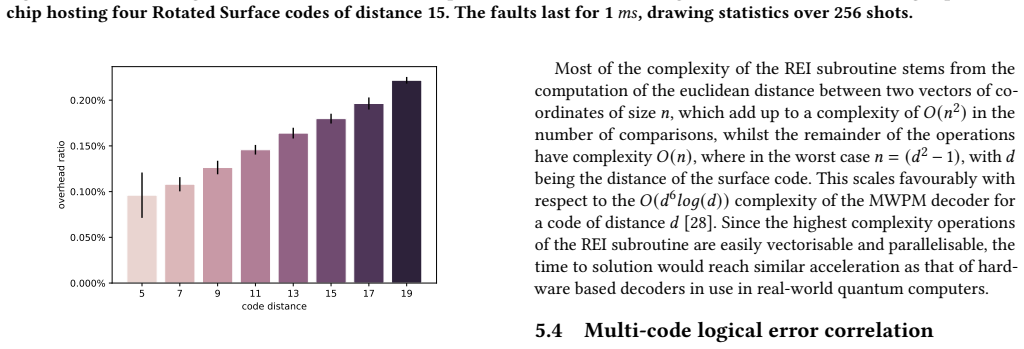
- REI can be inserted before any graph-based decoder with under 0.3% overhead, so radiation awareness is compatible with real-time decoding time constraints.
- Because REI is designed to be agnostic to the QEC code and the error basis, similar syndrome-correlation pre-processing should transfer to stabiliser codes beyond the Rotated Surface code.
- Larger code distances dilute a radiation event across more stabilisers, so higher-distance codes preserve a lower fraction of corrupted stabilisers and stay detectable for a shorter tail of the event.
- RadMatching lowers logical error by upwards of 25% at peak intensity relative to MWPM, while all four radiation-unaware graph decoders studied exceed roughly 50% logical error during the event.
- On a chip hosting several distance-15 surface codes, correlated logical-error spikes track proximity to the impact point, with equidistant codes spiking together.
Reading between the lines
- If real cosmic-ray events match the model's temporal and spatial profile, REI's output could trigger hardware-level responses such as pausing correction, flagging affected QEC rounds as unreliable, or dynamically remapping logical qubits away from the damaged region.
- The correlated multi-code error spikes imply that future large chips should schedule or place logical qubits with radiation geometry in mind, for example by duplicating logical qubits in well-separated regions rather than clustering them around one chip area.
- REI's radius and centroid could be used to adjust decoder edge weights continuously during a radiation transient, not just to flip binary stabiliser measurements, which might capture partial erasures more accurately than RadMatching's thresholded flip.
- The 100% detection number is a simulation result tied to the injected model; a natural next test is to run REI on real syndrome streams from a chip with a co-located cosmic-ray detector and measure the true detection rate and localisation bias.
Signed reviews
Editorial analysis
A structured set of objections, weighed in public.
Referee Report
Summary. The paper proposes Radiation Event Identification (REI), a runtime algorithm that analyzes syndrome measurements of a Rotated Surface code to detect cosmic-ray-induced correlated errors, estimate the impact centre, and identify the affected area. The authors also introduce RadMatching, a radiation-aware pre-processing step that flips stabiliser measurements in the estimated affected region before feeding the syndrome to a MWPM decoder. The claims—100% fault detection, accurate centre/area identification, sub-0.3% decoding overhead, and up to 20–25% improvement in decoder output correctness—are supported by a large STIM-based simulation campaign (over 11 million shots) using a physics-derived radiation model specified by Equations 1–4.
Significance. The topic is timely and practically relevant: radiation-induced correlated errors are a recognized obstacle to fault-tolerant superconducting quantum computing, and algorithmic mitigation at the decoder level would complement hardware shielding approaches. The paper's strengths include the scale of the simulation campaign, the explicit goal of runtime integration, the low overhead of REI, and the concrete proposal of a radiation-aware decoding step. If the claims hold, this would be a useful step toward radiation-aware QEC. However, the significance is contingent on the transferability of the results from the assumed physics model to real device behaviour; the current evidence is entirely simulation-based and the detector is matched to the model that generates its test data.
major comments (4)
- [Section 3.3 (Eqs. 1–4) and Algorithm 1] The REI detection logic (FIFO temporal correlation, spatial clustering test, weighted centroid, radius formula) is constructed to recognize exactly the correlated signatures generated by the paper's own radiation model: exp(10) coherence collapse, single-gate erasure probability, inverse-square spatial falloff, and product form. The manuscript tests the detector on this same model, so the reported 100% detection and localization accuracy may be an artifact of this closed loop. No sensitivity analysis over model parameters (e.g., the temporal decay exponent, the spatial falloff exponent, or event duration) is provided, and there is no validation on experimental correlated-error data such as those in McEwen et al. [36] or Wilen et al. [45]. This is load-bearing for the central claim; please add a systematic robustness study or an experimental benchmark.
- [Sections 5.1 and 5.2] The abstract claims that REI "accurately identify[ies] both the radiation impact centre and the area affected," but the evaluation never compares the returned (x, y) and radius against the injected locus. The reported metrics are detection rate and afflicted-stabiliser ratio over time; there is no quantitative localization error metric. Without e.g. the mean/median absolute error in centre coordinates and radius, as a function of time, code distance, and injection site, the localization claim is unsupported.
- [Section 5.5 and Figure 7] RadMatching is evaluated only for one configuration: d=9, central fault, 384 shots. The abstract's "up to 20%" improvement conflicts with the text's "upwards of 25%" in Section 5.5 and "about 25%" in the Conclusion. The improvement should be reported as an average over a meaningful ensemble with error bars, and should be tested across multiple fault positions, code distances, and radiation intensities to support the general claim. It should also be clarified whether the improvement is measured relative to MWPM alone or to all the compared decoders, since the comparison set matters for the abstract's wording.
- [Abstract, Figures 3 and 4] The claim that the technique "detects 100% of injected faults" is ambiguous. The detection-rate plots in Figures 3 and 4 show 100% only near event onset, with the rate falling before the end of the 1 ms event (earlier for peripheral faults and higher-distance codes). If the intended claim is that every injected event is detected at least once during its lifetime, this should be stated explicitly and supported with per-event detection counts. If the claim is a per-syndrome detection rate, it is contradicted by the presented data.
minor comments (6)
- [Abstract and Section 5.3] The abstract states overhead "lower than 0.3% the decoding time," but Section 5.3 reports measured overheads between 0.1% and 0.2% for distances 3–19. These numbers should be reconciled.
- [Section 5.5 and Conclusion] The improvement figure is reported inconsistently: "up to 20%" in the abstract, "upwards of 25%" in Section 5.5, and "about 25%" in the Conclusion. Use a single, precisely defined quantity.
- [References] Reference [5] is an anonymous placeholder URL with "to be disclosed after the review process." This is not acceptable for reproducibility; please provide a working repository link or a data-availability statement.
- [Table 1] The table caption contains a typo: "Instrinsic noise model" should be "Intrinsic noise model."
- [Figures 3 and 4] The detection-rate plots claim "no false positives" without reporting a quantitative false-positive rate. Please state the number of false-positive detections or the false-positive rate outside the event window.
- [Section 1 and Section 5] The 11 million shot figure is not reconciled with the reported sample sizes (128–512 per configuration). Please provide a breakdown of how the total number of shots is accumulated.
Circularity Check
Closed-loop validation: REI is a matched filter for the paper's own radiation model, so the 100% detection/localization claim is a consistency check rather than an independent prediction.
-
other
[Section 4 (Algorithm 1: temporal FIFO, spatial clustering, weighted centroid/radius), validated in Sections 5.1-5.2; abstract claim]
"Given the radiation fault model presented in Section 3.3, we know that high energy events show correlations in space, over neighbouring qubits on the quantum chip, and in time, across time spans that last for thousands of QEC shots. ... Given the properties of radiation faults described in Section 3.3, we expect the affected area to be circle-shaped and centred on the injection point."
The injected faults in the evaluation are generated by the paper's own model (Eqs. 1-4): P(Δs,Δt,t)=S(Δs)T(Δt,t) with S=1/(Δs+1)^2 and T=1-exp(-Δt/τ_rad(t)). REI's FIFO window, spatial clustering threshold (correlation_factor ≤ 2*device_avg_min_dist), and weighted centroid/radius (Algorithm 1, lines 28-38) are explicitly adapted to that correlated space-time signature. A fault drawn from Eq. 4 therefore produces, by construction, the clustered, persistent defect pattern that REI is designed to flag; the reported 100% detection and the 'circle-shaped' area expectation are consequences of this model-detector match, not independent empirical predictions. No sensitivity analysis over the model parameters or comparison with experimental correlated-error data is provided.
full rationale
The central detection and localization claims are not backed by an independent benchmark: REI is hand-constructed from the same physics model used to generate the injected faults. The temporal FIFO, spatial clustering test, and weighted centroid/radius formulas are matched to the exact temporal decay and inverse-square spatial falloff of Eqs. 1-4, so the 100% detection rate and accurate-area statements are largely a self-consistency check. This is partial circularity, not a definitional identity, because the RadMatching decoder comparison and the logical-error-rate measurements retain independent content: whether flipping identified stabilisers improves decoding is not logically forced by the model-detector match. The paper contains self-citations, but they are background and not load-bearing. The main weakness is the closed-loop evaluation and the absence of a quantitative localization-error metric against the injected ground truth; these are validation gaps as much as circularity. Score 6 reflects that the headline detection/localization prediction reduces by construction to the model-detector match, while the decoder-improvement claim does not.
Assumptions & free parameters
free parameters (5)
- K_max (FIFO length)
- alpha pruning threshold =
1/((rounds+1)*K)
- error weighting exponent =
2
- radius multiplier =
2
- correlation threshold factor =
2*device_avg_min_dist
assumptions (5)
- domain assumption Radiation faults follow the spatio-temporal model of Equations 1-4: tau_rad(t)=tau1*exp(10((t-t_rad)/Delta_t_rad-1)), T=1-exp(-Delta_t_g/tau_rad(t)), S=1/(Delta_s+1)^2, P=S*T.
- domain assumption Intrinsic noise is depolarizing Pauli noise at constant p=1e-5, uncorrelated across qubits and rounds.
- domain assumption The 760-qubit chip topology and surface-code mapping, with no SWAP operations, are representative of real devices.
- domain assumption Flipping stabiliser bits in the REI-identified area before MWPM decoding is a valid correction for radiation effects.
- domain assumption The affected area is approximately circular and centered at the weighted centroid, with radius 2 times the weighted mean distance.
Cite this review
Pith. "Pith review of Radiation-Induced Fault Detection in Superconducting Quantum Devices." pith.science (2026). https://pith.science/paper/SKBQIDXW
@misc{pith2026250616834,
  author       = {Pith},
  title        = {Pith review of: Radiation-Induced Fault Detection in Superconducting Quantum Devices},
  year         = {2026},
  howpublished = {\url{https://pith.science/paper/SKBQIDXW}},
  note         = {Machine review of arXiv:2506.16834}
}
abstract
The quest for universal superconducting quantum computing is hindered by noise and errors. It has been proven that Quantum Error Correction (QEC) codes will lay at the foundation of fault tolerant quantum computing. However, cosmic-ray induced correlated errors, which are the most detrimental events that can impact superconducting quantum computers, are yet to be efficiently tackled. In order to reach fault tolerance, we must also develop radiation aware methods to complement QEC. In this paper, we propose the first algorithm to effectively exploit syndrome information for the efficient detection of radiation events in superconducting quantum devices at runtime. We perform a thorough analysis of simulated Rotated Surface codes injecting over 11 million physics-modeled radiation-induced faults. We consider the properties of the X and Z check bases, the impact of code distance, and the decoder's time to solution constraints. Our technique detects $100\%$ of injected faults, regardless of the impact's position. Moreover, we accurately identify both the radiation impact centre and the area affected, with an overhead lower than $0.3\%$ the decoding time. Additionally, we use the fault identification information to propose a radiation fault correction technique that improves of up to $20\%$ the output correctness compared to existing decoders.
Figures


Figures from the paper (4 more)



Reference graph
Works this paper leans on
-
[36]
Resolving catastrophic error bursts from cosmic rays in large arrays of superconducting qubits
Matt McEwen et al. “Resolving catastrophic error bursts from cosmic rays in large arrays of superconducting qubits”. In: Nature Physics 18.1 (Jan. 2022), pp. 107–111. issn: 1745-2481. doi: 10.1038/s41567-021-01432-8. url: https://doi.org/10. 1038/s41567-021-01432-8
-
[45]
Correlated charge noise and re- laxation errors in superconducting qubits
Christopher D Wilen et al. “Correlated charge noise and re- laxation errors in superconducting qubits”. In:Nature 594.7863 (2021), pp. 369–373. doi: 10.1038/s41586-021-03557-5. url: https://doi.org/10.1038/s41586-021-03557-5
-
[1]
Quantum error correction below the surface code threshold
Rajeev Acharya et al. “Quantum error correction below the surface code threshold”. In: Nature 638.8052 (Feb. 2025), pp. 920–926. issn: 1476-4687. doi: 10 . 1038 / s41586 - 024 - 08449-y. url: https://doi.org/10.1038/s41586-024-08449-y
-
[2]
Suppressing quantum errors by scal- ing a surface code logical qubit
Rajeev Acharya et al. “Suppressing quantum errors by scal- ing a surface code logical qubit”. In: Nature 614.7949 (Feb. 2023), pp. 676–681. issn: 1476-4687. doi: 10.1038/s41586-022- 05434-1. url: https://doi.org/10.1038/s41586-022-05434-1
-
[3]
Fast scalable and low-power quantum circuit simulation on the cluster of GPUs platforms
Armin Ahmadzadeh and Hamid Sarbazi-Azad. “Fast scalable and low-power quantum circuit simulation on the cluster of GPUs platforms”. In: Optical and Quantum Electronics 56.10 (Sept. 2024), p. 1646. issn: 1572-817X. doi: 10.1007/s11082- 024-07492-3. url: https://doi.org/10.1007/s11082-024-07492- 3
-
[4]
Superconducting Qubits above 20 GHz Operating over 200 mK
Alexander Anferov et al. “Superconducting Qubits above 20 GHz Operating over 200 mK”. In: PRX Quantum 5 (3 Sept. 2024), p. 030347. doi: 10.1103/PRXQuantum.5.030347. url: https://link.aps.org/doi/10.1103/PRXQuantum.5.030347
-
[5]
Work repository to be disclosed after the review process
Anonymous Author. Work repository to be disclosed after the review process. https://github.com/. 2025
work page 2025
-
[6]
A real-time, scalable, fast and resource- efficient decoder for a quantum computer
Ben Barber et al. “A real-time, scalable, fast and resource- efficient decoder for a quantum computer”. In: Nature Elec- tronics 8.1 (Jan. 2025), pp. 84–91. issn: 2520-1131. doi: 10. 1038/s41928- 024- 01319- 5. url: https://doi.org/10.1038/ s41928-024-01319-5
work page 2025
Show all 50 references
-
[7]
Real-time decoding for fault-tolerant quan- tum computing: progress, challenges and outlook
F Battistel et al. “Real-time decoding for fault-tolerant quan- tum computing: progress, challenges and outlook”. In: Nano Futures 7.3 (Aug. 2023), p. 032003. doi: 10.1088/2399-1984/ aceba6. url: https://dx.doi.org/10.1088/2399-1984/aceba6
2023 doi
-
[8]
Soft errors in advanced computer sys- tems
Robert Baumann. “Soft errors in advanced computer sys- tems”. In: IEEE Design Test of Computers 22.3 (May 2005), pp. 258–266. issn: 0740-7475. doi: 10.1109/MDT.2005.69
2005 doi
-
[9]
Learning high-accuracy error de- coding for quantum processors
Johannes Bausch et al. “Learning high-accuracy error de- coding for quantum processors”. In: Nature 635.8040 (Nov. 2024), pp. 834–840. issn: 1476-4687. doi: 10.1038/s41586-024- 08148-8. url: https://doi.org/10.1038/s41586-024-08148-8
2024 doi
-
[10]
Optimal resources for topological two-dimensional stabilizer codes: Comparative study
H. Bombin and M. A. Martin-Delgado. “Optimal resources for topological two-dimensional stabilizer codes: Comparative study”. In: Physical Review A 76.1 (July 2007). issn: 1094-1622. doi: 10.1103/physreva.76.012305. url: http://dx.doi.org/10. 1103/PhysRevA.76.012305
2007 doi
-
[11]
High-threshold and low-overhead fault- tolerant quantum memory
Sergey Bravyi et al. “High-threshold and low-overhead fault- tolerant quantum memory”. In: Nature 627.8005 (Mar. 2024), pp. 778–782. issn: 1476-4687. doi: 10.1038/s41586-024-07107-
2024 doi
-
[12]
url: https://doi.org/10.1038/s41586-024-07107-7
-
[13]
Disentangling the sources of ionizing ra- diation in superconducting qubits
L. Cardani et al. “Disentangling the sources of ionizing ra- diation in superconducting qubits”. In: The European Phys- ical Journal C 83.1 (Jan. 2023), p. 94. issn: 1434-6052. doi: 10.1140/epjc/s10052-023-11199-2. url: https://doi.org/10. 1140/epjc/s10052-023-11199-2
2023 doi
-
[14]
Reducing the impact of radioactivity on quantum circuits in a deep-underground facility
Laura Cardani et al. “Reducing the impact of radioactivity on quantum circuits in a deep-underground facility”. In: Nature communications 12.1 (2021), p. 2733
2021
-
[15]
Understanding the Contributions of Terrestrial Radiation Sources to Error Rates in Quantum Devices
Gioele Casagranda et al. “Understanding the Contributions of Terrestrial Radiation Sources to Error Rates in Quantum Devices”. In: IEEE Transactions on Nuclear Science (2025), pp. 1–1. doi: 10.1109/TNS.2025.3537036
2025
-
[16]
Understanding the Impact of Cutting in Quantum Circuits Reliability to Transient Faults
Nadir Casciola et al. “Understanding the Impact of Cutting in Quantum Circuits Reliability to Transient Faults”. In:2022 IEEE 28th International Symposium on On-Line Testing and Robust System Design (IOLTS) . 2022, pp. 1–7. doi: 10.1109/ IOLTS56730.2022.9897308
2022
-
[17]
Quantum Error Correction For Dummies
Avimita Chatterjee, Koustubh Phalak, and Swaroop Ghosh. “Quantum Error Correction For Dummies”. In: 2023 IEEE In- ternational Conference on Quantum Computing and Engineer- ing (QCE). Vol. 01. 2023, pp. 70–81. doi: 10.1109/QCE57702. 2023.00017
2023
-
[18]
Christopher T. Chubb. General tensor network decoding of 2D Pauli codes . 2021. arXiv: 2101.04125 [quant-ph]. url: https://arxiv.org/abs/2101.04125. Vallero et al
2021 arXiv
-
[19]
Toward a Union-Find Decoder for Quantum LDPC Codes
Nicolas Delfosse, Vivien Londe, and Michael E. Beverland. “Toward a Union-Find Decoder for Quantum LDPC Codes”. In: IEEE Transactions on Information Theory68.5 (2022), pp. 3187–
2022
-
[20]
Paths, Trees, and Flowers
Jack Edmonds. “Paths, Trees, and Flowers”. In: Canadian Journal of Mathematics 17 (1965), pp. 449–467. doi: 10.4153/ CJM-1965-045-4
1965
-
[21]
Almost-linear time decoding algorithm for topological codes
Nicolas Delfosse and Naomi H. Nickerson. “Almost-linear time decoding algorithm for topological codes”. In:Quantum 5 (Dec. 2021), p. 595. issn: 2521-327X. doi: 10.22331/q-2021- 12-02-595. url: http://dx.doi.org/10.22331/q-2021-12-02- 595
2021 doi
-
[22]
Minimum weight perfect matching of fault-tolerant topological quantum error correction in aver- age O(1) parallel time
Austin G. Fowler. “Minimum weight perfect matching of fault-tolerant topological quantum error correction in aver- age O(1) parallel time”. In: Quantum Info. Comput. 15.1–2 (Jan. 2015), pp. 145–158. issn: 1533-7146
2015
-
[23]
Tensor Networks and Quantum Error Correction
Andrew J. Ferris and David Poulin. “Tensor Networks and Quantum Error Correction”. In: Phys. Rev. Lett. 113 (3 July 2014), p. 030501. doi: 10.1103/PhysRevLett.113.030501. url: https://link.aps.org/doi/10.1103/PhysRevLett.113.030501
2014 doi
-
[24]
Stim: a fast stabilizer circuit simulator
Craig Gidney. “Stim: a fast stabilizer circuit simulator”. In: Quantum 5 (July 2021), p. 497.issn: 2521-327X. doi: 10.22331/ q-2021-07-06-497. url: https://doi.org/10.22331/q-2021-07- 06-497
2021 doi
-
[25]
Modeling and simulating the noisy behavior of near- term quantum computers
Konstantinos Georgopoulos, Clive Emary, and Paolo Zu- liani. “Modeling and simulating the noisy behavior of near- term quantum computers”. In: Phys. Rev. A 104 (6 Dec. 2021), p. 062432. doi: 10.1103/PhysRevA.104.062432. url: https: //link.aps.org/doi/10.1103/PhysRevA.104.062432
2021 doi
-
[26]
Stabilizer Codes and Quantum Error Cor- rection
Daniel Gottesman. Stabilizer Codes and Quantum Error Cor- rection. 1997. arXiv: quant- ph/9705052 [quant-ph]. url: https://arxiv.org/abs/quant-ph/9705052
1997
-
[27]
Bench- marking the Planar Honeycomb Code
Craig Gidney, Michael Newman, and Matt McEwen. “Bench- marking the Planar Honeycomb Code”. In: Quantum 6 (Sept. 2022), p. 813. issn: 2521-327X. doi: 10.22331/q-2022-09-21-
2022 doi
-
[28]
PyMatching: A Python Package for Decod- ing Quantum Codes with Minimum-Weight Perfect Match- ing
Oscar Higgott. “PyMatching: A Python Package for Decod- ing Quantum Codes with Minimum-Weight Perfect Match- ing”. In: ACM Transactions on Quantum Computing 3.3 (June 2022). doi: 10.1145/3505637. url: https://doi.org/10.1145/ 3505637
2022 doi
-
[29]
Improved decoding of circuit noise and fragile boundaries of tailored surface codes
Oscar Higgott et al. Improved decoding of circuit noise and fragile boundaries of tailored surface codes . 2023. arXiv: 2203. 04948 [quant-ph]. url: https://arxiv.org/abs/2203.04948
2023
-
[30]
Harrington et al
Patrick M. Harrington et al. Synchronous Detection of Cosmic Rays and Correlated Errors in Superconducting Qubit Arrays
-
[31]
Implementation of scalable suspended superinductors
Christian Jünger et al. “Implementation of scalable suspended superinductors”. In: Applied Physics Letters 126.4 (Jan. 2025), p. 044003. issn: 0003-6951. doi: 10.1063/5.0250341. eprint: https://pubs.aip.org/aip/apl/article- pdf/doi/10.1063/5. 0250341/20367496/044003\_1\_5.0250...
2025 doi
-
[32]
Improved quan- tum hypergraph-product LDPC codes
Alexey A. Kovalev and Leonid P. Pryadko. “Improved quan- tum hypergraph-product LDPC codes”. In:2012 IEEE Interna- tional Symposium on Information Theory Proceedings . IEEE, July 2012, pp. 348–352. doi: 10.1109/isit.2012.6284206. url: http://dx.doi.org/10.1109/ISIT.2012.6284206
2012
-
[33]
Comparative Benchmarking of Utility- Scale Quantum Emulators
Anna Leonteva et al. Comparative Benchmarking of Utility- Scale Quantum Emulators. 2025. arXiv: 2504.14027[quant-ph]. url: https://arxiv.org/abs/2504.14027
2025 arXiv
-
[34]
Measurement and Reporting of Alpha Particle and Terrestrial Cosmic Ray-Induced Soft Errors in Semiconductor Devices
JEDEC. Measurement and Reporting of Alpha Particle and Terrestrial Cosmic Ray-Induced Soft Errors in Semiconductor Devices. Tech. rep. JESD89A. JEDEC Standard, 2006
2006
-
[35]
Saving superconducting quantum proces- sors from decay and correlated errors generated by gamma and cosmic rays
John M. Martinis. “Saving superconducting quantum proces- sors from decay and correlated errors generated by gamma and cosmic rays”. In: npj Quantum Information 7.1 (2021), p. 90. doi: 10.1038/s41534-021-00431-0. url: https://doi.org/ 10.1038/s41534-021-00431-0
2021 doi
-
[37]
QuFI: a Quantum Fault Injector to Measure the Reliability of Qubits and Quantum Circuits
Daniel Oliveira et al. “QuFI: a Quantum Fault Injector to Measure the Reliability of Qubits and Quantum Circuits”. In: arXiv preprint arXiv:2203.07183 (2022)
2022 arXiv
-
[38]
Abatement of ionizing radiation for super- conducting quantum devices
B. Loer et al. “Abatement of ionizing radiation for super- conducting quantum devices”. In: Journal of Instrumenta- tion 19.09 (Sept. 2024), P09001. doi: 10.1088/1748- 0221/ 19 / 09 / P09001.url: https : / / dx . doi . org / 10 . 1088 / 1748 - 0221/19/09/P09001
2024 doi
-
[39]
LDPC: Python tools for low density parity check codes
Joschka Roffe. LDPC: Python tools for low density parity check codes. 2022. url: https://pypi.org/project/ldpc/
2022
-
[40]
Reinforcement learning decoders for fault-tolerant quantum computation
Ryan Sweke et al. “Reinforcement learning decoders for fault-tolerant quantum computation”. In: Machine Learn- ing: Science and Technology 2.2 (Dec. 2020), p. 025005. doi: 10.1088/2632-2153/abc609. url: https://dx.doi.org/10.1088/ 2632-2153/abc609
2020 doi
-
[41]
State of prac- tice: Evaluating GPU performance of state vector and tensor network methods
Marzio Vallero, Paolo Rech, and Flavio Vella. “State of prac- tice: Evaluating GPU performance of state vector and tensor network methods”. In: Future Generation Computer Systems 174 (2026), p. 107927. issn: 0167-739X. doi: https://doi.org/ 10.1016/j.future.2025.107927. url: h...
2026
-
[42]
Quantum Computing in the NISQ era and beyond
John Preskill. “Quantum Computing in the NISQ era and beyond”. In: Quantum 2 (Aug. 2018), p. 79. issn: 2521-327X. doi: 10.22331/q-2018-08-06-79. url: http://dx.doi.org/10. 22331/q-2018-08-06-79
2018 doi
-
[43]
Understanding Logical-Shift Error Propagation in Quanvolutional Neural Networks
Marzio Vallero et al. “Understanding Logical-Shift Error Propagation in Quanvolutional Neural Networks”. In: IEEE Transactions on Quantum Engineering 5 (2024), pp. 1–14. doi: 10.1109/TQE.2024.3372880
2024
-
[44]
Impact of ionizing radiation on su- perconducting qubit coherence
Antti P. Vepsäläinen et al. “Impact of ionizing radiation on su- perconducting qubit coherence”. In: Nature 584.7822 (2020), pp. 551–556. doi: 10.1038/s41586-020-2619-8. url: https: //doi.org/10.1038/s41586-020-2619-8. Radiation-Induced Fault Detection in Superconducting Quant...
2020 doi
-
[46]
On the Efficacy of Surface Codes in Compensating for Radiation Events in Superconducting De- vices
Marzio Vallero et al. “On the Efficacy of Surface Codes in Compensating for Radiation Events in Superconducting De- vices”. In: SC24: International Conference for High Perfor- mance Computing, Networking, Storage and Analysis . 2024, pp. 1–15. doi: 10.1109/SC41406.2024.00075
2024 arXiv
-
[50]
A single quantum cannot be cloned
W. K. Wootters and W. H. Zurek. “A single quantum cannot be cloned”. In: Nature 299.5886 (Oct. 1982), pp. 802–803.issn: 1476-4687. doi: 10.1038/299802a0. url: https://doi.org/10. 1038/299802a0
1982 doi
-
[813]
url: http://dx.doi.org/10.22331/q-2022-09-21-813
2022 doi
-
[2024]
arXiv: 2402.03208 [quant-ph]
-
[3199]
doi: 10.1109/TIT.2022.3143452
2022
Reviewed August 15, 2026 · model on record in the stance chip above.
Discussion (0). Continue with ORCID to comment.