Slay the Shear: A Unified Statistical Framework for Weak Gravitational Lensing Shear Estimation
Pith reviewed 2026-06-25 20:37 UTC · model grok-4.3
The pith
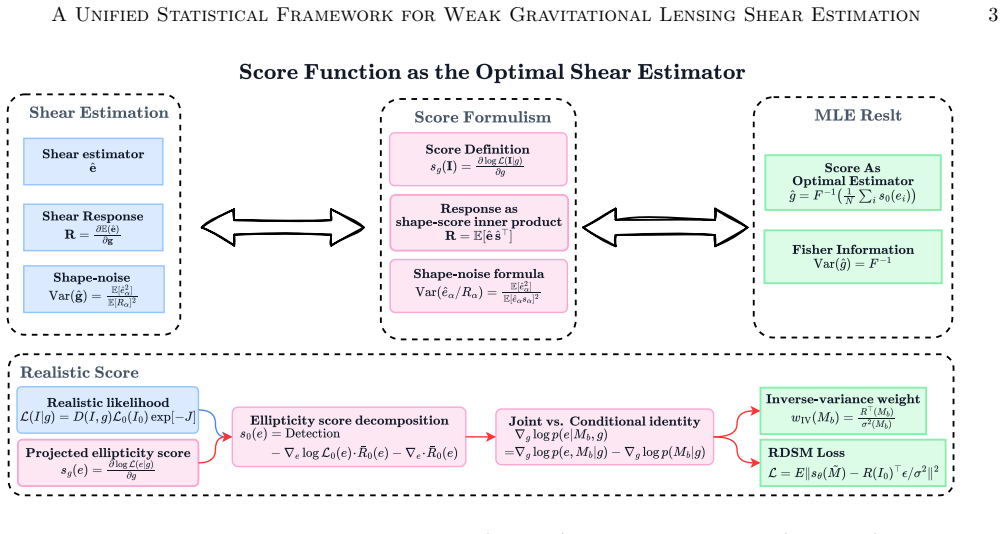
The score function of the image likelihood is the minimum-variance unbiased estimator for weak lensing shear.
A machine-rendered reading of the paper's core claim, the machinery that carries it, and where it could break.
Core claim
For a general spin-2 ellipticity definition, the ensemble shear response corresponds to an inner product between the estimator and the score function, and the score provides the minimum-variance unbiased shear estimator. By incorporating response into the classical inverse-variance weight, the response-weighted inverse-variance weight is a general shape-noise-minimizing weight, independent of the intrinsic shape distribution.
What carries the argument
The score function, the gradient of the image likelihood with respect to shear, which establishes the inner-product relation that makes response-based methods optimal and enables construction of improved estimators.
If this is right
- Existing response-based calibration techniques recover the inner-product relation with the score and are therefore statistically optimal within the framework.
- Response-weighted inverse-variance weighting minimizes shape noise for arbitrary intrinsic shape distributions.
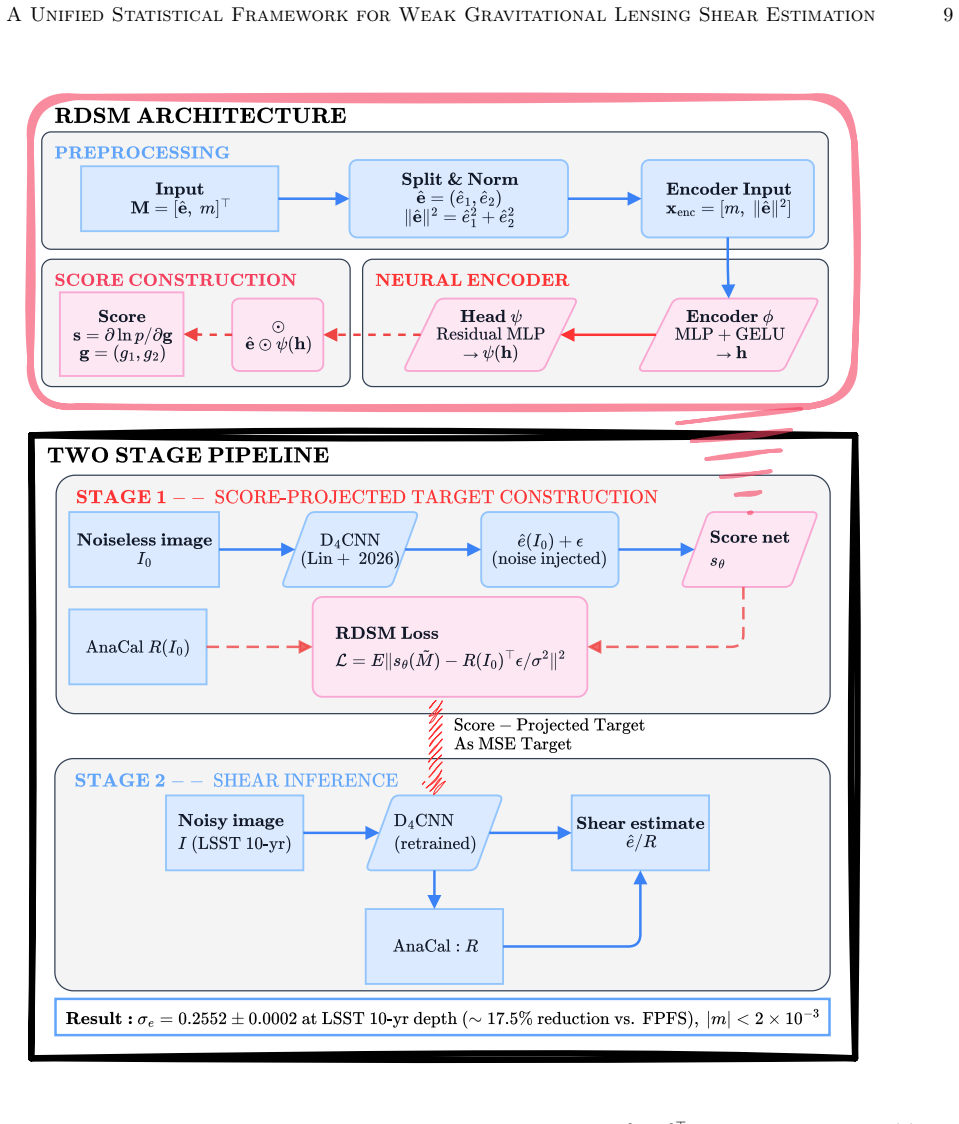
- Nonlinear shape transformations and learned representations can be inserted into the RDSM procedure to further reduce noise while preserving the bias bound.
- The framework unifies classical moment methods with modern machine-learning shear estimators under a single statistical relation.
Where Pith is reading between the lines
- If the differentiability condition holds after realistic selection cuts, pipelines could substitute score-based estimators for moment-based ones to obtain the reported noise reduction.
- The same inner-product relation supplies a route to combine multiple shear estimators in an optimal way without additional calibration steps.
- Taking higher derivatives of the likelihood could extend the framework to flexion or other higher-order lensing effects.
- Direct tests on end-to-end image simulations with injected shear would confirm whether the 17.5 percent improvement survives realistic PSF and selection systematics.
Load-bearing premise
The image likelihood must be differentiable with respect to shear and ensemble averages over galaxy morphologies must remain free of selection effects or systematics that would break the inner-product relation.
What would settle it
A calculation on simulated galaxy images in which the measured response fails to equal the inner product between the estimator and the score function, or in which the proposed RDSM estimator does not deliver the claimed noise reduction at the stated bias level.
Figures
read the original abstract
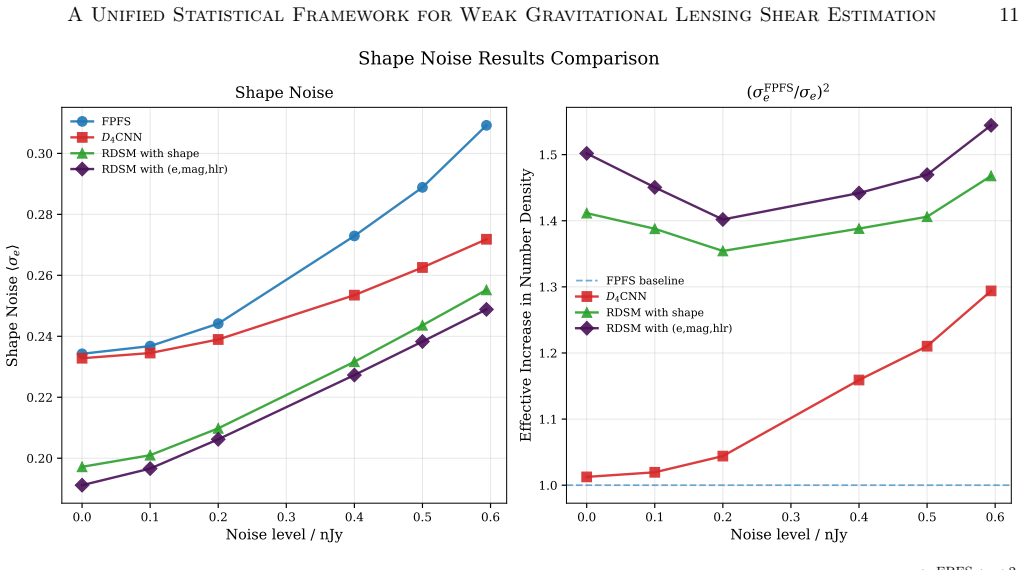
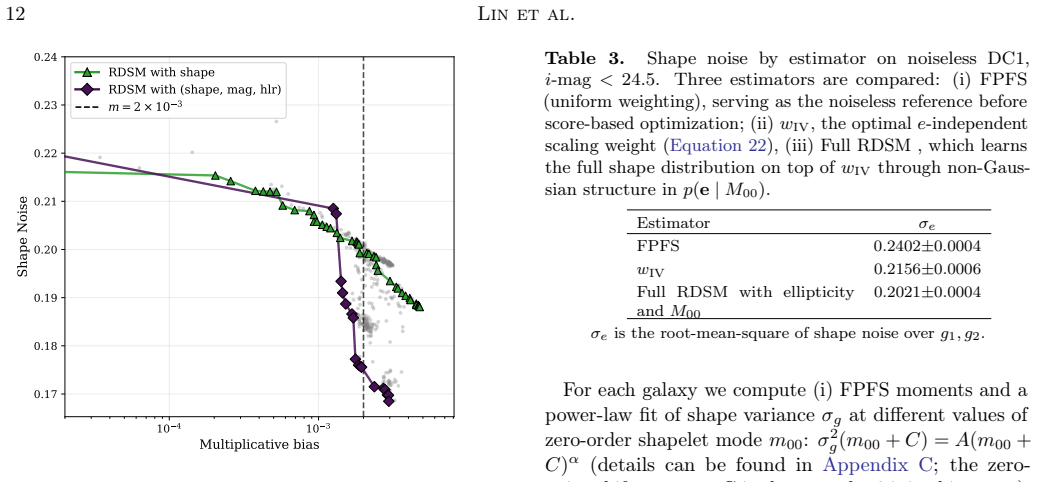
Weak gravitational lensing shear measurements are fundamentally limited by shape noise arising from the intrinsic diversity of galaxy morphologies. Upcoming surveys such as Rubin/LSST, Euclid, and Roman demand more flexible, statistically optimal approaches that can fully exploit high-dimensional image information. In this work, we develop a unified theoretical framework for shear estimation that connects classical response-based methods, shape noise, and modern machine-learning estimators through the concept of the score function -- the gradient of the image likelihood with respect to shear. We show that, for a general spin-2 ellipticity definition, the ensemble shear response corresponds to an inner product between the estimator and the score function, and that the score provides the minimum-variance unbiased shear estimator. By incorporating response into the classical inverse-variance weight, we prove that the response-weighted inverse-variance weight is a general shape-noise-minimizing weight, independent of the intrinsic shape distribution. Furthermore, we propose Response-weighted Denoising Score Matching (RDSM) that exploits the remaining structure to reduce shape noise by ${\sim}17.5\%$ relative to moment-based methods at LSST 10-year depth while maintaining a multiplicative shear estimation bias below $2\times 10^{-3}$. Our result clarifies the optimality of existing calibration techniques while revealing a principled pathway for constructing improved estimators via nonlinear shape transformations and learned representations.
Editorial analysis
A structured set of objections, weighed in public.
Referee Report
Summary. The paper develops a unified theoretical framework for weak gravitational lensing shear estimation using the score function of the image likelihood with respect to shear. It shows that the ensemble shear response is an inner product between the estimator and the score function for a general spin-2 ellipticity definition, that the score is the minimum-variance unbiased shear estimator, and that the response-weighted inverse-variance weight minimizes shape noise independently of the intrinsic shape distribution. The paper also proposes Response-weighted Denoising Score Matching (RDSM) that achieves approximately 17.5% shape noise reduction relative to moment-based methods at LSST 10-year depth with multiplicative bias below 2×10^{-3}.
Significance. If the derivations hold, this work supplies a principled statistical foundation that unifies classical response-based methods with modern machine-learning estimators for shear estimation. The demonstration that the optimal weighting is independent of the intrinsic shape distribution addresses a longstanding limitation and could simplify estimator design for surveys such as LSST, Euclid, and Roman. The explicit derivations from the likelihood score (without fitted parameters) constitute a clear strength. The proposed RDSM method supplies a concrete, quantifiable improvement pathway.
minor comments (2)
- [Abstract] The abstract states a specific 17.5% noise reduction; the main text should include the precise simulation setup, galaxy sample, and baseline moment-based estimator used to obtain this figure so that the result can be reproduced.
- The assumptions of likelihood differentiability with respect to shear and uncontaminated ensemble averages are stated; a brief dedicated paragraph early in the manuscript should summarize where these assumptions are used in the derivations and where they might be violated by real data.
Simulated Author's Rebuttal
We thank the referee for their supportive review, accurate summary of our contributions, and recommendation for minor revision. We are pleased that the statistical framework and the independence of optimal weighting from the intrinsic shape distribution are recognized as strengths. No specific major comments were raised in the report.
Circularity Check
No significant circularity identified
full rationale
The derivation chain begins from the definition of the score as the gradient of the log-likelihood with respect to shear and shows that the ensemble response equals the inner product of any estimator with this score; this is a direct consequence of interchanging differentiation and expectation under the differentiability assumption stated in the paper. The minimum-variance property of the score estimator and the optimality of response-weighted inverse-variance weights then follow from the same identity without any fitted parameters, self-referential definitions, or load-bearing self-citations. The framework therefore remains self-contained and does not reduce any claimed prediction to its own inputs by construction.
Axiom & Free-Parameter Ledger
axioms (2)
- domain assumption The image likelihood is differentiable with respect to shear parameters.
- domain assumption Ensemble averages over galaxy populations yield an inner product between response and score without selection or observational biases.
Reference graph
Works this paper leans on
-
[1]
2019, in Proceedings of the 25th ACM SIGKDD International Conference on Knowledge Discovery & Data
Akiba, T., Sano, S., Yanase, T., Ohta, T., & Koyama, M. 2019, in Proceedings of the 25th ACM SIGKDD International Conference on Knowledge Discovery & Data
2019
-
[2]
Mining, KDD 2019, Anchorage, AK, USA, August 4-8, 2019, 2623–2631, doi: 10.1145/3292500.3330701 Astropy Collaboration, Robitaille, T. P., Tollerud, E. J., et al. 2013, A&A, 558, A33, doi: 10.1051/0004-6361/201322068 Astropy Collaboration, Price-Whelan, A. M., Sipőcz, B. M., et al. 2018, AJ, 156, 123, doi: 10.3847/1538-3881/aabc4f Astropy Collaboration, Pr...
-
[3]
2001, Physics Reports, 340, 291, doi: 10.1016/S0370-1573(00)00082-X
Bartelmann, M., & Schneider, P. 2001, Physics Reports, 340, 291, doi: 10.1016/S0370-1573(00)00082-X
-
[4]
Bernstein, G. M., & Jarvis, M. 2002, AJ, 123, 583, doi: 10.1086/338085 Cramér, H. 1946, Princeton Mathematical Series, Vol. 9, Mathematical Methods of Statistics (Princeton University Press) Euclid Collaboration, Mellier, Y., Abdurro’uf, et al. 2024, arXiv e-prints, doi: 10.48550/ARXIV.2405.13491
-
[5]
Hendrycks, D., & Gimpel, K. 2016, arXiv e-prints. https://arxiv.org/abs/1606.08415
Pith/arXiv arXiv 2016
-
[6]
Metacalibration: Direct Self-Calibration of Biases in Shear Measurement
Huff, E., & Mandelbaum, R. 2017, arXiv e-prints, arXiv:1702.02600, doi: 10.48550/arXiv.1702.02600 Ivezić, Ž., Kahn, S. M., Tyson, J. A., et al. 2019, ApJ, 873, 111, doi: 10.3847/1538-4357/ab042c
work page internal anchor Pith review Pith/arXiv arXiv doi:10.48550/arxiv.1702.02600 2017
-
[7]
1995, ApJ, 449, 460, doi: 10.1086/176071
Kaiser, N., Squires, G., & Broadhurst, T. 1995, ApJ, 449, 460, doi: 10.1086/176071
-
[8]
and Lu, Lu and Perdikaris, Paris and Wang, Sifan and Yang, Liu , month = may, year =
Karniadakis, G. E., Kevrekidis, I. G., Lu, L., et al. 2021, Nature Reviews Physics, 3, 422, doi: 10.1038/s42254-021-00314-5
-
[9]
Kilbinger, M. 2015, Reports on Progress in Physics, 78, 086901, doi: 10.1088/0034-4885/78/8/086901
-
[10]
L., & Casella, G
Lehmann, E. L., & Casella, G. 1998, Theory of Point Estimation, 2nd edn. (New York: Springer)
1998
-
[11]
Li, X. 2025, arXiv e-prints, arXiv:2506.16607, doi: 10.48550/arXiv.2506.16607
-
[12]
2018, Monthly Notices of the Royal Astronomical Society, 481, 4445, doi: 10.1093/mnras/sty2548
Li, X., Katayama, N., Oguri, M., & More, S. 2018, MNRAS, 481, 4445, doi: 10.1093/mnras/sty2548
-
[13]
2022, Monthly Notices of the Royal Astronomical Society, 511, 4850, doi: 10.1093/mnras/stac342
Li, X., Li, Y., & Massey, R. 2022, MNRAS, 511, 4850, doi: 10.1093/mnras/stac342
-
[14]
2023, Monthly Notices of the Royal Astronomical Society, 521, 4904, doi: 10.1093/mnras/stad890
Li, X., & Mandelbaum, R. 2023, MNRAS, 521, 4904, doi: 10.1093/mnras/stad890
-
[15]
2025, Monthly Notices of the Royal Astronomical Society, 536, 3663, doi: 10.1093/mnras/stae2764
Li, X., Mandelbaum, R., & The LSST Dark Energy Science Collaboration. 2025, MNRAS, 536, 3663, doi: 10.1093/mnras/stae2764
-
[16]
2026, arXiv e-prints, doi: 10.48550/ARXIV.2603.19046
Lin, S., Li, X., Li, J., et al. 2026, arXiv e-prints, doi: 10.48550/ARXIV.2603.19046
-
[17]
Weak Lensing for Precision Cosmology , volume=
Mandelbaum, R. 2018, ARA&A, 56, 393, doi: 10.1146/annurev-astro-081817-051928
-
[18]
, year = 2005, month = apr, volume =
Massey, R., & Refregier, A. 2005, MNRAS, 363, 197, doi: 10.1111/j.1365-2966.2005.09453.x
-
[19]
1999, ARA&A, 37, 127, doi: 10.1146/annurev.astro.37.1.127
Mellier, Y. 1999, ARA&A, 37, 127, doi: 10.1146/annurev.astro.37.1.127
-
[20]
Miller, L., Heymans, C., Kitching, T. D., et al. 2013, MNRAS, 429, 2858, doi: 10.1093/mnras/sts454
-
[21]
Rao, C. R. 1945, Bulletin of the Calcutta Mathematical Society, 37, 81
1945
-
[22]
Refregier, A. 2003, MNRAS, 338, 35, doi: 10.1046/j.1365-8711.2003.05901.x
-
[23]
Refregier, A., & Bacon, D. 2003, MNRAS, 338, 48, doi: 10.1046/j.1365-8711.2003.05902.x
-
[24]
2019, MNRAS, 489, 4847, doi: 10.1093/mnras/stz2374
Ribli, D., Dobos, L., & Csabai, I. 2019, MNRAS, 489, 4847, doi: 10.1093/mnras/stz2374
-
[25]
Ribli, D., Pataki, B. Á., Zorrilla Matilla, J. M., et al. 2019, MNRAS, 490, 1843, doi: 10.1093/mnras/stz2610
-
[26]
Rowe, B. T. P., Jarvis, M., Mandelbaum, R., et al. 2015, Astronomy and Computing, 10, 121, doi: 10.1016/j.ascom.2015.02.002 Sánchez, J., Walter, C. W., Awan, H., et al. 2020, MNRAS, 497, 210, doi: 10.1093/mnras/staa1957
-
[27]
Sheldon, E. S., Becker, M. R., MacCrann, N., & Jarvis, M. 2020, ApJ, 902, 138, doi: 10.3847/1538-4357/abb595
-
[28]
Sheldon, E. S., & Huff, E. M. 2017, ApJ, 841, 24, doi: 10.3847/1538-4357/aa704b
-
[29]
Wide-Field InfrarRed Survey Telescope-Astrophysics Focused Telescope Assets WFIRST-AFTA 2015 Report
Spergel, D., Gehrels, N., Baltay, C., et al. 2015, arXiv e-prints, arXiv:1503.03757, doi: 10.48550/arXiv.1503.03757
work page internal anchor Pith review Pith/arXiv arXiv doi:10.48550/arxiv.1503.03757 2015
-
[30]
Springer, O. M., Ofek, E. O., Weiss, Y., & Merten, J. 2020, MNRAS, 491, 5301, doi: 10.1093/mnras/stz2991 24Lin et al
-
[31]
2019, A&A, 621, A36, doi: 10.1051/0004-6361/201833775
Tewes, M., Kuntzer, T., Nakajima, R., et al. 2019, A&A, 621, A36, doi: 10.1051/0004-6361/201833775
-
[32]
Observing and data analysis systems, discovery and timing of 100 pulsars
Trujillo, I., Aguerri, J., Cepa, J., & Gutiérrez, C. 2001, Monthly Notices of the Royal Astronomical Society, 328, 977–985, doi: 10.1046/j.1365-8711.2001.04937.x
-
[33]
Vincent, P. 2011, Neural Computation, 23, 1661, doi: 10.1162/NECO_a_00142
-
[34]
2016, The Astrophysical Journal, 834, 8, doi: 10.3847/1538-4357/834/1/8
Zhang, J., Zhang, P., & Luo, W. 2016, The Astrophysical Journal, 834, 8, doi: 10.3847/1538-4357/834/1/8
-
[35]
2024, A&A, 683, A209, doi: 10.1051/0004-6361/202345903
Zhang, Z., Shan, H., Li, N., et al. 2024, A&A, 683, A209, doi: 10.1051/0004-6361/202345903
discussion (0)
Sign in with ORCID, Apple, or X to comment. Anyone can read and Pith papers without signing in.