Nuclear-Electron Hyperfine Coupling of the Shallow States Associated with Vacancies in Gallium Nitride
Pith reviewed 2026-06-29 21:20 UTC · model grok-4.3
The pith
Multiband Green's functions solve the electronic structure of vacancies in GaN and yield their hyperfine fields for magnetic resonance identification.
A machine-rendered reading of the paper's core claim, the machinery that carries it, and where it could break.
Core claim
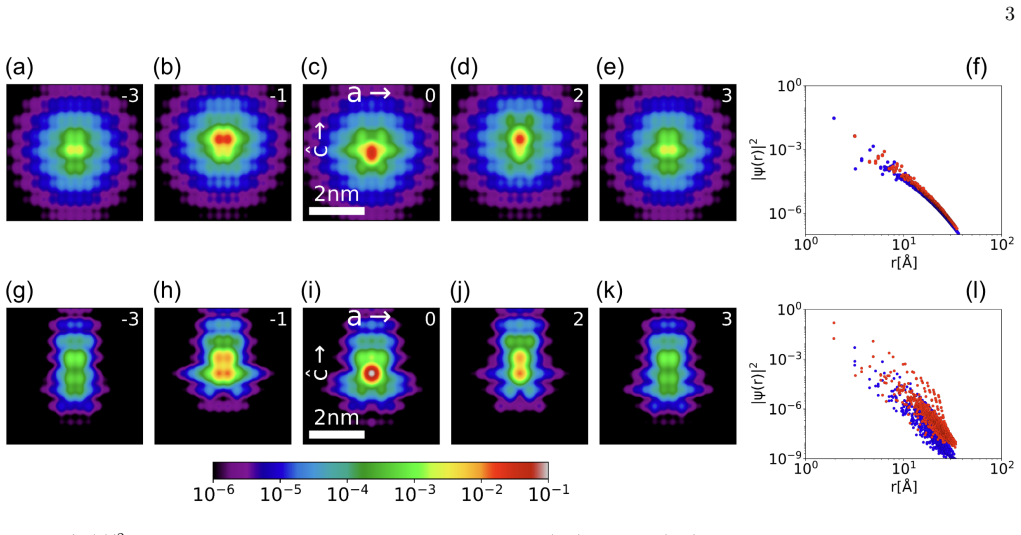
We use multiband real space Green's functions computed using open-boundary conditions for clean GaN to exactly solve the potential-scattering Dyson equation to obtain the electronic structure of single nitrogen and gallium vacancies. From these vacancy solutions, we compute the local density of states as well as the Fermi contact and anisotropic contributions to the hyperfine field in the vicinity of the defect. These quantities directly affect electrically-detected magnetic resonance signals, which can be used to identify these defects when present in GaN devices.
What carries the argument
Multiband real-space Green's functions with open-boundary conditions that exactly solve the potential-scattering Dyson equation for vacancy defects.
If this is right
- Local density of states is obtained in the vicinity of the vacancies.
- Fermi contact and anisotropic hyperfine field contributions are calculated.
- Electrically-detected magnetic resonance signals are influenced by these hyperfine fields.
- These signals can identify nitrogen and gallium vacancies in GaN devices.
Where Pith is reading between the lines
- Similar Green's function techniques could be applied to other point defects or impurities in GaN or related semiconductors.
- The computed hyperfine values might guide the design of experiments to confirm vacancy presence in real samples.
- Extending the model to include lattice relaxation around vacancies could refine the hyperfine predictions.
Load-bearing premise
The multiband real-space Green's functions computed with open-boundary conditions for clean GaN exactly solve the potential-scattering Dyson equation for the electronic structure of the vacancies.
What would settle it
An experimental measurement of the hyperfine coupling constants for nitrogen or gallium vacancies in GaN via EDMR that disagrees with the computed values.
Figures
read the original abstract
We use multiband real space Green's functions computed using open-boundary conditions for clean GaN to exactly solve the potential-scattering Dyson equation to obtain the electronic structure of single nitrogen and gallium vacancies. From these vacancy solutions, we compute the local density of states as well as the Fermi contact and anisotropic contributions to the hyperfine field in the vicinity of the defect. These quantities directly affect electrically-detected magnetic resonance signals, which can be used to identify these defects when present in GaN devices.
Editorial analysis
A structured set of objections, weighed in public.
Referee Report
Summary. The manuscript claims that multiband real-space Green's functions computed with open-boundary conditions for clean GaN exactly solve the potential-scattering Dyson equation for single N and Ga vacancies. From the resulting vacancy solutions the authors compute the local density of states together with the Fermi-contact and anisotropic hyperfine contributions near the defect, asserting that these quantities directly affect electrically-detected magnetic resonance signals usable for defect identification in GaN devices.
Significance. If the central claim of an exact solution holds and the computed hyperfine tensors prove accurate, the work would supply a parameter-free route to hyperfine tensors for vacancy defects, strengthening the link between theory and EDMR-based defect identification. The absence of any fitted parameters or invented entities is a methodological strength.
major comments (2)
- [Abstract] The manuscript supplies no numerical values for the computed LDOS or hyperfine tensors, no error estimates, and no comparison to existing theoretical or experimental hyperfine data for GaN vacancies. This absence is load-bearing for the claim that the quantities 'directly affect' and 'can be used to identify' the defects via EDMR.
- [Abstract] The assertion that the open-boundary Green's functions 'exactly solve' the Dyson equation for the vacancy problem is stated without an explicit demonstration that the open-boundary clean-system propagator satisfies the required boundary conditions when the vacancy potential is introduced; a concrete verification (e.g., recovery of a known test case or sum-rule check) is needed to substantiate the exactness claim.
minor comments (2)
- The title refers to 'shallow states' while the abstract treats generic vacancies; clarification of whether the computed states are shallow or resonant would improve precision.
- Notation for the Fermi-contact and dipolar hyperfine tensors is introduced without an explicit definition of the spin-density operator or the units employed.
Simulated Author's Rebuttal
We thank the referee for the careful reading and the opportunity to clarify the manuscript. We respond to each major comment below.
read point-by-point responses
-
Referee: [Abstract] The manuscript supplies no numerical values for the computed LDOS or hyperfine tensors, no error estimates, and no comparison to existing theoretical or experimental hyperfine data for GaN vacancies. This absence is load-bearing for the claim that the quantities 'directly affect' and 'can be used to identify' the defects via EDMR.
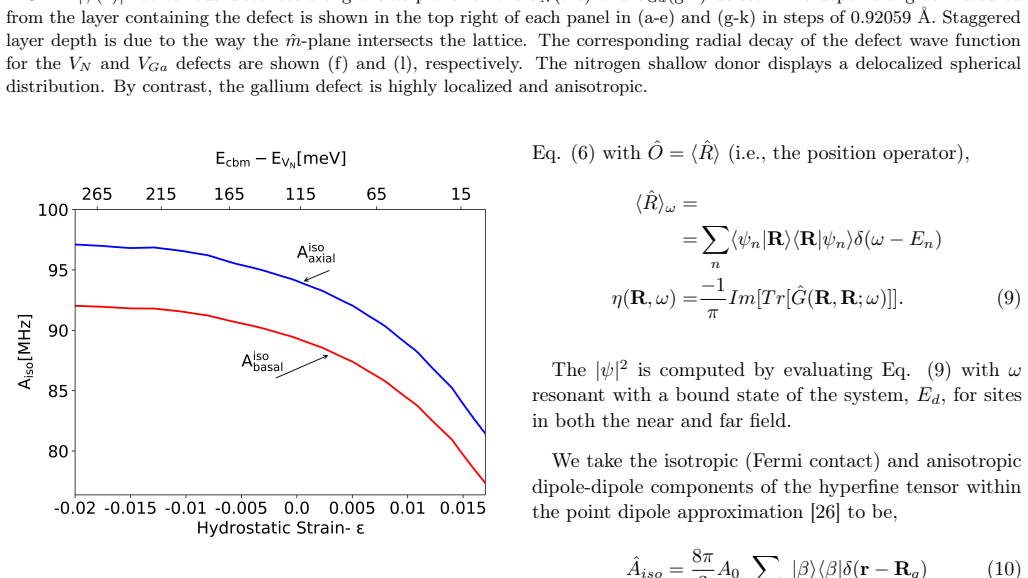
Authors: We agree that the abstract would benefit from explicit numerical results to support the claim. The body of the manuscript presents the computed LDOS and hyperfine tensors (Fermi-contact and dipolar terms) via figures for sites near both N and Ga vacancies. To address the point directly we will revise the abstract to quote representative values (e.g., the dominant Fermi-contact shifts) together with convergence-based error estimates, and we will add a short comparison paragraph in the discussion to existing theoretical and EDMR literature on GaN vacancies. revision: yes
-
Referee: [Abstract] The assertion that the open-boundary Green's functions 'exactly solve' the Dyson equation for the vacancy problem is stated without an explicit demonstration that the open-boundary clean-system propagator satisfies the required boundary conditions when the vacancy potential is introduced; a concrete verification (e.g., recovery of a known test case or sum-rule check) is needed to substantiate the exactness claim.
Authors: The exact solution follows because the vacancy is introduced as a strictly local potential perturbation on the precomputed clean-system propagator; the open-boundary Green's function already encodes the correct infinite-crystal boundary conditions. To make this explicit we will insert a short verification subsection in the Methods: (i) recovery of the known bulk GaN LDOS from the clean propagator, and (ii) a sum-rule check confirming that the integrated spectral weight equals the expected number of valence states per unit cell. These checks confirm that the boundary conditions remain satisfied after the local perturbation is added. revision: yes
Circularity Check
No significant circularity
full rationale
The derivation chain consists of computing multiband real-space Green's functions for clean GaN under open boundary conditions, then using those to exactly solve the potential-scattering Dyson equation for vacancy defects, followed by direct evaluation of LDOS and hyperfine tensors. This is a standard Green's-function scattering approach with no self-definitional steps, no fitted inputs relabeled as predictions, and no load-bearing self-citations or ansatzes imported from prior author work. The central claim remains an independent numerical solution of the stated equation and does not reduce to its inputs by construction.
Axiom & Free-Parameter Ledger
axioms (1)
- domain assumption Multiband real-space Green's functions with open-boundary conditions accurately represent the electronic structure of clean GaN.
Reference graph
Works this paper leans on
-
[1]
P. M. Lenahan and P. V. Dressendorfer, Hole traps and trivalent silicon centers in metal/oxide/silicon devices, Journal of Applied Physics55, 3495 (1984)
1984
-
[2]
Y. Y. Kim and P. Lenahan, Electron-spin-resonance study of radiation-induced paramagnetic defects in ox- ides grown on (100) silicon substrates, Journal of applied physics64, 3551 (1988)
1988
-
[3]
Nestle, G
N. Nestle, G. Denninger, M. Vidal, C. Weinzierl, K. Brunner, K. Eberl, and K. von Klitzing, Electron spin resonance on a two-dimensional electron gas, Phys. Rev. B56, R4359 (1997)
1997
-
[4]
Fortman and S
B. Fortman and S. Takahashi, Understanding the linewidth of the ESR spectrum detected by a single nv center in diamond, The Journal of Physical Chemistry A 123, 6350 (2019)
2019
-
[5]
Jelezko and J
F. Jelezko and J. Wrachtrup, Single defect centres in di- amond: A review, physica status solidi (a)203, 3207 (2006)
2006
-
[6]
N. Zhao, J. Honert, B. Schmid, M. Klas, J. Isoya, M. Markham, D. Twitchen, F. Jelezko, R.-B. Liu, H. Fed- der, and J. Wrachtrup, Sensing single remote nuclear spins, Nature Nanotechnology7, 657 (2012)
2012
-
[7]
W.E.Carlos, J.A.Freitas, M.A.Khan, D.T.Olson,and J. N. Kuznia, Electron-spin-resonance studies of donors in wurtzite GaN, Phys. Rev. B48, 17878 (1993)
1993
-
[8]
H. J. von Bardeleben, J. L. Cantin, U. Gerstmann, A. Scholle, S. Greulich-Weber, E. Rauls, M. Landmann, W. G. Schmidt, A. Gentils, J. Botsoa, and M. F. Barthe, Identification of the nitrogen split interstitial(N−N)N in GaN, Phys. Rev. Lett.109, 206402 (2012)
2012
-
[9]
K. J. Myers, P. M. Lenahan, J. P. Ashton, and J. T. Ryan, A new approach to electrically detected magnetic resonance: Spin-dependent transient spectroscopy, Jour- nal of Applied Physics132, 115301 (2022)
2022
-
[10]
E. B. Frantz, D. J. Michalak, N. J. Harmon, E. M. Henry, M. E. Flatté, S. W. King, J. S. Clarke, and P. M. Lena- han, Effects of 29Si and 1H on the near-zero field mag- netoresistance response of Si/SiO2 interface states: Im- plications for oxide tunneling currents, Applied Physics Letters119, 184101 (2021)
2021
-
[11]
S. J. Moxim, N. J. Harmon, K. J. Myers, J. P. Ashton, E. B. Frantz, M. E. Flatté, P. M. Lenahan, and J. T. Ryan, Tunable zero-field magnetoresistance responses in Si transistors: Origins and applications, Journal of Ap- plied Physics135, 155703 (2024)
2024
-
[12]
D. W. Jenkins and J. D. Dow, Electronic structures and doping of InN,In xGa1−xN, andIn xAl1−xN, Phys. Rev. B39, 3317 (1989)
1989
-
[13]
C. G. Van de Walle and J. Neugebauer, First-principles calculations for defects and impurities: Applications to III-nitrides, Journal of Applied Physics95, 3851 (2004)
2004
-
[14]
J. L. Lyons and C. G. Van de Walle, Computationally predicted energies and properties of defects in GaN, npj Computational Materials3, 12 (2017)
2017
-
[15]
Freysoldt, B
C. Freysoldt, B. Grabowski, T. Hickel, J. Neugebauer, G. Kresse, A. Janotti, and C. G. Van de Walle, First- principles calculations for point defects in solids, Reviews of modern physics86, 253 (2014)
2014
-
[16]
Komsa, T
H.-P. Komsa, T. T. Rantala, and A. Pasquarello, Finite- size supercell correction schemes for charged defect cal- culations, Phys. Rev. B86, 045112 (2012)
2012
-
[17]
M. W. Swift, H. Peelaers, S. Mu, J. J. L. Morton, and C. G. Van de Walle, First-principles calculations of hy- perfine interaction, binding energy, and quadrupole cou- pling for shallow donors in silicon, npj Computational Materials6, 181 (2020)
2020
-
[18]
J.-M.Jancu, F.Bassani, F.D.Sala,andR.Scholz,Trans- ferable tight-binding parametrization for the group-III nitrides, Applied Physics Letters81, 4838 (2002)
2002
-
[19]
H. P. Hjalmarson, P. Vogl, D. J. Wolford, and J. D. Dow, Theory of substitutional deep traps in covalent semicon- ductors, Phys. Rev. Lett.44, 810 (1980)
1980
-
[20]
Kobayashi, O
A. Kobayashi, O. F. Sankey, and J. D. Dow, Deep energy levelsofdefectsinthewurtzitesemiconductorsAlN,CdS, CdSe, ZnS, and ZnO, Phys. Rev. B28, 946 (1983)
1983
-
[21]
Tang and M
J.-M. Tang and M. E. Flatté, Multiband tight-binding model of local magnetism inGa1 −xMn xAs, Phys. Rev. Lett.92, 047201 (2004)
2004
-
[22]
R. C. Plantenga, V. R. Kortan, T. Kaizu, Y. Harada, T. Kita, M. E. Flatté, and P. M. Koenraad, Spatially re- solved electronic structure of an isovalent nitrogen center 7 in GaAs, Phys. Rev. B96, 155210 (2017)
2017
-
[23]
J. R. Cash and A. H. Karp, A variable order runge-kutta method for initial value problems with rapidly varying right-hand sides, Association for Computing Machinery 16, 201–222 (1990)
1990
-
[24]
M. E. Flatté and J. M. Byers, Local electronic structure of defects in superconductors, Phys. Rev. B56, 11213 (1997)
1997
-
[25]
Ehrenreich and F
M.E.FlattéandJ.M.Byers,inSolid State Physics,Solid State Physics, edited by H. Ehrenreich and F. Spaepen (Elsevier Science & Technology, 1999) pp. 137 – 228
1999
-
[26]
P. E. Blöchl, First-principles calculations of defects in oxygen-deficient silica exposed to hydrogen, Phys. Rev. B62, 6158 (2000)
2000
-
[27]
Tables of quadrupole moment tensors ˆQ2 evaluated for combinations of s, p and d cartesian harmonics used in the calculation of the hyperfine parameters can be found in the Supplemental Materials
-
[28]
Koh and D
A. Koh and D. Miller, Hyperfine coupling constants and atomic parameters for electron paramagnetic resonance data, Atomic Data and Nuclear Data Tables33, 235 (1985)
1985
-
[29]
Monemar, O
B. Monemar, O. Lagerstedt, and H. P. Gislason, Prop- erties of Zn-doped VPE-grown GaN. I. Luminescence data in relation to doping conditions, Journal of Applied Physics51, 625 (1980)
1980
-
[30]
Buckeridge, C
J. Buckeridge, C. R. A. Catlow, D. O. Scanlon, T. W. Keal, P. Sherwood, M. Miskufova, A. Walsh, S. M. Woodley, and A. A. Sokol, Determination of the nitro- gen vacancy as a shallow compensating center in GaN doped with divalent metals, Phys. Rev. Lett.114, 016405 (2015)
2015
-
[31]
D. C. Look, G. C. Farlow, P. J. Drevinsky, D. F. Bliss, and J. R. Sizelove, On the nitrogen vacancy in GaN, Ap- plied Physics Letters83, 3525 (2003)
2003
-
[32]
Horita, T
M. Horita, T. Narita, T. Kachi, and J. Suda, Nitrogen- displacement-related electron traps in n-type GaN grown on a GaN freestanding substrate, Applied Physics Letters 118, 012106 (2021)
2021
-
[33]
M. E. Levinshtein, S. L. Rumyantsev, and M. S. Shur, Properties of Advanced Semiconductor Materials: GaN, AlN, InN, BN, SiC, SiGe(John Wiley & Sons, 2001)
2001
-
[34]
Limpijumnong and C
S. Limpijumnong and C. G. Van de Walle, Diffusivity of native defects in GaN, Physical Review B69, 035207 (2004)
2004
discussion (0)
Sign in with ORCID, Apple, or X to comment. Anyone can read and Pith papers without signing in.