REVIEW 2 major objections 6 minor 1 cited by
Impact of the Scalar Isovector $\delta$-meson on the description of nuclear matter and neutron star properties
T0 review · 2 major / 6 minor · reviewed 2026-08-11 · deepseek-v4-flash
Pith's one-line read Adding the scalar isovector δ-meson to relativistic mean-field models widens the allowed density dependence of the symmetry energy, letting its curvature take positive values while leaving maximum neutron star mass almost unchanged.
desk verdict Competent Bayesian map of delta-meson effects on the isovector EOS, but the central 'extends phase space' claim is unproven without a no-delta refit control. read the letter →
The pith
A machine-rendered reading of the paper's core claim, the machinery that carries it, and where it could break.
The reading
What carries the argument
The central object is the δ-meson: a scalar, isovector field coupled to nucleons with strength gδ, added to the usual σ (scalar-isoscalar), ω (vector-isoscalar), and ρ (vector-isovector) mean fields. Its role is to give the isovector channel the same scalar/vector structure as the isoscalar channel, producing a contribution to the symmetry energy that depends on density differently from the ρ-meson term and splitting the neutron and proton Dirac effective masses in asymmetric matter. That different density dependence is what lets the symmetry energy curvature move from negative to positive values in the posterior. The inference machinery is a nested-sampling Bayesian fit over gρ, gδ, and the ω–ρ mixing product, with the isoscalar couplings of each base equation of state held fixed.
What would settle it
Re-run the same Bayesian inference on the three base equations of state without the δ-meson, allowing the ρ and ω–ρ mixing couplings to vary under the identical constraints and priors. If the 90% credible interval of the symmetry-energy curvature already reaches positive values, or the radius of a 1.0-solar-mass star already spreads over about 1.2 km, the δ-meson is not responsible for the widened phase space and the paper's central claim would be refuted; if the no-δ refit keeps the curvature negative and the radii narrow, the claim is supported.
Extended reading notes
Core claim
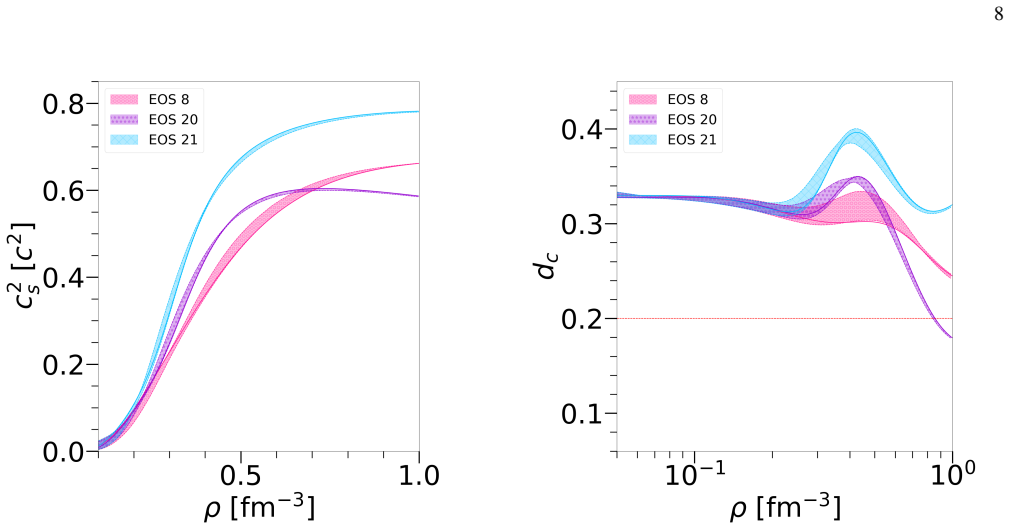
The discovery the paper argues for is that the isovector sector of a relativistic mean-field Lagrangian is substantially more degenerate than the usual ρ-only treatment suggests. With the δ-meson included, the symmetry energy at saturation, its slope L, and its curvature Ksym can vary over much wider ranges without violating the imposed nuclear, χEFT, and astrophysical constraints: across the three equation-of-state sets, L spans roughly 15 to 60 MeV and Ksym spans roughly −250 to +55 MeV within the 90% credible intervals, with positive Ksym now accessible. The maximum neutron star mass and the speed of sound in the interior remain essentially fixed by the isoscalar sector, whereas the radius of a 1.0-solar-mass star spreads from about 11.8 to 13.1 km. The proton fraction in β-equilibrium matter and the threshold density for direct Urca cooling shift accordingly, and neutrons and protons acquire different Dirac effective masses in asymmetric matter.
Load-bearing premise
The claim that the δ-meson, rather than the extra adjustable couplings alone, is what enlarges the allowed equation-of-state space rests on comparing against three fixed no-δ reference models; it also assumes the isoscalar sector of each reference can be held fixed, and the paper never runs a no-δ refit with the same constraints to check that the widening is actually caused by the δ-meson.
Editorial extensions
If this is right
- Including the δ-meson lets the symmetry-energy curvature be positive within the 90% credible interval (up to about +55 MeV for the stiffest base model), while the no-δ base models are mostly negative.
- The radius of 1.0-solar-mass neutron stars spans roughly 11.8–13.1 km across the three posterior sets, a spread about six times larger than the ~200 m among the original equations of state, whereas 2.0-solar-mass radii change by only 200–250 m.
- Maximum neutron star mass and the speed of sound in the core are nearly unchanged by the isovector channel; they are set by the isoscalar parameters.
- The proton fraction in β-equilibrium matter and the onset density of direct Urca cooling shift strongly with the isovector couplings, changing which stars can cool rapidly via neutrinos.
- The neutron and proton Dirac effective masses split in asymmetric matter, a feature absent when only the ρ-meson carries isospin.
Reading between the lines
- A direct test the paper does not run: feed PREX-II and CREX data into the same Bayesian likelihood. If the δ-posterior covers both, the claim that the δ-meson reconciles the two experiments becomes quantitative rather than heuristic.
- Because the isoscalar sector is held fixed in all three fits, the true parameter space of a fully free relativistic mean-field model may be wider still; relaxing the isoscalar couplings could shift or enlarge the credible intervals reported here.
- The δ-induced neutron–proton Dirac mass splitting is not directly constrained by neutron star observations; nuclear experiments or ab initio calculations sensitive to the isovector effective mass splitting could provide an independent check on the gδ values in the posterior.
- If the widened low-mass radius spread is real, then radius measurements of 1.0–1.4 solar-mass stars carry less information about the symmetry energy slope than ρ-only analyses assumed; future inferences should treat this degeneracy explicitly.
Editorial analysis
A structured set of objections, weighed in public.
Referee Report
Summary. The manuscript studies the effect of adding the scalar-isovector delta meson to three relativistic mean-field equations of state (EOS8, EOS20, EOS21) by performing Bayesian inference over the three isovector couplings g_rho, g_delta, and g_omega_rho*g_rho^2, constrained by nuclear saturation properties and chiral EFT neutron-matter pressures. The authors report posterior distributions for the symmetry energy and its derivatives, neutron star radii, tidal deformabilities, proton fractions, and direct Urca onset densities. The central claim is that the delta meson extends the isovector phase space, broadening the allowed ranges of the symmetry energy, its slope L, and especially its curvature K_sym (including positive values), while leaving the maximum mass and sound speed essentially unchanged. The paper also discusses compatibility with NICER and GW170817 observations.
Significance. If the central claim is established, the result is significant for the field: it would show that the isovector sector of RMF models is more degenerate than previously mapped, allowing substantial variations in low- and medium-mass neutron star radii and tidal deformabilities without changing high-mass predictions. The paper uses a standard Bayesian methodology (nested sampling, credible intervals) and makes a useful connection between the delta meson and the symmetry-energy curvature. However, because the comparison is made against fixed base EOS rather than a no-delta refit under the same likelihood and priors, and because the priors are not reported, the significance of the claimed phase-space extension is currently not fully quantified.
major comments (2)
- [Sec. IV, Fig. 1 and Table V] The broadening of the posterior ranges for Esym, L, and Ksym is compared to the fixed base EOS8/20/21 values, which are not the result of a no-delta Bayesian refit under the same likelihood and priors. Since the base models were calibrated with different data and without the chiEFT PNM pressure constraints of Table II, the observed widening could be caused by the additional free parameter or by the new constraints rather than by any specific role of the delta meson. A control calculation with g_delta identical to zero, sampling g_rho and g_omega_rho*g_rho^2 under the same NMP+PNM likelihood and the same priors, is necessary to support the claim that the delta meson itself extends the phase space.
- [Sec. III, Bayesian inference] The prior distributions for the three fitted couplings (g_rho, g_delta, g_omega_rho*g_rho^2) are never specified. Since posterior credible intervals depend on the prior volume, the reported 90% CIs for L (e.g., 14.5-56.0 MeV for EOS8) and Ksym (e.g., -250 to -70 MeV for EOS8) cannot be interpreted as the model's intrinsic allowed range unless the priors are stated. The paper should give the priors explicitly and, ideally, show the prior-to-posterior shrinkage to demonstrate that the ranges are data-driven rather than prior-dominated.
minor comments (6)
- [Sec. IV, Fig. 1 caption] The caption lists the third parameter as 'g_omega_rho', while the text and Table III define the third fitted quantity as g_omega_rho*g_rho^2; please make the notation consistent.
- [Table II, first row] The constraint for rho0 is labelled 'MeV' although the quantity is a baryon density in fm^-3.
- [Eq. (4)] The prefactor 1/(2 sigma_j^2) appears dimensionally inconsistent with a probability density; please clarify the normalization or state that the likelihood is used only up to a multiplicative constant.
- [Sec. IV and Conclusions] The discussion of the NICER pulsars PSR J1231-1411 and PSR J0437-4715 should be checked for consistency; the text presents radii for both pulsars but does not explicitly explain how the two constraints are related, and the presentation may confuse readers.
- [Sec. II] The authors keep the isoscalar sector fixed when adding the delta meson; while this is plausible because the delta field vanishes in symmetric matter, the paper should state this justification explicitly.
- [Conclusions, first paragraph] The statement that 'the condition of describing two solar mass neutron stars has been imposed' is not supported by Sec. III or Table II, where the likelihood contains only nuclear matter properties and chiEFT neutron-matter pressures; the maximum masses in the posterior do exceed 2.2 solar masses, but the constraint was not part of the inference, and the wording should be corrected.
Circularity Check
No circularity: the posterior outputs are computed consequences of parameters constrained by external NMP and χEFT data, and the self-cited base EOS are independent inputs rather than definitions of the result.
full rationale
The paper's inference chain is not circular. The couplings gρ, gδ, and gωρ are sampled subject to a likelihood built from external nuclear-matter properties (Table II: ρ0, ε0, K0, Esym,0) and chiral-EFT pure-neutron-matter pressures from Hebeler et al. (2013). The quantities emphasized as results, such as the symmetry-energy slope L, curvature Ksym, neutron-star radii, tidal deformabilities, proton fractions, and dUrca onset densities, are computed from the posterior samples as model outputs; none of these outputs is itself used as a fit input. The posterior concentration of Esym near 32 MeV merely reflects the explicit Esym,0 constraint and therefore is a calibration check rather than a predicted output. The base EOS8, EOS20, and EOS21 are taken from the authors' earlier published calibrations, but those are independent prior results with their own external constraints; the current work does not invoke a self-citation to forbid alternatives or to define the central claim. The acknowledged limitation that no gδ=0 refit under identical constraints is performed affects the attribution of the broadened posterior ranges to the δ-meson, but it is a missing-control/validity issue, not a circular reduction of the derivation to its inputs.
Assumptions & free parameters
free parameters (3)
- g_rho =
median ~13.04 (EOS8), 13.85 (EOS20), 13.16 (EOS21)
- g_delta =
median ~1.7 to 1.9 across the three sets
- g_omega_rho times g_rho squared =
median ~5.2 to 7.5 across the three sets
assumptions (5)
- domain assumption The relativistic mean-field Lagrangian in Eq. (1), with sigma, omega, rho, delta mesons and the specified nonlinear terms, is an adequate description of nuclear matter and neutron star interiors.
- domain assumption The isoscalar parameters and the three base equations of state EOS8, EOS20, and EOS21 from refs [25,29] remain valid when the delta meson is added.
- domain assumption The chiral effective field theory pure neutron matter pressures from Hebeler et al. [37] at 0.08, 0.12, and 0.16 fm^-3 are reliable constraints.
- domain assumption The Gaussian likelihood for nuclear matter properties and the super-Gaussian box likelihood for chiral effective field theory pressures adequately encode the experimental and theoretical uncertainties.
- standard math Neutron star structure follows from beta-equilibrium matter and the Tolman-Oppenheimer-Volkoff equations with no exotic degrees of freedom.
Cite this review
Pith. "Pith review of Impact of the Scalar Isovector $\delta$-meson on the description of nuclear matter and neutron star properties." pith.science (2026). https://pith.science/paper/SKQRFEKY
@misc{pith2026241204946,
  author       = {Pith},
  title        = {Pith review of: Impact of the Scalar Isovector $\delta$-meson on the description of nuclear matter and neutron star properties},
  year         = {2026},
  howpublished = {\url{https://pith.science/paper/SKQRFEKY}},
  note         = {Machine review of arXiv:2412.04946}
}
abstract
The implications of including the scalar isovector $\delta$-meson in a relativistic mean-field description of nuclear matter are discussed. A Bayesian inference approach is used to determine the parameters that define the isovector properties of the model. The properties of nuclear matter and neutron stars are discussed. The inclusion of the $\delta$-meson has only a small effect on the maximum mass of the neutron star (NS) and on the speed of sound in its interior, but it has a strong effect on the radius and the tidal deformability of low and medium mass stars. This is mainly due to the effect of the $\delta$-meson on the symmetry energy and its slope and curvature at saturation, increasing the range of possible values of these three properties, and in particular allowing positive values of the symmetry energy curvature. Due to the effect of the $\delta$-meson on the symmetry energy, the proton content of the star is also strongly affected. The inclusion of the $\delta$-meson in the relativistic mean-field description of nuclear matter extends the phase space spanned by the model, allowing for a more flexible density dependence of the symmetry energy compatible with experimental, observational, and ab initio constraints.
Figures


Figures from the paper (3 more)


Forward citations
Cited by 1 Pith paper
-
Tidal deformability and compactness of neutron stars and massive pulsars from semi-microscopic equations of state
CDM3Y equations of state with incompressibility 230 to 330 MeV reproduce observed neutron-star tidal deformability constraints and yield a nearly universal linear relation between log tidal deformability and compactness.
Reference graph
Works this paper leans on
-
[11]
B. T. Reed, F. J. Fattoyev, C. J. Horowitz, and J. Piekarewicz, Phys. Rev. C 109, 035803 (2024), arXiv:2305.19376 [nucl-th]
arXiv 2024
-
[1]
B. Liu, V . Greco, V . Baran, M. Colonna, and M. Di Toro, Phys. Rev. C 65, 045201 (2002)
work page 2002
-
[2]
B. D. Serot and J. D. Walecka, Adv. Nucl. Phys. 16, 1 (1986)
1986
-
[3]
T. Gaitanos, M. Di Toro, S. Typel, V . Baran, C. Fuchs, V . Greco, and H. H. Wolter, Nucl. Phys. A 732, 24 (2004), arXiv:nucl- th/0309021
-
[4]
D. P. Menezes and C. Providencia, Phys. Rev. C 70, 058801 (2004)
work page 2004
-
[5]
T. Klahn et al. , Phys. Rev. C 74, 035802 (2006), arXiv:nucl- th/0602038
-
[6]
H. Pais, A. Santos, and C. Providencia, Phys. Rev. C80, 045808 (2009), arXiv:0908.2259 [nucl-th]
work page Pith review arXiv 2009
-
[7]
X. Roca-Maza, X. Vinas, M. Centelles, P. Ring, and P. Schuck, Phys. Rev. C 84, 054309 (2011), [Erratum: Phys.Rev.C 93, 069905 (2016)], arXiv:1110.2311 [nucl-th]
arXiv 2011
Show all 64 references
-
[8]
Miyatsu, M.-K
T. Miyatsu, M.-K. Cheoun, and K. Saito, Astrophys. J. 929, 82 (2022), arXiv:2202.06468 [nucl-th]
2022 arXiv
-
[9]
Li, B.-J
F. Li, B.-J. Cai, Y . Zhou, W.-Z. Jiang, and L.-W. Chen, Astro- phys. J. 929, 183 (2022), arXiv:2202.08705 [nucl-th]
2022 arXiv
-
[10]
L. L. Lopes, D. P. Menezes, and M. R. Pelicer, Phys. Rev. C 109, 045801 (2024), arXiv:2311.00125 [hep-ph]
2024 arXiv
-
[12]
Demorest, T
P. Demorest, T. Pennucci, S. Ransom, M. Roberts, and J. Hes- sels, Nature 467, 1081 (2010)
2010
-
[13]
Antoniadis, P
J. Antoniadis, P. C. C. Freire, N. Wex, T. M. Tauris, R. S. Lynch, M. H. van Kerkwijk, M. Kramer, C. Bassa, V . S. Dhillon, T. Driebe, J. W. T. Hessels, V . M. Kaspi, V . I. Kondratiev, N. Langer, T. R. Marsh, M. A. McLaughlin, T. T. Pennucci, S. M. Ransom, I. H. Stairs, J. va...
2013
-
[14]
Fonseca et al
E. Fonseca et al. , Astrophys. J. 832, 167 (2016), arXiv:1603.00545 [astro-ph.HE]
2016 arXiv
-
[15]
H. T. Cromartie et al. (NANOGrav), Nature Astron. 4, 72 (2019), arXiv:1904.06759 [astro-ph.HE]
2019 arXiv
-
[16]
Fonseca et al
E. Fonseca et al. , Astrophys. J. Lett. 915, L12 (2021), arXiv:2104.00880 [astro-ph.HE]
2021 arXiv
-
[17]
B. P. Abbott et al. (LIGO Scientific, Virgo, Fermi GBM, IN- TEGRAL, IceCube, AstroSat Cadmium Zinc Telluride Im- ager Team, IPN, Insight-Hxmt, ANTARES, Swift, AGILE Team, 1M2H Team, Dark Energy Camera GW-EM, DES, DLT40, GRAWITA, Fermi-LAT, ATCA, ASKAP, Las Cum- bres Observator...
2017 arXiv
-
[18]
Abbott et al
R. Abbott et al. (LIGO Scientific, Virgo), Astrophys. J. Lett. 896, L44 (2020), arXiv:2006.12611 [astro-ph.HE]
2020 arXiv
-
[19]
T. E. Riley et al. , Astrophys. J. Lett. 887, L21 (2019), arXiv:1912.05702 [astro-ph.HE]
2019 arXiv
-
[20]
M. C. Miller et al. , Astrophys. J. Lett. 887, L24 (2019), arXiv:1912.05705 [astro-ph.HE]
2019 arXiv
-
[21]
T. E. Riley et al. , Astrophys. J. Lett. 918, L27 (2021), arXiv:2105.06980 [astro-ph.HE]
2021 arXiv
-
[22]
M. C. Miller et al. , Astrophys. J. Lett. 918, L28 (2021), arXiv:2105.06979 [astro-ph.HE]
2021 arXiv
-
[23]
Raaijmakers, S
G. Raaijmakers, S. K. Greif, K. Hebeler, T. Hinderer, S. Nis- sanke, A. Schwenk, T. E. Riley, A. L. Watts, J. M. Lat- timer, and W. C. G. Ho, Astrophys. J. Lett. 918, L29 (2021), arXiv:2105.06981 [astro-ph.HE]
2021 arXiv
-
[24]
Watts, Measuring Neutron Star Mass and Radius Using Pulse Profile Modelling – NICER and Beyond (2024)
A. Watts, Measuring Neutron Star Mass and Radius Using Pulse Profile Modelling – NICER and Beyond (2024)
2024
-
[25]
Malik, H
T. Malik, H. Pais, and C. Provid ˆencia, Astron. Astrophys. 689, A242 (2024), arXiv:2401.10842 [nucl-th]
2024 arXiv
-
[26]
Vidana, C
I. Vidana, C. Providencia, A. Polls, and A. Rios, Phys. Rev. C80, 045806 (2009), arXiv:0907.1165 [nucl-th]
2009 arXiv
-
[27]
P. Char, C. Mondal, F. Gulminelli, and M. Oertel, Phys. Rev. D 108, 103045 (2023), arXiv:2307.12364 [nucl-th]
2023 arXiv
-
[28]
Malik, M
T. Malik, M. Ferreira, B. K. Agrawal, and C. Provid ˆencia, As- trophys. J. 930, 17 (2022), arXiv:2201.12552 [nucl-th]
2022 arXiv
-
[29]
Malik, M
T. Malik, M. Ferreira, M. B. Albino, and C. Provid ˆencia, Phys. Rev. D 107, 103018 (2023), arXiv:2301.08169 [nucl-th]
2023 arXiv
-
[30]
Salinas and J
M. Salinas and J. Piekarewicz, Phys. Rev. C 107, 045802 (2023), arXiv:2301.09692 [nucl-th]
2023 arXiv
-
[31]
Scurto, H
L. Scurto, H. Pais, and F. Gulminelli, Phys. Rev. D109, 103015 (2024), arXiv:2402.15548 [nucl-th]
2024 arXiv
-
[32]
but only for low mass NS. The particularity of the study undertaken in [30] was that the bulk properties of symmetric nuclear matter at saturation density were almost unchanged during the Bayesian inference process. The paper is organized as follows: in Sec. II we review the m...
2013
-
[33]
Wesolowski, N
S. Wesolowski, N. Klco, R. J. Furnstahl, D. R. Phillips, and A. Thapaliya, J. Phys. G 43, 074001 (2016), arXiv:1511.03618 [nucl-th]
2016 arXiv
-
[34]
N. Alam, B. K. Agrawal, M. Fortin, H. Pais, C. Provid ˆencia, A. R. Raduta, and A. Sulaksono, Phys. Rev. C 94, 052801 (2016), arXiv:1610.06344 [nucl-th]
2016 arXiv
-
[35]
Ashton et al
G. Ashton et al. , Astrophys. J. Suppl. 241, 27 (2019), arXiv:1811.02042 [astro-ph.IM]
2019 arXiv
-
[36]
R. J. Furnstahl, N. Klco, D. R. Phillips, and S. Wesolowski, Phys. Rev. C 92, 024005 (2015), arXiv:1506.01343 [nucl-th]
2015 arXiv
-
[37]
in the left panel and the PNM energy per neutron from different χEFT calculations as compiled in Ref. [45]. We analyze in the following the results shown. The three initial models have quite different isovector properties, with Esym spanning a range of 5 MeV (28.5 - 33.8 MeV),...
-
[38]
Landry, R
P. Landry, R. Essick, and K. Chatziioannou, Phys. Rev. D 101, 123007 (2020), arXiv:2003.04880 [astro-ph.HE]
2020 arXiv
-
[39]
Hebeler, J
K. Hebeler, J. M. Lattimer, C. J. Pethick, and A. Schwenk, As- trophys. J. 773, 11 (2013), arXiv:1303.4662 [astro-ph.SR]
2013 arXiv
-
[40]
Typel and H
S. Typel and H. H. Wolter, Nucl. Phys. A 656, 331 (1999)
1999
-
[41]
Dutra, O
M. Dutra, O. Lourenc ¸o, S. S. Avancini, B. V . Carlson, A. Delfino, D. P. Menezes, C. Provid ˆencia, S. Typel, and J. R. Stone, Phys. Rev. C90, 055203 (2014), arXiv:1405.3633 [nucl- th]
2014 arXiv
-
[42]
M., and Col`o, G., Eur
Shlomo, S., Kolomietz, V . M., and Col`o, G., Eur. Phys. J. A 30, 23 (2006)
2006
-
[43]
B. G. Todd-Rutel and J. Piekarewicz, Phys. Rev. Lett. 95, 122501 (2005), arXiv:nucl-th/0504034
2005 arXiv
-
[44]
Essick, P
R. Essick, P. Landry, A. Schwenk, and I. Tews, Phys. Rev. C 104, 065804 (2021), arXiv:2107.05528 [nucl-th]
2021 arXiv
-
[45]
Buchner, A
J. Buchner, A. Georgakakis, K. Nandra, L. Hsu, C. Rangel, M. Brightman, A. Merloni, M. Salvato, J. Donley, and D. Ko- cevski, Astron. Astrophys. 564, A125 (2014), arXiv:1402.0004 [astro-ph.HE]
2014 arXiv
-
[46]
Foreman-Mackey, The Journal of Open Source Software 1, 24 (2016)
D. Foreman-Mackey, The Journal of Open Source Software 1, 24 (2016)
2016
-
[47]
Huth et al., Nature 606, 276 (2022), arXiv:2107.06229 [nucl- th]
S. Huth et al., Nature 606, 276 (2022), arXiv:2107.06229 [nucl- th]
2022 arXiv
-
[48]
B. P. Abbott et al. (LIGO Scientific, Virgo), Phys. Rev. Lett. 121, 161101 (2018), arXiv:1805.11581 [gr-qc]
2018 arXiv
-
[49]
Choudhury et al
D. Choudhury et al. , Astrophys. J. Lett. 971, L20 (2024), arXiv:2407.06789 [astro-ph.HE]. 12
2024 arXiv
-
[50]
C. J. Horowitz and J. Piekarewicz, Phys. Rev. Lett. 86, 5647 (2001), arXiv:astro-ph/0010227
2001 arXiv
-
[51]
Carriere, C
J. Carriere, C. J. Horowitz, and J. Piekarewicz, Astrophys. J. 593, 463 (2003), arXiv:nucl-th/0211015
2003 arXiv
-
[52]
Cavagnoli, D
R. Cavagnoli, D. P. Menezes, and C. Providencia, Phys. Rev. C 84, 065810 (2011), arXiv:1108.1733 [hep-ph]
2011 arXiv
-
[53]
Annala, T
E. Annala, T. Gorda, J. Hirvonen, O. Komoltsev, A. Kurkela, J. N¨attil¨a, and A. Vuorinen, Nature Commun. 14, 8451 (2023), arXiv:2303.11356 [astro-ph.HE]
2023 arXiv
-
[54]
Mueller and B
H. Mueller and B. D. Serot, Nucl. Phys. A 606, 508 (1996), arXiv:nucl-th/9603037
1996 arXiv
-
[55]
Fujimoto, K
Y . Fujimoto, K. Fukushima, L. D. McLerran, and M. Prasza- lowicz, Phys. Rev. Lett.129, 252702 (2022), arXiv:2207.06753 [nucl-th]
2022 arXiv
-
[56]
Provid ˆencia, T
C. Provid ˆencia, T. Malik, M. B. Albino, and M. Ferreira, Neu- tron star equation of state: identifying hadronic matter charac- teristics (Imprint CRC Press, 2023) Chap. 5
2023
-
[57]
Takatsy, P
J. Takatsy, P. Kovacs, G. Wolf, and J. Schaffner-Bielich, Phys. Rev. D 108, 043002 (2023), arXiv:2303.00013 [astro-ph.HE]
2023 arXiv
-
[58]
Malik, V
T. Malik, V . Dexheimer, and C. Providˆencia, Phys. Rev. D 110, 043042 (2024), arXiv:2404.07936 [nucl-th]
2024 arXiv
-
[59]
Chamseddine, J
M. Chamseddine, J. Margueron, G. Chanfray, H. Hansen, and R. Somasundaram, Eur. Phys. J. A 59, 177 (2023), arXiv:2304.01817 [nucl-th]
2023 arXiv
-
[60]
Salmi et al., Astrophys
T. Salmi et al., Astrophys. J. 976, 58 (2024), arXiv:2409.14923 [astro-ph.HE]
2024 arXiv
-
[61]
S. M. A. Imam, N. K. Patra, C. Mondal, T. Malik, and B. K. Agrawal, Phys. Rev. C 105, 015806 (2022), arXiv:2110.15776 [nucl-th]
2022 arXiv
-
[62]
P. B. de Tovar, M. Ferreira, and C. Provid ˆencia, Phys. Rev. D 104, 123036 (2021), arXiv:2112.05551 [nucl-th]
2021 arXiv
-
[63]
Mondal and F
C. Mondal and F. Gulminelli, Phys. Rev. D105, 083016 (2022), arXiv:2111.04520 [nucl-th]
2022 arXiv
-
[64]
Essick, I
R. Essick, I. Tews, P. Landry, and A. Schwenk, Phys. Rev. Lett. 127, 192701 (2021)
2021
Reviewed August 11, 2026 · model on record in the stance chip above.
Discussion (0). Continue with ORCID to comment.