REVIEW 2 major objections 4 minor 60 references
DualFit: A Two-Stage Virtual Try-On via Warping and Synthesis
T0 review · 2 major / 4 minor · reviewed 2026-08-05 · deepseek-v4-flash
Pith's one-line read DualFit claims a two-stage pipeline—learned-flow warping followed by a synthesis module that regenerates only seams, hands, and neck—can preserve logos and printed text in virtual try-on while producing perceptually seamless results, and re
desk verdict A sensible two-stage VTON with a credible synthesis design; the paper as written has a load-bearing mask-equation error and a test-set-tuned hyperparameter, so it needs major revision before it can be trusted. read the letter →
The pith
A machine-rendered reading of the paper's core claim, the machinery that carries it, and where it could break.
The reading
What carries the argument
The key mechanism is the pair of a preserved-region input and an inpainting mask. The preserved-region input is the person image with the upper body removed and the warped garment overlaid on it; the inpainting mask marks the areas the try-on module should regenerate—hands, neck, and narrow bands along the boundaries between garment sections. A Res-UNet generator then copies the warped garment inside the preserved region and inpaints the masked bands, with the flat garment supplied as an additional appearance cue. The warping module itself is the LFGP cascaded local-flow design, which predicts separate flows for the left sleeve, right sleeve, and torso and assembles them with a global parsin
What would settle it
Implement Eq. 3 exactly as written—the intersection of the six masks—and run the VITON-HD benchmark; if the mask is empty, the try-on module gets no regeneration signal and the reported PSNR 24.9, SSIM 0.91, and FID 5.3 should collapse, showing the equation does not describe the tested method. Conversely, swapping the intersection for a union and confirming the numbers would show the equation was a typo rather than a methodological flaw.
Extended reading notes
Core claim
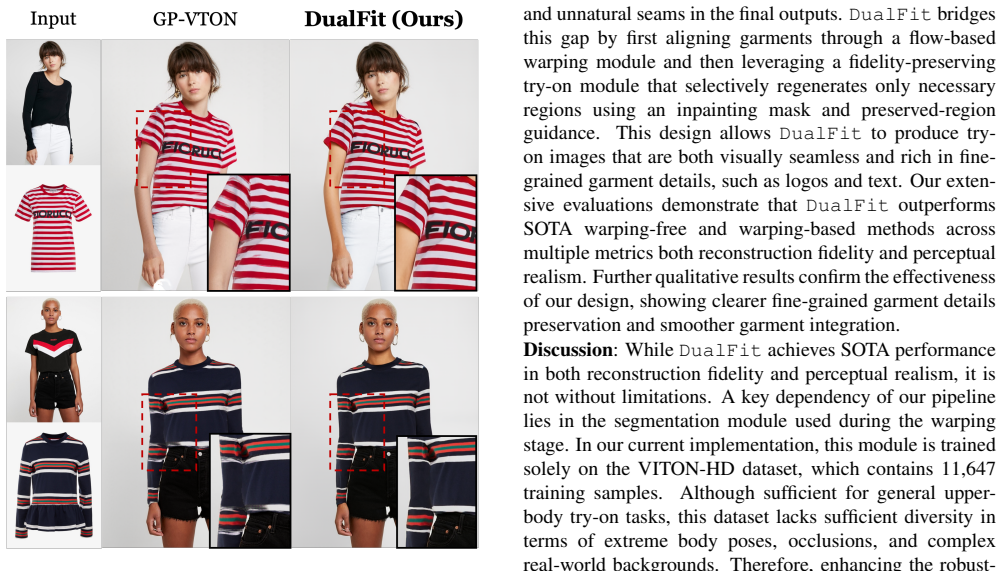
The central claim is that a hybrid warping-plus-synthesis design resolves the fidelity-realism trade-off in image-based virtual try-on. On VITON-HD, the paper reports the highest reconstruction scores (PSNR 24.9, SSIM 0.91) and the best perceptual scores (FID 5.3, LPIPS 0.064, DISTS 0.046) among the compared warping-free and warping-based methods. The mechanism is a preserved-region input and an inpainting mask: the model is told which pixels to copy from the warped garment and which pixels to regenerate, so it can keep the garment's fine details while letting a generative module smooth over the boundaries between sleeves, torso, and the body. Conditioned also on the flat input garment, the
Load-bearing premise
The load-bearing premise is that the inpainting mask as described in Eq. 3 actually marks the regions to regenerate; as written it is an intersection of six spatially disjoint masks, so it would be empty, whereas the reported seamless blending requires the union of those regions.
Editorial extensions
If this is right
- If the reported metrics are reproducible, a non-diffusion synthesis stage can match or exceed diffusion-based try-on realism while running far faster, opening room for real-time or video try-on.
- Garment details like logos and printed text can survive without a post-hoc overlay step, so brand-identifying elements stay intact in the final output.
- Because the try-on module copies the warped garment inside the preserved region, warp accuracy and synthesis quality can be improved independently.
- The ablation on band thickness shows the seam-regeneration width is a tunable knob balancing fidelity against smoothness, not a fixed design choice.
Reading between the lines
- The inpainting mask in Eq. 3 is written as an intersection of six spatially disjoint regions, which would be empty; the described behavior and reported results imply the implementation used a union, so readers should treat Eq. 3 as likely typographical rather than as the tested algorithm.
- The paper's own discussion notes the parsing module is trained only on VITON-HD, so robustness to diverse poses, occlusions, and real-world backgrounds is the evident next hurdle before the claimed advantage transfers beyond the benchmark.
- Conditioning on the flat garment may make DualFit adaptable to garment editing—swapping logos or changing textures by perturbing that conditioning input—though the paper does not test this.
- A stricter test would compare the same warped garment through a warping-free synthesizer to isolate whether the gains come from the mask design or from the warping stage itself.
Editorial analysis
A structured set of objections, weighed in public.
Referee Report
Summary. The paper proposes DualFit, a two-stage virtual try-on pipeline. Stage 1 uses a learned-flow warping module (adapted from GP-VTON) to align the in-shop garment to the person. Stage 2 uses a Res-UNet try-on module that blends the warped garment with a preserved-region input, guided by an inpainting mask and the flat garment as conditioning. The authors claim that this hybrid design preserves high-frequency garment details (logos, text) while avoiding the seams and artifacts typical of warping-based methods. On VITON-HD they report state-of-the-art PSNR (24.856), SSIM (0.913), FID (5.261), LPIPS (0.064), and DISTS (0.046), with inference speed comparable to the fastest warping-based baseline. The paper includes ablations on flat-garment conditioning and on the erosion-iteration parameter n that controls the width of the regenerated boundary bands.
Significance. If the reported results are reliable, DualFit would be a meaningful contribution: it demonstrates that a lightweight warping-plus-synthesis pipeline can outperform diffusion-based warping-free methods on both reconstruction fidelity and perceptual realism, while running in real time. The design is simple and reproducible in principle, and the quantitative gains over GP-VTON and CatVTON are substantial. The paper also provides useful ablations showing that conditioning on the flat garment and choosing an intermediate band width improve quality. However, the central mechanism as written is internally inconsistent (Eq. 3 defines the inpainting mask as an intersection of disjoint sets), and the key ablation used to select n is performed on the test set. These issues must be resolved before the SOTA claim can be accepted.
major comments (2)
- [§3.2, Eq. (3)] The inpainting mask is written as M = Se ∩ Si ∩ Sn ∩ Bl ∩ Br ∩ Bt. The six masks are spatially disjoint (left hand, right hand, neck, and three garment-boundary bands), so their intersection is empty or near-empty for a typical input. The method's stated mechanism—regenerating hands, neck, and garment seams—depends on M marking all of these regions. As written, the try-on module receives no regeneration signal, so the described pipeline cannot produce the claimed seamless outputs. The reported results imply the implementation actually combined the masks by union (or used a different construction). Please correct Eq. (3) and clarify the exact mask construction used in the experiments. This is load-bearing for the central claim.
- [§4.4, Table 3] The band-thickness parameter n is selected by evaluating on the VITON-HD test set: the table reports SSIM/FID/LPIPS for n = 2, 5, 10 and chooses n = 5. Since Table 1 uses this selected value, the headline numbers partly reflect fitting to the evaluation data. To support the SOTA claim, n should be chosen on a held-out validation split, or the paper should clearly state that Table 3 is a validation-set study and only the final model is evaluated on the test set. As reported, the quantitative comparison is circular for this hyperparameter.
minor comments (4)
- [Intro and §2] The phrase 'they often fail to they often fail to achieve high-fidelity reconstruction' is duplicated in both the introduction and related work. Please fix.
- [§3.2] The text says 'the warped garment G often contains artifacts' but G denotes the original in-shop garment; this should be G′ (the warped garment).
- [Eq. (1)] The morphological erosion in Eq. (1) does not specify boundary handling or the exact kernel center convention. For reproducibility, please specify the padding/border mode and the kernel anchor.
- [Table 1] The FIP-VTON row reports PSNR as '-' but the text discusses it as a warping-based baseline. Either report the value (or the reason it is omitted) in the table caption.
Circularity Check
Limited circularity: the reported SOTA metrics are partly produced by selecting the erosion-band parameter n on the VITON-HD test set; the core pipeline is otherwise externally grounded.
-
fitted input called prediction
[Section 3.2 (n configurable); Section 4.4 / Table 3; Section 4.2 / Table 1]
"In our experiments, we use n = 5 to obtain a narrow band approximately five pixels wide. ... Table 3 presents an ablation study on the effect of varying n. We observe that setting n = 5 yields the best performance, achieving the highest SSIM of 0.913, the lowest FID of 5.261, and the lowest LPIPS of 0.064."
The paper defines n as a configurable parameter controlling the thickness of the boundary band, then sweeps n in {2,5,10} on the VITON-HD test set (Table 3) and selects n=5 because it yields the best SSIM, FID, and LPIPS. The headline metrics in Table 1 for DualFit are exactly the metrics obtained with that test-set-selected n. Thus the SOTA numbers are not out-of-sample predictions; they are post-selection results, where the reported performance is partly forced by having chosen the hyperparameter to optimize the same metrics on the same evaluation set. This is the fitted-input-called-prediction pattern: a parameter tuned on the evaluation data is then presented as the method's predicted performance. The circularity is limited because the warping and try-on modules are trained on the stan
full rationale
The only genuine circularity in the paper is the test-set selection of the erosion iteration count n. In Section 3.2, n is described as a configurable parameter; in Section 4.4, the authors evaluate n = 2, 5, 10 on VITON-HD and report that n = 5 gives the best SSIM, FID, and LPIPS; in Table 1, those same n = 5 metrics are presented as DualFit's state-of-the-art result. This is not an independent prediction but a post-selection estimate, and it partially inflates the headline comparison. It does not, however, make the whole derivation circular: the warping module is adopted from external prior work (GP-VTON), the try-on module is trained with standard losses on the train split, and no load-bearing self-citation chain is present. Separately, Eq. (3) defines the inpainting mask as the intersection of hand, neck, and garment-boundary-band masks that are spatially disjoint, which would produce an empty or near-empty mask and undermines the described regeneration mechanism; this is a serious internal inconsistency/correctness flaw, but it is not a circularity because it does not reduce a prediction to an input by construction. That flaw is weighed as a correctness risk rather than as additional circularity. Overall, the circularity score is modest because only one hyperparameter is test-set-fitted, while the central pipeline and its external grounding remain independent.
Assumptions & free parameters
free parameters (1)
- erosion iterations n =
5
assumptions (3)
- ad hoc to paper The inpainting mask M is formed by the union of body-part masks (hands, neck) and garment boundary bands, despite Eq. 3 writing intersection.
- domain assumption The upper-body parsing map S from the warping module is accurate enough to define the preserved region and masks.
- domain assumption Training with ground-truth warped garments transfers to predicted warped garments at inference.
Cite this review
Pith. "Pith review of DualFit: A Two-Stage Virtual Try-On via Warping and Synthesis." pith.science (2026). https://pith.science/paper/SKQVTPGO
@misc{pith2026250812131,
  author       = {Pith},
  title        = {Pith review of: DualFit: A Two-Stage Virtual Try-On via Warping and Synthesis},
  year         = {2026},
  howpublished = {\url{https://pith.science/paper/SKQVTPGO}},
  note         = {Machine review of arXiv:2508.12131}
}
read the original abstract
Virtual Try-On technology has garnered significant attention for its potential to transform the online fashion retail experience by allowing users to visualize how garments would look on them without physical trials. While recent advances in diffusion-based warping-free methods have improved perceptual quality, they often fail to preserve fine-grained garment details such as logos and printed text elements that are critical for brand integrity and customer trust. In this work, we propose DualFit, a hybrid VTON pipeline that addresses this limitation by two-stage approach. In the first stage, DualFit warps the target garment to align with the person image using a learned flow field, ensuring high-fidelity preservation. In the second stage, a fidelity-preserving try-on module synthesizes the final output by blending the warped garment with preserved human regions. Particularly, to guide this process, we introduce a preserved-region input and an inpainting mask, enabling the model to retain key areas and regenerate only where necessary, particularly around garment seams. Extensive qualitative results show that DualFit achieves visually seamless try-on results while faithfully maintaining high-frequency garment details, striking an effective balance between reconstruction accuracy and perceptual realism.
Figures


Figures from the paper (1 more)
Reference graph
Works this paper leans on
-
[1]
Single stage virtual try-on via deformable attention flows
Shuai Bai, Huiling Zhou, Zhikang Li, Chang Zhou, and Hongxia Yang. Single stage virtual try-on via deformable attention flows. In European Conference on Computer Vi- sion, pages 409–425. Springer, 2022. 2
work page 2022
-
[2]
Multimodal garment designer: Human-centric latent diffusion models for fashion image editing
Alberto Baldrati, Davide Morelli, Giuseppe Cartella, Mar- cella Cornia, Marco Bertini, and Rita Cucchiara. Multimodal garment designer: Human-centric latent diffusion models for fashion image editing. In Proceedings of the IEEE/CVF international conference on computer vision , pages 23393– 23402, 2023. 3
work page 2023
-
[3]
Size does matter: Size-aware virtual try-on via clothing-oriented transformation try-on network
Chieh-Yun Chen, Yi-Chung Chen, Hong-Han Shuai, and Wen-Huang Cheng. Size does matter: Size-aware virtual try-on via clothing-oriented transformation try-on network. In Proceedings of the IEEE/CVF international conference on computer vision, pages 7513–7522, 2023. 2
work page 2023
-
[4]
Viton-hd: High-resolution virtual try-on via misalignment-aware normalization
Seunghwan Choi, Sunghyun Park, Minsoo Lee, and Jaegul Choo. Viton-hd: High-resolution virtual try-on via misalignment-aware normalization. In Proceedings of the IEEE/CVF conference on computer vision and pattern recognition, pages 14131–14140, 2021. 2, 5
work page 2021
-
[5]
Improving diffusion models for au- thentic virtual try-on in the wild
Yisol Choi, Sangkyung Kwak, Kyungmin Lee, Hyungwon Choi, and Jinwoo Shin. Improving diffusion models for au- thentic virtual try-on in the wild. InEuropean Conference on Computer Vision, pages 206–235. Springer, 2024. 1, 2, 3, 5, 6
work page 2024
-
[6]
Catvton: Concatenation is all you need for virtual try-on with diffusion models
Zheng Chong, Xiao Dong, Haoxiang Li, Shiyue Zhang, Wenqing Zhang, Xujie Zhang, Hanqing Zhao, Dongmei Jiang, and Xiaodan Liang. Catvton: Concatenation is all you need for virtual try-on with diffusion models. International Conference on Learning Representations, 2025. 2, 5, 6
work page 2025
-
[7]
Catv2ton: Taming diffusion transformers for vision-based virtual try-on with temporal concatenation
Zheng Chong, Wenqing Zhang, Shiyue Zhang, Jun Zheng, Xiao Dong, Haoxiang Li, Yiling Wu, Dongmei Jiang, and Xiaodan Liang. Catv2ton: Taming diffusion transformers for vision-based virtual try-on with temporal concatenation. arXiv preprint arXiv:2501.11325, 2025. 1
arXiv 2025
-
[8]
Zflow: Gated appearance flow-based virtual try-on with 3d priors
Ayush Chopra, Rishabh Jain, Mayur Hemani, and Balaji Kr- ishnamurthy. Zflow: Gated appearance flow-based virtual try-on with 3d priors. InProceedings of the IEEE/CVF Inter- national Conference on Computer Vision, pages 5433–5442,
Show all 60 references
-
[9]
Time-efficient and identity-consistent virtual try-on using a variant of altered diffusion models
Phuong Dam, Jihoon Jeong, Anh Tran, and Daeyoung Kim. Time-efficient and identity-consistent virtual try-on using a variant of altered diffusion models. In European Conference on Computer Vision, pages 35–51. Springer, 2024. 5, 6
2024
-
[10]
Image quality assessment: Unifying structure and texture similarity
Keyan Ding, Kede Ma, Shiqi Wang, and Eero P Simoncelli. Image quality assessment: Unifying structure and texture similarity. IEEE transactions on pattern analysis and ma- chine intelligence, 44(5):2567–2581, 2020. 5
2020
-
[11]
Fash- ion editing with adversarial parsing learning
Haoye Dong, Xiaodan Liang, Yixuan Zhang, Xujie Zhang, Xiaohui Shen, Zhenyu Xie, Bowen Wu, and Jian Yin. Fash- ion editing with adversarial parsing learning. In Proceedings of the IEEE/CVF conference on computer vision and pattern recognition, pages 8120–8128, 2020. 2
2020
-
[12]
Splines minimizing rotation-invariant semi- norms in sobolev spaces
Jean Duchon. Splines minimizing rotation-invariant semi- norms in sobolev spaces. In Constructive theory of functions of several variables: Proceedings of a conference held at Oberwolfach April 25–May 1, 1976, pages 85–100. Springer,
1976
-
[13]
C-vton: Context-driven image-based virtual try-on network
Benjamin Fele, Ajda Lampe, Peter Peer, and Vitomir Struc. C-vton: Context-driven image-based virtual try-on network. In Proceedings of the IEEE/CVF winter conference on appli- cations of computer vision, pages 3144–3153, 2022. 2
2022
-
[14]
Parser-free virtual try-on via distilling appearance flows
Yuying Ge, Yibing Song, Ruimao Zhang, Chongjian Ge, Wei Liu, and Ping Luo. Parser-free virtual try-on via distilling appearance flows. In Proceedings of the IEEE/CVF con- ference on computer vision and pattern recognition , pages 8485–8493, 2021. 2
2021
-
[15]
Digital image processing
Rafael C Gonzalez. Digital image processing. Pearson edu- cation india, 2009. 5
2009
-
[16]
Generative adversarial networks
Ian Goodfellow, Jean Pouget-Abadie, Mehdi Mirza, Bing Xu, David Warde-Farley, Sherjil Ozair, Aaron Courville, and Yoshua Bengio. Generative adversarial networks. Commu- nications of the ACM, 63(11):139–144, 2020. 2
2020
-
[17]
Taming the power of diffusion models for high-quality virtual try-on with appearance flow
Junhong Gou, Siyu Sun, Jianfu Zhang, Jianlou Si, Chen Qian, and Liqing Zhang. Taming the power of diffusion models for high-quality virtual try-on with appearance flow. In Proceedings of the 31st ACM International Conference on Multimedia, pages 7599–7607, 2023. 2, 3
2023
-
[18]
Viton: An image-based virtual try-on network
Xintong Han, Zuxuan Wu, Zhe Wu, Ruichi Yu, and Larry S Davis. Viton: An image-based virtual try-on network. In Proceedings of the IEEE conference on computer vision and pattern recognition, pages 7543–7552, 2018. 2
2018
-
[19]
Clothflow: A flow-based model for clothed person generation
Xintong Han, Xiaojun Hu, Weilin Huang, and Matthew R Scott. Clothflow: A flow-based model for clothed person generation. In Proceedings of the IEEE/CVF international conference on computer vision , pages 10471–10480, 2019. 2
2019
-
[20]
Style-based global appearance flow for virtual try-on
Sen He, Yi-Zhe Song, and Tao Xiang. Style-based global appearance flow for virtual try-on. In Proceedings of the IEEE/CVF conference on computer vision and pattern recognition, pages 3470–3479, 2022. 2
2022
-
[21]
Gans trained by a two time-scale update rule converge to a local nash equilib- rium
Martin Heusel, Hubert Ramsauer, Thomas Unterthiner, Bernhard Nessler, and Sepp Hochreiter. Gans trained by a two time-scale update rule converge to a local nash equilib- rium. Advances in neural information processing systems , 30, 2017. 5
2017
-
[22]
Denoising dif- fusion probabilistic models
Jonathan Ho, Ajay Jain, and Pieter Abbeel. Denoising dif- fusion probabilistic models. Advances in neural information processing systems, 33:6840–6851, 2020. 3
2020
-
[23]
Deep learning in virtual try-on: A comprehensive survey
Tasin Islam, Alina Miron, Xiaohui Liu, and Yongmin Li. Deep learning in virtual try-on: A comprehensive survey. IEEE Access, 2024. 1
2024
-
[24]
Do not mask what you do not need to mask: a parser-free virtual try-on
Thibaut Issenhuth, J ´er´emie Mary, and Cl ´ement Calauzenes. Do not mask what you do not need to mask: a parser-free virtual try-on. In Computer Vision–ECCV 2020: 16th Euro- pean Conference, Glasgow, UK, August 23–28, 2020, Pro- ceedings, Part XX 16, pages 619–635. Springer, 2020. 2
2020
-
[25]
Fitdit: Advancing the authentic garment details for high-fidelity virtual try-on
Boyuan Jiang, Xiaobin Hu, Donghao Luo, Qingdong He, Chengming Xu, Jinlong Peng, Jiangning Zhang, Chengjie Wang, Yunsheng Wu, and Yanwei Fu. Fitdit: Advancing the authentic garment details for high-fidelity virtual try-on. CoRR, 2024. 1
2024
-
[26]
Percep- tual losses for real-time style transfer and super-resolution
Justin Johnson, Alexandre Alahi, and Li Fei-Fei. Percep- tual losses for real-time style transfer and super-resolution. In Computer Vision–ECCV 2016: 14th European Confer- ence, Amsterdam, The Netherlands, October 11-14, 2016, Proceedings, Part II 14, pages 694–711. Springer, 2016. 5
2016
-
[27]
Stableviton: Learning semantic correspon- dence with latent diffusion model for virtual try-on
Jeongho Kim, Guojung Gu, Minho Park, Sunghyun Park, and Jaegul Choo. Stableviton: Learning semantic correspon- dence with latent diffusion model for virtual try-on. In Pro- ceedings of the IEEE/CVF conference on computer vision and pattern recognition, pages 8176–8185, 2024. 3, 6
2024
-
[28]
La-viton: A network for looking- attractive virtual try-on
Hyug Jae Lee, Rokkyu Lee, Minseok Kang, Myounghoon Cho, and Gunhan Park. La-viton: A network for looking- attractive virtual try-on. In Proceedings of the IEEE/CVF in- ternational conference on computer vision workshops, pages 0–0, 2019. 2
2019
-
[29]
High-resolution virtual try-on with misalignment and occlusion-handled conditions
Sangyun Lee, Gyojung Gu, Sunghyun Park, Seunghwan Choi, and Jaegul Choo. High-resolution virtual try-on with misalignment and occlusion-handled conditions. In Eu- ropean Conference on Computer Vision , pages 204–219. Springer, 2022. 2
2022
-
[30]
To- ward realistic virtual try-on through landmark guided shape matching
Guoqiang Liu, Dan Song, Ruofeng Tong, and Min Tang. To- ward realistic virtual try-on through landmark guided shape matching. In Proceedings of the AAAI conference on artifi- cial intelligence, pages 2118–2126, 2021. 2
2021
-
[31]
Mc-vton: Minimal control virtual try-on diffusion trans- former
Junsheng Luan, Guangyuan Li, Lei Zhao, and Wei Xing. Mc-vton: Minimal control virtual try-on diffusion trans- former. arXiv preprint arXiv:2501.03630, 2025. 1
2025 arXiv
-
[32]
Crossvton: Mimicking the logic reasoning on cross-category virtual try-on guided by tri-zone priors.arXiv preprint arXiv:2502.14373, 2025
Donghao Luo, Yujie Liang, Xu Peng, Xiaobin Hu, Boyuan Jiang, Chengming Xu, Taisong Jin, Chengjie Wang, and Yanwei Fu. Crossvton: Mimicking the logic reasoning on cross-category virtual try-on guided by tri-zone priors.arXiv preprint arXiv:2502.14373, 2025. 1
2025 arXiv
-
[33]
Cp-vton+: Clothing shape and tex- ture preserving image-based virtual try-on
Matiur Rahman Minar, Thai Thanh Tuan, Heejune Ahn, Paul Rosin, and Yu-Kun Lai. Cp-vton+: Clothing shape and tex- ture preserving image-based virtual try-on. In CVPR work- shops, pages 10–14, 2020. 2
2020
-
[34]
Ladi-vton: Latent diffusion textual-inversion enhanced virtual try-on
Davide Morelli, Alberto Baldrati, Giuseppe Cartella, Mar- cella Cornia, Marco Bertini, and Rita Cucchiara. Ladi-vton: Latent diffusion textual-inversion enhanced virtual try-on. In Proceedings of the 31st ACM international conference on multimedia, pages 8580–8589, 2023. 2, 3, 6
2023
-
[35]
Virtual try-on with pose-aware diffusion models
Taenam Park and Seoung Bum Kim. Virtual try-on with pose-aware diffusion models. Journal of Visual Communi- cation and Image Representation, 108:104424, 2025. 6
2025
-
[36]
Zero-shot text-to-image generation
Aditya Ramesh, Mikhail Pavlov, Gabriel Goh, Scott Gray, Chelsea V oss, Alec Radford, Mark Chen, and Ilya Sutskever. Zero-shot text-to-image generation. In International confer- ence on machine learning, pages 8821–8831. Pmlr, 2021. 3
2021
-
[37]
High-resolution image synthesis with latent diffusion models
Robin Rombach, Andreas Blattmann, Dominik Lorenz, Patrick Esser, and Bj ¨orn Ommer. High-resolution image synthesis with latent diffusion models. In Proceedings of the IEEE/CVF conference on computer vision and pattern recognition, pages 10684–10695, 2022. 2, 3
2022
-
[38]
U- net: Convolutional networks for biomedical image segmen- tation
Olaf Ronneberger, Philipp Fischer, and Thomas Brox. U- net: Convolutional networks for biomedical image segmen- tation. In Medical image computing and computer-assisted intervention–MICCAI 2015: 18th international conference, Munich, Germany, October 5-9, 2015, proceedings, pa...
2015
-
[39]
Photorealistic text-to-image diffusion models with deep language understanding
Chitwan Saharia, William Chan, Saurabh Saxena, Lala Li, Jay Whang, Emily L Denton, Kamyar Ghasemipour, Raphael Gontijo Lopes, Burcu Karagol Ayan, Tim Salimans, et al. Photorealistic text-to-image diffusion models with deep language understanding. Advances in neural information...
2022
-
[40]
Revolutionizing online shopping with fitmi: a realistic virtual try-on solution
Tassneam M Samy, Beshoy I Asham, Salwa O Slim, and Amr A Abohany. Revolutionizing online shopping with fitmi: a realistic virtual try-on solution. Neural Computing and Applications, pages 1–20, 2025. 6
2025
-
[41]
Mfp-vton: Enhancing mask-free person-to-person vir- tual try-on via diffusion transformer
Le Shen, Yanting Kang, Rong Huang, and Zhijie Wang. Mfp-vton: Enhancing mask-free person-to-person vir- tual try-on via diffusion transformer. arXiv preprint arXiv:2502.01626, 2025. 1
2025 arXiv
-
[42]
Towards squeezing-averse virtual try-on via sequential deformation
Sang-Heon Shim, Jiwoo Chung, and Jae-Pil Heo. Towards squeezing-averse virtual try-on via sequential deformation. In Proceedings of the AAAI Conference on Artificial Intelli- gence, pages 4856–4863, 2024. 6
2024
-
[43]
Make-it-3d: High-fidelity 3d creation from a single image with diffusion prior
Junshu Tang, Tengfei Wang, Bo Zhang, Ting Zhang, Ran Yi, Lizhuang Ma, and Dong Chen. Make-it-3d: High-fidelity 3d creation from a single image with diffusion prior. In Pro- ceedings of the IEEE/CVF international conference on com- puter vision, pages 22819–22829, 2023. 2
2023
-
[44]
Toward characteristic- preserving image-based virtual try-on network
Bochao Wang, Huabin Zheng, Xiaodan Liang, Yimin Chen, Liang Lin, and Meng Yang. Toward characteristic- preserving image-based virtual try-on network. In Proceed- ings of the European conference on computer vision (ECCV), pages 589–604, 2018. 2
2018
-
[45]
Mv-vton: Multi-view virtual try-on with diffusion models
Haoyu Wang, Zhilu Zhang, Donglin Di, Shiliang Zhang, and Wangmeng Zuo. Mv-vton: Multi-view virtual try-on with diffusion models. In Proceedings of the AAAI Conference on Artificial Intelligence, pages 7682–7690, 2025. 1
2025
-
[46]
Image quality assessment: from error visibility to structural similarity
Zhou Wang, Alan C Bovik, Hamid R Sheikh, and Eero P Si- moncelli. Image quality assessment: from error visibility to structural similarity. IEEE transactions on image processing, 13(4):600–612, 2004. 5
2004
-
[47]
Dh-vton: Deep text-driven vir- tual try-on via hybrid attention learning
Jiabao Wei and Zhiyuan Ma. Dh-vton: Deep text-driven vir- tual try-on via hybrid attention learning. In ICASSP 2025- 2025 IEEE International Conference on Acoustics, Speech and Signal Processing (ICASSP), pages 1–5. IEEE, 2025. 1
2025
-
[48]
Lg-vton: Fashion landmark meets image-based virtual try-on
Zhenyu Xie, Jianhuang Lai, and Xiaohua Xie. Lg-vton: Fashion landmark meets image-based virtual try-on. In Chi- nese Conference on Pattern Recognition and Computer Vi- sion (PRCV), pages 286–297. Springer, 2020. 2
2020
-
[49]
Gp- vton: Towards general purpose virtual try-on via collabora- tive local-flow global-parsing learning
Zhenyu Xie, Zaiyu Huang, Xin Dong, Fuwei Zhao, Haoye Dong, Xijin Zhang, Feida Zhu, and Xiaodan Liang. Gp- vton: Towards general purpose virtual try-on via collabora- tive local-flow global-parsing learning. In Proceedings of the IEEE/CVF conference on computer vision and patte...
2023
-
[50]
Ootd- iffusion: Outfitting fusion based latent diffusion for control- lable virtual try-on
Yuhao Xu, Tao Gu, Weifeng Chen, and Arlene Chen. Ootd- iffusion: Outfitting fusion based latent diffusion for control- lable virtual try-on. In Proceedings of the AAAI Conference on Artificial Intelligence, pages 8996–9004, 2025. 6
2025
-
[51]
Linking garment with person via semantically associated landmarks for virtual try-on
Keyu Yan, Tingwei Gao, Hui Zhang, and Chengjun Xie. Linking garment with person via semantically associated landmarks for virtual try-on. In Proceedings of the IEEE/CVF conference on computer vision and pattern recognition, pages 17194–17204, 2023. 2
2023
-
[52]
Towards photo-realistic virtual try-on by adaptively generating-preserving image content
Han Yang, Ruimao Zhang, Xiaobao Guo, Wei Liu, Wang- meng Zuo, and Ping Luo. Towards photo-realistic virtual try-on by adaptively generating-preserving image content. In Proceedings of the IEEE/CVF conference on computer vi- sion and pattern recognition, pages 7850–7859, 2020. 2
2020
-
[53]
Full-range virtual try-on with recurrent tri-level transform
Han Yang, Xinrui Yu, and Ziwei Liu. Full-range virtual try-on with recurrent tri-level transform. In Proceedings of the IEEE/CVF conference on computer vision and pattern recognition, pages 3460–3469, 2022. 2
2022
-
[54]
Texture-preserving diffusion models for high-fidelity virtual try-on
Xu Yang, Changxing Ding, Zhibin Hong, Junhao Huang, Jin Tao, and Xiangmin Xu. Texture-preserving diffusion models for high-fidelity virtual try-on. In Proceedings of the IEEE/CVF conference on computer vision and pattern recognition, pages 7017–7026, 2024. 3, 5, 6
2024
-
[55]
Vtnfp: An image-based virtual try-on network with body and clothing feature preservation
Ruiyun Yu, Xiaoqi Wang, and Xiaohui Xie. Vtnfp: An image-based virtual try-on network with body and clothing feature preservation. In Proceedings of the IEEE/CVF in- ternational conference on computer vision , pages 10511– 10520, 2019. 2
2019
-
[56]
Cat-dm: Controllable acceler- ated virtual try-on with diffusion model
Jianhao Zeng, Dan Song, Weizhi Nie, Hongshuo Tian, Tong- tong Wang, and An-An Liu. Cat-dm: Controllable acceler- ated virtual try-on with diffusion model. In Proceedings of the IEEE/CVF conference on computer vision and pattern recognition, pages 8372–8382, 2024. 3
2024
-
[57]
The unreasonable effectiveness of deep features as a perceptual metric
Richard Zhang, Phillip Isola, Alexei A Efros, Eli Shecht- man, and Oliver Wang. The unreasonable effectiveness of deep features as a perceptual metric. In Proceedings of the IEEE conference on computer vision and pattern recogni- tion, pages 586–595, 2018. 5
2018
-
[58]
Boow-vton: Boosting in-the-wild virtual try-on via mask- free pseudo data training
Xuanpu Zhang, Dan Song, Pengxin Zhan, Tianyu Chang, Jianhao Zeng, Qingguo Chen, Weihua Luo, and An-An Liu. Boow-vton: Boosting in-the-wild virtual try-on via mask- free pseudo data training. In Proceedings of the Computer Vision and Pattern Recognition Conference , pages 26399...
2025
-
[59]
View synthesis by appearance flow
Tinghui Zhou, Shubham Tulsiani, Weilun Sun, Jitendra Ma- lik, and Alexei A Efros. View synthesis by appearance flow. In Computer Vision–ECCV 2016: 14th European Confer- ence, Amsterdam, The Netherlands, October 11–14, 2016, Proceedings, Part IV 14, pages 286–301. Springer, 2016. 2
2016
-
[60]
Tryondiffusion: A tale of two unets
Luyang Zhu, Dawei Yang, Tyler Zhu, Fitsum Reda, William Chan, Chitwan Saharia, Mohammad Norouzi, and Ira Kemelmacher-Shlizerman. Tryondiffusion: A tale of two unets. In Proceedings of the IEEE/CVF Conference on Com- puter Vision and Pattern Recognition , pages 4606–4615,
Reviewed August 5, 2026 · model on record in the stance chip above.
Discussion (0). Sign in to comment.